
Elisabeth Moss has acted in more projects than you can remember for more years than you might guess, but it was “Mad Men” in 2007 that made her the reason to watch a show — an impression cemented by “Top of the Lake” and taken for granted by the time of “The Handmaid’s Tale.”
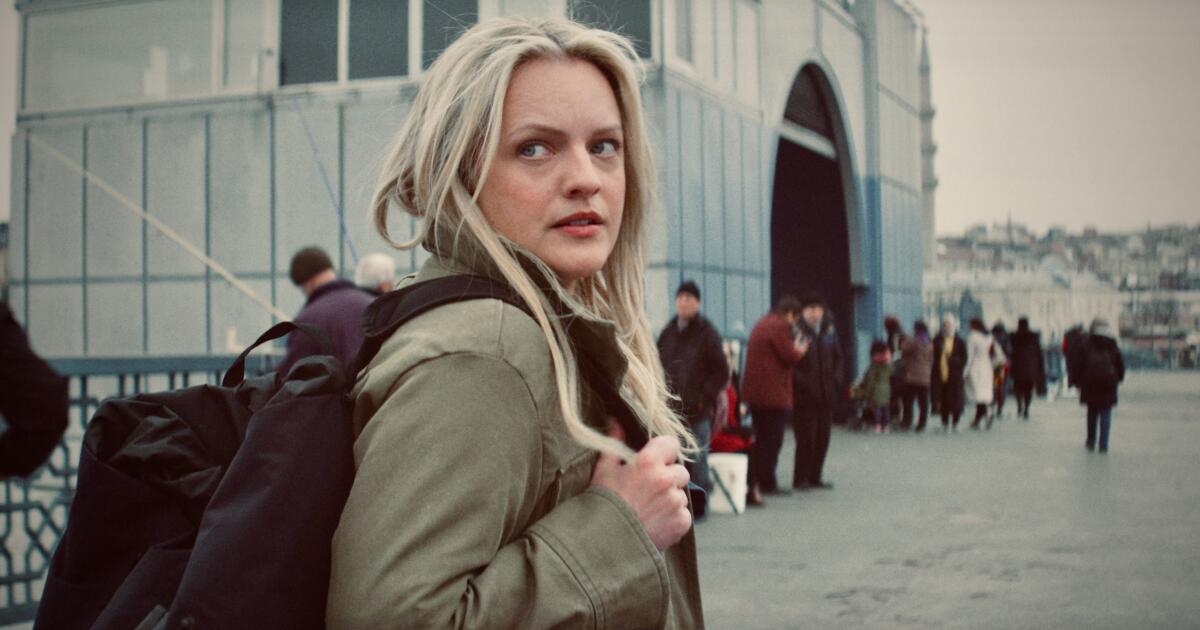
She’s a fierce presence; even when playing powerlessness, she radiates intensity. In “The Veil,” created by Steven Knight (“Peaky Blinders”) and premiering Tuesday on Hulu, the camera makes a habit of looking straight at her face, submitting you to her penetrating gaze.
Moss plays MI6 agent Imogen Salter, which we understand immediately is just her latest nom d’espionnage. (The actor’s father was British, so she comes by the accent half honestly.) She turns up incognito at a snowy U.N. refugee camp at the Syrian-Turkish border, where a young woman, Adilah El Idrissi (Yumna Marwan), has been taken into protective custody after having nearly been lynched by a mob that believes her to be Sabaine al Kubaisi, an upper-level Islamic State commander, “the most wanted woman in the world.”
Imogen has come to the camp to find out what Adilah, or Sabaine, might know about a rumored big terrorist attack on a Western target, and spirits her away. Owing in no small part to Marwan’s deep soulfulness, our sympathy at first runs to Adilah, a lone, broken figure hoping only to get back to her 10-year-old daughter in Paris.
She at least seems to be telling the truth, whereas Imogen, who represents powerful government institutions, professionally lies all the time — though we’re kept uncertain just how much to believe what either says. “Even though we’re lying to each other, I feel like I’ve been more honest with her than most people,” Imogen will tell French agent Malik Amar (Dali Benssalah), her contact and more-or-less boyfriend, in regard to Adilah.
Elisabeth Moss, left, with Yumna Marwan, who plays Adilah El Idrissi.
(FX)
Imogen can seem a little mad; she has a habit of smiling at odd times, making it difficult to know exactly what’s going on in there. We can infer from her smoking and drinking that she’s an unsettled sort of person, and we’re fed morsels of an origin story to suggest unresolved trauma, which seems engineered to parallel Adilah‘s but will obviously be assembled further down the line.
In the end — near the beginning, actually — Imogen will go rogue, setting herself against her superiors and protecting (and interrogating) Adilah as they travel from Syria to Istanbul to Paris and England, their way obstructed by terrorist proxies and warring intelligence agencies.
It’s a road movie, basically, one of those in which strangers thrown together become less strange to one another. As a spy story, it’s a decent example of its kind, but as a dramatic two-hander, fueled by subtle performances from Moss and Marwan, it’s pretty terrific.
Josh Charles plays CIA agent Max Peterson, a caricature of U.S. bluster, impatience, self-approval and Francophobia, sent to Paris to hijack the investigation from French intelligence. (Imogen is on loan to them, being the absolute best at what she does; British intelligence doesn’t enter the picture.)
Described by Malik’s superior, Magritte (the august Thibault de Montalembert, who recently provided similar service in “Franklin”), as “the most American American America has ever produced,” Max isn’t out of the airport before he’s actually tussling with Malik. Their butting-stags competitive relationship is as close to comic relief as “The Veil” will come.
Terrorism, as depicted onscreen, is a tired and tricky theme, subject to cultural stereotype. Accordingly, Knight has left the composition of his malefactors — not even ISIS (that is, Islamic State) but “a breakaway ISIS cell,” a marginal marginal group — a little vague, and painted sides in a variety of ethnicities. (One notes that both Adilah and Malik are French Algerian.) But terrorism is a device here, not a subject.
Though its premise makes it unavoidably political, “The Veil” is only, one might say, incidentally so, no more interested in actual geopolitics or ideology than “Ronin,” which the Paris locations bring to mind, or “The 39 Steps.” This strikes me as its strength; in terms of storytelling, the death of hundreds, thousands, millions or billions is merely a tool, a sensational, meaningless abstraction — as it can be in life, sadly. We’ve seen the world or significant portions thereof destroyed onscreen so often that apocalypse has become an empty cliche, nothing more than a vehicle for expensive effects and cheap thrills. But the tearing of a single friendship can break your heart.
If it’s not always clear in the moment who is shooting at whom or why, whenever the script ignites a fight or a gunfight or a chase or an escape, there’s no question whom to root for — both Imogen and Adilah. Asked to choose between them, one simply suspends judgment, hoping, as with any troubled couple, that things will work out well. Though all six episodes were sent to reviewers, only the first four were allowed to be reviewed, so you will have to see and decide for yourself.

Elisabeth Moss has acted in more projects than you can remember for more years than you might guess, but it was “Mad Men” in 2007 that made her the reason to watch a show — an impression cemented by “Top of the Lake” and taken for granted by the time of “The Handmaid’s Tale.”
She’s a fierce presence; even when playing powerlessness, she radiates intensity. In “The Veil,” created by Steven Knight (“Peaky Blinders”) and premiering Tuesday on Hulu, the camera makes a habit of looking straight at her face, submitting you to her penetrating gaze.
Moss plays MI6 agent Imogen Salter, which we understand immediately is just her latest nom d’espionnage. (The actor’s father was British, so she comes by the accent half honestly.) She turns up incognito at a snowy U.N. refugee camp at the Syrian-Turkish border, where a young woman, Adilah El Idrissi (Yumna Marwan), has been taken into protective custody after having nearly been lynched by a mob that believes her to be Sabaine al Kubaisi, an upper-level Islamic State commander, “the most wanted woman in the world.”
Imogen has come to the camp to find out what Adilah, or Sabaine, might know about a rumored big terrorist attack on a Western target, and spirits her away. Owing in no small part to Marwan’s deep soulfulness, our sympathy at first runs to Adilah, a lone, broken figure hoping only to get back to her 10-year-old daughter in Paris.
She at least seems to be telling the truth, whereas Imogen, who represents powerful government institutions, professionally lies all the time — though we’re kept uncertain just how much to believe what either says. “Even though we’re lying to each other, I feel like I’ve been more honest with her than most people,” Imogen will tell French agent Malik Amar (Dali Benssalah), her contact and more-or-less boyfriend, in regard to Adilah.
Elisabeth Moss, left, with Yumna Marwan, who plays Adilah El Idrissi.
(FX)
Imogen can seem a little mad; she has a habit of smiling at odd times, making it difficult to know exactly what’s going on in there. We can infer from her smoking and drinking that she’s an unsettled sort of person, and we’re fed morsels of an origin story to suggest unresolved trauma, which seems engineered to parallel Adilah‘s but will obviously be assembled further down the line.
In the end — near the beginning, actually — Imogen will go rogue, setting herself against her superiors and protecting (and interrogating) Adilah as they travel from Syria to Istanbul to Paris and England, their way obstructed by terrorist proxies and warring intelligence agencies.
It’s a road movie, basically, one of those in which strangers thrown together become less strange to one another. As a spy story, it’s a decent example of its kind, but as a dramatic two-hander, fueled by subtle performances from Moss and Marwan, it’s pretty terrific.
Josh Charles plays CIA agent Max Peterson, a caricature of U.S. bluster, impatience, self-approval and Francophobia, sent to Paris to hijack the investigation from French intelligence. (Imogen is on loan to them, being the absolute best at what she does; British intelligence doesn’t enter the picture.)
Described by Malik’s superior, Magritte (the august Thibault de Montalembert, who recently provided similar service in “Franklin”), as “the most American American America has ever produced,” Max isn’t out of the airport before he’s actually tussling with Malik. Their butting-stags competitive relationship is as close to comic relief as “The Veil” will come.
Terrorism, as depicted onscreen, is a tired and tricky theme, subject to cultural stereotype. Accordingly, Knight has left the composition of his malefactors — not even ISIS (that is, Islamic State) but “a breakaway ISIS cell,” a marginal marginal group — a little vague, and painted sides in a variety of ethnicities. (One notes that both Adilah and Malik are French Algerian.) But terrorism is a device here, not a subject.
Though its premise makes it unavoidably political, “The Veil” is only, one might say, incidentally so, no more interested in actual geopolitics or ideology than “Ronin,” which the Paris locations bring to mind, or “The 39 Steps.” This strikes me as its strength; in terms of storytelling, the death of hundreds, thousands, millions or billions is merely a tool, a sensational, meaningless abstraction — as it can be in life, sadly. We’ve seen the world or significant portions thereof destroyed onscreen so often that apocalypse has become an empty cliche, nothing more than a vehicle for expensive effects and cheap thrills. But the tearing of a single friendship can break your heart.
If it’s not always clear in the moment who is shooting at whom or why, whenever the script ignites a fight or a gunfight or a chase or an escape, there’s no question whom to root for — both Imogen and Adilah. Asked to choose between them, one simply suspends judgment, hoping, as with any troubled couple, that things will work out well. Though all six episodes were sent to reviewers, only the first four were allowed to be reviewed, so you will have to see and decide for yourself.

Elisabeth Moss has acted in more projects than you can remember for more years than you might guess, but it was “Mad Men” in 2007 that made her the reason to watch a show — an impression cemented by “Top of the Lake” and taken for granted by the time of “The Handmaid’s Tale.”
She’s a fierce presence; even when playing powerlessness, she radiates intensity. In “The Veil,” created by Steven Knight (“Peaky Blinders”) and premiering Tuesday on Hulu, the camera makes a habit of looking straight at her face, submitting you to her penetrating gaze.
Moss plays MI6 agent Imogen Salter, which we understand immediately is just her latest nom d’espionnage. (The actor’s father was British, so she comes by the accent half honestly.) She turns up incognito at a snowy U.N. refugee camp at the Syrian-Turkish border, where a young woman, Adilah El Idrissi (Yumna Marwan), has been taken into protective custody after having nearly been lynched by a mob that believes her to be Sabaine al Kubaisi, an upper-level Islamic State commander, “the most wanted woman in the world.”
Imogen has come to the camp to find out what Adilah, or Sabaine, might know about a rumored big terrorist attack on a Western target, and spirits her away. Owing in no small part to Marwan’s deep soulfulness, our sympathy at first runs to Adilah, a lone, broken figure hoping only to get back to her 10-year-old daughter in Paris.
She at least seems to be telling the truth, whereas Imogen, who represents powerful government institutions, professionally lies all the time — though we’re kept uncertain just how much to believe what either says. “Even though we’re lying to each other, I feel like I’ve been more honest with her than most people,” Imogen will tell French agent Malik Amar (Dali Benssalah), her contact and more-or-less boyfriend, in regard to Adilah.
Elisabeth Moss, left, with Yumna Marwan, who plays Adilah El Idrissi.
(FX)
Imogen can seem a little mad; she has a habit of smiling at odd times, making it difficult to know exactly what’s going on in there. We can infer from her smoking and drinking that she’s an unsettled sort of person, and we’re fed morsels of an origin story to suggest unresolved trauma, which seems engineered to parallel Adilah‘s but will obviously be assembled further down the line.
In the end — near the beginning, actually — Imogen will go rogue, setting herself against her superiors and protecting (and interrogating) Adilah as they travel from Syria to Istanbul to Paris and England, their way obstructed by terrorist proxies and warring intelligence agencies.
It’s a road movie, basically, one of those in which strangers thrown together become less strange to one another. As a spy story, it’s a decent example of its kind, but as a dramatic two-hander, fueled by subtle performances from Moss and Marwan, it’s pretty terrific.
Josh Charles plays CIA agent Max Peterson, a caricature of U.S. bluster, impatience, self-approval and Francophobia, sent to Paris to hijack the investigation from French intelligence. (Imogen is on loan to them, being the absolute best at what she does; British intelligence doesn’t enter the picture.)
Described by Malik’s superior, Magritte (the august Thibault de Montalembert, who recently provided similar service in “Franklin”), as “the most American American America has ever produced,” Max isn’t out of the airport before he’s actually tussling with Malik. Their butting-stags competitive relationship is as close to comic relief as “The Veil” will come.
Terrorism, as depicted onscreen, is a tired and tricky theme, subject to cultural stereotype. Accordingly, Knight has left the composition of his malefactors — not even ISIS (that is, Islamic State) but “a breakaway ISIS cell,” a marginal marginal group — a little vague, and painted sides in a variety of ethnicities. (One notes that both Adilah and Malik are French Algerian.) But terrorism is a device here, not a subject.
Though its premise makes it unavoidably political, “The Veil” is only, one might say, incidentally so, no more interested in actual geopolitics or ideology than “Ronin,” which the Paris locations bring to mind, or “The 39 Steps.” This strikes me as its strength; in terms of storytelling, the death of hundreds, thousands, millions or billions is merely a tool, a sensational, meaningless abstraction — as it can be in life, sadly. We’ve seen the world or significant portions thereof destroyed onscreen so often that apocalypse has become an empty cliche, nothing more than a vehicle for expensive effects and cheap thrills. But the tearing of a single friendship can break your heart.
If it’s not always clear in the moment who is shooting at whom or why, whenever the script ignites a fight or a gunfight or a chase or an escape, there’s no question whom to root for — both Imogen and Adilah. Asked to choose between them, one simply suspends judgment, hoping, as with any troubled couple, that things will work out well. Though all six episodes were sent to reviewers, only the first four were allowed to be reviewed, so you will have to see and decide for yourself.
Elisabeth Moss has acted in more projects than you can remember for more years than you might guess, but it was “Mad Men” in 2007 that made her the reason to watch a show — an impression cemented by “Top of the Lake” and taken for granted by the time of “The Handmaid’s Tale.”
She’s a fierce presence; even when playing powerlessness, she radiates intensity. In “The Veil,” created by Steven Knight (“Peaky Blinders”) and premiering Tuesday on Hulu, the camera makes a habit of looking straight at her face, submitting you to her penetrating gaze.
Moss plays MI6 agent Imogen Salter, which we understand immediately is just her latest nom d’espionnage. (The actor’s father was British, so she comes by the accent half honestly.) She turns up incognito at a snowy U.N. refugee camp at the Syrian-Turkish border, where a young woman, Adilah El Idrissi (Yumna Marwan), has been taken into protective custody after having nearly been lynched by a mob that believes her to be Sabaine al Kubaisi, an upper-level Islamic State commander, “the most wanted woman in the world.”
Imogen has come to the camp to find out what Adilah, or Sabaine, might know about a rumored big terrorist attack on a Western target, and spirits her away. Owing in no small part to Marwan’s deep soulfulness, our sympathy at first runs to Adilah, a lone, broken figure hoping only to get back to her 10-year-old daughter in Paris.
She at least seems to be telling the truth, whereas Imogen, who represents powerful government institutions, professionally lies all the time — though we’re kept uncertain just how much to believe what either says. “Even though we’re lying to each other, I feel like I’ve been more honest with her than most people,” Imogen will tell French agent Malik Amar (Dali Benssalah), her contact and more-or-less boyfriend, in regard to Adilah.
Elisabeth Moss, left, with Yumna Marwan, who plays Adilah El Idrissi.
(FX)
Imogen can seem a little mad; she has a habit of smiling at odd times, making it difficult to know exactly what’s going on in there. We can infer from her smoking and drinking that she’s an unsettled sort of person, and we’re fed morsels of an origin story to suggest unresolved trauma, which seems engineered to parallel Adilah‘s but will obviously be assembled further down the line.
In the end — near the beginning, actually — Imogen will go rogue, setting herself against her superiors and protecting (and interrogating) Adilah as they travel from Syria to Istanbul to Paris and England, their way obstructed by terrorist proxies and warring intelligence agencies.
It’s a road movie, basically, one of those in which strangers thrown together become less strange to one another. As a spy story, it’s a decent example of its kind, but as a dramatic two-hander, fueled by subtle performances from Moss and Marwan, it’s pretty terrific.
Josh Charles plays CIA agent Max Peterson, a caricature of U.S. bluster, impatience, self-approval and Francophobia, sent to Paris to hijack the investigation from French intelligence. (Imogen is on loan to them, being the absolute best at what she does; British intelligence doesn’t enter the picture.)
Described by Malik’s superior, Magritte (the august Thibault de Montalembert, who recently provided similar service in “Franklin”), as “the most American American America has ever produced,” Max isn’t out of the airport before he’s actually tussling with Malik. Their butting-stags competitive relationship is as close to comic relief as “The Veil” will come.
Terrorism, as depicted onscreen, is a tired and tricky theme, subject to cultural stereotype. Accordingly, Knight has left the composition of his malefactors — not even ISIS (that is, Islamic State) but “a breakaway ISIS cell,” a marginal marginal group — a little vague, and painted sides in a variety of ethnicities. (One notes that both Adilah and Malik are French Algerian.) But terrorism is a device here, not a subject.
Though its premise makes it unavoidably political, “The Veil” is only, one might say, incidentally so, no more interested in actual geopolitics or ideology than “Ronin,” which the Paris locations bring to mind, or “The 39 Steps.” This strikes me as its strength; in terms of storytelling, the death of hundreds, thousands, millions or billions is merely a tool, a sensational, meaningless abstraction — as it can be in life, sadly. We’ve seen the world or significant portions thereof destroyed onscreen so often that apocalypse has become an empty cliche, nothing more than a vehicle for expensive effects and cheap thrills. But the tearing of a single friendship can break your heart.
If it’s not always clear in the moment who is shooting at whom or why, whenever the script ignites a fight or a gunfight or a chase or an escape, there’s no question whom to root for — both Imogen and Adilah. Asked to choose between them, one simply suspends judgment, hoping, as with any troubled couple, that things will work out well. Though all six episodes were sent to reviewers, only the first four were allowed to be reviewed, so you will have to see and decide for yourself.