Inflation and high food and housing costs are squeezing millions of families in the United States. At the same time, a designer pineapple priced at nearly $400 sold out within weeks of its launch. The disparity reflects a deepening chasm between luxury food consumers and average American families just scraping by.
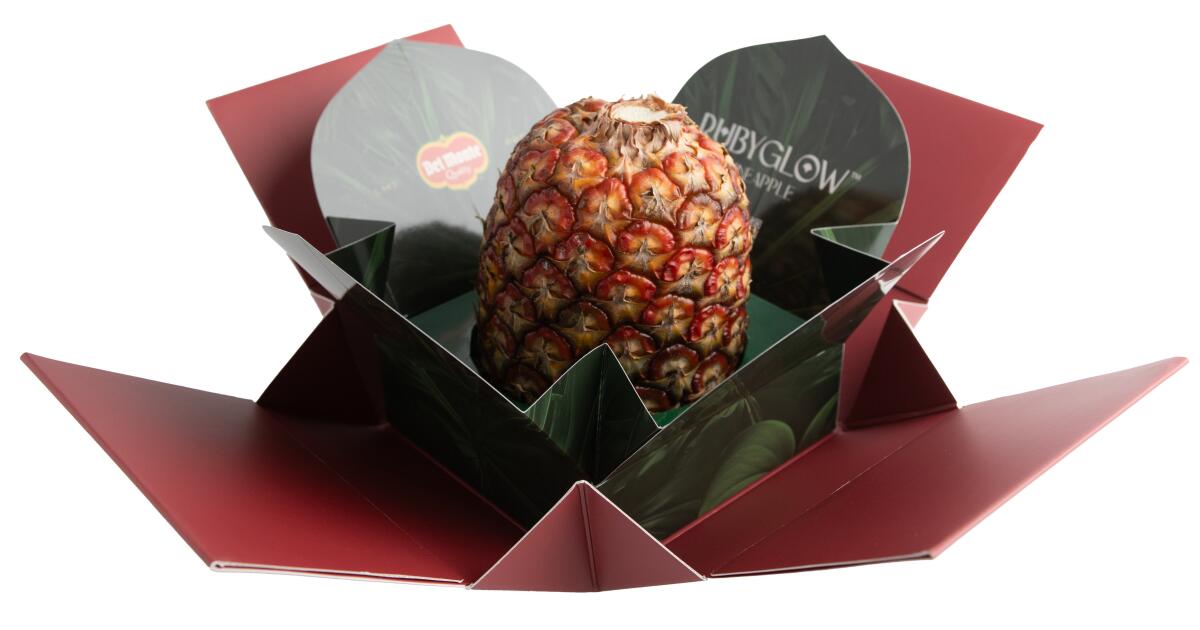
In late March, Melissa’s Produce and Fresh Del Monte Produce debuted a new designer pineapple for sale in the United States at a whopping price tag of $395.99. The pineapple resembles a ruby on the outside and tastes super sweet on the inside, according to the sellers.
It’s now sold out.
As of Monday morning, the Rubyglow pineapple — a hybrid between a classic pineapple and a Morada variety — is out of stock in the United States, said Robert Schueller, spokesperson for Melissa’s Produce. The Vernon-based grocer is the only online distributor to offer the specialty pineapple in the United States.
The Rubyglow pineapple from Melissa’s Produce.
(Israel Solis / Melissa’s Produce)
Buzz about the rare fruit generated a buying frenzy in the last few months. The pricy pineapple is just the latest in a string of luxury produce — $128 melons and $89 strawberries —that has become popular with some consumers.
The rise of luxury fruits comes at a time when some Americans are struggling to afford groceries and food insecurity is on the rise.
The cost of one Rubyglow pineapple is nearly double what the average American spends on groceries in a week. On average, U.S. consumers spend about $250 a week on groceries, according to a recent study. In California, that cost is closer to $300 a month.
In L.A. County, 30% of residents experienced food insecurity last year, according to the latest data provided by USC researchers.
The impact of inflation, high cost of living and other factors have led to an increase in food insecurity, said Michael Flood, president of the Los Angeles Regional Food Bank, which serves 900,000 people a month in conjunction with its partner agency of networks.
“It ranges from people who are struggling every day to feed themselves to people whose shortfall of food may be three or four days getting to that next paycheck or, for a senior, a Social Security check,” Flood said. ”Food insecurity is real.”
At the same time, there are people who are willing to shell out for the next shipment of Rubyglows from Costa Rica in August. Only about 50 to 100 will be made available, Schueller said.
“It’s not for everyone,” he said. “There is a market for everything in the United States. Not everyone buys a Ferrari.”
Schueller noted that Melissa’s Produce is also a top produce donor for the Los Angeles Regional Food Bank.
The extravagant price of the pineapple is partly because it took 16 years for Fresh Del Monte to develop the fruit, according to the company’s website. The Rubyglow has red-hued outer skin, while inside the fruit is the familiar yellow color. This isn’t the company’s first designer pineapple. It started in the 1990s with the debut of the Del Monte Gold Extra Sweet pineapple. Since then, it has released other luxury pineapples, such as the Pinkglow pineapple, which has a pink-fleshed interior.
“It takes two years to grow each Rubyglow pineapple, which are then naturally ripened on the plant and sold crownless in elegantly designed packaging,” according to the company’s website. “This complicated and time-consuming cultivation cycle — coupled with limited seed supply — are the reasons behind the scarcity of Rubyglow pineapples in the U.S. market and globally.”

The Ruby Glow pineapple from Melissa’s Produce.
(Melissa’s Produce)
“It’s pure supply and demand,” Schueller said.
Melissa only had 50 Rubyglows available to sell to the U.S. market, with most going to upscale restaurants in California and Las Vegas.
Schueller, who said he doesn’t fit the demographic that would spend the money to buy the fruit, had an opportunity to try it. He described it as deliciously sweet.
Melisssa’s website said the fruit “delivers a luxurious, smooth flavor with minimal acidity.”
For now, only a few thousand of the Rubyglows are cultivated each year. It first launched in January in China, just in time for the Lunar New Year celebrations. They sold out there too.

Inflation and high food and housing costs are squeezing millions of families in the United States. At the same time, a designer pineapple priced at nearly $400 sold out within weeks of its launch. The disparity reflects a deepening chasm between luxury food consumers and average American families just scraping by.
In late March, Melissa’s Produce and Fresh Del Monte Produce debuted a new designer pineapple for sale in the United States at a whopping price tag of $395.99. The pineapple resembles a ruby on the outside and tastes super sweet on the inside, according to the sellers.
It’s now sold out.
As of Monday morning, the Rubyglow pineapple — a hybrid between a classic pineapple and a Morada variety — is out of stock in the United States, said Robert Schueller, spokesperson for Melissa’s Produce. The Vernon-based grocer is the only online distributor to offer the specialty pineapple in the United States.
The Rubyglow pineapple from Melissa’s Produce.
(Israel Solis / Melissa’s Produce)
Buzz about the rare fruit generated a buying frenzy in the last few months. The pricy pineapple is just the latest in a string of luxury produce — $128 melons and $89 strawberries —that has become popular with some consumers.
The rise of luxury fruits comes at a time when some Americans are struggling to afford groceries and food insecurity is on the rise.
The cost of one Rubyglow pineapple is nearly double what the average American spends on groceries in a week. On average, U.S. consumers spend about $250 a week on groceries, according to a recent study. In California, that cost is closer to $300 a month.
In L.A. County, 30% of residents experienced food insecurity last year, according to the latest data provided by USC researchers.
The impact of inflation, high cost of living and other factors have led to an increase in food insecurity, said Michael Flood, president of the Los Angeles Regional Food Bank, which serves 900,000 people a month in conjunction with its partner agency of networks.
“It ranges from people who are struggling every day to feed themselves to people whose shortfall of food may be three or four days getting to that next paycheck or, for a senior, a Social Security check,” Flood said. ”Food insecurity is real.”
At the same time, there are people who are willing to shell out for the next shipment of Rubyglows from Costa Rica in August. Only about 50 to 100 will be made available, Schueller said.
“It’s not for everyone,” he said. “There is a market for everything in the United States. Not everyone buys a Ferrari.”
Schueller noted that Melissa’s Produce is also a top produce donor for the Los Angeles Regional Food Bank.
The extravagant price of the pineapple is partly because it took 16 years for Fresh Del Monte to develop the fruit, according to the company’s website. The Rubyglow has red-hued outer skin, while inside the fruit is the familiar yellow color. This isn’t the company’s first designer pineapple. It started in the 1990s with the debut of the Del Monte Gold Extra Sweet pineapple. Since then, it has released other luxury pineapples, such as the Pinkglow pineapple, which has a pink-fleshed interior.
“It takes two years to grow each Rubyglow pineapple, which are then naturally ripened on the plant and sold crownless in elegantly designed packaging,” according to the company’s website. “This complicated and time-consuming cultivation cycle — coupled with limited seed supply — are the reasons behind the scarcity of Rubyglow pineapples in the U.S. market and globally.”
The Ruby Glow pineapple from Melissa’s Produce.
(Melissa’s Produce)
“It’s pure supply and demand,” Schueller said.
Melissa only had 50 Rubyglows available to sell to the U.S. market, with most going to upscale restaurants in California and Las Vegas.
Schueller, who said he doesn’t fit the demographic that would spend the money to buy the fruit, had an opportunity to try it. He described it as deliciously sweet.
Melisssa’s website said the fruit “delivers a luxurious, smooth flavor with minimal acidity.”
For now, only a few thousand of the Rubyglows are cultivated each year. It first launched in January in China, just in time for the Lunar New Year celebrations. They sold out there too.

Inflation and high food and housing costs are squeezing millions of families in the United States. At the same time, a designer pineapple priced at nearly $400 sold out within weeks of its launch. The disparity reflects a deepening chasm between luxury food consumers and average American families just scraping by.
In late March, Melissa’s Produce and Fresh Del Monte Produce debuted a new designer pineapple for sale in the United States at a whopping price tag of $395.99. The pineapple resembles a ruby on the outside and tastes super sweet on the inside, according to the sellers.
It’s now sold out.
As of Monday morning, the Rubyglow pineapple — a hybrid between a classic pineapple and a Morada variety — is out of stock in the United States, said Robert Schueller, spokesperson for Melissa’s Produce. The Vernon-based grocer is the only online distributor to offer the specialty pineapple in the United States.
The Rubyglow pineapple from Melissa’s Produce.
(Israel Solis / Melissa’s Produce)
Buzz about the rare fruit generated a buying frenzy in the last few months. The pricy pineapple is just the latest in a string of luxury produce — $128 melons and $89 strawberries —that has become popular with some consumers.
The rise of luxury fruits comes at a time when some Americans are struggling to afford groceries and food insecurity is on the rise.
The cost of one Rubyglow pineapple is nearly double what the average American spends on groceries in a week. On average, U.S. consumers spend about $250 a week on groceries, according to a recent study. In California, that cost is closer to $300 a month.
In L.A. County, 30% of residents experienced food insecurity last year, according to the latest data provided by USC researchers.
The impact of inflation, high cost of living and other factors have led to an increase in food insecurity, said Michael Flood, president of the Los Angeles Regional Food Bank, which serves 900,000 people a month in conjunction with its partner agency of networks.
“It ranges from people who are struggling every day to feed themselves to people whose shortfall of food may be three or four days getting to that next paycheck or, for a senior, a Social Security check,” Flood said. ”Food insecurity is real.”
At the same time, there are people who are willing to shell out for the next shipment of Rubyglows from Costa Rica in August. Only about 50 to 100 will be made available, Schueller said.
“It’s not for everyone,” he said. “There is a market for everything in the United States. Not everyone buys a Ferrari.”
Schueller noted that Melissa’s Produce is also a top produce donor for the Los Angeles Regional Food Bank.
The extravagant price of the pineapple is partly because it took 16 years for Fresh Del Monte to develop the fruit, according to the company’s website. The Rubyglow has red-hued outer skin, while inside the fruit is the familiar yellow color. This isn’t the company’s first designer pineapple. It started in the 1990s with the debut of the Del Monte Gold Extra Sweet pineapple. Since then, it has released other luxury pineapples, such as the Pinkglow pineapple, which has a pink-fleshed interior.
“It takes two years to grow each Rubyglow pineapple, which are then naturally ripened on the plant and sold crownless in elegantly designed packaging,” according to the company’s website. “This complicated and time-consuming cultivation cycle — coupled with limited seed supply — are the reasons behind the scarcity of Rubyglow pineapples in the U.S. market and globally.”
The Ruby Glow pineapple from Melissa’s Produce.
(Melissa’s Produce)
“It’s pure supply and demand,” Schueller said.
Melissa only had 50 Rubyglows available to sell to the U.S. market, with most going to upscale restaurants in California and Las Vegas.
Schueller, who said he doesn’t fit the demographic that would spend the money to buy the fruit, had an opportunity to try it. He described it as deliciously sweet.
Melisssa’s website said the fruit “delivers a luxurious, smooth flavor with minimal acidity.”
For now, only a few thousand of the Rubyglows are cultivated each year. It first launched in January in China, just in time for the Lunar New Year celebrations. They sold out there too.
Inflation and high food and housing costs are squeezing millions of families in the United States. At the same time, a designer pineapple priced at nearly $400 sold out within weeks of its launch. The disparity reflects a deepening chasm between luxury food consumers and average American families just scraping by.
In late March, Melissa’s Produce and Fresh Del Monte Produce debuted a new designer pineapple for sale in the United States at a whopping price tag of $395.99. The pineapple resembles a ruby on the outside and tastes super sweet on the inside, according to the sellers.
It’s now sold out.
As of Monday morning, the Rubyglow pineapple — a hybrid between a classic pineapple and a Morada variety — is out of stock in the United States, said Robert Schueller, spokesperson for Melissa’s Produce. The Vernon-based grocer is the only online distributor to offer the specialty pineapple in the United States.
The Rubyglow pineapple from Melissa’s Produce.
(Israel Solis / Melissa’s Produce)
Buzz about the rare fruit generated a buying frenzy in the last few months. The pricy pineapple is just the latest in a string of luxury produce — $128 melons and $89 strawberries —that has become popular with some consumers.
The rise of luxury fruits comes at a time when some Americans are struggling to afford groceries and food insecurity is on the rise.
The cost of one Rubyglow pineapple is nearly double what the average American spends on groceries in a week. On average, U.S. consumers spend about $250 a week on groceries, according to a recent study. In California, that cost is closer to $300 a month.
In L.A. County, 30% of residents experienced food insecurity last year, according to the latest data provided by USC researchers.
The impact of inflation, high cost of living and other factors have led to an increase in food insecurity, said Michael Flood, president of the Los Angeles Regional Food Bank, which serves 900,000 people a month in conjunction with its partner agency of networks.
“It ranges from people who are struggling every day to feed themselves to people whose shortfall of food may be three or four days getting to that next paycheck or, for a senior, a Social Security check,” Flood said. ”Food insecurity is real.”
At the same time, there are people who are willing to shell out for the next shipment of Rubyglows from Costa Rica in August. Only about 50 to 100 will be made available, Schueller said.
“It’s not for everyone,” he said. “There is a market for everything in the United States. Not everyone buys a Ferrari.”
Schueller noted that Melissa’s Produce is also a top produce donor for the Los Angeles Regional Food Bank.
The extravagant price of the pineapple is partly because it took 16 years for Fresh Del Monte to develop the fruit, according to the company’s website. The Rubyglow has red-hued outer skin, while inside the fruit is the familiar yellow color. This isn’t the company’s first designer pineapple. It started in the 1990s with the debut of the Del Monte Gold Extra Sweet pineapple. Since then, it has released other luxury pineapples, such as the Pinkglow pineapple, which has a pink-fleshed interior.
“It takes two years to grow each Rubyglow pineapple, which are then naturally ripened on the plant and sold crownless in elegantly designed packaging,” according to the company’s website. “This complicated and time-consuming cultivation cycle — coupled with limited seed supply — are the reasons behind the scarcity of Rubyglow pineapples in the U.S. market and globally.”
The Ruby Glow pineapple from Melissa’s Produce.
(Melissa’s Produce)
“It’s pure supply and demand,” Schueller said.
Melissa only had 50 Rubyglows available to sell to the U.S. market, with most going to upscale restaurants in California and Las Vegas.
Schueller, who said he doesn’t fit the demographic that would spend the money to buy the fruit, had an opportunity to try it. He described it as deliciously sweet.
Melisssa’s website said the fruit “delivers a luxurious, smooth flavor with minimal acidity.”
For now, only a few thousand of the Rubyglows are cultivated each year. It first launched in January in China, just in time for the Lunar New Year celebrations. They sold out there too.

Inflation and high food and housing costs are squeezing millions of families in the United States. At the same time, a designer pineapple priced at nearly $400 sold out within weeks of its launch. The disparity reflects a deepening chasm between luxury food consumers and average American families just scraping by.
In late March, Melissa’s Produce and Fresh Del Monte Produce debuted a new designer pineapple for sale in the United States at a whopping price tag of $395.99. The pineapple resembles a ruby on the outside and tastes super sweet on the inside, according to the sellers.
It’s now sold out.
As of Monday morning, the Rubyglow pineapple — a hybrid between a classic pineapple and a Morada variety — is out of stock in the United States, said Robert Schueller, spokesperson for Melissa’s Produce. The Vernon-based grocer is the only online distributor to offer the specialty pineapple in the United States.
The Rubyglow pineapple from Melissa’s Produce.
(Israel Solis / Melissa’s Produce)
Buzz about the rare fruit generated a buying frenzy in the last few months. The pricy pineapple is just the latest in a string of luxury produce — $128 melons and $89 strawberries —that has become popular with some consumers.
The rise of luxury fruits comes at a time when some Americans are struggling to afford groceries and food insecurity is on the rise.
The cost of one Rubyglow pineapple is nearly double what the average American spends on groceries in a week. On average, U.S. consumers spend about $250 a week on groceries, according to a recent study. In California, that cost is closer to $300 a month.
In L.A. County, 30% of residents experienced food insecurity last year, according to the latest data provided by USC researchers.
The impact of inflation, high cost of living and other factors have led to an increase in food insecurity, said Michael Flood, president of the Los Angeles Regional Food Bank, which serves 900,000 people a month in conjunction with its partner agency of networks.
“It ranges from people who are struggling every day to feed themselves to people whose shortfall of food may be three or four days getting to that next paycheck or, for a senior, a Social Security check,” Flood said. ”Food insecurity is real.”
At the same time, there are people who are willing to shell out for the next shipment of Rubyglows from Costa Rica in August. Only about 50 to 100 will be made available, Schueller said.
“It’s not for everyone,” he said. “There is a market for everything in the United States. Not everyone buys a Ferrari.”
Schueller noted that Melissa’s Produce is also a top produce donor for the Los Angeles Regional Food Bank.
The extravagant price of the pineapple is partly because it took 16 years for Fresh Del Monte to develop the fruit, according to the company’s website. The Rubyglow has red-hued outer skin, while inside the fruit is the familiar yellow color. This isn’t the company’s first designer pineapple. It started in the 1990s with the debut of the Del Monte Gold Extra Sweet pineapple. Since then, it has released other luxury pineapples, such as the Pinkglow pineapple, which has a pink-fleshed interior.
“It takes two years to grow each Rubyglow pineapple, which are then naturally ripened on the plant and sold crownless in elegantly designed packaging,” according to the company’s website. “This complicated and time-consuming cultivation cycle — coupled with limited seed supply — are the reasons behind the scarcity of Rubyglow pineapples in the U.S. market and globally.”
The Ruby Glow pineapple from Melissa’s Produce.
(Melissa’s Produce)
“It’s pure supply and demand,” Schueller said.
Melissa only had 50 Rubyglows available to sell to the U.S. market, with most going to upscale restaurants in California and Las Vegas.
Schueller, who said he doesn’t fit the demographic that would spend the money to buy the fruit, had an opportunity to try it. He described it as deliciously sweet.
Melisssa’s website said the fruit “delivers a luxurious, smooth flavor with minimal acidity.”
For now, only a few thousand of the Rubyglows are cultivated each year. It first launched in January in China, just in time for the Lunar New Year celebrations. They sold out there too.
Inflation and high food and housing costs are squeezing millions of families in the United States. At the same time, a designer pineapple priced at nearly $400 sold out within weeks of its launch. The disparity reflects a deepening chasm between luxury food consumers and average American families just scraping by.
In late March, Melissa’s Produce and Fresh Del Monte Produce debuted a new designer pineapple for sale in the United States at a whopping price tag of $395.99. The pineapple resembles a ruby on the outside and tastes super sweet on the inside, according to the sellers.
It’s now sold out.
As of Monday morning, the Rubyglow pineapple — a hybrid between a classic pineapple and a Morada variety — is out of stock in the United States, said Robert Schueller, spokesperson for Melissa’s Produce. The Vernon-based grocer is the only online distributor to offer the specialty pineapple in the United States.
The Rubyglow pineapple from Melissa’s Produce.
(Israel Solis / Melissa’s Produce)
Buzz about the rare fruit generated a buying frenzy in the last few months. The pricy pineapple is just the latest in a string of luxury produce — $128 melons and $89 strawberries —that has become popular with some consumers.
The rise of luxury fruits comes at a time when some Americans are struggling to afford groceries and food insecurity is on the rise.
The cost of one Rubyglow pineapple is nearly double what the average American spends on groceries in a week. On average, U.S. consumers spend about $250 a week on groceries, according to a recent study. In California, that cost is closer to $300 a month.
In L.A. County, 30% of residents experienced food insecurity last year, according to the latest data provided by USC researchers.
The impact of inflation, high cost of living and other factors have led to an increase in food insecurity, said Michael Flood, president of the Los Angeles Regional Food Bank, which serves 900,000 people a month in conjunction with its partner agency of networks.
“It ranges from people who are struggling every day to feed themselves to people whose shortfall of food may be three or four days getting to that next paycheck or, for a senior, a Social Security check,” Flood said. ”Food insecurity is real.”
At the same time, there are people who are willing to shell out for the next shipment of Rubyglows from Costa Rica in August. Only about 50 to 100 will be made available, Schueller said.
“It’s not for everyone,” he said. “There is a market for everything in the United States. Not everyone buys a Ferrari.”
Schueller noted that Melissa’s Produce is also a top produce donor for the Los Angeles Regional Food Bank.
The extravagant price of the pineapple is partly because it took 16 years for Fresh Del Monte to develop the fruit, according to the company’s website. The Rubyglow has red-hued outer skin, while inside the fruit is the familiar yellow color. This isn’t the company’s first designer pineapple. It started in the 1990s with the debut of the Del Monte Gold Extra Sweet pineapple. Since then, it has released other luxury pineapples, such as the Pinkglow pineapple, which has a pink-fleshed interior.
“It takes two years to grow each Rubyglow pineapple, which are then naturally ripened on the plant and sold crownless in elegantly designed packaging,” according to the company’s website. “This complicated and time-consuming cultivation cycle — coupled with limited seed supply — are the reasons behind the scarcity of Rubyglow pineapples in the U.S. market and globally.”
The Ruby Glow pineapple from Melissa’s Produce.
(Melissa’s Produce)
“It’s pure supply and demand,” Schueller said.
Melissa only had 50 Rubyglows available to sell to the U.S. market, with most going to upscale restaurants in California and Las Vegas.
Schueller, who said he doesn’t fit the demographic that would spend the money to buy the fruit, had an opportunity to try it. He described it as deliciously sweet.
Melisssa’s website said the fruit “delivers a luxurious, smooth flavor with minimal acidity.”
For now, only a few thousand of the Rubyglows are cultivated each year. It first launched in January in China, just in time for the Lunar New Year celebrations. They sold out there too.
Inflation and high food and housing costs are squeezing millions of families in the United States. At the same time, a designer pineapple priced at nearly $400 sold out within weeks of its launch. The disparity reflects a deepening chasm between luxury food consumers and average American families just scraping by.
In late March, Melissa’s Produce and Fresh Del Monte Produce debuted a new designer pineapple for sale in the United States at a whopping price tag of $395.99. The pineapple resembles a ruby on the outside and tastes super sweet on the inside, according to the sellers.
It’s now sold out.
As of Monday morning, the Rubyglow pineapple — a hybrid between a classic pineapple and a Morada variety — is out of stock in the United States, said Robert Schueller, spokesperson for Melissa’s Produce. The Vernon-based grocer is the only online distributor to offer the specialty pineapple in the United States.
The Rubyglow pineapple from Melissa’s Produce.
(Israel Solis / Melissa’s Produce)
Buzz about the rare fruit generated a buying frenzy in the last few months. The pricy pineapple is just the latest in a string of luxury produce — $128 melons and $89 strawberries —that has become popular with some consumers.
The rise of luxury fruits comes at a time when some Americans are struggling to afford groceries and food insecurity is on the rise.
The cost of one Rubyglow pineapple is nearly double what the average American spends on groceries in a week. On average, U.S. consumers spend about $250 a week on groceries, according to a recent study. In California, that cost is closer to $300 a month.
In L.A. County, 30% of residents experienced food insecurity last year, according to the latest data provided by USC researchers.
The impact of inflation, high cost of living and other factors have led to an increase in food insecurity, said Michael Flood, president of the Los Angeles Regional Food Bank, which serves 900,000 people a month in conjunction with its partner agency of networks.
“It ranges from people who are struggling every day to feed themselves to people whose shortfall of food may be three or four days getting to that next paycheck or, for a senior, a Social Security check,” Flood said. ”Food insecurity is real.”
At the same time, there are people who are willing to shell out for the next shipment of Rubyglows from Costa Rica in August. Only about 50 to 100 will be made available, Schueller said.
“It’s not for everyone,” he said. “There is a market for everything in the United States. Not everyone buys a Ferrari.”
Schueller noted that Melissa’s Produce is also a top produce donor for the Los Angeles Regional Food Bank.
The extravagant price of the pineapple is partly because it took 16 years for Fresh Del Monte to develop the fruit, according to the company’s website. The Rubyglow has red-hued outer skin, while inside the fruit is the familiar yellow color. This isn’t the company’s first designer pineapple. It started in the 1990s with the debut of the Del Monte Gold Extra Sweet pineapple. Since then, it has released other luxury pineapples, such as the Pinkglow pineapple, which has a pink-fleshed interior.
“It takes two years to grow each Rubyglow pineapple, which are then naturally ripened on the plant and sold crownless in elegantly designed packaging,” according to the company’s website. “This complicated and time-consuming cultivation cycle — coupled with limited seed supply — are the reasons behind the scarcity of Rubyglow pineapples in the U.S. market and globally.”
The Ruby Glow pineapple from Melissa’s Produce.
(Melissa’s Produce)
“It’s pure supply and demand,” Schueller said.
Melissa only had 50 Rubyglows available to sell to the U.S. market, with most going to upscale restaurants in California and Las Vegas.
Schueller, who said he doesn’t fit the demographic that would spend the money to buy the fruit, had an opportunity to try it. He described it as deliciously sweet.
Melisssa’s website said the fruit “delivers a luxurious, smooth flavor with minimal acidity.”
For now, only a few thousand of the Rubyglows are cultivated each year. It first launched in January in China, just in time for the Lunar New Year celebrations. They sold out there too.
Inflation and high food and housing costs are squeezing millions of families in the United States. At the same time, a designer pineapple priced at nearly $400 sold out within weeks of its launch. The disparity reflects a deepening chasm between luxury food consumers and average American families just scraping by.
In late March, Melissa’s Produce and Fresh Del Monte Produce debuted a new designer pineapple for sale in the United States at a whopping price tag of $395.99. The pineapple resembles a ruby on the outside and tastes super sweet on the inside, according to the sellers.
It’s now sold out.
As of Monday morning, the Rubyglow pineapple — a hybrid between a classic pineapple and a Morada variety — is out of stock in the United States, said Robert Schueller, spokesperson for Melissa’s Produce. The Vernon-based grocer is the only online distributor to offer the specialty pineapple in the United States.
The Rubyglow pineapple from Melissa’s Produce.
(Israel Solis / Melissa’s Produce)
Buzz about the rare fruit generated a buying frenzy in the last few months. The pricy pineapple is just the latest in a string of luxury produce — $128 melons and $89 strawberries —that has become popular with some consumers.
The rise of luxury fruits comes at a time when some Americans are struggling to afford groceries and food insecurity is on the rise.
The cost of one Rubyglow pineapple is nearly double what the average American spends on groceries in a week. On average, U.S. consumers spend about $250 a week on groceries, according to a recent study. In California, that cost is closer to $300 a month.
In L.A. County, 30% of residents experienced food insecurity last year, according to the latest data provided by USC researchers.
The impact of inflation, high cost of living and other factors have led to an increase in food insecurity, said Michael Flood, president of the Los Angeles Regional Food Bank, which serves 900,000 people a month in conjunction with its partner agency of networks.
“It ranges from people who are struggling every day to feed themselves to people whose shortfall of food may be three or four days getting to that next paycheck or, for a senior, a Social Security check,” Flood said. ”Food insecurity is real.”
At the same time, there are people who are willing to shell out for the next shipment of Rubyglows from Costa Rica in August. Only about 50 to 100 will be made available, Schueller said.
“It’s not for everyone,” he said. “There is a market for everything in the United States. Not everyone buys a Ferrari.”
Schueller noted that Melissa’s Produce is also a top produce donor for the Los Angeles Regional Food Bank.
The extravagant price of the pineapple is partly because it took 16 years for Fresh Del Monte to develop the fruit, according to the company’s website. The Rubyglow has red-hued outer skin, while inside the fruit is the familiar yellow color. This isn’t the company’s first designer pineapple. It started in the 1990s with the debut of the Del Monte Gold Extra Sweet pineapple. Since then, it has released other luxury pineapples, such as the Pinkglow pineapple, which has a pink-fleshed interior.
“It takes two years to grow each Rubyglow pineapple, which are then naturally ripened on the plant and sold crownless in elegantly designed packaging,” according to the company’s website. “This complicated and time-consuming cultivation cycle — coupled with limited seed supply — are the reasons behind the scarcity of Rubyglow pineapples in the U.S. market and globally.”
The Ruby Glow pineapple from Melissa’s Produce.
(Melissa’s Produce)
“It’s pure supply and demand,” Schueller said.
Melissa only had 50 Rubyglows available to sell to the U.S. market, with most going to upscale restaurants in California and Las Vegas.
Schueller, who said he doesn’t fit the demographic that would spend the money to buy the fruit, had an opportunity to try it. He described it as deliciously sweet.
Melisssa’s website said the fruit “delivers a luxurious, smooth flavor with minimal acidity.”
For now, only a few thousand of the Rubyglows are cultivated each year. It first launched in January in China, just in time for the Lunar New Year celebrations. They sold out there too.