

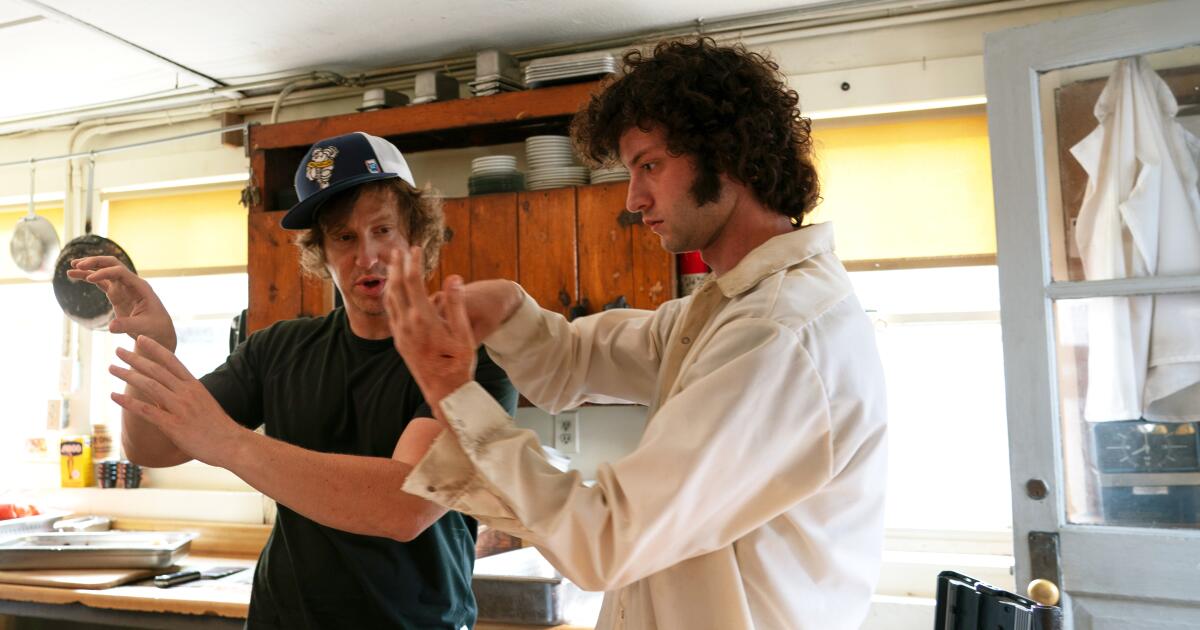

In the second film of the summer that smooths the rough edges of a complicated man, we meet the future chef and global TV star Anthony Bourdain at age 19, blustering through a comically pretentious fellowship proposal for the dour-faced members of a Vassar College faculty committee.
At first, this young Bourdain is easy to imagine as a slightly older version of actor Dominic Sessa’s breakout role in “The Holdovers,” as if the earlier movie’s sullen and arrogant high school student was now a sullen and arrogant college student — without the emotional growth brought about by Paul Giamatti’s dysfunctional history teacher.
“What I’m trying to do,” Sessa’s overly confident Bourdain tells the professors, “is create a metaphorical conversation between George Orwell and Jack Kerouac, as if ‘Down and Out in Paris and London’ was typed out on one long piece of paper.” He’s referencing the now-totemic scroll on which a Benzedrine-fueled Kerouac typed “On the Road” — the novel’s taped-together pages sold for $12.1 million at auction in March — as well as the Orwell book that the real Bourdain once called “a template and an inspiration” for his bestselling memoir and chef-culture tell-all “Kitchen Confidential.”
Of course, the real Bourdain did not propose such a ludicrous project, which the movie professors pass on after he’d already boasted to his family and friends that he’d gotten the fellowship.
Nor was Bourdain at this point in his life as romantically bumbling as the film portrays, chasing the more experienced Nancy (Emilia Jones from “CODA” and HBO’s “Task”) to Provincetown, where at the start of his summer break we see him broke, lovesick and drunk. (In reality, Bourdain and Nancy, who would become his first wife, had been seeing each other on and off since high school, though he did admit to chasing her to Vassar.)
Rescue comes in the form of Antonio Banderas as the disciplined chef who not only gives Bourdain a job but a place to sleep and his life’s purpose amid the pirate band of chefs and line cooks who work in restaurant kitchens. This chef is also a fictional construct by “Tony” writer-director Matt Johnson and co-writers Todd Bartels, Lou Howe and Matthew Miller. He is an amalgamation of several people the real Bourdain encountered in kitchens with an added layer of soulfulness that Banderas fully embodies.
Dominic Sessa, left, in “Tony” as Anthony Bourdain, with Antonio Banderas as the chef who teaches the future chef about cooking and life.
(Seacia Pavao / A24)
“Factually, it’s baloney,” Times film critic Amy Nicholson wrote in her review of “Tony.” But “spiritually, it’s fantastic.”
Indeed, in “Kitchen Confidential” as well as the oral biography put together by Bourdain’s former assistant and cookbook co-author Laurie Woolever, there are several fake-it-’til-you-make-it moments of pretension in the kitchen and the literary world before the chef is taken seriously.
“I saw in young Bourdain something that I identified with, which was an ambition to be something he wasn’t,” says Johnson. “His kind of self-mythologizing and exaggerating is part of what makes his youth so interesting.”

Dominic Sessa, center, as Anthony Bourdain, flanked by Antonio Banderas, left, as the young cook’s chef-mentor, and Leo Woodall as bad-boy cook Sal in “Tony.”
(Bob Gruen / A24)
Deluded self-mythologizing was at the core of Johnson’s mockumentary series “Nirvanna the Band the Show” and well-regarded movie expansion about two musicians perpetually scheming to perform at Toronto’s Rivoli club. Fakery was central to his alternate-history moon landing film “Operation Avalanche” and there was a wild ride of bravado in “BlackBerry,” about the rise and fall of the company that prepped the world for the iPhone.
In each of those projects, Johnson created a role for himself, typically a clownish dreamer. But in “Tony” he stays behind the camera, with not even a Tarantino-style cameo.
“In some ways this is my most autobiographical film,” Johnson says. “Which sounds ridiculous, because I’ve made movies where I play myself and I use my own name, but it just seemed that in the true Matt Johnson autobiography, I wouldn’t be able to appear.”
The initial script, which appeared on the 2024 Black List of Hollywood’s best unproduced screenplays, was written by Howe, director of the 2014 Rory Culkin film “Gabriel,” and Bartels, who was an actor before devoting himself to screenwriting. (The pair also wrote another Black List script, still unproduced, about Dolly Parton’s rise to fame.)
Johnson and his producing partner Miller liked what they saw in the original script. But after meeting Sessa, who grew up in New Jersey like Bourdain, the team of four reshaped the script.
“Within 30 minutes of talking to Dom, I knew that we had to make a movie about Anthony Bourdain together,” Johnson says. “The way he talked about this exact same period of his life made me remember this obsession with lying and feeling insufficient, but really wanting to prove myself. So it was like we formed a conspiracy with the autobiography of Anthony Bourdain, and then selected these moments that all three of us seemed to have a perspective on.
“Bourdain isn’t with us any longer,” says Miller of the chef who died by suicide in 2018, “and so there is a certain responsibility to his legions of fans and the people who love him and protect him. We wanted to be honest to that, but we also wanted to tell our interpretation to get to the truth of who this guy was and what drove him and motivated him.”
Johnson even moved to Provincetown for a short period to find strands of Bourdain’s that still remain, including restaurants like the Lobster Pot and Spiritus Pizza, where the real and movie version of Nancy worked.
“I tried to write it in a way where everything that Bourdain went through was something that Dom, in some way or another, had been through himself,” says Johnson.
Most crucial to the story, however, was finding a way to portray Bourdain’s struggles between the dark and light sides of the restaurant business. The answer was in a push-pull between Banderas’ chef and Leo Woodall’s bad-boy cook Sal.
“We always had this idea of the angel and the devil influences on Tony and the two paths that were laid in front of him,” Howe says. “[Banderas’] chef was a vision of a possible future, an angel.” While Sal tempts Sessa’s Bourdain with drugs, thievery and more bad behavior.
“Are you a good guy or a bad guy?” Jones’ Nancy asks at one point.

Dominic Sessa, left, as future chef and TV host Anthony Bourdain and Leo Woodall as bad-boy line cook Sal in a scene from the film “Tony.”
(Seacia Pavao / A24 via Associated Press)
In the film, Bourdain doesn’t succumb as deeply to drugs and other bad habits that the chef owned up to in his writing. With culture shifts happening in restaurant kitchens, perhaps it was prudent to show Bourdain’s character merely flirting with the dark side.
Banderas’ chef calls Sal the kitchen’s sin-eater, but he might also be the film’s sin-eater for the entire restaurant business.
“With our biopic work, we’re always trying to capture emotional truth, not journalistic truth,” Bartels says. “Tony wrote later in his life that he regretted valorizing bad behavior in the kitchen. You know, that militaristic culture of toxic male troubled geniuses who can party through a service and yell at other people.”
And, in fact, for all of the shock value in his writing and swipes at the food establishment, Bourdain became extraordinarily generous and even sweet as his fame grew, quick to heap praise, especially for writers and chefs on the rise. For a time, until the darkness that led to his death consumed him, he seemed to have found some measure of peace in the light.

In the second film of the summer that smooths the rough edges of a complicated man, we meet the future chef and global TV star Anthony Bourdain at age 19, blustering through a comically pretentious fellowship proposal for the dour-faced members of a Vassar College faculty committee.
At first, this young Bourdain is easy to imagine as a slightly older version of actor Dominic Sessa’s breakout role in “The Holdovers,” as if the earlier movie’s sullen and arrogant high school student was now a sullen and arrogant college student — without the emotional growth brought about by Paul Giamatti’s dysfunctional history teacher.
“What I’m trying to do,” Sessa’s overly confident Bourdain tells the professors, “is create a metaphorical conversation between George Orwell and Jack Kerouac, as if ‘Down and Out in Paris and London’ was typed out on one long piece of paper.” He’s referencing the now-totemic scroll on which a Benzedrine-fueled Kerouac typed “On the Road” — the novel’s taped-together pages sold for $12.1 million at auction in March — as well as the Orwell book that the real Bourdain once called “a template and an inspiration” for his bestselling memoir and chef-culture tell-all “Kitchen Confidential.”
Of course, the real Bourdain did not propose such a ludicrous project, which the movie professors pass on after he’d already boasted to his family and friends that he’d gotten the fellowship.
Nor was Bourdain at this point in his life as romantically bumbling as the film portrays, chasing the more experienced Nancy (Emilia Jones from “CODA” and HBO’s “Task”) to Provincetown, where at the start of his summer break we see him broke, lovesick and drunk. (In reality, Bourdain and Nancy, who would become his first wife, had been seeing each other on and off since high school, though he did admit to chasing her to Vassar.)
Rescue comes in the form of Antonio Banderas as the disciplined chef who not only gives Bourdain a job but a place to sleep and his life’s purpose amid the pirate band of chefs and line cooks who work in restaurant kitchens. This chef is also a fictional construct by “Tony” writer-director Matt Johnson and co-writers Todd Bartels, Lou Howe and Matthew Miller. He is an amalgamation of several people the real Bourdain encountered in kitchens with an added layer of soulfulness that Banderas fully embodies.
Dominic Sessa, left, in “Tony” as Anthony Bourdain, with Antonio Banderas as the chef who teaches the future chef about cooking and life.
(Seacia Pavao / A24)
“Factually, it’s baloney,” Times film critic Amy Nicholson wrote in her review of “Tony.” But “spiritually, it’s fantastic.”
Indeed, in “Kitchen Confidential” as well as the oral biography put together by Bourdain’s former assistant and cookbook co-author Laurie Woolever, there are several fake-it-’til-you-make-it moments of pretension in the kitchen and the literary world before the chef is taken seriously.
“I saw in young Bourdain something that I identified with, which was an ambition to be something he wasn’t,” says Johnson. “His kind of self-mythologizing and exaggerating is part of what makes his youth so interesting.”
Dominic Sessa, center, as Anthony Bourdain, flanked by Antonio Banderas, left, as the young cook’s chef-mentor, and Leo Woodall as bad-boy cook Sal in “Tony.”
(Bob Gruen / A24)
Deluded self-mythologizing was at the core of Johnson’s mockumentary series “Nirvanna the Band the Show” and well-regarded movie expansion about two musicians perpetually scheming to perform at Toronto’s Rivoli club. Fakery was central to his alternate-history moon landing film “Operation Avalanche” and there was a wild ride of bravado in “BlackBerry,” about the rise and fall of the company that prepped the world for the iPhone.
In each of those projects, Johnson created a role for himself, typically a clownish dreamer. But in “Tony” he stays behind the camera, with not even a Tarantino-style cameo.
“In some ways this is my most autobiographical film,” Johnson says. “Which sounds ridiculous, because I’ve made movies where I play myself and I use my own name, but it just seemed that in the true Matt Johnson autobiography, I wouldn’t be able to appear.”
The initial script, which appeared on the 2024 Black List of Hollywood’s best unproduced screenplays, was written by Howe, director of the 2014 Rory Culkin film “Gabriel,” and Bartels, who was an actor before devoting himself to screenwriting. (The pair also wrote another Black List script, still unproduced, about Dolly Parton’s rise to fame.)
Johnson and his producing partner Miller liked what they saw in the original script. But after meeting Sessa, who grew up in New Jersey like Bourdain, the team of four reshaped the script.
“Within 30 minutes of talking to Dom, I knew that we had to make a movie about Anthony Bourdain together,” Johnson says. “The way he talked about this exact same period of his life made me remember this obsession with lying and feeling insufficient, but really wanting to prove myself. So it was like we formed a conspiracy with the autobiography of Anthony Bourdain, and then selected these moments that all three of us seemed to have a perspective on.
“Bourdain isn’t with us any longer,” says Miller of the chef who died by suicide in 2018, “and so there is a certain responsibility to his legions of fans and the people who love him and protect him. We wanted to be honest to that, but we also wanted to tell our interpretation to get to the truth of who this guy was and what drove him and motivated him.”
Johnson even moved to Provincetown for a short period to find strands of Bourdain’s that still remain, including restaurants like the Lobster Pot and Spiritus Pizza, where the real and movie version of Nancy worked.
“I tried to write it in a way where everything that Bourdain went through was something that Dom, in some way or another, had been through himself,” says Johnson.
Most crucial to the story, however, was finding a way to portray Bourdain’s struggles between the dark and light sides of the restaurant business. The answer was in a push-pull between Banderas’ chef and Leo Woodall’s bad-boy cook Sal.
“We always had this idea of the angel and the devil influences on Tony and the two paths that were laid in front of him,” Howe says. “[Banderas’] chef was a vision of a possible future, an angel.” While Sal tempts Sessa’s Bourdain with drugs, thievery and more bad behavior.
“Are you a good guy or a bad guy?” Jones’ Nancy asks at one point.
Dominic Sessa, left, as future chef and TV host Anthony Bourdain and Leo Woodall as bad-boy line cook Sal in a scene from the film “Tony.”
(Seacia Pavao / A24 via Associated Press)
In the film, Bourdain doesn’t succumb as deeply to drugs and other bad habits that the chef owned up to in his writing. With culture shifts happening in restaurant kitchens, perhaps it was prudent to show Bourdain’s character merely flirting with the dark side.
Banderas’ chef calls Sal the kitchen’s sin-eater, but he might also be the film’s sin-eater for the entire restaurant business.
“With our biopic work, we’re always trying to capture emotional truth, not journalistic truth,” Bartels says. “Tony wrote later in his life that he regretted valorizing bad behavior in the kitchen. You know, that militaristic culture of toxic male troubled geniuses who can party through a service and yell at other people.”
And, in fact, for all of the shock value in his writing and swipes at the food establishment, Bourdain became extraordinarily generous and even sweet as his fame grew, quick to heap praise, especially for writers and chefs on the rise. For a time, until the darkness that led to his death consumed him, he seemed to have found some measure of peace in the light.

In the second film of the summer that smooths the rough edges of a complicated man, we meet the future chef and global TV star Anthony Bourdain at age 19, blustering through a comically pretentious fellowship proposal for the dour-faced members of a Vassar College faculty committee.
At first, this young Bourdain is easy to imagine as a slightly older version of actor Dominic Sessa’s breakout role in “The Holdovers,” as if the earlier movie’s sullen and arrogant high school student was now a sullen and arrogant college student — without the emotional growth brought about by Paul Giamatti’s dysfunctional history teacher.
“What I’m trying to do,” Sessa’s overly confident Bourdain tells the professors, “is create a metaphorical conversation between George Orwell and Jack Kerouac, as if ‘Down and Out in Paris and London’ was typed out on one long piece of paper.” He’s referencing the now-totemic scroll on which a Benzedrine-fueled Kerouac typed “On the Road” — the novel’s taped-together pages sold for $12.1 million at auction in March — as well as the Orwell book that the real Bourdain once called “a template and an inspiration” for his bestselling memoir and chef-culture tell-all “Kitchen Confidential.”
Of course, the real Bourdain did not propose such a ludicrous project, which the movie professors pass on after he’d already boasted to his family and friends that he’d gotten the fellowship.
Nor was Bourdain at this point in his life as romantically bumbling as the film portrays, chasing the more experienced Nancy (Emilia Jones from “CODA” and HBO’s “Task”) to Provincetown, where at the start of his summer break we see him broke, lovesick and drunk. (In reality, Bourdain and Nancy, who would become his first wife, had been seeing each other on and off since high school, though he did admit to chasing her to Vassar.)
Rescue comes in the form of Antonio Banderas as the disciplined chef who not only gives Bourdain a job but a place to sleep and his life’s purpose amid the pirate band of chefs and line cooks who work in restaurant kitchens. This chef is also a fictional construct by “Tony” writer-director Matt Johnson and co-writers Todd Bartels, Lou Howe and Matthew Miller. He is an amalgamation of several people the real Bourdain encountered in kitchens with an added layer of soulfulness that Banderas fully embodies.
Dominic Sessa, left, in “Tony” as Anthony Bourdain, with Antonio Banderas as the chef who teaches the future chef about cooking and life.
(Seacia Pavao / A24)
“Factually, it’s baloney,” Times film critic Amy Nicholson wrote in her review of “Tony.” But “spiritually, it’s fantastic.”
Indeed, in “Kitchen Confidential” as well as the oral biography put together by Bourdain’s former assistant and cookbook co-author Laurie Woolever, there are several fake-it-’til-you-make-it moments of pretension in the kitchen and the literary world before the chef is taken seriously.
“I saw in young Bourdain something that I identified with, which was an ambition to be something he wasn’t,” says Johnson. “His kind of self-mythologizing and exaggerating is part of what makes his youth so interesting.”
Dominic Sessa, center, as Anthony Bourdain, flanked by Antonio Banderas, left, as the young cook’s chef-mentor, and Leo Woodall as bad-boy cook Sal in “Tony.”
(Bob Gruen / A24)
Deluded self-mythologizing was at the core of Johnson’s mockumentary series “Nirvanna the Band the Show” and well-regarded movie expansion about two musicians perpetually scheming to perform at Toronto’s Rivoli club. Fakery was central to his alternate-history moon landing film “Operation Avalanche” and there was a wild ride of bravado in “BlackBerry,” about the rise and fall of the company that prepped the world for the iPhone.
In each of those projects, Johnson created a role for himself, typically a clownish dreamer. But in “Tony” he stays behind the camera, with not even a Tarantino-style cameo.
“In some ways this is my most autobiographical film,” Johnson says. “Which sounds ridiculous, because I’ve made movies where I play myself and I use my own name, but it just seemed that in the true Matt Johnson autobiography, I wouldn’t be able to appear.”
The initial script, which appeared on the 2024 Black List of Hollywood’s best unproduced screenplays, was written by Howe, director of the 2014 Rory Culkin film “Gabriel,” and Bartels, who was an actor before devoting himself to screenwriting. (The pair also wrote another Black List script, still unproduced, about Dolly Parton’s rise to fame.)
Johnson and his producing partner Miller liked what they saw in the original script. But after meeting Sessa, who grew up in New Jersey like Bourdain, the team of four reshaped the script.
“Within 30 minutes of talking to Dom, I knew that we had to make a movie about Anthony Bourdain together,” Johnson says. “The way he talked about this exact same period of his life made me remember this obsession with lying and feeling insufficient, but really wanting to prove myself. So it was like we formed a conspiracy with the autobiography of Anthony Bourdain, and then selected these moments that all three of us seemed to have a perspective on.
“Bourdain isn’t with us any longer,” says Miller of the chef who died by suicide in 2018, “and so there is a certain responsibility to his legions of fans and the people who love him and protect him. We wanted to be honest to that, but we also wanted to tell our interpretation to get to the truth of who this guy was and what drove him and motivated him.”
Johnson even moved to Provincetown for a short period to find strands of Bourdain’s that still remain, including restaurants like the Lobster Pot and Spiritus Pizza, where the real and movie version of Nancy worked.
“I tried to write it in a way where everything that Bourdain went through was something that Dom, in some way or another, had been through himself,” says Johnson.
Most crucial to the story, however, was finding a way to portray Bourdain’s struggles between the dark and light sides of the restaurant business. The answer was in a push-pull between Banderas’ chef and Leo Woodall’s bad-boy cook Sal.
“We always had this idea of the angel and the devil influences on Tony and the two paths that were laid in front of him,” Howe says. “[Banderas’] chef was a vision of a possible future, an angel.” While Sal tempts Sessa’s Bourdain with drugs, thievery and more bad behavior.
“Are you a good guy or a bad guy?” Jones’ Nancy asks at one point.
Dominic Sessa, left, as future chef and TV host Anthony Bourdain and Leo Woodall as bad-boy line cook Sal in a scene from the film “Tony.”
(Seacia Pavao / A24 via Associated Press)
In the film, Bourdain doesn’t succumb as deeply to drugs and other bad habits that the chef owned up to in his writing. With culture shifts happening in restaurant kitchens, perhaps it was prudent to show Bourdain’s character merely flirting with the dark side.
Banderas’ chef calls Sal the kitchen’s sin-eater, but he might also be the film’s sin-eater for the entire restaurant business.
“With our biopic work, we’re always trying to capture emotional truth, not journalistic truth,” Bartels says. “Tony wrote later in his life that he regretted valorizing bad behavior in the kitchen. You know, that militaristic culture of toxic male troubled geniuses who can party through a service and yell at other people.”
And, in fact, for all of the shock value in his writing and swipes at the food establishment, Bourdain became extraordinarily generous and even sweet as his fame grew, quick to heap praise, especially for writers and chefs on the rise. For a time, until the darkness that led to his death consumed him, he seemed to have found some measure of peace in the light.
In the second film of the summer that smooths the rough edges of a complicated man, we meet the future chef and global TV star Anthony Bourdain at age 19, blustering through a comically pretentious fellowship proposal for the dour-faced members of a Vassar College faculty committee.
At first, this young Bourdain is easy to imagine as a slightly older version of actor Dominic Sessa’s breakout role in “The Holdovers,” as if the earlier movie’s sullen and arrogant high school student was now a sullen and arrogant college student — without the emotional growth brought about by Paul Giamatti’s dysfunctional history teacher.
“What I’m trying to do,” Sessa’s overly confident Bourdain tells the professors, “is create a metaphorical conversation between George Orwell and Jack Kerouac, as if ‘Down and Out in Paris and London’ was typed out on one long piece of paper.” He’s referencing the now-totemic scroll on which a Benzedrine-fueled Kerouac typed “On the Road” — the novel’s taped-together pages sold for $12.1 million at auction in March — as well as the Orwell book that the real Bourdain once called “a template and an inspiration” for his bestselling memoir and chef-culture tell-all “Kitchen Confidential.”
Of course, the real Bourdain did not propose such a ludicrous project, which the movie professors pass on after he’d already boasted to his family and friends that he’d gotten the fellowship.
Nor was Bourdain at this point in his life as romantically bumbling as the film portrays, chasing the more experienced Nancy (Emilia Jones from “CODA” and HBO’s “Task”) to Provincetown, where at the start of his summer break we see him broke, lovesick and drunk. (In reality, Bourdain and Nancy, who would become his first wife, had been seeing each other on and off since high school, though he did admit to chasing her to Vassar.)
Rescue comes in the form of Antonio Banderas as the disciplined chef who not only gives Bourdain a job but a place to sleep and his life’s purpose amid the pirate band of chefs and line cooks who work in restaurant kitchens. This chef is also a fictional construct by “Tony” writer-director Matt Johnson and co-writers Todd Bartels, Lou Howe and Matthew Miller. He is an amalgamation of several people the real Bourdain encountered in kitchens with an added layer of soulfulness that Banderas fully embodies.
Dominic Sessa, left, in “Tony” as Anthony Bourdain, with Antonio Banderas as the chef who teaches the future chef about cooking and life.
(Seacia Pavao / A24)
“Factually, it’s baloney,” Times film critic Amy Nicholson wrote in her review of “Tony.” But “spiritually, it’s fantastic.”
Indeed, in “Kitchen Confidential” as well as the oral biography put together by Bourdain’s former assistant and cookbook co-author Laurie Woolever, there are several fake-it-’til-you-make-it moments of pretension in the kitchen and the literary world before the chef is taken seriously.
“I saw in young Bourdain something that I identified with, which was an ambition to be something he wasn’t,” says Johnson. “His kind of self-mythologizing and exaggerating is part of what makes his youth so interesting.”
Dominic Sessa, center, as Anthony Bourdain, flanked by Antonio Banderas, left, as the young cook’s chef-mentor, and Leo Woodall as bad-boy cook Sal in “Tony.”
(Bob Gruen / A24)
Deluded self-mythologizing was at the core of Johnson’s mockumentary series “Nirvanna the Band the Show” and well-regarded movie expansion about two musicians perpetually scheming to perform at Toronto’s Rivoli club. Fakery was central to his alternate-history moon landing film “Operation Avalanche” and there was a wild ride of bravado in “BlackBerry,” about the rise and fall of the company that prepped the world for the iPhone.
In each of those projects, Johnson created a role for himself, typically a clownish dreamer. But in “Tony” he stays behind the camera, with not even a Tarantino-style cameo.
“In some ways this is my most autobiographical film,” Johnson says. “Which sounds ridiculous, because I’ve made movies where I play myself and I use my own name, but it just seemed that in the true Matt Johnson autobiography, I wouldn’t be able to appear.”
The initial script, which appeared on the 2024 Black List of Hollywood’s best unproduced screenplays, was written by Howe, director of the 2014 Rory Culkin film “Gabriel,” and Bartels, who was an actor before devoting himself to screenwriting. (The pair also wrote another Black List script, still unproduced, about Dolly Parton’s rise to fame.)
Johnson and his producing partner Miller liked what they saw in the original script. But after meeting Sessa, who grew up in New Jersey like Bourdain, the team of four reshaped the script.
“Within 30 minutes of talking to Dom, I knew that we had to make a movie about Anthony Bourdain together,” Johnson says. “The way he talked about this exact same period of his life made me remember this obsession with lying and feeling insufficient, but really wanting to prove myself. So it was like we formed a conspiracy with the autobiography of Anthony Bourdain, and then selected these moments that all three of us seemed to have a perspective on.
“Bourdain isn’t with us any longer,” says Miller of the chef who died by suicide in 2018, “and so there is a certain responsibility to his legions of fans and the people who love him and protect him. We wanted to be honest to that, but we also wanted to tell our interpretation to get to the truth of who this guy was and what drove him and motivated him.”
Johnson even moved to Provincetown for a short period to find strands of Bourdain’s that still remain, including restaurants like the Lobster Pot and Spiritus Pizza, where the real and movie version of Nancy worked.
“I tried to write it in a way where everything that Bourdain went through was something that Dom, in some way or another, had been through himself,” says Johnson.
Most crucial to the story, however, was finding a way to portray Bourdain’s struggles between the dark and light sides of the restaurant business. The answer was in a push-pull between Banderas’ chef and Leo Woodall’s bad-boy cook Sal.
“We always had this idea of the angel and the devil influences on Tony and the two paths that were laid in front of him,” Howe says. “[Banderas’] chef was a vision of a possible future, an angel.” While Sal tempts Sessa’s Bourdain with drugs, thievery and more bad behavior.
“Are you a good guy or a bad guy?” Jones’ Nancy asks at one point.
Dominic Sessa, left, as future chef and TV host Anthony Bourdain and Leo Woodall as bad-boy line cook Sal in a scene from the film “Tony.”
(Seacia Pavao / A24 via Associated Press)
In the film, Bourdain doesn’t succumb as deeply to drugs and other bad habits that the chef owned up to in his writing. With culture shifts happening in restaurant kitchens, perhaps it was prudent to show Bourdain’s character merely flirting with the dark side.
Banderas’ chef calls Sal the kitchen’s sin-eater, but he might also be the film’s sin-eater for the entire restaurant business.
“With our biopic work, we’re always trying to capture emotional truth, not journalistic truth,” Bartels says. “Tony wrote later in his life that he regretted valorizing bad behavior in the kitchen. You know, that militaristic culture of toxic male troubled geniuses who can party through a service and yell at other people.”
And, in fact, for all of the shock value in his writing and swipes at the food establishment, Bourdain became extraordinarily generous and even sweet as his fame grew, quick to heap praise, especially for writers and chefs on the rise. For a time, until the darkness that led to his death consumed him, he seemed to have found some measure of peace in the light.


