
Demolition is a state of mind in “White Building,” Cambodian filmmaker Kavich Neang’s sad, beautiful feature debut, an urban elegy about what’s thick in the air when the home one has always known is not long for the world. In this case, an iconic low-income housing complex in Phnom Penh that had outlasted Khmer Rouge purges when government workers lived there, and in later disrepair became a haven for artists, but which wasn’t cut out to survive the 21st century pace of modern city gentrification.
Even if you didn’t know Neang grew up in this historic location, which the filmmaker captured in its last days for a 2019 documentary (“Last Night I Saw You Smiling”), something intensely personal emanates from his doleful tale of a teenage boy named Samnang (Piseth Chhun) coming to grips with the displacement of his family, the limits of tradition, and a turning point for his sense of self.
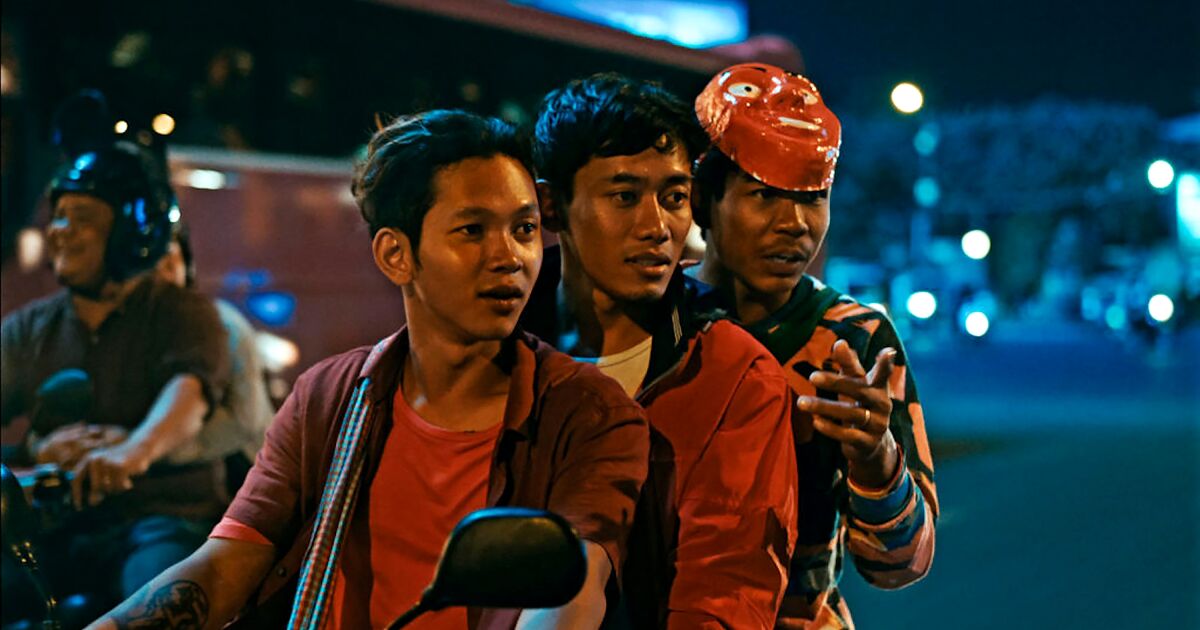
Kind-eyed and ambitious, young Samnang is a hip-hop dancer in a performing trio with his best pals and building mates Ah Kha (Chinnaro Soem), a handsome brooder, and easygoing Tol (Sovann Tho). Readying themselves for an upcoming competition, they make the most of a pulsating Phnom Penh nightlife to dance for donations, marvel at the city’s colors, sounds and mouthwatering aromas, and talk girls and dreams.
At home, however, where the building’s decrepit condition goes unattended, it’s reality with an expiration date, which has created an atmosphere of stifling pressure. Samnang’s dad (Sithan Hout), a sculptor and retired government employee with a passive mien, represents the residents in their negotiations with the company eager to force them out. But his sleepy optimism for a miracle renewal isn’t holding this worried, angry, and fearful bunch together; many dwellers are scared about where they’ll be able to afford to live (certainly not in Phnom Penh anymore), but ready to bail with a guaranteed check.
A misplaced faith in old ways also doesn’t bode well for the black toe that Samnang’s diabetic dad won’t get medically treated, preferring painkillers, honey, tamarind, and a wait-and-see approach. You could argue a rotting toe is a tad on-the-nose for a visual tied to a story about decay. (The movie was written by Neang and Daniel Mattes.) But Neang’s trust in perspective, cinematographer Douglas Seok’s evocative imagery, and the meditative strengths of slow cinema, end up complementing this narrative element. The toe becomes a signal to Samnang, as much to us, of greater wounds in need of addressing. Later, when Samnang’s father enters one of his dreams, it’s a figure in a dank, dark hallway, standing tall in a nice suit, but then turning and walking away, becoming smaller and smaller.
One of the co-producers of “White Building” is filmmaker Jia Zhangke, and it’s a show of support that immediately makes cosmic sense — you can feel the connection between Neang’s semiautobiographical, fully poetic act of mourning about a fast-changing Cambodia and the Chinese master’s vivid epics about the upheavals transforming his own country. It’s there in the emptied spaces and tableaus of construction, in the contrast between a city’s buzzy new vibe and its quieter, alienated corners, and in the idea that through development projects such as these, history, too, is being cleared away with each brick, packing box and evacuee.
There’s an incredible, heavy tracking shot toward the end of Neang’s movie I can only imagine came from the White Building’s final days — it follows along the rundown façade until it reaches one end, where a demolition crane is picking away like a big, hungry praying mantis. It’s a shot without his characters, perhaps because it came from Neang’s documentary footage before “White Building” described a movie, but just a place where people lived until 2017. But in this context, the shot sure does feel like something out of his young alter ego’s head: a towering home, but also a heavy memory, one as susceptible as a neglected structure or forgotten soul to being chipped at or leveled. Movies like these, one realizes, are why people pick up cameras.
‘White Building’
In Central Khmer with English subtitles
Not rated
Running time: 1 hour, 30 minutes
Playing: Laemmle Monica, Santa Monica

Demolition is a state of mind in “White Building,” Cambodian filmmaker Kavich Neang’s sad, beautiful feature debut, an urban elegy about what’s thick in the air when the home one has always known is not long for the world. In this case, an iconic low-income housing complex in Phnom Penh that had outlasted Khmer Rouge purges when government workers lived there, and in later disrepair became a haven for artists, but which wasn’t cut out to survive the 21st century pace of modern city gentrification.
Even if you didn’t know Neang grew up in this historic location, which the filmmaker captured in its last days for a 2019 documentary (“Last Night I Saw You Smiling”), something intensely personal emanates from his doleful tale of a teenage boy named Samnang (Piseth Chhun) coming to grips with the displacement of his family, the limits of tradition, and a turning point for his sense of self.
Kind-eyed and ambitious, young Samnang is a hip-hop dancer in a performing trio with his best pals and building mates Ah Kha (Chinnaro Soem), a handsome brooder, and easygoing Tol (Sovann Tho). Readying themselves for an upcoming competition, they make the most of a pulsating Phnom Penh nightlife to dance for donations, marvel at the city’s colors, sounds and mouthwatering aromas, and talk girls and dreams.
At home, however, where the building’s decrepit condition goes unattended, it’s reality with an expiration date, which has created an atmosphere of stifling pressure. Samnang’s dad (Sithan Hout), a sculptor and retired government employee with a passive mien, represents the residents in their negotiations with the company eager to force them out. But his sleepy optimism for a miracle renewal isn’t holding this worried, angry, and fearful bunch together; many dwellers are scared about where they’ll be able to afford to live (certainly not in Phnom Penh anymore), but ready to bail with a guaranteed check.
A misplaced faith in old ways also doesn’t bode well for the black toe that Samnang’s diabetic dad won’t get medically treated, preferring painkillers, honey, tamarind, and a wait-and-see approach. You could argue a rotting toe is a tad on-the-nose for a visual tied to a story about decay. (The movie was written by Neang and Daniel Mattes.) But Neang’s trust in perspective, cinematographer Douglas Seok’s evocative imagery, and the meditative strengths of slow cinema, end up complementing this narrative element. The toe becomes a signal to Samnang, as much to us, of greater wounds in need of addressing. Later, when Samnang’s father enters one of his dreams, it’s a figure in a dank, dark hallway, standing tall in a nice suit, but then turning and walking away, becoming smaller and smaller.
One of the co-producers of “White Building” is filmmaker Jia Zhangke, and it’s a show of support that immediately makes cosmic sense — you can feel the connection between Neang’s semiautobiographical, fully poetic act of mourning about a fast-changing Cambodia and the Chinese master’s vivid epics about the upheavals transforming his own country. It’s there in the emptied spaces and tableaus of construction, in the contrast between a city’s buzzy new vibe and its quieter, alienated corners, and in the idea that through development projects such as these, history, too, is being cleared away with each brick, packing box and evacuee.
There’s an incredible, heavy tracking shot toward the end of Neang’s movie I can only imagine came from the White Building’s final days — it follows along the rundown façade until it reaches one end, where a demolition crane is picking away like a big, hungry praying mantis. It’s a shot without his characters, perhaps because it came from Neang’s documentary footage before “White Building” described a movie, but just a place where people lived until 2017. But in this context, the shot sure does feel like something out of his young alter ego’s head: a towering home, but also a heavy memory, one as susceptible as a neglected structure or forgotten soul to being chipped at or leveled. Movies like these, one realizes, are why people pick up cameras.
‘White Building’
In Central Khmer with English subtitles
Not rated
Running time: 1 hour, 30 minutes
Playing: Laemmle Monica, Santa Monica

Demolition is a state of mind in “White Building,” Cambodian filmmaker Kavich Neang’s sad, beautiful feature debut, an urban elegy about what’s thick in the air when the home one has always known is not long for the world. In this case, an iconic low-income housing complex in Phnom Penh that had outlasted Khmer Rouge purges when government workers lived there, and in later disrepair became a haven for artists, but which wasn’t cut out to survive the 21st century pace of modern city gentrification.
Even if you didn’t know Neang grew up in this historic location, which the filmmaker captured in its last days for a 2019 documentary (“Last Night I Saw You Smiling”), something intensely personal emanates from his doleful tale of a teenage boy named Samnang (Piseth Chhun) coming to grips with the displacement of his family, the limits of tradition, and a turning point for his sense of self.
Kind-eyed and ambitious, young Samnang is a hip-hop dancer in a performing trio with his best pals and building mates Ah Kha (Chinnaro Soem), a handsome brooder, and easygoing Tol (Sovann Tho). Readying themselves for an upcoming competition, they make the most of a pulsating Phnom Penh nightlife to dance for donations, marvel at the city’s colors, sounds and mouthwatering aromas, and talk girls and dreams.
At home, however, where the building’s decrepit condition goes unattended, it’s reality with an expiration date, which has created an atmosphere of stifling pressure. Samnang’s dad (Sithan Hout), a sculptor and retired government employee with a passive mien, represents the residents in their negotiations with the company eager to force them out. But his sleepy optimism for a miracle renewal isn’t holding this worried, angry, and fearful bunch together; many dwellers are scared about where they’ll be able to afford to live (certainly not in Phnom Penh anymore), but ready to bail with a guaranteed check.
A misplaced faith in old ways also doesn’t bode well for the black toe that Samnang’s diabetic dad won’t get medically treated, preferring painkillers, honey, tamarind, and a wait-and-see approach. You could argue a rotting toe is a tad on-the-nose for a visual tied to a story about decay. (The movie was written by Neang and Daniel Mattes.) But Neang’s trust in perspective, cinematographer Douglas Seok’s evocative imagery, and the meditative strengths of slow cinema, end up complementing this narrative element. The toe becomes a signal to Samnang, as much to us, of greater wounds in need of addressing. Later, when Samnang’s father enters one of his dreams, it’s a figure in a dank, dark hallway, standing tall in a nice suit, but then turning and walking away, becoming smaller and smaller.
One of the co-producers of “White Building” is filmmaker Jia Zhangke, and it’s a show of support that immediately makes cosmic sense — you can feel the connection between Neang’s semiautobiographical, fully poetic act of mourning about a fast-changing Cambodia and the Chinese master’s vivid epics about the upheavals transforming his own country. It’s there in the emptied spaces and tableaus of construction, in the contrast between a city’s buzzy new vibe and its quieter, alienated corners, and in the idea that through development projects such as these, history, too, is being cleared away with each brick, packing box and evacuee.
There’s an incredible, heavy tracking shot toward the end of Neang’s movie I can only imagine came from the White Building’s final days — it follows along the rundown façade until it reaches one end, where a demolition crane is picking away like a big, hungry praying mantis. It’s a shot without his characters, perhaps because it came from Neang’s documentary footage before “White Building” described a movie, but just a place where people lived until 2017. But in this context, the shot sure does feel like something out of his young alter ego’s head: a towering home, but also a heavy memory, one as susceptible as a neglected structure or forgotten soul to being chipped at or leveled. Movies like these, one realizes, are why people pick up cameras.
‘White Building’
In Central Khmer with English subtitles
Not rated
Running time: 1 hour, 30 minutes
Playing: Laemmle Monica, Santa Monica
Demolition is a state of mind in “White Building,” Cambodian filmmaker Kavich Neang’s sad, beautiful feature debut, an urban elegy about what’s thick in the air when the home one has always known is not long for the world. In this case, an iconic low-income housing complex in Phnom Penh that had outlasted Khmer Rouge purges when government workers lived there, and in later disrepair became a haven for artists, but which wasn’t cut out to survive the 21st century pace of modern city gentrification.
Even if you didn’t know Neang grew up in this historic location, which the filmmaker captured in its last days for a 2019 documentary (“Last Night I Saw You Smiling”), something intensely personal emanates from his doleful tale of a teenage boy named Samnang (Piseth Chhun) coming to grips with the displacement of his family, the limits of tradition, and a turning point for his sense of self.
Kind-eyed and ambitious, young Samnang is a hip-hop dancer in a performing trio with his best pals and building mates Ah Kha (Chinnaro Soem), a handsome brooder, and easygoing Tol (Sovann Tho). Readying themselves for an upcoming competition, they make the most of a pulsating Phnom Penh nightlife to dance for donations, marvel at the city’s colors, sounds and mouthwatering aromas, and talk girls and dreams.
At home, however, where the building’s decrepit condition goes unattended, it’s reality with an expiration date, which has created an atmosphere of stifling pressure. Samnang’s dad (Sithan Hout), a sculptor and retired government employee with a passive mien, represents the residents in their negotiations with the company eager to force them out. But his sleepy optimism for a miracle renewal isn’t holding this worried, angry, and fearful bunch together; many dwellers are scared about where they’ll be able to afford to live (certainly not in Phnom Penh anymore), but ready to bail with a guaranteed check.
A misplaced faith in old ways also doesn’t bode well for the black toe that Samnang’s diabetic dad won’t get medically treated, preferring painkillers, honey, tamarind, and a wait-and-see approach. You could argue a rotting toe is a tad on-the-nose for a visual tied to a story about decay. (The movie was written by Neang and Daniel Mattes.) But Neang’s trust in perspective, cinematographer Douglas Seok’s evocative imagery, and the meditative strengths of slow cinema, end up complementing this narrative element. The toe becomes a signal to Samnang, as much to us, of greater wounds in need of addressing. Later, when Samnang’s father enters one of his dreams, it’s a figure in a dank, dark hallway, standing tall in a nice suit, but then turning and walking away, becoming smaller and smaller.
One of the co-producers of “White Building” is filmmaker Jia Zhangke, and it’s a show of support that immediately makes cosmic sense — you can feel the connection between Neang’s semiautobiographical, fully poetic act of mourning about a fast-changing Cambodia and the Chinese master’s vivid epics about the upheavals transforming his own country. It’s there in the emptied spaces and tableaus of construction, in the contrast between a city’s buzzy new vibe and its quieter, alienated corners, and in the idea that through development projects such as these, history, too, is being cleared away with each brick, packing box and evacuee.
There’s an incredible, heavy tracking shot toward the end of Neang’s movie I can only imagine came from the White Building’s final days — it follows along the rundown façade until it reaches one end, where a demolition crane is picking away like a big, hungry praying mantis. It’s a shot without his characters, perhaps because it came from Neang’s documentary footage before “White Building” described a movie, but just a place where people lived until 2017. But in this context, the shot sure does feel like something out of his young alter ego’s head: a towering home, but also a heavy memory, one as susceptible as a neglected structure or forgotten soul to being chipped at or leveled. Movies like these, one realizes, are why people pick up cameras.
‘White Building’
In Central Khmer with English subtitles
Not rated
Running time: 1 hour, 30 minutes
Playing: Laemmle Monica, Santa Monica