

On the Shelf
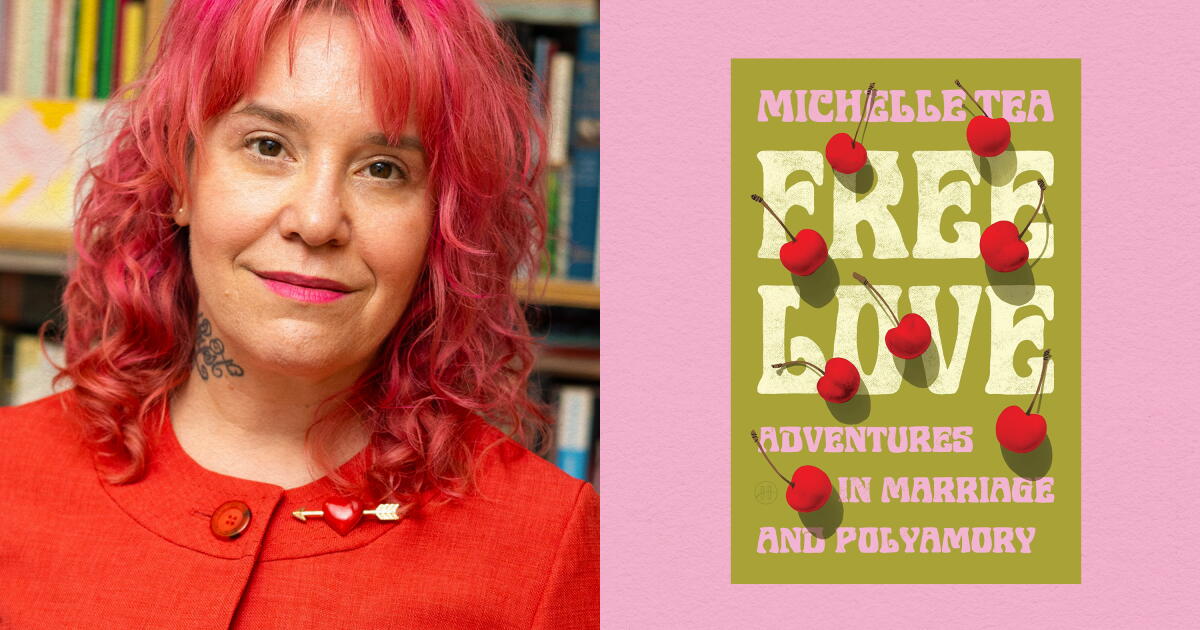
Free Love: Adventures in Marriage and Polyamory
By Michelle Tea
HarperOne: 304 pages, $30
If you buy books linked on our site, The Times may earn a commission from Bookshop.org, whose fees support independent bookstores.
To list the accomplishments of the prolific polyamorous polymath Michelle Tea requires a surfeit of descriptors. Publisher. Tarot apostle. San Francisco-to-Los Angeles transplant. Mom. Poet. Practicing witch. Inventor of that catnip for bigots, Drag Queen Story Hour. Lover (of several). Guggenheim Fellow, PEN America and Lambda Literary award winner. Fifty-five-year-old punk goth, or is it goth punk? Oh, and an author of 30 (30!) books of memoir, fiction, poetry, essays, young adult fantasy and, most recently, the inventive mix of memoir and gonzo journalism in, “Free Love: Adventures in Marriage and Polyamory.”
If you’re considering a trial run with polyamory — and really, these days, who isn’t? — “Free Love” is unlikely to push you over that edgy edge. True to her trademark transparency, Tea exposes the downside as well as the delights of getting down with a small circle of friends — a polycule, in the lingo. On Page 1, we meet Tea just before COVID struck, en route to a therapy session to process “a polyamorous marriage that was falling apart.” “I loved my freedom,” Tea writes, “but felt the ground beneath my feet was receding … I was crying into my computer constantly, a nervous wreck as I felt the partner I loved slipping further and further away.”
Ever faithful to her ideals and accepting of the real-life suffering they can bring, Tea reveals on Page 2, a few years later, she is “stoned on oxytocin, in a snuggly new marriage” that was “open from the start, albeit theoretically,” because “non-monogamy was normal for me, but not my husband … He wanted monogamy. For a while, it was fine. And then, it wasn’t. I knew I’d lost touch with some crucial, animal part of myself, an interior space where wildness and liberty lived.”
Every pearl is born of its host’s irritation, and “Free Love” is no exception. Driven by Tea’s curiosity — both carnal and intellectual — the book is an intimate, journalistic exploration of where polyamory came from and how it looks today. We caught up with Tea to talk about her own evolving open marriage, the radical history of the “free love” movement and whether being poly is a cop-out.
This interview has been edited and condensed for clarity.
Given the heartache of your first poly marriage and divorce, what made you ask your new spouse to open your marriage?
I consider polyamory to be my orientation. It’s deeply who I am. After my 2020 divorce, I was committed to living that truth. When COVID hit and most people stopped having recreational sex, that left me with just one lovely gentleman. He and I fell in love and married in 2022.
As it turned out, he really wasn’t into poly. To avoid conflict, we took it off the table. That was a big mistake. I grew resentful and angry at myself for selling out my own desires. When I told him I felt that way, I didn’t have a plan beyond owning what I wanted. A year later, my husband suggested we talk about opening up. I was shocked and thrilled.
How does your longtime goth identification relate to your longtime poly identification?
When I came of age as a goth in the ’80s, before I ever identified as queer, I understood firsthand that in the U.S. bullies will punish you, often physically, for flaunting your difference. The people who threatened and attacked my punk, goth, and queer friends were also racist and misogynistic and hated unhoused people and immigrants — the list goes on. Becoming aware of this landscape of intersecting oppressions led me to question how our sex and relationship structures can support liberation and freedom — seeing people as free individuals, not as property or security blankets.
Has anyone ever accused you of using your poly “orientation” as a cop-out —“I can’t help being poly; I was born this way”?
The “born this way” argument, which came from LGBTQ folks trying to get people who are mean to us to be nicer to us, is riddled with problems. I’m pansexual. I probably could have chosen to be primarily if not entirely heterosexual. But in queerness I saw inspirational potential, incredible excitement, hot, hot, hot sex, and a way of being in relationships that matched my ideology. I chose to act on and pursue queer life and queer people because I saw it as a better way to live. Polyamory helps me feel my wild, free self; a way of being in relationships that foments radical growth, embodies feminist theories and allows for much more communion with kindred spirits. This doesn’t work for everyone, but it works for me.
As you often do, in “Free Love” you’ve written about emotions and experiences that most people wouldn’t even admit to themselves. Do you ever concern yourself with privacy — yours or others’?
I didn’t used to think so. But in writing “Free Love,” I was surprised to realize how inhibited I felt by other people’s voices inside my head. I don’t think these things I’ve done and imagined are wrong, but I felt hyperaware that others likely would. That made me determined to not censor myself on behalf of faceless others. Writing the edgier parts of “Free Love” felt crucial, electric. I’m unable to resist the pull to write when it feels like that.
Did you show your “characters” their quotes before you turned in the manuscript?
I did not, save the person I’m partnered with. I only offer that read to my most important current relationships. With everyone else, I just grit my teeth, hope for the best and prepare to accept the consequences. It is perhaps worth noting that I have been writing about my personal life for, like, 30 years, so it is strange when anyone gets upset about this.
What moved you to include so much journalistic research in “Free Love”?
My adored agent advised me against making this book too memoir-heavy. I was also conscious of publishing yet another polyamory book by a cis white female. Yes, I’m queer and a bit of a perverted dirtbag, and that matters. But there are many ways to be polyamorous, so I really wanted to include other voices and histories. Also, it was inspiring to step out of my own perspective and dive into queer free love communes in 1960s San Francisco, and Norwegian studies on risk avoidance, and the other side quests I take in the book.
As a former hippie in the 1960s era of “anyone, anytime,” I get huffy about today’s poly people acting as if they invented free love.
The hippies were copying the Victorians! The phrase “free love” was coined at the Oneida Community in the 1800s. Many of the 1960s communes consciously adopted Oneida’s ways and beliefs.
I feel most inspired by and connected to the open sexuality that gay men have always enjoyed. The traditions of cruising, sex clubs, back rooms and sexual flexibility in relationships have always been inspiring to me. Admittedly, that legacy is fraught. Gay men’s public cruising arose from the dangers of bringing a lover home.
Also, the way BDSM (bondage and domination, sadism and masochism) scenes, particularly queer ones, have long held nonmonogamy as a given. I’m not not influenced by hippie history — I’m an Aquarius! And there was much overlap between heterosexual hippie scenes and burgeoning queer liberation camps. But people have always been interested in being sexually free. There have been moments in human history when the critical mass of individuals looking for different ways to do relationships swells, and moments when it recedes. But I believe sexual inventiveness is a perennial, particularly in the underground, where I live.
Maran, a Silver Lake-based author, has written “The New Old Me” and other books.


