
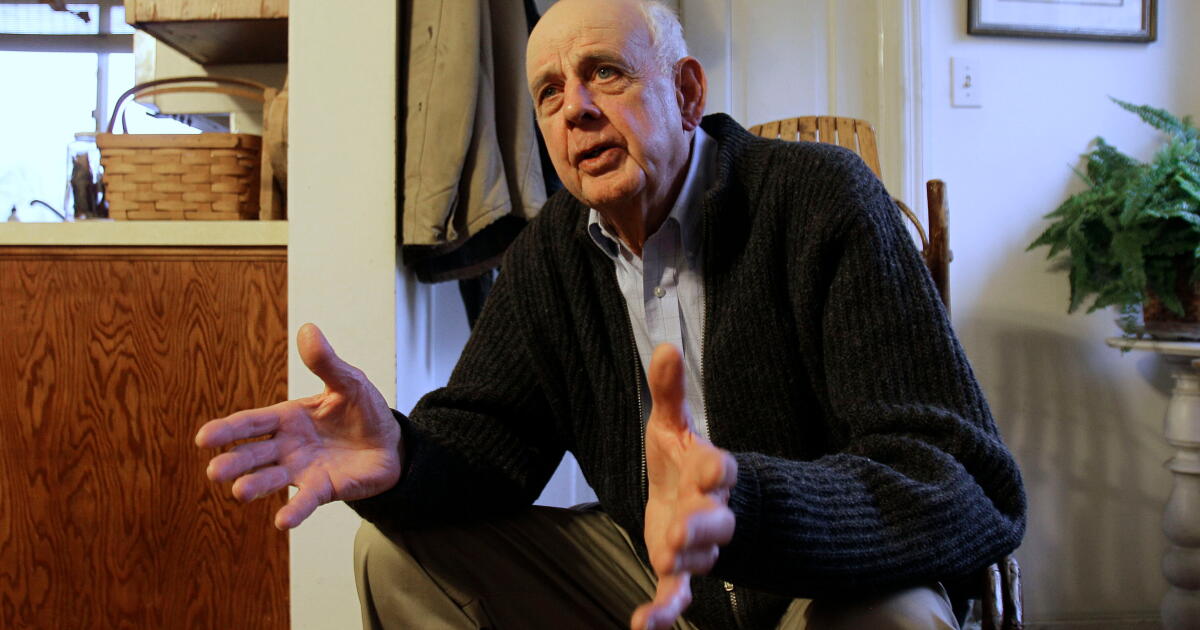
Wendell Berry, a Kentucky farmer and writer whose work advocated fiercely for working landscapes and working people, died “suddenly and peacefully” on Monday at his home in Port Royal, Ky., according to his family. He was 92.
His daughter, Mary Berry, confirmed his death. On Thursday, she told The Times that her father, until about six months ago, was still writing regularly in his cabin on the banks of the Kentucky River, a place he called “camp,” where many of his more than 50 volumes of poetry, short stories, essays and novels were written.
Berry championed sustainable farming and rural community preservation and railed against industrial agriculture and corporate agribusiness.
“He was fierce and he was fearless, and he remained fearless,” she said, explaining that her family taught her the erosion of rural places wasn’t inevitable but “destruction by design,” engineered by corporate interests and political policies.
Berry, whose writings were often fueled by an anger toward the forces that have driven the destruction of the rural land and communities that he dedicated his life to defending, softened in his final years, according to his daughter. “He was always a tender man, and that part of him got stronger. He was rereading a lot of books that he had loved in his life, and he told me he was looking for the tenderness in the books, and that’s a lovely thing.”
Berry’s most influential work began with a list of the problems he’d observed in modern agriculture, scribbled onto a legal pad as he traveled the long stretch of road between Kentucky’s Henry County and Spokane, Wash., where Berry would deliver a speech at the “Agriculture for a Small Planet” symposium in 1974.
“I was asked to talk about labor-intensive microsystems agriculture. That’s not my language, and it’s not the sort of language that I wish to use because it’s the way people speak when they don’t want to be understood by most people,” he began.
Berry spoke of the six generations of farmers who worked his land before him, and the concerns for farming communities and their agricultural economy that he inherited from his father. He decried “the experts and politicians who have prescribed, encouraged, and applauded the disintegration of such farming communities all over this country into our allegedly miraculous modern American agriculture.”
The speech would later become Berry’s 1977 manifesto “The Unsettling of America: Culture & Agriculture,” which launched a sustainable-farming movement and cemented Berry’s authority on agrarian issues on the national stage.
Beyond his cultural critiques, Berry wrote notable novels including “The Memory of Old Jack,” “Jayber Crow” and “Hannah Coulter.” He was a prolific poet as well. His verse included his debut collection, “The Broken Ground,” and his celebrated Sabbath Poems series, which explored living in harmony with the land.
Over the course of his career, he was honored with the T. S. Eliot Prize, the Aiken Taylor Award for Modern American Poetry and the Richard C. Holbrooke Distinguished Achievement Award from the Dayton Literary Peace Prize, among other accolades. In 2010, Berry was awarded the National Humanities Medal by then-President Obama for his achievements as a poet, novelist, farmer and conservationist. In 2016, he was the recipient of the Ivan Sandrof Life Achievement Award from the National Book Critics Circle.
Wendell Erdman Berry was born on Aug. 5, 1934, in Louisville, Ky., to John Marshall Berry Sr., a lawyer and tobacco farmer, and Virginia Perry Berry. Wendell was the eldest of four children, two boys and two girls. In high school, his parents shipped him off to Millersburg Military Institute, a former military boarding school in Kentucky, where rather than conform to the teachings, he later wrote that his takeaway was, “Take a simpleton and give him power and confront him with intelligence — and you have a tyrant.”
He went on to study English and creative writing at the University of Kentucky. There he met and wooed Tanya Amyx, who would become his wife and the mother of his two children, Mary and Pryor. He landed a Wallace Stegner writing fellowship at Stanford in 1958, and in 1961 he was granted a Guggenheim Fellowship, which allowed him to pack up the family and live in Tuscany and southern France.
After Berry’s scholarly pursuits took him to the West Coast, then Europe, then the East Coast, where he taught at New York University, he accepted a job at the University of Kentucky, allowing him to return home and back to his roots, on a farm near the river.
Then-President Obama presents the 2010 National Humanities Medal to Wendell Berry during a ceremony March 2, 2011, in the East Room of the White House.
(Mark Wilson / Getty Images)
“Within a few years, Mom and Dad were raising 85% of the food we were eating,” Mary told The Times. “We had a milk cow, raised hogs for our own use, and by the time I was a teenager, I resented the whole thing pretty seriously, and I remember saying to them more than once, ‘I did not choose to live this way, and I don’t know why we have to do everything the hardest way possible.’ We had no television. … But I was in a heck of a position with my parents because I never really thought they were wrong about anything, and I still don’t.”
When Mary would gripe, she said, her dad would laugh or “just keep working.” But “he talked about what we were doing and why we were doing it,” she said. “He told my brother and me from the time I can remember to look and see that this is good and don’t forget, and I have not forgotten.”
In 2011, when Berry was nearly 80 years old, he joined a high-profile sit-in at the office of Kentucky’s then-Gov. Steve Beshear to protest the destructive mountaintop strip-mining of coal. In an interview with Bill Moyers shared by the Berry Center in 2025, Berry said that he and his compatriots had had enough of the state government ceding control of resources to the coal companies. “In our society,” he said, “people with money are bigger and more powerful and more noticeable and count more as citizens than people without much money. … So we did confront the governor and tell him we weren’t going to leave.”
His attempt at civil disobedience was turned on its head when the governor invited Berry and the Kentucky Rising activists to stay.
“We did stay,” he said. “The whole weekend.”
“We were beautifully treated by the security staff and people who sent us food and bedding and good wishes and even came in and gave us massages. And it was altogether one of the loveliest weekends I’ve ever spent in my life.”
Berry continued writing into his old age.
Next month, Counterpoint Press will posthumously release “Dispatches From Rural America,” a collection of 15 essays. In one, “The Problem Is Industrialism,” Berry wrote about a 2021 conversation he had with a friend of more than 40 years, author Wes Jackson.
“To the extent that we were talking in earnest, our subject was the set of calamities that the media and the commentators frequently take up, typically dealing with each one in isolation from the others and representing each as an emergency more or less apocalyptic, and in tones recalling a number of vernacular alarms, from ‘Last chance for beer’ to ‘Prepare to meet God.’”
He continued later that the two discussed how industrialism “grows only by consuming, once and for all, the living world.”
Mary said she wanted people to know that, yes, her father was worried and wouldn’t have written so much if he weren’t terribly concerned about the future of rural America, but she wants people to understand that he was a man of great hope.
“Hope he felt was a duty, and I learned that from him,” she said. “As he said in one of his many poems, hope is what we owe people younger than ourselves.”
Mary said she was continuing her father’s work through the Berry Center, a nonprofit that aims to put Berry’s writings to work and advocates for farmers, land-conserving communities and healthy regional economies.
Berry is survived by his wife of nearly 70 years, Tanya, his daughter Mary, son Pryor, five grandchildren and four great-grandchildren.

Wendell Berry, a Kentucky farmer and writer whose work advocated fiercely for working landscapes and working people, died “suddenly and peacefully” on Monday at his home in Port Royal, Ky., according to his family. He was 92.
His daughter, Mary Berry, confirmed his death. On Thursday, she told The Times that her father, until about six months ago, was still writing regularly in his cabin on the banks of the Kentucky River, a place he called “camp,” where many of his more than 50 volumes of poetry, short stories, essays and novels were written.
Berry championed sustainable farming and rural community preservation and railed against industrial agriculture and corporate agribusiness.
“He was fierce and he was fearless, and he remained fearless,” she said, explaining that her family taught her the erosion of rural places wasn’t inevitable but “destruction by design,” engineered by corporate interests and political policies.
Berry, whose writings were often fueled by an anger toward the forces that have driven the destruction of the rural land and communities that he dedicated his life to defending, softened in his final years, according to his daughter. “He was always a tender man, and that part of him got stronger. He was rereading a lot of books that he had loved in his life, and he told me he was looking for the tenderness in the books, and that’s a lovely thing.”
Berry’s most influential work began with a list of the problems he’d observed in modern agriculture, scribbled onto a legal pad as he traveled the long stretch of road between Kentucky’s Henry County and Spokane, Wash., where Berry would deliver a speech at the “Agriculture for a Small Planet” symposium in 1974.
“I was asked to talk about labor-intensive microsystems agriculture. That’s not my language, and it’s not the sort of language that I wish to use because it’s the way people speak when they don’t want to be understood by most people,” he began.
Berry spoke of the six generations of farmers who worked his land before him, and the concerns for farming communities and their agricultural economy that he inherited from his father. He decried “the experts and politicians who have prescribed, encouraged, and applauded the disintegration of such farming communities all over this country into our allegedly miraculous modern American agriculture.”
The speech would later become Berry’s 1977 manifesto “The Unsettling of America: Culture & Agriculture,” which launched a sustainable-farming movement and cemented Berry’s authority on agrarian issues on the national stage.
Beyond his cultural critiques, Berry wrote notable novels including “The Memory of Old Jack,” “Jayber Crow” and “Hannah Coulter.” He was a prolific poet as well. His verse included his debut collection, “The Broken Ground,” and his celebrated Sabbath Poems series, which explored living in harmony with the land.
Over the course of his career, he was honored with the T. S. Eliot Prize, the Aiken Taylor Award for Modern American Poetry and the Richard C. Holbrooke Distinguished Achievement Award from the Dayton Literary Peace Prize, among other accolades. In 2010, Berry was awarded the National Humanities Medal by then-President Obama for his achievements as a poet, novelist, farmer and conservationist. In 2016, he was the recipient of the Ivan Sandrof Life Achievement Award from the National Book Critics Circle.
Wendell Erdman Berry was born on Aug. 5, 1934, in Louisville, Ky., to John Marshall Berry Sr., a lawyer and tobacco farmer, and Virginia Perry Berry. Wendell was the eldest of four children, two boys and two girls. In high school, his parents shipped him off to Millersburg Military Institute, a former military boarding school in Kentucky, where rather than conform to the teachings, he later wrote that his takeaway was, “Take a simpleton and give him power and confront him with intelligence — and you have a tyrant.”
He went on to study English and creative writing at the University of Kentucky. There he met and wooed Tanya Amyx, who would become his wife and the mother of his two children, Mary and Pryor. He landed a Wallace Stegner writing fellowship at Stanford in 1958, and in 1961 he was granted a Guggenheim Fellowship, which allowed him to pack up the family and live in Tuscany and southern France.
After Berry’s scholarly pursuits took him to the West Coast, then Europe, then the East Coast, where he taught at New York University, he accepted a job at the University of Kentucky, allowing him to return home and back to his roots, on a farm near the river.
Then-President Obama presents the 2010 National Humanities Medal to Wendell Berry during a ceremony March 2, 2011, in the East Room of the White House.
(Mark Wilson / Getty Images)
“Within a few years, Mom and Dad were raising 85% of the food we were eating,” Mary told The Times. “We had a milk cow, raised hogs for our own use, and by the time I was a teenager, I resented the whole thing pretty seriously, and I remember saying to them more than once, ‘I did not choose to live this way, and I don’t know why we have to do everything the hardest way possible.’ We had no television. … But I was in a heck of a position with my parents because I never really thought they were wrong about anything, and I still don’t.”
When Mary would gripe, she said, her dad would laugh or “just keep working.” But “he talked about what we were doing and why we were doing it,” she said. “He told my brother and me from the time I can remember to look and see that this is good and don’t forget, and I have not forgotten.”
In 2011, when Berry was nearly 80 years old, he joined a high-profile sit-in at the office of Kentucky’s then-Gov. Steve Beshear to protest the destructive mountaintop strip-mining of coal. In an interview with Bill Moyers shared by the Berry Center in 2025, Berry said that he and his compatriots had had enough of the state government ceding control of resources to the coal companies. “In our society,” he said, “people with money are bigger and more powerful and more noticeable and count more as citizens than people without much money. … So we did confront the governor and tell him we weren’t going to leave.”
His attempt at civil disobedience was turned on its head when the governor invited Berry and the Kentucky Rising activists to stay.
“We did stay,” he said. “The whole weekend.”
“We were beautifully treated by the security staff and people who sent us food and bedding and good wishes and even came in and gave us massages. And it was altogether one of the loveliest weekends I’ve ever spent in my life.”
Berry continued writing into his old age.
Next month, Counterpoint Press will posthumously release “Dispatches From Rural America,” a collection of 15 essays. In one, “The Problem Is Industrialism,” Berry wrote about a 2021 conversation he had with a friend of more than 40 years, author Wes Jackson.
“To the extent that we were talking in earnest, our subject was the set of calamities that the media and the commentators frequently take up, typically dealing with each one in isolation from the others and representing each as an emergency more or less apocalyptic, and in tones recalling a number of vernacular alarms, from ‘Last chance for beer’ to ‘Prepare to meet God.’”
He continued later that the two discussed how industrialism “grows only by consuming, once and for all, the living world.”
Mary said she wanted people to know that, yes, her father was worried and wouldn’t have written so much if he weren’t terribly concerned about the future of rural America, but she wants people to understand that he was a man of great hope.
“Hope he felt was a duty, and I learned that from him,” she said. “As he said in one of his many poems, hope is what we owe people younger than ourselves.”
Mary said she was continuing her father’s work through the Berry Center, a nonprofit that aims to put Berry’s writings to work and advocates for farmers, land-conserving communities and healthy regional economies.
Berry is survived by his wife of nearly 70 years, Tanya, his daughter Mary, son Pryor, five grandchildren and four great-grandchildren.

Wendell Berry, a Kentucky farmer and writer whose work advocated fiercely for working landscapes and working people, died “suddenly and peacefully” on Monday at his home in Port Royal, Ky., according to his family. He was 92.
His daughter, Mary Berry, confirmed his death. On Thursday, she told The Times that her father, until about six months ago, was still writing regularly in his cabin on the banks of the Kentucky River, a place he called “camp,” where many of his more than 50 volumes of poetry, short stories, essays and novels were written.
Berry championed sustainable farming and rural community preservation and railed against industrial agriculture and corporate agribusiness.
“He was fierce and he was fearless, and he remained fearless,” she said, explaining that her family taught her the erosion of rural places wasn’t inevitable but “destruction by design,” engineered by corporate interests and political policies.
Berry, whose writings were often fueled by an anger toward the forces that have driven the destruction of the rural land and communities that he dedicated his life to defending, softened in his final years, according to his daughter. “He was always a tender man, and that part of him got stronger. He was rereading a lot of books that he had loved in his life, and he told me he was looking for the tenderness in the books, and that’s a lovely thing.”
Berry’s most influential work began with a list of the problems he’d observed in modern agriculture, scribbled onto a legal pad as he traveled the long stretch of road between Kentucky’s Henry County and Spokane, Wash., where Berry would deliver a speech at the “Agriculture for a Small Planet” symposium in 1974.
“I was asked to talk about labor-intensive microsystems agriculture. That’s not my language, and it’s not the sort of language that I wish to use because it’s the way people speak when they don’t want to be understood by most people,” he began.
Berry spoke of the six generations of farmers who worked his land before him, and the concerns for farming communities and their agricultural economy that he inherited from his father. He decried “the experts and politicians who have prescribed, encouraged, and applauded the disintegration of such farming communities all over this country into our allegedly miraculous modern American agriculture.”
The speech would later become Berry’s 1977 manifesto “The Unsettling of America: Culture & Agriculture,” which launched a sustainable-farming movement and cemented Berry’s authority on agrarian issues on the national stage.
Beyond his cultural critiques, Berry wrote notable novels including “The Memory of Old Jack,” “Jayber Crow” and “Hannah Coulter.” He was a prolific poet as well. His verse included his debut collection, “The Broken Ground,” and his celebrated Sabbath Poems series, which explored living in harmony with the land.
Over the course of his career, he was honored with the T. S. Eliot Prize, the Aiken Taylor Award for Modern American Poetry and the Richard C. Holbrooke Distinguished Achievement Award from the Dayton Literary Peace Prize, among other accolades. In 2010, Berry was awarded the National Humanities Medal by then-President Obama for his achievements as a poet, novelist, farmer and conservationist. In 2016, he was the recipient of the Ivan Sandrof Life Achievement Award from the National Book Critics Circle.
Wendell Erdman Berry was born on Aug. 5, 1934, in Louisville, Ky., to John Marshall Berry Sr., a lawyer and tobacco farmer, and Virginia Perry Berry. Wendell was the eldest of four children, two boys and two girls. In high school, his parents shipped him off to Millersburg Military Institute, a former military boarding school in Kentucky, where rather than conform to the teachings, he later wrote that his takeaway was, “Take a simpleton and give him power and confront him with intelligence — and you have a tyrant.”
He went on to study English and creative writing at the University of Kentucky. There he met and wooed Tanya Amyx, who would become his wife and the mother of his two children, Mary and Pryor. He landed a Wallace Stegner writing fellowship at Stanford in 1958, and in 1961 he was granted a Guggenheim Fellowship, which allowed him to pack up the family and live in Tuscany and southern France.
After Berry’s scholarly pursuits took him to the West Coast, then Europe, then the East Coast, where he taught at New York University, he accepted a job at the University of Kentucky, allowing him to return home and back to his roots, on a farm near the river.
Then-President Obama presents the 2010 National Humanities Medal to Wendell Berry during a ceremony March 2, 2011, in the East Room of the White House.
(Mark Wilson / Getty Images)
“Within a few years, Mom and Dad were raising 85% of the food we were eating,” Mary told The Times. “We had a milk cow, raised hogs for our own use, and by the time I was a teenager, I resented the whole thing pretty seriously, and I remember saying to them more than once, ‘I did not choose to live this way, and I don’t know why we have to do everything the hardest way possible.’ We had no television. … But I was in a heck of a position with my parents because I never really thought they were wrong about anything, and I still don’t.”
When Mary would gripe, she said, her dad would laugh or “just keep working.” But “he talked about what we were doing and why we were doing it,” she said. “He told my brother and me from the time I can remember to look and see that this is good and don’t forget, and I have not forgotten.”
In 2011, when Berry was nearly 80 years old, he joined a high-profile sit-in at the office of Kentucky’s then-Gov. Steve Beshear to protest the destructive mountaintop strip-mining of coal. In an interview with Bill Moyers shared by the Berry Center in 2025, Berry said that he and his compatriots had had enough of the state government ceding control of resources to the coal companies. “In our society,” he said, “people with money are bigger and more powerful and more noticeable and count more as citizens than people without much money. … So we did confront the governor and tell him we weren’t going to leave.”
His attempt at civil disobedience was turned on its head when the governor invited Berry and the Kentucky Rising activists to stay.
“We did stay,” he said. “The whole weekend.”
“We were beautifully treated by the security staff and people who sent us food and bedding and good wishes and even came in and gave us massages. And it was altogether one of the loveliest weekends I’ve ever spent in my life.”
Berry continued writing into his old age.
Next month, Counterpoint Press will posthumously release “Dispatches From Rural America,” a collection of 15 essays. In one, “The Problem Is Industrialism,” Berry wrote about a 2021 conversation he had with a friend of more than 40 years, author Wes Jackson.
“To the extent that we were talking in earnest, our subject was the set of calamities that the media and the commentators frequently take up, typically dealing with each one in isolation from the others and representing each as an emergency more or less apocalyptic, and in tones recalling a number of vernacular alarms, from ‘Last chance for beer’ to ‘Prepare to meet God.’”
He continued later that the two discussed how industrialism “grows only by consuming, once and for all, the living world.”
Mary said she wanted people to know that, yes, her father was worried and wouldn’t have written so much if he weren’t terribly concerned about the future of rural America, but she wants people to understand that he was a man of great hope.
“Hope he felt was a duty, and I learned that from him,” she said. “As he said in one of his many poems, hope is what we owe people younger than ourselves.”
Mary said she was continuing her father’s work through the Berry Center, a nonprofit that aims to put Berry’s writings to work and advocates for farmers, land-conserving communities and healthy regional economies.
Berry is survived by his wife of nearly 70 years, Tanya, his daughter Mary, son Pryor, five grandchildren and four great-grandchildren.
Wendell Berry, a Kentucky farmer and writer whose work advocated fiercely for working landscapes and working people, died “suddenly and peacefully” on Monday at his home in Port Royal, Ky., according to his family. He was 92.
His daughter, Mary Berry, confirmed his death. On Thursday, she told The Times that her father, until about six months ago, was still writing regularly in his cabin on the banks of the Kentucky River, a place he called “camp,” where many of his more than 50 volumes of poetry, short stories, essays and novels were written.
Berry championed sustainable farming and rural community preservation and railed against industrial agriculture and corporate agribusiness.
“He was fierce and he was fearless, and he remained fearless,” she said, explaining that her family taught her the erosion of rural places wasn’t inevitable but “destruction by design,” engineered by corporate interests and political policies.
Berry, whose writings were often fueled by an anger toward the forces that have driven the destruction of the rural land and communities that he dedicated his life to defending, softened in his final years, according to his daughter. “He was always a tender man, and that part of him got stronger. He was rereading a lot of books that he had loved in his life, and he told me he was looking for the tenderness in the books, and that’s a lovely thing.”
Berry’s most influential work began with a list of the problems he’d observed in modern agriculture, scribbled onto a legal pad as he traveled the long stretch of road between Kentucky’s Henry County and Spokane, Wash., where Berry would deliver a speech at the “Agriculture for a Small Planet” symposium in 1974.
“I was asked to talk about labor-intensive microsystems agriculture. That’s not my language, and it’s not the sort of language that I wish to use because it’s the way people speak when they don’t want to be understood by most people,” he began.
Berry spoke of the six generations of farmers who worked his land before him, and the concerns for farming communities and their agricultural economy that he inherited from his father. He decried “the experts and politicians who have prescribed, encouraged, and applauded the disintegration of such farming communities all over this country into our allegedly miraculous modern American agriculture.”
The speech would later become Berry’s 1977 manifesto “The Unsettling of America: Culture & Agriculture,” which launched a sustainable-farming movement and cemented Berry’s authority on agrarian issues on the national stage.
Beyond his cultural critiques, Berry wrote notable novels including “The Memory of Old Jack,” “Jayber Crow” and “Hannah Coulter.” He was a prolific poet as well. His verse included his debut collection, “The Broken Ground,” and his celebrated Sabbath Poems series, which explored living in harmony with the land.
Over the course of his career, he was honored with the T. S. Eliot Prize, the Aiken Taylor Award for Modern American Poetry and the Richard C. Holbrooke Distinguished Achievement Award from the Dayton Literary Peace Prize, among other accolades. In 2010, Berry was awarded the National Humanities Medal by then-President Obama for his achievements as a poet, novelist, farmer and conservationist. In 2016, he was the recipient of the Ivan Sandrof Life Achievement Award from the National Book Critics Circle.
Wendell Erdman Berry was born on Aug. 5, 1934, in Louisville, Ky., to John Marshall Berry Sr., a lawyer and tobacco farmer, and Virginia Perry Berry. Wendell was the eldest of four children, two boys and two girls. In high school, his parents shipped him off to Millersburg Military Institute, a former military boarding school in Kentucky, where rather than conform to the teachings, he later wrote that his takeaway was, “Take a simpleton and give him power and confront him with intelligence — and you have a tyrant.”
He went on to study English and creative writing at the University of Kentucky. There he met and wooed Tanya Amyx, who would become his wife and the mother of his two children, Mary and Pryor. He landed a Wallace Stegner writing fellowship at Stanford in 1958, and in 1961 he was granted a Guggenheim Fellowship, which allowed him to pack up the family and live in Tuscany and southern France.
After Berry’s scholarly pursuits took him to the West Coast, then Europe, then the East Coast, where he taught at New York University, he accepted a job at the University of Kentucky, allowing him to return home and back to his roots, on a farm near the river.
Then-President Obama presents the 2010 National Humanities Medal to Wendell Berry during a ceremony March 2, 2011, in the East Room of the White House.
(Mark Wilson / Getty Images)
“Within a few years, Mom and Dad were raising 85% of the food we were eating,” Mary told The Times. “We had a milk cow, raised hogs for our own use, and by the time I was a teenager, I resented the whole thing pretty seriously, and I remember saying to them more than once, ‘I did not choose to live this way, and I don’t know why we have to do everything the hardest way possible.’ We had no television. … But I was in a heck of a position with my parents because I never really thought they were wrong about anything, and I still don’t.”
When Mary would gripe, she said, her dad would laugh or “just keep working.” But “he talked about what we were doing and why we were doing it,” she said. “He told my brother and me from the time I can remember to look and see that this is good and don’t forget, and I have not forgotten.”
In 2011, when Berry was nearly 80 years old, he joined a high-profile sit-in at the office of Kentucky’s then-Gov. Steve Beshear to protest the destructive mountaintop strip-mining of coal. In an interview with Bill Moyers shared by the Berry Center in 2025, Berry said that he and his compatriots had had enough of the state government ceding control of resources to the coal companies. “In our society,” he said, “people with money are bigger and more powerful and more noticeable and count more as citizens than people without much money. … So we did confront the governor and tell him we weren’t going to leave.”
His attempt at civil disobedience was turned on its head when the governor invited Berry and the Kentucky Rising activists to stay.
“We did stay,” he said. “The whole weekend.”
“We were beautifully treated by the security staff and people who sent us food and bedding and good wishes and even came in and gave us massages. And it was altogether one of the loveliest weekends I’ve ever spent in my life.”
Berry continued writing into his old age.
Next month, Counterpoint Press will posthumously release “Dispatches From Rural America,” a collection of 15 essays. In one, “The Problem Is Industrialism,” Berry wrote about a 2021 conversation he had with a friend of more than 40 years, author Wes Jackson.
“To the extent that we were talking in earnest, our subject was the set of calamities that the media and the commentators frequently take up, typically dealing with each one in isolation from the others and representing each as an emergency more or less apocalyptic, and in tones recalling a number of vernacular alarms, from ‘Last chance for beer’ to ‘Prepare to meet God.’”
He continued later that the two discussed how industrialism “grows only by consuming, once and for all, the living world.”
Mary said she wanted people to know that, yes, her father was worried and wouldn’t have written so much if he weren’t terribly concerned about the future of rural America, but she wants people to understand that he was a man of great hope.
“Hope he felt was a duty, and I learned that from him,” she said. “As he said in one of his many poems, hope is what we owe people younger than ourselves.”
Mary said she was continuing her father’s work through the Berry Center, a nonprofit that aims to put Berry’s writings to work and advocates for farmers, land-conserving communities and healthy regional economies.
Berry is survived by his wife of nearly 70 years, Tanya, his daughter Mary, son Pryor, five grandchildren and four great-grandchildren.

Wendell Berry, a Kentucky farmer and writer whose work advocated fiercely for working landscapes and working people, died “suddenly and peacefully” on Monday at his home in Port Royal, Ky., according to his family. He was 92.
His daughter, Mary Berry, confirmed his death. On Thursday, she told The Times that her father, until about six months ago, was still writing regularly in his cabin on the banks of the Kentucky River, a place he called “camp,” where many of his more than 50 volumes of poetry, short stories, essays and novels were written.
Berry championed sustainable farming and rural community preservation and railed against industrial agriculture and corporate agribusiness.
“He was fierce and he was fearless, and he remained fearless,” she said, explaining that her family taught her the erosion of rural places wasn’t inevitable but “destruction by design,” engineered by corporate interests and political policies.
Berry, whose writings were often fueled by an anger toward the forces that have driven the destruction of the rural land and communities that he dedicated his life to defending, softened in his final years, according to his daughter. “He was always a tender man, and that part of him got stronger. He was rereading a lot of books that he had loved in his life, and he told me he was looking for the tenderness in the books, and that’s a lovely thing.”
Berry’s most influential work began with a list of the problems he’d observed in modern agriculture, scribbled onto a legal pad as he traveled the long stretch of road between Kentucky’s Henry County and Spokane, Wash., where Berry would deliver a speech at the “Agriculture for a Small Planet” symposium in 1974.
“I was asked to talk about labor-intensive microsystems agriculture. That’s not my language, and it’s not the sort of language that I wish to use because it’s the way people speak when they don’t want to be understood by most people,” he began.
Berry spoke of the six generations of farmers who worked his land before him, and the concerns for farming communities and their agricultural economy that he inherited from his father. He decried “the experts and politicians who have prescribed, encouraged, and applauded the disintegration of such farming communities all over this country into our allegedly miraculous modern American agriculture.”
The speech would later become Berry’s 1977 manifesto “The Unsettling of America: Culture & Agriculture,” which launched a sustainable-farming movement and cemented Berry’s authority on agrarian issues on the national stage.
Beyond his cultural critiques, Berry wrote notable novels including “The Memory of Old Jack,” “Jayber Crow” and “Hannah Coulter.” He was a prolific poet as well. His verse included his debut collection, “The Broken Ground,” and his celebrated Sabbath Poems series, which explored living in harmony with the land.
Over the course of his career, he was honored with the T. S. Eliot Prize, the Aiken Taylor Award for Modern American Poetry and the Richard C. Holbrooke Distinguished Achievement Award from the Dayton Literary Peace Prize, among other accolades. In 2010, Berry was awarded the National Humanities Medal by then-President Obama for his achievements as a poet, novelist, farmer and conservationist. In 2016, he was the recipient of the Ivan Sandrof Life Achievement Award from the National Book Critics Circle.
Wendell Erdman Berry was born on Aug. 5, 1934, in Louisville, Ky., to John Marshall Berry Sr., a lawyer and tobacco farmer, and Virginia Perry Berry. Wendell was the eldest of four children, two boys and two girls. In high school, his parents shipped him off to Millersburg Military Institute, a former military boarding school in Kentucky, where rather than conform to the teachings, he later wrote that his takeaway was, “Take a simpleton and give him power and confront him with intelligence — and you have a tyrant.”
He went on to study English and creative writing at the University of Kentucky. There he met and wooed Tanya Amyx, who would become his wife and the mother of his two children, Mary and Pryor. He landed a Wallace Stegner writing fellowship at Stanford in 1958, and in 1961 he was granted a Guggenheim Fellowship, which allowed him to pack up the family and live in Tuscany and southern France.
After Berry’s scholarly pursuits took him to the West Coast, then Europe, then the East Coast, where he taught at New York University, he accepted a job at the University of Kentucky, allowing him to return home and back to his roots, on a farm near the river.
Then-President Obama presents the 2010 National Humanities Medal to Wendell Berry during a ceremony March 2, 2011, in the East Room of the White House.
(Mark Wilson / Getty Images)
“Within a few years, Mom and Dad were raising 85% of the food we were eating,” Mary told The Times. “We had a milk cow, raised hogs for our own use, and by the time I was a teenager, I resented the whole thing pretty seriously, and I remember saying to them more than once, ‘I did not choose to live this way, and I don’t know why we have to do everything the hardest way possible.’ We had no television. … But I was in a heck of a position with my parents because I never really thought they were wrong about anything, and I still don’t.”
When Mary would gripe, she said, her dad would laugh or “just keep working.” But “he talked about what we were doing and why we were doing it,” she said. “He told my brother and me from the time I can remember to look and see that this is good and don’t forget, and I have not forgotten.”
In 2011, when Berry was nearly 80 years old, he joined a high-profile sit-in at the office of Kentucky’s then-Gov. Steve Beshear to protest the destructive mountaintop strip-mining of coal. In an interview with Bill Moyers shared by the Berry Center in 2025, Berry said that he and his compatriots had had enough of the state government ceding control of resources to the coal companies. “In our society,” he said, “people with money are bigger and more powerful and more noticeable and count more as citizens than people without much money. … So we did confront the governor and tell him we weren’t going to leave.”
His attempt at civil disobedience was turned on its head when the governor invited Berry and the Kentucky Rising activists to stay.
“We did stay,” he said. “The whole weekend.”
“We were beautifully treated by the security staff and people who sent us food and bedding and good wishes and even came in and gave us massages. And it was altogether one of the loveliest weekends I’ve ever spent in my life.”
Berry continued writing into his old age.
Next month, Counterpoint Press will posthumously release “Dispatches From Rural America,” a collection of 15 essays. In one, “The Problem Is Industrialism,” Berry wrote about a 2021 conversation he had with a friend of more than 40 years, author Wes Jackson.
“To the extent that we were talking in earnest, our subject was the set of calamities that the media and the commentators frequently take up, typically dealing with each one in isolation from the others and representing each as an emergency more or less apocalyptic, and in tones recalling a number of vernacular alarms, from ‘Last chance for beer’ to ‘Prepare to meet God.’”
He continued later that the two discussed how industrialism “grows only by consuming, once and for all, the living world.”
Mary said she wanted people to know that, yes, her father was worried and wouldn’t have written so much if he weren’t terribly concerned about the future of rural America, but she wants people to understand that he was a man of great hope.
“Hope he felt was a duty, and I learned that from him,” she said. “As he said in one of his many poems, hope is what we owe people younger than ourselves.”
Mary said she was continuing her father’s work through the Berry Center, a nonprofit that aims to put Berry’s writings to work and advocates for farmers, land-conserving communities and healthy regional economies.
Berry is survived by his wife of nearly 70 years, Tanya, his daughter Mary, son Pryor, five grandchildren and four great-grandchildren.
Wendell Berry, a Kentucky farmer and writer whose work advocated fiercely for working landscapes and working people, died “suddenly and peacefully” on Monday at his home in Port Royal, Ky., according to his family. He was 92.
His daughter, Mary Berry, confirmed his death. On Thursday, she told The Times that her father, until about six months ago, was still writing regularly in his cabin on the banks of the Kentucky River, a place he called “camp,” where many of his more than 50 volumes of poetry, short stories, essays and novels were written.
Berry championed sustainable farming and rural community preservation and railed against industrial agriculture and corporate agribusiness.
“He was fierce and he was fearless, and he remained fearless,” she said, explaining that her family taught her the erosion of rural places wasn’t inevitable but “destruction by design,” engineered by corporate interests and political policies.
Berry, whose writings were often fueled by an anger toward the forces that have driven the destruction of the rural land and communities that he dedicated his life to defending, softened in his final years, according to his daughter. “He was always a tender man, and that part of him got stronger. He was rereading a lot of books that he had loved in his life, and he told me he was looking for the tenderness in the books, and that’s a lovely thing.”
Berry’s most influential work began with a list of the problems he’d observed in modern agriculture, scribbled onto a legal pad as he traveled the long stretch of road between Kentucky’s Henry County and Spokane, Wash., where Berry would deliver a speech at the “Agriculture for a Small Planet” symposium in 1974.
“I was asked to talk about labor-intensive microsystems agriculture. That’s not my language, and it’s not the sort of language that I wish to use because it’s the way people speak when they don’t want to be understood by most people,” he began.
Berry spoke of the six generations of farmers who worked his land before him, and the concerns for farming communities and their agricultural economy that he inherited from his father. He decried “the experts and politicians who have prescribed, encouraged, and applauded the disintegration of such farming communities all over this country into our allegedly miraculous modern American agriculture.”
The speech would later become Berry’s 1977 manifesto “The Unsettling of America: Culture & Agriculture,” which launched a sustainable-farming movement and cemented Berry’s authority on agrarian issues on the national stage.
Beyond his cultural critiques, Berry wrote notable novels including “The Memory of Old Jack,” “Jayber Crow” and “Hannah Coulter.” He was a prolific poet as well. His verse included his debut collection, “The Broken Ground,” and his celebrated Sabbath Poems series, which explored living in harmony with the land.
Over the course of his career, he was honored with the T. S. Eliot Prize, the Aiken Taylor Award for Modern American Poetry and the Richard C. Holbrooke Distinguished Achievement Award from the Dayton Literary Peace Prize, among other accolades. In 2010, Berry was awarded the National Humanities Medal by then-President Obama for his achievements as a poet, novelist, farmer and conservationist. In 2016, he was the recipient of the Ivan Sandrof Life Achievement Award from the National Book Critics Circle.
Wendell Erdman Berry was born on Aug. 5, 1934, in Louisville, Ky., to John Marshall Berry Sr., a lawyer and tobacco farmer, and Virginia Perry Berry. Wendell was the eldest of four children, two boys and two girls. In high school, his parents shipped him off to Millersburg Military Institute, a former military boarding school in Kentucky, where rather than conform to the teachings, he later wrote that his takeaway was, “Take a simpleton and give him power and confront him with intelligence — and you have a tyrant.”
He went on to study English and creative writing at the University of Kentucky. There he met and wooed Tanya Amyx, who would become his wife and the mother of his two children, Mary and Pryor. He landed a Wallace Stegner writing fellowship at Stanford in 1958, and in 1961 he was granted a Guggenheim Fellowship, which allowed him to pack up the family and live in Tuscany and southern France.
After Berry’s scholarly pursuits took him to the West Coast, then Europe, then the East Coast, where he taught at New York University, he accepted a job at the University of Kentucky, allowing him to return home and back to his roots, on a farm near the river.
Then-President Obama presents the 2010 National Humanities Medal to Wendell Berry during a ceremony March 2, 2011, in the East Room of the White House.
(Mark Wilson / Getty Images)
“Within a few years, Mom and Dad were raising 85% of the food we were eating,” Mary told The Times. “We had a milk cow, raised hogs for our own use, and by the time I was a teenager, I resented the whole thing pretty seriously, and I remember saying to them more than once, ‘I did not choose to live this way, and I don’t know why we have to do everything the hardest way possible.’ We had no television. … But I was in a heck of a position with my parents because I never really thought they were wrong about anything, and I still don’t.”
When Mary would gripe, she said, her dad would laugh or “just keep working.” But “he talked about what we were doing and why we were doing it,” she said. “He told my brother and me from the time I can remember to look and see that this is good and don’t forget, and I have not forgotten.”
In 2011, when Berry was nearly 80 years old, he joined a high-profile sit-in at the office of Kentucky’s then-Gov. Steve Beshear to protest the destructive mountaintop strip-mining of coal. In an interview with Bill Moyers shared by the Berry Center in 2025, Berry said that he and his compatriots had had enough of the state government ceding control of resources to the coal companies. “In our society,” he said, “people with money are bigger and more powerful and more noticeable and count more as citizens than people without much money. … So we did confront the governor and tell him we weren’t going to leave.”
His attempt at civil disobedience was turned on its head when the governor invited Berry and the Kentucky Rising activists to stay.
“We did stay,” he said. “The whole weekend.”
“We were beautifully treated by the security staff and people who sent us food and bedding and good wishes and even came in and gave us massages. And it was altogether one of the loveliest weekends I’ve ever spent in my life.”
Berry continued writing into his old age.
Next month, Counterpoint Press will posthumously release “Dispatches From Rural America,” a collection of 15 essays. In one, “The Problem Is Industrialism,” Berry wrote about a 2021 conversation he had with a friend of more than 40 years, author Wes Jackson.
“To the extent that we were talking in earnest, our subject was the set of calamities that the media and the commentators frequently take up, typically dealing with each one in isolation from the others and representing each as an emergency more or less apocalyptic, and in tones recalling a number of vernacular alarms, from ‘Last chance for beer’ to ‘Prepare to meet God.’”
He continued later that the two discussed how industrialism “grows only by consuming, once and for all, the living world.”
Mary said she wanted people to know that, yes, her father was worried and wouldn’t have written so much if he weren’t terribly concerned about the future of rural America, but she wants people to understand that he was a man of great hope.
“Hope he felt was a duty, and I learned that from him,” she said. “As he said in one of his many poems, hope is what we owe people younger than ourselves.”
Mary said she was continuing her father’s work through the Berry Center, a nonprofit that aims to put Berry’s writings to work and advocates for farmers, land-conserving communities and healthy regional economies.
Berry is survived by his wife of nearly 70 years, Tanya, his daughter Mary, son Pryor, five grandchildren and four great-grandchildren.
Wendell Berry, a Kentucky farmer and writer whose work advocated fiercely for working landscapes and working people, died “suddenly and peacefully” on Monday at his home in Port Royal, Ky., according to his family. He was 92.
His daughter, Mary Berry, confirmed his death. On Thursday, she told The Times that her father, until about six months ago, was still writing regularly in his cabin on the banks of the Kentucky River, a place he called “camp,” where many of his more than 50 volumes of poetry, short stories, essays and novels were written.
Berry championed sustainable farming and rural community preservation and railed against industrial agriculture and corporate agribusiness.
“He was fierce and he was fearless, and he remained fearless,” she said, explaining that her family taught her the erosion of rural places wasn’t inevitable but “destruction by design,” engineered by corporate interests and political policies.
Berry, whose writings were often fueled by an anger toward the forces that have driven the destruction of the rural land and communities that he dedicated his life to defending, softened in his final years, according to his daughter. “He was always a tender man, and that part of him got stronger. He was rereading a lot of books that he had loved in his life, and he told me he was looking for the tenderness in the books, and that’s a lovely thing.”
Berry’s most influential work began with a list of the problems he’d observed in modern agriculture, scribbled onto a legal pad as he traveled the long stretch of road between Kentucky’s Henry County and Spokane, Wash., where Berry would deliver a speech at the “Agriculture for a Small Planet” symposium in 1974.
“I was asked to talk about labor-intensive microsystems agriculture. That’s not my language, and it’s not the sort of language that I wish to use because it’s the way people speak when they don’t want to be understood by most people,” he began.
Berry spoke of the six generations of farmers who worked his land before him, and the concerns for farming communities and their agricultural economy that he inherited from his father. He decried “the experts and politicians who have prescribed, encouraged, and applauded the disintegration of such farming communities all over this country into our allegedly miraculous modern American agriculture.”
The speech would later become Berry’s 1977 manifesto “The Unsettling of America: Culture & Agriculture,” which launched a sustainable-farming movement and cemented Berry’s authority on agrarian issues on the national stage.
Beyond his cultural critiques, Berry wrote notable novels including “The Memory of Old Jack,” “Jayber Crow” and “Hannah Coulter.” He was a prolific poet as well. His verse included his debut collection, “The Broken Ground,” and his celebrated Sabbath Poems series, which explored living in harmony with the land.
Over the course of his career, he was honored with the T. S. Eliot Prize, the Aiken Taylor Award for Modern American Poetry and the Richard C. Holbrooke Distinguished Achievement Award from the Dayton Literary Peace Prize, among other accolades. In 2010, Berry was awarded the National Humanities Medal by then-President Obama for his achievements as a poet, novelist, farmer and conservationist. In 2016, he was the recipient of the Ivan Sandrof Life Achievement Award from the National Book Critics Circle.
Wendell Erdman Berry was born on Aug. 5, 1934, in Louisville, Ky., to John Marshall Berry Sr., a lawyer and tobacco farmer, and Virginia Perry Berry. Wendell was the eldest of four children, two boys and two girls. In high school, his parents shipped him off to Millersburg Military Institute, a former military boarding school in Kentucky, where rather than conform to the teachings, he later wrote that his takeaway was, “Take a simpleton and give him power and confront him with intelligence — and you have a tyrant.”
He went on to study English and creative writing at the University of Kentucky. There he met and wooed Tanya Amyx, who would become his wife and the mother of his two children, Mary and Pryor. He landed a Wallace Stegner writing fellowship at Stanford in 1958, and in 1961 he was granted a Guggenheim Fellowship, which allowed him to pack up the family and live in Tuscany and southern France.
After Berry’s scholarly pursuits took him to the West Coast, then Europe, then the East Coast, where he taught at New York University, he accepted a job at the University of Kentucky, allowing him to return home and back to his roots, on a farm near the river.
Then-President Obama presents the 2010 National Humanities Medal to Wendell Berry during a ceremony March 2, 2011, in the East Room of the White House.
(Mark Wilson / Getty Images)
“Within a few years, Mom and Dad were raising 85% of the food we were eating,” Mary told The Times. “We had a milk cow, raised hogs for our own use, and by the time I was a teenager, I resented the whole thing pretty seriously, and I remember saying to them more than once, ‘I did not choose to live this way, and I don’t know why we have to do everything the hardest way possible.’ We had no television. … But I was in a heck of a position with my parents because I never really thought they were wrong about anything, and I still don’t.”
When Mary would gripe, she said, her dad would laugh or “just keep working.” But “he talked about what we were doing and why we were doing it,” she said. “He told my brother and me from the time I can remember to look and see that this is good and don’t forget, and I have not forgotten.”
In 2011, when Berry was nearly 80 years old, he joined a high-profile sit-in at the office of Kentucky’s then-Gov. Steve Beshear to protest the destructive mountaintop strip-mining of coal. In an interview with Bill Moyers shared by the Berry Center in 2025, Berry said that he and his compatriots had had enough of the state government ceding control of resources to the coal companies. “In our society,” he said, “people with money are bigger and more powerful and more noticeable and count more as citizens than people without much money. … So we did confront the governor and tell him we weren’t going to leave.”
His attempt at civil disobedience was turned on its head when the governor invited Berry and the Kentucky Rising activists to stay.
“We did stay,” he said. “The whole weekend.”
“We were beautifully treated by the security staff and people who sent us food and bedding and good wishes and even came in and gave us massages. And it was altogether one of the loveliest weekends I’ve ever spent in my life.”
Berry continued writing into his old age.
Next month, Counterpoint Press will posthumously release “Dispatches From Rural America,” a collection of 15 essays. In one, “The Problem Is Industrialism,” Berry wrote about a 2021 conversation he had with a friend of more than 40 years, author Wes Jackson.
“To the extent that we were talking in earnest, our subject was the set of calamities that the media and the commentators frequently take up, typically dealing with each one in isolation from the others and representing each as an emergency more or less apocalyptic, and in tones recalling a number of vernacular alarms, from ‘Last chance for beer’ to ‘Prepare to meet God.’”
He continued later that the two discussed how industrialism “grows only by consuming, once and for all, the living world.”
Mary said she wanted people to know that, yes, her father was worried and wouldn’t have written so much if he weren’t terribly concerned about the future of rural America, but she wants people to understand that he was a man of great hope.
“Hope he felt was a duty, and I learned that from him,” she said. “As he said in one of his many poems, hope is what we owe people younger than ourselves.”
Mary said she was continuing her father’s work through the Berry Center, a nonprofit that aims to put Berry’s writings to work and advocates for farmers, land-conserving communities and healthy regional economies.
Berry is survived by his wife of nearly 70 years, Tanya, his daughter Mary, son Pryor, five grandchildren and four great-grandchildren.
Wendell Berry, a Kentucky farmer and writer whose work advocated fiercely for working landscapes and working people, died “suddenly and peacefully” on Monday at his home in Port Royal, Ky., according to his family. He was 92.
His daughter, Mary Berry, confirmed his death. On Thursday, she told The Times that her father, until about six months ago, was still writing regularly in his cabin on the banks of the Kentucky River, a place he called “camp,” where many of his more than 50 volumes of poetry, short stories, essays and novels were written.
Berry championed sustainable farming and rural community preservation and railed against industrial agriculture and corporate agribusiness.
“He was fierce and he was fearless, and he remained fearless,” she said, explaining that her family taught her the erosion of rural places wasn’t inevitable but “destruction by design,” engineered by corporate interests and political policies.
Berry, whose writings were often fueled by an anger toward the forces that have driven the destruction of the rural land and communities that he dedicated his life to defending, softened in his final years, according to his daughter. “He was always a tender man, and that part of him got stronger. He was rereading a lot of books that he had loved in his life, and he told me he was looking for the tenderness in the books, and that’s a lovely thing.”
Berry’s most influential work began with a list of the problems he’d observed in modern agriculture, scribbled onto a legal pad as he traveled the long stretch of road between Kentucky’s Henry County and Spokane, Wash., where Berry would deliver a speech at the “Agriculture for a Small Planet” symposium in 1974.
“I was asked to talk about labor-intensive microsystems agriculture. That’s not my language, and it’s not the sort of language that I wish to use because it’s the way people speak when they don’t want to be understood by most people,” he began.
Berry spoke of the six generations of farmers who worked his land before him, and the concerns for farming communities and their agricultural economy that he inherited from his father. He decried “the experts and politicians who have prescribed, encouraged, and applauded the disintegration of such farming communities all over this country into our allegedly miraculous modern American agriculture.”
The speech would later become Berry’s 1977 manifesto “The Unsettling of America: Culture & Agriculture,” which launched a sustainable-farming movement and cemented Berry’s authority on agrarian issues on the national stage.
Beyond his cultural critiques, Berry wrote notable novels including “The Memory of Old Jack,” “Jayber Crow” and “Hannah Coulter.” He was a prolific poet as well. His verse included his debut collection, “The Broken Ground,” and his celebrated Sabbath Poems series, which explored living in harmony with the land.
Over the course of his career, he was honored with the T. S. Eliot Prize, the Aiken Taylor Award for Modern American Poetry and the Richard C. Holbrooke Distinguished Achievement Award from the Dayton Literary Peace Prize, among other accolades. In 2010, Berry was awarded the National Humanities Medal by then-President Obama for his achievements as a poet, novelist, farmer and conservationist. In 2016, he was the recipient of the Ivan Sandrof Life Achievement Award from the National Book Critics Circle.
Wendell Erdman Berry was born on Aug. 5, 1934, in Louisville, Ky., to John Marshall Berry Sr., a lawyer and tobacco farmer, and Virginia Perry Berry. Wendell was the eldest of four children, two boys and two girls. In high school, his parents shipped him off to Millersburg Military Institute, a former military boarding school in Kentucky, where rather than conform to the teachings, he later wrote that his takeaway was, “Take a simpleton and give him power and confront him with intelligence — and you have a tyrant.”
He went on to study English and creative writing at the University of Kentucky. There he met and wooed Tanya Amyx, who would become his wife and the mother of his two children, Mary and Pryor. He landed a Wallace Stegner writing fellowship at Stanford in 1958, and in 1961 he was granted a Guggenheim Fellowship, which allowed him to pack up the family and live in Tuscany and southern France.
After Berry’s scholarly pursuits took him to the West Coast, then Europe, then the East Coast, where he taught at New York University, he accepted a job at the University of Kentucky, allowing him to return home and back to his roots, on a farm near the river.
Then-President Obama presents the 2010 National Humanities Medal to Wendell Berry during a ceremony March 2, 2011, in the East Room of the White House.
(Mark Wilson / Getty Images)
“Within a few years, Mom and Dad were raising 85% of the food we were eating,” Mary told The Times. “We had a milk cow, raised hogs for our own use, and by the time I was a teenager, I resented the whole thing pretty seriously, and I remember saying to them more than once, ‘I did not choose to live this way, and I don’t know why we have to do everything the hardest way possible.’ We had no television. … But I was in a heck of a position with my parents because I never really thought they were wrong about anything, and I still don’t.”
When Mary would gripe, she said, her dad would laugh or “just keep working.” But “he talked about what we were doing and why we were doing it,” she said. “He told my brother and me from the time I can remember to look and see that this is good and don’t forget, and I have not forgotten.”
In 2011, when Berry was nearly 80 years old, he joined a high-profile sit-in at the office of Kentucky’s then-Gov. Steve Beshear to protest the destructive mountaintop strip-mining of coal. In an interview with Bill Moyers shared by the Berry Center in 2025, Berry said that he and his compatriots had had enough of the state government ceding control of resources to the coal companies. “In our society,” he said, “people with money are bigger and more powerful and more noticeable and count more as citizens than people without much money. … So we did confront the governor and tell him we weren’t going to leave.”
His attempt at civil disobedience was turned on its head when the governor invited Berry and the Kentucky Rising activists to stay.
“We did stay,” he said. “The whole weekend.”
“We were beautifully treated by the security staff and people who sent us food and bedding and good wishes and even came in and gave us massages. And it was altogether one of the loveliest weekends I’ve ever spent in my life.”
Berry continued writing into his old age.
Next month, Counterpoint Press will posthumously release “Dispatches From Rural America,” a collection of 15 essays. In one, “The Problem Is Industrialism,” Berry wrote about a 2021 conversation he had with a friend of more than 40 years, author Wes Jackson.
“To the extent that we were talking in earnest, our subject was the set of calamities that the media and the commentators frequently take up, typically dealing with each one in isolation from the others and representing each as an emergency more or less apocalyptic, and in tones recalling a number of vernacular alarms, from ‘Last chance for beer’ to ‘Prepare to meet God.’”
He continued later that the two discussed how industrialism “grows only by consuming, once and for all, the living world.”
Mary said she wanted people to know that, yes, her father was worried and wouldn’t have written so much if he weren’t terribly concerned about the future of rural America, but she wants people to understand that he was a man of great hope.
“Hope he felt was a duty, and I learned that from him,” she said. “As he said in one of his many poems, hope is what we owe people younger than ourselves.”
Mary said she was continuing her father’s work through the Berry Center, a nonprofit that aims to put Berry’s writings to work and advocates for farmers, land-conserving communities and healthy regional economies.
Berry is survived by his wife of nearly 70 years, Tanya, his daughter Mary, son Pryor, five grandchildren and four great-grandchildren.