

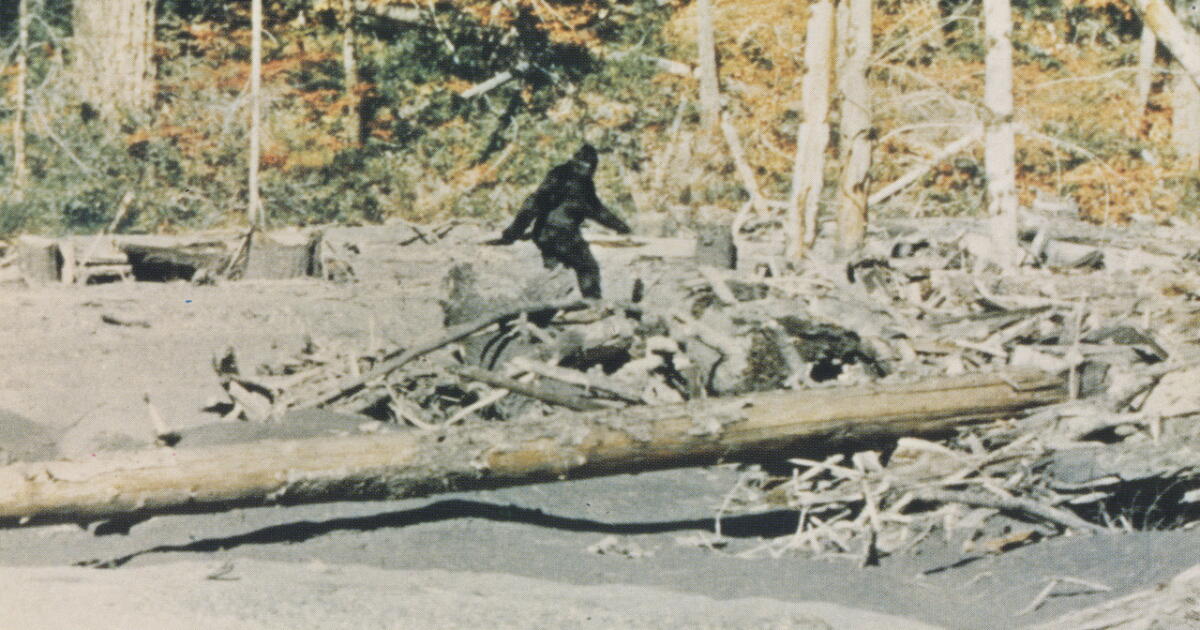

For years, Bigfoot devotees cited a 1967 film clip, shot by Roger Patterson with friend Bob Gimlin, showing the creature in the wilds of Northern California as proof positive of its existence. In the late 1990s, a man came forward and claimed he was the costumed creature and soon after that, another man named Greg Long wrote a book filled with facts debunking claims of the giant’s existence. Still, believers kept on believing.
But recently filmmaker Marq Evans (“Claydream”) was approached by a woman who worked at Olympic College, where he teaches, with film that had been sitting in her father’s safe for decades. The film turned out to be footage shot by Patterson in 1966 with a different-looking Bigfoot. The impossible-to-ignore implication was that it was a test run, but Patterson felt that costumed friend walked too much like a human so he recast the role.
Evans’ new documentary, “Capturing Bigfoot,” not only reveals this footage for the first time, but he also got Patterson’s son, Clint, and his widow, Patricia, to confirm on camera for the first time that the whole thing was a hoax. (Patterson, who was a rodeo cowboy, a talented artist and something of a con artist, died in 1972 from stomach cancer.)
Well Documented
With networks and streamers seeking to create compelling content, many have found the answer in true stories. But with the surge in documentaries, it can be hard to sift through what’s worth your time. Each month, we provide an inside look at a documentary and others you should add to your queue.
Even people who never believed Bigfoot was real will find the documentary, now available to rent on Prime Video, compelling for the colorful characters clashing for decades as they tried to protect or expose the secrets behind the hoax. This interview was edited for length and clarity.
When did you realize that the film would revolve as much around the people behind the hoax as it would be about proving the hoax?
Marq Evans: That’s how I’d want to tell a story, as a human interest piece, to have laughs and cries. It really changed when we got Clint and later his mother involved because they’d never done on-camera interviews.
Before that, I had a 25-minute rough cut telling a straightforward story, but an hour into talking to Clint, I saw how he was wearing his heart on his sleeve about what this did to him and I realized my cut was garbage and I would make him my main character.
Clint, why did you come clean on camera?
Clint Patterson: I was tired of people asking me if it’s real and saying, “I don’t know, I wasn’t there,” when I knew it was lying because at a certain point I knew it was a hoax. When I told my mom that I wanted to tell the truth, she initially disowned me. I paid a severe price for telling the truth. But now she realizes it was the right thing to do.
When my dad came home and told me he caught Bigfoot on film, he turned away from me. In hindsight, I realized he couldn’t look at me as he said it. I’ve had to carry all this until I told the stories for this movie. Wow. What a relief it has been. It has changed my life.
Has telling the truth changed how you think about your dad?
Patterson: No. He has always been my hero. He was a gifted guy. I just wish he used his gifts in a different way.
Will believers change their mind or just dismiss everything in the movie?
Patterson: People don’t like getting the rug pulled out from underneath them. A lot of people are saying, “We’re not even gonna watch,” and they’ll call me a liar. But they’ve never stepped one foot in my boots. They should just keep quiet because we know what really happened.
And some people are making money from saying Bigfoot is real. I think some know for a fact now that it’s not true, but they’re not going to admit it.
Evans: When you’re really dug in and have spent decades yelling at each other on the internet, then to change their mind now means admitting they were wrong all along. People don’t like to do that.
People who were 70-30 or 60-40 in believing might come away with a different opinion. You can’t force people to change their minds. It’s not really my intent. My intent is to make an honest and authentic film.
What was it like showing the footage to the true believers you interviewed?
Evans: It was intense but I didn’t feel bad about, as people have put it, killing Santa Claus. Getting to the truth of something outweighs anything else. And we’re also relieving Clint, his family and other people of this burden that they’ve carried.
‘Norm: The Tale of Norm Macdonald,’ ‘Paralyzed by Hope: The Maria Bamford Story,’ ‘Who Is Martin Mull?’ and ‘SCTV: The Greatest Show You’ve Never Heard Of’ (Netflix)
Judd Apatow and Maria Bamford in “Paralyzed by Hope: The Maria Bamford Story.”
(Netflix)
As the country hurtles toward a pivotal but divisive election, Netflix has done us all a favor by dropping four documentaries about really funny people this month. While they all feature plenty of laughs, three have more than just comedy on their mind; all four are worth watching, though.
Judd Apatow directed the Macdonald documentary, now streaming, and co-directed the one on Bamford, which premieres Friday. Each comedian has a very specific sense of humor with fans who love them or others who don’t get them. “Paralyzed by Hope” is born out of Bamford’s bipolar disorder and her OCD, and it explores her and her family’s mental health issues in depth. Bamford’s suffering is heartbreaking, her resilience is moving and her material about it all is a warped kind of genius. (A bit about her mother’s death in the second half of this clip is the perfect test case of whether you’ll love this special.)
Meanwhile, Macdonald was seen as an acerbic wit from his “Weekend Update” days, but he could also be intellectual and delighted in the absurd: His early tweets jumped from bits about pedophile ducks to thoughts on reading Tolstoy and his super silly late-night anecdotes are beloved. But Macdonald also spent the last nine years of his life battling leukemia while keeping it secret not just from his audience but his friends. His philosophy about living and dying give this documentary extra resonance.
“Who Is Martin Mull?” spends as much time on Mull’s career as a painter as it does on his comedy, which is how he would have wanted it. While his “Fernwood Tonight” segments with the incomparable Fred Willard are still really funny, it’s the paintings that stand out. Mull’s art is impressively varied and original and grows more powerful in the years after he sobered up and confronted some of the demons of his difficult childhood. The film, which is a bit long and repetitive, was completed by Neil Berkeley after the death of its original director, Bob Saget, in 2022. Mull’s death in 2024 makes the ending bittersweet.
“SCTV: The Greatest Show You’ve Never Heard Of,” premiering Oct. 30, is the most straightforward of this bunch and therefore the funniest. It recounts the story of Canada’s answer to “Saturday Night Live” in the 1970s and ‘80s. The cast, who did double duty as writers, was probably as talented as their “SNL” rivals and included John Candy, Eugene Levy, Catherine O’Hara, Andrea Martin, Harold Ramis, Joe Flaherty, Dave Thomas, Rick Moranis and Martin Short. The clips are wacky but most hold up well (although the Bob and Doug McKenzie material feels like a “you had to be there” thing). The alums who are still alive are all interviewed and gathered together to reminisce and watch old clips. (It’s especially moving to watch O’Hara with her friends since she died not long after filming.)
‘Super Scam Me’ (Hulu, Disney+)

Mariana van Zeller examines herself in the mirror as her fake persona Mary Zelle.
(National Geographic)
Journalist Mariana van Zeller found a way to expose romance scammers, who took more than $1 billion from vulnerable and gullible Americans last year, in an entertaining show from National Geographic. Van Zeller creates her own fake persona for social media and then catfishes a catfisher. And with the help of a former hacker turned cybersecurity expert, she tracks the man behind the mask to his home in West Africa and pays him a visit. Along the way, she reveals the various psychological and technological tactics these scammers use, hopefully arming potential victims with information to help them see through any ruses.
‘Africa: Earth’s Wild Home’ (Hulu, Disney+)
This National Geographic docuseries offers absolutely stunning visuals (partially undercut by overwritten narration), including footage of a sole hyena attacking thousands of flamingos and hippos getting their skin cleaned by fish, but it’s worth tuning in just to see adorably weird black rain frogs emerge from underground.
‘Free Leonard Peltier’ (Netflix)
While this film has serious flaws — it uses AI in ways that are unsettling and ineffectual and it’s too long and slow — it goes beyond Peltier’s individual story to tell the story of how modern Native Americans have been subjugated and oppressed and how they have continued fighting for their rights and freedoms.

For years, Bigfoot devotees cited a 1967 film clip, shot by Roger Patterson with friend Bob Gimlin, showing the creature in the wilds of Northern California as proof positive of its existence. In the late 1990s, a man came forward and claimed he was the costumed creature and soon after that, another man named Greg Long wrote a book filled with facts debunking claims of the giant’s existence. Still, believers kept on believing.
But recently filmmaker Marq Evans (“Claydream”) was approached by a woman who worked at Olympic College, where he teaches, with film that had been sitting in her father’s safe for decades. The film turned out to be footage shot by Patterson in 1966 with a different-looking Bigfoot. The impossible-to-ignore implication was that it was a test run, but Patterson felt that costumed friend walked too much like a human so he recast the role.
Evans’ new documentary, “Capturing Bigfoot,” not only reveals this footage for the first time, but he also got Patterson’s son, Clint, and his widow, Patricia, to confirm on camera for the first time that the whole thing was a hoax. (Patterson, who was a rodeo cowboy, a talented artist and something of a con artist, died in 1972 from stomach cancer.)
Well Documented
With networks and streamers seeking to create compelling content, many have found the answer in true stories. But with the surge in documentaries, it can be hard to sift through what’s worth your time. Each month, we provide an inside look at a documentary and others you should add to your queue.
Even people who never believed Bigfoot was real will find the documentary, now available to rent on Prime Video, compelling for the colorful characters clashing for decades as they tried to protect or expose the secrets behind the hoax. This interview was edited for length and clarity.
When did you realize that the film would revolve as much around the people behind the hoax as it would be about proving the hoax?
Marq Evans: That’s how I’d want to tell a story, as a human interest piece, to have laughs and cries. It really changed when we got Clint and later his mother involved because they’d never done on-camera interviews.
Before that, I had a 25-minute rough cut telling a straightforward story, but an hour into talking to Clint, I saw how he was wearing his heart on his sleeve about what this did to him and I realized my cut was garbage and I would make him my main character.
Clint, why did you come clean on camera?
Clint Patterson: I was tired of people asking me if it’s real and saying, “I don’t know, I wasn’t there,” when I knew it was lying because at a certain point I knew it was a hoax. When I told my mom that I wanted to tell the truth, she initially disowned me. I paid a severe price for telling the truth. But now she realizes it was the right thing to do.
When my dad came home and told me he caught Bigfoot on film, he turned away from me. In hindsight, I realized he couldn’t look at me as he said it. I’ve had to carry all this until I told the stories for this movie. Wow. What a relief it has been. It has changed my life.
Has telling the truth changed how you think about your dad?
Patterson: No. He has always been my hero. He was a gifted guy. I just wish he used his gifts in a different way.
Will believers change their mind or just dismiss everything in the movie?
Patterson: People don’t like getting the rug pulled out from underneath them. A lot of people are saying, “We’re not even gonna watch,” and they’ll call me a liar. But they’ve never stepped one foot in my boots. They should just keep quiet because we know what really happened.
And some people are making money from saying Bigfoot is real. I think some know for a fact now that it’s not true, but they’re not going to admit it.
Evans: When you’re really dug in and have spent decades yelling at each other on the internet, then to change their mind now means admitting they were wrong all along. People don’t like to do that.
People who were 70-30 or 60-40 in believing might come away with a different opinion. You can’t force people to change their minds. It’s not really my intent. My intent is to make an honest and authentic film.
What was it like showing the footage to the true believers you interviewed?
Evans: It was intense but I didn’t feel bad about, as people have put it, killing Santa Claus. Getting to the truth of something outweighs anything else. And we’re also relieving Clint, his family and other people of this burden that they’ve carried.
‘Norm: The Tale of Norm Macdonald,’ ‘Paralyzed by Hope: The Maria Bamford Story,’ ‘Who Is Martin Mull?’ and ‘SCTV: The Greatest Show You’ve Never Heard Of’ (Netflix)
Judd Apatow and Maria Bamford in “Paralyzed by Hope: The Maria Bamford Story.”
(Netflix)
As the country hurtles toward a pivotal but divisive election, Netflix has done us all a favor by dropping four documentaries about really funny people this month. While they all feature plenty of laughs, three have more than just comedy on their mind; all four are worth watching, though.
Judd Apatow directed the Macdonald documentary, now streaming, and co-directed the one on Bamford, which premieres Friday. Each comedian has a very specific sense of humor with fans who love them or others who don’t get them. “Paralyzed by Hope” is born out of Bamford’s bipolar disorder and her OCD, and it explores her and her family’s mental health issues in depth. Bamford’s suffering is heartbreaking, her resilience is moving and her material about it all is a warped kind of genius. (A bit about her mother’s death in the second half of this clip is the perfect test case of whether you’ll love this special.)
Meanwhile, Macdonald was seen as an acerbic wit from his “Weekend Update” days, but he could also be intellectual and delighted in the absurd: His early tweets jumped from bits about pedophile ducks to thoughts on reading Tolstoy and his super silly late-night anecdotes are beloved. But Macdonald also spent the last nine years of his life battling leukemia while keeping it secret not just from his audience but his friends. His philosophy about living and dying give this documentary extra resonance.
“Who Is Martin Mull?” spends as much time on Mull’s career as a painter as it does on his comedy, which is how he would have wanted it. While his “Fernwood Tonight” segments with the incomparable Fred Willard are still really funny, it’s the paintings that stand out. Mull’s art is impressively varied and original and grows more powerful in the years after he sobered up and confronted some of the demons of his difficult childhood. The film, which is a bit long and repetitive, was completed by Neil Berkeley after the death of its original director, Bob Saget, in 2022. Mull’s death in 2024 makes the ending bittersweet.
“SCTV: The Greatest Show You’ve Never Heard Of,” premiering Oct. 30, is the most straightforward of this bunch and therefore the funniest. It recounts the story of Canada’s answer to “Saturday Night Live” in the 1970s and ‘80s. The cast, who did double duty as writers, was probably as talented as their “SNL” rivals and included John Candy, Eugene Levy, Catherine O’Hara, Andrea Martin, Harold Ramis, Joe Flaherty, Dave Thomas, Rick Moranis and Martin Short. The clips are wacky but most hold up well (although the Bob and Doug McKenzie material feels like a “you had to be there” thing). The alums who are still alive are all interviewed and gathered together to reminisce and watch old clips. (It’s especially moving to watch O’Hara with her friends since she died not long after filming.)
‘Super Scam Me’ (Hulu, Disney+)
Mariana van Zeller examines herself in the mirror as her fake persona Mary Zelle.
(National Geographic)
Journalist Mariana van Zeller found a way to expose romance scammers, who took more than $1 billion from vulnerable and gullible Americans last year, in an entertaining show from National Geographic. Van Zeller creates her own fake persona for social media and then catfishes a catfisher. And with the help of a former hacker turned cybersecurity expert, she tracks the man behind the mask to his home in West Africa and pays him a visit. Along the way, she reveals the various psychological and technological tactics these scammers use, hopefully arming potential victims with information to help them see through any ruses.
‘Africa: Earth’s Wild Home’ (Hulu, Disney+)
This National Geographic docuseries offers absolutely stunning visuals (partially undercut by overwritten narration), including footage of a sole hyena attacking thousands of flamingos and hippos getting their skin cleaned by fish, but it’s worth tuning in just to see adorably weird black rain frogs emerge from underground.
‘Free Leonard Peltier’ (Netflix)
While this film has serious flaws — it uses AI in ways that are unsettling and ineffectual and it’s too long and slow — it goes beyond Peltier’s individual story to tell the story of how modern Native Americans have been subjugated and oppressed and how they have continued fighting for their rights and freedoms.


