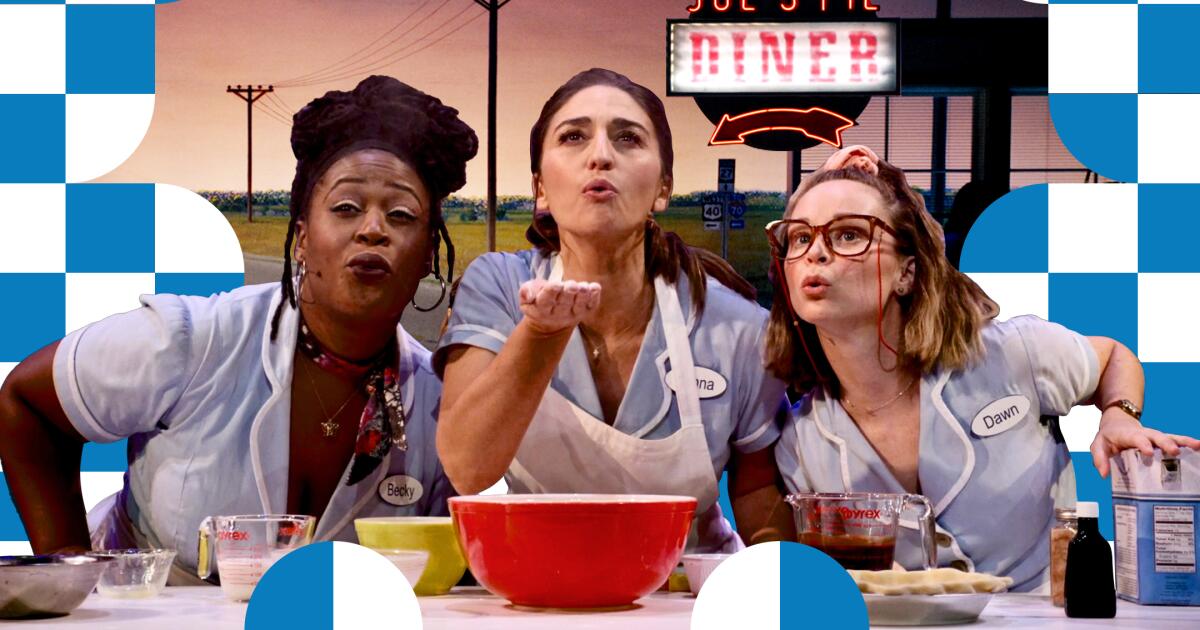

Compared to the splashier spectacles that play Broadway and beyond, “Waitress” is relatively simple. It isn’t set in a notable time or place. It doesn’t zoom in on a famous figure. It forgoes ornate costumes, elaborate sets and ensemble-wide dance numbers. And though the stage show is, like many productions these days, based on a movie, it’s not one with the massive fan base of “Harry Potter” or the pedigree of “The Color Purple”: It adapts a 2007 indie film about a server who dreams of opening a pie shop but finds herself unexpectedly pregnant.
In commercial theater terms, it’s not exactly a recipe for success.
And yet “Waitress” recouped its initial investment — a milestone reached by only 20% of all Broadway productions — in less than 10 months. It went on to play over 1,500 performances, earn four Tony Award nominations and launch multiple national tours. And a filmed performance of the stage show, starring its composer-lyricist Sara Bareilles, is coming to the big screen as a five-day theatrical event beginning Dec. 7.
So how did this pie-in-the-sky musical — with its delicate pop melodies, taboo topics and quirky physical humor — become such an unlikely success? Its extraordinary run arguably can be attributed to its ordinariness: In making its characters’ commonplace concerns the stuff of an upbeat, crowd-pleasing musical, “Waitress” connected with, and ultimately won over, what might be Broadway’s most underappreciated audience: women.
After all, Jenna (Bareilles) and her co-workers Becky and Dawn are working people with modest dreams, mundane hobbies and humble paychecks; they aren’t reaching for “happily ever after” so much as they’re grasping for what one character calls “happy enough.”
“Take a breath when you need to be reminded that, with days like these, we can only do the best we can,” they sing during another busy morning at the diner. “’Til we do it again.”
Sara Bareilles in “Waitress: The Musical.”
(Bleecker Street)
After their shifts, these friendly but flawed women come home to very real issues — horrible husbands, caretaker duties, palpable regret about the seemingly little decisions that add up to a life. The show’s emotional climax is the heartbreaking ballad “She Used to Be Mine,” in which Jenna “is talking about the person she used to be and how far away she feels from her, panicked that there is no way to get her back,” as Bareilles wrote in her memoir “Sounds Like Me.”
With a book by Jessie Nelson adapted from Adrienne Shelly‘s film script, “Waitress” has a humanizing matter-of-factness about tropes that other theatrical stories about women often idealize. In the world of “Waitress,” much like our own, not every romantic relationship is an epic love story, and not every pregnancy feels like a miracle. And that’s OK. “Not everyone wants to be a mother, Dawn,” Jenna tells her co-worker. “That doesn’t make me a bad person.”
She later tells her gynecologist, “I’m keeping it, not that I judge that” — a line that gets a bit of applause in the filmed version. “I’m just telling you I’m not so happy about it like everybody else would be, so maybe you can be sensitive and not congratulate me and make a big deal every time you see me. I’m having the baby and that’s that. It’s not a party, though.” (Instead, Lorin Latarro’s choreography features a subtle but beautiful interlude celebrating childbirth, as well as whimsical dream sequences that accompany Jenna’s piemaking — an act by which she honors her mother, who taught her how to bake.)

Drew Gehling and Sara Bareilles in “Waitress: The Musical.”
(Bleecker Street)
A contemporary-set musical led by ordinary female characters — and one that treats their arcs as the main course, not a side dish — remains a rarity in musical theater, even though more than 60% of Broadway audiences are female, according to demographic studies conducted by the Broadway League for more than 20 seasons.
Women also hold the purchasing power when it comes to live theater. In the most recent Broadway League study, which examined the 2018-19 season, 54% of female respondents said they made the ticket-buying decision, as opposed to 43% percent of male respondents. (And 63% of “Waitress” ticket purchasers were female, slightly higher than the 58% average for Broadway musicals, according to data shared with The Times by the Broadway production.)
In other words, “Waitress” — the first Broadway musical led by an all-female creative team — offers the industry’s core fan base an unusual opportunity to see themselves reflected onstage: normal women who work hard, make mistakes and deal with whatever they’ve been served in life, all in the here and now, not some faraway decade or fantasy realm. And the show’s success is proof that women are hungry for this representation, having been denied it so long.

A scene from “Waitress: The Musical.”
(Bleecker Street)
Despite its resounding success, the shows that follow in “Waitress’” footsteps have been few and far between — suggesting that Broadway will not learn its lessons easily. But theatermakers seeking to tap into the same audience should remember that a musical’s message needn’t be explicitly “feminist” to be effectively empowering, that a protagonist needn’t be well-known to be compelling, that female characters needn’t be witches or princesses or murderers to find an audience.
They can just be women. Because, like those buying tickets to watch them in such impressive numbers, their stories are well worth telling too.
‘Waitress: The Musical’
Rating: Not rated
Running time: 2 hours, 35 minutes
Playing: In theaters Dec. 7 through Dec. 11

Compared to the splashier spectacles that play Broadway and beyond, “Waitress” is relatively simple. It isn’t set in a notable time or place. It doesn’t zoom in on a famous figure. It forgoes ornate costumes, elaborate sets and ensemble-wide dance numbers. And though the stage show is, like many productions these days, based on a movie, it’s not one with the massive fan base of “Harry Potter” or the pedigree of “The Color Purple”: It adapts a 2007 indie film about a server who dreams of opening a pie shop but finds herself unexpectedly pregnant.
In commercial theater terms, it’s not exactly a recipe for success.
And yet “Waitress” recouped its initial investment — a milestone reached by only 20% of all Broadway productions — in less than 10 months. It went on to play over 1,500 performances, earn four Tony Award nominations and launch multiple national tours. And a filmed performance of the stage show, starring its composer-lyricist Sara Bareilles, is coming to the big screen as a five-day theatrical event beginning Dec. 7.
So how did this pie-in-the-sky musical — with its delicate pop melodies, taboo topics and quirky physical humor — become such an unlikely success? Its extraordinary run arguably can be attributed to its ordinariness: In making its characters’ commonplace concerns the stuff of an upbeat, crowd-pleasing musical, “Waitress” connected with, and ultimately won over, what might be Broadway’s most underappreciated audience: women.
After all, Jenna (Bareilles) and her co-workers Becky and Dawn are working people with modest dreams, mundane hobbies and humble paychecks; they aren’t reaching for “happily ever after” so much as they’re grasping for what one character calls “happy enough.”
“Take a breath when you need to be reminded that, with days like these, we can only do the best we can,” they sing during another busy morning at the diner. “’Til we do it again.”
Sara Bareilles in “Waitress: The Musical.”
(Bleecker Street)
After their shifts, these friendly but flawed women come home to very real issues — horrible husbands, caretaker duties, palpable regret about the seemingly little decisions that add up to a life. The show’s emotional climax is the heartbreaking ballad “She Used to Be Mine,” in which Jenna “is talking about the person she used to be and how far away she feels from her, panicked that there is no way to get her back,” as Bareilles wrote in her memoir “Sounds Like Me.”
With a book by Jessie Nelson adapted from Adrienne Shelly‘s film script, “Waitress” has a humanizing matter-of-factness about tropes that other theatrical stories about women often idealize. In the world of “Waitress,” much like our own, not every romantic relationship is an epic love story, and not every pregnancy feels like a miracle. And that’s OK. “Not everyone wants to be a mother, Dawn,” Jenna tells her co-worker. “That doesn’t make me a bad person.”
She later tells her gynecologist, “I’m keeping it, not that I judge that” — a line that gets a bit of applause in the filmed version. “I’m just telling you I’m not so happy about it like everybody else would be, so maybe you can be sensitive and not congratulate me and make a big deal every time you see me. I’m having the baby and that’s that. It’s not a party, though.” (Instead, Lorin Latarro’s choreography features a subtle but beautiful interlude celebrating childbirth, as well as whimsical dream sequences that accompany Jenna’s piemaking — an act by which she honors her mother, who taught her how to bake.)
Drew Gehling and Sara Bareilles in “Waitress: The Musical.”
(Bleecker Street)
A contemporary-set musical led by ordinary female characters — and one that treats their arcs as the main course, not a side dish — remains a rarity in musical theater, even though more than 60% of Broadway audiences are female, according to demographic studies conducted by the Broadway League for more than 20 seasons.
Women also hold the purchasing power when it comes to live theater. In the most recent Broadway League study, which examined the 2018-19 season, 54% of female respondents said they made the ticket-buying decision, as opposed to 43% percent of male respondents. (And 63% of “Waitress” ticket purchasers were female, slightly higher than the 58% average for Broadway musicals, according to data shared with The Times by the Broadway production.)
In other words, “Waitress” — the first Broadway musical led by an all-female creative team — offers the industry’s core fan base an unusual opportunity to see themselves reflected onstage: normal women who work hard, make mistakes and deal with whatever they’ve been served in life, all in the here and now, not some faraway decade or fantasy realm. And the show’s success is proof that women are hungry for this representation, having been denied it so long.
A scene from “Waitress: The Musical.”
(Bleecker Street)
Despite its resounding success, the shows that follow in “Waitress’” footsteps have been few and far between — suggesting that Broadway will not learn its lessons easily. But theatermakers seeking to tap into the same audience should remember that a musical’s message needn’t be explicitly “feminist” to be effectively empowering, that a protagonist needn’t be well-known to be compelling, that female characters needn’t be witches or princesses or murderers to find an audience.
They can just be women. Because, like those buying tickets to watch them in such impressive numbers, their stories are well worth telling too.
‘Waitress: The Musical’
Rating: Not rated
Running time: 2 hours, 35 minutes
Playing: In theaters Dec. 7 through Dec. 11

Compared to the splashier spectacles that play Broadway and beyond, “Waitress” is relatively simple. It isn’t set in a notable time or place. It doesn’t zoom in on a famous figure. It forgoes ornate costumes, elaborate sets and ensemble-wide dance numbers. And though the stage show is, like many productions these days, based on a movie, it’s not one with the massive fan base of “Harry Potter” or the pedigree of “The Color Purple”: It adapts a 2007 indie film about a server who dreams of opening a pie shop but finds herself unexpectedly pregnant.
In commercial theater terms, it’s not exactly a recipe for success.
And yet “Waitress” recouped its initial investment — a milestone reached by only 20% of all Broadway productions — in less than 10 months. It went on to play over 1,500 performances, earn four Tony Award nominations and launch multiple national tours. And a filmed performance of the stage show, starring its composer-lyricist Sara Bareilles, is coming to the big screen as a five-day theatrical event beginning Dec. 7.
So how did this pie-in-the-sky musical — with its delicate pop melodies, taboo topics and quirky physical humor — become such an unlikely success? Its extraordinary run arguably can be attributed to its ordinariness: In making its characters’ commonplace concerns the stuff of an upbeat, crowd-pleasing musical, “Waitress” connected with, and ultimately won over, what might be Broadway’s most underappreciated audience: women.
After all, Jenna (Bareilles) and her co-workers Becky and Dawn are working people with modest dreams, mundane hobbies and humble paychecks; they aren’t reaching for “happily ever after” so much as they’re grasping for what one character calls “happy enough.”
“Take a breath when you need to be reminded that, with days like these, we can only do the best we can,” they sing during another busy morning at the diner. “’Til we do it again.”
Sara Bareilles in “Waitress: The Musical.”
(Bleecker Street)
After their shifts, these friendly but flawed women come home to very real issues — horrible husbands, caretaker duties, palpable regret about the seemingly little decisions that add up to a life. The show’s emotional climax is the heartbreaking ballad “She Used to Be Mine,” in which Jenna “is talking about the person she used to be and how far away she feels from her, panicked that there is no way to get her back,” as Bareilles wrote in her memoir “Sounds Like Me.”
With a book by Jessie Nelson adapted from Adrienne Shelly‘s film script, “Waitress” has a humanizing matter-of-factness about tropes that other theatrical stories about women often idealize. In the world of “Waitress,” much like our own, not every romantic relationship is an epic love story, and not every pregnancy feels like a miracle. And that’s OK. “Not everyone wants to be a mother, Dawn,” Jenna tells her co-worker. “That doesn’t make me a bad person.”
She later tells her gynecologist, “I’m keeping it, not that I judge that” — a line that gets a bit of applause in the filmed version. “I’m just telling you I’m not so happy about it like everybody else would be, so maybe you can be sensitive and not congratulate me and make a big deal every time you see me. I’m having the baby and that’s that. It’s not a party, though.” (Instead, Lorin Latarro’s choreography features a subtle but beautiful interlude celebrating childbirth, as well as whimsical dream sequences that accompany Jenna’s piemaking — an act by which she honors her mother, who taught her how to bake.)
Drew Gehling and Sara Bareilles in “Waitress: The Musical.”
(Bleecker Street)
A contemporary-set musical led by ordinary female characters — and one that treats their arcs as the main course, not a side dish — remains a rarity in musical theater, even though more than 60% of Broadway audiences are female, according to demographic studies conducted by the Broadway League for more than 20 seasons.
Women also hold the purchasing power when it comes to live theater. In the most recent Broadway League study, which examined the 2018-19 season, 54% of female respondents said they made the ticket-buying decision, as opposed to 43% percent of male respondents. (And 63% of “Waitress” ticket purchasers were female, slightly higher than the 58% average for Broadway musicals, according to data shared with The Times by the Broadway production.)
In other words, “Waitress” — the first Broadway musical led by an all-female creative team — offers the industry’s core fan base an unusual opportunity to see themselves reflected onstage: normal women who work hard, make mistakes and deal with whatever they’ve been served in life, all in the here and now, not some faraway decade or fantasy realm. And the show’s success is proof that women are hungry for this representation, having been denied it so long.
A scene from “Waitress: The Musical.”
(Bleecker Street)
Despite its resounding success, the shows that follow in “Waitress’” footsteps have been few and far between — suggesting that Broadway will not learn its lessons easily. But theatermakers seeking to tap into the same audience should remember that a musical’s message needn’t be explicitly “feminist” to be effectively empowering, that a protagonist needn’t be well-known to be compelling, that female characters needn’t be witches or princesses or murderers to find an audience.
They can just be women. Because, like those buying tickets to watch them in such impressive numbers, their stories are well worth telling too.
‘Waitress: The Musical’
Rating: Not rated
Running time: 2 hours, 35 minutes
Playing: In theaters Dec. 7 through Dec. 11
Compared to the splashier spectacles that play Broadway and beyond, “Waitress” is relatively simple. It isn’t set in a notable time or place. It doesn’t zoom in on a famous figure. It forgoes ornate costumes, elaborate sets and ensemble-wide dance numbers. And though the stage show is, like many productions these days, based on a movie, it’s not one with the massive fan base of “Harry Potter” or the pedigree of “The Color Purple”: It adapts a 2007 indie film about a server who dreams of opening a pie shop but finds herself unexpectedly pregnant.
In commercial theater terms, it’s not exactly a recipe for success.
And yet “Waitress” recouped its initial investment — a milestone reached by only 20% of all Broadway productions — in less than 10 months. It went on to play over 1,500 performances, earn four Tony Award nominations and launch multiple national tours. And a filmed performance of the stage show, starring its composer-lyricist Sara Bareilles, is coming to the big screen as a five-day theatrical event beginning Dec. 7.
So how did this pie-in-the-sky musical — with its delicate pop melodies, taboo topics and quirky physical humor — become such an unlikely success? Its extraordinary run arguably can be attributed to its ordinariness: In making its characters’ commonplace concerns the stuff of an upbeat, crowd-pleasing musical, “Waitress” connected with, and ultimately won over, what might be Broadway’s most underappreciated audience: women.
After all, Jenna (Bareilles) and her co-workers Becky and Dawn are working people with modest dreams, mundane hobbies and humble paychecks; they aren’t reaching for “happily ever after” so much as they’re grasping for what one character calls “happy enough.”
“Take a breath when you need to be reminded that, with days like these, we can only do the best we can,” they sing during another busy morning at the diner. “’Til we do it again.”
Sara Bareilles in “Waitress: The Musical.”
(Bleecker Street)
After their shifts, these friendly but flawed women come home to very real issues — horrible husbands, caretaker duties, palpable regret about the seemingly little decisions that add up to a life. The show’s emotional climax is the heartbreaking ballad “She Used to Be Mine,” in which Jenna “is talking about the person she used to be and how far away she feels from her, panicked that there is no way to get her back,” as Bareilles wrote in her memoir “Sounds Like Me.”
With a book by Jessie Nelson adapted from Adrienne Shelly‘s film script, “Waitress” has a humanizing matter-of-factness about tropes that other theatrical stories about women often idealize. In the world of “Waitress,” much like our own, not every romantic relationship is an epic love story, and not every pregnancy feels like a miracle. And that’s OK. “Not everyone wants to be a mother, Dawn,” Jenna tells her co-worker. “That doesn’t make me a bad person.”
She later tells her gynecologist, “I’m keeping it, not that I judge that” — a line that gets a bit of applause in the filmed version. “I’m just telling you I’m not so happy about it like everybody else would be, so maybe you can be sensitive and not congratulate me and make a big deal every time you see me. I’m having the baby and that’s that. It’s not a party, though.” (Instead, Lorin Latarro’s choreography features a subtle but beautiful interlude celebrating childbirth, as well as whimsical dream sequences that accompany Jenna’s piemaking — an act by which she honors her mother, who taught her how to bake.)
Drew Gehling and Sara Bareilles in “Waitress: The Musical.”
(Bleecker Street)
A contemporary-set musical led by ordinary female characters — and one that treats their arcs as the main course, not a side dish — remains a rarity in musical theater, even though more than 60% of Broadway audiences are female, according to demographic studies conducted by the Broadway League for more than 20 seasons.
Women also hold the purchasing power when it comes to live theater. In the most recent Broadway League study, which examined the 2018-19 season, 54% of female respondents said they made the ticket-buying decision, as opposed to 43% percent of male respondents. (And 63% of “Waitress” ticket purchasers were female, slightly higher than the 58% average for Broadway musicals, according to data shared with The Times by the Broadway production.)
In other words, “Waitress” — the first Broadway musical led by an all-female creative team — offers the industry’s core fan base an unusual opportunity to see themselves reflected onstage: normal women who work hard, make mistakes and deal with whatever they’ve been served in life, all in the here and now, not some faraway decade or fantasy realm. And the show’s success is proof that women are hungry for this representation, having been denied it so long.
A scene from “Waitress: The Musical.”
(Bleecker Street)
Despite its resounding success, the shows that follow in “Waitress’” footsteps have been few and far between — suggesting that Broadway will not learn its lessons easily. But theatermakers seeking to tap into the same audience should remember that a musical’s message needn’t be explicitly “feminist” to be effectively empowering, that a protagonist needn’t be well-known to be compelling, that female characters needn’t be witches or princesses or murderers to find an audience.
They can just be women. Because, like those buying tickets to watch them in such impressive numbers, their stories are well worth telling too.
‘Waitress: The Musical’
Rating: Not rated
Running time: 2 hours, 35 minutes
Playing: In theaters Dec. 7 through Dec. 11