
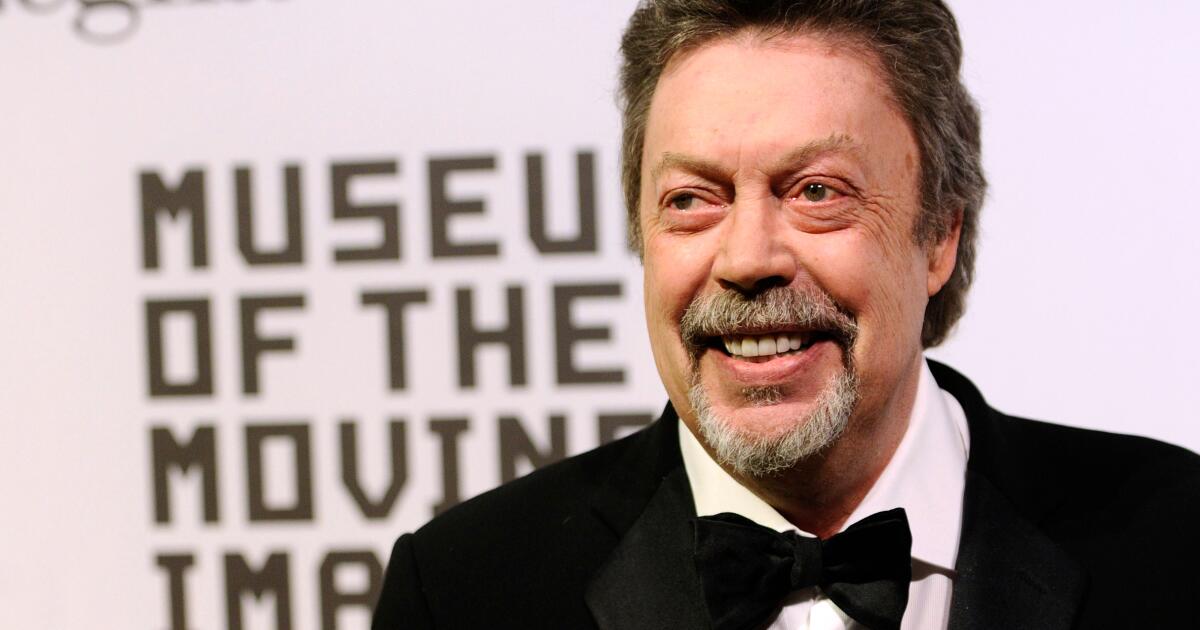

The death of Tim Curry, at 80, has inspired many to praise his performance as Pennywise in the 1990 ABC miniseries “It” — second, after “The Rocky Horror Picture Show” — though that is not at all the thing I’d want to attach to his memory. About “Rocky Horror” it’s impossible to say enough good things, as entertainment and long-echoing cultural force, but to my mind the world is better remembering him as the sweet transvestite from Transexual, Transylvania, rather than a child-murdering clown who lives in a sewer.
Of course, there was much more to him than these polar roles. Curry was a stage actor first, creating the part of Dr. Frank-N-Furter in “The Rocky Horror Show” (pre-“Picture”), and playing dadaist Tristan Tzara in Tom Stoppard’s “Travesties,” Mozart in “Amadeus” and King Arthur in “Spamalot” in their original Broadway productions. (I can only imagine his Puck in the Scottish Opera’s 1972 production of “A Midsummer Night’s Dream,” and perhaps you’d like to too.) He made a lot of movies and, though you might not have noticed, a good deal of television.
As has been the case with many U.K. actors looking for work on American TV — especially in the years before they all mastered American accents and became indistinguishable from the homegrown brand — Curry looked to comedy. His appearances here accentuate his Britishness (read: propriety), giving him multisyllabic words (e.g., “nomenclature”) and fancy locutions to play with. Some play off a character’s propriety, all profit from the actor’s charm — which might be turned to evil ends but remain, for the viewer, you know, charming. There is no way around those bright eyes, that Cheshire grin.
Here’s a brief compendium of some of those appearances, forgotten or well-remembered, in series short- or long-lived. I can recommend them all.
‘Saturday Night Live’ (1981)
Around the time he was appearing in “Amadeus” on Broadway, Curry hosted the Dec. 5, 1981, episode. In the opening monologue, he’s joined by Eddie Murphy, in janitorial coveralls, sweeping up the stage. Asked why, he answers, “Well, Mr. Curry, there‘s not much for an old Black buck like me to do on this show sometimes; they tell me you can’t do no political sketches ‘cause there ain’t no Black politicians; and I can’t do no man-woman sketches, Lord knows … and I can’t do no sketches with no family ‘cause everybody knows I ain’t nobody’s family on this show.” “Believe it or not,” Curry offers, visibly delighted by his scene partner, “I have problems with typecasting myself. … After I did ‘Rocky Horror,’ which is one part in drag, you know what I was offered? The Brooke Shields part in ‘Blue Lagoon.’” Sketches include Curry’s imitation of Mick Jagger, who, after a bit of “Sympathy for the Devil,” tries to persuade the audience that, “I’m just an ordinary guy like you … I like puppies and plum pudding … or just walking down the street in Anytown, USA,” and “The Zucchini Song,” a phallic double-entendre British music hall number, performed with cane, bowler hat and Cockney accent. (“Ooohhh what a beauty! I’ve never seen one as big as that before!”) It culminates in an audience sing-along.
‘Family Affair’ (2002)
A top-billed Curry takes the Sebastian Cabot role in this quite good straightforward reboot of the 1966 sitcom, produced by Sid and Marty Krofft, of all people. (There are no puppets or dragon costumes.) As Mr. French, the butler to a New York City swinging bachelor (Gary Cole in for Brian Keith as Uncle Bill) who finds himself saddled with orphaned nieces and a nephew — well, you know how that’ll go. A man who stands firmly on ceremony (Bill: “I can open the door myself.” French: “But of course you can, sir, but really how would it look?”), he finds that ground shifting uneasily beneath his feet. He refers to little Sissy’s imaginary friend cum doll Mrs. Beasley as “an imaginary ethos [constructed] with the specific intent of avoiding reality,” and provides a classroom of small fry a lunch of duck confit with cucumber flowers, individual spinach quiches “and my personal favorite, Scottish smoked salmon on whole wheat toast points.” He will attempt to civilize them, and they will soften him. The series aired only 13 of 15 episodes, which was quite enough for me to recall it immediately when I learned of Curry’s death.
‘Roseanne’ (1993): ‘Promises, Promises’ and ’Glengarry, Glen Rosy’
As a friend of a friend of the Connors, Curry flirts with Roseanne and Sandra Bernhard’s Nancy Bartlett, before involving the Conners in a house-flipping scheme and (spoilers) disappearing with their money. The second of these episodes includes the bonus cameo of Chris Farley, trying on a leather jacket several sizes too small for him.
‘The Naked Truth’ (1995): ’Sewer Gators, Swordplay, Santa From Hell’ and ‘Sisters in Sex Triangle With Gazillionaire’

Curry recurs in Téa Leoni’s excellent sitcom as Sir Rudolph Halley, the imperious, amoral owner of the tabloid paper where Nora, Leoni’s character, works as a photographer. He first appears dressed as Santa Claus, who has come to deliver a hand towel or a pink slip to his employees, depending on whether he deems them naughty or nice. He leaves the room commanding the staff to “Make. Me. Money” and summons the elevator by barking “Open!” In the former episode, he and Leoni (and their stunt doubles) fence for possession of Chelsea Clinton’s diary, which Leoni wants returned and Haley wants published.
‘Rude Awakening’ (1999)
Curry recurs in the second and third season of this Sherilyn Fenn-led comedy melodrama as Martin Crisp, a lawyer who proudly proclaims (in the only clip I was able to find) that he got charges against a serial killer “reduced from triple homicide to trespassing,” and describes another case as a “classic example of the destitute exploiting the idle rich — these cases are the reason I bought my way into Harvard Law.”
‘Bette’ (2000): ‘… Or Not to Be’
In this episode of Bette Midler‘s single-season series, straight out of “I Love Lucy,” Curry plays himself, coming to Los Angeles to perform “Hamlet” (at “the Ahmanson”), a production so nebulous that Midler, who is concerned that no one takes her seriously, manages to talk herself into the role of Gertrude. (We get a little bit of the arras scene.) As a guest, he’s largely, even unavoidably, a straight man for Midler (“Have you ever done Shakespeare?” “No, but I once let Harold Pinter feel me up. I jest”). But this just seems polite.
‘Will & Grace’ (2004): ‘I Do’ and ‘Oh, No, You Di-in’t’

In this two-part episode that concludes the series’ sixth season, Curry plays Marion, the strange brother of John Cleese’s Lyle Finster, about to marry Megan Mullally’s Karen Walker. “Welcome to the family, I’ve always wanted a sister,” he tells her, before bending her back in a long kiss, before similarly planting one on Cleese. Later, wedding performed, as they dance the “Chicken Dance” with one another, Marion sighs, “Oh, Lyle, it’s too bad our father isn’t alive to see this.” Lyle: “He isn’t?” “Oh damn, I knew there was something I was supposed to tell you.”

The death of Tim Curry, at 80, has inspired many to praise his performance as Pennywise in the 1990 ABC miniseries “It” — second, after “The Rocky Horror Picture Show” — though that is not at all the thing I’d want to attach to his memory. About “Rocky Horror” it’s impossible to say enough good things, as entertainment and long-echoing cultural force, but to my mind the world is better remembering him as the sweet transvestite from Transexual, Transylvania, rather than a child-murdering clown who lives in a sewer.
Of course, there was much more to him than these polar roles. Curry was a stage actor first, creating the part of Dr. Frank-N-Furter in “The Rocky Horror Show” (pre-“Picture”), and playing dadaist Tristan Tzara in Tom Stoppard’s “Travesties,” Mozart in “Amadeus” and King Arthur in “Spamalot” in their original Broadway productions. (I can only imagine his Puck in the Scottish Opera’s 1972 production of “A Midsummer Night’s Dream,” and perhaps you’d like to too.) He made a lot of movies and, though you might not have noticed, a good deal of television.
As has been the case with many U.K. actors looking for work on American TV — especially in the years before they all mastered American accents and became indistinguishable from the homegrown brand — Curry looked to comedy. His appearances here accentuate his Britishness (read: propriety), giving him multisyllabic words (e.g., “nomenclature”) and fancy locutions to play with. Some play off a character’s propriety, all profit from the actor’s charm — which might be turned to evil ends but remain, for the viewer, you know, charming. There is no way around those bright eyes, that Cheshire grin.
Here’s a brief compendium of some of those appearances, forgotten or well-remembered, in series short- or long-lived. I can recommend them all.
‘Saturday Night Live’ (1981)
Around the time he was appearing in “Amadeus” on Broadway, Curry hosted the Dec. 5, 1981, episode. In the opening monologue, he’s joined by Eddie Murphy, in janitorial coveralls, sweeping up the stage. Asked why, he answers, “Well, Mr. Curry, there‘s not much for an old Black buck like me to do on this show sometimes; they tell me you can’t do no political sketches ‘cause there ain’t no Black politicians; and I can’t do no man-woman sketches, Lord knows … and I can’t do no sketches with no family ‘cause everybody knows I ain’t nobody’s family on this show.” “Believe it or not,” Curry offers, visibly delighted by his scene partner, “I have problems with typecasting myself. … After I did ‘Rocky Horror,’ which is one part in drag, you know what I was offered? The Brooke Shields part in ‘Blue Lagoon.’” Sketches include Curry’s imitation of Mick Jagger, who, after a bit of “Sympathy for the Devil,” tries to persuade the audience that, “I’m just an ordinary guy like you … I like puppies and plum pudding … or just walking down the street in Anytown, USA,” and “The Zucchini Song,” a phallic double-entendre British music hall number, performed with cane, bowler hat and Cockney accent. (“Ooohhh what a beauty! I’ve never seen one as big as that before!”) It culminates in an audience sing-along.
‘Family Affair’ (2002)
A top-billed Curry takes the Sebastian Cabot role in this quite good straightforward reboot of the 1966 sitcom, produced by Sid and Marty Krofft, of all people. (There are no puppets or dragon costumes.) As Mr. French, the butler to a New York City swinging bachelor (Gary Cole in for Brian Keith as Uncle Bill) who finds himself saddled with orphaned nieces and a nephew — well, you know how that’ll go. A man who stands firmly on ceremony (Bill: “I can open the door myself.” French: “But of course you can, sir, but really how would it look?”), he finds that ground shifting uneasily beneath his feet. He refers to little Sissy’s imaginary friend cum doll Mrs. Beasley as “an imaginary ethos [constructed] with the specific intent of avoiding reality,” and provides a classroom of small fry a lunch of duck confit with cucumber flowers, individual spinach quiches “and my personal favorite, Scottish smoked salmon on whole wheat toast points.” He will attempt to civilize them, and they will soften him. The series aired only 13 of 15 episodes, which was quite enough for me to recall it immediately when I learned of Curry’s death.
‘Roseanne’ (1993): ‘Promises, Promises’ and ’Glengarry, Glen Rosy’
As a friend of a friend of the Connors, Curry flirts with Roseanne and Sandra Bernhard’s Nancy Bartlett, before involving the Conners in a house-flipping scheme and (spoilers) disappearing with their money. The second of these episodes includes the bonus cameo of Chris Farley, trying on a leather jacket several sizes too small for him.
‘The Naked Truth’ (1995): ’Sewer Gators, Swordplay, Santa From Hell’ and ‘Sisters in Sex Triangle With Gazillionaire’
Curry recurs in Téa Leoni’s excellent sitcom as Sir Rudolph Halley, the imperious, amoral owner of the tabloid paper where Nora, Leoni’s character, works as a photographer. He first appears dressed as Santa Claus, who has come to deliver a hand towel or a pink slip to his employees, depending on whether he deems them naughty or nice. He leaves the room commanding the staff to “Make. Me. Money” and summons the elevator by barking “Open!” In the former episode, he and Leoni (and their stunt doubles) fence for possession of Chelsea Clinton’s diary, which Leoni wants returned and Haley wants published.
‘Rude Awakening’ (1999)
Curry recurs in the second and third season of this Sherilyn Fenn-led comedy melodrama as Martin Crisp, a lawyer who proudly proclaims (in the only clip I was able to find) that he got charges against a serial killer “reduced from triple homicide to trespassing,” and describes another case as a “classic example of the destitute exploiting the idle rich — these cases are the reason I bought my way into Harvard Law.”
‘Bette’ (2000): ‘… Or Not to Be’
In this episode of Bette Midler‘s single-season series, straight out of “I Love Lucy,” Curry plays himself, coming to Los Angeles to perform “Hamlet” (at “the Ahmanson”), a production so nebulous that Midler, who is concerned that no one takes her seriously, manages to talk herself into the role of Gertrude. (We get a little bit of the arras scene.) As a guest, he’s largely, even unavoidably, a straight man for Midler (“Have you ever done Shakespeare?” “No, but I once let Harold Pinter feel me up. I jest”). But this just seems polite.
‘Will & Grace’ (2004): ‘I Do’ and ‘Oh, No, You Di-in’t’
In this two-part episode that concludes the series’ sixth season, Curry plays Marion, the strange brother of John Cleese’s Lyle Finster, about to marry Megan Mullally’s Karen Walker. “Welcome to the family, I’ve always wanted a sister,” he tells her, before bending her back in a long kiss, before similarly planting one on Cleese. Later, wedding performed, as they dance the “Chicken Dance” with one another, Marion sighs, “Oh, Lyle, it’s too bad our father isn’t alive to see this.” Lyle: “He isn’t?” “Oh damn, I knew there was something I was supposed to tell you.”

The death of Tim Curry, at 80, has inspired many to praise his performance as Pennywise in the 1990 ABC miniseries “It” — second, after “The Rocky Horror Picture Show” — though that is not at all the thing I’d want to attach to his memory. About “Rocky Horror” it’s impossible to say enough good things, as entertainment and long-echoing cultural force, but to my mind the world is better remembering him as the sweet transvestite from Transexual, Transylvania, rather than a child-murdering clown who lives in a sewer.
Of course, there was much more to him than these polar roles. Curry was a stage actor first, creating the part of Dr. Frank-N-Furter in “The Rocky Horror Show” (pre-“Picture”), and playing dadaist Tristan Tzara in Tom Stoppard’s “Travesties,” Mozart in “Amadeus” and King Arthur in “Spamalot” in their original Broadway productions. (I can only imagine his Puck in the Scottish Opera’s 1972 production of “A Midsummer Night’s Dream,” and perhaps you’d like to too.) He made a lot of movies and, though you might not have noticed, a good deal of television.
As has been the case with many U.K. actors looking for work on American TV — especially in the years before they all mastered American accents and became indistinguishable from the homegrown brand — Curry looked to comedy. His appearances here accentuate his Britishness (read: propriety), giving him multisyllabic words (e.g., “nomenclature”) and fancy locutions to play with. Some play off a character’s propriety, all profit from the actor’s charm — which might be turned to evil ends but remain, for the viewer, you know, charming. There is no way around those bright eyes, that Cheshire grin.
Here’s a brief compendium of some of those appearances, forgotten or well-remembered, in series short- or long-lived. I can recommend them all.
‘Saturday Night Live’ (1981)
Around the time he was appearing in “Amadeus” on Broadway, Curry hosted the Dec. 5, 1981, episode. In the opening monologue, he’s joined by Eddie Murphy, in janitorial coveralls, sweeping up the stage. Asked why, he answers, “Well, Mr. Curry, there‘s not much for an old Black buck like me to do on this show sometimes; they tell me you can’t do no political sketches ‘cause there ain’t no Black politicians; and I can’t do no man-woman sketches, Lord knows … and I can’t do no sketches with no family ‘cause everybody knows I ain’t nobody’s family on this show.” “Believe it or not,” Curry offers, visibly delighted by his scene partner, “I have problems with typecasting myself. … After I did ‘Rocky Horror,’ which is one part in drag, you know what I was offered? The Brooke Shields part in ‘Blue Lagoon.’” Sketches include Curry’s imitation of Mick Jagger, who, after a bit of “Sympathy for the Devil,” tries to persuade the audience that, “I’m just an ordinary guy like you … I like puppies and plum pudding … or just walking down the street in Anytown, USA,” and “The Zucchini Song,” a phallic double-entendre British music hall number, performed with cane, bowler hat and Cockney accent. (“Ooohhh what a beauty! I’ve never seen one as big as that before!”) It culminates in an audience sing-along.
‘Family Affair’ (2002)
A top-billed Curry takes the Sebastian Cabot role in this quite good straightforward reboot of the 1966 sitcom, produced by Sid and Marty Krofft, of all people. (There are no puppets or dragon costumes.) As Mr. French, the butler to a New York City swinging bachelor (Gary Cole in for Brian Keith as Uncle Bill) who finds himself saddled with orphaned nieces and a nephew — well, you know how that’ll go. A man who stands firmly on ceremony (Bill: “I can open the door myself.” French: “But of course you can, sir, but really how would it look?”), he finds that ground shifting uneasily beneath his feet. He refers to little Sissy’s imaginary friend cum doll Mrs. Beasley as “an imaginary ethos [constructed] with the specific intent of avoiding reality,” and provides a classroom of small fry a lunch of duck confit with cucumber flowers, individual spinach quiches “and my personal favorite, Scottish smoked salmon on whole wheat toast points.” He will attempt to civilize them, and they will soften him. The series aired only 13 of 15 episodes, which was quite enough for me to recall it immediately when I learned of Curry’s death.
‘Roseanne’ (1993): ‘Promises, Promises’ and ’Glengarry, Glen Rosy’
As a friend of a friend of the Connors, Curry flirts with Roseanne and Sandra Bernhard’s Nancy Bartlett, before involving the Conners in a house-flipping scheme and (spoilers) disappearing with their money. The second of these episodes includes the bonus cameo of Chris Farley, trying on a leather jacket several sizes too small for him.
‘The Naked Truth’ (1995): ’Sewer Gators, Swordplay, Santa From Hell’ and ‘Sisters in Sex Triangle With Gazillionaire’
Curry recurs in Téa Leoni’s excellent sitcom as Sir Rudolph Halley, the imperious, amoral owner of the tabloid paper where Nora, Leoni’s character, works as a photographer. He first appears dressed as Santa Claus, who has come to deliver a hand towel or a pink slip to his employees, depending on whether he deems them naughty or nice. He leaves the room commanding the staff to “Make. Me. Money” and summons the elevator by barking “Open!” In the former episode, he and Leoni (and their stunt doubles) fence for possession of Chelsea Clinton’s diary, which Leoni wants returned and Haley wants published.
‘Rude Awakening’ (1999)
Curry recurs in the second and third season of this Sherilyn Fenn-led comedy melodrama as Martin Crisp, a lawyer who proudly proclaims (in the only clip I was able to find) that he got charges against a serial killer “reduced from triple homicide to trespassing,” and describes another case as a “classic example of the destitute exploiting the idle rich — these cases are the reason I bought my way into Harvard Law.”
‘Bette’ (2000): ‘… Or Not to Be’
In this episode of Bette Midler‘s single-season series, straight out of “I Love Lucy,” Curry plays himself, coming to Los Angeles to perform “Hamlet” (at “the Ahmanson”), a production so nebulous that Midler, who is concerned that no one takes her seriously, manages to talk herself into the role of Gertrude. (We get a little bit of the arras scene.) As a guest, he’s largely, even unavoidably, a straight man for Midler (“Have you ever done Shakespeare?” “No, but I once let Harold Pinter feel me up. I jest”). But this just seems polite.
‘Will & Grace’ (2004): ‘I Do’ and ‘Oh, No, You Di-in’t’
In this two-part episode that concludes the series’ sixth season, Curry plays Marion, the strange brother of John Cleese’s Lyle Finster, about to marry Megan Mullally’s Karen Walker. “Welcome to the family, I’ve always wanted a sister,” he tells her, before bending her back in a long kiss, before similarly planting one on Cleese. Later, wedding performed, as they dance the “Chicken Dance” with one another, Marion sighs, “Oh, Lyle, it’s too bad our father isn’t alive to see this.” Lyle: “He isn’t?” “Oh damn, I knew there was something I was supposed to tell you.”
The death of Tim Curry, at 80, has inspired many to praise his performance as Pennywise in the 1990 ABC miniseries “It” — second, after “The Rocky Horror Picture Show” — though that is not at all the thing I’d want to attach to his memory. About “Rocky Horror” it’s impossible to say enough good things, as entertainment and long-echoing cultural force, but to my mind the world is better remembering him as the sweet transvestite from Transexual, Transylvania, rather than a child-murdering clown who lives in a sewer.
Of course, there was much more to him than these polar roles. Curry was a stage actor first, creating the part of Dr. Frank-N-Furter in “The Rocky Horror Show” (pre-“Picture”), and playing dadaist Tristan Tzara in Tom Stoppard’s “Travesties,” Mozart in “Amadeus” and King Arthur in “Spamalot” in their original Broadway productions. (I can only imagine his Puck in the Scottish Opera’s 1972 production of “A Midsummer Night’s Dream,” and perhaps you’d like to too.) He made a lot of movies and, though you might not have noticed, a good deal of television.
As has been the case with many U.K. actors looking for work on American TV — especially in the years before they all mastered American accents and became indistinguishable from the homegrown brand — Curry looked to comedy. His appearances here accentuate his Britishness (read: propriety), giving him multisyllabic words (e.g., “nomenclature”) and fancy locutions to play with. Some play off a character’s propriety, all profit from the actor’s charm — which might be turned to evil ends but remain, for the viewer, you know, charming. There is no way around those bright eyes, that Cheshire grin.
Here’s a brief compendium of some of those appearances, forgotten or well-remembered, in series short- or long-lived. I can recommend them all.
‘Saturday Night Live’ (1981)
Around the time he was appearing in “Amadeus” on Broadway, Curry hosted the Dec. 5, 1981, episode. In the opening monologue, he’s joined by Eddie Murphy, in janitorial coveralls, sweeping up the stage. Asked why, he answers, “Well, Mr. Curry, there‘s not much for an old Black buck like me to do on this show sometimes; they tell me you can’t do no political sketches ‘cause there ain’t no Black politicians; and I can’t do no man-woman sketches, Lord knows … and I can’t do no sketches with no family ‘cause everybody knows I ain’t nobody’s family on this show.” “Believe it or not,” Curry offers, visibly delighted by his scene partner, “I have problems with typecasting myself. … After I did ‘Rocky Horror,’ which is one part in drag, you know what I was offered? The Brooke Shields part in ‘Blue Lagoon.’” Sketches include Curry’s imitation of Mick Jagger, who, after a bit of “Sympathy for the Devil,” tries to persuade the audience that, “I’m just an ordinary guy like you … I like puppies and plum pudding … or just walking down the street in Anytown, USA,” and “The Zucchini Song,” a phallic double-entendre British music hall number, performed with cane, bowler hat and Cockney accent. (“Ooohhh what a beauty! I’ve never seen one as big as that before!”) It culminates in an audience sing-along.
‘Family Affair’ (2002)
A top-billed Curry takes the Sebastian Cabot role in this quite good straightforward reboot of the 1966 sitcom, produced by Sid and Marty Krofft, of all people. (There are no puppets or dragon costumes.) As Mr. French, the butler to a New York City swinging bachelor (Gary Cole in for Brian Keith as Uncle Bill) who finds himself saddled with orphaned nieces and a nephew — well, you know how that’ll go. A man who stands firmly on ceremony (Bill: “I can open the door myself.” French: “But of course you can, sir, but really how would it look?”), he finds that ground shifting uneasily beneath his feet. He refers to little Sissy’s imaginary friend cum doll Mrs. Beasley as “an imaginary ethos [constructed] with the specific intent of avoiding reality,” and provides a classroom of small fry a lunch of duck confit with cucumber flowers, individual spinach quiches “and my personal favorite, Scottish smoked salmon on whole wheat toast points.” He will attempt to civilize them, and they will soften him. The series aired only 13 of 15 episodes, which was quite enough for me to recall it immediately when I learned of Curry’s death.
‘Roseanne’ (1993): ‘Promises, Promises’ and ’Glengarry, Glen Rosy’
As a friend of a friend of the Connors, Curry flirts with Roseanne and Sandra Bernhard’s Nancy Bartlett, before involving the Conners in a house-flipping scheme and (spoilers) disappearing with their money. The second of these episodes includes the bonus cameo of Chris Farley, trying on a leather jacket several sizes too small for him.
‘The Naked Truth’ (1995): ’Sewer Gators, Swordplay, Santa From Hell’ and ‘Sisters in Sex Triangle With Gazillionaire’
Curry recurs in Téa Leoni’s excellent sitcom as Sir Rudolph Halley, the imperious, amoral owner of the tabloid paper where Nora, Leoni’s character, works as a photographer. He first appears dressed as Santa Claus, who has come to deliver a hand towel or a pink slip to his employees, depending on whether he deems them naughty or nice. He leaves the room commanding the staff to “Make. Me. Money” and summons the elevator by barking “Open!” In the former episode, he and Leoni (and their stunt doubles) fence for possession of Chelsea Clinton’s diary, which Leoni wants returned and Haley wants published.
‘Rude Awakening’ (1999)
Curry recurs in the second and third season of this Sherilyn Fenn-led comedy melodrama as Martin Crisp, a lawyer who proudly proclaims (in the only clip I was able to find) that he got charges against a serial killer “reduced from triple homicide to trespassing,” and describes another case as a “classic example of the destitute exploiting the idle rich — these cases are the reason I bought my way into Harvard Law.”
‘Bette’ (2000): ‘… Or Not to Be’
In this episode of Bette Midler‘s single-season series, straight out of “I Love Lucy,” Curry plays himself, coming to Los Angeles to perform “Hamlet” (at “the Ahmanson”), a production so nebulous that Midler, who is concerned that no one takes her seriously, manages to talk herself into the role of Gertrude. (We get a little bit of the arras scene.) As a guest, he’s largely, even unavoidably, a straight man for Midler (“Have you ever done Shakespeare?” “No, but I once let Harold Pinter feel me up. I jest”). But this just seems polite.
‘Will & Grace’ (2004): ‘I Do’ and ‘Oh, No, You Di-in’t’
In this two-part episode that concludes the series’ sixth season, Curry plays Marion, the strange brother of John Cleese’s Lyle Finster, about to marry Megan Mullally’s Karen Walker. “Welcome to the family, I’ve always wanted a sister,” he tells her, before bending her back in a long kiss, before similarly planting one on Cleese. Later, wedding performed, as they dance the “Chicken Dance” with one another, Marion sighs, “Oh, Lyle, it’s too bad our father isn’t alive to see this.” Lyle: “He isn’t?” “Oh damn, I knew there was something I was supposed to tell you.”


