

The first lines that greet viewers of Vera Drew’s gonzo new film, “The People’s Joker,” are a necessary disclaimer meant to assure audiences (and whatever legal departments at various corporations may be watching) that this passion project was never intended to infringe on any known copyright. Later, a logo of the film will more specifically make this point. It labels Drew’s wildly inventive take on everyone’s favorite Batman villain as “a fair-use comic-book parody/trans autofiction.” But much like Drew’s fictional alter ego, a wannabe comedian-slash-villain living in Gotham City coming into her own, the beauty of this DIY project is found in that slash, in the infinite possibility opened up by bridging two things (be they gender or genre) and creating something altogether dazzling and new.
Drew, who co-wrote the script (with Bri LeRose), edited, directed and stars in “The People’s Joker,” is clearly aping the trappings of the self-serious superhero origin story. The kind that found its zenith in Todd Phillips’ 2019 take on Batman’s clownish foe. And indeed, there’s a way of seeing Drew’s own take on this “Joker the Harlequin” as a playful middle finger to such dour depictions of a character whose first live-action iteration was in the campy hands of Cesar Romero. “Why so self-serious?” the film winks at every turn.
The moment we first meet Drew’s Joker, backstage as she waits to go on camera for a comedy show, is meant to evoke Joaquin Phoenix’s Oscar-winning performance. She’s donning Phoenix’s now iconic red clown suit. She’s made up in similar makeup. And she seems just as wary of what she’s about to do when she steps on set.
But just as quickly as Drew has encouraged us to connect her project with that other Joker, she asserts how deftly she’s about to reframe such a comparison. In this version, her Joker is a trans girl who’s grappling with childhood trauma and some unresolved gender identity issues. More tellingly, she is driven to pursue a career in comedy. Except in this world, comedy is only allowed at the “UCB Live” show, an “SNL” parody that’s sanctioned by Batman (a pot-bellied animated hero voiced by Phil Braun) and run by Lorne Michaels (a Sims-like CGI figure voiced by Maria Bamford).
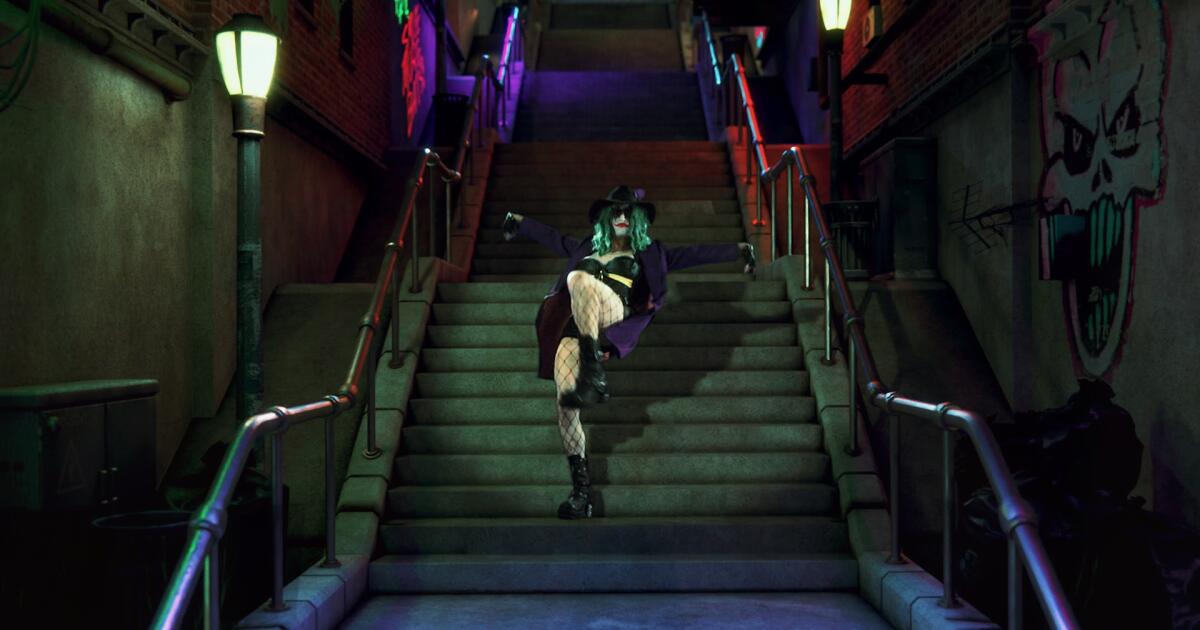
Vera Drew in the movie “The People’s Joker.”
(Haunted Gay Ride Productions)
This Joker, then, is waging a war against comedy. Or rather, against the comedy that’s allowed to be broadcast to mainstream audiences. The “anti-comedy” troupe she assembles with her friend Penguin (Nathan Faustyn) looks uncannily like a who’s who of well-known Gotham dwellers, including a sly cat burglar, a mouth-guarded muscle man and an ivied plant-human hybrid.
Drew isn’t subtle in wanting to puncture the insidious claim that women, trans folks and any and every minority — not to mention zoomers writ large — have killed comedy. And so, amid this unique version of Gotham City, her Joker finds her own villain origin story in wanting to break into a comedy boys’ club.
As she hones her routine (and her fashion sense, borrowing from various iconic Joker looks over the years), Drew’s protagonist falls madly in love with “Mr. J” (Kane Distler), a trans stand-up whose green slicked-back hair, white makeup and “damaged” forehead tattoo aren’t enough of a red flag for her to care. Instead, she becomes enamored with Mr. J, whose backstory with their shared Bat-foe turns this T4T romance into something far thornier than you’d imagine.
In essence, this is a bonkers remixing of one of the most well-known comic book characters of all time. But with a raw vulnerability that comes from Drew plundering her own lived experience, she’s made the film serve just as well as, alternately, a trans coming-of-age tale, a probing meditation on abusive relationships and a visually inventive reminder of the queer art of camp appropriation. In her hands — and this does feel like a hand-crafted film whose scrappy animations and digitally painted backdrops lend it a homemade, textured sensibility — decades’ worth of depictions of the Joker and Batman are entry points into how pop culture can function as a self-fashioning tool.
For Drew, that early text was “Batman Forever.” In Joel Schumacher’s neon-colored vision of a rave-like Gotham City, the Chicago-born filmmaker first found herself connecting those on-screen avatars with her own unruly desires. “The People’s Joker” is a valiant guerrilla-like attempt at bringing Schumacher’s queered sensibility back into the superhero genre, expanding his movie into a rather bruising personal drama.
Equally brazen and ambitious, Drew’s film is committed to embracing the zany undertones that have always bubbled under the surface of a comic book tale in which secret identities, arch performances and fabulous outfits (all worn in the dead of night, no less) have always felt like lifelines for queer and trans kids worldwide.
‘The People’s Joker’
Not rated
Running time: 1 hour, 32 minutes
Playing: Opens Friday, April 11 at Landmark’s Nuart Theatre, West Los Angeles

The first lines that greet viewers of Vera Drew’s gonzo new film, “The People’s Joker,” are a necessary disclaimer meant to assure audiences (and whatever legal departments at various corporations may be watching) that this passion project was never intended to infringe on any known copyright. Later, a logo of the film will more specifically make this point. It labels Drew’s wildly inventive take on everyone’s favorite Batman villain as “a fair-use comic-book parody/trans autofiction.” But much like Drew’s fictional alter ego, a wannabe comedian-slash-villain living in Gotham City coming into her own, the beauty of this DIY project is found in that slash, in the infinite possibility opened up by bridging two things (be they gender or genre) and creating something altogether dazzling and new.
Drew, who co-wrote the script (with Bri LeRose), edited, directed and stars in “The People’s Joker,” is clearly aping the trappings of the self-serious superhero origin story. The kind that found its zenith in Todd Phillips’ 2019 take on Batman’s clownish foe. And indeed, there’s a way of seeing Drew’s own take on this “Joker the Harlequin” as a playful middle finger to such dour depictions of a character whose first live-action iteration was in the campy hands of Cesar Romero. “Why so self-serious?” the film winks at every turn.
The moment we first meet Drew’s Joker, backstage as she waits to go on camera for a comedy show, is meant to evoke Joaquin Phoenix’s Oscar-winning performance. She’s donning Phoenix’s now iconic red clown suit. She’s made up in similar makeup. And she seems just as wary of what she’s about to do when she steps on set.
But just as quickly as Drew has encouraged us to connect her project with that other Joker, she asserts how deftly she’s about to reframe such a comparison. In this version, her Joker is a trans girl who’s grappling with childhood trauma and some unresolved gender identity issues. More tellingly, she is driven to pursue a career in comedy. Except in this world, comedy is only allowed at the “UCB Live” show, an “SNL” parody that’s sanctioned by Batman (a pot-bellied animated hero voiced by Phil Braun) and run by Lorne Michaels (a Sims-like CGI figure voiced by Maria Bamford).
Vera Drew in the movie “The People’s Joker.”
(Haunted Gay Ride Productions)
This Joker, then, is waging a war against comedy. Or rather, against the comedy that’s allowed to be broadcast to mainstream audiences. The “anti-comedy” troupe she assembles with her friend Penguin (Nathan Faustyn) looks uncannily like a who’s who of well-known Gotham dwellers, including a sly cat burglar, a mouth-guarded muscle man and an ivied plant-human hybrid.
Drew isn’t subtle in wanting to puncture the insidious claim that women, trans folks and any and every minority — not to mention zoomers writ large — have killed comedy. And so, amid this unique version of Gotham City, her Joker finds her own villain origin story in wanting to break into a comedy boys’ club.
As she hones her routine (and her fashion sense, borrowing from various iconic Joker looks over the years), Drew’s protagonist falls madly in love with “Mr. J” (Kane Distler), a trans stand-up whose green slicked-back hair, white makeup and “damaged” forehead tattoo aren’t enough of a red flag for her to care. Instead, she becomes enamored with Mr. J, whose backstory with their shared Bat-foe turns this T4T romance into something far thornier than you’d imagine.
In essence, this is a bonkers remixing of one of the most well-known comic book characters of all time. But with a raw vulnerability that comes from Drew plundering her own lived experience, she’s made the film serve just as well as, alternately, a trans coming-of-age tale, a probing meditation on abusive relationships and a visually inventive reminder of the queer art of camp appropriation. In her hands — and this does feel like a hand-crafted film whose scrappy animations and digitally painted backdrops lend it a homemade, textured sensibility — decades’ worth of depictions of the Joker and Batman are entry points into how pop culture can function as a self-fashioning tool.
For Drew, that early text was “Batman Forever.” In Joel Schumacher’s neon-colored vision of a rave-like Gotham City, the Chicago-born filmmaker first found herself connecting those on-screen avatars with her own unruly desires. “The People’s Joker” is a valiant guerrilla-like attempt at bringing Schumacher’s queered sensibility back into the superhero genre, expanding his movie into a rather bruising personal drama.
Equally brazen and ambitious, Drew’s film is committed to embracing the zany undertones that have always bubbled under the surface of a comic book tale in which secret identities, arch performances and fabulous outfits (all worn in the dead of night, no less) have always felt like lifelines for queer and trans kids worldwide.
‘The People’s Joker’
Not rated
Running time: 1 hour, 32 minutes
Playing: Opens Friday, April 11 at Landmark’s Nuart Theatre, West Los Angeles

The first lines that greet viewers of Vera Drew’s gonzo new film, “The People’s Joker,” are a necessary disclaimer meant to assure audiences (and whatever legal departments at various corporations may be watching) that this passion project was never intended to infringe on any known copyright. Later, a logo of the film will more specifically make this point. It labels Drew’s wildly inventive take on everyone’s favorite Batman villain as “a fair-use comic-book parody/trans autofiction.” But much like Drew’s fictional alter ego, a wannabe comedian-slash-villain living in Gotham City coming into her own, the beauty of this DIY project is found in that slash, in the infinite possibility opened up by bridging two things (be they gender or genre) and creating something altogether dazzling and new.
Drew, who co-wrote the script (with Bri LeRose), edited, directed and stars in “The People’s Joker,” is clearly aping the trappings of the self-serious superhero origin story. The kind that found its zenith in Todd Phillips’ 2019 take on Batman’s clownish foe. And indeed, there’s a way of seeing Drew’s own take on this “Joker the Harlequin” as a playful middle finger to such dour depictions of a character whose first live-action iteration was in the campy hands of Cesar Romero. “Why so self-serious?” the film winks at every turn.
The moment we first meet Drew’s Joker, backstage as she waits to go on camera for a comedy show, is meant to evoke Joaquin Phoenix’s Oscar-winning performance. She’s donning Phoenix’s now iconic red clown suit. She’s made up in similar makeup. And she seems just as wary of what she’s about to do when she steps on set.
But just as quickly as Drew has encouraged us to connect her project with that other Joker, she asserts how deftly she’s about to reframe such a comparison. In this version, her Joker is a trans girl who’s grappling with childhood trauma and some unresolved gender identity issues. More tellingly, she is driven to pursue a career in comedy. Except in this world, comedy is only allowed at the “UCB Live” show, an “SNL” parody that’s sanctioned by Batman (a pot-bellied animated hero voiced by Phil Braun) and run by Lorne Michaels (a Sims-like CGI figure voiced by Maria Bamford).
Vera Drew in the movie “The People’s Joker.”
(Haunted Gay Ride Productions)
This Joker, then, is waging a war against comedy. Or rather, against the comedy that’s allowed to be broadcast to mainstream audiences. The “anti-comedy” troupe she assembles with her friend Penguin (Nathan Faustyn) looks uncannily like a who’s who of well-known Gotham dwellers, including a sly cat burglar, a mouth-guarded muscle man and an ivied plant-human hybrid.
Drew isn’t subtle in wanting to puncture the insidious claim that women, trans folks and any and every minority — not to mention zoomers writ large — have killed comedy. And so, amid this unique version of Gotham City, her Joker finds her own villain origin story in wanting to break into a comedy boys’ club.
As she hones her routine (and her fashion sense, borrowing from various iconic Joker looks over the years), Drew’s protagonist falls madly in love with “Mr. J” (Kane Distler), a trans stand-up whose green slicked-back hair, white makeup and “damaged” forehead tattoo aren’t enough of a red flag for her to care. Instead, she becomes enamored with Mr. J, whose backstory with their shared Bat-foe turns this T4T romance into something far thornier than you’d imagine.
In essence, this is a bonkers remixing of one of the most well-known comic book characters of all time. But with a raw vulnerability that comes from Drew plundering her own lived experience, she’s made the film serve just as well as, alternately, a trans coming-of-age tale, a probing meditation on abusive relationships and a visually inventive reminder of the queer art of camp appropriation. In her hands — and this does feel like a hand-crafted film whose scrappy animations and digitally painted backdrops lend it a homemade, textured sensibility — decades’ worth of depictions of the Joker and Batman are entry points into how pop culture can function as a self-fashioning tool.
For Drew, that early text was “Batman Forever.” In Joel Schumacher’s neon-colored vision of a rave-like Gotham City, the Chicago-born filmmaker first found herself connecting those on-screen avatars with her own unruly desires. “The People’s Joker” is a valiant guerrilla-like attempt at bringing Schumacher’s queered sensibility back into the superhero genre, expanding his movie into a rather bruising personal drama.
Equally brazen and ambitious, Drew’s film is committed to embracing the zany undertones that have always bubbled under the surface of a comic book tale in which secret identities, arch performances and fabulous outfits (all worn in the dead of night, no less) have always felt like lifelines for queer and trans kids worldwide.
‘The People’s Joker’
Not rated
Running time: 1 hour, 32 minutes
Playing: Opens Friday, April 11 at Landmark’s Nuart Theatre, West Los Angeles
The first lines that greet viewers of Vera Drew’s gonzo new film, “The People’s Joker,” are a necessary disclaimer meant to assure audiences (and whatever legal departments at various corporations may be watching) that this passion project was never intended to infringe on any known copyright. Later, a logo of the film will more specifically make this point. It labels Drew’s wildly inventive take on everyone’s favorite Batman villain as “a fair-use comic-book parody/trans autofiction.” But much like Drew’s fictional alter ego, a wannabe comedian-slash-villain living in Gotham City coming into her own, the beauty of this DIY project is found in that slash, in the infinite possibility opened up by bridging two things (be they gender or genre) and creating something altogether dazzling and new.
Drew, who co-wrote the script (with Bri LeRose), edited, directed and stars in “The People’s Joker,” is clearly aping the trappings of the self-serious superhero origin story. The kind that found its zenith in Todd Phillips’ 2019 take on Batman’s clownish foe. And indeed, there’s a way of seeing Drew’s own take on this “Joker the Harlequin” as a playful middle finger to such dour depictions of a character whose first live-action iteration was in the campy hands of Cesar Romero. “Why so self-serious?” the film winks at every turn.
The moment we first meet Drew’s Joker, backstage as she waits to go on camera for a comedy show, is meant to evoke Joaquin Phoenix’s Oscar-winning performance. She’s donning Phoenix’s now iconic red clown suit. She’s made up in similar makeup. And she seems just as wary of what she’s about to do when she steps on set.
But just as quickly as Drew has encouraged us to connect her project with that other Joker, she asserts how deftly she’s about to reframe such a comparison. In this version, her Joker is a trans girl who’s grappling with childhood trauma and some unresolved gender identity issues. More tellingly, she is driven to pursue a career in comedy. Except in this world, comedy is only allowed at the “UCB Live” show, an “SNL” parody that’s sanctioned by Batman (a pot-bellied animated hero voiced by Phil Braun) and run by Lorne Michaels (a Sims-like CGI figure voiced by Maria Bamford).
Vera Drew in the movie “The People’s Joker.”
(Haunted Gay Ride Productions)
This Joker, then, is waging a war against comedy. Or rather, against the comedy that’s allowed to be broadcast to mainstream audiences. The “anti-comedy” troupe she assembles with her friend Penguin (Nathan Faustyn) looks uncannily like a who’s who of well-known Gotham dwellers, including a sly cat burglar, a mouth-guarded muscle man and an ivied plant-human hybrid.
Drew isn’t subtle in wanting to puncture the insidious claim that women, trans folks and any and every minority — not to mention zoomers writ large — have killed comedy. And so, amid this unique version of Gotham City, her Joker finds her own villain origin story in wanting to break into a comedy boys’ club.
As she hones her routine (and her fashion sense, borrowing from various iconic Joker looks over the years), Drew’s protagonist falls madly in love with “Mr. J” (Kane Distler), a trans stand-up whose green slicked-back hair, white makeup and “damaged” forehead tattoo aren’t enough of a red flag for her to care. Instead, she becomes enamored with Mr. J, whose backstory with their shared Bat-foe turns this T4T romance into something far thornier than you’d imagine.
In essence, this is a bonkers remixing of one of the most well-known comic book characters of all time. But with a raw vulnerability that comes from Drew plundering her own lived experience, she’s made the film serve just as well as, alternately, a trans coming-of-age tale, a probing meditation on abusive relationships and a visually inventive reminder of the queer art of camp appropriation. In her hands — and this does feel like a hand-crafted film whose scrappy animations and digitally painted backdrops lend it a homemade, textured sensibility — decades’ worth of depictions of the Joker and Batman are entry points into how pop culture can function as a self-fashioning tool.
For Drew, that early text was “Batman Forever.” In Joel Schumacher’s neon-colored vision of a rave-like Gotham City, the Chicago-born filmmaker first found herself connecting those on-screen avatars with her own unruly desires. “The People’s Joker” is a valiant guerrilla-like attempt at bringing Schumacher’s queered sensibility back into the superhero genre, expanding his movie into a rather bruising personal drama.
Equally brazen and ambitious, Drew’s film is committed to embracing the zany undertones that have always bubbled under the surface of a comic book tale in which secret identities, arch performances and fabulous outfits (all worn in the dead of night, no less) have always felt like lifelines for queer and trans kids worldwide.
‘The People’s Joker’
Not rated
Running time: 1 hour, 32 minutes
Playing: Opens Friday, April 11 at Landmark’s Nuart Theatre, West Los Angeles


