
When composing the score of a horror movie, are you empathetic toward its victims, or acting as their tormentor?
Ethel Cain and Robin Carolan pondered that as they composed the mournful and guttural score for Robert Eggers’ forthcoming film “Werwulf.” The movie, set in 14th century England, is Eggers’ latest dive into meticulously researched, period-piece horror. After 2024’s smash “Nosferatu,” “Werwulf” (in theaters Dec. 25) looks to be Eggers’ most historically exacting film since his colonial-America nightmare “The Witch,” and his most brutal and upsetting movie yet.
For this particular sound of pastoral despair, the singer and composer tried to understand how the freezing, terrified peasants of medieval England (here played by Aaron Taylor-Johnson, Willem Dafoe, and Lily-Rose Depp) would have felt being stalked by an entity beyond their comprehension.
“I started to wonder — is the music coming from a sympathetic place toward the characters, or is it coming from the antagonism of the evil that’s pursuing them?’ Cain asked in an interview about their single “Wynter Waxeth,” which also serves as a theme in the film. “Or is it more of this neutrality of nature watching it all unfold?”
For the score, Cain — the cult-favorite Southern gothic project from singer-songwriter Hayden Anhedönia — joined up with Carolan, the founder of the tastemaking indie label Tri Angle and a composer who worked on the music Eggers’ “Nosferatu” and “The Northman.” Cain’s voice is a spectral presence throughout the movie, in terribly beautiful harmonies that serve as a portent of its characters’ desperate faith and impending doom.
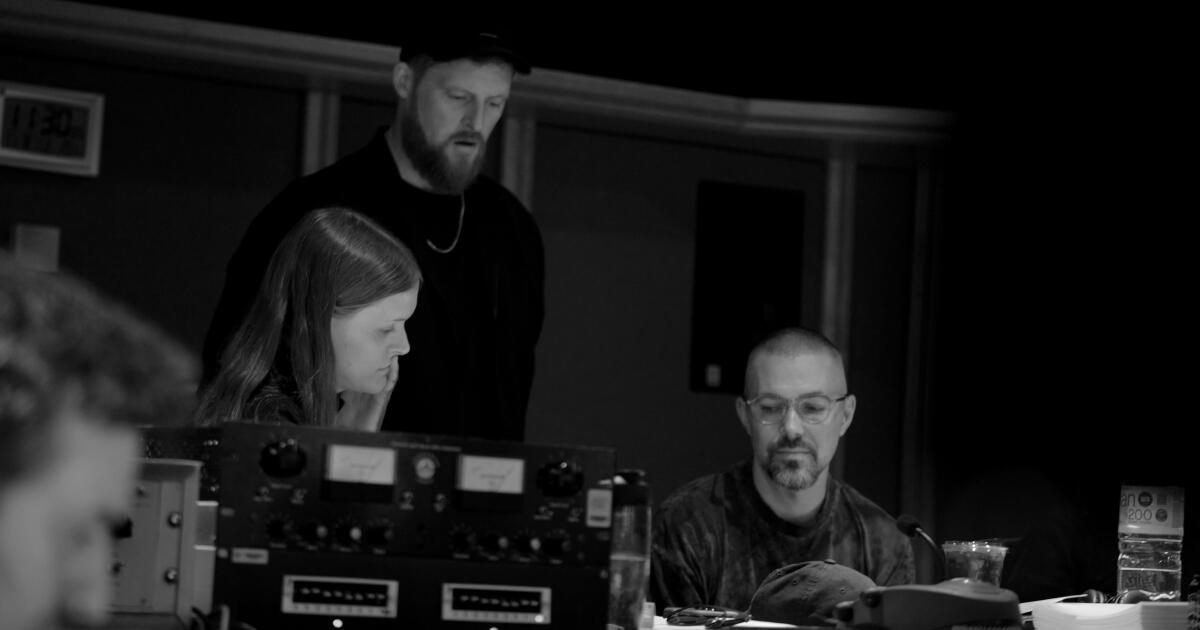
Carolan’s instrumentation is grounded in period-accurate instruments like the hurdy gurdy (they had a custom “mega-stretch” model made that requires two people to play it), distended through spectral reverbs and percussion made from crunching bones and chopped wood.
“What I really wanted to capture was that kind of rugged, in-the-earth feeling, really plunging you into the medieval world because it would have been a very hard world to have lived in,” Carolan said. “My favorite parts of the process are doing the research, finding the instruments, thinking about the music of the time and then thinking, ‘How can I subvert this?’
“I also wanted the score to sound mysterious and otherworldly as well,” he added, “because the characters were incredibly superstitious and obsessed with God, demons, devils. It was a time of very heightened emotions because there was so much superstition, and so much of a lack of understanding of the world around them.”
Those themes, from a very different angle, are core concerns of Cain’s catalog too. The closest reference point for the sound of “Werwulf” might be “Perverts,” the divisive but profoundly emotional noise record she made to detonate possible pop stardom after 2022’s hit “Preacher’s Daughter.” The score harkens back to a formative interest of Cain’s — Gregorian chant — that predates and runs alongside her singer-songwriter material. Both of these projects are obsessed with God, sin, filth and salvation.
“It feels a little full circle to be coming back around and creating this very fantastical, superstitious, religious fervor,” Cain said. “But you can also go off the rails in the sense that it’s still a horror movie, so you can bend it to create something that toes the line between a horror movie soundtrack and something echoing off the walls of a monastery. It’s really nice to go into this meticulously crafted universe, and then dig in the dirt with it.”
For “Wynter Waxeth,” Cain sings in Middle English lyrics written with Eggers (“Werwulf’s” dialog is written and spoken in the same dialect). She’s always been a particularly commanding vocalist, attuned to devastating melodic turns and gorgeously pained phrasing.
The resolutely autonomous Cain wasn’t used to being coached on much of anything in music. But working with Eggers to wrap her voice around the phonemes of Middle English, the sessions brought something ancient and profound out of her.
“You’re getting to take words that, to the English speaker’s ear, sound vaguely English because it is, but you get to incorporate different kinds of trills and glottal stops,” Cain said. “Different languages have different cultural connotations, and they carry so much weight with them. It really does take you into a different headspace. I loved to wear all my black drapes to the studio and sit with the harpist invoking this feeling that I haven’t felt in a very long time. It was nice to say hello to a new ghostly image that I would like to get to know a little bit better.”
“Wynter Waxeth” builds from the hymnal melodies of a frostbitten gothic abbey, into groans of percussion and stacks of frantic, escalating chants. You feel both the majesty of faith and the gnash of claws in the treeline.
While “Nosferatu” took aesthetic liberties with a timeless vampire tale, and “The Northman” dropped viewers into a mythopoetic Viking era, the score work for “Werwulf” comes closest to inhabiting its characters’ real fears and moments of solace as death slinks outside.
“The film is brutal, I think it’s Rob’s most devastating film,” Carolan said. “But there are certain scenes where there was space for tenderness. You want to embrace the characters, especially when you know the hardships they’re going through and where the story is headed.”
“I feel less like I’m sympathizing with the characters being terrified and helpless, and it almost sounds like we are on the creature’s side,” Cain laughed. “It feels like we are creating the atmosphere that is so terrifying.”
“Your voice is in a lot pretty evil scenes,” Carolan agreed. “What Hayden’s doing with her voice, it’s antagonistic. They’re some of the the most intense music cues in the film. Hayden’s a little bit of heaven and a little bit well, not heaven.”


