
Like any good side quest, Jack Wagner’s journey into the history of the Integratron began with curiosity.
The host of the “Otherworld” podcast had spoken to someone who experienced something unexplained at the mysterious dome in the Mojave Desert. Wagner knew little about the landmark or why it had been built, but ended up being key to its ultimate journey. It was partially thanks to him that the Huntington recently acquired an extensive archive documenting the dome and the postwar UFO community that cohered around its creator, ufologist George Van Tassel.
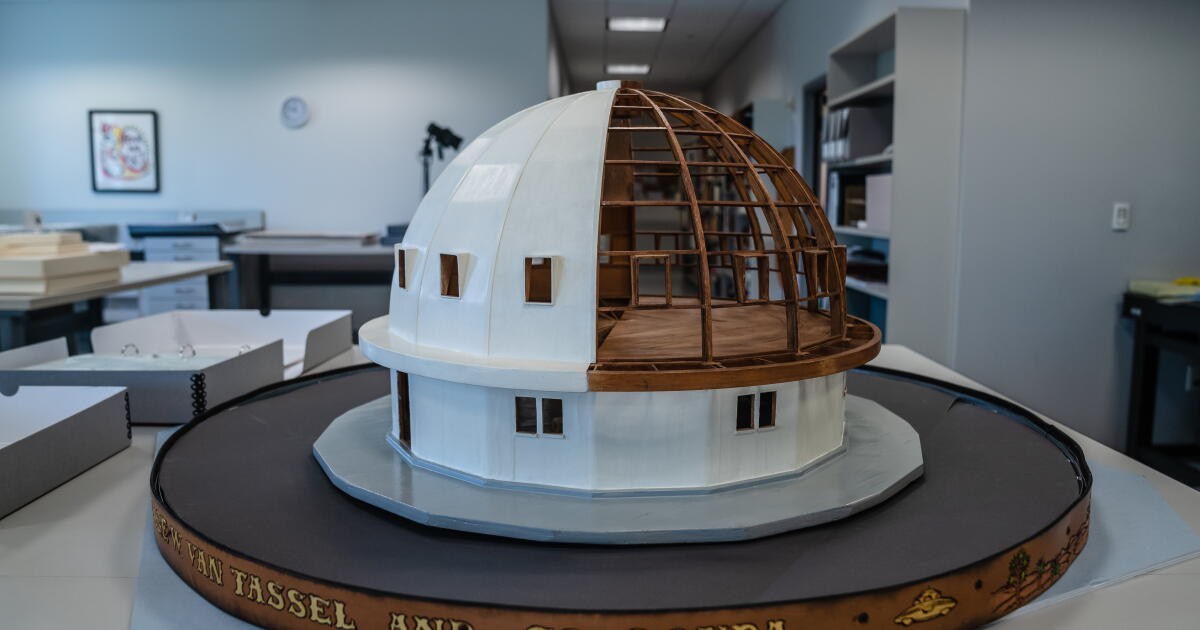
The collection, announced by the museum Tuesday, is deep and vast, with materials dating from the 1910s through the 1990s. It includes an architectural model and original blueprints of the Integratron, as well as nearly 630 photographs, negatives and slides, more than 250 audio recordings, 8-millimeter film footage, books, publications and other records and ephemera.
“I was like, I want to learn more about this place,” Wagner said. “I started reaching out to find an expert.”
That’s how Wagner found Daniel Paul, an architectural historian who researched and documented the 38-foot-tall cupola-style structure built in 1960 by Van Tassel, who ascribed it miraculous powers including antigravity, rejuvenation and time travel. Paul’s work goes back a decade, when he was hired to get the building designated a historical landmark.
Architectural historian Daniel Paul and Erin Chase, associate curator of architecture and photography at the Huntington, look through blueprints of the Integratron designed and built by George Van Tassel.
(Ariana Drehsler / For The Times)
Paul suggested Wagner visit Donald and Dale McKinney in the desert town of Landers, Calif. The eccentric man and his wife preserved a number of items belonging to Van Tassel in a climate-controlled room in their home.
The original model of the Integratron was among the collection, along with blueprints, photographs, books and recordings of Van Tassel channeling what he described as “beings from beyond.” With help from his producers and Paul, Wagner began digitizing the collection and searching for a permanent home. The Huntington ended up purchasing the collection from the McKinneys.
“[The Huntington] had to have this,” said Erin Chase, the Huntington’s associate curator of architecture and photography. “We weren’t looking for it, but when we went and viewed the archive and saw the beautiful model and learned more about Van Tassel and his role in pioneering ufology in the Mojave desert, we just knew it had to come here.”

Old photos showing UFOs in the sky are seen in the Integratron archive acquired by the Huntington.
(Ariana Drehsler / For The Times)
Chase said the acquisition marked an expansion of the library’s collecting interests beyond its millions of rare books, manuscripts and historical items spanning from the 11th through the 21st centuries.
The Integratron collection captures the curious life of Van Tassel, an aviation mechanic and test pilot who claimed to have communicated with Solganda, a being from Venus. Van Tassel said he received telepathic instructions for building a metal-free dome that could generate electrostatic energy and eventually help rejuvenate cells and make time travel possible.
After the alleged encounter, Van Tassel began building the machine and hosting the Giant Rock Interplanetary Spacecraft Convention, where he gave other contactees a platform to speak about their experiences. He also provided entertainment, including a child playing Beethoven on piano outside the boulder, for people who flocked to the conventions.
Photographs of these events contained in the archive capture a communal experience shared by people of all ages. The gatherings were family events meant for diversion, Paul said. It was about sharing knowledge with anyone willing to listen — and looking for what exists beyond the sky.
“This was [Van Tassel’s] way of caring about people. Apparently this being told him the problem with humans is by the time you’re learning this wisdom you need to know in this lifetime, you’re ready to die,” Paul said. “So you need to extend life, so that wisdom can be implemented and more wisdom can be received.”
Some of that wisdom in Van Tassel’s growing community was centered on “Peace, love and harmony” — a chant that allegedly made someone at The Times suspicious.

A vintage photo of George Van Tassel at a spacecraft convention at Giant Rock in the Mojave Desert.
(Ariana Drehsler / For The Times)
“The L.A. Times filed the initial complaint that kicked off the FBI file… Somebody [using Times stationary] … sent a complaint that they were chanting ‘peace, love and harmony’ and that was a problem,” Paul said, adding that the writer deemed the chant un-American.
The FBI investigation didn’t lead anywhere and Van Tassel and his community were deemed harmless by the bureau’s agents, Paul said.
The Integratron archive doesn’t just intersect with the Huntington’s collections on aerospace and architecture, it captures a niche chapter in the history of California, Chase said.
“We got it cataloged immediately, which means someone can order it up in the reading room tomorrow, and that’s warp speed for us,” she added.
The collection demonstrates an important aspect of California history, she noted: a questing people’s search for more than they are getting from their regular faith.
This might be because the Integratron was apparently built on a geomagnetic vortex.
“You do feel something there, whether or not it’s healing I guess is up to the person experiencing it,” Chase said.
She hopes the archives, the Huntington’s first major acquisition centered on ufology, will help people appreciate the progressive experimental architecture of the building, even if they don’t fully buy the story of the visiting alien from Venus.
Is this collection a sign of more to come?

Vintage black-and-white photos dating to the late 1950s and early 1960s are part of the Integratron archive.
(Ariana Drehsler / For The Times)
Possibly, Chase said, adding that she’s waiting to see how many people turn up to see it.
Paul hopes the new collection provides a deeper understanding of the sense of openness that drew people to California in the first place.
“Not just the openness of the land but the openness to ideas,” he said. “One does not have to live their life a certain way, one can have different beliefs.”
“California was a place that was accepting and tolerant of all of that,” he said.

Like any good side quest, Jack Wagner’s journey into the history of the Integratron began with curiosity.
The host of the “Otherworld” podcast had spoken to someone who experienced something unexplained at the mysterious dome in the Mojave Desert. Wagner knew little about the landmark or why it had been built, but ended up being key to its ultimate journey. It was partially thanks to him that the Huntington recently acquired an extensive archive documenting the dome and the postwar UFO community that cohered around its creator, ufologist George Van Tassel.
The collection, announced by the museum Tuesday, is deep and vast, with materials dating from the 1910s through the 1990s. It includes an architectural model and original blueprints of the Integratron, as well as nearly 630 photographs, negatives and slides, more than 250 audio recordings, 8-millimeter film footage, books, publications and other records and ephemera.
“I was like, I want to learn more about this place,” Wagner said. “I started reaching out to find an expert.”
That’s how Wagner found Daniel Paul, an architectural historian who researched and documented the 38-foot-tall cupola-style structure built in 1960 by Van Tassel, who ascribed it miraculous powers including antigravity, rejuvenation and time travel. Paul’s work goes back a decade, when he was hired to get the building designated a historical landmark.
Architectural historian Daniel Paul and Erin Chase, associate curator of architecture and photography at the Huntington, look through blueprints of the Integratron designed and built by George Van Tassel.
(Ariana Drehsler / For The Times)
Paul suggested Wagner visit Donald and Dale McKinney in the desert town of Landers, Calif. The eccentric man and his wife preserved a number of items belonging to Van Tassel in a climate-controlled room in their home.
The original model of the Integratron was among the collection, along with blueprints, photographs, books and recordings of Van Tassel channeling what he described as “beings from beyond.” With help from his producers and Paul, Wagner began digitizing the collection and searching for a permanent home. The Huntington ended up purchasing the collection from the McKinneys.
“[The Huntington] had to have this,” said Erin Chase, the Huntington’s associate curator of architecture and photography. “We weren’t looking for it, but when we went and viewed the archive and saw the beautiful model and learned more about Van Tassel and his role in pioneering ufology in the Mojave desert, we just knew it had to come here.”
Old photos showing UFOs in the sky are seen in the Integratron archive acquired by the Huntington.
(Ariana Drehsler / For The Times)
Chase said the acquisition marked an expansion of the library’s collecting interests beyond its millions of rare books, manuscripts and historical items spanning from the 11th through the 21st centuries.
The Integratron collection captures the curious life of Van Tassel, an aviation mechanic and test pilot who claimed to have communicated with Solganda, a being from Venus. Van Tassel said he received telepathic instructions for building a metal-free dome that could generate electrostatic energy and eventually help rejuvenate cells and make time travel possible.
After the alleged encounter, Van Tassel began building the machine and hosting the Giant Rock Interplanetary Spacecraft Convention, where he gave other contactees a platform to speak about their experiences. He also provided entertainment, including a child playing Beethoven on piano outside the boulder, for people who flocked to the conventions.
Photographs of these events contained in the archive capture a communal experience shared by people of all ages. The gatherings were family events meant for diversion, Paul said. It was about sharing knowledge with anyone willing to listen — and looking for what exists beyond the sky.
“This was [Van Tassel’s] way of caring about people. Apparently this being told him the problem with humans is by the time you’re learning this wisdom you need to know in this lifetime, you’re ready to die,” Paul said. “So you need to extend life, so that wisdom can be implemented and more wisdom can be received.”
Some of that wisdom in Van Tassel’s growing community was centered on “Peace, love and harmony” — a chant that allegedly made someone at The Times suspicious.
A vintage photo of George Van Tassel at a spacecraft convention at Giant Rock in the Mojave Desert.
(Ariana Drehsler / For The Times)
“The L.A. Times filed the initial complaint that kicked off the FBI file… Somebody [using Times stationary] … sent a complaint that they were chanting ‘peace, love and harmony’ and that was a problem,” Paul said, adding that the writer deemed the chant un-American.
The FBI investigation didn’t lead anywhere and Van Tassel and his community were deemed harmless by the bureau’s agents, Paul said.
The Integratron archive doesn’t just intersect with the Huntington’s collections on aerospace and architecture, it captures a niche chapter in the history of California, Chase said.
“We got it cataloged immediately, which means someone can order it up in the reading room tomorrow, and that’s warp speed for us,” she added.
The collection demonstrates an important aspect of California history, she noted: a questing people’s search for more than they are getting from their regular faith.
This might be because the Integratron was apparently built on a geomagnetic vortex.
“You do feel something there, whether or not it’s healing I guess is up to the person experiencing it,” Chase said.
She hopes the archives, the Huntington’s first major acquisition centered on ufology, will help people appreciate the progressive experimental architecture of the building, even if they don’t fully buy the story of the visiting alien from Venus.
Is this collection a sign of more to come?
Vintage black-and-white photos dating to the late 1950s and early 1960s are part of the Integratron archive.
(Ariana Drehsler / For The Times)
Possibly, Chase said, adding that she’s waiting to see how many people turn up to see it.
Paul hopes the new collection provides a deeper understanding of the sense of openness that drew people to California in the first place.
“Not just the openness of the land but the openness to ideas,” he said. “One does not have to live their life a certain way, one can have different beliefs.”
“California was a place that was accepting and tolerant of all of that,” he said.

Like any good side quest, Jack Wagner’s journey into the history of the Integratron began with curiosity.
The host of the “Otherworld” podcast had spoken to someone who experienced something unexplained at the mysterious dome in the Mojave Desert. Wagner knew little about the landmark or why it had been built, but ended up being key to its ultimate journey. It was partially thanks to him that the Huntington recently acquired an extensive archive documenting the dome and the postwar UFO community that cohered around its creator, ufologist George Van Tassel.
The collection, announced by the museum Tuesday, is deep and vast, with materials dating from the 1910s through the 1990s. It includes an architectural model and original blueprints of the Integratron, as well as nearly 630 photographs, negatives and slides, more than 250 audio recordings, 8-millimeter film footage, books, publications and other records and ephemera.
“I was like, I want to learn more about this place,” Wagner said. “I started reaching out to find an expert.”
That’s how Wagner found Daniel Paul, an architectural historian who researched and documented the 38-foot-tall cupola-style structure built in 1960 by Van Tassel, who ascribed it miraculous powers including antigravity, rejuvenation and time travel. Paul’s work goes back a decade, when he was hired to get the building designated a historical landmark.
Architectural historian Daniel Paul and Erin Chase, associate curator of architecture and photography at the Huntington, look through blueprints of the Integratron designed and built by George Van Tassel.
(Ariana Drehsler / For The Times)
Paul suggested Wagner visit Donald and Dale McKinney in the desert town of Landers, Calif. The eccentric man and his wife preserved a number of items belonging to Van Tassel in a climate-controlled room in their home.
The original model of the Integratron was among the collection, along with blueprints, photographs, books and recordings of Van Tassel channeling what he described as “beings from beyond.” With help from his producers and Paul, Wagner began digitizing the collection and searching for a permanent home. The Huntington ended up purchasing the collection from the McKinneys.
“[The Huntington] had to have this,” said Erin Chase, the Huntington’s associate curator of architecture and photography. “We weren’t looking for it, but when we went and viewed the archive and saw the beautiful model and learned more about Van Tassel and his role in pioneering ufology in the Mojave desert, we just knew it had to come here.”
Old photos showing UFOs in the sky are seen in the Integratron archive acquired by the Huntington.
(Ariana Drehsler / For The Times)
Chase said the acquisition marked an expansion of the library’s collecting interests beyond its millions of rare books, manuscripts and historical items spanning from the 11th through the 21st centuries.
The Integratron collection captures the curious life of Van Tassel, an aviation mechanic and test pilot who claimed to have communicated with Solganda, a being from Venus. Van Tassel said he received telepathic instructions for building a metal-free dome that could generate electrostatic energy and eventually help rejuvenate cells and make time travel possible.
After the alleged encounter, Van Tassel began building the machine and hosting the Giant Rock Interplanetary Spacecraft Convention, where he gave other contactees a platform to speak about their experiences. He also provided entertainment, including a child playing Beethoven on piano outside the boulder, for people who flocked to the conventions.
Photographs of these events contained in the archive capture a communal experience shared by people of all ages. The gatherings were family events meant for diversion, Paul said. It was about sharing knowledge with anyone willing to listen — and looking for what exists beyond the sky.
“This was [Van Tassel’s] way of caring about people. Apparently this being told him the problem with humans is by the time you’re learning this wisdom you need to know in this lifetime, you’re ready to die,” Paul said. “So you need to extend life, so that wisdom can be implemented and more wisdom can be received.”
Some of that wisdom in Van Tassel’s growing community was centered on “Peace, love and harmony” — a chant that allegedly made someone at The Times suspicious.
A vintage photo of George Van Tassel at a spacecraft convention at Giant Rock in the Mojave Desert.
(Ariana Drehsler / For The Times)
“The L.A. Times filed the initial complaint that kicked off the FBI file… Somebody [using Times stationary] … sent a complaint that they were chanting ‘peace, love and harmony’ and that was a problem,” Paul said, adding that the writer deemed the chant un-American.
The FBI investigation didn’t lead anywhere and Van Tassel and his community were deemed harmless by the bureau’s agents, Paul said.
The Integratron archive doesn’t just intersect with the Huntington’s collections on aerospace and architecture, it captures a niche chapter in the history of California, Chase said.
“We got it cataloged immediately, which means someone can order it up in the reading room tomorrow, and that’s warp speed for us,” she added.
The collection demonstrates an important aspect of California history, she noted: a questing people’s search for more than they are getting from their regular faith.
This might be because the Integratron was apparently built on a geomagnetic vortex.
“You do feel something there, whether or not it’s healing I guess is up to the person experiencing it,” Chase said.
She hopes the archives, the Huntington’s first major acquisition centered on ufology, will help people appreciate the progressive experimental architecture of the building, even if they don’t fully buy the story of the visiting alien from Venus.
Is this collection a sign of more to come?
Vintage black-and-white photos dating to the late 1950s and early 1960s are part of the Integratron archive.
(Ariana Drehsler / For The Times)
Possibly, Chase said, adding that she’s waiting to see how many people turn up to see it.
Paul hopes the new collection provides a deeper understanding of the sense of openness that drew people to California in the first place.
“Not just the openness of the land but the openness to ideas,” he said. “One does not have to live their life a certain way, one can have different beliefs.”
“California was a place that was accepting and tolerant of all of that,” he said.
Like any good side quest, Jack Wagner’s journey into the history of the Integratron began with curiosity.
The host of the “Otherworld” podcast had spoken to someone who experienced something unexplained at the mysterious dome in the Mojave Desert. Wagner knew little about the landmark or why it had been built, but ended up being key to its ultimate journey. It was partially thanks to him that the Huntington recently acquired an extensive archive documenting the dome and the postwar UFO community that cohered around its creator, ufologist George Van Tassel.
The collection, announced by the museum Tuesday, is deep and vast, with materials dating from the 1910s through the 1990s. It includes an architectural model and original blueprints of the Integratron, as well as nearly 630 photographs, negatives and slides, more than 250 audio recordings, 8-millimeter film footage, books, publications and other records and ephemera.
“I was like, I want to learn more about this place,” Wagner said. “I started reaching out to find an expert.”
That’s how Wagner found Daniel Paul, an architectural historian who researched and documented the 38-foot-tall cupola-style structure built in 1960 by Van Tassel, who ascribed it miraculous powers including antigravity, rejuvenation and time travel. Paul’s work goes back a decade, when he was hired to get the building designated a historical landmark.
Architectural historian Daniel Paul and Erin Chase, associate curator of architecture and photography at the Huntington, look through blueprints of the Integratron designed and built by George Van Tassel.
(Ariana Drehsler / For The Times)
Paul suggested Wagner visit Donald and Dale McKinney in the desert town of Landers, Calif. The eccentric man and his wife preserved a number of items belonging to Van Tassel in a climate-controlled room in their home.
The original model of the Integratron was among the collection, along with blueprints, photographs, books and recordings of Van Tassel channeling what he described as “beings from beyond.” With help from his producers and Paul, Wagner began digitizing the collection and searching for a permanent home. The Huntington ended up purchasing the collection from the McKinneys.
“[The Huntington] had to have this,” said Erin Chase, the Huntington’s associate curator of architecture and photography. “We weren’t looking for it, but when we went and viewed the archive and saw the beautiful model and learned more about Van Tassel and his role in pioneering ufology in the Mojave desert, we just knew it had to come here.”
Old photos showing UFOs in the sky are seen in the Integratron archive acquired by the Huntington.
(Ariana Drehsler / For The Times)
Chase said the acquisition marked an expansion of the library’s collecting interests beyond its millions of rare books, manuscripts and historical items spanning from the 11th through the 21st centuries.
The Integratron collection captures the curious life of Van Tassel, an aviation mechanic and test pilot who claimed to have communicated with Solganda, a being from Venus. Van Tassel said he received telepathic instructions for building a metal-free dome that could generate electrostatic energy and eventually help rejuvenate cells and make time travel possible.
After the alleged encounter, Van Tassel began building the machine and hosting the Giant Rock Interplanetary Spacecraft Convention, where he gave other contactees a platform to speak about their experiences. He also provided entertainment, including a child playing Beethoven on piano outside the boulder, for people who flocked to the conventions.
Photographs of these events contained in the archive capture a communal experience shared by people of all ages. The gatherings were family events meant for diversion, Paul said. It was about sharing knowledge with anyone willing to listen — and looking for what exists beyond the sky.
“This was [Van Tassel’s] way of caring about people. Apparently this being told him the problem with humans is by the time you’re learning this wisdom you need to know in this lifetime, you’re ready to die,” Paul said. “So you need to extend life, so that wisdom can be implemented and more wisdom can be received.”
Some of that wisdom in Van Tassel’s growing community was centered on “Peace, love and harmony” — a chant that allegedly made someone at The Times suspicious.
A vintage photo of George Van Tassel at a spacecraft convention at Giant Rock in the Mojave Desert.
(Ariana Drehsler / For The Times)
“The L.A. Times filed the initial complaint that kicked off the FBI file… Somebody [using Times stationary] … sent a complaint that they were chanting ‘peace, love and harmony’ and that was a problem,” Paul said, adding that the writer deemed the chant un-American.
The FBI investigation didn’t lead anywhere and Van Tassel and his community were deemed harmless by the bureau’s agents, Paul said.
The Integratron archive doesn’t just intersect with the Huntington’s collections on aerospace and architecture, it captures a niche chapter in the history of California, Chase said.
“We got it cataloged immediately, which means someone can order it up in the reading room tomorrow, and that’s warp speed for us,” she added.
The collection demonstrates an important aspect of California history, she noted: a questing people’s search for more than they are getting from their regular faith.
This might be because the Integratron was apparently built on a geomagnetic vortex.
“You do feel something there, whether or not it’s healing I guess is up to the person experiencing it,” Chase said.
She hopes the archives, the Huntington’s first major acquisition centered on ufology, will help people appreciate the progressive experimental architecture of the building, even if they don’t fully buy the story of the visiting alien from Venus.
Is this collection a sign of more to come?
Vintage black-and-white photos dating to the late 1950s and early 1960s are part of the Integratron archive.
(Ariana Drehsler / For The Times)
Possibly, Chase said, adding that she’s waiting to see how many people turn up to see it.
Paul hopes the new collection provides a deeper understanding of the sense of openness that drew people to California in the first place.
“Not just the openness of the land but the openness to ideas,” he said. “One does not have to live their life a certain way, one can have different beliefs.”
“California was a place that was accepting and tolerant of all of that,” he said.