Horror-comedy “The Blackening” started as a way to skewer a tired trope: the frequency with which Black characters are killed first in horror movies. Though this cliché has been called out frequently by horror fans and Black audiences, here it serves as the entire premise for a feature film, posing a provocative question: If all the characters in the horror movie are Black, who dies first?
A 2018 Comedy Central sketch by the comedy group 3Peat was the proof of concept for “The Blackening,” and the video, in which a group of friends debate “who’s the Blackest” while a psycho killer stalks at the door, went viral. For the feature, the star and writer of the sketch, comedian and Emmy-nominated TV writer Dewayne Perkins partnered with writer/producer Tracy Oliver (“Girls Trip”) and director Tim Story (“Barbershop”) to expand the idea to feature length. Perkins also stars as Dewayne, one of the central members of a group of tightknit college friends who descend on a creepy old cabin in a remote location for a celebratory reunion over the Juneteenth holiday weekend.
We think we know what happens next — but “The Blackening” seeks to test our assumptions, using a slasher movie formula as a vehicle for fast, funny and whip-smart cultural commentary.
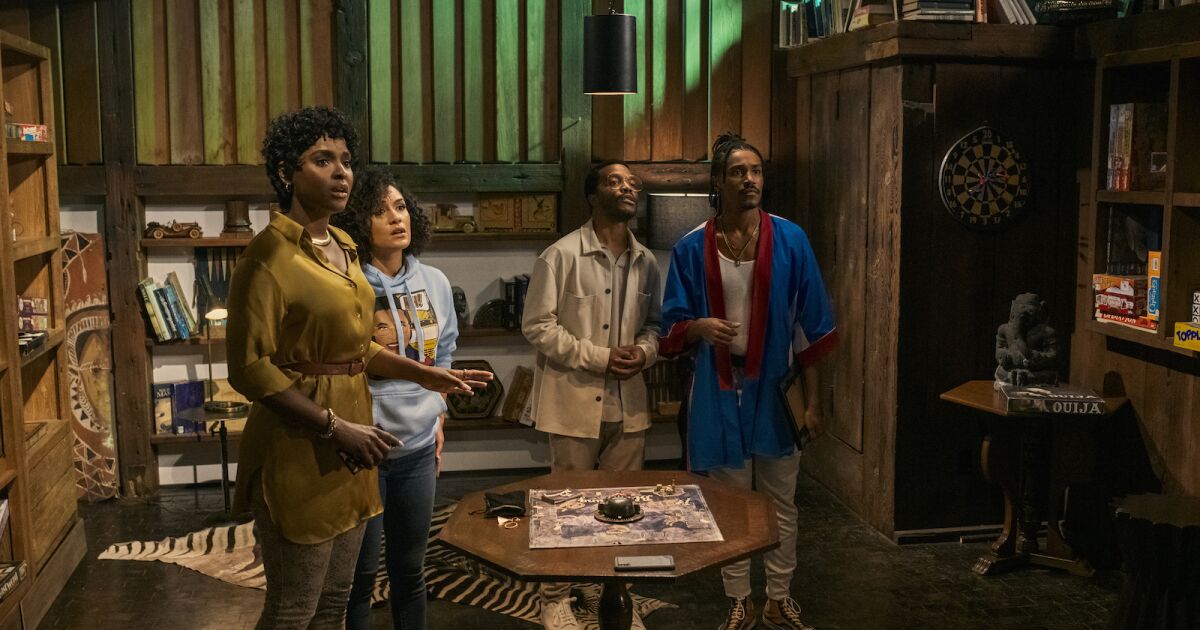
Antoinette Robertson, left, Sinqua Walls and Dewayne Perkins in the movie “The Blackening.”
(Glen Wilson / Lionsgate)
The party crackles with tension fueled by long interpersonal histories and resentments, amped up by booze, psychedelics and a weird old college chum, Clifton (Jermaine Fowler). In a mysterious game room, they stumble upon a board game called the Blackening and a closed-circuit television that reveals their host Morgan (Yvonne Orji) has been abducted by a leather-faced killer. The unsettlingly racist caricature at the center of the game torments them with increasingly challenging trivia questions about Black history and culture, with the goal of saving Morgan, but soon the stakes are heightened — they have to choose “the Blackest” among them to sacrifice.
“The Blackening” fires on all cylinders when the friends are dissecting Black culture, puzzling through questions about how many Black characters appeared on “Friends,” the mathematics of Nas songs, the merits of various Aunt Vivs on “The Fresh Prince of Bel-Air.” The dialogue feels like the way friends actually talk, laden with movie and TV references, lovingly roasting each other.
The social commentary swings from pop to political, all with the same light but incisive tone, which is what makes “The Blackening” both entertaining and trenchant. But in terms of suspense and horror filmmaking, the movie is lacking. It’s not scary, the villain seems obvious from the jump, and there are a few missed opportunities and loose ends, storywise. It succeeds as a comedy but not quite as a horror film, the genre merely a setting and style for sending up insidious character stereotypes.
However, screenwriter Perkins delivers a starmaking performance as the ultra-bothered Dewayne, who is feuding with his best friend Lisa (Antoinette Robertson) over her reunion with the formerly philandering Nnamdi (Sinqua Walls). Though it’s an ensemble piece (X Mayo is also a standout), your attention never leaves Perkins when he’s onscreen. Perhaps because he wrote and performed in both the original sketch and the screenplay, he seems more finely attuned to the rhythms and nuances of the material and the purpose that it is intended to serve.
Consider “The Blackening” not just a send-up, but a send-off to this old cliché. Here’s to finally killing “the Black character dies first” trope once and for all, and crossing our fingers that it doesn’t pop up again, Michael Myers style.
Katie Walsh is a Tribune News Service film critic.
‘The Blackening’
Rating: R, for pervasive language, violence and drug use
Running time: 1 hour, 36 minutes
Playing: Starts June 16 in general release

Horror-comedy “The Blackening” started as a way to skewer a tired trope: the frequency with which Black characters are killed first in horror movies. Though this cliché has been called out frequently by horror fans and Black audiences, here it serves as the entire premise for a feature film, posing a provocative question: If all the characters in the horror movie are Black, who dies first?
A 2018 Comedy Central sketch by the comedy group 3Peat was the proof of concept for “The Blackening,” and the video, in which a group of friends debate “who’s the Blackest” while a psycho killer stalks at the door, went viral. For the feature, the star and writer of the sketch, comedian and Emmy-nominated TV writer Dewayne Perkins partnered with writer/producer Tracy Oliver (“Girls Trip”) and director Tim Story (“Barbershop”) to expand the idea to feature length. Perkins also stars as Dewayne, one of the central members of a group of tightknit college friends who descend on a creepy old cabin in a remote location for a celebratory reunion over the Juneteenth holiday weekend.
We think we know what happens next — but “The Blackening” seeks to test our assumptions, using a slasher movie formula as a vehicle for fast, funny and whip-smart cultural commentary.
Antoinette Robertson, left, Sinqua Walls and Dewayne Perkins in the movie “The Blackening.”
(Glen Wilson / Lionsgate)
The party crackles with tension fueled by long interpersonal histories and resentments, amped up by booze, psychedelics and a weird old college chum, Clifton (Jermaine Fowler). In a mysterious game room, they stumble upon a board game called the Blackening and a closed-circuit television that reveals their host Morgan (Yvonne Orji) has been abducted by a leather-faced killer. The unsettlingly racist caricature at the center of the game torments them with increasingly challenging trivia questions about Black history and culture, with the goal of saving Morgan, but soon the stakes are heightened — they have to choose “the Blackest” among them to sacrifice.
“The Blackening” fires on all cylinders when the friends are dissecting Black culture, puzzling through questions about how many Black characters appeared on “Friends,” the mathematics of Nas songs, the merits of various Aunt Vivs on “The Fresh Prince of Bel-Air.” The dialogue feels like the way friends actually talk, laden with movie and TV references, lovingly roasting each other.
The social commentary swings from pop to political, all with the same light but incisive tone, which is what makes “The Blackening” both entertaining and trenchant. But in terms of suspense and horror filmmaking, the movie is lacking. It’s not scary, the villain seems obvious from the jump, and there are a few missed opportunities and loose ends, storywise. It succeeds as a comedy but not quite as a horror film, the genre merely a setting and style for sending up insidious character stereotypes.
However, screenwriter Perkins delivers a starmaking performance as the ultra-bothered Dewayne, who is feuding with his best friend Lisa (Antoinette Robertson) over her reunion with the formerly philandering Nnamdi (Sinqua Walls). Though it’s an ensemble piece (X Mayo is also a standout), your attention never leaves Perkins when he’s onscreen. Perhaps because he wrote and performed in both the original sketch and the screenplay, he seems more finely attuned to the rhythms and nuances of the material and the purpose that it is intended to serve.
Consider “The Blackening” not just a send-up, but a send-off to this old cliché. Here’s to finally killing “the Black character dies first” trope once and for all, and crossing our fingers that it doesn’t pop up again, Michael Myers style.
Katie Walsh is a Tribune News Service film critic.
‘The Blackening’
Rating: R, for pervasive language, violence and drug use
Running time: 1 hour, 36 minutes
Playing: Starts June 16 in general release

Horror-comedy “The Blackening” started as a way to skewer a tired trope: the frequency with which Black characters are killed first in horror movies. Though this cliché has been called out frequently by horror fans and Black audiences, here it serves as the entire premise for a feature film, posing a provocative question: If all the characters in the horror movie are Black, who dies first?
A 2018 Comedy Central sketch by the comedy group 3Peat was the proof of concept for “The Blackening,” and the video, in which a group of friends debate “who’s the Blackest” while a psycho killer stalks at the door, went viral. For the feature, the star and writer of the sketch, comedian and Emmy-nominated TV writer Dewayne Perkins partnered with writer/producer Tracy Oliver (“Girls Trip”) and director Tim Story (“Barbershop”) to expand the idea to feature length. Perkins also stars as Dewayne, one of the central members of a group of tightknit college friends who descend on a creepy old cabin in a remote location for a celebratory reunion over the Juneteenth holiday weekend.
We think we know what happens next — but “The Blackening” seeks to test our assumptions, using a slasher movie formula as a vehicle for fast, funny and whip-smart cultural commentary.
Antoinette Robertson, left, Sinqua Walls and Dewayne Perkins in the movie “The Blackening.”
(Glen Wilson / Lionsgate)
The party crackles with tension fueled by long interpersonal histories and resentments, amped up by booze, psychedelics and a weird old college chum, Clifton (Jermaine Fowler). In a mysterious game room, they stumble upon a board game called the Blackening and a closed-circuit television that reveals their host Morgan (Yvonne Orji) has been abducted by a leather-faced killer. The unsettlingly racist caricature at the center of the game torments them with increasingly challenging trivia questions about Black history and culture, with the goal of saving Morgan, but soon the stakes are heightened — they have to choose “the Blackest” among them to sacrifice.
“The Blackening” fires on all cylinders when the friends are dissecting Black culture, puzzling through questions about how many Black characters appeared on “Friends,” the mathematics of Nas songs, the merits of various Aunt Vivs on “The Fresh Prince of Bel-Air.” The dialogue feels like the way friends actually talk, laden with movie and TV references, lovingly roasting each other.
The social commentary swings from pop to political, all with the same light but incisive tone, which is what makes “The Blackening” both entertaining and trenchant. But in terms of suspense and horror filmmaking, the movie is lacking. It’s not scary, the villain seems obvious from the jump, and there are a few missed opportunities and loose ends, storywise. It succeeds as a comedy but not quite as a horror film, the genre merely a setting and style for sending up insidious character stereotypes.
However, screenwriter Perkins delivers a starmaking performance as the ultra-bothered Dewayne, who is feuding with his best friend Lisa (Antoinette Robertson) over her reunion with the formerly philandering Nnamdi (Sinqua Walls). Though it’s an ensemble piece (X Mayo is also a standout), your attention never leaves Perkins when he’s onscreen. Perhaps because he wrote and performed in both the original sketch and the screenplay, he seems more finely attuned to the rhythms and nuances of the material and the purpose that it is intended to serve.
Consider “The Blackening” not just a send-up, but a send-off to this old cliché. Here’s to finally killing “the Black character dies first” trope once and for all, and crossing our fingers that it doesn’t pop up again, Michael Myers style.
Katie Walsh is a Tribune News Service film critic.
‘The Blackening’
Rating: R, for pervasive language, violence and drug use
Running time: 1 hour, 36 minutes
Playing: Starts June 16 in general release
Horror-comedy “The Blackening” started as a way to skewer a tired trope: the frequency with which Black characters are killed first in horror movies. Though this cliché has been called out frequently by horror fans and Black audiences, here it serves as the entire premise for a feature film, posing a provocative question: If all the characters in the horror movie are Black, who dies first?
A 2018 Comedy Central sketch by the comedy group 3Peat was the proof of concept for “The Blackening,” and the video, in which a group of friends debate “who’s the Blackest” while a psycho killer stalks at the door, went viral. For the feature, the star and writer of the sketch, comedian and Emmy-nominated TV writer Dewayne Perkins partnered with writer/producer Tracy Oliver (“Girls Trip”) and director Tim Story (“Barbershop”) to expand the idea to feature length. Perkins also stars as Dewayne, one of the central members of a group of tightknit college friends who descend on a creepy old cabin in a remote location for a celebratory reunion over the Juneteenth holiday weekend.
We think we know what happens next — but “The Blackening” seeks to test our assumptions, using a slasher movie formula as a vehicle for fast, funny and whip-smart cultural commentary.
Antoinette Robertson, left, Sinqua Walls and Dewayne Perkins in the movie “The Blackening.”
(Glen Wilson / Lionsgate)
The party crackles with tension fueled by long interpersonal histories and resentments, amped up by booze, psychedelics and a weird old college chum, Clifton (Jermaine Fowler). In a mysterious game room, they stumble upon a board game called the Blackening and a closed-circuit television that reveals their host Morgan (Yvonne Orji) has been abducted by a leather-faced killer. The unsettlingly racist caricature at the center of the game torments them with increasingly challenging trivia questions about Black history and culture, with the goal of saving Morgan, but soon the stakes are heightened — they have to choose “the Blackest” among them to sacrifice.
“The Blackening” fires on all cylinders when the friends are dissecting Black culture, puzzling through questions about how many Black characters appeared on “Friends,” the mathematics of Nas songs, the merits of various Aunt Vivs on “The Fresh Prince of Bel-Air.” The dialogue feels like the way friends actually talk, laden with movie and TV references, lovingly roasting each other.
The social commentary swings from pop to political, all with the same light but incisive tone, which is what makes “The Blackening” both entertaining and trenchant. But in terms of suspense and horror filmmaking, the movie is lacking. It’s not scary, the villain seems obvious from the jump, and there are a few missed opportunities and loose ends, storywise. It succeeds as a comedy but not quite as a horror film, the genre merely a setting and style for sending up insidious character stereotypes.
However, screenwriter Perkins delivers a starmaking performance as the ultra-bothered Dewayne, who is feuding with his best friend Lisa (Antoinette Robertson) over her reunion with the formerly philandering Nnamdi (Sinqua Walls). Though it’s an ensemble piece (X Mayo is also a standout), your attention never leaves Perkins when he’s onscreen. Perhaps because he wrote and performed in both the original sketch and the screenplay, he seems more finely attuned to the rhythms and nuances of the material and the purpose that it is intended to serve.
Consider “The Blackening” not just a send-up, but a send-off to this old cliché. Here’s to finally killing “the Black character dies first” trope once and for all, and crossing our fingers that it doesn’t pop up again, Michael Myers style.
Katie Walsh is a Tribune News Service film critic.
‘The Blackening’
Rating: R, for pervasive language, violence and drug use
Running time: 1 hour, 36 minutes
Playing: Starts June 16 in general release

Horror-comedy “The Blackening” started as a way to skewer a tired trope: the frequency with which Black characters are killed first in horror movies. Though this cliché has been called out frequently by horror fans and Black audiences, here it serves as the entire premise for a feature film, posing a provocative question: If all the characters in the horror movie are Black, who dies first?
A 2018 Comedy Central sketch by the comedy group 3Peat was the proof of concept for “The Blackening,” and the video, in which a group of friends debate “who’s the Blackest” while a psycho killer stalks at the door, went viral. For the feature, the star and writer of the sketch, comedian and Emmy-nominated TV writer Dewayne Perkins partnered with writer/producer Tracy Oliver (“Girls Trip”) and director Tim Story (“Barbershop”) to expand the idea to feature length. Perkins also stars as Dewayne, one of the central members of a group of tightknit college friends who descend on a creepy old cabin in a remote location for a celebratory reunion over the Juneteenth holiday weekend.
We think we know what happens next — but “The Blackening” seeks to test our assumptions, using a slasher movie formula as a vehicle for fast, funny and whip-smart cultural commentary.
Antoinette Robertson, left, Sinqua Walls and Dewayne Perkins in the movie “The Blackening.”
(Glen Wilson / Lionsgate)
The party crackles with tension fueled by long interpersonal histories and resentments, amped up by booze, psychedelics and a weird old college chum, Clifton (Jermaine Fowler). In a mysterious game room, they stumble upon a board game called the Blackening and a closed-circuit television that reveals their host Morgan (Yvonne Orji) has been abducted by a leather-faced killer. The unsettlingly racist caricature at the center of the game torments them with increasingly challenging trivia questions about Black history and culture, with the goal of saving Morgan, but soon the stakes are heightened — they have to choose “the Blackest” among them to sacrifice.
“The Blackening” fires on all cylinders when the friends are dissecting Black culture, puzzling through questions about how many Black characters appeared on “Friends,” the mathematics of Nas songs, the merits of various Aunt Vivs on “The Fresh Prince of Bel-Air.” The dialogue feels like the way friends actually talk, laden with movie and TV references, lovingly roasting each other.
The social commentary swings from pop to political, all with the same light but incisive tone, which is what makes “The Blackening” both entertaining and trenchant. But in terms of suspense and horror filmmaking, the movie is lacking. It’s not scary, the villain seems obvious from the jump, and there are a few missed opportunities and loose ends, storywise. It succeeds as a comedy but not quite as a horror film, the genre merely a setting and style for sending up insidious character stereotypes.
However, screenwriter Perkins delivers a starmaking performance as the ultra-bothered Dewayne, who is feuding with his best friend Lisa (Antoinette Robertson) over her reunion with the formerly philandering Nnamdi (Sinqua Walls). Though it’s an ensemble piece (X Mayo is also a standout), your attention never leaves Perkins when he’s onscreen. Perhaps because he wrote and performed in both the original sketch and the screenplay, he seems more finely attuned to the rhythms and nuances of the material and the purpose that it is intended to serve.
Consider “The Blackening” not just a send-up, but a send-off to this old cliché. Here’s to finally killing “the Black character dies first” trope once and for all, and crossing our fingers that it doesn’t pop up again, Michael Myers style.
Katie Walsh is a Tribune News Service film critic.
‘The Blackening’
Rating: R, for pervasive language, violence and drug use
Running time: 1 hour, 36 minutes
Playing: Starts June 16 in general release
Horror-comedy “The Blackening” started as a way to skewer a tired trope: the frequency with which Black characters are killed first in horror movies. Though this cliché has been called out frequently by horror fans and Black audiences, here it serves as the entire premise for a feature film, posing a provocative question: If all the characters in the horror movie are Black, who dies first?
A 2018 Comedy Central sketch by the comedy group 3Peat was the proof of concept for “The Blackening,” and the video, in which a group of friends debate “who’s the Blackest” while a psycho killer stalks at the door, went viral. For the feature, the star and writer of the sketch, comedian and Emmy-nominated TV writer Dewayne Perkins partnered with writer/producer Tracy Oliver (“Girls Trip”) and director Tim Story (“Barbershop”) to expand the idea to feature length. Perkins also stars as Dewayne, one of the central members of a group of tightknit college friends who descend on a creepy old cabin in a remote location for a celebratory reunion over the Juneteenth holiday weekend.
We think we know what happens next — but “The Blackening” seeks to test our assumptions, using a slasher movie formula as a vehicle for fast, funny and whip-smart cultural commentary.
Antoinette Robertson, left, Sinqua Walls and Dewayne Perkins in the movie “The Blackening.”
(Glen Wilson / Lionsgate)
The party crackles with tension fueled by long interpersonal histories and resentments, amped up by booze, psychedelics and a weird old college chum, Clifton (Jermaine Fowler). In a mysterious game room, they stumble upon a board game called the Blackening and a closed-circuit television that reveals their host Morgan (Yvonne Orji) has been abducted by a leather-faced killer. The unsettlingly racist caricature at the center of the game torments them with increasingly challenging trivia questions about Black history and culture, with the goal of saving Morgan, but soon the stakes are heightened — they have to choose “the Blackest” among them to sacrifice.
“The Blackening” fires on all cylinders when the friends are dissecting Black culture, puzzling through questions about how many Black characters appeared on “Friends,” the mathematics of Nas songs, the merits of various Aunt Vivs on “The Fresh Prince of Bel-Air.” The dialogue feels like the way friends actually talk, laden with movie and TV references, lovingly roasting each other.
The social commentary swings from pop to political, all with the same light but incisive tone, which is what makes “The Blackening” both entertaining and trenchant. But in terms of suspense and horror filmmaking, the movie is lacking. It’s not scary, the villain seems obvious from the jump, and there are a few missed opportunities and loose ends, storywise. It succeeds as a comedy but not quite as a horror film, the genre merely a setting and style for sending up insidious character stereotypes.
However, screenwriter Perkins delivers a starmaking performance as the ultra-bothered Dewayne, who is feuding with his best friend Lisa (Antoinette Robertson) over her reunion with the formerly philandering Nnamdi (Sinqua Walls). Though it’s an ensemble piece (X Mayo is also a standout), your attention never leaves Perkins when he’s onscreen. Perhaps because he wrote and performed in both the original sketch and the screenplay, he seems more finely attuned to the rhythms and nuances of the material and the purpose that it is intended to serve.
Consider “The Blackening” not just a send-up, but a send-off to this old cliché. Here’s to finally killing “the Black character dies first” trope once and for all, and crossing our fingers that it doesn’t pop up again, Michael Myers style.
Katie Walsh is a Tribune News Service film critic.
‘The Blackening’
Rating: R, for pervasive language, violence and drug use
Running time: 1 hour, 36 minutes
Playing: Starts June 16 in general release
Horror-comedy “The Blackening” started as a way to skewer a tired trope: the frequency with which Black characters are killed first in horror movies. Though this cliché has been called out frequently by horror fans and Black audiences, here it serves as the entire premise for a feature film, posing a provocative question: If all the characters in the horror movie are Black, who dies first?
A 2018 Comedy Central sketch by the comedy group 3Peat was the proof of concept for “The Blackening,” and the video, in which a group of friends debate “who’s the Blackest” while a psycho killer stalks at the door, went viral. For the feature, the star and writer of the sketch, comedian and Emmy-nominated TV writer Dewayne Perkins partnered with writer/producer Tracy Oliver (“Girls Trip”) and director Tim Story (“Barbershop”) to expand the idea to feature length. Perkins also stars as Dewayne, one of the central members of a group of tightknit college friends who descend on a creepy old cabin in a remote location for a celebratory reunion over the Juneteenth holiday weekend.
We think we know what happens next — but “The Blackening” seeks to test our assumptions, using a slasher movie formula as a vehicle for fast, funny and whip-smart cultural commentary.
Antoinette Robertson, left, Sinqua Walls and Dewayne Perkins in the movie “The Blackening.”
(Glen Wilson / Lionsgate)
The party crackles with tension fueled by long interpersonal histories and resentments, amped up by booze, psychedelics and a weird old college chum, Clifton (Jermaine Fowler). In a mysterious game room, they stumble upon a board game called the Blackening and a closed-circuit television that reveals their host Morgan (Yvonne Orji) has been abducted by a leather-faced killer. The unsettlingly racist caricature at the center of the game torments them with increasingly challenging trivia questions about Black history and culture, with the goal of saving Morgan, but soon the stakes are heightened — they have to choose “the Blackest” among them to sacrifice.
“The Blackening” fires on all cylinders when the friends are dissecting Black culture, puzzling through questions about how many Black characters appeared on “Friends,” the mathematics of Nas songs, the merits of various Aunt Vivs on “The Fresh Prince of Bel-Air.” The dialogue feels like the way friends actually talk, laden with movie and TV references, lovingly roasting each other.
The social commentary swings from pop to political, all with the same light but incisive tone, which is what makes “The Blackening” both entertaining and trenchant. But in terms of suspense and horror filmmaking, the movie is lacking. It’s not scary, the villain seems obvious from the jump, and there are a few missed opportunities and loose ends, storywise. It succeeds as a comedy but not quite as a horror film, the genre merely a setting and style for sending up insidious character stereotypes.
However, screenwriter Perkins delivers a starmaking performance as the ultra-bothered Dewayne, who is feuding with his best friend Lisa (Antoinette Robertson) over her reunion with the formerly philandering Nnamdi (Sinqua Walls). Though it’s an ensemble piece (X Mayo is also a standout), your attention never leaves Perkins when he’s onscreen. Perhaps because he wrote and performed in both the original sketch and the screenplay, he seems more finely attuned to the rhythms and nuances of the material and the purpose that it is intended to serve.
Consider “The Blackening” not just a send-up, but a send-off to this old cliché. Here’s to finally killing “the Black character dies first” trope once and for all, and crossing our fingers that it doesn’t pop up again, Michael Myers style.
Katie Walsh is a Tribune News Service film critic.
‘The Blackening’
Rating: R, for pervasive language, violence and drug use
Running time: 1 hour, 36 minutes
Playing: Starts June 16 in general release
Horror-comedy “The Blackening” started as a way to skewer a tired trope: the frequency with which Black characters are killed first in horror movies. Though this cliché has been called out frequently by horror fans and Black audiences, here it serves as the entire premise for a feature film, posing a provocative question: If all the characters in the horror movie are Black, who dies first?
A 2018 Comedy Central sketch by the comedy group 3Peat was the proof of concept for “The Blackening,” and the video, in which a group of friends debate “who’s the Blackest” while a psycho killer stalks at the door, went viral. For the feature, the star and writer of the sketch, comedian and Emmy-nominated TV writer Dewayne Perkins partnered with writer/producer Tracy Oliver (“Girls Trip”) and director Tim Story (“Barbershop”) to expand the idea to feature length. Perkins also stars as Dewayne, one of the central members of a group of tightknit college friends who descend on a creepy old cabin in a remote location for a celebratory reunion over the Juneteenth holiday weekend.
We think we know what happens next — but “The Blackening” seeks to test our assumptions, using a slasher movie formula as a vehicle for fast, funny and whip-smart cultural commentary.
Antoinette Robertson, left, Sinqua Walls and Dewayne Perkins in the movie “The Blackening.”
(Glen Wilson / Lionsgate)
The party crackles with tension fueled by long interpersonal histories and resentments, amped up by booze, psychedelics and a weird old college chum, Clifton (Jermaine Fowler). In a mysterious game room, they stumble upon a board game called the Blackening and a closed-circuit television that reveals their host Morgan (Yvonne Orji) has been abducted by a leather-faced killer. The unsettlingly racist caricature at the center of the game torments them with increasingly challenging trivia questions about Black history and culture, with the goal of saving Morgan, but soon the stakes are heightened — they have to choose “the Blackest” among them to sacrifice.
“The Blackening” fires on all cylinders when the friends are dissecting Black culture, puzzling through questions about how many Black characters appeared on “Friends,” the mathematics of Nas songs, the merits of various Aunt Vivs on “The Fresh Prince of Bel-Air.” The dialogue feels like the way friends actually talk, laden with movie and TV references, lovingly roasting each other.
The social commentary swings from pop to political, all with the same light but incisive tone, which is what makes “The Blackening” both entertaining and trenchant. But in terms of suspense and horror filmmaking, the movie is lacking. It’s not scary, the villain seems obvious from the jump, and there are a few missed opportunities and loose ends, storywise. It succeeds as a comedy but not quite as a horror film, the genre merely a setting and style for sending up insidious character stereotypes.
However, screenwriter Perkins delivers a starmaking performance as the ultra-bothered Dewayne, who is feuding with his best friend Lisa (Antoinette Robertson) over her reunion with the formerly philandering Nnamdi (Sinqua Walls). Though it’s an ensemble piece (X Mayo is also a standout), your attention never leaves Perkins when he’s onscreen. Perhaps because he wrote and performed in both the original sketch and the screenplay, he seems more finely attuned to the rhythms and nuances of the material and the purpose that it is intended to serve.
Consider “The Blackening” not just a send-up, but a send-off to this old cliché. Here’s to finally killing “the Black character dies first” trope once and for all, and crossing our fingers that it doesn’t pop up again, Michael Myers style.
Katie Walsh is a Tribune News Service film critic.
‘The Blackening’
Rating: R, for pervasive language, violence and drug use
Running time: 1 hour, 36 minutes
Playing: Starts June 16 in general release