

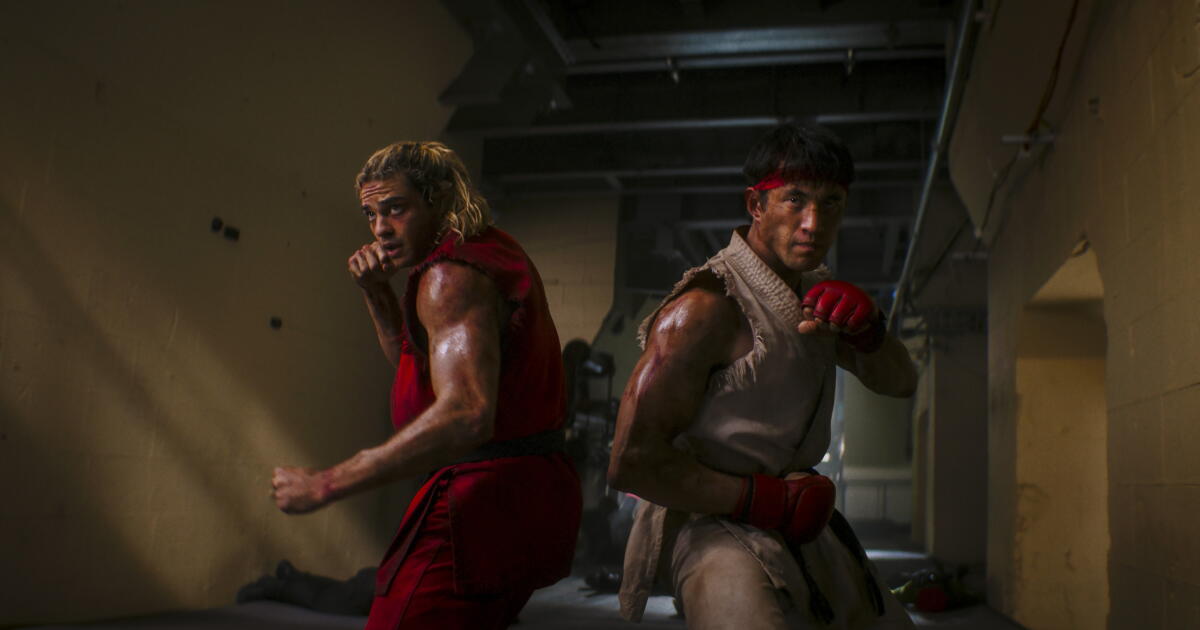
As one would expect, fight scenes litter the new “Street Fighter,” Hollywood’s third stab at making the popular video game a viable big-screen franchise. But none of that martial-arts mayhem is as compelling as the battle being waged behind the scenes as director Kitao Sakurai tries to insert his irreverent, ironic approach into a property resistant to that kind of impish goofing around.
One of the architects of the anti-talk show “The Eric Andre Show” and the raucous 2021 hidden-camera comedy “Bad Trip” — both of them aided and abetted by frequent collaborator Eric André — Sakurai relishes exploding tired showbiz conventions. But in his attempt to lend a little hipness to “Street Fighter,” he ends up far more pummeled than competitors in the World Warrior Tournament.
Set in 1993, the film centers on the estranged friendship between Ken Masters (Noah Centineo) and Ryu (Andrew Koji), who were as close as brothers when they were mentored by their wise master Gouken (Don Lee). But after Gouken’s tragic murder — the particulars will eventually be revealed in flashbacks — Ken and Ryu went their separate ways, Ken never forgiving Ryu for failing to save Gouken’s life. It has now been six years since the two men spoke, with Ryu going into seclusion and Ken selling out, hawking products like Duracell while signing up for gimmicky bouts unworthy of his talent.
The plot gets rolling once Ken and Ryu both enter the second World Warrior Tournament, the first since 1987, which Ryu won. But neither man realizes that the tyrannical ruler Lord M. Bison (David Dastmalchian) has staged the event as a ploy to gather the planet’s finest fighters so he can drain them of their powers.
Early on, Sakurai exploits the inherent absurdity of telling a story populated by so many ludicrous characters. By the standards of “Street Fighter,” Ken and Ryu are actually fairly normal — this is a bizarro universe in which Bison dresses like a Nazi fashionista, complete with flowing cape and a peaked cap. There are green-skinned beasts and monosyllabic men with impossibly tall blond hair. One reason the first film adaptation of “Street Fighter,” which came out in 1994 and starred Jean-Claude Van Damme, was unintentionally hilarious was that writer-director Steven E. de Souza took the game’s one-note avatars seriously. Sakurai is already ahead of the curve by leaning into the material’s brainless escapism.
But acknowledging a property’s cheesy elements isn’t the same as generating consistent laughs from the situation. Ever since the success of the 2012 comedy “21 Jump Street,” filmmakers have tried to resuscitate moribund IP by mocking its datedness. But from “Baywatch” to this summer’s “Masters of the Universe,” we’ve endured plenty of painful illustrations of the trend’s downside: If what you’re rebooting is so bad, why make us sit through it?
Sakurai is helped by the fact that he clearly loves the Capcom video game series, which debuted in 1987. Before there was a “Mortal Kombat,” “Street Fighter” resonated because of its simplicity — you have to beat up somebody before they beat you up — and Sakurai doesn’t overthink the game’s primal appeal. While none of the movie’s fight sequences are especially inspired, there are many of them and they go on forever.
Whereas the woeful video game movies of the 1990s were doomed by junky production design, this new “Street Fighter” benefits from a slick sheen that gives the film the dank aura of a second-tier “Blade Runner.” The flashbacks are rendered in dynamic hand-drawn animation that harkens back to 1990s Japanese anime. Sakurai further gooses the nostalgia factor by laying in time-capsule radio smashes, with 4 Non Blondes’ “What’s Up?” proving particularly important to the plot. The director even sneaks in homages that only hardcore fans will appreciate, such as having Dastmalchian repeat a line from the 1994 film that Raul Julia made indelible when he played Bison — his final role.
But although there’s a refreshing lack of snark in “Street Fighter’s” playful humor, the demands of brand management soon overwhelm whatever prankster ideas that Sakurai (who also co-wrote the script) might have had in mind. André quips as fast as he can as the caffeinated tournament emcee, but without his usual surreal surroundings, the comedian’s rapid-fire riffing feels like a limp rebuke to the corporate product in which he finds himself. And Dastmalchian, who portrays Bison with an emphasis on sniveling evil, struggles to quietly undercut the character’s cartoonishly menacing getup.
What we’re left with is a wannabe blockbuster shadowboxing with itself. Sakurai hopes to show us a good time while delivering the desired fan service and overblown spectacle. But as the movie awkwardly pivots to weighty themes like forgiveness, honor and grief, the initial sparks of subversiveness fizzle out. As silly as many of these characters are, it’s Sakurai’s aspirations that ultimately look ridiculous.
‘Street Fighter’
Rated: PG 13, for violence/action, bloody images, strong language, sexual references, partial nudity and brief smoking
Running time: 1 hour, 59 minutes
Playing: Opens Friday, Oct 16 in wide release

As one would expect, fight scenes litter the new “Street Fighter,” Hollywood’s third stab at making the popular video game a viable big-screen franchise. But none of that martial-arts mayhem is as compelling as the battle being waged behind the scenes as director Kitao Sakurai tries to insert his irreverent, ironic approach into a property resistant to that kind of impish goofing around.
One of the architects of the anti-talk show “The Eric Andre Show” and the raucous 2021 hidden-camera comedy “Bad Trip” — both of them aided and abetted by frequent collaborator Eric André — Sakurai relishes exploding tired showbiz conventions. But in his attempt to lend a little hipness to “Street Fighter,” he ends up far more pummeled than competitors in the World Warrior Tournament.
Set in 1993, the film centers on the estranged friendship between Ken Masters (Noah Centineo) and Ryu (Andrew Koji), who were as close as brothers when they were mentored by their wise master Gouken (Don Lee). But after Gouken’s tragic murder — the particulars will eventually be revealed in flashbacks — Ken and Ryu went their separate ways, Ken never forgiving Ryu for failing to save Gouken’s life. It has now been six years since the two men spoke, with Ryu going into seclusion and Ken selling out, hawking products like Duracell while signing up for gimmicky bouts unworthy of his talent.
The plot gets rolling once Ken and Ryu both enter the second World Warrior Tournament, the first since 1987, which Ryu won. But neither man realizes that the tyrannical ruler Lord M. Bison (David Dastmalchian) has staged the event as a ploy to gather the planet’s finest fighters so he can drain them of their powers.
Early on, Sakurai exploits the inherent absurdity of telling a story populated by so many ludicrous characters. By the standards of “Street Fighter,” Ken and Ryu are actually fairly normal — this is a bizarro universe in which Bison dresses like a Nazi fashionista, complete with flowing cape and a peaked cap. There are green-skinned beasts and monosyllabic men with impossibly tall blond hair. One reason the first film adaptation of “Street Fighter,” which came out in 1994 and starred Jean-Claude Van Damme, was unintentionally hilarious was that writer-director Steven E. de Souza took the game’s one-note avatars seriously. Sakurai is already ahead of the curve by leaning into the material’s brainless escapism.
But acknowledging a property’s cheesy elements isn’t the same as generating consistent laughs from the situation. Ever since the success of the 2012 comedy “21 Jump Street,” filmmakers have tried to resuscitate moribund IP by mocking its datedness. But from “Baywatch” to this summer’s “Masters of the Universe,” we’ve endured plenty of painful illustrations of the trend’s downside: If what you’re rebooting is so bad, why make us sit through it?
Sakurai is helped by the fact that he clearly loves the Capcom video game series, which debuted in 1987. Before there was a “Mortal Kombat,” “Street Fighter” resonated because of its simplicity — you have to beat up somebody before they beat you up — and Sakurai doesn’t overthink the game’s primal appeal. While none of the movie’s fight sequences are especially inspired, there are many of them and they go on forever.
Whereas the woeful video game movies of the 1990s were doomed by junky production design, this new “Street Fighter” benefits from a slick sheen that gives the film the dank aura of a second-tier “Blade Runner.” The flashbacks are rendered in dynamic hand-drawn animation that harkens back to 1990s Japanese anime. Sakurai further gooses the nostalgia factor by laying in time-capsule radio smashes, with 4 Non Blondes’ “What’s Up?” proving particularly important to the plot. The director even sneaks in homages that only hardcore fans will appreciate, such as having Dastmalchian repeat a line from the 1994 film that Raul Julia made indelible when he played Bison — his final role.
But although there’s a refreshing lack of snark in “Street Fighter’s” playful humor, the demands of brand management soon overwhelm whatever prankster ideas that Sakurai (who also co-wrote the script) might have had in mind. André quips as fast as he can as the caffeinated tournament emcee, but without his usual surreal surroundings, the comedian’s rapid-fire riffing feels like a limp rebuke to the corporate product in which he finds himself. And Dastmalchian, who portrays Bison with an emphasis on sniveling evil, struggles to quietly undercut the character’s cartoonishly menacing getup.
What we’re left with is a wannabe blockbuster shadowboxing with itself. Sakurai hopes to show us a good time while delivering the desired fan service and overblown spectacle. But as the movie awkwardly pivots to weighty themes like forgiveness, honor and grief, the initial sparks of subversiveness fizzle out. As silly as many of these characters are, it’s Sakurai’s aspirations that ultimately look ridiculous.
‘Street Fighter’
Rated: PG 13, for violence/action, bloody images, strong language, sexual references, partial nudity and brief smoking
Running time: 1 hour, 59 minutes
Playing: Opens Friday, Oct 16 in wide release

As one would expect, fight scenes litter the new “Street Fighter,” Hollywood’s third stab at making the popular video game a viable big-screen franchise. But none of that martial-arts mayhem is as compelling as the battle being waged behind the scenes as director Kitao Sakurai tries to insert his irreverent, ironic approach into a property resistant to that kind of impish goofing around.
One of the architects of the anti-talk show “The Eric Andre Show” and the raucous 2021 hidden-camera comedy “Bad Trip” — both of them aided and abetted by frequent collaborator Eric André — Sakurai relishes exploding tired showbiz conventions. But in his attempt to lend a little hipness to “Street Fighter,” he ends up far more pummeled than competitors in the World Warrior Tournament.
Set in 1993, the film centers on the estranged friendship between Ken Masters (Noah Centineo) and Ryu (Andrew Koji), who were as close as brothers when they were mentored by their wise master Gouken (Don Lee). But after Gouken’s tragic murder — the particulars will eventually be revealed in flashbacks — Ken and Ryu went their separate ways, Ken never forgiving Ryu for failing to save Gouken’s life. It has now been six years since the two men spoke, with Ryu going into seclusion and Ken selling out, hawking products like Duracell while signing up for gimmicky bouts unworthy of his talent.
The plot gets rolling once Ken and Ryu both enter the second World Warrior Tournament, the first since 1987, which Ryu won. But neither man realizes that the tyrannical ruler Lord M. Bison (David Dastmalchian) has staged the event as a ploy to gather the planet’s finest fighters so he can drain them of their powers.
Early on, Sakurai exploits the inherent absurdity of telling a story populated by so many ludicrous characters. By the standards of “Street Fighter,” Ken and Ryu are actually fairly normal — this is a bizarro universe in which Bison dresses like a Nazi fashionista, complete with flowing cape and a peaked cap. There are green-skinned beasts and monosyllabic men with impossibly tall blond hair. One reason the first film adaptation of “Street Fighter,” which came out in 1994 and starred Jean-Claude Van Damme, was unintentionally hilarious was that writer-director Steven E. de Souza took the game’s one-note avatars seriously. Sakurai is already ahead of the curve by leaning into the material’s brainless escapism.
But acknowledging a property’s cheesy elements isn’t the same as generating consistent laughs from the situation. Ever since the success of the 2012 comedy “21 Jump Street,” filmmakers have tried to resuscitate moribund IP by mocking its datedness. But from “Baywatch” to this summer’s “Masters of the Universe,” we’ve endured plenty of painful illustrations of the trend’s downside: If what you’re rebooting is so bad, why make us sit through it?
Sakurai is helped by the fact that he clearly loves the Capcom video game series, which debuted in 1987. Before there was a “Mortal Kombat,” “Street Fighter” resonated because of its simplicity — you have to beat up somebody before they beat you up — and Sakurai doesn’t overthink the game’s primal appeal. While none of the movie’s fight sequences are especially inspired, there are many of them and they go on forever.
Whereas the woeful video game movies of the 1990s were doomed by junky production design, this new “Street Fighter” benefits from a slick sheen that gives the film the dank aura of a second-tier “Blade Runner.” The flashbacks are rendered in dynamic hand-drawn animation that harkens back to 1990s Japanese anime. Sakurai further gooses the nostalgia factor by laying in time-capsule radio smashes, with 4 Non Blondes’ “What’s Up?” proving particularly important to the plot. The director even sneaks in homages that only hardcore fans will appreciate, such as having Dastmalchian repeat a line from the 1994 film that Raul Julia made indelible when he played Bison — his final role.
But although there’s a refreshing lack of snark in “Street Fighter’s” playful humor, the demands of brand management soon overwhelm whatever prankster ideas that Sakurai (who also co-wrote the script) might have had in mind. André quips as fast as he can as the caffeinated tournament emcee, but without his usual surreal surroundings, the comedian’s rapid-fire riffing feels like a limp rebuke to the corporate product in which he finds himself. And Dastmalchian, who portrays Bison with an emphasis on sniveling evil, struggles to quietly undercut the character’s cartoonishly menacing getup.
What we’re left with is a wannabe blockbuster shadowboxing with itself. Sakurai hopes to show us a good time while delivering the desired fan service and overblown spectacle. But as the movie awkwardly pivots to weighty themes like forgiveness, honor and grief, the initial sparks of subversiveness fizzle out. As silly as many of these characters are, it’s Sakurai’s aspirations that ultimately look ridiculous.
‘Street Fighter’
Rated: PG 13, for violence/action, bloody images, strong language, sexual references, partial nudity and brief smoking
Running time: 1 hour, 59 minutes
Playing: Opens Friday, Oct 16 in wide release
As one would expect, fight scenes litter the new “Street Fighter,” Hollywood’s third stab at making the popular video game a viable big-screen franchise. But none of that martial-arts mayhem is as compelling as the battle being waged behind the scenes as director Kitao Sakurai tries to insert his irreverent, ironic approach into a property resistant to that kind of impish goofing around.
One of the architects of the anti-talk show “The Eric Andre Show” and the raucous 2021 hidden-camera comedy “Bad Trip” — both of them aided and abetted by frequent collaborator Eric André — Sakurai relishes exploding tired showbiz conventions. But in his attempt to lend a little hipness to “Street Fighter,” he ends up far more pummeled than competitors in the World Warrior Tournament.
Set in 1993, the film centers on the estranged friendship between Ken Masters (Noah Centineo) and Ryu (Andrew Koji), who were as close as brothers when they were mentored by their wise master Gouken (Don Lee). But after Gouken’s tragic murder — the particulars will eventually be revealed in flashbacks — Ken and Ryu went their separate ways, Ken never forgiving Ryu for failing to save Gouken’s life. It has now been six years since the two men spoke, with Ryu going into seclusion and Ken selling out, hawking products like Duracell while signing up for gimmicky bouts unworthy of his talent.
The plot gets rolling once Ken and Ryu both enter the second World Warrior Tournament, the first since 1987, which Ryu won. But neither man realizes that the tyrannical ruler Lord M. Bison (David Dastmalchian) has staged the event as a ploy to gather the planet’s finest fighters so he can drain them of their powers.
Early on, Sakurai exploits the inherent absurdity of telling a story populated by so many ludicrous characters. By the standards of “Street Fighter,” Ken and Ryu are actually fairly normal — this is a bizarro universe in which Bison dresses like a Nazi fashionista, complete with flowing cape and a peaked cap. There are green-skinned beasts and monosyllabic men with impossibly tall blond hair. One reason the first film adaptation of “Street Fighter,” which came out in 1994 and starred Jean-Claude Van Damme, was unintentionally hilarious was that writer-director Steven E. de Souza took the game’s one-note avatars seriously. Sakurai is already ahead of the curve by leaning into the material’s brainless escapism.
But acknowledging a property’s cheesy elements isn’t the same as generating consistent laughs from the situation. Ever since the success of the 2012 comedy “21 Jump Street,” filmmakers have tried to resuscitate moribund IP by mocking its datedness. But from “Baywatch” to this summer’s “Masters of the Universe,” we’ve endured plenty of painful illustrations of the trend’s downside: If what you’re rebooting is so bad, why make us sit through it?
Sakurai is helped by the fact that he clearly loves the Capcom video game series, which debuted in 1987. Before there was a “Mortal Kombat,” “Street Fighter” resonated because of its simplicity — you have to beat up somebody before they beat you up — and Sakurai doesn’t overthink the game’s primal appeal. While none of the movie’s fight sequences are especially inspired, there are many of them and they go on forever.
Whereas the woeful video game movies of the 1990s were doomed by junky production design, this new “Street Fighter” benefits from a slick sheen that gives the film the dank aura of a second-tier “Blade Runner.” The flashbacks are rendered in dynamic hand-drawn animation that harkens back to 1990s Japanese anime. Sakurai further gooses the nostalgia factor by laying in time-capsule radio smashes, with 4 Non Blondes’ “What’s Up?” proving particularly important to the plot. The director even sneaks in homages that only hardcore fans will appreciate, such as having Dastmalchian repeat a line from the 1994 film that Raul Julia made indelible when he played Bison — his final role.
But although there’s a refreshing lack of snark in “Street Fighter’s” playful humor, the demands of brand management soon overwhelm whatever prankster ideas that Sakurai (who also co-wrote the script) might have had in mind. André quips as fast as he can as the caffeinated tournament emcee, but without his usual surreal surroundings, the comedian’s rapid-fire riffing feels like a limp rebuke to the corporate product in which he finds himself. And Dastmalchian, who portrays Bison with an emphasis on sniveling evil, struggles to quietly undercut the character’s cartoonishly menacing getup.
What we’re left with is a wannabe blockbuster shadowboxing with itself. Sakurai hopes to show us a good time while delivering the desired fan service and overblown spectacle. But as the movie awkwardly pivots to weighty themes like forgiveness, honor and grief, the initial sparks of subversiveness fizzle out. As silly as many of these characters are, it’s Sakurai’s aspirations that ultimately look ridiculous.
‘Street Fighter’
Rated: PG 13, for violence/action, bloody images, strong language, sexual references, partial nudity and brief smoking
Running time: 1 hour, 59 minutes
Playing: Opens Friday, Oct 16 in wide release

As one would expect, fight scenes litter the new “Street Fighter,” Hollywood’s third stab at making the popular video game a viable big-screen franchise. But none of that martial-arts mayhem is as compelling as the battle being waged behind the scenes as director Kitao Sakurai tries to insert his irreverent, ironic approach into a property resistant to that kind of impish goofing around.
One of the architects of the anti-talk show “The Eric Andre Show” and the raucous 2021 hidden-camera comedy “Bad Trip” — both of them aided and abetted by frequent collaborator Eric André — Sakurai relishes exploding tired showbiz conventions. But in his attempt to lend a little hipness to “Street Fighter,” he ends up far more pummeled than competitors in the World Warrior Tournament.
Set in 1993, the film centers on the estranged friendship between Ken Masters (Noah Centineo) and Ryu (Andrew Koji), who were as close as brothers when they were mentored by their wise master Gouken (Don Lee). But after Gouken’s tragic murder — the particulars will eventually be revealed in flashbacks — Ken and Ryu went their separate ways, Ken never forgiving Ryu for failing to save Gouken’s life. It has now been six years since the two men spoke, with Ryu going into seclusion and Ken selling out, hawking products like Duracell while signing up for gimmicky bouts unworthy of his talent.
The plot gets rolling once Ken and Ryu both enter the second World Warrior Tournament, the first since 1987, which Ryu won. But neither man realizes that the tyrannical ruler Lord M. Bison (David Dastmalchian) has staged the event as a ploy to gather the planet’s finest fighters so he can drain them of their powers.
Early on, Sakurai exploits the inherent absurdity of telling a story populated by so many ludicrous characters. By the standards of “Street Fighter,” Ken and Ryu are actually fairly normal — this is a bizarro universe in which Bison dresses like a Nazi fashionista, complete with flowing cape and a peaked cap. There are green-skinned beasts and monosyllabic men with impossibly tall blond hair. One reason the first film adaptation of “Street Fighter,” which came out in 1994 and starred Jean-Claude Van Damme, was unintentionally hilarious was that writer-director Steven E. de Souza took the game’s one-note avatars seriously. Sakurai is already ahead of the curve by leaning into the material’s brainless escapism.
But acknowledging a property’s cheesy elements isn’t the same as generating consistent laughs from the situation. Ever since the success of the 2012 comedy “21 Jump Street,” filmmakers have tried to resuscitate moribund IP by mocking its datedness. But from “Baywatch” to this summer’s “Masters of the Universe,” we’ve endured plenty of painful illustrations of the trend’s downside: If what you’re rebooting is so bad, why make us sit through it?
Sakurai is helped by the fact that he clearly loves the Capcom video game series, which debuted in 1987. Before there was a “Mortal Kombat,” “Street Fighter” resonated because of its simplicity — you have to beat up somebody before they beat you up — and Sakurai doesn’t overthink the game’s primal appeal. While none of the movie’s fight sequences are especially inspired, there are many of them and they go on forever.
Whereas the woeful video game movies of the 1990s were doomed by junky production design, this new “Street Fighter” benefits from a slick sheen that gives the film the dank aura of a second-tier “Blade Runner.” The flashbacks are rendered in dynamic hand-drawn animation that harkens back to 1990s Japanese anime. Sakurai further gooses the nostalgia factor by laying in time-capsule radio smashes, with 4 Non Blondes’ “What’s Up?” proving particularly important to the plot. The director even sneaks in homages that only hardcore fans will appreciate, such as having Dastmalchian repeat a line from the 1994 film that Raul Julia made indelible when he played Bison — his final role.
But although there’s a refreshing lack of snark in “Street Fighter’s” playful humor, the demands of brand management soon overwhelm whatever prankster ideas that Sakurai (who also co-wrote the script) might have had in mind. André quips as fast as he can as the caffeinated tournament emcee, but without his usual surreal surroundings, the comedian’s rapid-fire riffing feels like a limp rebuke to the corporate product in which he finds himself. And Dastmalchian, who portrays Bison with an emphasis on sniveling evil, struggles to quietly undercut the character’s cartoonishly menacing getup.
What we’re left with is a wannabe blockbuster shadowboxing with itself. Sakurai hopes to show us a good time while delivering the desired fan service and overblown spectacle. But as the movie awkwardly pivots to weighty themes like forgiveness, honor and grief, the initial sparks of subversiveness fizzle out. As silly as many of these characters are, it’s Sakurai’s aspirations that ultimately look ridiculous.
‘Street Fighter’
Rated: PG 13, for violence/action, bloody images, strong language, sexual references, partial nudity and brief smoking
Running time: 1 hour, 59 minutes
Playing: Opens Friday, Oct 16 in wide release
As one would expect, fight scenes litter the new “Street Fighter,” Hollywood’s third stab at making the popular video game a viable big-screen franchise. But none of that martial-arts mayhem is as compelling as the battle being waged behind the scenes as director Kitao Sakurai tries to insert his irreverent, ironic approach into a property resistant to that kind of impish goofing around.
One of the architects of the anti-talk show “The Eric Andre Show” and the raucous 2021 hidden-camera comedy “Bad Trip” — both of them aided and abetted by frequent collaborator Eric André — Sakurai relishes exploding tired showbiz conventions. But in his attempt to lend a little hipness to “Street Fighter,” he ends up far more pummeled than competitors in the World Warrior Tournament.
Set in 1993, the film centers on the estranged friendship between Ken Masters (Noah Centineo) and Ryu (Andrew Koji), who were as close as brothers when they were mentored by their wise master Gouken (Don Lee). But after Gouken’s tragic murder — the particulars will eventually be revealed in flashbacks — Ken and Ryu went their separate ways, Ken never forgiving Ryu for failing to save Gouken’s life. It has now been six years since the two men spoke, with Ryu going into seclusion and Ken selling out, hawking products like Duracell while signing up for gimmicky bouts unworthy of his talent.
The plot gets rolling once Ken and Ryu both enter the second World Warrior Tournament, the first since 1987, which Ryu won. But neither man realizes that the tyrannical ruler Lord M. Bison (David Dastmalchian) has staged the event as a ploy to gather the planet’s finest fighters so he can drain them of their powers.
Early on, Sakurai exploits the inherent absurdity of telling a story populated by so many ludicrous characters. By the standards of “Street Fighter,” Ken and Ryu are actually fairly normal — this is a bizarro universe in which Bison dresses like a Nazi fashionista, complete with flowing cape and a peaked cap. There are green-skinned beasts and monosyllabic men with impossibly tall blond hair. One reason the first film adaptation of “Street Fighter,” which came out in 1994 and starred Jean-Claude Van Damme, was unintentionally hilarious was that writer-director Steven E. de Souza took the game’s one-note avatars seriously. Sakurai is already ahead of the curve by leaning into the material’s brainless escapism.
But acknowledging a property’s cheesy elements isn’t the same as generating consistent laughs from the situation. Ever since the success of the 2012 comedy “21 Jump Street,” filmmakers have tried to resuscitate moribund IP by mocking its datedness. But from “Baywatch” to this summer’s “Masters of the Universe,” we’ve endured plenty of painful illustrations of the trend’s downside: If what you’re rebooting is so bad, why make us sit through it?
Sakurai is helped by the fact that he clearly loves the Capcom video game series, which debuted in 1987. Before there was a “Mortal Kombat,” “Street Fighter” resonated because of its simplicity — you have to beat up somebody before they beat you up — and Sakurai doesn’t overthink the game’s primal appeal. While none of the movie’s fight sequences are especially inspired, there are many of them and they go on forever.
Whereas the woeful video game movies of the 1990s were doomed by junky production design, this new “Street Fighter” benefits from a slick sheen that gives the film the dank aura of a second-tier “Blade Runner.” The flashbacks are rendered in dynamic hand-drawn animation that harkens back to 1990s Japanese anime. Sakurai further gooses the nostalgia factor by laying in time-capsule radio smashes, with 4 Non Blondes’ “What’s Up?” proving particularly important to the plot. The director even sneaks in homages that only hardcore fans will appreciate, such as having Dastmalchian repeat a line from the 1994 film that Raul Julia made indelible when he played Bison — his final role.
But although there’s a refreshing lack of snark in “Street Fighter’s” playful humor, the demands of brand management soon overwhelm whatever prankster ideas that Sakurai (who also co-wrote the script) might have had in mind. André quips as fast as he can as the caffeinated tournament emcee, but without his usual surreal surroundings, the comedian’s rapid-fire riffing feels like a limp rebuke to the corporate product in which he finds himself. And Dastmalchian, who portrays Bison with an emphasis on sniveling evil, struggles to quietly undercut the character’s cartoonishly menacing getup.
What we’re left with is a wannabe blockbuster shadowboxing with itself. Sakurai hopes to show us a good time while delivering the desired fan service and overblown spectacle. But as the movie awkwardly pivots to weighty themes like forgiveness, honor and grief, the initial sparks of subversiveness fizzle out. As silly as many of these characters are, it’s Sakurai’s aspirations that ultimately look ridiculous.
‘Street Fighter’
Rated: PG 13, for violence/action, bloody images, strong language, sexual references, partial nudity and brief smoking
Running time: 1 hour, 59 minutes
Playing: Opens Friday, Oct 16 in wide release
As one would expect, fight scenes litter the new “Street Fighter,” Hollywood’s third stab at making the popular video game a viable big-screen franchise. But none of that martial-arts mayhem is as compelling as the battle being waged behind the scenes as director Kitao Sakurai tries to insert his irreverent, ironic approach into a property resistant to that kind of impish goofing around.
One of the architects of the anti-talk show “The Eric Andre Show” and the raucous 2021 hidden-camera comedy “Bad Trip” — both of them aided and abetted by frequent collaborator Eric André — Sakurai relishes exploding tired showbiz conventions. But in his attempt to lend a little hipness to “Street Fighter,” he ends up far more pummeled than competitors in the World Warrior Tournament.
Set in 1993, the film centers on the estranged friendship between Ken Masters (Noah Centineo) and Ryu (Andrew Koji), who were as close as brothers when they were mentored by their wise master Gouken (Don Lee). But after Gouken’s tragic murder — the particulars will eventually be revealed in flashbacks — Ken and Ryu went their separate ways, Ken never forgiving Ryu for failing to save Gouken’s life. It has now been six years since the two men spoke, with Ryu going into seclusion and Ken selling out, hawking products like Duracell while signing up for gimmicky bouts unworthy of his talent.
The plot gets rolling once Ken and Ryu both enter the second World Warrior Tournament, the first since 1987, which Ryu won. But neither man realizes that the tyrannical ruler Lord M. Bison (David Dastmalchian) has staged the event as a ploy to gather the planet’s finest fighters so he can drain them of their powers.
Early on, Sakurai exploits the inherent absurdity of telling a story populated by so many ludicrous characters. By the standards of “Street Fighter,” Ken and Ryu are actually fairly normal — this is a bizarro universe in which Bison dresses like a Nazi fashionista, complete with flowing cape and a peaked cap. There are green-skinned beasts and monosyllabic men with impossibly tall blond hair. One reason the first film adaptation of “Street Fighter,” which came out in 1994 and starred Jean-Claude Van Damme, was unintentionally hilarious was that writer-director Steven E. de Souza took the game’s one-note avatars seriously. Sakurai is already ahead of the curve by leaning into the material’s brainless escapism.
But acknowledging a property’s cheesy elements isn’t the same as generating consistent laughs from the situation. Ever since the success of the 2012 comedy “21 Jump Street,” filmmakers have tried to resuscitate moribund IP by mocking its datedness. But from “Baywatch” to this summer’s “Masters of the Universe,” we’ve endured plenty of painful illustrations of the trend’s downside: If what you’re rebooting is so bad, why make us sit through it?
Sakurai is helped by the fact that he clearly loves the Capcom video game series, which debuted in 1987. Before there was a “Mortal Kombat,” “Street Fighter” resonated because of its simplicity — you have to beat up somebody before they beat you up — and Sakurai doesn’t overthink the game’s primal appeal. While none of the movie’s fight sequences are especially inspired, there are many of them and they go on forever.
Whereas the woeful video game movies of the 1990s were doomed by junky production design, this new “Street Fighter” benefits from a slick sheen that gives the film the dank aura of a second-tier “Blade Runner.” The flashbacks are rendered in dynamic hand-drawn animation that harkens back to 1990s Japanese anime. Sakurai further gooses the nostalgia factor by laying in time-capsule radio smashes, with 4 Non Blondes’ “What’s Up?” proving particularly important to the plot. The director even sneaks in homages that only hardcore fans will appreciate, such as having Dastmalchian repeat a line from the 1994 film that Raul Julia made indelible when he played Bison — his final role.
But although there’s a refreshing lack of snark in “Street Fighter’s” playful humor, the demands of brand management soon overwhelm whatever prankster ideas that Sakurai (who also co-wrote the script) might have had in mind. André quips as fast as he can as the caffeinated tournament emcee, but without his usual surreal surroundings, the comedian’s rapid-fire riffing feels like a limp rebuke to the corporate product in which he finds himself. And Dastmalchian, who portrays Bison with an emphasis on sniveling evil, struggles to quietly undercut the character’s cartoonishly menacing getup.
What we’re left with is a wannabe blockbuster shadowboxing with itself. Sakurai hopes to show us a good time while delivering the desired fan service and overblown spectacle. But as the movie awkwardly pivots to weighty themes like forgiveness, honor and grief, the initial sparks of subversiveness fizzle out. As silly as many of these characters are, it’s Sakurai’s aspirations that ultimately look ridiculous.
‘Street Fighter’
Rated: PG 13, for violence/action, bloody images, strong language, sexual references, partial nudity and brief smoking
Running time: 1 hour, 59 minutes
Playing: Opens Friday, Oct 16 in wide release
As one would expect, fight scenes litter the new “Street Fighter,” Hollywood’s third stab at making the popular video game a viable big-screen franchise. But none of that martial-arts mayhem is as compelling as the battle being waged behind the scenes as director Kitao Sakurai tries to insert his irreverent, ironic approach into a property resistant to that kind of impish goofing around.
One of the architects of the anti-talk show “The Eric Andre Show” and the raucous 2021 hidden-camera comedy “Bad Trip” — both of them aided and abetted by frequent collaborator Eric André — Sakurai relishes exploding tired showbiz conventions. But in his attempt to lend a little hipness to “Street Fighter,” he ends up far more pummeled than competitors in the World Warrior Tournament.
Set in 1993, the film centers on the estranged friendship between Ken Masters (Noah Centineo) and Ryu (Andrew Koji), who were as close as brothers when they were mentored by their wise master Gouken (Don Lee). But after Gouken’s tragic murder — the particulars will eventually be revealed in flashbacks — Ken and Ryu went their separate ways, Ken never forgiving Ryu for failing to save Gouken’s life. It has now been six years since the two men spoke, with Ryu going into seclusion and Ken selling out, hawking products like Duracell while signing up for gimmicky bouts unworthy of his talent.
The plot gets rolling once Ken and Ryu both enter the second World Warrior Tournament, the first since 1987, which Ryu won. But neither man realizes that the tyrannical ruler Lord M. Bison (David Dastmalchian) has staged the event as a ploy to gather the planet’s finest fighters so he can drain them of their powers.
Early on, Sakurai exploits the inherent absurdity of telling a story populated by so many ludicrous characters. By the standards of “Street Fighter,” Ken and Ryu are actually fairly normal — this is a bizarro universe in which Bison dresses like a Nazi fashionista, complete with flowing cape and a peaked cap. There are green-skinned beasts and monosyllabic men with impossibly tall blond hair. One reason the first film adaptation of “Street Fighter,” which came out in 1994 and starred Jean-Claude Van Damme, was unintentionally hilarious was that writer-director Steven E. de Souza took the game’s one-note avatars seriously. Sakurai is already ahead of the curve by leaning into the material’s brainless escapism.
But acknowledging a property’s cheesy elements isn’t the same as generating consistent laughs from the situation. Ever since the success of the 2012 comedy “21 Jump Street,” filmmakers have tried to resuscitate moribund IP by mocking its datedness. But from “Baywatch” to this summer’s “Masters of the Universe,” we’ve endured plenty of painful illustrations of the trend’s downside: If what you’re rebooting is so bad, why make us sit through it?
Sakurai is helped by the fact that he clearly loves the Capcom video game series, which debuted in 1987. Before there was a “Mortal Kombat,” “Street Fighter” resonated because of its simplicity — you have to beat up somebody before they beat you up — and Sakurai doesn’t overthink the game’s primal appeal. While none of the movie’s fight sequences are especially inspired, there are many of them and they go on forever.
Whereas the woeful video game movies of the 1990s were doomed by junky production design, this new “Street Fighter” benefits from a slick sheen that gives the film the dank aura of a second-tier “Blade Runner.” The flashbacks are rendered in dynamic hand-drawn animation that harkens back to 1990s Japanese anime. Sakurai further gooses the nostalgia factor by laying in time-capsule radio smashes, with 4 Non Blondes’ “What’s Up?” proving particularly important to the plot. The director even sneaks in homages that only hardcore fans will appreciate, such as having Dastmalchian repeat a line from the 1994 film that Raul Julia made indelible when he played Bison — his final role.
But although there’s a refreshing lack of snark in “Street Fighter’s” playful humor, the demands of brand management soon overwhelm whatever prankster ideas that Sakurai (who also co-wrote the script) might have had in mind. André quips as fast as he can as the caffeinated tournament emcee, but without his usual surreal surroundings, the comedian’s rapid-fire riffing feels like a limp rebuke to the corporate product in which he finds himself. And Dastmalchian, who portrays Bison with an emphasis on sniveling evil, struggles to quietly undercut the character’s cartoonishly menacing getup.
What we’re left with is a wannabe blockbuster shadowboxing with itself. Sakurai hopes to show us a good time while delivering the desired fan service and overblown spectacle. But as the movie awkwardly pivots to weighty themes like forgiveness, honor and grief, the initial sparks of subversiveness fizzle out. As silly as many of these characters are, it’s Sakurai’s aspirations that ultimately look ridiculous.
‘Street Fighter’
Rated: PG 13, for violence/action, bloody images, strong language, sexual references, partial nudity and brief smoking
Running time: 1 hour, 59 minutes
Playing: Opens Friday, Oct 16 in wide release


