
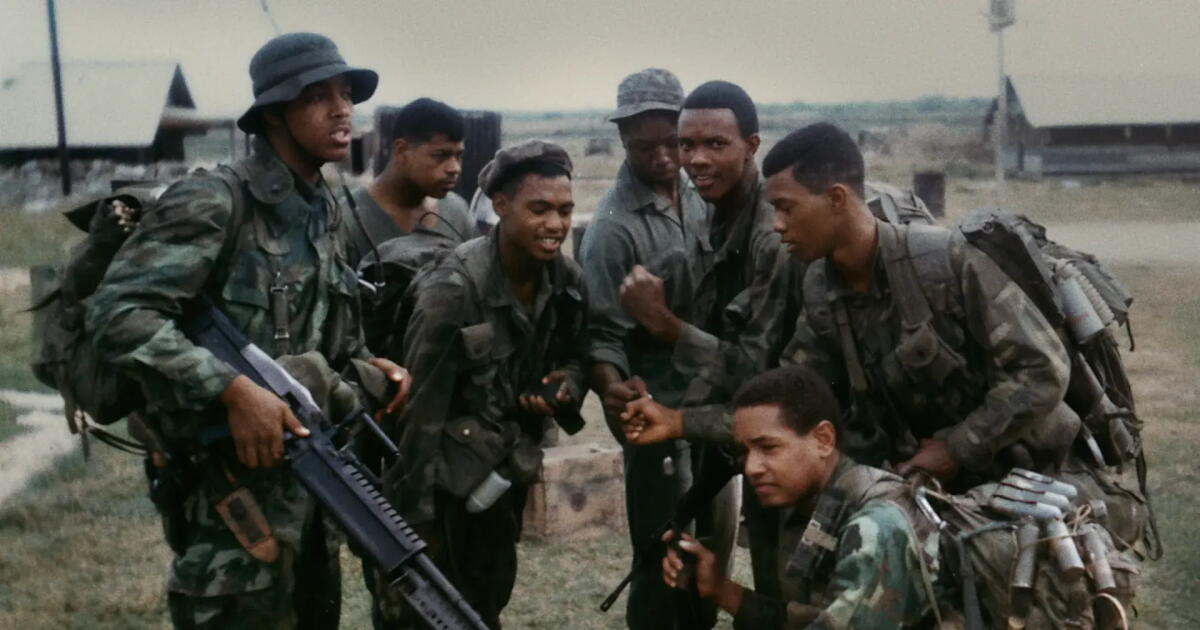
J.M. Harper’s documentary “Soul Patrol” reminds us that hundreds of thousands of Black men fought in the Vietnam War, yet the historical record routinely treats their combat service — disproportionate, population-wise, to that of whites — as a barely acknowledged footnote.
One published account that puts the Black combat experience front and center is Compton native Ed Emanuel’s 2003 memoir, also called “Soul Patrol,” about his year-plus tour as part of an elite long-range reconnaissance patrol (or “lurp”) made up solely of Black soldiers trained for the deadliest tasks: recon behind enemy lines. Harper’s film, which prominently features Emanuel, is an adaptation of sorts: a sharply edited, evocative mélange of interviews, re-creations, scenes from a recent reunion, photographs, archival montages and never-before-seen Super 8 footage filmed by the soldiers themselves, most of them teenagers at the time.
It’s a story made up of stories, but most prominently it’s an assertion of life in a maelstrom of death. When Emanuel’s measured voice-over intones, “We were there,” it feels like an unburdening. Harper also adds some surreality to suggest the weight of that memory: Emanuel in the aisles of a grocery store suddenly encountering his younger M-60-brandishing self, like a vision of strength and exile. It’s not the subtlest of touches but the seriousness with which it’s deployed is genuine.
For Black soldiers, serving in Vietnam was a battle on two fronts: against an enemy that America sent them there to kill and against an image of themselves that fostered the inequality they fought back home. The draft swept up many and the pay helped, but Black Panther voices routinely criticized any acquiescence to the power structure’s war aims. Still, the prospect of fighting for one’s country seemed like the type of action that would burnish their lot in the nation’s eyes. (We know how that optimism worked out for Vietnam veterans when they returned.)
The picture we get of a necessary brotherhood is meaningful, especially where the trajectory of Lawton Mackey Jr., the platoon’s youngest, is concerned, and Harper’s way with location-rich reconstructions is cinematic enough to not be out of place in a war epic.
Emanuel tells us he bristled at his unit being conveniently labeled the “soul patrol” by others, although the music they blasted — such as James Brown, who also performed for the troops — made the higher-ups uncomfortable for its Black pride connotations. But the appellation carries a resonance outside that racial-cultural tag: In life-or-death situations, the soul is just as endangered as the body.
Seeing the surviving veterans at their private black-tie reunion, watching their moments of tears and laughter, and a scene between the wives as they discuss living with their husbands’ pain, is another reminder that history matters most when we hear from those who were there. Even if you’ve seen a lot of documentaries about Vietnam’s realities and costs, you haven’t seen a sober reckoning like “Soul Patrol.”
‘Soul Patrol’
Not rated
Running time: 1 hour, 40 minutes
Playing: Opens Friday, Nov. 13 at Laemmle Glendale