
In a year when outsider horror — “Obsession,” “Backrooms,” even Ken Russell’s “The Devils” reissue — did boffo box office, add “Tenebrae” to that list of gory discoveries.
The 1982 slasher flick from giallo master Dario Argento is a fan favorite in his catalog of crimson-splattered, beautifully stylized films like “Suspiria” and “Deep Red.” It was a pre-”Scream” stab at meta-horror, where a crime author visits Rome on a book tour to find a killer re-creating his murder scenes.
“Tenebrae” earned some shine as featured pick on Criterion Channel this Halloween season, but its soundtrack deserved a stage of its own. Composed by Claudio Simonetti, Fabio Pignatelli and Massimo Morante (whose band Goblin was a fixture in Argento’s films), the crunchy synth-rock score has been a favorite drop in edgy disco sets (Justice sampled it on “Phantom”).
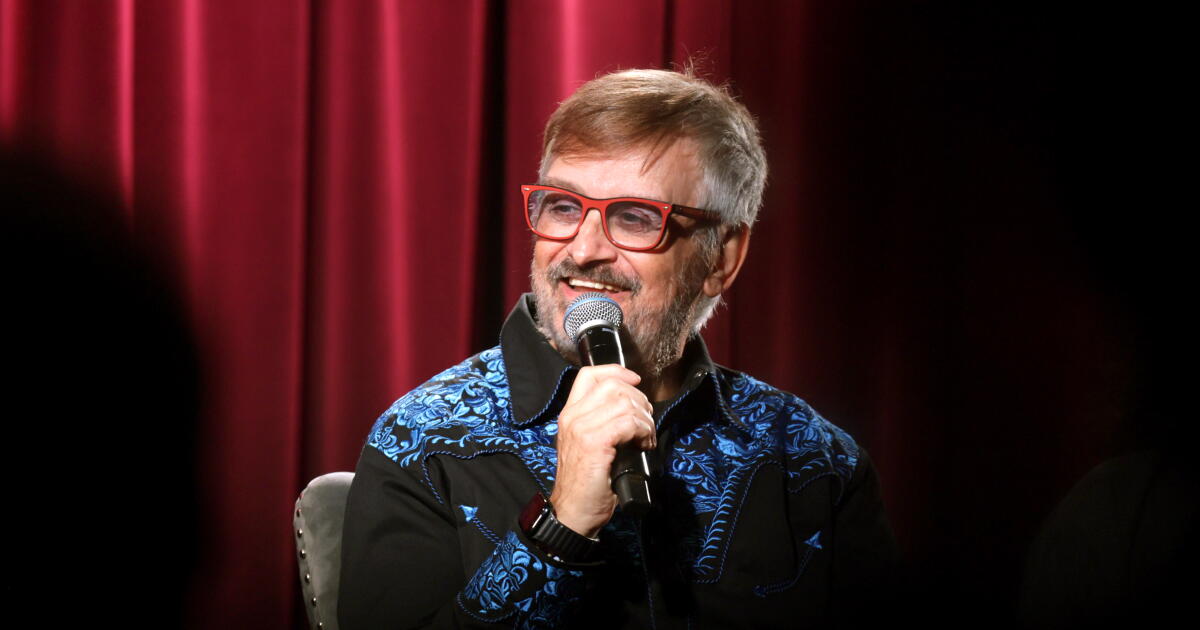
“We’ve played ‘Suspiria,’ ‘Dawn of the Dead’ and ‘Deep Red,’ but we had so many requests this year to play ‘Tenebrae,’ ” Simonetti said from a call on the road where a new version of Goblin is playing the score live with the film (it hits the Alex Theatre in Glendale on Wednesday). “It was a completely different kind of music. Dario Argento’s first films were made by Morricone and the greatest musicians in the old style with an orchestra. So when he chose us, he said, ‘I want something new. I want a rock sound.’”
Simonetti, 74, and Goblin have achieved a kind of Italian goth-unc status in the horror world, where their creeping synthesizers and delirious sound design first arrived in Argento’s films as ‘70s contemporaries of both Giorgio Moroder and John Carpenter. “I’m a big fan of John Carpenter, and he once told me that sometimes I inspired him. I said, ‘Wow, you’re joking,’ because all of us were influenced by John,” he said.
Simonetti and Goblin’s pinprick arpeggios and noise lashes would endure too, inspiring acts like the Weeknd, (whose recent synth-noir albums owe a lot to Goblin), and Thom Yorke, who did his own “Suspiria” theme for its 2018 Luca Guadagino remake.
Simonetti has played most of these soundtracks on tour over the years, but “Tenebrae” stands out an influential synth rock record too. The film’s main theme, a vocodered slab at the juncture of disco and post-punk, and groovy tracks like “Lesbo” clearly provided some DNA for Daft Punk and dark wave acts like Carpenter Brut and Perturbator.
“‘Tenebrae’ is something completely different from the films before, because it’s more modern, innovative,” Simonetti said. “ That’s why the music is so different, because Dario, even if he turned back to the style of the original thrillers, he changed something.”
The film was widely seen as a response to criticism around Argento making a gorgeous artistic aesthetic out of brutally murdered women. (In “Tenebrae,” one is literally killed by a sculpture.) The film arrived at the height of serial killer panic in Los Angeles, and in the mix of stylized violence in a beautiful setting, set to throbbing electronic rock, obviously made an impact on the likes of “Drive’s” Nicolas Winding Refin and “MaXXXine’s” Ti West.
Even after monster hits like “Obsession,” though, Simonetti is worried about the studio system won’t take chances on experimental young composers, leaving them without the opportunity to write their own ageless horror themes.
“We have very good horror movies now, but the music is just a background, nobody thinks that the film needs a very special theme that remains in your head,” he said. “Now many composers use a lot of sounds, but no melodies. When you hear ‘Halloween’ or ‘Deep Red’ or ‘Suspiria,’ you will remember the melody.”
Echoing the fears of many in his industry, “I am very scared about A.I.,” he continued. “I think that will destroy not only the field of music but many fields. It’s not easy now for a musician to start writing a soundtrack for a movie, because it’s not like in the ‘70s or ‘80s. Most of those films don’t have any distribution, or just go on streaming, and they don’t pay enough. I don’t know what what will happen in the future. I don’t know if there is some film that you will see like ‘Tenebrae’ after 50 years.”
He’s not worried his own collaborations could disappear into the digital ether, however. After decades of revisiting the Argento canon before a growing cult audience, Goblin’s scores have become an intergenerational passion.
On tour, Simonetti said, “I always ask these young people ‘Why you like this kind of music, or love Dario Argento’s films?’ They told me, ‘Thanks to my father, to my family, I grew up listening to this kind of music. Maybe now the young people they find something new in the old style rock, you know?”


