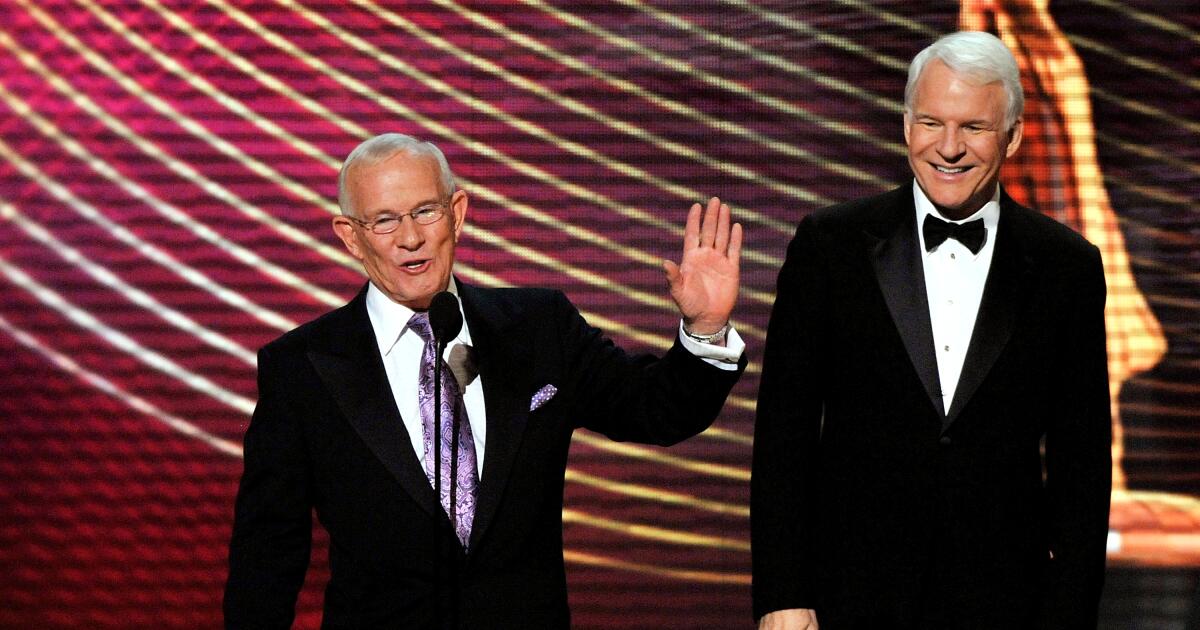
Puppeteer, producer, self-described “artist” and “dreamer” Sid Krofft, who with his brother Marty made a wonderland of Saturday morning television through the 1970s, died Friday at 96. (Marty, younger by nearly eight years, died in 2023.) Their left-field shared fantasies included “H.R. Pufnstuf” (magical island, with a dragon for a mayor), “Lidsville” (anthropomorphic hats), “The Bugaloos” (British pop band resembling insects), “Sigmund and the Sea Monsters” (human children befriend a mild-mannered sea creature) and “Land of the Lost” (family trapped in a reality inhabited by dinosaurs and monsters).
There’s a special, frictional magic to creative teamwork — Laurel and Hardy, Nichols and May, Powell and Pressburger, Rankin and Bass — amplified when the teammates are linked by blood. The brothers Marx, Smothers, Everly, Mills, Jonas, the sisters Andrews and Haim. Walt and Roy Disney, who, like the Kroffts, split the work of having big ideas and making them possible. Broadly speaking, Sid left the business to Marty, who liked it and was good at it. His brother, Sid wrote in The Times after Marty’s death in 2023, “helped my dreams grow which quickly became our dreams together.” They didn’t always agree: “Marty and I were oil and vinegar. We worked in different ways, but if you shook us up, we were a great dressing.” Watching them interviewed side by side, Sid soft-spoken and rambling, Marty fidgety and anxious to get to the point, their dynamic is abundantly clear.
Sid, who performed professionally from the age of 10, was opening shows for Judy Garland in the late 1950s when an assistant quit and he brought Marty (who had been performing with some of Sid’s puppets back home while his brother worked abroad) into the act. Together they mounted the adults-only “Les Poupées de Paris,” a “topless” puppet revue à la the Folies Bergère, which played in nightclubs and at world’s fairs, and opened their Show Business Factory, a props and puppets shop. In 1968, they designed the costumes for NBC’s “Banana Splits,” a sort of furry take on “The Monkees,” which led to “Pufnstuf,” their first original work for television. Its title character was remodeled from one created for “Kaleidoscope,” a show they devised for San Antonio’s HemisFair ‘68.
Puppets, which is also to say puppeteers, have been involved with television since the beginning, and — thanks mostly to the legacy of Jim Henson — are not done with it yet. The superstar marionette Howdy Doody; the improvisational brilliance of Burr Tillstrom and “Kukla, Fran and Ollie”; the satirical genius of “Beany & Cecil,” of which Albert Einstein was a reputed fan; on through Captain Kangaroo’s “Treasure House,” Fred Rogers’ Make Believe friends and Gerry and Sylvia Anderson’s Supermarionation shows (“Thunderbirds,” et al.). “Pufnstuf” preceded “Sesame Street” onto the air by two months, in September 1969.
But TV had never seen anything quite like the Krofft shows, with its Day-Glo aesthetic, crazy conceptions and combination of puppets, costume puppets and costumed human characters into a half-hour comedy. Given the numinous world of “Pufnstuf,” inhabited by talking flutes and flowers, the word psychedelic springs to mind, and times being what they were, some viewers of little imagination assumed it was somehow drug-inspired. (It wasn’t, name notwithstanding, though Sid would describe their shows as “trippy.”)
The Kroffts would go on to produce live-action prime-time variety shows, as kooky as any of their puppet-based shows. (Every episode of “Donny & Marie” began on ice; “The Brady Bunch Variety Hour” featured a swimming pool for water ballet.) But in the end, they returned to the original recipe. Their last big series, “Mutt & Stuff” (sounds like “Pufnstuf”) created in 2015, for Nick Jr. and set in a canine preschool, featured a human host, real dogs and puppets of varying sizes. (Reckoned by the number of episodes, if not cultural penetration or permanence, it was their biggest hit.) Their influence was, in its way, subversive. What Sid and Marty created is the very foundation of “Pee-wee’s Playhouse” — Paul Reubens and Sid were inevitably friends — and if you look a little further, and I recommend that you do, Thu Tran’s surrealist “Food Party.”
Puppet magic, though it may come in and out of fashion, is ancient and undeniable. This is the year that the Bob Baker Marionettes — whose hipster cred and general renown increased when the theater moved to Highland Park from its longtime home tucked obscurely west of downtown — played Coachella. Puppets create a liminal space between the quotidian and the fantastic, while inhabiting the same, actual three-dimensional space as the rest of us. Sid Krofft lived in that space and made his art there.

Puppeteer, producer, self-described “artist” and “dreamer” Sid Krofft, who with his brother Marty made a wonderland of Saturday morning television through the 1970s, died Friday at 96. (Marty, younger by nearly eight years, died in 2023.) Their left-field shared fantasies included “H.R. Pufnstuf” (magical island, with a dragon for a mayor), “Lidsville” (anthropomorphic hats), “The Bugaloos” (British pop band resembling insects), “Sigmund and the Sea Monsters” (human children befriend a mild-mannered sea creature) and “Land of the Lost” (family trapped in a reality inhabited by dinosaurs and monsters).
There’s a special, frictional magic to creative teamwork — Laurel and Hardy, Nichols and May, Powell and Pressburger, Rankin and Bass — amplified when the teammates are linked by blood. The brothers Marx, Smothers, Everly, Mills, Jonas, the sisters Andrews and Haim. Walt and Roy Disney, who, like the Kroffts, split the work of having big ideas and making them possible. Broadly speaking, Sid left the business to Marty, who liked it and was good at it. His brother, Sid wrote in The Times after Marty’s death in 2023, “helped my dreams grow which quickly became our dreams together.” They didn’t always agree: “Marty and I were oil and vinegar. We worked in different ways, but if you shook us up, we were a great dressing.” Watching them interviewed side by side, Sid soft-spoken and rambling, Marty fidgety and anxious to get to the point, their dynamic is abundantly clear.
Sid, who performed professionally from the age of 10, was opening shows for Judy Garland in the late 1950s when an assistant quit and he brought Marty (who had been performing with some of Sid’s puppets back home while his brother worked abroad) into the act. Together they mounted the adults-only “Les Poupées de Paris,” a “topless” puppet revue à la the Folies Bergère, which played in nightclubs and at world’s fairs, and opened their Show Business Factory, a props and puppets shop. In 1968, they designed the costumes for NBC’s “Banana Splits,” a sort of furry take on “The Monkees,” which led to “Pufnstuf,” their first original work for television. Its title character was remodeled from one created for “Kaleidoscope,” a show they devised for San Antonio’s HemisFair ‘68.
Puppets, which is also to say puppeteers, have been involved with television since the beginning, and — thanks mostly to the legacy of Jim Henson — are not done with it yet. The superstar marionette Howdy Doody; the improvisational brilliance of Burr Tillstrom and “Kukla, Fran and Ollie”; the satirical genius of “Beany & Cecil,” of which Albert Einstein was a reputed fan; on through Captain Kangaroo’s “Treasure House,” Fred Rogers’ Make Believe friends and Gerry and Sylvia Anderson’s Supermarionation shows (“Thunderbirds,” et al.). “Pufnstuf” preceded “Sesame Street” onto the air by two months, in September 1969.
But TV had never seen anything quite like the Krofft shows, with its Day-Glo aesthetic, crazy conceptions and combination of puppets, costume puppets and costumed human characters into a half-hour comedy. Given the numinous world of “Pufnstuf,” inhabited by talking flutes and flowers, the word psychedelic springs to mind, and times being what they were, some viewers of little imagination assumed it was somehow drug-inspired. (It wasn’t, name notwithstanding, though Sid would describe their shows as “trippy.”)
The Kroffts would go on to produce live-action prime-time variety shows, as kooky as any of their puppet-based shows. (Every episode of “Donny & Marie” began on ice; “The Brady Bunch Variety Hour” featured a swimming pool for water ballet.) But in the end, they returned to the original recipe. Their last big series, “Mutt & Stuff” (sounds like “Pufnstuf”) created in 2015, for Nick Jr. and set in a canine preschool, featured a human host, real dogs and puppets of varying sizes. (Reckoned by the number of episodes, if not cultural penetration or permanence, it was their biggest hit.) Their influence was, in its way, subversive. What Sid and Marty created is the very foundation of “Pee-wee’s Playhouse” — Paul Reubens and Sid were inevitably friends — and if you look a little further, and I recommend that you do, Thu Tran’s surrealist “Food Party.”
Puppet magic, though it may come in and out of fashion, is ancient and undeniable. This is the year that the Bob Baker Marionettes — whose hipster cred and general renown increased when the theater moved to Highland Park from its longtime home tucked obscurely west of downtown — played Coachella. Puppets create a liminal space between the quotidian and the fantastic, while inhabiting the same, actual three-dimensional space as the rest of us. Sid Krofft lived in that space and made his art there.

Puppeteer, producer, self-described “artist” and “dreamer” Sid Krofft, who with his brother Marty made a wonderland of Saturday morning television through the 1970s, died Friday at 96. (Marty, younger by nearly eight years, died in 2023.) Their left-field shared fantasies included “H.R. Pufnstuf” (magical island, with a dragon for a mayor), “Lidsville” (anthropomorphic hats), “The Bugaloos” (British pop band resembling insects), “Sigmund and the Sea Monsters” (human children befriend a mild-mannered sea creature) and “Land of the Lost” (family trapped in a reality inhabited by dinosaurs and monsters).
There’s a special, frictional magic to creative teamwork — Laurel and Hardy, Nichols and May, Powell and Pressburger, Rankin and Bass — amplified when the teammates are linked by blood. The brothers Marx, Smothers, Everly, Mills, Jonas, the sisters Andrews and Haim. Walt and Roy Disney, who, like the Kroffts, split the work of having big ideas and making them possible. Broadly speaking, Sid left the business to Marty, who liked it and was good at it. His brother, Sid wrote in The Times after Marty’s death in 2023, “helped my dreams grow which quickly became our dreams together.” They didn’t always agree: “Marty and I were oil and vinegar. We worked in different ways, but if you shook us up, we were a great dressing.” Watching them interviewed side by side, Sid soft-spoken and rambling, Marty fidgety and anxious to get to the point, their dynamic is abundantly clear.
Sid, who performed professionally from the age of 10, was opening shows for Judy Garland in the late 1950s when an assistant quit and he brought Marty (who had been performing with some of Sid’s puppets back home while his brother worked abroad) into the act. Together they mounted the adults-only “Les Poupées de Paris,” a “topless” puppet revue à la the Folies Bergère, which played in nightclubs and at world’s fairs, and opened their Show Business Factory, a props and puppets shop. In 1968, they designed the costumes for NBC’s “Banana Splits,” a sort of furry take on “The Monkees,” which led to “Pufnstuf,” their first original work for television. Its title character was remodeled from one created for “Kaleidoscope,” a show they devised for San Antonio’s HemisFair ‘68.
Puppets, which is also to say puppeteers, have been involved with television since the beginning, and — thanks mostly to the legacy of Jim Henson — are not done with it yet. The superstar marionette Howdy Doody; the improvisational brilliance of Burr Tillstrom and “Kukla, Fran and Ollie”; the satirical genius of “Beany & Cecil,” of which Albert Einstein was a reputed fan; on through Captain Kangaroo’s “Treasure House,” Fred Rogers’ Make Believe friends and Gerry and Sylvia Anderson’s Supermarionation shows (“Thunderbirds,” et al.). “Pufnstuf” preceded “Sesame Street” onto the air by two months, in September 1969.
But TV had never seen anything quite like the Krofft shows, with its Day-Glo aesthetic, crazy conceptions and combination of puppets, costume puppets and costumed human characters into a half-hour comedy. Given the numinous world of “Pufnstuf,” inhabited by talking flutes and flowers, the word psychedelic springs to mind, and times being what they were, some viewers of little imagination assumed it was somehow drug-inspired. (It wasn’t, name notwithstanding, though Sid would describe their shows as “trippy.”)
The Kroffts would go on to produce live-action prime-time variety shows, as kooky as any of their puppet-based shows. (Every episode of “Donny & Marie” began on ice; “The Brady Bunch Variety Hour” featured a swimming pool for water ballet.) But in the end, they returned to the original recipe. Their last big series, “Mutt & Stuff” (sounds like “Pufnstuf”) created in 2015, for Nick Jr. and set in a canine preschool, featured a human host, real dogs and puppets of varying sizes. (Reckoned by the number of episodes, if not cultural penetration or permanence, it was their biggest hit.) Their influence was, in its way, subversive. What Sid and Marty created is the very foundation of “Pee-wee’s Playhouse” — Paul Reubens and Sid were inevitably friends — and if you look a little further, and I recommend that you do, Thu Tran’s surrealist “Food Party.”
Puppet magic, though it may come in and out of fashion, is ancient and undeniable. This is the year that the Bob Baker Marionettes — whose hipster cred and general renown increased when the theater moved to Highland Park from its longtime home tucked obscurely west of downtown — played Coachella. Puppets create a liminal space between the quotidian and the fantastic, while inhabiting the same, actual three-dimensional space as the rest of us. Sid Krofft lived in that space and made his art there.
Puppeteer, producer, self-described “artist” and “dreamer” Sid Krofft, who with his brother Marty made a wonderland of Saturday morning television through the 1970s, died Friday at 96. (Marty, younger by nearly eight years, died in 2023.) Their left-field shared fantasies included “H.R. Pufnstuf” (magical island, with a dragon for a mayor), “Lidsville” (anthropomorphic hats), “The Bugaloos” (British pop band resembling insects), “Sigmund and the Sea Monsters” (human children befriend a mild-mannered sea creature) and “Land of the Lost” (family trapped in a reality inhabited by dinosaurs and monsters).
There’s a special, frictional magic to creative teamwork — Laurel and Hardy, Nichols and May, Powell and Pressburger, Rankin and Bass — amplified when the teammates are linked by blood. The brothers Marx, Smothers, Everly, Mills, Jonas, the sisters Andrews and Haim. Walt and Roy Disney, who, like the Kroffts, split the work of having big ideas and making them possible. Broadly speaking, Sid left the business to Marty, who liked it and was good at it. His brother, Sid wrote in The Times after Marty’s death in 2023, “helped my dreams grow which quickly became our dreams together.” They didn’t always agree: “Marty and I were oil and vinegar. We worked in different ways, but if you shook us up, we were a great dressing.” Watching them interviewed side by side, Sid soft-spoken and rambling, Marty fidgety and anxious to get to the point, their dynamic is abundantly clear.
Sid, who performed professionally from the age of 10, was opening shows for Judy Garland in the late 1950s when an assistant quit and he brought Marty (who had been performing with some of Sid’s puppets back home while his brother worked abroad) into the act. Together they mounted the adults-only “Les Poupées de Paris,” a “topless” puppet revue à la the Folies Bergère, which played in nightclubs and at world’s fairs, and opened their Show Business Factory, a props and puppets shop. In 1968, they designed the costumes for NBC’s “Banana Splits,” a sort of furry take on “The Monkees,” which led to “Pufnstuf,” their first original work for television. Its title character was remodeled from one created for “Kaleidoscope,” a show they devised for San Antonio’s HemisFair ‘68.
Puppets, which is also to say puppeteers, have been involved with television since the beginning, and — thanks mostly to the legacy of Jim Henson — are not done with it yet. The superstar marionette Howdy Doody; the improvisational brilliance of Burr Tillstrom and “Kukla, Fran and Ollie”; the satirical genius of “Beany & Cecil,” of which Albert Einstein was a reputed fan; on through Captain Kangaroo’s “Treasure House,” Fred Rogers’ Make Believe friends and Gerry and Sylvia Anderson’s Supermarionation shows (“Thunderbirds,” et al.). “Pufnstuf” preceded “Sesame Street” onto the air by two months, in September 1969.
But TV had never seen anything quite like the Krofft shows, with its Day-Glo aesthetic, crazy conceptions and combination of puppets, costume puppets and costumed human characters into a half-hour comedy. Given the numinous world of “Pufnstuf,” inhabited by talking flutes and flowers, the word psychedelic springs to mind, and times being what they were, some viewers of little imagination assumed it was somehow drug-inspired. (It wasn’t, name notwithstanding, though Sid would describe their shows as “trippy.”)
The Kroffts would go on to produce live-action prime-time variety shows, as kooky as any of their puppet-based shows. (Every episode of “Donny & Marie” began on ice; “The Brady Bunch Variety Hour” featured a swimming pool for water ballet.) But in the end, they returned to the original recipe. Their last big series, “Mutt & Stuff” (sounds like “Pufnstuf”) created in 2015, for Nick Jr. and set in a canine preschool, featured a human host, real dogs and puppets of varying sizes. (Reckoned by the number of episodes, if not cultural penetration or permanence, it was their biggest hit.) Their influence was, in its way, subversive. What Sid and Marty created is the very foundation of “Pee-wee’s Playhouse” — Paul Reubens and Sid were inevitably friends — and if you look a little further, and I recommend that you do, Thu Tran’s surrealist “Food Party.”
Puppet magic, though it may come in and out of fashion, is ancient and undeniable. This is the year that the Bob Baker Marionettes — whose hipster cred and general renown increased when the theater moved to Highland Park from its longtime home tucked obscurely west of downtown — played Coachella. Puppets create a liminal space between the quotidian and the fantastic, while inhabiting the same, actual three-dimensional space as the rest of us. Sid Krofft lived in that space and made his art there.