The documentary “Riotsville, USA” is, on the surface, a movie about America in the late 1960s, at a time when nightly news stories about civil unrest provoked citizens and politicians alike to demand the restoration of law and order, by any means necessary. Through archival film and TV clips — mostly presented without comment or context — director Sierra Pettengill looks back at two of the highest-profile efforts back then to address the problem. One was social engineering; the other brute force.
This sets up what “Riotsville, USA” is really about: a mostly forgotten moment more than 50 years ago, when the country could have adopted some radical changes, but didn’t.
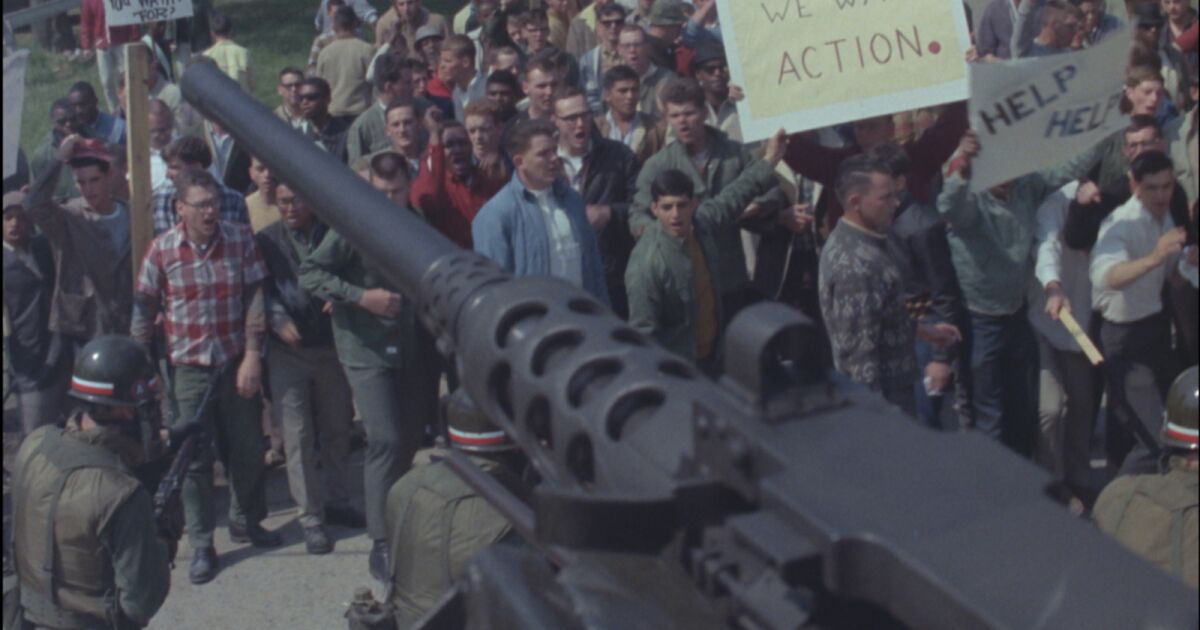
Pettengill weaves together three main threads. The film’s title is drawn from a series of exercises conducted by the U.S. military and law enforcement, which involved constructing fake city blocks and simulating violent protests to test new strategies for quelling public disturbances. The footage from these demonstrations — long buried in a government archive — are the main selling-point of “Riotsville, USA.” The images are eerie and darkly funny; and they tell their own story about how dismissive the authorities of the time could be toward the hippies and civil rights activists they imitated in their training games.
Pettengill also draws heavily on the public television panel shows of the era, which hosted robust and still-relevant debates about bigotry and policing. Those conversations informed President Johnson’s bipartisan Kerner Commission, which produced a 1968 report — covered at length in this documentary — contending that the best way to reduce crime and violence would be to improve public education, introduce new job programs and acknowledge the effects of systemic racism.
The third thread ties the other two together. Pettengill digs up TV news stories about the 1968 Republican National Convention in Miami, which isn’t talked about today as much as the Democrats’ more turbulent Chicago convention a few weeks later. The nomination and eventual election of Richard Nixon would ultimately close the book on the Kerner Commission’s recommendations — aside from the report’s suggestion that cities increase their police budgets.
There’s a clear point of view to “Riotsville, USA,” likely to appeal more to the “defund the police” crowd than to people with “Blue Lives Matter” stickers on their cars. Still, by letting the archival material carry most of the weight, Pettengill creates an instructive kind of time-travel experience for viewers of all political persuasions, transporting them to a past hauntingly similar to our present.
From the unshakable objectivity of the news anchors to the impassioned statements of the protesters in the streets, “Riotsville, USA” re-creates both the mood of the times and the frustratingly narrow mainstream perspective on what everyone was so angry about. By the end, this becomes a film about how and why we seem to keep having the same arguments, generation after generation.
‘Riotsville, USA’
Not rated
Running time: 1 hour, 31 minutes
Playing: Starts Sept. 23, Laemmle Glendale

The documentary “Riotsville, USA” is, on the surface, a movie about America in the late 1960s, at a time when nightly news stories about civil unrest provoked citizens and politicians alike to demand the restoration of law and order, by any means necessary. Through archival film and TV clips — mostly presented without comment or context — director Sierra Pettengill looks back at two of the highest-profile efforts back then to address the problem. One was social engineering; the other brute force.
This sets up what “Riotsville, USA” is really about: a mostly forgotten moment more than 50 years ago, when the country could have adopted some radical changes, but didn’t.
Pettengill weaves together three main threads. The film’s title is drawn from a series of exercises conducted by the U.S. military and law enforcement, which involved constructing fake city blocks and simulating violent protests to test new strategies for quelling public disturbances. The footage from these demonstrations — long buried in a government archive — are the main selling-point of “Riotsville, USA.” The images are eerie and darkly funny; and they tell their own story about how dismissive the authorities of the time could be toward the hippies and civil rights activists they imitated in their training games.
Pettengill also draws heavily on the public television panel shows of the era, which hosted robust and still-relevant debates about bigotry and policing. Those conversations informed President Johnson’s bipartisan Kerner Commission, which produced a 1968 report — covered at length in this documentary — contending that the best way to reduce crime and violence would be to improve public education, introduce new job programs and acknowledge the effects of systemic racism.
The third thread ties the other two together. Pettengill digs up TV news stories about the 1968 Republican National Convention in Miami, which isn’t talked about today as much as the Democrats’ more turbulent Chicago convention a few weeks later. The nomination and eventual election of Richard Nixon would ultimately close the book on the Kerner Commission’s recommendations — aside from the report’s suggestion that cities increase their police budgets.
There’s a clear point of view to “Riotsville, USA,” likely to appeal more to the “defund the police” crowd than to people with “Blue Lives Matter” stickers on their cars. Still, by letting the archival material carry most of the weight, Pettengill creates an instructive kind of time-travel experience for viewers of all political persuasions, transporting them to a past hauntingly similar to our present.
From the unshakable objectivity of the news anchors to the impassioned statements of the protesters in the streets, “Riotsville, USA” re-creates both the mood of the times and the frustratingly narrow mainstream perspective on what everyone was so angry about. By the end, this becomes a film about how and why we seem to keep having the same arguments, generation after generation.
‘Riotsville, USA’
Not rated
Running time: 1 hour, 31 minutes
Playing: Starts Sept. 23, Laemmle Glendale

The documentary “Riotsville, USA” is, on the surface, a movie about America in the late 1960s, at a time when nightly news stories about civil unrest provoked citizens and politicians alike to demand the restoration of law and order, by any means necessary. Through archival film and TV clips — mostly presented without comment or context — director Sierra Pettengill looks back at two of the highest-profile efforts back then to address the problem. One was social engineering; the other brute force.
This sets up what “Riotsville, USA” is really about: a mostly forgotten moment more than 50 years ago, when the country could have adopted some radical changes, but didn’t.
Pettengill weaves together three main threads. The film’s title is drawn from a series of exercises conducted by the U.S. military and law enforcement, which involved constructing fake city blocks and simulating violent protests to test new strategies for quelling public disturbances. The footage from these demonstrations — long buried in a government archive — are the main selling-point of “Riotsville, USA.” The images are eerie and darkly funny; and they tell their own story about how dismissive the authorities of the time could be toward the hippies and civil rights activists they imitated in their training games.
Pettengill also draws heavily on the public television panel shows of the era, which hosted robust and still-relevant debates about bigotry and policing. Those conversations informed President Johnson’s bipartisan Kerner Commission, which produced a 1968 report — covered at length in this documentary — contending that the best way to reduce crime and violence would be to improve public education, introduce new job programs and acknowledge the effects of systemic racism.
The third thread ties the other two together. Pettengill digs up TV news stories about the 1968 Republican National Convention in Miami, which isn’t talked about today as much as the Democrats’ more turbulent Chicago convention a few weeks later. The nomination and eventual election of Richard Nixon would ultimately close the book on the Kerner Commission’s recommendations — aside from the report’s suggestion that cities increase their police budgets.
There’s a clear point of view to “Riotsville, USA,” likely to appeal more to the “defund the police” crowd than to people with “Blue Lives Matter” stickers on their cars. Still, by letting the archival material carry most of the weight, Pettengill creates an instructive kind of time-travel experience for viewers of all political persuasions, transporting them to a past hauntingly similar to our present.
From the unshakable objectivity of the news anchors to the impassioned statements of the protesters in the streets, “Riotsville, USA” re-creates both the mood of the times and the frustratingly narrow mainstream perspective on what everyone was so angry about. By the end, this becomes a film about how and why we seem to keep having the same arguments, generation after generation.
‘Riotsville, USA’
Not rated
Running time: 1 hour, 31 minutes
Playing: Starts Sept. 23, Laemmle Glendale
The documentary “Riotsville, USA” is, on the surface, a movie about America in the late 1960s, at a time when nightly news stories about civil unrest provoked citizens and politicians alike to demand the restoration of law and order, by any means necessary. Through archival film and TV clips — mostly presented without comment or context — director Sierra Pettengill looks back at two of the highest-profile efforts back then to address the problem. One was social engineering; the other brute force.
This sets up what “Riotsville, USA” is really about: a mostly forgotten moment more than 50 years ago, when the country could have adopted some radical changes, but didn’t.
Pettengill weaves together three main threads. The film’s title is drawn from a series of exercises conducted by the U.S. military and law enforcement, which involved constructing fake city blocks and simulating violent protests to test new strategies for quelling public disturbances. The footage from these demonstrations — long buried in a government archive — are the main selling-point of “Riotsville, USA.” The images are eerie and darkly funny; and they tell their own story about how dismissive the authorities of the time could be toward the hippies and civil rights activists they imitated in their training games.
Pettengill also draws heavily on the public television panel shows of the era, which hosted robust and still-relevant debates about bigotry and policing. Those conversations informed President Johnson’s bipartisan Kerner Commission, which produced a 1968 report — covered at length in this documentary — contending that the best way to reduce crime and violence would be to improve public education, introduce new job programs and acknowledge the effects of systemic racism.
The third thread ties the other two together. Pettengill digs up TV news stories about the 1968 Republican National Convention in Miami, which isn’t talked about today as much as the Democrats’ more turbulent Chicago convention a few weeks later. The nomination and eventual election of Richard Nixon would ultimately close the book on the Kerner Commission’s recommendations — aside from the report’s suggestion that cities increase their police budgets.
There’s a clear point of view to “Riotsville, USA,” likely to appeal more to the “defund the police” crowd than to people with “Blue Lives Matter” stickers on their cars. Still, by letting the archival material carry most of the weight, Pettengill creates an instructive kind of time-travel experience for viewers of all political persuasions, transporting them to a past hauntingly similar to our present.
From the unshakable objectivity of the news anchors to the impassioned statements of the protesters in the streets, “Riotsville, USA” re-creates both the mood of the times and the frustratingly narrow mainstream perspective on what everyone was so angry about. By the end, this becomes a film about how and why we seem to keep having the same arguments, generation after generation.
‘Riotsville, USA’
Not rated
Running time: 1 hour, 31 minutes
Playing: Starts Sept. 23, Laemmle Glendale

The documentary “Riotsville, USA” is, on the surface, a movie about America in the late 1960s, at a time when nightly news stories about civil unrest provoked citizens and politicians alike to demand the restoration of law and order, by any means necessary. Through archival film and TV clips — mostly presented without comment or context — director Sierra Pettengill looks back at two of the highest-profile efforts back then to address the problem. One was social engineering; the other brute force.
This sets up what “Riotsville, USA” is really about: a mostly forgotten moment more than 50 years ago, when the country could have adopted some radical changes, but didn’t.
Pettengill weaves together three main threads. The film’s title is drawn from a series of exercises conducted by the U.S. military and law enforcement, which involved constructing fake city blocks and simulating violent protests to test new strategies for quelling public disturbances. The footage from these demonstrations — long buried in a government archive — are the main selling-point of “Riotsville, USA.” The images are eerie and darkly funny; and they tell their own story about how dismissive the authorities of the time could be toward the hippies and civil rights activists they imitated in their training games.
Pettengill also draws heavily on the public television panel shows of the era, which hosted robust and still-relevant debates about bigotry and policing. Those conversations informed President Johnson’s bipartisan Kerner Commission, which produced a 1968 report — covered at length in this documentary — contending that the best way to reduce crime and violence would be to improve public education, introduce new job programs and acknowledge the effects of systemic racism.
The third thread ties the other two together. Pettengill digs up TV news stories about the 1968 Republican National Convention in Miami, which isn’t talked about today as much as the Democrats’ more turbulent Chicago convention a few weeks later. The nomination and eventual election of Richard Nixon would ultimately close the book on the Kerner Commission’s recommendations — aside from the report’s suggestion that cities increase their police budgets.
There’s a clear point of view to “Riotsville, USA,” likely to appeal more to the “defund the police” crowd than to people with “Blue Lives Matter” stickers on their cars. Still, by letting the archival material carry most of the weight, Pettengill creates an instructive kind of time-travel experience for viewers of all political persuasions, transporting them to a past hauntingly similar to our present.
From the unshakable objectivity of the news anchors to the impassioned statements of the protesters in the streets, “Riotsville, USA” re-creates both the mood of the times and the frustratingly narrow mainstream perspective on what everyone was so angry about. By the end, this becomes a film about how and why we seem to keep having the same arguments, generation after generation.
‘Riotsville, USA’
Not rated
Running time: 1 hour, 31 minutes
Playing: Starts Sept. 23, Laemmle Glendale
The documentary “Riotsville, USA” is, on the surface, a movie about America in the late 1960s, at a time when nightly news stories about civil unrest provoked citizens and politicians alike to demand the restoration of law and order, by any means necessary. Through archival film and TV clips — mostly presented without comment or context — director Sierra Pettengill looks back at two of the highest-profile efforts back then to address the problem. One was social engineering; the other brute force.
This sets up what “Riotsville, USA” is really about: a mostly forgotten moment more than 50 years ago, when the country could have adopted some radical changes, but didn’t.
Pettengill weaves together three main threads. The film’s title is drawn from a series of exercises conducted by the U.S. military and law enforcement, which involved constructing fake city blocks and simulating violent protests to test new strategies for quelling public disturbances. The footage from these demonstrations — long buried in a government archive — are the main selling-point of “Riotsville, USA.” The images are eerie and darkly funny; and they tell their own story about how dismissive the authorities of the time could be toward the hippies and civil rights activists they imitated in their training games.
Pettengill also draws heavily on the public television panel shows of the era, which hosted robust and still-relevant debates about bigotry and policing. Those conversations informed President Johnson’s bipartisan Kerner Commission, which produced a 1968 report — covered at length in this documentary — contending that the best way to reduce crime and violence would be to improve public education, introduce new job programs and acknowledge the effects of systemic racism.
The third thread ties the other two together. Pettengill digs up TV news stories about the 1968 Republican National Convention in Miami, which isn’t talked about today as much as the Democrats’ more turbulent Chicago convention a few weeks later. The nomination and eventual election of Richard Nixon would ultimately close the book on the Kerner Commission’s recommendations — aside from the report’s suggestion that cities increase their police budgets.
There’s a clear point of view to “Riotsville, USA,” likely to appeal more to the “defund the police” crowd than to people with “Blue Lives Matter” stickers on their cars. Still, by letting the archival material carry most of the weight, Pettengill creates an instructive kind of time-travel experience for viewers of all political persuasions, transporting them to a past hauntingly similar to our present.
From the unshakable objectivity of the news anchors to the impassioned statements of the protesters in the streets, “Riotsville, USA” re-creates both the mood of the times and the frustratingly narrow mainstream perspective on what everyone was so angry about. By the end, this becomes a film about how and why we seem to keep having the same arguments, generation after generation.
‘Riotsville, USA’
Not rated
Running time: 1 hour, 31 minutes
Playing: Starts Sept. 23, Laemmle Glendale
The documentary “Riotsville, USA” is, on the surface, a movie about America in the late 1960s, at a time when nightly news stories about civil unrest provoked citizens and politicians alike to demand the restoration of law and order, by any means necessary. Through archival film and TV clips — mostly presented without comment or context — director Sierra Pettengill looks back at two of the highest-profile efforts back then to address the problem. One was social engineering; the other brute force.
This sets up what “Riotsville, USA” is really about: a mostly forgotten moment more than 50 years ago, when the country could have adopted some radical changes, but didn’t.
Pettengill weaves together three main threads. The film’s title is drawn from a series of exercises conducted by the U.S. military and law enforcement, which involved constructing fake city blocks and simulating violent protests to test new strategies for quelling public disturbances. The footage from these demonstrations — long buried in a government archive — are the main selling-point of “Riotsville, USA.” The images are eerie and darkly funny; and they tell their own story about how dismissive the authorities of the time could be toward the hippies and civil rights activists they imitated in their training games.
Pettengill also draws heavily on the public television panel shows of the era, which hosted robust and still-relevant debates about bigotry and policing. Those conversations informed President Johnson’s bipartisan Kerner Commission, which produced a 1968 report — covered at length in this documentary — contending that the best way to reduce crime and violence would be to improve public education, introduce new job programs and acknowledge the effects of systemic racism.
The third thread ties the other two together. Pettengill digs up TV news stories about the 1968 Republican National Convention in Miami, which isn’t talked about today as much as the Democrats’ more turbulent Chicago convention a few weeks later. The nomination and eventual election of Richard Nixon would ultimately close the book on the Kerner Commission’s recommendations — aside from the report’s suggestion that cities increase their police budgets.
There’s a clear point of view to “Riotsville, USA,” likely to appeal more to the “defund the police” crowd than to people with “Blue Lives Matter” stickers on their cars. Still, by letting the archival material carry most of the weight, Pettengill creates an instructive kind of time-travel experience for viewers of all political persuasions, transporting them to a past hauntingly similar to our present.
From the unshakable objectivity of the news anchors to the impassioned statements of the protesters in the streets, “Riotsville, USA” re-creates both the mood of the times and the frustratingly narrow mainstream perspective on what everyone was so angry about. By the end, this becomes a film about how and why we seem to keep having the same arguments, generation after generation.
‘Riotsville, USA’
Not rated
Running time: 1 hour, 31 minutes
Playing: Starts Sept. 23, Laemmle Glendale
The documentary “Riotsville, USA” is, on the surface, a movie about America in the late 1960s, at a time when nightly news stories about civil unrest provoked citizens and politicians alike to demand the restoration of law and order, by any means necessary. Through archival film and TV clips — mostly presented without comment or context — director Sierra Pettengill looks back at two of the highest-profile efforts back then to address the problem. One was social engineering; the other brute force.
This sets up what “Riotsville, USA” is really about: a mostly forgotten moment more than 50 years ago, when the country could have adopted some radical changes, but didn’t.
Pettengill weaves together three main threads. The film’s title is drawn from a series of exercises conducted by the U.S. military and law enforcement, which involved constructing fake city blocks and simulating violent protests to test new strategies for quelling public disturbances. The footage from these demonstrations — long buried in a government archive — are the main selling-point of “Riotsville, USA.” The images are eerie and darkly funny; and they tell their own story about how dismissive the authorities of the time could be toward the hippies and civil rights activists they imitated in their training games.
Pettengill also draws heavily on the public television panel shows of the era, which hosted robust and still-relevant debates about bigotry and policing. Those conversations informed President Johnson’s bipartisan Kerner Commission, which produced a 1968 report — covered at length in this documentary — contending that the best way to reduce crime and violence would be to improve public education, introduce new job programs and acknowledge the effects of systemic racism.
The third thread ties the other two together. Pettengill digs up TV news stories about the 1968 Republican National Convention in Miami, which isn’t talked about today as much as the Democrats’ more turbulent Chicago convention a few weeks later. The nomination and eventual election of Richard Nixon would ultimately close the book on the Kerner Commission’s recommendations — aside from the report’s suggestion that cities increase their police budgets.
There’s a clear point of view to “Riotsville, USA,” likely to appeal more to the “defund the police” crowd than to people with “Blue Lives Matter” stickers on their cars. Still, by letting the archival material carry most of the weight, Pettengill creates an instructive kind of time-travel experience for viewers of all political persuasions, transporting them to a past hauntingly similar to our present.
From the unshakable objectivity of the news anchors to the impassioned statements of the protesters in the streets, “Riotsville, USA” re-creates both the mood of the times and the frustratingly narrow mainstream perspective on what everyone was so angry about. By the end, this becomes a film about how and why we seem to keep having the same arguments, generation after generation.
‘Riotsville, USA’
Not rated
Running time: 1 hour, 31 minutes
Playing: Starts Sept. 23, Laemmle Glendale