Agency is the necessary word that always comes up with “Lucia di Lammermoor,” which opened Los Angeles Opera’s new season at the Dorothy Chandler Pavilion Saturday night. This time in a startling new production updated to the present-day disenfranchised Rust Belt America.
There has never been the slightest doubt about whose side we are on in the nearly two centuries since Donizetti’s most popular opera, written in 1835, has been consistently on the lyric stage. Forced into a loveless political marriage, Lucia simply kills her unwanted groom on their nuptial bed and goes mad.
It is, of course, not simple, at all. Must insanity be the excuse for agency? Do we pity Lucia because, well, she’s a dreamy, vulnerable woman and has one of the most exquisitely transporting mad scenes in an art form that has made an industry of producing mad scenes for women? Is agency merely singing like a bird, with mind-bending coloratura?
Obviously not. The greatest Lucia on record is Maria Callas, who was not a freak of nature but a force of nature. The most persuasive, as well as brilliantly sung, performance of “Lucia” I ever witnessed was Beverly Sills’. The great American soprano made it clear that she was the sane one, a pawn in a sick patriarchal society. Her mad scene proved a transcendental 15 minutes of lucidity, an illumination of the world as it was meant to be.
In Simon Stone’s new production — a co-production between L.A. Opera and the Metropolitan Opera, which first presented in May — an oxycodone-addicted Lucia shares a house with her older, no-good brother, Enrico. She is saved from an attempted rape by a guy who works in the local convenience store and is her brother’s enemy, Edgardo. They instantly fall in love.
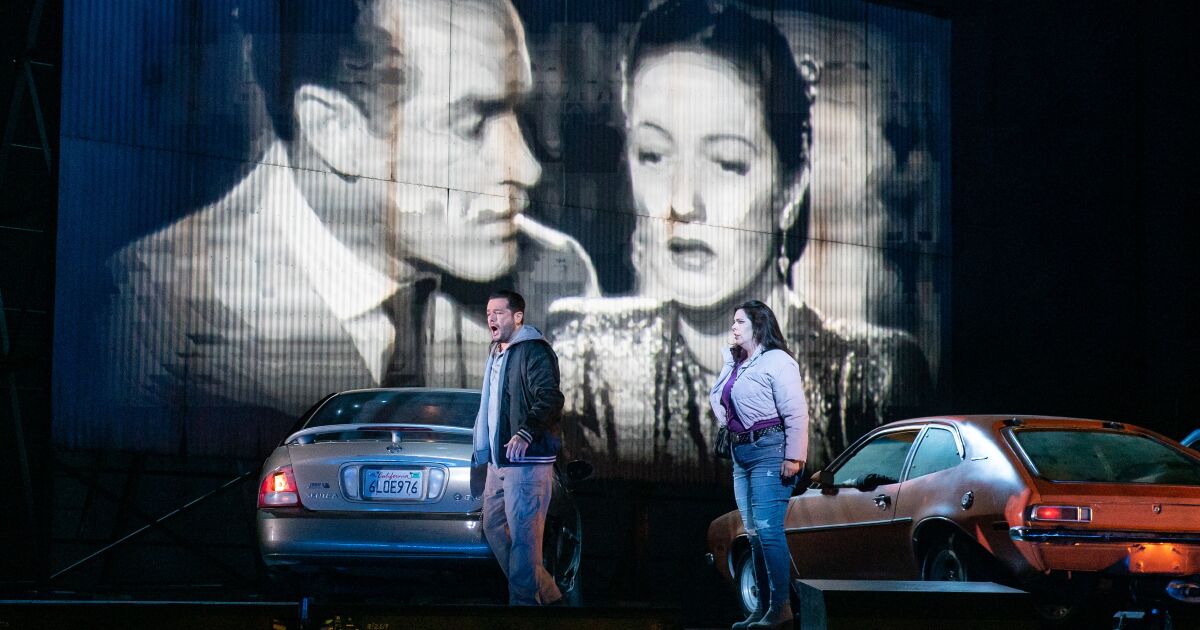
It’s a nasty, decaying small town, full of angry people. They don’t exactly look like the Jan. 6 rioters, but they rile easily enough that you get the point. The cars and pickup trucks are old (when have you last seen a Pinto?). The pawnshop is open 24/7.
Although Netflix describes, “The Dig,” the feature that Stone directed last year for the site, as “understated,” the Australian director who lives in Vienna is anything but that in opera. He exposes the toxic underbelly of modern society, be it Wagner’s “Tristan und Isolde” or Kaija Saariaho’s exceptional latest opera, “Innocence,” concerning a school mass shooting.
The Lucia updating doesn’t always work. The parallels between the mores of the 19th century and those of our era are hardly exact. The last half century of feminism has caused considerable thinking and rethinking about interpretations and implications of “Lucia.” Many productions over the last three decades have been been directed by women, including a particularly effective one by Katie Mitchell at Royal Opera that is now on video.
Two previous L.A. Opera productions were by the German actress Marthe Keller and most recently, in 2014, by Elkhanah Pulitzer, the director of the new John Adams opera “Antony and Cleopatra” in San Francisco. Martin Bernheimer dubbed the company’s first “Lucia” in 1993, directed by Andrei Serban on a wasteland of concrete slabs, “Our Lady of the Petrified Dung Heap.”
We’ve come a long way. But not all the way. The opera’s original depressingly gloomy Scottish setting, where Lucia is forced into a marriage for financial and political reasons, almost looks good compared with what Stone offers. In the 19th century, Lucia had no options for agency. In this new production, you wonder why she lets her brother force her hand. Why don’t she and Edgardo just hop into his pickup and take off. Why? Because she’s on oxycodone, he’s off to join the Army and Enrico shows her doctored social media pictures of an unfaithful Edgardo.
This then becomes a “Lucia” meant not for pity but outrage. Rather than bemoaning the mores of the British empire a couple of centuries ago, Stone shows a perturbed picture of America just when the U.K. is momentarily looking admirable, collective in its mourning the death of Queen Elizabeth II.
Still, it is a striking production, the most theatrically engaging that L.A. Opera has mounted in some time, and also with the most consistently excellent cast, the excellence being in both the singing and the acting.
The action takes place on a revolving set, continually changing perspective. A video screen above Lizzie Clachan’s realistic set reveals live shots of the singers, sometimes close-ups of them onstage, sometimes in rooms or places not seen onstage.
Stone is easily satisfied by his visual imagination. A decrepit drive-in movie theater screens a 1947 noir spoof, “My Favorite Brunette,” for seemingly no other reason, possibly, than that Bob Hope and Dorothy Lamour get locked up in a sanitarium. At its worst, the disconnect between the old libretto and the updating (the translations on the projected titles is also updated to better conform with the production) caused audience laughs in the wrong places.
The singers need a strong presence throughout to take their own agency when it comes to the audience’s divided attentions. All but one in the cast are L.A. Opera veterans and/or alumni of its Domingo-Colburn-Stein Young Artists Program. All but one singer is American. What is new is that Saturday marked the first performance of Lina González-Granados’ in her new role as L.A. Opera resident conductor, and L.A. Opera chorus’ first performance under its new director, Jeremy Frank.
Amanda Woodbury’s is a hardened Lucia with a sweet, full, radiant voice. She does very little to show off Donizetti’s coloratura, but rather all flows from her as if without effort. She sings her mad scene, replete with the otherworldly glass harmonica rather than the more usual flute, in what appears to be a narcotic fog rather than madness. She offers an arresting cadenza, but one more studied than instinctive.
The impact of the scene, though, is further lessened by showing what’s going on in her mind on prerecorded video. As Lucia wanders in her blood-soaked white wedding gown like someone out of a horror film, we see her happily with Edgardo, dutifully illustrating what every note she reveals of her imagination.
Mexican tenor Arturo Chacón-Cruz is an ardent Edgardo, intense onstage and vibrantly sung. The major debut is that of Alexander Birch Elliott, who’s Enrico as the drunken lout of your nightmares. The commanding presence and exacting singing of Eric Owens, the chaplain Raimondo who tries to bring a sense of reason to the community, is luxury casting. Anthony León, Madeleine Lyon and Anthony Ciaramitaro, in the small roles of the troublemaker Normanno, Lucia’s friend Alisa and the woe-begotten bridegroom Arturo, all make sure their smaller roles matter.
González-Granados seems to have won over the orchestra, which played with suave beauty. But her connection with the stage was, at this first performance, uneven. Slow tempos and a general sense of cautiousness resulted in a lack of dramatic propulsion.
For its part, the chorus sounded on edge, but acted disconcertingly on the money, as though well practiced in igniting fears of national unrest in a country where a sense of lack of agency could be reaching the crisis point.
‘Lucia di Lammermoor’
Where: Dorothy Chandler Pavilion, 135 S. Grand Ave., L.A.
When: 7:30 p.m. Wednesday, Saturday and Sept. 28; 2 p.m. Oct. 2 and 9. (Liv Redpath is Lucia Sept. 28-Oct. 9)
Tickets: $20-$324
Info: (213) 972-8001 or laopera.org
Running time: 3 hours, 20 minutes

Agency is the necessary word that always comes up with “Lucia di Lammermoor,” which opened Los Angeles Opera’s new season at the Dorothy Chandler Pavilion Saturday night. This time in a startling new production updated to the present-day disenfranchised Rust Belt America.
There has never been the slightest doubt about whose side we are on in the nearly two centuries since Donizetti’s most popular opera, written in 1835, has been consistently on the lyric stage. Forced into a loveless political marriage, Lucia simply kills her unwanted groom on their nuptial bed and goes mad.
It is, of course, not simple, at all. Must insanity be the excuse for agency? Do we pity Lucia because, well, she’s a dreamy, vulnerable woman and has one of the most exquisitely transporting mad scenes in an art form that has made an industry of producing mad scenes for women? Is agency merely singing like a bird, with mind-bending coloratura?
Obviously not. The greatest Lucia on record is Maria Callas, who was not a freak of nature but a force of nature. The most persuasive, as well as brilliantly sung, performance of “Lucia” I ever witnessed was Beverly Sills’. The great American soprano made it clear that she was the sane one, a pawn in a sick patriarchal society. Her mad scene proved a transcendental 15 minutes of lucidity, an illumination of the world as it was meant to be.
In Simon Stone’s new production — a co-production between L.A. Opera and the Metropolitan Opera, which first presented in May — an oxycodone-addicted Lucia shares a house with her older, no-good brother, Enrico. She is saved from an attempted rape by a guy who works in the local convenience store and is her brother’s enemy, Edgardo. They instantly fall in love.
It’s a nasty, decaying small town, full of angry people. They don’t exactly look like the Jan. 6 rioters, but they rile easily enough that you get the point. The cars and pickup trucks are old (when have you last seen a Pinto?). The pawnshop is open 24/7.
Although Netflix describes, “The Dig,” the feature that Stone directed last year for the site, as “understated,” the Australian director who lives in Vienna is anything but that in opera. He exposes the toxic underbelly of modern society, be it Wagner’s “Tristan und Isolde” or Kaija Saariaho’s exceptional latest opera, “Innocence,” concerning a school mass shooting.
The Lucia updating doesn’t always work. The parallels between the mores of the 19th century and those of our era are hardly exact. The last half century of feminism has caused considerable thinking and rethinking about interpretations and implications of “Lucia.” Many productions over the last three decades have been been directed by women, including a particularly effective one by Katie Mitchell at Royal Opera that is now on video.
Two previous L.A. Opera productions were by the German actress Marthe Keller and most recently, in 2014, by Elkhanah Pulitzer, the director of the new John Adams opera “Antony and Cleopatra” in San Francisco. Martin Bernheimer dubbed the company’s first “Lucia” in 1993, directed by Andrei Serban on a wasteland of concrete slabs, “Our Lady of the Petrified Dung Heap.”
We’ve come a long way. But not all the way. The opera’s original depressingly gloomy Scottish setting, where Lucia is forced into a marriage for financial and political reasons, almost looks good compared with what Stone offers. In the 19th century, Lucia had no options for agency. In this new production, you wonder why she lets her brother force her hand. Why don’t she and Edgardo just hop into his pickup and take off. Why? Because she’s on oxycodone, he’s off to join the Army and Enrico shows her doctored social media pictures of an unfaithful Edgardo.
This then becomes a “Lucia” meant not for pity but outrage. Rather than bemoaning the mores of the British empire a couple of centuries ago, Stone shows a perturbed picture of America just when the U.K. is momentarily looking admirable, collective in its mourning the death of Queen Elizabeth II.
Still, it is a striking production, the most theatrically engaging that L.A. Opera has mounted in some time, and also with the most consistently excellent cast, the excellence being in both the singing and the acting.
The action takes place on a revolving set, continually changing perspective. A video screen above Lizzie Clachan’s realistic set reveals live shots of the singers, sometimes close-ups of them onstage, sometimes in rooms or places not seen onstage.
Stone is easily satisfied by his visual imagination. A decrepit drive-in movie theater screens a 1947 noir spoof, “My Favorite Brunette,” for seemingly no other reason, possibly, than that Bob Hope and Dorothy Lamour get locked up in a sanitarium. At its worst, the disconnect between the old libretto and the updating (the translations on the projected titles is also updated to better conform with the production) caused audience laughs in the wrong places.
The singers need a strong presence throughout to take their own agency when it comes to the audience’s divided attentions. All but one in the cast are L.A. Opera veterans and/or alumni of its Domingo-Colburn-Stein Young Artists Program. All but one singer is American. What is new is that Saturday marked the first performance of Lina González-Granados’ in her new role as L.A. Opera resident conductor, and L.A. Opera chorus’ first performance under its new director, Jeremy Frank.
Amanda Woodbury’s is a hardened Lucia with a sweet, full, radiant voice. She does very little to show off Donizetti’s coloratura, but rather all flows from her as if without effort. She sings her mad scene, replete with the otherworldly glass harmonica rather than the more usual flute, in what appears to be a narcotic fog rather than madness. She offers an arresting cadenza, but one more studied than instinctive.
The impact of the scene, though, is further lessened by showing what’s going on in her mind on prerecorded video. As Lucia wanders in her blood-soaked white wedding gown like someone out of a horror film, we see her happily with Edgardo, dutifully illustrating what every note she reveals of her imagination.
Mexican tenor Arturo Chacón-Cruz is an ardent Edgardo, intense onstage and vibrantly sung. The major debut is that of Alexander Birch Elliott, who’s Enrico as the drunken lout of your nightmares. The commanding presence and exacting singing of Eric Owens, the chaplain Raimondo who tries to bring a sense of reason to the community, is luxury casting. Anthony León, Madeleine Lyon and Anthony Ciaramitaro, in the small roles of the troublemaker Normanno, Lucia’s friend Alisa and the woe-begotten bridegroom Arturo, all make sure their smaller roles matter.
González-Granados seems to have won over the orchestra, which played with suave beauty. But her connection with the stage was, at this first performance, uneven. Slow tempos and a general sense of cautiousness resulted in a lack of dramatic propulsion.
For its part, the chorus sounded on edge, but acted disconcertingly on the money, as though well practiced in igniting fears of national unrest in a country where a sense of lack of agency could be reaching the crisis point.
‘Lucia di Lammermoor’
Where: Dorothy Chandler Pavilion, 135 S. Grand Ave., L.A.
When: 7:30 p.m. Wednesday, Saturday and Sept. 28; 2 p.m. Oct. 2 and 9. (Liv Redpath is Lucia Sept. 28-Oct. 9)
Tickets: $20-$324
Info: (213) 972-8001 or laopera.org
Running time: 3 hours, 20 minutes

Agency is the necessary word that always comes up with “Lucia di Lammermoor,” which opened Los Angeles Opera’s new season at the Dorothy Chandler Pavilion Saturday night. This time in a startling new production updated to the present-day disenfranchised Rust Belt America.
There has never been the slightest doubt about whose side we are on in the nearly two centuries since Donizetti’s most popular opera, written in 1835, has been consistently on the lyric stage. Forced into a loveless political marriage, Lucia simply kills her unwanted groom on their nuptial bed and goes mad.
It is, of course, not simple, at all. Must insanity be the excuse for agency? Do we pity Lucia because, well, she’s a dreamy, vulnerable woman and has one of the most exquisitely transporting mad scenes in an art form that has made an industry of producing mad scenes for women? Is agency merely singing like a bird, with mind-bending coloratura?
Obviously not. The greatest Lucia on record is Maria Callas, who was not a freak of nature but a force of nature. The most persuasive, as well as brilliantly sung, performance of “Lucia” I ever witnessed was Beverly Sills’. The great American soprano made it clear that she was the sane one, a pawn in a sick patriarchal society. Her mad scene proved a transcendental 15 minutes of lucidity, an illumination of the world as it was meant to be.
In Simon Stone’s new production — a co-production between L.A. Opera and the Metropolitan Opera, which first presented in May — an oxycodone-addicted Lucia shares a house with her older, no-good brother, Enrico. She is saved from an attempted rape by a guy who works in the local convenience store and is her brother’s enemy, Edgardo. They instantly fall in love.
It’s a nasty, decaying small town, full of angry people. They don’t exactly look like the Jan. 6 rioters, but they rile easily enough that you get the point. The cars and pickup trucks are old (when have you last seen a Pinto?). The pawnshop is open 24/7.
Although Netflix describes, “The Dig,” the feature that Stone directed last year for the site, as “understated,” the Australian director who lives in Vienna is anything but that in opera. He exposes the toxic underbelly of modern society, be it Wagner’s “Tristan und Isolde” or Kaija Saariaho’s exceptional latest opera, “Innocence,” concerning a school mass shooting.
The Lucia updating doesn’t always work. The parallels between the mores of the 19th century and those of our era are hardly exact. The last half century of feminism has caused considerable thinking and rethinking about interpretations and implications of “Lucia.” Many productions over the last three decades have been been directed by women, including a particularly effective one by Katie Mitchell at Royal Opera that is now on video.
Two previous L.A. Opera productions were by the German actress Marthe Keller and most recently, in 2014, by Elkhanah Pulitzer, the director of the new John Adams opera “Antony and Cleopatra” in San Francisco. Martin Bernheimer dubbed the company’s first “Lucia” in 1993, directed by Andrei Serban on a wasteland of concrete slabs, “Our Lady of the Petrified Dung Heap.”
We’ve come a long way. But not all the way. The opera’s original depressingly gloomy Scottish setting, where Lucia is forced into a marriage for financial and political reasons, almost looks good compared with what Stone offers. In the 19th century, Lucia had no options for agency. In this new production, you wonder why she lets her brother force her hand. Why don’t she and Edgardo just hop into his pickup and take off. Why? Because she’s on oxycodone, he’s off to join the Army and Enrico shows her doctored social media pictures of an unfaithful Edgardo.
This then becomes a “Lucia” meant not for pity but outrage. Rather than bemoaning the mores of the British empire a couple of centuries ago, Stone shows a perturbed picture of America just when the U.K. is momentarily looking admirable, collective in its mourning the death of Queen Elizabeth II.
Still, it is a striking production, the most theatrically engaging that L.A. Opera has mounted in some time, and also with the most consistently excellent cast, the excellence being in both the singing and the acting.
The action takes place on a revolving set, continually changing perspective. A video screen above Lizzie Clachan’s realistic set reveals live shots of the singers, sometimes close-ups of them onstage, sometimes in rooms or places not seen onstage.
Stone is easily satisfied by his visual imagination. A decrepit drive-in movie theater screens a 1947 noir spoof, “My Favorite Brunette,” for seemingly no other reason, possibly, than that Bob Hope and Dorothy Lamour get locked up in a sanitarium. At its worst, the disconnect between the old libretto and the updating (the translations on the projected titles is also updated to better conform with the production) caused audience laughs in the wrong places.
The singers need a strong presence throughout to take their own agency when it comes to the audience’s divided attentions. All but one in the cast are L.A. Opera veterans and/or alumni of its Domingo-Colburn-Stein Young Artists Program. All but one singer is American. What is new is that Saturday marked the first performance of Lina González-Granados’ in her new role as L.A. Opera resident conductor, and L.A. Opera chorus’ first performance under its new director, Jeremy Frank.
Amanda Woodbury’s is a hardened Lucia with a sweet, full, radiant voice. She does very little to show off Donizetti’s coloratura, but rather all flows from her as if without effort. She sings her mad scene, replete with the otherworldly glass harmonica rather than the more usual flute, in what appears to be a narcotic fog rather than madness. She offers an arresting cadenza, but one more studied than instinctive.
The impact of the scene, though, is further lessened by showing what’s going on in her mind on prerecorded video. As Lucia wanders in her blood-soaked white wedding gown like someone out of a horror film, we see her happily with Edgardo, dutifully illustrating what every note she reveals of her imagination.
Mexican tenor Arturo Chacón-Cruz is an ardent Edgardo, intense onstage and vibrantly sung. The major debut is that of Alexander Birch Elliott, who’s Enrico as the drunken lout of your nightmares. The commanding presence and exacting singing of Eric Owens, the chaplain Raimondo who tries to bring a sense of reason to the community, is luxury casting. Anthony León, Madeleine Lyon and Anthony Ciaramitaro, in the small roles of the troublemaker Normanno, Lucia’s friend Alisa and the woe-begotten bridegroom Arturo, all make sure their smaller roles matter.
González-Granados seems to have won over the orchestra, which played with suave beauty. But her connection with the stage was, at this first performance, uneven. Slow tempos and a general sense of cautiousness resulted in a lack of dramatic propulsion.
For its part, the chorus sounded on edge, but acted disconcertingly on the money, as though well practiced in igniting fears of national unrest in a country where a sense of lack of agency could be reaching the crisis point.
‘Lucia di Lammermoor’
Where: Dorothy Chandler Pavilion, 135 S. Grand Ave., L.A.
When: 7:30 p.m. Wednesday, Saturday and Sept. 28; 2 p.m. Oct. 2 and 9. (Liv Redpath is Lucia Sept. 28-Oct. 9)
Tickets: $20-$324
Info: (213) 972-8001 or laopera.org
Running time: 3 hours, 20 minutes
Agency is the necessary word that always comes up with “Lucia di Lammermoor,” which opened Los Angeles Opera’s new season at the Dorothy Chandler Pavilion Saturday night. This time in a startling new production updated to the present-day disenfranchised Rust Belt America.
There has never been the slightest doubt about whose side we are on in the nearly two centuries since Donizetti’s most popular opera, written in 1835, has been consistently on the lyric stage. Forced into a loveless political marriage, Lucia simply kills her unwanted groom on their nuptial bed and goes mad.
It is, of course, not simple, at all. Must insanity be the excuse for agency? Do we pity Lucia because, well, she’s a dreamy, vulnerable woman and has one of the most exquisitely transporting mad scenes in an art form that has made an industry of producing mad scenes for women? Is agency merely singing like a bird, with mind-bending coloratura?
Obviously not. The greatest Lucia on record is Maria Callas, who was not a freak of nature but a force of nature. The most persuasive, as well as brilliantly sung, performance of “Lucia” I ever witnessed was Beverly Sills’. The great American soprano made it clear that she was the sane one, a pawn in a sick patriarchal society. Her mad scene proved a transcendental 15 minutes of lucidity, an illumination of the world as it was meant to be.
In Simon Stone’s new production — a co-production between L.A. Opera and the Metropolitan Opera, which first presented in May — an oxycodone-addicted Lucia shares a house with her older, no-good brother, Enrico. She is saved from an attempted rape by a guy who works in the local convenience store and is her brother’s enemy, Edgardo. They instantly fall in love.
It’s a nasty, decaying small town, full of angry people. They don’t exactly look like the Jan. 6 rioters, but they rile easily enough that you get the point. The cars and pickup trucks are old (when have you last seen a Pinto?). The pawnshop is open 24/7.
Although Netflix describes, “The Dig,” the feature that Stone directed last year for the site, as “understated,” the Australian director who lives in Vienna is anything but that in opera. He exposes the toxic underbelly of modern society, be it Wagner’s “Tristan und Isolde” or Kaija Saariaho’s exceptional latest opera, “Innocence,” concerning a school mass shooting.
The Lucia updating doesn’t always work. The parallels between the mores of the 19th century and those of our era are hardly exact. The last half century of feminism has caused considerable thinking and rethinking about interpretations and implications of “Lucia.” Many productions over the last three decades have been been directed by women, including a particularly effective one by Katie Mitchell at Royal Opera that is now on video.
Two previous L.A. Opera productions were by the German actress Marthe Keller and most recently, in 2014, by Elkhanah Pulitzer, the director of the new John Adams opera “Antony and Cleopatra” in San Francisco. Martin Bernheimer dubbed the company’s first “Lucia” in 1993, directed by Andrei Serban on a wasteland of concrete slabs, “Our Lady of the Petrified Dung Heap.”
We’ve come a long way. But not all the way. The opera’s original depressingly gloomy Scottish setting, where Lucia is forced into a marriage for financial and political reasons, almost looks good compared with what Stone offers. In the 19th century, Lucia had no options for agency. In this new production, you wonder why she lets her brother force her hand. Why don’t she and Edgardo just hop into his pickup and take off. Why? Because she’s on oxycodone, he’s off to join the Army and Enrico shows her doctored social media pictures of an unfaithful Edgardo.
This then becomes a “Lucia” meant not for pity but outrage. Rather than bemoaning the mores of the British empire a couple of centuries ago, Stone shows a perturbed picture of America just when the U.K. is momentarily looking admirable, collective in its mourning the death of Queen Elizabeth II.
Still, it is a striking production, the most theatrically engaging that L.A. Opera has mounted in some time, and also with the most consistently excellent cast, the excellence being in both the singing and the acting.
The action takes place on a revolving set, continually changing perspective. A video screen above Lizzie Clachan’s realistic set reveals live shots of the singers, sometimes close-ups of them onstage, sometimes in rooms or places not seen onstage.
Stone is easily satisfied by his visual imagination. A decrepit drive-in movie theater screens a 1947 noir spoof, “My Favorite Brunette,” for seemingly no other reason, possibly, than that Bob Hope and Dorothy Lamour get locked up in a sanitarium. At its worst, the disconnect between the old libretto and the updating (the translations on the projected titles is also updated to better conform with the production) caused audience laughs in the wrong places.
The singers need a strong presence throughout to take their own agency when it comes to the audience’s divided attentions. All but one in the cast are L.A. Opera veterans and/or alumni of its Domingo-Colburn-Stein Young Artists Program. All but one singer is American. What is new is that Saturday marked the first performance of Lina González-Granados’ in her new role as L.A. Opera resident conductor, and L.A. Opera chorus’ first performance under its new director, Jeremy Frank.
Amanda Woodbury’s is a hardened Lucia with a sweet, full, radiant voice. She does very little to show off Donizetti’s coloratura, but rather all flows from her as if without effort. She sings her mad scene, replete with the otherworldly glass harmonica rather than the more usual flute, in what appears to be a narcotic fog rather than madness. She offers an arresting cadenza, but one more studied than instinctive.
The impact of the scene, though, is further lessened by showing what’s going on in her mind on prerecorded video. As Lucia wanders in her blood-soaked white wedding gown like someone out of a horror film, we see her happily with Edgardo, dutifully illustrating what every note she reveals of her imagination.
Mexican tenor Arturo Chacón-Cruz is an ardent Edgardo, intense onstage and vibrantly sung. The major debut is that of Alexander Birch Elliott, who’s Enrico as the drunken lout of your nightmares. The commanding presence and exacting singing of Eric Owens, the chaplain Raimondo who tries to bring a sense of reason to the community, is luxury casting. Anthony León, Madeleine Lyon and Anthony Ciaramitaro, in the small roles of the troublemaker Normanno, Lucia’s friend Alisa and the woe-begotten bridegroom Arturo, all make sure their smaller roles matter.
González-Granados seems to have won over the orchestra, which played with suave beauty. But her connection with the stage was, at this first performance, uneven. Slow tempos and a general sense of cautiousness resulted in a lack of dramatic propulsion.
For its part, the chorus sounded on edge, but acted disconcertingly on the money, as though well practiced in igniting fears of national unrest in a country where a sense of lack of agency could be reaching the crisis point.
‘Lucia di Lammermoor’
Where: Dorothy Chandler Pavilion, 135 S. Grand Ave., L.A.
When: 7:30 p.m. Wednesday, Saturday and Sept. 28; 2 p.m. Oct. 2 and 9. (Liv Redpath is Lucia Sept. 28-Oct. 9)
Tickets: $20-$324
Info: (213) 972-8001 or laopera.org
Running time: 3 hours, 20 minutes

Agency is the necessary word that always comes up with “Lucia di Lammermoor,” which opened Los Angeles Opera’s new season at the Dorothy Chandler Pavilion Saturday night. This time in a startling new production updated to the present-day disenfranchised Rust Belt America.
There has never been the slightest doubt about whose side we are on in the nearly two centuries since Donizetti’s most popular opera, written in 1835, has been consistently on the lyric stage. Forced into a loveless political marriage, Lucia simply kills her unwanted groom on their nuptial bed and goes mad.
It is, of course, not simple, at all. Must insanity be the excuse for agency? Do we pity Lucia because, well, she’s a dreamy, vulnerable woman and has one of the most exquisitely transporting mad scenes in an art form that has made an industry of producing mad scenes for women? Is agency merely singing like a bird, with mind-bending coloratura?
Obviously not. The greatest Lucia on record is Maria Callas, who was not a freak of nature but a force of nature. The most persuasive, as well as brilliantly sung, performance of “Lucia” I ever witnessed was Beverly Sills’. The great American soprano made it clear that she was the sane one, a pawn in a sick patriarchal society. Her mad scene proved a transcendental 15 minutes of lucidity, an illumination of the world as it was meant to be.
In Simon Stone’s new production — a co-production between L.A. Opera and the Metropolitan Opera, which first presented in May — an oxycodone-addicted Lucia shares a house with her older, no-good brother, Enrico. She is saved from an attempted rape by a guy who works in the local convenience store and is her brother’s enemy, Edgardo. They instantly fall in love.
It’s a nasty, decaying small town, full of angry people. They don’t exactly look like the Jan. 6 rioters, but they rile easily enough that you get the point. The cars and pickup trucks are old (when have you last seen a Pinto?). The pawnshop is open 24/7.
Although Netflix describes, “The Dig,” the feature that Stone directed last year for the site, as “understated,” the Australian director who lives in Vienna is anything but that in opera. He exposes the toxic underbelly of modern society, be it Wagner’s “Tristan und Isolde” or Kaija Saariaho’s exceptional latest opera, “Innocence,” concerning a school mass shooting.
The Lucia updating doesn’t always work. The parallels between the mores of the 19th century and those of our era are hardly exact. The last half century of feminism has caused considerable thinking and rethinking about interpretations and implications of “Lucia.” Many productions over the last three decades have been been directed by women, including a particularly effective one by Katie Mitchell at Royal Opera that is now on video.
Two previous L.A. Opera productions were by the German actress Marthe Keller and most recently, in 2014, by Elkhanah Pulitzer, the director of the new John Adams opera “Antony and Cleopatra” in San Francisco. Martin Bernheimer dubbed the company’s first “Lucia” in 1993, directed by Andrei Serban on a wasteland of concrete slabs, “Our Lady of the Petrified Dung Heap.”
We’ve come a long way. But not all the way. The opera’s original depressingly gloomy Scottish setting, where Lucia is forced into a marriage for financial and political reasons, almost looks good compared with what Stone offers. In the 19th century, Lucia had no options for agency. In this new production, you wonder why she lets her brother force her hand. Why don’t she and Edgardo just hop into his pickup and take off. Why? Because she’s on oxycodone, he’s off to join the Army and Enrico shows her doctored social media pictures of an unfaithful Edgardo.
This then becomes a “Lucia” meant not for pity but outrage. Rather than bemoaning the mores of the British empire a couple of centuries ago, Stone shows a perturbed picture of America just when the U.K. is momentarily looking admirable, collective in its mourning the death of Queen Elizabeth II.
Still, it is a striking production, the most theatrically engaging that L.A. Opera has mounted in some time, and also with the most consistently excellent cast, the excellence being in both the singing and the acting.
The action takes place on a revolving set, continually changing perspective. A video screen above Lizzie Clachan’s realistic set reveals live shots of the singers, sometimes close-ups of them onstage, sometimes in rooms or places not seen onstage.
Stone is easily satisfied by his visual imagination. A decrepit drive-in movie theater screens a 1947 noir spoof, “My Favorite Brunette,” for seemingly no other reason, possibly, than that Bob Hope and Dorothy Lamour get locked up in a sanitarium. At its worst, the disconnect between the old libretto and the updating (the translations on the projected titles is also updated to better conform with the production) caused audience laughs in the wrong places.
The singers need a strong presence throughout to take their own agency when it comes to the audience’s divided attentions. All but one in the cast are L.A. Opera veterans and/or alumni of its Domingo-Colburn-Stein Young Artists Program. All but one singer is American. What is new is that Saturday marked the first performance of Lina González-Granados’ in her new role as L.A. Opera resident conductor, and L.A. Opera chorus’ first performance under its new director, Jeremy Frank.
Amanda Woodbury’s is a hardened Lucia with a sweet, full, radiant voice. She does very little to show off Donizetti’s coloratura, but rather all flows from her as if without effort. She sings her mad scene, replete with the otherworldly glass harmonica rather than the more usual flute, in what appears to be a narcotic fog rather than madness. She offers an arresting cadenza, but one more studied than instinctive.
The impact of the scene, though, is further lessened by showing what’s going on in her mind on prerecorded video. As Lucia wanders in her blood-soaked white wedding gown like someone out of a horror film, we see her happily with Edgardo, dutifully illustrating what every note she reveals of her imagination.
Mexican tenor Arturo Chacón-Cruz is an ardent Edgardo, intense onstage and vibrantly sung. The major debut is that of Alexander Birch Elliott, who’s Enrico as the drunken lout of your nightmares. The commanding presence and exacting singing of Eric Owens, the chaplain Raimondo who tries to bring a sense of reason to the community, is luxury casting. Anthony León, Madeleine Lyon and Anthony Ciaramitaro, in the small roles of the troublemaker Normanno, Lucia’s friend Alisa and the woe-begotten bridegroom Arturo, all make sure their smaller roles matter.
González-Granados seems to have won over the orchestra, which played with suave beauty. But her connection with the stage was, at this first performance, uneven. Slow tempos and a general sense of cautiousness resulted in a lack of dramatic propulsion.
For its part, the chorus sounded on edge, but acted disconcertingly on the money, as though well practiced in igniting fears of national unrest in a country where a sense of lack of agency could be reaching the crisis point.
‘Lucia di Lammermoor’
Where: Dorothy Chandler Pavilion, 135 S. Grand Ave., L.A.
When: 7:30 p.m. Wednesday, Saturday and Sept. 28; 2 p.m. Oct. 2 and 9. (Liv Redpath is Lucia Sept. 28-Oct. 9)
Tickets: $20-$324
Info: (213) 972-8001 or laopera.org
Running time: 3 hours, 20 minutes
Agency is the necessary word that always comes up with “Lucia di Lammermoor,” which opened Los Angeles Opera’s new season at the Dorothy Chandler Pavilion Saturday night. This time in a startling new production updated to the present-day disenfranchised Rust Belt America.
There has never been the slightest doubt about whose side we are on in the nearly two centuries since Donizetti’s most popular opera, written in 1835, has been consistently on the lyric stage. Forced into a loveless political marriage, Lucia simply kills her unwanted groom on their nuptial bed and goes mad.
It is, of course, not simple, at all. Must insanity be the excuse for agency? Do we pity Lucia because, well, she’s a dreamy, vulnerable woman and has one of the most exquisitely transporting mad scenes in an art form that has made an industry of producing mad scenes for women? Is agency merely singing like a bird, with mind-bending coloratura?
Obviously not. The greatest Lucia on record is Maria Callas, who was not a freak of nature but a force of nature. The most persuasive, as well as brilliantly sung, performance of “Lucia” I ever witnessed was Beverly Sills’. The great American soprano made it clear that she was the sane one, a pawn in a sick patriarchal society. Her mad scene proved a transcendental 15 minutes of lucidity, an illumination of the world as it was meant to be.
In Simon Stone’s new production — a co-production between L.A. Opera and the Metropolitan Opera, which first presented in May — an oxycodone-addicted Lucia shares a house with her older, no-good brother, Enrico. She is saved from an attempted rape by a guy who works in the local convenience store and is her brother’s enemy, Edgardo. They instantly fall in love.
It’s a nasty, decaying small town, full of angry people. They don’t exactly look like the Jan. 6 rioters, but they rile easily enough that you get the point. The cars and pickup trucks are old (when have you last seen a Pinto?). The pawnshop is open 24/7.
Although Netflix describes, “The Dig,” the feature that Stone directed last year for the site, as “understated,” the Australian director who lives in Vienna is anything but that in opera. He exposes the toxic underbelly of modern society, be it Wagner’s “Tristan und Isolde” or Kaija Saariaho’s exceptional latest opera, “Innocence,” concerning a school mass shooting.
The Lucia updating doesn’t always work. The parallels between the mores of the 19th century and those of our era are hardly exact. The last half century of feminism has caused considerable thinking and rethinking about interpretations and implications of “Lucia.” Many productions over the last three decades have been been directed by women, including a particularly effective one by Katie Mitchell at Royal Opera that is now on video.
Two previous L.A. Opera productions were by the German actress Marthe Keller and most recently, in 2014, by Elkhanah Pulitzer, the director of the new John Adams opera “Antony and Cleopatra” in San Francisco. Martin Bernheimer dubbed the company’s first “Lucia” in 1993, directed by Andrei Serban on a wasteland of concrete slabs, “Our Lady of the Petrified Dung Heap.”
We’ve come a long way. But not all the way. The opera’s original depressingly gloomy Scottish setting, where Lucia is forced into a marriage for financial and political reasons, almost looks good compared with what Stone offers. In the 19th century, Lucia had no options for agency. In this new production, you wonder why she lets her brother force her hand. Why don’t she and Edgardo just hop into his pickup and take off. Why? Because she’s on oxycodone, he’s off to join the Army and Enrico shows her doctored social media pictures of an unfaithful Edgardo.
This then becomes a “Lucia” meant not for pity but outrage. Rather than bemoaning the mores of the British empire a couple of centuries ago, Stone shows a perturbed picture of America just when the U.K. is momentarily looking admirable, collective in its mourning the death of Queen Elizabeth II.
Still, it is a striking production, the most theatrically engaging that L.A. Opera has mounted in some time, and also with the most consistently excellent cast, the excellence being in both the singing and the acting.
The action takes place on a revolving set, continually changing perspective. A video screen above Lizzie Clachan’s realistic set reveals live shots of the singers, sometimes close-ups of them onstage, sometimes in rooms or places not seen onstage.
Stone is easily satisfied by his visual imagination. A decrepit drive-in movie theater screens a 1947 noir spoof, “My Favorite Brunette,” for seemingly no other reason, possibly, than that Bob Hope and Dorothy Lamour get locked up in a sanitarium. At its worst, the disconnect between the old libretto and the updating (the translations on the projected titles is also updated to better conform with the production) caused audience laughs in the wrong places.
The singers need a strong presence throughout to take their own agency when it comes to the audience’s divided attentions. All but one in the cast are L.A. Opera veterans and/or alumni of its Domingo-Colburn-Stein Young Artists Program. All but one singer is American. What is new is that Saturday marked the first performance of Lina González-Granados’ in her new role as L.A. Opera resident conductor, and L.A. Opera chorus’ first performance under its new director, Jeremy Frank.
Amanda Woodbury’s is a hardened Lucia with a sweet, full, radiant voice. She does very little to show off Donizetti’s coloratura, but rather all flows from her as if without effort. She sings her mad scene, replete with the otherworldly glass harmonica rather than the more usual flute, in what appears to be a narcotic fog rather than madness. She offers an arresting cadenza, but one more studied than instinctive.
The impact of the scene, though, is further lessened by showing what’s going on in her mind on prerecorded video. As Lucia wanders in her blood-soaked white wedding gown like someone out of a horror film, we see her happily with Edgardo, dutifully illustrating what every note she reveals of her imagination.
Mexican tenor Arturo Chacón-Cruz is an ardent Edgardo, intense onstage and vibrantly sung. The major debut is that of Alexander Birch Elliott, who’s Enrico as the drunken lout of your nightmares. The commanding presence and exacting singing of Eric Owens, the chaplain Raimondo who tries to bring a sense of reason to the community, is luxury casting. Anthony León, Madeleine Lyon and Anthony Ciaramitaro, in the small roles of the troublemaker Normanno, Lucia’s friend Alisa and the woe-begotten bridegroom Arturo, all make sure their smaller roles matter.
González-Granados seems to have won over the orchestra, which played with suave beauty. But her connection with the stage was, at this first performance, uneven. Slow tempos and a general sense of cautiousness resulted in a lack of dramatic propulsion.
For its part, the chorus sounded on edge, but acted disconcertingly on the money, as though well practiced in igniting fears of national unrest in a country where a sense of lack of agency could be reaching the crisis point.
‘Lucia di Lammermoor’
Where: Dorothy Chandler Pavilion, 135 S. Grand Ave., L.A.
When: 7:30 p.m. Wednesday, Saturday and Sept. 28; 2 p.m. Oct. 2 and 9. (Liv Redpath is Lucia Sept. 28-Oct. 9)
Tickets: $20-$324
Info: (213) 972-8001 or laopera.org
Running time: 3 hours, 20 minutes
Agency is the necessary word that always comes up with “Lucia di Lammermoor,” which opened Los Angeles Opera’s new season at the Dorothy Chandler Pavilion Saturday night. This time in a startling new production updated to the present-day disenfranchised Rust Belt America.
There has never been the slightest doubt about whose side we are on in the nearly two centuries since Donizetti’s most popular opera, written in 1835, has been consistently on the lyric stage. Forced into a loveless political marriage, Lucia simply kills her unwanted groom on their nuptial bed and goes mad.
It is, of course, not simple, at all. Must insanity be the excuse for agency? Do we pity Lucia because, well, she’s a dreamy, vulnerable woman and has one of the most exquisitely transporting mad scenes in an art form that has made an industry of producing mad scenes for women? Is agency merely singing like a bird, with mind-bending coloratura?
Obviously not. The greatest Lucia on record is Maria Callas, who was not a freak of nature but a force of nature. The most persuasive, as well as brilliantly sung, performance of “Lucia” I ever witnessed was Beverly Sills’. The great American soprano made it clear that she was the sane one, a pawn in a sick patriarchal society. Her mad scene proved a transcendental 15 minutes of lucidity, an illumination of the world as it was meant to be.
In Simon Stone’s new production — a co-production between L.A. Opera and the Metropolitan Opera, which first presented in May — an oxycodone-addicted Lucia shares a house with her older, no-good brother, Enrico. She is saved from an attempted rape by a guy who works in the local convenience store and is her brother’s enemy, Edgardo. They instantly fall in love.
It’s a nasty, decaying small town, full of angry people. They don’t exactly look like the Jan. 6 rioters, but they rile easily enough that you get the point. The cars and pickup trucks are old (when have you last seen a Pinto?). The pawnshop is open 24/7.
Although Netflix describes, “The Dig,” the feature that Stone directed last year for the site, as “understated,” the Australian director who lives in Vienna is anything but that in opera. He exposes the toxic underbelly of modern society, be it Wagner’s “Tristan und Isolde” or Kaija Saariaho’s exceptional latest opera, “Innocence,” concerning a school mass shooting.
The Lucia updating doesn’t always work. The parallels between the mores of the 19th century and those of our era are hardly exact. The last half century of feminism has caused considerable thinking and rethinking about interpretations and implications of “Lucia.” Many productions over the last three decades have been been directed by women, including a particularly effective one by Katie Mitchell at Royal Opera that is now on video.
Two previous L.A. Opera productions were by the German actress Marthe Keller and most recently, in 2014, by Elkhanah Pulitzer, the director of the new John Adams opera “Antony and Cleopatra” in San Francisco. Martin Bernheimer dubbed the company’s first “Lucia” in 1993, directed by Andrei Serban on a wasteland of concrete slabs, “Our Lady of the Petrified Dung Heap.”
We’ve come a long way. But not all the way. The opera’s original depressingly gloomy Scottish setting, where Lucia is forced into a marriage for financial and political reasons, almost looks good compared with what Stone offers. In the 19th century, Lucia had no options for agency. In this new production, you wonder why she lets her brother force her hand. Why don’t she and Edgardo just hop into his pickup and take off. Why? Because she’s on oxycodone, he’s off to join the Army and Enrico shows her doctored social media pictures of an unfaithful Edgardo.
This then becomes a “Lucia” meant not for pity but outrage. Rather than bemoaning the mores of the British empire a couple of centuries ago, Stone shows a perturbed picture of America just when the U.K. is momentarily looking admirable, collective in its mourning the death of Queen Elizabeth II.
Still, it is a striking production, the most theatrically engaging that L.A. Opera has mounted in some time, and also with the most consistently excellent cast, the excellence being in both the singing and the acting.
The action takes place on a revolving set, continually changing perspective. A video screen above Lizzie Clachan’s realistic set reveals live shots of the singers, sometimes close-ups of them onstage, sometimes in rooms or places not seen onstage.
Stone is easily satisfied by his visual imagination. A decrepit drive-in movie theater screens a 1947 noir spoof, “My Favorite Brunette,” for seemingly no other reason, possibly, than that Bob Hope and Dorothy Lamour get locked up in a sanitarium. At its worst, the disconnect between the old libretto and the updating (the translations on the projected titles is also updated to better conform with the production) caused audience laughs in the wrong places.
The singers need a strong presence throughout to take their own agency when it comes to the audience’s divided attentions. All but one in the cast are L.A. Opera veterans and/or alumni of its Domingo-Colburn-Stein Young Artists Program. All but one singer is American. What is new is that Saturday marked the first performance of Lina González-Granados’ in her new role as L.A. Opera resident conductor, and L.A. Opera chorus’ first performance under its new director, Jeremy Frank.
Amanda Woodbury’s is a hardened Lucia with a sweet, full, radiant voice. She does very little to show off Donizetti’s coloratura, but rather all flows from her as if without effort. She sings her mad scene, replete with the otherworldly glass harmonica rather than the more usual flute, in what appears to be a narcotic fog rather than madness. She offers an arresting cadenza, but one more studied than instinctive.
The impact of the scene, though, is further lessened by showing what’s going on in her mind on prerecorded video. As Lucia wanders in her blood-soaked white wedding gown like someone out of a horror film, we see her happily with Edgardo, dutifully illustrating what every note she reveals of her imagination.
Mexican tenor Arturo Chacón-Cruz is an ardent Edgardo, intense onstage and vibrantly sung. The major debut is that of Alexander Birch Elliott, who’s Enrico as the drunken lout of your nightmares. The commanding presence and exacting singing of Eric Owens, the chaplain Raimondo who tries to bring a sense of reason to the community, is luxury casting. Anthony León, Madeleine Lyon and Anthony Ciaramitaro, in the small roles of the troublemaker Normanno, Lucia’s friend Alisa and the woe-begotten bridegroom Arturo, all make sure their smaller roles matter.
González-Granados seems to have won over the orchestra, which played with suave beauty. But her connection with the stage was, at this first performance, uneven. Slow tempos and a general sense of cautiousness resulted in a lack of dramatic propulsion.
For its part, the chorus sounded on edge, but acted disconcertingly on the money, as though well practiced in igniting fears of national unrest in a country where a sense of lack of agency could be reaching the crisis point.
‘Lucia di Lammermoor’
Where: Dorothy Chandler Pavilion, 135 S. Grand Ave., L.A.
When: 7:30 p.m. Wednesday, Saturday and Sept. 28; 2 p.m. Oct. 2 and 9. (Liv Redpath is Lucia Sept. 28-Oct. 9)
Tickets: $20-$324
Info: (213) 972-8001 or laopera.org
Running time: 3 hours, 20 minutes
Agency is the necessary word that always comes up with “Lucia di Lammermoor,” which opened Los Angeles Opera’s new season at the Dorothy Chandler Pavilion Saturday night. This time in a startling new production updated to the present-day disenfranchised Rust Belt America.
There has never been the slightest doubt about whose side we are on in the nearly two centuries since Donizetti’s most popular opera, written in 1835, has been consistently on the lyric stage. Forced into a loveless political marriage, Lucia simply kills her unwanted groom on their nuptial bed and goes mad.
It is, of course, not simple, at all. Must insanity be the excuse for agency? Do we pity Lucia because, well, she’s a dreamy, vulnerable woman and has one of the most exquisitely transporting mad scenes in an art form that has made an industry of producing mad scenes for women? Is agency merely singing like a bird, with mind-bending coloratura?
Obviously not. The greatest Lucia on record is Maria Callas, who was not a freak of nature but a force of nature. The most persuasive, as well as brilliantly sung, performance of “Lucia” I ever witnessed was Beverly Sills’. The great American soprano made it clear that she was the sane one, a pawn in a sick patriarchal society. Her mad scene proved a transcendental 15 minutes of lucidity, an illumination of the world as it was meant to be.
In Simon Stone’s new production — a co-production between L.A. Opera and the Metropolitan Opera, which first presented in May — an oxycodone-addicted Lucia shares a house with her older, no-good brother, Enrico. She is saved from an attempted rape by a guy who works in the local convenience store and is her brother’s enemy, Edgardo. They instantly fall in love.
It’s a nasty, decaying small town, full of angry people. They don’t exactly look like the Jan. 6 rioters, but they rile easily enough that you get the point. The cars and pickup trucks are old (when have you last seen a Pinto?). The pawnshop is open 24/7.
Although Netflix describes, “The Dig,” the feature that Stone directed last year for the site, as “understated,” the Australian director who lives in Vienna is anything but that in opera. He exposes the toxic underbelly of modern society, be it Wagner’s “Tristan und Isolde” or Kaija Saariaho’s exceptional latest opera, “Innocence,” concerning a school mass shooting.
The Lucia updating doesn’t always work. The parallels between the mores of the 19th century and those of our era are hardly exact. The last half century of feminism has caused considerable thinking and rethinking about interpretations and implications of “Lucia.” Many productions over the last three decades have been been directed by women, including a particularly effective one by Katie Mitchell at Royal Opera that is now on video.
Two previous L.A. Opera productions were by the German actress Marthe Keller and most recently, in 2014, by Elkhanah Pulitzer, the director of the new John Adams opera “Antony and Cleopatra” in San Francisco. Martin Bernheimer dubbed the company’s first “Lucia” in 1993, directed by Andrei Serban on a wasteland of concrete slabs, “Our Lady of the Petrified Dung Heap.”
We’ve come a long way. But not all the way. The opera’s original depressingly gloomy Scottish setting, where Lucia is forced into a marriage for financial and political reasons, almost looks good compared with what Stone offers. In the 19th century, Lucia had no options for agency. In this new production, you wonder why she lets her brother force her hand. Why don’t she and Edgardo just hop into his pickup and take off. Why? Because she’s on oxycodone, he’s off to join the Army and Enrico shows her doctored social media pictures of an unfaithful Edgardo.
This then becomes a “Lucia” meant not for pity but outrage. Rather than bemoaning the mores of the British empire a couple of centuries ago, Stone shows a perturbed picture of America just when the U.K. is momentarily looking admirable, collective in its mourning the death of Queen Elizabeth II.
Still, it is a striking production, the most theatrically engaging that L.A. Opera has mounted in some time, and also with the most consistently excellent cast, the excellence being in both the singing and the acting.
The action takes place on a revolving set, continually changing perspective. A video screen above Lizzie Clachan’s realistic set reveals live shots of the singers, sometimes close-ups of them onstage, sometimes in rooms or places not seen onstage.
Stone is easily satisfied by his visual imagination. A decrepit drive-in movie theater screens a 1947 noir spoof, “My Favorite Brunette,” for seemingly no other reason, possibly, than that Bob Hope and Dorothy Lamour get locked up in a sanitarium. At its worst, the disconnect between the old libretto and the updating (the translations on the projected titles is also updated to better conform with the production) caused audience laughs in the wrong places.
The singers need a strong presence throughout to take their own agency when it comes to the audience’s divided attentions. All but one in the cast are L.A. Opera veterans and/or alumni of its Domingo-Colburn-Stein Young Artists Program. All but one singer is American. What is new is that Saturday marked the first performance of Lina González-Granados’ in her new role as L.A. Opera resident conductor, and L.A. Opera chorus’ first performance under its new director, Jeremy Frank.
Amanda Woodbury’s is a hardened Lucia with a sweet, full, radiant voice. She does very little to show off Donizetti’s coloratura, but rather all flows from her as if without effort. She sings her mad scene, replete with the otherworldly glass harmonica rather than the more usual flute, in what appears to be a narcotic fog rather than madness. She offers an arresting cadenza, but one more studied than instinctive.
The impact of the scene, though, is further lessened by showing what’s going on in her mind on prerecorded video. As Lucia wanders in her blood-soaked white wedding gown like someone out of a horror film, we see her happily with Edgardo, dutifully illustrating what every note she reveals of her imagination.
Mexican tenor Arturo Chacón-Cruz is an ardent Edgardo, intense onstage and vibrantly sung. The major debut is that of Alexander Birch Elliott, who’s Enrico as the drunken lout of your nightmares. The commanding presence and exacting singing of Eric Owens, the chaplain Raimondo who tries to bring a sense of reason to the community, is luxury casting. Anthony León, Madeleine Lyon and Anthony Ciaramitaro, in the small roles of the troublemaker Normanno, Lucia’s friend Alisa and the woe-begotten bridegroom Arturo, all make sure their smaller roles matter.
González-Granados seems to have won over the orchestra, which played with suave beauty. But her connection with the stage was, at this first performance, uneven. Slow tempos and a general sense of cautiousness resulted in a lack of dramatic propulsion.
For its part, the chorus sounded on edge, but acted disconcertingly on the money, as though well practiced in igniting fears of national unrest in a country where a sense of lack of agency could be reaching the crisis point.
‘Lucia di Lammermoor’
Where: Dorothy Chandler Pavilion, 135 S. Grand Ave., L.A.
When: 7:30 p.m. Wednesday, Saturday and Sept. 28; 2 p.m. Oct. 2 and 9. (Liv Redpath is Lucia Sept. 28-Oct. 9)
Tickets: $20-$324
Info: (213) 972-8001 or laopera.org
Running time: 3 hours, 20 minutes