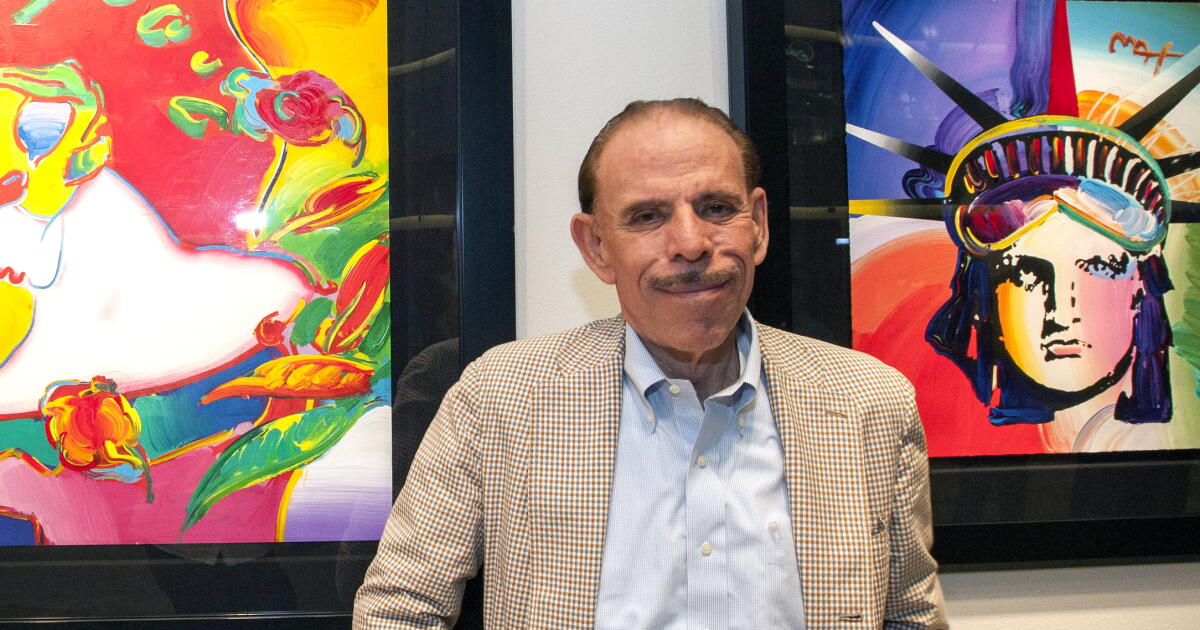

Peter Max, the pop artist and hippie icon who helped define the vibrant psychedelic style of the 1960s and whose work graced posters, album covers, T-shirts, dinnerware, postage stamps and beyond, has died. He was 88.
Max died Monday at a Manhattan hospital, according to a statement provided to the New York Times by his son, Adam Max. No cause of death was provided, but Peter Max had been suffering from advanced dementia, according to the Associated Press.
“We will remember his extraordinary creativity, his warmth, his curiosity, and the way he saw beauty and possibility everywhere,” Adam Max said in a statement to the AP. “His art became part of American culture, but the man behind that art — the father we knew and loved — is the person we will miss most.”
A commercial art powerhouse, Peter Max started his career in graphic design in the 1960s. With bright colors and bold, swirling lines, his vivid imagery captured the era’s infectious optimism. His art was accessible and enduringly popular: In 2000, the Washington Post reported that Max was the single biggest seller on EBay, behind Beanie Babies.
His work’s broad appeal meant Max was often called on to commemorate special occasions. He was the official artist for events including the Olympics, the Super Bowl, the World Series, the Kentucky Derby and the Indianapolis 500.
“Culture has a certain velocity,” Max told the Daily Pilot in 2005, “and I’m very culturally in tune.”
Artist Peter Max in his New York City studio in July 1986.
(Associated Press)
Born Peter Max Finkelstein on Oct. 19, 1937, in Berlin, his Jewish family fled Nazi Germany for Shanghai when he was an infant. Max was raised in China, Israel and Paris before his family settled in New York City when he was 16.
But his education in American pop culture started long before he moved to the United States. As a young boy in China, he persuaded his father to buy four large bags of what turned out to be American comic books featuring classic characters such as Captain Marvel, Superman and Batman, he told the Daily Pilot. While in China, he listened to American bebop and jazz on the radio and watched American films at the movie theater owned by his best friend’s father.
“When I was 16, I knew more about American iconography than most people do today,” Max told the outlet.
After attending Lafayette High School in New York, Max studied art at the Art Students League, the School of Visual Arts and Pratt Institute, according to the AP. In addition to posters, album covers, clothing and household goods, Max’s art has appeared on a Boeing 777 airplane and a Norwegian Cruise Line ship.
“I think his accessibility and appeal to the general public probably has taken away from his position amongst the art world cognoscenti, but that quality, in and of itself, shouldn’t be the detractor from his position as a serious artist,” “The Warhol Economy: How Fashion, Art and Music Drive New York City” author Elizabeth Currid-Halkett told the AP in 2015. “His art is accessible and can be understood without a PhD in art history, and that is a good thing.”
Still, Max’s work has been featured around the world in museum exhibitions and galleries.
The art for the Beatles’ “Yellow Submarine” film and album, however, is something that has at times been mistakenly attributed to Max — at least in part because he often took credit for it, according to the New York Times. But the late German illustrator Heinz Edelmann is officially credited for the art direction and character design.
Max is survived by his son Adam and his daughter Libra Astro.

Peter Max, the pop artist and hippie icon who helped define the vibrant psychedelic style of the 1960s and whose work graced posters, album covers, T-shirts, dinnerware, postage stamps and beyond, has died. He was 88.
Max died Monday at a Manhattan hospital, according to a statement provided to the New York Times by his son, Adam Max. No cause of death was provided, but Peter Max had been suffering from advanced dementia, according to the Associated Press.
“We will remember his extraordinary creativity, his warmth, his curiosity, and the way he saw beauty and possibility everywhere,” Adam Max said in a statement to the AP. “His art became part of American culture, but the man behind that art — the father we knew and loved — is the person we will miss most.”
A commercial art powerhouse, Peter Max started his career in graphic design in the 1960s. With bright colors and bold, swirling lines, his vivid imagery captured the era’s infectious optimism. His art was accessible and enduringly popular: In 2000, the Washington Post reported that Max was the single biggest seller on EBay, behind Beanie Babies.
His work’s broad appeal meant Max was often called on to commemorate special occasions. He was the official artist for events including the Olympics, the Super Bowl, the World Series, the Kentucky Derby and the Indianapolis 500.
“Culture has a certain velocity,” Max told the Daily Pilot in 2005, “and I’m very culturally in tune.”
Artist Peter Max in his New York City studio in July 1986.
(Associated Press)
Born Peter Max Finkelstein on Oct. 19, 1937, in Berlin, his Jewish family fled Nazi Germany for Shanghai when he was an infant. Max was raised in China, Israel and Paris before his family settled in New York City when he was 16.
But his education in American pop culture started long before he moved to the United States. As a young boy in China, he persuaded his father to buy four large bags of what turned out to be American comic books featuring classic characters such as Captain Marvel, Superman and Batman, he told the Daily Pilot. While in China, he listened to American bebop and jazz on the radio and watched American films at the movie theater owned by his best friend’s father.
“When I was 16, I knew more about American iconography than most people do today,” Max told the outlet.
After attending Lafayette High School in New York, Max studied art at the Art Students League, the School of Visual Arts and Pratt Institute, according to the AP. In addition to posters, album covers, clothing and household goods, Max’s art has appeared on a Boeing 777 airplane and a Norwegian Cruise Line ship.
“I think his accessibility and appeal to the general public probably has taken away from his position amongst the art world cognoscenti, but that quality, in and of itself, shouldn’t be the detractor from his position as a serious artist,” “The Warhol Economy: How Fashion, Art and Music Drive New York City” author Elizabeth Currid-Halkett told the AP in 2015. “His art is accessible and can be understood without a PhD in art history, and that is a good thing.”
Still, Max’s work has been featured around the world in museum exhibitions and galleries.
The art for the Beatles’ “Yellow Submarine” film and album, however, is something that has at times been mistakenly attributed to Max — at least in part because he often took credit for it, according to the New York Times. But the late German illustrator Heinz Edelmann is officially credited for the art direction and character design.
Max is survived by his son Adam and his daughter Libra Astro.

Peter Max, the pop artist and hippie icon who helped define the vibrant psychedelic style of the 1960s and whose work graced posters, album covers, T-shirts, dinnerware, postage stamps and beyond, has died. He was 88.
Max died Monday at a Manhattan hospital, according to a statement provided to the New York Times by his son, Adam Max. No cause of death was provided, but Peter Max had been suffering from advanced dementia, according to the Associated Press.
“We will remember his extraordinary creativity, his warmth, his curiosity, and the way he saw beauty and possibility everywhere,” Adam Max said in a statement to the AP. “His art became part of American culture, but the man behind that art — the father we knew and loved — is the person we will miss most.”
A commercial art powerhouse, Peter Max started his career in graphic design in the 1960s. With bright colors and bold, swirling lines, his vivid imagery captured the era’s infectious optimism. His art was accessible and enduringly popular: In 2000, the Washington Post reported that Max was the single biggest seller on EBay, behind Beanie Babies.
His work’s broad appeal meant Max was often called on to commemorate special occasions. He was the official artist for events including the Olympics, the Super Bowl, the World Series, the Kentucky Derby and the Indianapolis 500.
“Culture has a certain velocity,” Max told the Daily Pilot in 2005, “and I’m very culturally in tune.”
Artist Peter Max in his New York City studio in July 1986.
(Associated Press)
Born Peter Max Finkelstein on Oct. 19, 1937, in Berlin, his Jewish family fled Nazi Germany for Shanghai when he was an infant. Max was raised in China, Israel and Paris before his family settled in New York City when he was 16.
But his education in American pop culture started long before he moved to the United States. As a young boy in China, he persuaded his father to buy four large bags of what turned out to be American comic books featuring classic characters such as Captain Marvel, Superman and Batman, he told the Daily Pilot. While in China, he listened to American bebop and jazz on the radio and watched American films at the movie theater owned by his best friend’s father.
“When I was 16, I knew more about American iconography than most people do today,” Max told the outlet.
After attending Lafayette High School in New York, Max studied art at the Art Students League, the School of Visual Arts and Pratt Institute, according to the AP. In addition to posters, album covers, clothing and household goods, Max’s art has appeared on a Boeing 777 airplane and a Norwegian Cruise Line ship.
“I think his accessibility and appeal to the general public probably has taken away from his position amongst the art world cognoscenti, but that quality, in and of itself, shouldn’t be the detractor from his position as a serious artist,” “The Warhol Economy: How Fashion, Art and Music Drive New York City” author Elizabeth Currid-Halkett told the AP in 2015. “His art is accessible and can be understood without a PhD in art history, and that is a good thing.”
Still, Max’s work has been featured around the world in museum exhibitions and galleries.
The art for the Beatles’ “Yellow Submarine” film and album, however, is something that has at times been mistakenly attributed to Max — at least in part because he often took credit for it, according to the New York Times. But the late German illustrator Heinz Edelmann is officially credited for the art direction and character design.
Max is survived by his son Adam and his daughter Libra Astro.
Peter Max, the pop artist and hippie icon who helped define the vibrant psychedelic style of the 1960s and whose work graced posters, album covers, T-shirts, dinnerware, postage stamps and beyond, has died. He was 88.
Max died Monday at a Manhattan hospital, according to a statement provided to the New York Times by his son, Adam Max. No cause of death was provided, but Peter Max had been suffering from advanced dementia, according to the Associated Press.
“We will remember his extraordinary creativity, his warmth, his curiosity, and the way he saw beauty and possibility everywhere,” Adam Max said in a statement to the AP. “His art became part of American culture, but the man behind that art — the father we knew and loved — is the person we will miss most.”
A commercial art powerhouse, Peter Max started his career in graphic design in the 1960s. With bright colors and bold, swirling lines, his vivid imagery captured the era’s infectious optimism. His art was accessible and enduringly popular: In 2000, the Washington Post reported that Max was the single biggest seller on EBay, behind Beanie Babies.
His work’s broad appeal meant Max was often called on to commemorate special occasions. He was the official artist for events including the Olympics, the Super Bowl, the World Series, the Kentucky Derby and the Indianapolis 500.
“Culture has a certain velocity,” Max told the Daily Pilot in 2005, “and I’m very culturally in tune.”
Artist Peter Max in his New York City studio in July 1986.
(Associated Press)
Born Peter Max Finkelstein on Oct. 19, 1937, in Berlin, his Jewish family fled Nazi Germany for Shanghai when he was an infant. Max was raised in China, Israel and Paris before his family settled in New York City when he was 16.
But his education in American pop culture started long before he moved to the United States. As a young boy in China, he persuaded his father to buy four large bags of what turned out to be American comic books featuring classic characters such as Captain Marvel, Superman and Batman, he told the Daily Pilot. While in China, he listened to American bebop and jazz on the radio and watched American films at the movie theater owned by his best friend’s father.
“When I was 16, I knew more about American iconography than most people do today,” Max told the outlet.
After attending Lafayette High School in New York, Max studied art at the Art Students League, the School of Visual Arts and Pratt Institute, according to the AP. In addition to posters, album covers, clothing and household goods, Max’s art has appeared on a Boeing 777 airplane and a Norwegian Cruise Line ship.
“I think his accessibility and appeal to the general public probably has taken away from his position amongst the art world cognoscenti, but that quality, in and of itself, shouldn’t be the detractor from his position as a serious artist,” “The Warhol Economy: How Fashion, Art and Music Drive New York City” author Elizabeth Currid-Halkett told the AP in 2015. “His art is accessible and can be understood without a PhD in art history, and that is a good thing.”
Still, Max’s work has been featured around the world in museum exhibitions and galleries.
The art for the Beatles’ “Yellow Submarine” film and album, however, is something that has at times been mistakenly attributed to Max — at least in part because he often took credit for it, according to the New York Times. But the late German illustrator Heinz Edelmann is officially credited for the art direction and character design.
Max is survived by his son Adam and his daughter Libra Astro.