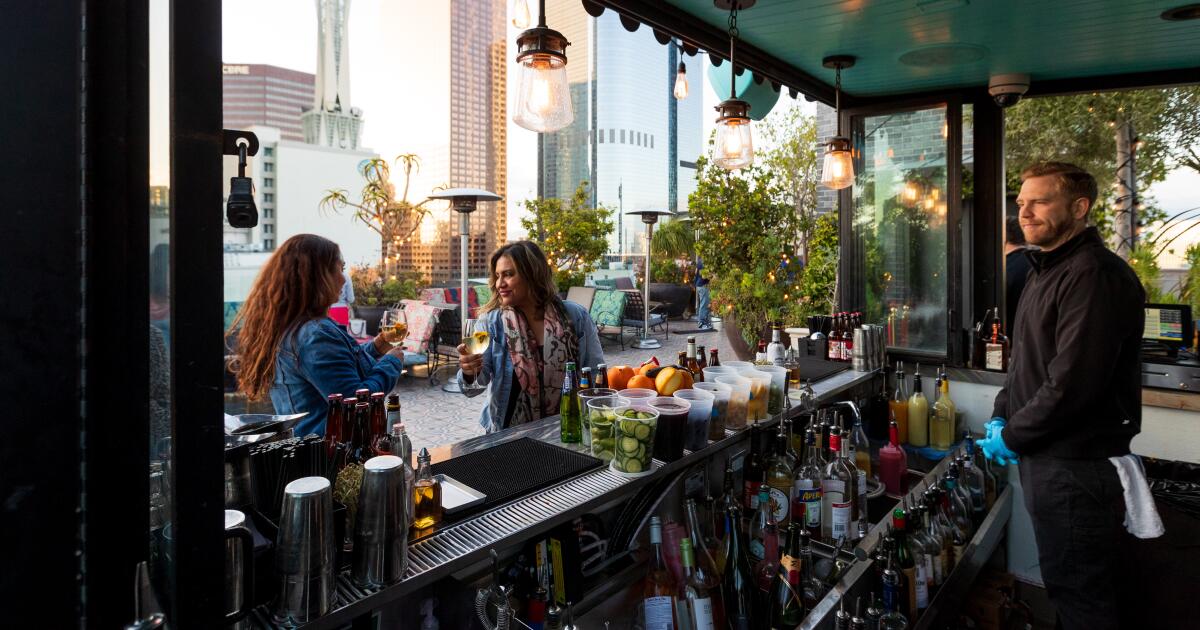

A downtown Los Angeles restaurant is adding a “security charge” to diners’ bills, representing the latest in a wave of surcharges catching customers by surprise.
Perch, a rooftop bar and restaurant near Pershing Square, tacks an extra 4.5% charge to all customer checks to “ensure the safety for all staff and guests,” said Melody Lin, a Perch employee. According to the dinner menu on the restaurant’s website, “The entirety of the charge is retained by the restaurant for safety and security resources.”
A Reddit post by a user dubbed “Individual-Schemes” first brought attention to the fee, and not in a good way.
“Having security isn’t atypical,” the post said. “It’s included in our rent. All of the buildings down here have security. So why 4.5%? Why not $1.00 per check? Why this amount? How much does this fee generate for them per night?”
State lawmakers sought to ban surprise charges on consumers’ bills last year by passing Senate Bill 478, which goes into effect July 1. Applying to any business active in California, it declares that “advertising, displaying, or offering a price for a good or service that does not include all mandatory fees or charges” violates the state prohibition on unfair or deceptive practices.
Whether that law applies to restaurants, however, is subject to debate — apparently, even within state Atty. Gen. Rob Bonta’s office, and Bonta was one of the measure’s sponsors.
At issue is whether restaurants simply have to disclose their fees on their menus and in advertisements, or whether they have to fold the fees into the prices they charge for food and drinks.
Last year, a spokesperson for Sen. Nancy Skinner (D-Berkeley), who co-authored the bill with Sen. Bill Dodd (D-Napa), told Eater SF that the legislation would permit service fees at restaurants if they were disclosed on menus. Representatives of the attorney general also told the San Francisco Chronicle that the law would not end fees but merely require them to be disclosed.
The attorney general’s office told Eater SF and The Times, however, that disclosing the fees was not enough — they had to be included in the prices on the menu.
Matthew Sutton, senior vice president of government affairs and public policy for the California Restaurant Assn., said in a statement that the law shouldn’t increase menu prices if it’s applied correctly.
“The law on its face does not apply to restaurants that properly disclose charges (nor was it intended to),” Sutton said. “Courts have repeatedly indicated that restaurant menus are not ‘advertisements’ and that restaurants don’t provide ‘goods or services.’”
The Golden Gate Restaurant Assn. has asked Bonta’s office to clarify how its members will be affected by SB 478. “While California regulatory authorities are expected to publish guidelines clarifying what exactly the law prohibits prior to July 1, there is uncertainty as to whether fees such as surcharges or service charges will be banned altogether or, alternatively, whether more conspicuous disclosure of such fees at the outset of the purchasing process will be sufficient to comply,” the law firm BakerHostetler said on its website.
Some customers weren’t pleased with the new Perch fee.
“Us paying their security fee is crazy, if you think about it,” Earnest Traylor told KTLA-TV.
The attorney general’s guidelines for SB 478 could turn service charges into mere footnotes on a restaurant bill while raising the price of items on the menu. Or it could let restaurants impose all manner of surcharges, as long as they list the fees on their menus so diners will know about them before they order.
Either way, it would be costly for restaurants to defy the new law. The penalty per violation is at least $1,000.

A downtown Los Angeles restaurant is adding a “security charge” to diners’ bills, representing the latest in a wave of surcharges catching customers by surprise.
Perch, a rooftop bar and restaurant near Pershing Square, tacks an extra 4.5% charge to all customer checks to “ensure the safety for all staff and guests,” said Melody Lin, a Perch employee. According to the dinner menu on the restaurant’s website, “The entirety of the charge is retained by the restaurant for safety and security resources.”
A Reddit post by a user dubbed “Individual-Schemes” first brought attention to the fee, and not in a good way.
“Having security isn’t atypical,” the post said. “It’s included in our rent. All of the buildings down here have security. So why 4.5%? Why not $1.00 per check? Why this amount? How much does this fee generate for them per night?”
State lawmakers sought to ban surprise charges on consumers’ bills last year by passing Senate Bill 478, which goes into effect July 1. Applying to any business active in California, it declares that “advertising, displaying, or offering a price for a good or service that does not include all mandatory fees or charges” violates the state prohibition on unfair or deceptive practices.
Whether that law applies to restaurants, however, is subject to debate — apparently, even within state Atty. Gen. Rob Bonta’s office, and Bonta was one of the measure’s sponsors.
At issue is whether restaurants simply have to disclose their fees on their menus and in advertisements, or whether they have to fold the fees into the prices they charge for food and drinks.
Last year, a spokesperson for Sen. Nancy Skinner (D-Berkeley), who co-authored the bill with Sen. Bill Dodd (D-Napa), told Eater SF that the legislation would permit service fees at restaurants if they were disclosed on menus. Representatives of the attorney general also told the San Francisco Chronicle that the law would not end fees but merely require them to be disclosed.
The attorney general’s office told Eater SF and The Times, however, that disclosing the fees was not enough — they had to be included in the prices on the menu.
Matthew Sutton, senior vice president of government affairs and public policy for the California Restaurant Assn., said in a statement that the law shouldn’t increase menu prices if it’s applied correctly.
“The law on its face does not apply to restaurants that properly disclose charges (nor was it intended to),” Sutton said. “Courts have repeatedly indicated that restaurant menus are not ‘advertisements’ and that restaurants don’t provide ‘goods or services.’”
The Golden Gate Restaurant Assn. has asked Bonta’s office to clarify how its members will be affected by SB 478. “While California regulatory authorities are expected to publish guidelines clarifying what exactly the law prohibits prior to July 1, there is uncertainty as to whether fees such as surcharges or service charges will be banned altogether or, alternatively, whether more conspicuous disclosure of such fees at the outset of the purchasing process will be sufficient to comply,” the law firm BakerHostetler said on its website.
Some customers weren’t pleased with the new Perch fee.
“Us paying their security fee is crazy, if you think about it,” Earnest Traylor told KTLA-TV.
The attorney general’s guidelines for SB 478 could turn service charges into mere footnotes on a restaurant bill while raising the price of items on the menu. Or it could let restaurants impose all manner of surcharges, as long as they list the fees on their menus so diners will know about them before they order.
Either way, it would be costly for restaurants to defy the new law. The penalty per violation is at least $1,000.

A downtown Los Angeles restaurant is adding a “security charge” to diners’ bills, representing the latest in a wave of surcharges catching customers by surprise.
Perch, a rooftop bar and restaurant near Pershing Square, tacks an extra 4.5% charge to all customer checks to “ensure the safety for all staff and guests,” said Melody Lin, a Perch employee. According to the dinner menu on the restaurant’s website, “The entirety of the charge is retained by the restaurant for safety and security resources.”
A Reddit post by a user dubbed “Individual-Schemes” first brought attention to the fee, and not in a good way.
“Having security isn’t atypical,” the post said. “It’s included in our rent. All of the buildings down here have security. So why 4.5%? Why not $1.00 per check? Why this amount? How much does this fee generate for them per night?”
State lawmakers sought to ban surprise charges on consumers’ bills last year by passing Senate Bill 478, which goes into effect July 1. Applying to any business active in California, it declares that “advertising, displaying, or offering a price for a good or service that does not include all mandatory fees or charges” violates the state prohibition on unfair or deceptive practices.
Whether that law applies to restaurants, however, is subject to debate — apparently, even within state Atty. Gen. Rob Bonta’s office, and Bonta was one of the measure’s sponsors.
At issue is whether restaurants simply have to disclose their fees on their menus and in advertisements, or whether they have to fold the fees into the prices they charge for food and drinks.
Last year, a spokesperson for Sen. Nancy Skinner (D-Berkeley), who co-authored the bill with Sen. Bill Dodd (D-Napa), told Eater SF that the legislation would permit service fees at restaurants if they were disclosed on menus. Representatives of the attorney general also told the San Francisco Chronicle that the law would not end fees but merely require them to be disclosed.
The attorney general’s office told Eater SF and The Times, however, that disclosing the fees was not enough — they had to be included in the prices on the menu.
Matthew Sutton, senior vice president of government affairs and public policy for the California Restaurant Assn., said in a statement that the law shouldn’t increase menu prices if it’s applied correctly.
“The law on its face does not apply to restaurants that properly disclose charges (nor was it intended to),” Sutton said. “Courts have repeatedly indicated that restaurant menus are not ‘advertisements’ and that restaurants don’t provide ‘goods or services.’”
The Golden Gate Restaurant Assn. has asked Bonta’s office to clarify how its members will be affected by SB 478. “While California regulatory authorities are expected to publish guidelines clarifying what exactly the law prohibits prior to July 1, there is uncertainty as to whether fees such as surcharges or service charges will be banned altogether or, alternatively, whether more conspicuous disclosure of such fees at the outset of the purchasing process will be sufficient to comply,” the law firm BakerHostetler said on its website.
Some customers weren’t pleased with the new Perch fee.
“Us paying their security fee is crazy, if you think about it,” Earnest Traylor told KTLA-TV.
The attorney general’s guidelines for SB 478 could turn service charges into mere footnotes on a restaurant bill while raising the price of items on the menu. Or it could let restaurants impose all manner of surcharges, as long as they list the fees on their menus so diners will know about them before they order.
Either way, it would be costly for restaurants to defy the new law. The penalty per violation is at least $1,000.
A downtown Los Angeles restaurant is adding a “security charge” to diners’ bills, representing the latest in a wave of surcharges catching customers by surprise.
Perch, a rooftop bar and restaurant near Pershing Square, tacks an extra 4.5% charge to all customer checks to “ensure the safety for all staff and guests,” said Melody Lin, a Perch employee. According to the dinner menu on the restaurant’s website, “The entirety of the charge is retained by the restaurant for safety and security resources.”
A Reddit post by a user dubbed “Individual-Schemes” first brought attention to the fee, and not in a good way.
“Having security isn’t atypical,” the post said. “It’s included in our rent. All of the buildings down here have security. So why 4.5%? Why not $1.00 per check? Why this amount? How much does this fee generate for them per night?”
State lawmakers sought to ban surprise charges on consumers’ bills last year by passing Senate Bill 478, which goes into effect July 1. Applying to any business active in California, it declares that “advertising, displaying, or offering a price for a good or service that does not include all mandatory fees or charges” violates the state prohibition on unfair or deceptive practices.
Whether that law applies to restaurants, however, is subject to debate — apparently, even within state Atty. Gen. Rob Bonta’s office, and Bonta was one of the measure’s sponsors.
At issue is whether restaurants simply have to disclose their fees on their menus and in advertisements, or whether they have to fold the fees into the prices they charge for food and drinks.
Last year, a spokesperson for Sen. Nancy Skinner (D-Berkeley), who co-authored the bill with Sen. Bill Dodd (D-Napa), told Eater SF that the legislation would permit service fees at restaurants if they were disclosed on menus. Representatives of the attorney general also told the San Francisco Chronicle that the law would not end fees but merely require them to be disclosed.
The attorney general’s office told Eater SF and The Times, however, that disclosing the fees was not enough — they had to be included in the prices on the menu.
Matthew Sutton, senior vice president of government affairs and public policy for the California Restaurant Assn., said in a statement that the law shouldn’t increase menu prices if it’s applied correctly.
“The law on its face does not apply to restaurants that properly disclose charges (nor was it intended to),” Sutton said. “Courts have repeatedly indicated that restaurant menus are not ‘advertisements’ and that restaurants don’t provide ‘goods or services.’”
The Golden Gate Restaurant Assn. has asked Bonta’s office to clarify how its members will be affected by SB 478. “While California regulatory authorities are expected to publish guidelines clarifying what exactly the law prohibits prior to July 1, there is uncertainty as to whether fees such as surcharges or service charges will be banned altogether or, alternatively, whether more conspicuous disclosure of such fees at the outset of the purchasing process will be sufficient to comply,” the law firm BakerHostetler said on its website.
Some customers weren’t pleased with the new Perch fee.
“Us paying their security fee is crazy, if you think about it,” Earnest Traylor told KTLA-TV.
The attorney general’s guidelines for SB 478 could turn service charges into mere footnotes on a restaurant bill while raising the price of items on the menu. Or it could let restaurants impose all manner of surcharges, as long as they list the fees on their menus so diners will know about them before they order.
Either way, it would be costly for restaurants to defy the new law. The penalty per violation is at least $1,000.