

Virginia Woolf’s fantastical 1928 feminist novel “Orlando: A Biography,” inspired by her lover Vita Sackville-West, charts 300 years of an invented life that starts as a boy’s and changes into a woman’s. But as posited by Spanish-born trans thinker and first-time filmmaker Paul B. Preciado in his imaginative, vibrant essay-documentary, Woolf’s satiric provocation of a book unconsciously launched a century of trans lives, including his: a temporal diaspora of Orlandos navigating normative barriers and soulful new realms.
Structured with loosely adapted scenes from the novel, and featuring over 20 trans and non-binary performers sharing the role of Woolf’s protagonist, Preciado’s fusion manifesto “Orlando, My Political Biography” is cheekily unclassifiable, which, considering its source and subject, isn’t surprising. But at its core, the film is sparklingly intelligent, Godard-puckish and moving, capable of deadpan wit and the most intimate swirl of ideas and emotions.
Framed by an honest, interrogative conversation with the British modernist legend across a historical and sociological divide, Preciado’s creative construct opens us to a trans consciousness as vital as it is joyous, funny and necessarily artful. It’s obviously political too — that’s the unforgiving reality for every trans person — but it’s through the prism of poetry, Preciado argues, that a hopeful future for trans people can crystallize. “You have to be poetic,” he narrates, “to describe who I want to be.”
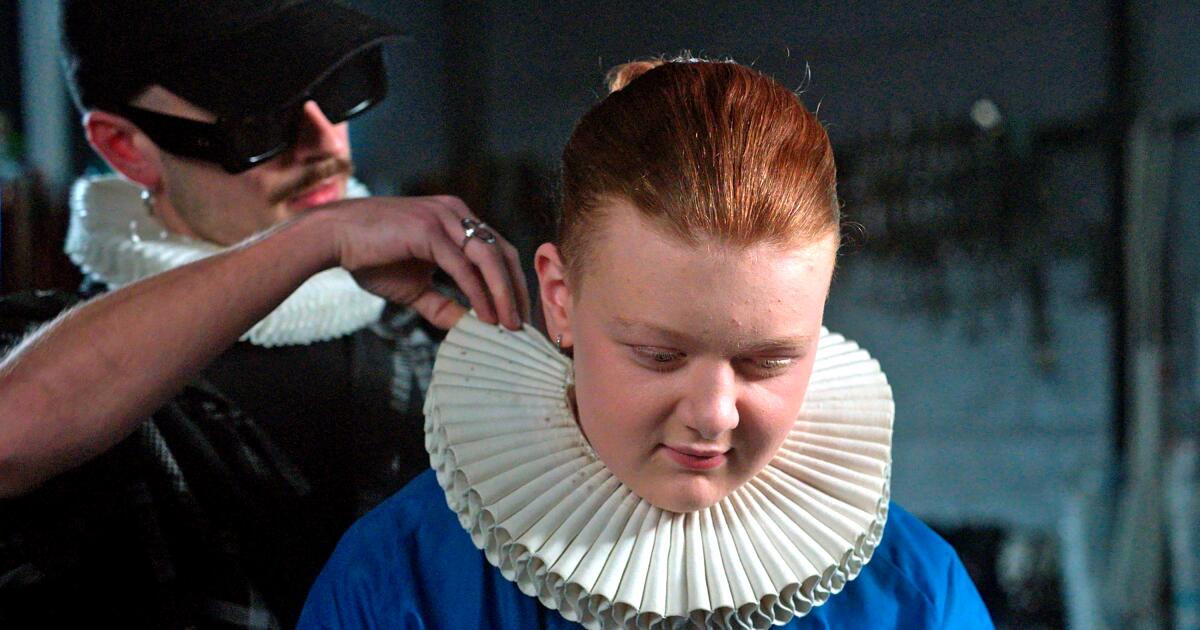
Everyone (even the director’s dog) in the all-ages cast gets a ruff, the frilly white neck adornment signifying the Elizabethan beginnings of Woolf’s tale, before it segues to 18th century Constantinople and lands for good in Victorian England. But each body and mind sporting the collar, whether nonbinary or trans, is their own Orlando. Preciado’s approach mixes the book’s elements and language — sometimes filmed on artificial sets, other times using real locations — with his and his participants’ own stories of transitioning.
Koriangelis Brawns in “Orlando, My Political Biography.”
(Sideshow / Janus Films)
The effect, bold and woozy and exhilarating, is like a series of interviews folded inside a collective performance. When a trans woman named Julia, after a sound check from a visible clapperboard, starts talking to someone off-camera about the delight in having no name, of profound thoughts of obscurity, it takes a second to realize these are Woolf’s lines. In another scene, the flush of young love between boy Orlando and a Russian princess is performed by two trans male teenagers who include testimony of their own healing, real-life bond.
The melding of literature, play-acting and mockumentary-like humor centers this key notion that binary narratives of trans lives simply won’t cut it, but that engagement with art, beauty and creativity can and should. With lightness and cleverness, Preciado stresses how transitioning isn’t some phase that replaces one institutionally imposed label with another. Rather, it’s a beautiful unfolding that cherishes the richness of life: its memories and possibilities.
At times there’s a startling clarity when Preciado comments on systems designed to confound any trans journey. In tart scenes poking at doctor consultations, psychiatric sessions and legal snafus — the institutional hoops where binary, normative strictures are most assertive — Preciado dexterously implies these gauntlets push life’s fictions. They exist in contrast to the imagination, an eternal truth about humans that allows someone like Woolf to write a 21st century trans man’s autobiography and give meaningful shape to his subjective, political reality. It’s a vision of gender-queer respect that time-travels both ways, too: Preciado uses “they/them” whenever referencing the novel’s Orlando, the retroactively applied pronoun like a newly synthesized color restoring a period portrait.
As intellectually spry as it is (and shaggy to a fault), Preciado’s indispensable “Orlando, My Political Biography” is still as much an adaptation as it is an experiment. He saves his most inspirational and touching corollary for the end, when a judge (writer Virginie Despentes), invoking the powers given her “by Virginia Woolf and literature,” hands out papers of “planetary, non-binary citizenship” to each Orlando. May millions more versions of “Orlando” bloom as beautifully.
‘Orlando, My Political Biography’
In French, with English subtitles
Not rated
Running time: 1 hour, 38 minutes
Playing: In limited release at Laemmle Royal, Laemmle Town Center, Laemmle Claremont 5

Virginia Woolf’s fantastical 1928 feminist novel “Orlando: A Biography,” inspired by her lover Vita Sackville-West, charts 300 years of an invented life that starts as a boy’s and changes into a woman’s. But as posited by Spanish-born trans thinker and first-time filmmaker Paul B. Preciado in his imaginative, vibrant essay-documentary, Woolf’s satiric provocation of a book unconsciously launched a century of trans lives, including his: a temporal diaspora of Orlandos navigating normative barriers and soulful new realms.
Structured with loosely adapted scenes from the novel, and featuring over 20 trans and non-binary performers sharing the role of Woolf’s protagonist, Preciado’s fusion manifesto “Orlando, My Political Biography” is cheekily unclassifiable, which, considering its source and subject, isn’t surprising. But at its core, the film is sparklingly intelligent, Godard-puckish and moving, capable of deadpan wit and the most intimate swirl of ideas and emotions.
Framed by an honest, interrogative conversation with the British modernist legend across a historical and sociological divide, Preciado’s creative construct opens us to a trans consciousness as vital as it is joyous, funny and necessarily artful. It’s obviously political too — that’s the unforgiving reality for every trans person — but it’s through the prism of poetry, Preciado argues, that a hopeful future for trans people can crystallize. “You have to be poetic,” he narrates, “to describe who I want to be.”
Everyone (even the director’s dog) in the all-ages cast gets a ruff, the frilly white neck adornment signifying the Elizabethan beginnings of Woolf’s tale, before it segues to 18th century Constantinople and lands for good in Victorian England. But each body and mind sporting the collar, whether nonbinary or trans, is their own Orlando. Preciado’s approach mixes the book’s elements and language — sometimes filmed on artificial sets, other times using real locations — with his and his participants’ own stories of transitioning.
Koriangelis Brawns in “Orlando, My Political Biography.”
(Sideshow / Janus Films)
The effect, bold and woozy and exhilarating, is like a series of interviews folded inside a collective performance. When a trans woman named Julia, after a sound check from a visible clapperboard, starts talking to someone off-camera about the delight in having no name, of profound thoughts of obscurity, it takes a second to realize these are Woolf’s lines. In another scene, the flush of young love between boy Orlando and a Russian princess is performed by two trans male teenagers who include testimony of their own healing, real-life bond.
The melding of literature, play-acting and mockumentary-like humor centers this key notion that binary narratives of trans lives simply won’t cut it, but that engagement with art, beauty and creativity can and should. With lightness and cleverness, Preciado stresses how transitioning isn’t some phase that replaces one institutionally imposed label with another. Rather, it’s a beautiful unfolding that cherishes the richness of life: its memories and possibilities.
At times there’s a startling clarity when Preciado comments on systems designed to confound any trans journey. In tart scenes poking at doctor consultations, psychiatric sessions and legal snafus — the institutional hoops where binary, normative strictures are most assertive — Preciado dexterously implies these gauntlets push life’s fictions. They exist in contrast to the imagination, an eternal truth about humans that allows someone like Woolf to write a 21st century trans man’s autobiography and give meaningful shape to his subjective, political reality. It’s a vision of gender-queer respect that time-travels both ways, too: Preciado uses “they/them” whenever referencing the novel’s Orlando, the retroactively applied pronoun like a newly synthesized color restoring a period portrait.
As intellectually spry as it is (and shaggy to a fault), Preciado’s indispensable “Orlando, My Political Biography” is still as much an adaptation as it is an experiment. He saves his most inspirational and touching corollary for the end, when a judge (writer Virginie Despentes), invoking the powers given her “by Virginia Woolf and literature,” hands out papers of “planetary, non-binary citizenship” to each Orlando. May millions more versions of “Orlando” bloom as beautifully.
‘Orlando, My Political Biography’
In French, with English subtitles
Not rated
Running time: 1 hour, 38 minutes
Playing: In limited release at Laemmle Royal, Laemmle Town Center, Laemmle Claremont 5

Virginia Woolf’s fantastical 1928 feminist novel “Orlando: A Biography,” inspired by her lover Vita Sackville-West, charts 300 years of an invented life that starts as a boy’s and changes into a woman’s. But as posited by Spanish-born trans thinker and first-time filmmaker Paul B. Preciado in his imaginative, vibrant essay-documentary, Woolf’s satiric provocation of a book unconsciously launched a century of trans lives, including his: a temporal diaspora of Orlandos navigating normative barriers and soulful new realms.
Structured with loosely adapted scenes from the novel, and featuring over 20 trans and non-binary performers sharing the role of Woolf’s protagonist, Preciado’s fusion manifesto “Orlando, My Political Biography” is cheekily unclassifiable, which, considering its source and subject, isn’t surprising. But at its core, the film is sparklingly intelligent, Godard-puckish and moving, capable of deadpan wit and the most intimate swirl of ideas and emotions.
Framed by an honest, interrogative conversation with the British modernist legend across a historical and sociological divide, Preciado’s creative construct opens us to a trans consciousness as vital as it is joyous, funny and necessarily artful. It’s obviously political too — that’s the unforgiving reality for every trans person — but it’s through the prism of poetry, Preciado argues, that a hopeful future for trans people can crystallize. “You have to be poetic,” he narrates, “to describe who I want to be.”
Everyone (even the director’s dog) in the all-ages cast gets a ruff, the frilly white neck adornment signifying the Elizabethan beginnings of Woolf’s tale, before it segues to 18th century Constantinople and lands for good in Victorian England. But each body and mind sporting the collar, whether nonbinary or trans, is their own Orlando. Preciado’s approach mixes the book’s elements and language — sometimes filmed on artificial sets, other times using real locations — with his and his participants’ own stories of transitioning.
Koriangelis Brawns in “Orlando, My Political Biography.”
(Sideshow / Janus Films)
The effect, bold and woozy and exhilarating, is like a series of interviews folded inside a collective performance. When a trans woman named Julia, after a sound check from a visible clapperboard, starts talking to someone off-camera about the delight in having no name, of profound thoughts of obscurity, it takes a second to realize these are Woolf’s lines. In another scene, the flush of young love between boy Orlando and a Russian princess is performed by two trans male teenagers who include testimony of their own healing, real-life bond.
The melding of literature, play-acting and mockumentary-like humor centers this key notion that binary narratives of trans lives simply won’t cut it, but that engagement with art, beauty and creativity can and should. With lightness and cleverness, Preciado stresses how transitioning isn’t some phase that replaces one institutionally imposed label with another. Rather, it’s a beautiful unfolding that cherishes the richness of life: its memories and possibilities.
At times there’s a startling clarity when Preciado comments on systems designed to confound any trans journey. In tart scenes poking at doctor consultations, psychiatric sessions and legal snafus — the institutional hoops where binary, normative strictures are most assertive — Preciado dexterously implies these gauntlets push life’s fictions. They exist in contrast to the imagination, an eternal truth about humans that allows someone like Woolf to write a 21st century trans man’s autobiography and give meaningful shape to his subjective, political reality. It’s a vision of gender-queer respect that time-travels both ways, too: Preciado uses “they/them” whenever referencing the novel’s Orlando, the retroactively applied pronoun like a newly synthesized color restoring a period portrait.
As intellectually spry as it is (and shaggy to a fault), Preciado’s indispensable “Orlando, My Political Biography” is still as much an adaptation as it is an experiment. He saves his most inspirational and touching corollary for the end, when a judge (writer Virginie Despentes), invoking the powers given her “by Virginia Woolf and literature,” hands out papers of “planetary, non-binary citizenship” to each Orlando. May millions more versions of “Orlando” bloom as beautifully.
‘Orlando, My Political Biography’
In French, with English subtitles
Not rated
Running time: 1 hour, 38 minutes
Playing: In limited release at Laemmle Royal, Laemmle Town Center, Laemmle Claremont 5
Virginia Woolf’s fantastical 1928 feminist novel “Orlando: A Biography,” inspired by her lover Vita Sackville-West, charts 300 years of an invented life that starts as a boy’s and changes into a woman’s. But as posited by Spanish-born trans thinker and first-time filmmaker Paul B. Preciado in his imaginative, vibrant essay-documentary, Woolf’s satiric provocation of a book unconsciously launched a century of trans lives, including his: a temporal diaspora of Orlandos navigating normative barriers and soulful new realms.
Structured with loosely adapted scenes from the novel, and featuring over 20 trans and non-binary performers sharing the role of Woolf’s protagonist, Preciado’s fusion manifesto “Orlando, My Political Biography” is cheekily unclassifiable, which, considering its source and subject, isn’t surprising. But at its core, the film is sparklingly intelligent, Godard-puckish and moving, capable of deadpan wit and the most intimate swirl of ideas and emotions.
Framed by an honest, interrogative conversation with the British modernist legend across a historical and sociological divide, Preciado’s creative construct opens us to a trans consciousness as vital as it is joyous, funny and necessarily artful. It’s obviously political too — that’s the unforgiving reality for every trans person — but it’s through the prism of poetry, Preciado argues, that a hopeful future for trans people can crystallize. “You have to be poetic,” he narrates, “to describe who I want to be.”
Everyone (even the director’s dog) in the all-ages cast gets a ruff, the frilly white neck adornment signifying the Elizabethan beginnings of Woolf’s tale, before it segues to 18th century Constantinople and lands for good in Victorian England. But each body and mind sporting the collar, whether nonbinary or trans, is their own Orlando. Preciado’s approach mixes the book’s elements and language — sometimes filmed on artificial sets, other times using real locations — with his and his participants’ own stories of transitioning.
Koriangelis Brawns in “Orlando, My Political Biography.”
(Sideshow / Janus Films)
The effect, bold and woozy and exhilarating, is like a series of interviews folded inside a collective performance. When a trans woman named Julia, after a sound check from a visible clapperboard, starts talking to someone off-camera about the delight in having no name, of profound thoughts of obscurity, it takes a second to realize these are Woolf’s lines. In another scene, the flush of young love between boy Orlando and a Russian princess is performed by two trans male teenagers who include testimony of their own healing, real-life bond.
The melding of literature, play-acting and mockumentary-like humor centers this key notion that binary narratives of trans lives simply won’t cut it, but that engagement with art, beauty and creativity can and should. With lightness and cleverness, Preciado stresses how transitioning isn’t some phase that replaces one institutionally imposed label with another. Rather, it’s a beautiful unfolding that cherishes the richness of life: its memories and possibilities.
At times there’s a startling clarity when Preciado comments on systems designed to confound any trans journey. In tart scenes poking at doctor consultations, psychiatric sessions and legal snafus — the institutional hoops where binary, normative strictures are most assertive — Preciado dexterously implies these gauntlets push life’s fictions. They exist in contrast to the imagination, an eternal truth about humans that allows someone like Woolf to write a 21st century trans man’s autobiography and give meaningful shape to his subjective, political reality. It’s a vision of gender-queer respect that time-travels both ways, too: Preciado uses “they/them” whenever referencing the novel’s Orlando, the retroactively applied pronoun like a newly synthesized color restoring a period portrait.
As intellectually spry as it is (and shaggy to a fault), Preciado’s indispensable “Orlando, My Political Biography” is still as much an adaptation as it is an experiment. He saves his most inspirational and touching corollary for the end, when a judge (writer Virginie Despentes), invoking the powers given her “by Virginia Woolf and literature,” hands out papers of “planetary, non-binary citizenship” to each Orlando. May millions more versions of “Orlando” bloom as beautifully.
‘Orlando, My Political Biography’
In French, with English subtitles
Not rated
Running time: 1 hour, 38 minutes
Playing: In limited release at Laemmle Royal, Laemmle Town Center, Laemmle Claremont 5


