
Thursday, April 16, 2026
Washington DC
New York
Toronto
Distribution: (800) 510 9863
Press ID
  • Login
RH NEWSROOM National News and Press Releases. Local and Regional Perspectives. Media Advisories.
Yonkers Observer
  • Home
  • World
  • Politics
  • Finance
  • Technology
  • Health
  • Culture
  • Entertainment
  • Trend
No Result
View All Result
  • Home
  • World
  • Politics
  • Finance
  • Technology
  • Health
  • Culture
  • Entertainment
  • Trend
No Result
View All Result
Yonkers Observer
No Result
View All Result
Home Culture

‘Origin’ review: A work of social analysis turned into drama

by Yonkers Observer Report
December 8, 2023
in Culture
Share on FacebookShare on Twitter

The pleasure of historian Isabel Wilkerson’s writing is its luxuriant engagement with our head and our heart, with the notion that any analysis — for example, one focused on America’s Great Migration, in the case of her Pulitzer Prize-winning masterwork “The Warmth of Other Suns” — is most affecting when viewed through deep dives into the human beings who lived it.

It’s not surprising, then, that Ava DuVernay, a filmmaker also attuned to a story’s totality, would consider adapting Wilkerson’s memorable 2020 book about systems of dehumanization, “Caste: The Origins of Our Discontents,” using a complementary approach. DuVernay does neither a straight-ahead documentary (“The 13th”) nor a pure docudrama (as she did with “Selma” or the series “When They See Us”), but a fusing of subjects both society-sized and intimate. Her resulting film “Origin” not only articulates the argument Wilkerson makes — about American racism’s roots in the enduring hierarchy known as caste — but frames it within the story of the author herself, played by Aunjanue Ellis-Taylor, grappling with personal tragedy as she mines the contours of a global one.

It’s a lot to pack into one hybridized feature, as if your four-course meal came with a dramatization of the sweat and joy that went into preparing it. And yet DuVernay, whose first movie this is since 2018’s sweet if ungainly “A Wrinkle in Time,” feels more tightly connected to her ambitions this time around. Historical vignettes blend with domestic scenes, dotted by conversations about big ideas.

In Ellis-Taylor’s affecting portrait of a professional woman looking for answers through the prism of work, one is inclined to imagine DuVernay, who wrote the screenplay, making “Origin” as an act of commiseration with her subject: two Black women exploring the feelings and rigor that go into seeking hard truths, whatever one’s chosen medium. That alone gives “Origin” a status-quo-upending power, even when its components don’t always mix smoothly.

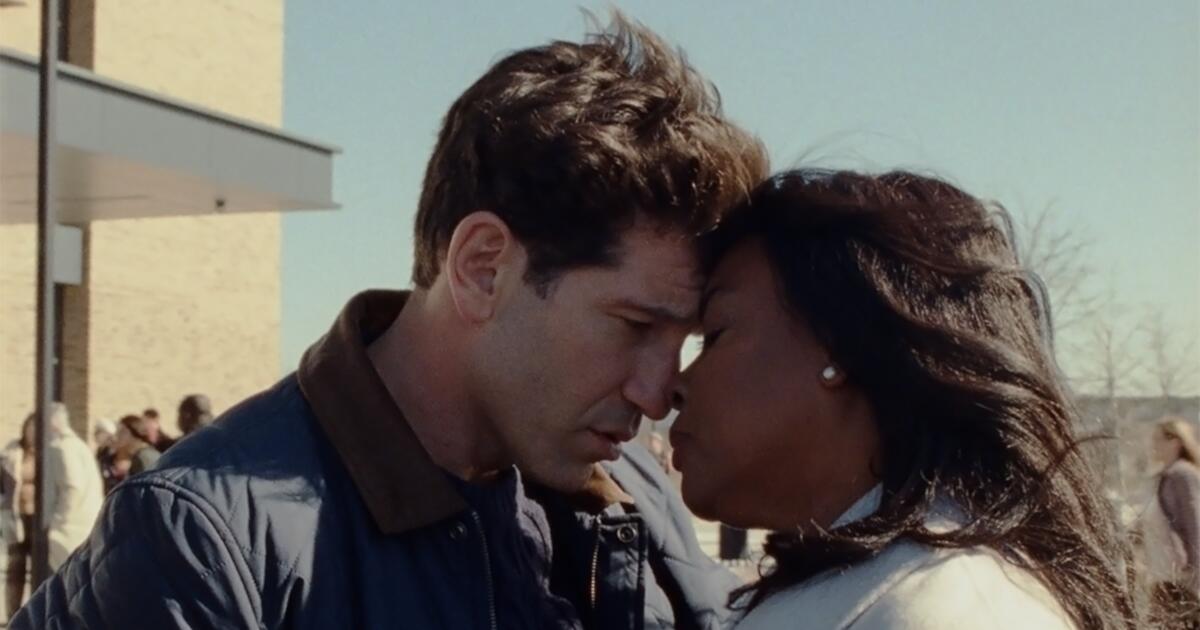
We’re introduced to Wilkerson in the glow of her Pulitzer win, when the pressure is on from her editor (Vera Farmiga) to get another book going, and from a magazine editor (Blair Underwood) to apply her analytical powers to a piece on the recent killing of Trayvon Martin. Claiming a hiatus mind-set and the desire to look after her infirm mother (Emily Yancy), she declines, but to her doting partner, Brett (Jon Bernthal), it looks like a smart, in-demand writer denying herself the happiness of her calling.

Emily Yancy and Jon Bernthal in the movie “Origin.”

(Atsushi Nishijima / Neon)

So when personal catastrophe strikes, and not just once, the grief halts everything. Wilkerson emerges, though, returning to her thoughts about the outcry surrounding Martin: a young Black teenager’s death at the hands of a Latino man playing sentry to a mostly white neighborhood, and what sociological connection it could have to the white supremacist rally in Charlottesville. Believing racism an insufficient catch-all descriptor for such societal violence, she develops a thesis that caste — the hierarchical, legally enforced separator of peoples typically associated with India — connects oppressive states everywhere. Whether the goal is subjugation, as with American Blacks, or annihilation, as in the Holocaust, Wilkerson says, humans require architectures of superiority and inferiority, color be damned.

It sounds, of course, like an academic work, which “Caste” was, and not a movie, which “Origin” needs to be. DuVernay is aware of that, which is why the great Niecy Nash-Betts shows up as Wilkerson’s cousin, to tell it straight at the family barbecue: Make the book about “real people, real things,” she says. Hence, DuVernay shows us the lives in Wilkerson’s mission of connecting past to present: a married pair of anthropologists — one Black, one white — doing undercover work in the ‘30s on the Jim Crow South; a pioneer scholar from India’s “untouchable” Dalit class who sought to erase those distinctions; and testimony from a friend (Audra McDonald, killing it) about a devastating childhood experience with open racism.

DuVernay’s era-shifting scope is given indie-flecked intimacy through Matthew J. Lloyd’s 16mm cinematography. But that also means what pierces more readily are the smaller moments, like the private sorrow and intellectual excitement girding Ellis-Taylor’s portrayal. Packing one of the hardest punches is an older white man relating to Wilkerson the heavy, life-changing story of watching his sole Black teammate from Little League barred from the public pool. Eventually, he is allowed, but he must lie in a raft, alone and watched, being instructed never to touch the water.

By the end, DuVernay has, with editor Spencer Averick’s fleet stitching, massaged her adaptation’s various threads into a collage of insight and emotion worth treasuring. At times stumbling and heavy-handed, but always reaching and pulling us along (touching others is a central visual motif), “Origin” demonstrates a deeply felt purpose: to realize how things are and who people are, by doing the work of seeing, reading, listening, then telling others. Where Wilkerson’s book rightly sparked a conversation about what violence and oppression stems from, DuVernay’s vision of that message, at its heartfelt best, holds focus as a worthy sister achievement.

‘Origin’

Rating: PG-13, for thematic material involving racism, violence, some disturbing images, language and smoking

Running time: 2 hours, 15 minutes

Playing: AMC Century City 15

The pleasure of historian Isabel Wilkerson’s writing is its luxuriant engagement with our head and our heart, with the notion that any analysis — for example, one focused on America’s Great Migration, in the case of her Pulitzer Prize-winning masterwork “The Warmth of Other Suns” — is most affecting when viewed through deep dives into the human beings who lived it.

It’s not surprising, then, that Ava DuVernay, a filmmaker also attuned to a story’s totality, would consider adapting Wilkerson’s memorable 2020 book about systems of dehumanization, “Caste: The Origins of Our Discontents,” using a complementary approach. DuVernay does neither a straight-ahead documentary (“The 13th”) nor a pure docudrama (as she did with “Selma” or the series “When They See Us”), but a fusing of subjects both society-sized and intimate. Her resulting film “Origin” not only articulates the argument Wilkerson makes — about American racism’s roots in the enduring hierarchy known as caste — but frames it within the story of the author herself, played by Aunjanue Ellis-Taylor, grappling with personal tragedy as she mines the contours of a global one.

It’s a lot to pack into one hybridized feature, as if your four-course meal came with a dramatization of the sweat and joy that went into preparing it. And yet DuVernay, whose first movie this is since 2018’s sweet if ungainly “A Wrinkle in Time,” feels more tightly connected to her ambitions this time around. Historical vignettes blend with domestic scenes, dotted by conversations about big ideas.

In Ellis-Taylor’s affecting portrait of a professional woman looking for answers through the prism of work, one is inclined to imagine DuVernay, who wrote the screenplay, making “Origin” as an act of commiseration with her subject: two Black women exploring the feelings and rigor that go into seeking hard truths, whatever one’s chosen medium. That alone gives “Origin” a status-quo-upending power, even when its components don’t always mix smoothly.

We’re introduced to Wilkerson in the glow of her Pulitzer win, when the pressure is on from her editor (Vera Farmiga) to get another book going, and from a magazine editor (Blair Underwood) to apply her analytical powers to a piece on the recent killing of Trayvon Martin. Claiming a hiatus mind-set and the desire to look after her infirm mother (Emily Yancy), she declines, but to her doting partner, Brett (Jon Bernthal), it looks like a smart, in-demand writer denying herself the happiness of her calling.

Emily Yancy and Jon Bernthal in the movie “Origin.”

(Atsushi Nishijima / Neon)

So when personal catastrophe strikes, and not just once, the grief halts everything. Wilkerson emerges, though, returning to her thoughts about the outcry surrounding Martin: a young Black teenager’s death at the hands of a Latino man playing sentry to a mostly white neighborhood, and what sociological connection it could have to the white supremacist rally in Charlottesville. Believing racism an insufficient catch-all descriptor for such societal violence, she develops a thesis that caste — the hierarchical, legally enforced separator of peoples typically associated with India — connects oppressive states everywhere. Whether the goal is subjugation, as with American Blacks, or annihilation, as in the Holocaust, Wilkerson says, humans require architectures of superiority and inferiority, color be damned.

It sounds, of course, like an academic work, which “Caste” was, and not a movie, which “Origin” needs to be. DuVernay is aware of that, which is why the great Niecy Nash-Betts shows up as Wilkerson’s cousin, to tell it straight at the family barbecue: Make the book about “real people, real things,” she says. Hence, DuVernay shows us the lives in Wilkerson’s mission of connecting past to present: a married pair of anthropologists — one Black, one white — doing undercover work in the ‘30s on the Jim Crow South; a pioneer scholar from India’s “untouchable” Dalit class who sought to erase those distinctions; and testimony from a friend (Audra McDonald, killing it) about a devastating childhood experience with open racism.

DuVernay’s era-shifting scope is given indie-flecked intimacy through Matthew J. Lloyd’s 16mm cinematography. But that also means what pierces more readily are the smaller moments, like the private sorrow and intellectual excitement girding Ellis-Taylor’s portrayal. Packing one of the hardest punches is an older white man relating to Wilkerson the heavy, life-changing story of watching his sole Black teammate from Little League barred from the public pool. Eventually, he is allowed, but he must lie in a raft, alone and watched, being instructed never to touch the water.

By the end, DuVernay has, with editor Spencer Averick’s fleet stitching, massaged her adaptation’s various threads into a collage of insight and emotion worth treasuring. At times stumbling and heavy-handed, but always reaching and pulling us along (touching others is a central visual motif), “Origin” demonstrates a deeply felt purpose: to realize how things are and who people are, by doing the work of seeing, reading, listening, then telling others. Where Wilkerson’s book rightly sparked a conversation about what violence and oppression stems from, DuVernay’s vision of that message, at its heartfelt best, holds focus as a worthy sister achievement.

‘Origin’

Rating: PG-13, for thematic material involving racism, violence, some disturbing images, language and smoking

Running time: 2 hours, 15 minutes

Playing: AMC Century City 15

The pleasure of historian Isabel Wilkerson’s writing is its luxuriant engagement with our head and our heart, with the notion that any analysis — for example, one focused on America’s Great Migration, in the case of her Pulitzer Prize-winning masterwork “The Warmth of Other Suns” — is most affecting when viewed through deep dives into the human beings who lived it.

It’s not surprising, then, that Ava DuVernay, a filmmaker also attuned to a story’s totality, would consider adapting Wilkerson’s memorable 2020 book about systems of dehumanization, “Caste: The Origins of Our Discontents,” using a complementary approach. DuVernay does neither a straight-ahead documentary (“The 13th”) nor a pure docudrama (as she did with “Selma” or the series “When They See Us”), but a fusing of subjects both society-sized and intimate. Her resulting film “Origin” not only articulates the argument Wilkerson makes — about American racism’s roots in the enduring hierarchy known as caste — but frames it within the story of the author herself, played by Aunjanue Ellis-Taylor, grappling with personal tragedy as she mines the contours of a global one.

It’s a lot to pack into one hybridized feature, as if your four-course meal came with a dramatization of the sweat and joy that went into preparing it. And yet DuVernay, whose first movie this is since 2018’s sweet if ungainly “A Wrinkle in Time,” feels more tightly connected to her ambitions this time around. Historical vignettes blend with domestic scenes, dotted by conversations about big ideas.

In Ellis-Taylor’s affecting portrait of a professional woman looking for answers through the prism of work, one is inclined to imagine DuVernay, who wrote the screenplay, making “Origin” as an act of commiseration with her subject: two Black women exploring the feelings and rigor that go into seeking hard truths, whatever one’s chosen medium. That alone gives “Origin” a status-quo-upending power, even when its components don’t always mix smoothly.

We’re introduced to Wilkerson in the glow of her Pulitzer win, when the pressure is on from her editor (Vera Farmiga) to get another book going, and from a magazine editor (Blair Underwood) to apply her analytical powers to a piece on the recent killing of Trayvon Martin. Claiming a hiatus mind-set and the desire to look after her infirm mother (Emily Yancy), she declines, but to her doting partner, Brett (Jon Bernthal), it looks like a smart, in-demand writer denying herself the happiness of her calling.

Emily Yancy and Jon Bernthal in the movie “Origin.”

(Atsushi Nishijima / Neon)

So when personal catastrophe strikes, and not just once, the grief halts everything. Wilkerson emerges, though, returning to her thoughts about the outcry surrounding Martin: a young Black teenager’s death at the hands of a Latino man playing sentry to a mostly white neighborhood, and what sociological connection it could have to the white supremacist rally in Charlottesville. Believing racism an insufficient catch-all descriptor for such societal violence, she develops a thesis that caste — the hierarchical, legally enforced separator of peoples typically associated with India — connects oppressive states everywhere. Whether the goal is subjugation, as with American Blacks, or annihilation, as in the Holocaust, Wilkerson says, humans require architectures of superiority and inferiority, color be damned.

It sounds, of course, like an academic work, which “Caste” was, and not a movie, which “Origin” needs to be. DuVernay is aware of that, which is why the great Niecy Nash-Betts shows up as Wilkerson’s cousin, to tell it straight at the family barbecue: Make the book about “real people, real things,” she says. Hence, DuVernay shows us the lives in Wilkerson’s mission of connecting past to present: a married pair of anthropologists — one Black, one white — doing undercover work in the ‘30s on the Jim Crow South; a pioneer scholar from India’s “untouchable” Dalit class who sought to erase those distinctions; and testimony from a friend (Audra McDonald, killing it) about a devastating childhood experience with open racism.

DuVernay’s era-shifting scope is given indie-flecked intimacy through Matthew J. Lloyd’s 16mm cinematography. But that also means what pierces more readily are the smaller moments, like the private sorrow and intellectual excitement girding Ellis-Taylor’s portrayal. Packing one of the hardest punches is an older white man relating to Wilkerson the heavy, life-changing story of watching his sole Black teammate from Little League barred from the public pool. Eventually, he is allowed, but he must lie in a raft, alone and watched, being instructed never to touch the water.

By the end, DuVernay has, with editor Spencer Averick’s fleet stitching, massaged her adaptation’s various threads into a collage of insight and emotion worth treasuring. At times stumbling and heavy-handed, but always reaching and pulling us along (touching others is a central visual motif), “Origin” demonstrates a deeply felt purpose: to realize how things are and who people are, by doing the work of seeing, reading, listening, then telling others. Where Wilkerson’s book rightly sparked a conversation about what violence and oppression stems from, DuVernay’s vision of that message, at its heartfelt best, holds focus as a worthy sister achievement.

‘Origin’

Rating: PG-13, for thematic material involving racism, violence, some disturbing images, language and smoking

Running time: 2 hours, 15 minutes

Playing: AMC Century City 15

The pleasure of historian Isabel Wilkerson’s writing is its luxuriant engagement with our head and our heart, with the notion that any analysis — for example, one focused on America’s Great Migration, in the case of her Pulitzer Prize-winning masterwork “The Warmth of Other Suns” — is most affecting when viewed through deep dives into the human beings who lived it.

It’s not surprising, then, that Ava DuVernay, a filmmaker also attuned to a story’s totality, would consider adapting Wilkerson’s memorable 2020 book about systems of dehumanization, “Caste: The Origins of Our Discontents,” using a complementary approach. DuVernay does neither a straight-ahead documentary (“The 13th”) nor a pure docudrama (as she did with “Selma” or the series “When They See Us”), but a fusing of subjects both society-sized and intimate. Her resulting film “Origin” not only articulates the argument Wilkerson makes — about American racism’s roots in the enduring hierarchy known as caste — but frames it within the story of the author herself, played by Aunjanue Ellis-Taylor, grappling with personal tragedy as she mines the contours of a global one.

It’s a lot to pack into one hybridized feature, as if your four-course meal came with a dramatization of the sweat and joy that went into preparing it. And yet DuVernay, whose first movie this is since 2018’s sweet if ungainly “A Wrinkle in Time,” feels more tightly connected to her ambitions this time around. Historical vignettes blend with domestic scenes, dotted by conversations about big ideas.

In Ellis-Taylor’s affecting portrait of a professional woman looking for answers through the prism of work, one is inclined to imagine DuVernay, who wrote the screenplay, making “Origin” as an act of commiseration with her subject: two Black women exploring the feelings and rigor that go into seeking hard truths, whatever one’s chosen medium. That alone gives “Origin” a status-quo-upending power, even when its components don’t always mix smoothly.

We’re introduced to Wilkerson in the glow of her Pulitzer win, when the pressure is on from her editor (Vera Farmiga) to get another book going, and from a magazine editor (Blair Underwood) to apply her analytical powers to a piece on the recent killing of Trayvon Martin. Claiming a hiatus mind-set and the desire to look after her infirm mother (Emily Yancy), she declines, but to her doting partner, Brett (Jon Bernthal), it looks like a smart, in-demand writer denying herself the happiness of her calling.

Emily Yancy and Jon Bernthal in the movie “Origin.”

(Atsushi Nishijima / Neon)

So when personal catastrophe strikes, and not just once, the grief halts everything. Wilkerson emerges, though, returning to her thoughts about the outcry surrounding Martin: a young Black teenager’s death at the hands of a Latino man playing sentry to a mostly white neighborhood, and what sociological connection it could have to the white supremacist rally in Charlottesville. Believing racism an insufficient catch-all descriptor for such societal violence, she develops a thesis that caste — the hierarchical, legally enforced separator of peoples typically associated with India — connects oppressive states everywhere. Whether the goal is subjugation, as with American Blacks, or annihilation, as in the Holocaust, Wilkerson says, humans require architectures of superiority and inferiority, color be damned.

It sounds, of course, like an academic work, which “Caste” was, and not a movie, which “Origin” needs to be. DuVernay is aware of that, which is why the great Niecy Nash-Betts shows up as Wilkerson’s cousin, to tell it straight at the family barbecue: Make the book about “real people, real things,” she says. Hence, DuVernay shows us the lives in Wilkerson’s mission of connecting past to present: a married pair of anthropologists — one Black, one white — doing undercover work in the ‘30s on the Jim Crow South; a pioneer scholar from India’s “untouchable” Dalit class who sought to erase those distinctions; and testimony from a friend (Audra McDonald, killing it) about a devastating childhood experience with open racism.

DuVernay’s era-shifting scope is given indie-flecked intimacy through Matthew J. Lloyd’s 16mm cinematography. But that also means what pierces more readily are the smaller moments, like the private sorrow and intellectual excitement girding Ellis-Taylor’s portrayal. Packing one of the hardest punches is an older white man relating to Wilkerson the heavy, life-changing story of watching his sole Black teammate from Little League barred from the public pool. Eventually, he is allowed, but he must lie in a raft, alone and watched, being instructed never to touch the water.

By the end, DuVernay has, with editor Spencer Averick’s fleet stitching, massaged her adaptation’s various threads into a collage of insight and emotion worth treasuring. At times stumbling and heavy-handed, but always reaching and pulling us along (touching others is a central visual motif), “Origin” demonstrates a deeply felt purpose: to realize how things are and who people are, by doing the work of seeing, reading, listening, then telling others. Where Wilkerson’s book rightly sparked a conversation about what violence and oppression stems from, DuVernay’s vision of that message, at its heartfelt best, holds focus as a worthy sister achievement.

‘Origin’

Rating: PG-13, for thematic material involving racism, violence, some disturbing images, language and smoking

Running time: 2 hours, 15 minutes

Playing: AMC Century City 15

The pleasure of historian Isabel Wilkerson’s writing is its luxuriant engagement with our head and our heart, with the notion that any analysis — for example, one focused on America’s Great Migration, in the case of her Pulitzer Prize-winning masterwork “The Warmth of Other Suns” — is most affecting when viewed through deep dives into the human beings who lived it.

It’s not surprising, then, that Ava DuVernay, a filmmaker also attuned to a story’s totality, would consider adapting Wilkerson’s memorable 2020 book about systems of dehumanization, “Caste: The Origins of Our Discontents,” using a complementary approach. DuVernay does neither a straight-ahead documentary (“The 13th”) nor a pure docudrama (as she did with “Selma” or the series “When They See Us”), but a fusing of subjects both society-sized and intimate. Her resulting film “Origin” not only articulates the argument Wilkerson makes — about American racism’s roots in the enduring hierarchy known as caste — but frames it within the story of the author herself, played by Aunjanue Ellis-Taylor, grappling with personal tragedy as she mines the contours of a global one.

It’s a lot to pack into one hybridized feature, as if your four-course meal came with a dramatization of the sweat and joy that went into preparing it. And yet DuVernay, whose first movie this is since 2018’s sweet if ungainly “A Wrinkle in Time,” feels more tightly connected to her ambitions this time around. Historical vignettes blend with domestic scenes, dotted by conversations about big ideas.

In Ellis-Taylor’s affecting portrait of a professional woman looking for answers through the prism of work, one is inclined to imagine DuVernay, who wrote the screenplay, making “Origin” as an act of commiseration with her subject: two Black women exploring the feelings and rigor that go into seeking hard truths, whatever one’s chosen medium. That alone gives “Origin” a status-quo-upending power, even when its components don’t always mix smoothly.

We’re introduced to Wilkerson in the glow of her Pulitzer win, when the pressure is on from her editor (Vera Farmiga) to get another book going, and from a magazine editor (Blair Underwood) to apply her analytical powers to a piece on the recent killing of Trayvon Martin. Claiming a hiatus mind-set and the desire to look after her infirm mother (Emily Yancy), she declines, but to her doting partner, Brett (Jon Bernthal), it looks like a smart, in-demand writer denying herself the happiness of her calling.

Emily Yancy and Jon Bernthal in the movie “Origin.”

(Atsushi Nishijima / Neon)

So when personal catastrophe strikes, and not just once, the grief halts everything. Wilkerson emerges, though, returning to her thoughts about the outcry surrounding Martin: a young Black teenager’s death at the hands of a Latino man playing sentry to a mostly white neighborhood, and what sociological connection it could have to the white supremacist rally in Charlottesville. Believing racism an insufficient catch-all descriptor for such societal violence, she develops a thesis that caste — the hierarchical, legally enforced separator of peoples typically associated with India — connects oppressive states everywhere. Whether the goal is subjugation, as with American Blacks, or annihilation, as in the Holocaust, Wilkerson says, humans require architectures of superiority and inferiority, color be damned.

It sounds, of course, like an academic work, which “Caste” was, and not a movie, which “Origin” needs to be. DuVernay is aware of that, which is why the great Niecy Nash-Betts shows up as Wilkerson’s cousin, to tell it straight at the family barbecue: Make the book about “real people, real things,” she says. Hence, DuVernay shows us the lives in Wilkerson’s mission of connecting past to present: a married pair of anthropologists — one Black, one white — doing undercover work in the ‘30s on the Jim Crow South; a pioneer scholar from India’s “untouchable” Dalit class who sought to erase those distinctions; and testimony from a friend (Audra McDonald, killing it) about a devastating childhood experience with open racism.

DuVernay’s era-shifting scope is given indie-flecked intimacy through Matthew J. Lloyd’s 16mm cinematography. But that also means what pierces more readily are the smaller moments, like the private sorrow and intellectual excitement girding Ellis-Taylor’s portrayal. Packing one of the hardest punches is an older white man relating to Wilkerson the heavy, life-changing story of watching his sole Black teammate from Little League barred from the public pool. Eventually, he is allowed, but he must lie in a raft, alone and watched, being instructed never to touch the water.

By the end, DuVernay has, with editor Spencer Averick’s fleet stitching, massaged her adaptation’s various threads into a collage of insight and emotion worth treasuring. At times stumbling and heavy-handed, but always reaching and pulling us along (touching others is a central visual motif), “Origin” demonstrates a deeply felt purpose: to realize how things are and who people are, by doing the work of seeing, reading, listening, then telling others. Where Wilkerson’s book rightly sparked a conversation about what violence and oppression stems from, DuVernay’s vision of that message, at its heartfelt best, holds focus as a worthy sister achievement.

‘Origin’

Rating: PG-13, for thematic material involving racism, violence, some disturbing images, language and smoking

Running time: 2 hours, 15 minutes

Playing: AMC Century City 15

The pleasure of historian Isabel Wilkerson’s writing is its luxuriant engagement with our head and our heart, with the notion that any analysis — for example, one focused on America’s Great Migration, in the case of her Pulitzer Prize-winning masterwork “The Warmth of Other Suns” — is most affecting when viewed through deep dives into the human beings who lived it.

It’s not surprising, then, that Ava DuVernay, a filmmaker also attuned to a story’s totality, would consider adapting Wilkerson’s memorable 2020 book about systems of dehumanization, “Caste: The Origins of Our Discontents,” using a complementary approach. DuVernay does neither a straight-ahead documentary (“The 13th”) nor a pure docudrama (as she did with “Selma” or the series “When They See Us”), but a fusing of subjects both society-sized and intimate. Her resulting film “Origin” not only articulates the argument Wilkerson makes — about American racism’s roots in the enduring hierarchy known as caste — but frames it within the story of the author herself, played by Aunjanue Ellis-Taylor, grappling with personal tragedy as she mines the contours of a global one.

It’s a lot to pack into one hybridized feature, as if your four-course meal came with a dramatization of the sweat and joy that went into preparing it. And yet DuVernay, whose first movie this is since 2018’s sweet if ungainly “A Wrinkle in Time,” feels more tightly connected to her ambitions this time around. Historical vignettes blend with domestic scenes, dotted by conversations about big ideas.

In Ellis-Taylor’s affecting portrait of a professional woman looking for answers through the prism of work, one is inclined to imagine DuVernay, who wrote the screenplay, making “Origin” as an act of commiseration with her subject: two Black women exploring the feelings and rigor that go into seeking hard truths, whatever one’s chosen medium. That alone gives “Origin” a status-quo-upending power, even when its components don’t always mix smoothly.

We’re introduced to Wilkerson in the glow of her Pulitzer win, when the pressure is on from her editor (Vera Farmiga) to get another book going, and from a magazine editor (Blair Underwood) to apply her analytical powers to a piece on the recent killing of Trayvon Martin. Claiming a hiatus mind-set and the desire to look after her infirm mother (Emily Yancy), she declines, but to her doting partner, Brett (Jon Bernthal), it looks like a smart, in-demand writer denying herself the happiness of her calling.

Emily Yancy and Jon Bernthal in the movie “Origin.”

(Atsushi Nishijima / Neon)

So when personal catastrophe strikes, and not just once, the grief halts everything. Wilkerson emerges, though, returning to her thoughts about the outcry surrounding Martin: a young Black teenager’s death at the hands of a Latino man playing sentry to a mostly white neighborhood, and what sociological connection it could have to the white supremacist rally in Charlottesville. Believing racism an insufficient catch-all descriptor for such societal violence, she develops a thesis that caste — the hierarchical, legally enforced separator of peoples typically associated with India — connects oppressive states everywhere. Whether the goal is subjugation, as with American Blacks, or annihilation, as in the Holocaust, Wilkerson says, humans require architectures of superiority and inferiority, color be damned.

It sounds, of course, like an academic work, which “Caste” was, and not a movie, which “Origin” needs to be. DuVernay is aware of that, which is why the great Niecy Nash-Betts shows up as Wilkerson’s cousin, to tell it straight at the family barbecue: Make the book about “real people, real things,” she says. Hence, DuVernay shows us the lives in Wilkerson’s mission of connecting past to present: a married pair of anthropologists — one Black, one white — doing undercover work in the ‘30s on the Jim Crow South; a pioneer scholar from India’s “untouchable” Dalit class who sought to erase those distinctions; and testimony from a friend (Audra McDonald, killing it) about a devastating childhood experience with open racism.

DuVernay’s era-shifting scope is given indie-flecked intimacy through Matthew J. Lloyd’s 16mm cinematography. But that also means what pierces more readily are the smaller moments, like the private sorrow and intellectual excitement girding Ellis-Taylor’s portrayal. Packing one of the hardest punches is an older white man relating to Wilkerson the heavy, life-changing story of watching his sole Black teammate from Little League barred from the public pool. Eventually, he is allowed, but he must lie in a raft, alone and watched, being instructed never to touch the water.

By the end, DuVernay has, with editor Spencer Averick’s fleet stitching, massaged her adaptation’s various threads into a collage of insight and emotion worth treasuring. At times stumbling and heavy-handed, but always reaching and pulling us along (touching others is a central visual motif), “Origin” demonstrates a deeply felt purpose: to realize how things are and who people are, by doing the work of seeing, reading, listening, then telling others. Where Wilkerson’s book rightly sparked a conversation about what violence and oppression stems from, DuVernay’s vision of that message, at its heartfelt best, holds focus as a worthy sister achievement.

‘Origin’

Rating: PG-13, for thematic material involving racism, violence, some disturbing images, language and smoking

Running time: 2 hours, 15 minutes

Playing: AMC Century City 15

The pleasure of historian Isabel Wilkerson’s writing is its luxuriant engagement with our head and our heart, with the notion that any analysis — for example, one focused on America’s Great Migration, in the case of her Pulitzer Prize-winning masterwork “The Warmth of Other Suns” — is most affecting when viewed through deep dives into the human beings who lived it.

It’s not surprising, then, that Ava DuVernay, a filmmaker also attuned to a story’s totality, would consider adapting Wilkerson’s memorable 2020 book about systems of dehumanization, “Caste: The Origins of Our Discontents,” using a complementary approach. DuVernay does neither a straight-ahead documentary (“The 13th”) nor a pure docudrama (as she did with “Selma” or the series “When They See Us”), but a fusing of subjects both society-sized and intimate. Her resulting film “Origin” not only articulates the argument Wilkerson makes — about American racism’s roots in the enduring hierarchy known as caste — but frames it within the story of the author herself, played by Aunjanue Ellis-Taylor, grappling with personal tragedy as she mines the contours of a global one.

It’s a lot to pack into one hybridized feature, as if your four-course meal came with a dramatization of the sweat and joy that went into preparing it. And yet DuVernay, whose first movie this is since 2018’s sweet if ungainly “A Wrinkle in Time,” feels more tightly connected to her ambitions this time around. Historical vignettes blend with domestic scenes, dotted by conversations about big ideas.

In Ellis-Taylor’s affecting portrait of a professional woman looking for answers through the prism of work, one is inclined to imagine DuVernay, who wrote the screenplay, making “Origin” as an act of commiseration with her subject: two Black women exploring the feelings and rigor that go into seeking hard truths, whatever one’s chosen medium. That alone gives “Origin” a status-quo-upending power, even when its components don’t always mix smoothly.

We’re introduced to Wilkerson in the glow of her Pulitzer win, when the pressure is on from her editor (Vera Farmiga) to get another book going, and from a magazine editor (Blair Underwood) to apply her analytical powers to a piece on the recent killing of Trayvon Martin. Claiming a hiatus mind-set and the desire to look after her infirm mother (Emily Yancy), she declines, but to her doting partner, Brett (Jon Bernthal), it looks like a smart, in-demand writer denying herself the happiness of her calling.

Emily Yancy and Jon Bernthal in the movie “Origin.”

(Atsushi Nishijima / Neon)

So when personal catastrophe strikes, and not just once, the grief halts everything. Wilkerson emerges, though, returning to her thoughts about the outcry surrounding Martin: a young Black teenager’s death at the hands of a Latino man playing sentry to a mostly white neighborhood, and what sociological connection it could have to the white supremacist rally in Charlottesville. Believing racism an insufficient catch-all descriptor for such societal violence, she develops a thesis that caste — the hierarchical, legally enforced separator of peoples typically associated with India — connects oppressive states everywhere. Whether the goal is subjugation, as with American Blacks, or annihilation, as in the Holocaust, Wilkerson says, humans require architectures of superiority and inferiority, color be damned.

It sounds, of course, like an academic work, which “Caste” was, and not a movie, which “Origin” needs to be. DuVernay is aware of that, which is why the great Niecy Nash-Betts shows up as Wilkerson’s cousin, to tell it straight at the family barbecue: Make the book about “real people, real things,” she says. Hence, DuVernay shows us the lives in Wilkerson’s mission of connecting past to present: a married pair of anthropologists — one Black, one white — doing undercover work in the ‘30s on the Jim Crow South; a pioneer scholar from India’s “untouchable” Dalit class who sought to erase those distinctions; and testimony from a friend (Audra McDonald, killing it) about a devastating childhood experience with open racism.

DuVernay’s era-shifting scope is given indie-flecked intimacy through Matthew J. Lloyd’s 16mm cinematography. But that also means what pierces more readily are the smaller moments, like the private sorrow and intellectual excitement girding Ellis-Taylor’s portrayal. Packing one of the hardest punches is an older white man relating to Wilkerson the heavy, life-changing story of watching his sole Black teammate from Little League barred from the public pool. Eventually, he is allowed, but he must lie in a raft, alone and watched, being instructed never to touch the water.

By the end, DuVernay has, with editor Spencer Averick’s fleet stitching, massaged her adaptation’s various threads into a collage of insight and emotion worth treasuring. At times stumbling and heavy-handed, but always reaching and pulling us along (touching others is a central visual motif), “Origin” demonstrates a deeply felt purpose: to realize how things are and who people are, by doing the work of seeing, reading, listening, then telling others. Where Wilkerson’s book rightly sparked a conversation about what violence and oppression stems from, DuVernay’s vision of that message, at its heartfelt best, holds focus as a worthy sister achievement.

‘Origin’

Rating: PG-13, for thematic material involving racism, violence, some disturbing images, language and smoking

Running time: 2 hours, 15 minutes

Playing: AMC Century City 15

The pleasure of historian Isabel Wilkerson’s writing is its luxuriant engagement with our head and our heart, with the notion that any analysis — for example, one focused on America’s Great Migration, in the case of her Pulitzer Prize-winning masterwork “The Warmth of Other Suns” — is most affecting when viewed through deep dives into the human beings who lived it.

It’s not surprising, then, that Ava DuVernay, a filmmaker also attuned to a story’s totality, would consider adapting Wilkerson’s memorable 2020 book about systems of dehumanization, “Caste: The Origins of Our Discontents,” using a complementary approach. DuVernay does neither a straight-ahead documentary (“The 13th”) nor a pure docudrama (as she did with “Selma” or the series “When They See Us”), but a fusing of subjects both society-sized and intimate. Her resulting film “Origin” not only articulates the argument Wilkerson makes — about American racism’s roots in the enduring hierarchy known as caste — but frames it within the story of the author herself, played by Aunjanue Ellis-Taylor, grappling with personal tragedy as she mines the contours of a global one.

It’s a lot to pack into one hybridized feature, as if your four-course meal came with a dramatization of the sweat and joy that went into preparing it. And yet DuVernay, whose first movie this is since 2018’s sweet if ungainly “A Wrinkle in Time,” feels more tightly connected to her ambitions this time around. Historical vignettes blend with domestic scenes, dotted by conversations about big ideas.

In Ellis-Taylor’s affecting portrait of a professional woman looking for answers through the prism of work, one is inclined to imagine DuVernay, who wrote the screenplay, making “Origin” as an act of commiseration with her subject: two Black women exploring the feelings and rigor that go into seeking hard truths, whatever one’s chosen medium. That alone gives “Origin” a status-quo-upending power, even when its components don’t always mix smoothly.

We’re introduced to Wilkerson in the glow of her Pulitzer win, when the pressure is on from her editor (Vera Farmiga) to get another book going, and from a magazine editor (Blair Underwood) to apply her analytical powers to a piece on the recent killing of Trayvon Martin. Claiming a hiatus mind-set and the desire to look after her infirm mother (Emily Yancy), she declines, but to her doting partner, Brett (Jon Bernthal), it looks like a smart, in-demand writer denying herself the happiness of her calling.

Emily Yancy and Jon Bernthal in the movie “Origin.”

(Atsushi Nishijima / Neon)

So when personal catastrophe strikes, and not just once, the grief halts everything. Wilkerson emerges, though, returning to her thoughts about the outcry surrounding Martin: a young Black teenager’s death at the hands of a Latino man playing sentry to a mostly white neighborhood, and what sociological connection it could have to the white supremacist rally in Charlottesville. Believing racism an insufficient catch-all descriptor for such societal violence, she develops a thesis that caste — the hierarchical, legally enforced separator of peoples typically associated with India — connects oppressive states everywhere. Whether the goal is subjugation, as with American Blacks, or annihilation, as in the Holocaust, Wilkerson says, humans require architectures of superiority and inferiority, color be damned.

It sounds, of course, like an academic work, which “Caste” was, and not a movie, which “Origin” needs to be. DuVernay is aware of that, which is why the great Niecy Nash-Betts shows up as Wilkerson’s cousin, to tell it straight at the family barbecue: Make the book about “real people, real things,” she says. Hence, DuVernay shows us the lives in Wilkerson’s mission of connecting past to present: a married pair of anthropologists — one Black, one white — doing undercover work in the ‘30s on the Jim Crow South; a pioneer scholar from India’s “untouchable” Dalit class who sought to erase those distinctions; and testimony from a friend (Audra McDonald, killing it) about a devastating childhood experience with open racism.

DuVernay’s era-shifting scope is given indie-flecked intimacy through Matthew J. Lloyd’s 16mm cinematography. But that also means what pierces more readily are the smaller moments, like the private sorrow and intellectual excitement girding Ellis-Taylor’s portrayal. Packing one of the hardest punches is an older white man relating to Wilkerson the heavy, life-changing story of watching his sole Black teammate from Little League barred from the public pool. Eventually, he is allowed, but he must lie in a raft, alone and watched, being instructed never to touch the water.

By the end, DuVernay has, with editor Spencer Averick’s fleet stitching, massaged her adaptation’s various threads into a collage of insight and emotion worth treasuring. At times stumbling and heavy-handed, but always reaching and pulling us along (touching others is a central visual motif), “Origin” demonstrates a deeply felt purpose: to realize how things are and who people are, by doing the work of seeing, reading, listening, then telling others. Where Wilkerson’s book rightly sparked a conversation about what violence and oppression stems from, DuVernay’s vision of that message, at its heartfelt best, holds focus as a worthy sister achievement.

‘Origin’

Rating: PG-13, for thematic material involving racism, violence, some disturbing images, language and smoking

Running time: 2 hours, 15 minutes

Playing: AMC Century City 15

Leave a Reply Cancel reply

Your email address will not be published. Required fields are marked *

Recommended

Latest listeria recall affects Trader Joe’s and other retailers

1 year ago

‘The Enduring Wild’ review: Josh Jackson pays homage to public lands

10 months ago

Crypto Wants Its Shine Back

3 years ago

‘The ‘Burbs’ review: A charming cast draws you into this mystery

2 months ago
Yonkers Observer

© 2025 Yonkers Observer or its affiliated companies.

Navigate Site

  • About
  • Advertise
  • Terms & Conditions
  • Privacy Policy
  • Disclaimer
  • Contact

Follow Us

No Result
View All Result
  • Home
  • World
  • Politics
  • Finance
  • Technology
  • Health
  • Culture
  • Entertainment
  • Trend

© 2025 Yonkers Observer or its affiliated companies.

Welcome Back!

Login to your account below

Forgotten Password?

Retrieve your password

Please enter your username or email address to reset your password.

Log In