

The cinematic image of children boarding trains in World War II is, typically, a traumatic one. But in “One Life,” directed by James Hawes, it is wildly, blindly hopeful, as children board trains in Prague, bound for England, escaping dire conditions in refugee camps and the encroaching Nazi occupation, seemingly steps away.
“One Life” is the true story of Nicholas “Nicky” Winton, a British stockbroker and humanitarian who, in 1939, helped to arrange the escape of 669 children from Czechoslovakia. Written by Lucinda Coxon and Nick Drake, the film is based on a book by Winton’s daughter, Barbara Winton, “If It’s Not Impossible … the Life of Sir Nicholas Winton.” The film marks the feature directorial debut of Hawes, who also did the first season of the Apple TV+ spy series “Slow Horses.”
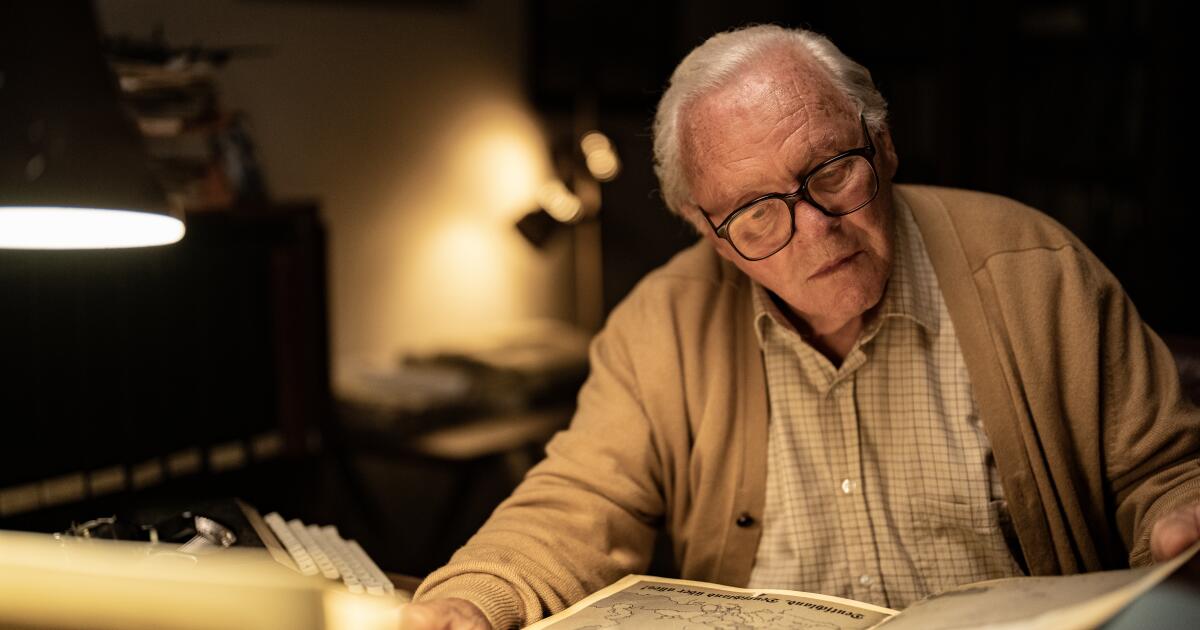
“One Life” weaves together two periods in Winton’s life, 50 years apart. Anthony Hopkins plays Winton in 1987, enjoying a life of peaceful retirement with his wife, Grete (Lena Olin). At the behest of Grete, while cleaning out his office, he uncovers his old scrapbook containing the records and remnants of his pre-war endeavors helping refugee children. His efforts have gone unrecognized in the years since, the children scattered to foster families across Britain, but he remains haunted by their faces, snapped in photographs that he pores over with a magnifying glass.
Johnny Flynn plays Winton five decades earlier, a stern and quiet man, the son of German Jewish immigrants who converted to Christianity and changed their last name in order to assimilate in England. Concerned with reports from occupied Sudentenland, Winton takes a leave from his banking job and meets a friend in Prague in order to assist with the refugee efforts. He immediately becomes taken with the cause of evacuating as many children as he can to England.
Johnny Flynn in the movie “One Life.”
(Peter Mountain / Bleecker Street)
The comparison to “Schindler’s List” is apt — Winton has colloquially been known as “the British Schindler” — and the film will feel familiar, if not formulaic, because we have seen films like this about World War II and the Holocaust. Hawes utilizes that iconography without exploiting or sensationalizing the material; the film is emotionally restrained in a way that is almost frustrating at times but ultimately reflects the character of Winton’s quiet, self-effacing personality.
As Hopkins’ Winton puzzles over what to do with his scrapbook, it’s the other people in his life, including his old friend Martin (Jonathan Pryce) and others like Elizabeth “Betty” Maxwell (Marthe Keller) — a Holocaust researcher and the wife of the infamous media magnate Robert Maxwell — who emphasize what an important humanitarian achievement he spearheaded. In fact, it’s not until Winton appears on a surprising 1988 episode of the British chat show “That’s Life!” that he’s able to comprehend the sheer human impact of his efforts and the emotion begins to seep through.
There is a subdued, unshowy but profound beauty to Hawes’ work. The pre-war timeline is the kind of sturdy World War II-era filmmaking that we have come to expect, rendered with a comforting authenticity. As audience members, we do crave a bit more naked emotion or even personal motivation from young Nicky (Flynn’s performance is as muted as he’s ever been). But Hawes and the screenwriters steer away from delving into psychological inquiries.
They seem less interested in why Winton did it and more that he simply just did. Bound by certain inherent values of decency and kindness instilled in him by his mother (Helena Bonham Carter), he applied his skill for paperwork to the logistical nightmare that was extracting these kids from a terrible situation. He and his friends, Doreen Warriner (Romola Garai) and Trevor Chadwick (Alex Sharp), describe themselves as simply ordinary people raising an army of ordinary people to do something not only good but life-saving for innocent children caught in the maw of war.
“One Life” is a slow burn, slowly establishing Winton’s modest character as a younger and older man, but when it cracks open, it is a deeply moving portrait of true human goodness. The emotional resonance comes not from the dramatic wartime events, but rather from the long-term effects of Winton’s efforts many years later. His story proves that a few months of helping others can turn into generational legacies, that 600 souls can turn into 6,000, and that one life can have a lasting impact on the world.
Walsh is a Tribune News Service film critic.
‘One Life’
Rated: PG for thematic material, smoking and some language
Running time: 1 hour, 50 minutes
Playing: In wide release Friday, March 15

The cinematic image of children boarding trains in World War II is, typically, a traumatic one. But in “One Life,” directed by James Hawes, it is wildly, blindly hopeful, as children board trains in Prague, bound for England, escaping dire conditions in refugee camps and the encroaching Nazi occupation, seemingly steps away.
“One Life” is the true story of Nicholas “Nicky” Winton, a British stockbroker and humanitarian who, in 1939, helped to arrange the escape of 669 children from Czechoslovakia. Written by Lucinda Coxon and Nick Drake, the film is based on a book by Winton’s daughter, Barbara Winton, “If It’s Not Impossible … the Life of Sir Nicholas Winton.” The film marks the feature directorial debut of Hawes, who also did the first season of the Apple TV+ spy series “Slow Horses.”
“One Life” weaves together two periods in Winton’s life, 50 years apart. Anthony Hopkins plays Winton in 1987, enjoying a life of peaceful retirement with his wife, Grete (Lena Olin). At the behest of Grete, while cleaning out his office, he uncovers his old scrapbook containing the records and remnants of his pre-war endeavors helping refugee children. His efforts have gone unrecognized in the years since, the children scattered to foster families across Britain, but he remains haunted by their faces, snapped in photographs that he pores over with a magnifying glass.
Johnny Flynn plays Winton five decades earlier, a stern and quiet man, the son of German Jewish immigrants who converted to Christianity and changed their last name in order to assimilate in England. Concerned with reports from occupied Sudentenland, Winton takes a leave from his banking job and meets a friend in Prague in order to assist with the refugee efforts. He immediately becomes taken with the cause of evacuating as many children as he can to England.
Johnny Flynn in the movie “One Life.”
(Peter Mountain / Bleecker Street)
The comparison to “Schindler’s List” is apt — Winton has colloquially been known as “the British Schindler” — and the film will feel familiar, if not formulaic, because we have seen films like this about World War II and the Holocaust. Hawes utilizes that iconography without exploiting or sensationalizing the material; the film is emotionally restrained in a way that is almost frustrating at times but ultimately reflects the character of Winton’s quiet, self-effacing personality.
As Hopkins’ Winton puzzles over what to do with his scrapbook, it’s the other people in his life, including his old friend Martin (Jonathan Pryce) and others like Elizabeth “Betty” Maxwell (Marthe Keller) — a Holocaust researcher and the wife of the infamous media magnate Robert Maxwell — who emphasize what an important humanitarian achievement he spearheaded. In fact, it’s not until Winton appears on a surprising 1988 episode of the British chat show “That’s Life!” that he’s able to comprehend the sheer human impact of his efforts and the emotion begins to seep through.
There is a subdued, unshowy but profound beauty to Hawes’ work. The pre-war timeline is the kind of sturdy World War II-era filmmaking that we have come to expect, rendered with a comforting authenticity. As audience members, we do crave a bit more naked emotion or even personal motivation from young Nicky (Flynn’s performance is as muted as he’s ever been). But Hawes and the screenwriters steer away from delving into psychological inquiries.
They seem less interested in why Winton did it and more that he simply just did. Bound by certain inherent values of decency and kindness instilled in him by his mother (Helena Bonham Carter), he applied his skill for paperwork to the logistical nightmare that was extracting these kids from a terrible situation. He and his friends, Doreen Warriner (Romola Garai) and Trevor Chadwick (Alex Sharp), describe themselves as simply ordinary people raising an army of ordinary people to do something not only good but life-saving for innocent children caught in the maw of war.
“One Life” is a slow burn, slowly establishing Winton’s modest character as a younger and older man, but when it cracks open, it is a deeply moving portrait of true human goodness. The emotional resonance comes not from the dramatic wartime events, but rather from the long-term effects of Winton’s efforts many years later. His story proves that a few months of helping others can turn into generational legacies, that 600 souls can turn into 6,000, and that one life can have a lasting impact on the world.
Walsh is a Tribune News Service film critic.
‘One Life’
Rated: PG for thematic material, smoking and some language
Running time: 1 hour, 50 minutes
Playing: In wide release Friday, March 15

The cinematic image of children boarding trains in World War II is, typically, a traumatic one. But in “One Life,” directed by James Hawes, it is wildly, blindly hopeful, as children board trains in Prague, bound for England, escaping dire conditions in refugee camps and the encroaching Nazi occupation, seemingly steps away.
“One Life” is the true story of Nicholas “Nicky” Winton, a British stockbroker and humanitarian who, in 1939, helped to arrange the escape of 669 children from Czechoslovakia. Written by Lucinda Coxon and Nick Drake, the film is based on a book by Winton’s daughter, Barbara Winton, “If It’s Not Impossible … the Life of Sir Nicholas Winton.” The film marks the feature directorial debut of Hawes, who also did the first season of the Apple TV+ spy series “Slow Horses.”
“One Life” weaves together two periods in Winton’s life, 50 years apart. Anthony Hopkins plays Winton in 1987, enjoying a life of peaceful retirement with his wife, Grete (Lena Olin). At the behest of Grete, while cleaning out his office, he uncovers his old scrapbook containing the records and remnants of his pre-war endeavors helping refugee children. His efforts have gone unrecognized in the years since, the children scattered to foster families across Britain, but he remains haunted by their faces, snapped in photographs that he pores over with a magnifying glass.
Johnny Flynn plays Winton five decades earlier, a stern and quiet man, the son of German Jewish immigrants who converted to Christianity and changed their last name in order to assimilate in England. Concerned with reports from occupied Sudentenland, Winton takes a leave from his banking job and meets a friend in Prague in order to assist with the refugee efforts. He immediately becomes taken with the cause of evacuating as many children as he can to England.
Johnny Flynn in the movie “One Life.”
(Peter Mountain / Bleecker Street)
The comparison to “Schindler’s List” is apt — Winton has colloquially been known as “the British Schindler” — and the film will feel familiar, if not formulaic, because we have seen films like this about World War II and the Holocaust. Hawes utilizes that iconography without exploiting or sensationalizing the material; the film is emotionally restrained in a way that is almost frustrating at times but ultimately reflects the character of Winton’s quiet, self-effacing personality.
As Hopkins’ Winton puzzles over what to do with his scrapbook, it’s the other people in his life, including his old friend Martin (Jonathan Pryce) and others like Elizabeth “Betty” Maxwell (Marthe Keller) — a Holocaust researcher and the wife of the infamous media magnate Robert Maxwell — who emphasize what an important humanitarian achievement he spearheaded. In fact, it’s not until Winton appears on a surprising 1988 episode of the British chat show “That’s Life!” that he’s able to comprehend the sheer human impact of his efforts and the emotion begins to seep through.
There is a subdued, unshowy but profound beauty to Hawes’ work. The pre-war timeline is the kind of sturdy World War II-era filmmaking that we have come to expect, rendered with a comforting authenticity. As audience members, we do crave a bit more naked emotion or even personal motivation from young Nicky (Flynn’s performance is as muted as he’s ever been). But Hawes and the screenwriters steer away from delving into psychological inquiries.
They seem less interested in why Winton did it and more that he simply just did. Bound by certain inherent values of decency and kindness instilled in him by his mother (Helena Bonham Carter), he applied his skill for paperwork to the logistical nightmare that was extracting these kids from a terrible situation. He and his friends, Doreen Warriner (Romola Garai) and Trevor Chadwick (Alex Sharp), describe themselves as simply ordinary people raising an army of ordinary people to do something not only good but life-saving for innocent children caught in the maw of war.
“One Life” is a slow burn, slowly establishing Winton’s modest character as a younger and older man, but when it cracks open, it is a deeply moving portrait of true human goodness. The emotional resonance comes not from the dramatic wartime events, but rather from the long-term effects of Winton’s efforts many years later. His story proves that a few months of helping others can turn into generational legacies, that 600 souls can turn into 6,000, and that one life can have a lasting impact on the world.
Walsh is a Tribune News Service film critic.
‘One Life’
Rated: PG for thematic material, smoking and some language
Running time: 1 hour, 50 minutes
Playing: In wide release Friday, March 15
The cinematic image of children boarding trains in World War II is, typically, a traumatic one. But in “One Life,” directed by James Hawes, it is wildly, blindly hopeful, as children board trains in Prague, bound for England, escaping dire conditions in refugee camps and the encroaching Nazi occupation, seemingly steps away.
“One Life” is the true story of Nicholas “Nicky” Winton, a British stockbroker and humanitarian who, in 1939, helped to arrange the escape of 669 children from Czechoslovakia. Written by Lucinda Coxon and Nick Drake, the film is based on a book by Winton’s daughter, Barbara Winton, “If It’s Not Impossible … the Life of Sir Nicholas Winton.” The film marks the feature directorial debut of Hawes, who also did the first season of the Apple TV+ spy series “Slow Horses.”
“One Life” weaves together two periods in Winton’s life, 50 years apart. Anthony Hopkins plays Winton in 1987, enjoying a life of peaceful retirement with his wife, Grete (Lena Olin). At the behest of Grete, while cleaning out his office, he uncovers his old scrapbook containing the records and remnants of his pre-war endeavors helping refugee children. His efforts have gone unrecognized in the years since, the children scattered to foster families across Britain, but he remains haunted by their faces, snapped in photographs that he pores over with a magnifying glass.
Johnny Flynn plays Winton five decades earlier, a stern and quiet man, the son of German Jewish immigrants who converted to Christianity and changed their last name in order to assimilate in England. Concerned with reports from occupied Sudentenland, Winton takes a leave from his banking job and meets a friend in Prague in order to assist with the refugee efforts. He immediately becomes taken with the cause of evacuating as many children as he can to England.
Johnny Flynn in the movie “One Life.”
(Peter Mountain / Bleecker Street)
The comparison to “Schindler’s List” is apt — Winton has colloquially been known as “the British Schindler” — and the film will feel familiar, if not formulaic, because we have seen films like this about World War II and the Holocaust. Hawes utilizes that iconography without exploiting or sensationalizing the material; the film is emotionally restrained in a way that is almost frustrating at times but ultimately reflects the character of Winton’s quiet, self-effacing personality.
As Hopkins’ Winton puzzles over what to do with his scrapbook, it’s the other people in his life, including his old friend Martin (Jonathan Pryce) and others like Elizabeth “Betty” Maxwell (Marthe Keller) — a Holocaust researcher and the wife of the infamous media magnate Robert Maxwell — who emphasize what an important humanitarian achievement he spearheaded. In fact, it’s not until Winton appears on a surprising 1988 episode of the British chat show “That’s Life!” that he’s able to comprehend the sheer human impact of his efforts and the emotion begins to seep through.
There is a subdued, unshowy but profound beauty to Hawes’ work. The pre-war timeline is the kind of sturdy World War II-era filmmaking that we have come to expect, rendered with a comforting authenticity. As audience members, we do crave a bit more naked emotion or even personal motivation from young Nicky (Flynn’s performance is as muted as he’s ever been). But Hawes and the screenwriters steer away from delving into psychological inquiries.
They seem less interested in why Winton did it and more that he simply just did. Bound by certain inherent values of decency and kindness instilled in him by his mother (Helena Bonham Carter), he applied his skill for paperwork to the logistical nightmare that was extracting these kids from a terrible situation. He and his friends, Doreen Warriner (Romola Garai) and Trevor Chadwick (Alex Sharp), describe themselves as simply ordinary people raising an army of ordinary people to do something not only good but life-saving for innocent children caught in the maw of war.
“One Life” is a slow burn, slowly establishing Winton’s modest character as a younger and older man, but when it cracks open, it is a deeply moving portrait of true human goodness. The emotional resonance comes not from the dramatic wartime events, but rather from the long-term effects of Winton’s efforts many years later. His story proves that a few months of helping others can turn into generational legacies, that 600 souls can turn into 6,000, and that one life can have a lasting impact on the world.
Walsh is a Tribune News Service film critic.
‘One Life’
Rated: PG for thematic material, smoking and some language
Running time: 1 hour, 50 minutes
Playing: In wide release Friday, March 15

The cinematic image of children boarding trains in World War II is, typically, a traumatic one. But in “One Life,” directed by James Hawes, it is wildly, blindly hopeful, as children board trains in Prague, bound for England, escaping dire conditions in refugee camps and the encroaching Nazi occupation, seemingly steps away.
“One Life” is the true story of Nicholas “Nicky” Winton, a British stockbroker and humanitarian who, in 1939, helped to arrange the escape of 669 children from Czechoslovakia. Written by Lucinda Coxon and Nick Drake, the film is based on a book by Winton’s daughter, Barbara Winton, “If It’s Not Impossible … the Life of Sir Nicholas Winton.” The film marks the feature directorial debut of Hawes, who also did the first season of the Apple TV+ spy series “Slow Horses.”
“One Life” weaves together two periods in Winton’s life, 50 years apart. Anthony Hopkins plays Winton in 1987, enjoying a life of peaceful retirement with his wife, Grete (Lena Olin). At the behest of Grete, while cleaning out his office, he uncovers his old scrapbook containing the records and remnants of his pre-war endeavors helping refugee children. His efforts have gone unrecognized in the years since, the children scattered to foster families across Britain, but he remains haunted by their faces, snapped in photographs that he pores over with a magnifying glass.
Johnny Flynn plays Winton five decades earlier, a stern and quiet man, the son of German Jewish immigrants who converted to Christianity and changed their last name in order to assimilate in England. Concerned with reports from occupied Sudentenland, Winton takes a leave from his banking job and meets a friend in Prague in order to assist with the refugee efforts. He immediately becomes taken with the cause of evacuating as many children as he can to England.
Johnny Flynn in the movie “One Life.”
(Peter Mountain / Bleecker Street)
The comparison to “Schindler’s List” is apt — Winton has colloquially been known as “the British Schindler” — and the film will feel familiar, if not formulaic, because we have seen films like this about World War II and the Holocaust. Hawes utilizes that iconography without exploiting or sensationalizing the material; the film is emotionally restrained in a way that is almost frustrating at times but ultimately reflects the character of Winton’s quiet, self-effacing personality.
As Hopkins’ Winton puzzles over what to do with his scrapbook, it’s the other people in his life, including his old friend Martin (Jonathan Pryce) and others like Elizabeth “Betty” Maxwell (Marthe Keller) — a Holocaust researcher and the wife of the infamous media magnate Robert Maxwell — who emphasize what an important humanitarian achievement he spearheaded. In fact, it’s not until Winton appears on a surprising 1988 episode of the British chat show “That’s Life!” that he’s able to comprehend the sheer human impact of his efforts and the emotion begins to seep through.
There is a subdued, unshowy but profound beauty to Hawes’ work. The pre-war timeline is the kind of sturdy World War II-era filmmaking that we have come to expect, rendered with a comforting authenticity. As audience members, we do crave a bit more naked emotion or even personal motivation from young Nicky (Flynn’s performance is as muted as he’s ever been). But Hawes and the screenwriters steer away from delving into psychological inquiries.
They seem less interested in why Winton did it and more that he simply just did. Bound by certain inherent values of decency and kindness instilled in him by his mother (Helena Bonham Carter), he applied his skill for paperwork to the logistical nightmare that was extracting these kids from a terrible situation. He and his friends, Doreen Warriner (Romola Garai) and Trevor Chadwick (Alex Sharp), describe themselves as simply ordinary people raising an army of ordinary people to do something not only good but life-saving for innocent children caught in the maw of war.
“One Life” is a slow burn, slowly establishing Winton’s modest character as a younger and older man, but when it cracks open, it is a deeply moving portrait of true human goodness. The emotional resonance comes not from the dramatic wartime events, but rather from the long-term effects of Winton’s efforts many years later. His story proves that a few months of helping others can turn into generational legacies, that 600 souls can turn into 6,000, and that one life can have a lasting impact on the world.
Walsh is a Tribune News Service film critic.
‘One Life’
Rated: PG for thematic material, smoking and some language
Running time: 1 hour, 50 minutes
Playing: In wide release Friday, March 15
The cinematic image of children boarding trains in World War II is, typically, a traumatic one. But in “One Life,” directed by James Hawes, it is wildly, blindly hopeful, as children board trains in Prague, bound for England, escaping dire conditions in refugee camps and the encroaching Nazi occupation, seemingly steps away.
“One Life” is the true story of Nicholas “Nicky” Winton, a British stockbroker and humanitarian who, in 1939, helped to arrange the escape of 669 children from Czechoslovakia. Written by Lucinda Coxon and Nick Drake, the film is based on a book by Winton’s daughter, Barbara Winton, “If It’s Not Impossible … the Life of Sir Nicholas Winton.” The film marks the feature directorial debut of Hawes, who also did the first season of the Apple TV+ spy series “Slow Horses.”
“One Life” weaves together two periods in Winton’s life, 50 years apart. Anthony Hopkins plays Winton in 1987, enjoying a life of peaceful retirement with his wife, Grete (Lena Olin). At the behest of Grete, while cleaning out his office, he uncovers his old scrapbook containing the records and remnants of his pre-war endeavors helping refugee children. His efforts have gone unrecognized in the years since, the children scattered to foster families across Britain, but he remains haunted by their faces, snapped in photographs that he pores over with a magnifying glass.
Johnny Flynn plays Winton five decades earlier, a stern and quiet man, the son of German Jewish immigrants who converted to Christianity and changed their last name in order to assimilate in England. Concerned with reports from occupied Sudentenland, Winton takes a leave from his banking job and meets a friend in Prague in order to assist with the refugee efforts. He immediately becomes taken with the cause of evacuating as many children as he can to England.
Johnny Flynn in the movie “One Life.”
(Peter Mountain / Bleecker Street)
The comparison to “Schindler’s List” is apt — Winton has colloquially been known as “the British Schindler” — and the film will feel familiar, if not formulaic, because we have seen films like this about World War II and the Holocaust. Hawes utilizes that iconography without exploiting or sensationalizing the material; the film is emotionally restrained in a way that is almost frustrating at times but ultimately reflects the character of Winton’s quiet, self-effacing personality.
As Hopkins’ Winton puzzles over what to do with his scrapbook, it’s the other people in his life, including his old friend Martin (Jonathan Pryce) and others like Elizabeth “Betty” Maxwell (Marthe Keller) — a Holocaust researcher and the wife of the infamous media magnate Robert Maxwell — who emphasize what an important humanitarian achievement he spearheaded. In fact, it’s not until Winton appears on a surprising 1988 episode of the British chat show “That’s Life!” that he’s able to comprehend the sheer human impact of his efforts and the emotion begins to seep through.
There is a subdued, unshowy but profound beauty to Hawes’ work. The pre-war timeline is the kind of sturdy World War II-era filmmaking that we have come to expect, rendered with a comforting authenticity. As audience members, we do crave a bit more naked emotion or even personal motivation from young Nicky (Flynn’s performance is as muted as he’s ever been). But Hawes and the screenwriters steer away from delving into psychological inquiries.
They seem less interested in why Winton did it and more that he simply just did. Bound by certain inherent values of decency and kindness instilled in him by his mother (Helena Bonham Carter), he applied his skill for paperwork to the logistical nightmare that was extracting these kids from a terrible situation. He and his friends, Doreen Warriner (Romola Garai) and Trevor Chadwick (Alex Sharp), describe themselves as simply ordinary people raising an army of ordinary people to do something not only good but life-saving for innocent children caught in the maw of war.
“One Life” is a slow burn, slowly establishing Winton’s modest character as a younger and older man, but when it cracks open, it is a deeply moving portrait of true human goodness. The emotional resonance comes not from the dramatic wartime events, but rather from the long-term effects of Winton’s efforts many years later. His story proves that a few months of helping others can turn into generational legacies, that 600 souls can turn into 6,000, and that one life can have a lasting impact on the world.
Walsh is a Tribune News Service film critic.
‘One Life’
Rated: PG for thematic material, smoking and some language
Running time: 1 hour, 50 minutes
Playing: In wide release Friday, March 15
The cinematic image of children boarding trains in World War II is, typically, a traumatic one. But in “One Life,” directed by James Hawes, it is wildly, blindly hopeful, as children board trains in Prague, bound for England, escaping dire conditions in refugee camps and the encroaching Nazi occupation, seemingly steps away.
“One Life” is the true story of Nicholas “Nicky” Winton, a British stockbroker and humanitarian who, in 1939, helped to arrange the escape of 669 children from Czechoslovakia. Written by Lucinda Coxon and Nick Drake, the film is based on a book by Winton’s daughter, Barbara Winton, “If It’s Not Impossible … the Life of Sir Nicholas Winton.” The film marks the feature directorial debut of Hawes, who also did the first season of the Apple TV+ spy series “Slow Horses.”
“One Life” weaves together two periods in Winton’s life, 50 years apart. Anthony Hopkins plays Winton in 1987, enjoying a life of peaceful retirement with his wife, Grete (Lena Olin). At the behest of Grete, while cleaning out his office, he uncovers his old scrapbook containing the records and remnants of his pre-war endeavors helping refugee children. His efforts have gone unrecognized in the years since, the children scattered to foster families across Britain, but he remains haunted by their faces, snapped in photographs that he pores over with a magnifying glass.
Johnny Flynn plays Winton five decades earlier, a stern and quiet man, the son of German Jewish immigrants who converted to Christianity and changed their last name in order to assimilate in England. Concerned with reports from occupied Sudentenland, Winton takes a leave from his banking job and meets a friend in Prague in order to assist with the refugee efforts. He immediately becomes taken with the cause of evacuating as many children as he can to England.
Johnny Flynn in the movie “One Life.”
(Peter Mountain / Bleecker Street)
The comparison to “Schindler’s List” is apt — Winton has colloquially been known as “the British Schindler” — and the film will feel familiar, if not formulaic, because we have seen films like this about World War II and the Holocaust. Hawes utilizes that iconography without exploiting or sensationalizing the material; the film is emotionally restrained in a way that is almost frustrating at times but ultimately reflects the character of Winton’s quiet, self-effacing personality.
As Hopkins’ Winton puzzles over what to do with his scrapbook, it’s the other people in his life, including his old friend Martin (Jonathan Pryce) and others like Elizabeth “Betty” Maxwell (Marthe Keller) — a Holocaust researcher and the wife of the infamous media magnate Robert Maxwell — who emphasize what an important humanitarian achievement he spearheaded. In fact, it’s not until Winton appears on a surprising 1988 episode of the British chat show “That’s Life!” that he’s able to comprehend the sheer human impact of his efforts and the emotion begins to seep through.
There is a subdued, unshowy but profound beauty to Hawes’ work. The pre-war timeline is the kind of sturdy World War II-era filmmaking that we have come to expect, rendered with a comforting authenticity. As audience members, we do crave a bit more naked emotion or even personal motivation from young Nicky (Flynn’s performance is as muted as he’s ever been). But Hawes and the screenwriters steer away from delving into psychological inquiries.
They seem less interested in why Winton did it and more that he simply just did. Bound by certain inherent values of decency and kindness instilled in him by his mother (Helena Bonham Carter), he applied his skill for paperwork to the logistical nightmare that was extracting these kids from a terrible situation. He and his friends, Doreen Warriner (Romola Garai) and Trevor Chadwick (Alex Sharp), describe themselves as simply ordinary people raising an army of ordinary people to do something not only good but life-saving for innocent children caught in the maw of war.
“One Life” is a slow burn, slowly establishing Winton’s modest character as a younger and older man, but when it cracks open, it is a deeply moving portrait of true human goodness. The emotional resonance comes not from the dramatic wartime events, but rather from the long-term effects of Winton’s efforts many years later. His story proves that a few months of helping others can turn into generational legacies, that 600 souls can turn into 6,000, and that one life can have a lasting impact on the world.
Walsh is a Tribune News Service film critic.
‘One Life’
Rated: PG for thematic material, smoking and some language
Running time: 1 hour, 50 minutes
Playing: In wide release Friday, March 15
The cinematic image of children boarding trains in World War II is, typically, a traumatic one. But in “One Life,” directed by James Hawes, it is wildly, blindly hopeful, as children board trains in Prague, bound for England, escaping dire conditions in refugee camps and the encroaching Nazi occupation, seemingly steps away.
“One Life” is the true story of Nicholas “Nicky” Winton, a British stockbroker and humanitarian who, in 1939, helped to arrange the escape of 669 children from Czechoslovakia. Written by Lucinda Coxon and Nick Drake, the film is based on a book by Winton’s daughter, Barbara Winton, “If It’s Not Impossible … the Life of Sir Nicholas Winton.” The film marks the feature directorial debut of Hawes, who also did the first season of the Apple TV+ spy series “Slow Horses.”
“One Life” weaves together two periods in Winton’s life, 50 years apart. Anthony Hopkins plays Winton in 1987, enjoying a life of peaceful retirement with his wife, Grete (Lena Olin). At the behest of Grete, while cleaning out his office, he uncovers his old scrapbook containing the records and remnants of his pre-war endeavors helping refugee children. His efforts have gone unrecognized in the years since, the children scattered to foster families across Britain, but he remains haunted by their faces, snapped in photographs that he pores over with a magnifying glass.
Johnny Flynn plays Winton five decades earlier, a stern and quiet man, the son of German Jewish immigrants who converted to Christianity and changed their last name in order to assimilate in England. Concerned with reports from occupied Sudentenland, Winton takes a leave from his banking job and meets a friend in Prague in order to assist with the refugee efforts. He immediately becomes taken with the cause of evacuating as many children as he can to England.
Johnny Flynn in the movie “One Life.”
(Peter Mountain / Bleecker Street)
The comparison to “Schindler’s List” is apt — Winton has colloquially been known as “the British Schindler” — and the film will feel familiar, if not formulaic, because we have seen films like this about World War II and the Holocaust. Hawes utilizes that iconography without exploiting or sensationalizing the material; the film is emotionally restrained in a way that is almost frustrating at times but ultimately reflects the character of Winton’s quiet, self-effacing personality.
As Hopkins’ Winton puzzles over what to do with his scrapbook, it’s the other people in his life, including his old friend Martin (Jonathan Pryce) and others like Elizabeth “Betty” Maxwell (Marthe Keller) — a Holocaust researcher and the wife of the infamous media magnate Robert Maxwell — who emphasize what an important humanitarian achievement he spearheaded. In fact, it’s not until Winton appears on a surprising 1988 episode of the British chat show “That’s Life!” that he’s able to comprehend the sheer human impact of his efforts and the emotion begins to seep through.
There is a subdued, unshowy but profound beauty to Hawes’ work. The pre-war timeline is the kind of sturdy World War II-era filmmaking that we have come to expect, rendered with a comforting authenticity. As audience members, we do crave a bit more naked emotion or even personal motivation from young Nicky (Flynn’s performance is as muted as he’s ever been). But Hawes and the screenwriters steer away from delving into psychological inquiries.
They seem less interested in why Winton did it and more that he simply just did. Bound by certain inherent values of decency and kindness instilled in him by his mother (Helena Bonham Carter), he applied his skill for paperwork to the logistical nightmare that was extracting these kids from a terrible situation. He and his friends, Doreen Warriner (Romola Garai) and Trevor Chadwick (Alex Sharp), describe themselves as simply ordinary people raising an army of ordinary people to do something not only good but life-saving for innocent children caught in the maw of war.
“One Life” is a slow burn, slowly establishing Winton’s modest character as a younger and older man, but when it cracks open, it is a deeply moving portrait of true human goodness. The emotional resonance comes not from the dramatic wartime events, but rather from the long-term effects of Winton’s efforts many years later. His story proves that a few months of helping others can turn into generational legacies, that 600 souls can turn into 6,000, and that one life can have a lasting impact on the world.
Walsh is a Tribune News Service film critic.
‘One Life’
Rated: PG for thematic material, smoking and some language
Running time: 1 hour, 50 minutes
Playing: In wide release Friday, March 15


