
Wednesday, February 18, 2026
Washington DC
New York
Toronto
Distribution: (800) 510 9863
Press ID
  • Login
RH NEWSROOM National News and Press Releases. Local and Regional Perspectives. Media Advisories.
Yonkers Observer
  • Home
  • World
  • Politics
  • Finance
  • Technology
  • Health
  • Culture
  • Entertainment
  • Trend
No Result
View All Result
  • Home
  • World
  • Politics
  • Finance
  • Technology
  • Health
  • Culture
  • Entertainment
  • Trend
No Result
View All Result
Yonkers Observer
No Result
View All Result
Home Health

O.C. Chipotle spots debut ‘Autocado’ and a robotic burrito bowl maker

by Yonkers Observer Report
September 19, 2024
in Health
Share on FacebookShare on Twitter

Robots that fully flesh out avocados and build burrito bowls are now making food for customers at two Chipotle Mexican Grill restaurants in Southern California, as automation and artificial intelligence continue to enter the fast-food industry and raise fears about the supplanting of workers.

Chipotle earlier this week announced the debut of the robots at two locations in Orange County, where customers can watch the “Autocado” in action at Chipotle’s Huntington Beach location on Magnolia Street, and the “Augmented Makeline” at the Corona del Mar restaurant on East Coast Highway.

Chipotle said the machines are part of a pilot program before a decision is made on whether to roll out the robots to other locations. Both robots have been in place for about a month.

Company officials stressed that the Autocado and Augmented Makeline are not displacing human workers. “Autocado and the Augmented Makeline will not eliminate any jobs,” Chipotle spokesman Tyler Benson said.

Chipotle officials call the new innovations “cobots” because they say the devices work alongside humans.

The Autocado robot can cut, core and peel avocados in 26 seconds on average, reducing the labor necessary to prepare the restaurant’s guacamole so that crew members can assist with other food prep tasks, Benson said.

Similarly, the Augmented Makeline robot is an automated bowl and salad maker that dispenses rice, lettuce and other ingredients into a bowl beneath the counter, churning out Chipotle’s famous burrito bowls.

In recent years, several restaurant chains have implemented technology inside and outside their kitchens, part of an industry-wide push to make restaurants more efficient. Last year, California-based Sweetgreen began testing automation for some food preparation after buying Spyce, a robotic kitchen startup. And fast-food restaurants such as Taco Bell have tried AI for its drive-through locations with mixed results.

Restaurant operators are at a “crossroads” with the implementation of technology in their businesses, said National Restaurant Assn. President and CEO Michelle Korsmo.

“In an economy where there are far more jobs open than workers to fill them, operators are leaning into testing and adopting technology like robotics, AI and automation to fine-tune their processes while freeing their employees up to focus the hospitality that is the root of the industry’s success,” Korsmo said.

Korsmo said restaurant operators tell her how important it is to keep the human touch in the hospitality offered at restaurants.

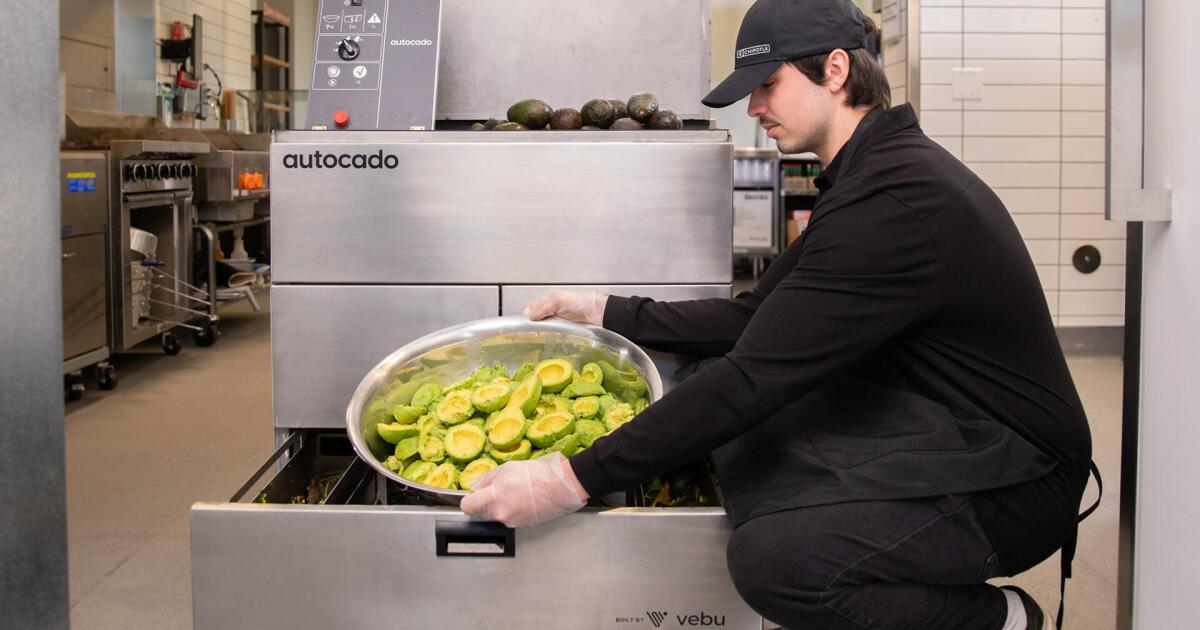
A Chipotle employee pours avocado into a large bowl, while the Autocado sits beneath. Human workers must still mash the guacamole.

(Chipotle Mexican Grill Inc.)

Chipotle first announced testing of the Autocado about a year ago, describing how the machine works.

First, a human worker loads the machine with a full case of ripe avocados — up to 25 pounds at once. The latest iteration of the Autocado recognizes variability in the fruit and automatically adjusts itself to accommodate the size of the avocados being loaded, Chipotle officials stated.

“One at a time, avocados are vertically oriented, then transferred to the processing device. The avocados are sliced in half. Their cores and skin are automatically removed, and the waste is discarded,” according to the press release. “The fruit is safely collected in a stainless-steel bowl in the bottom of the device.”

A human worker then adds ingredients and mashes the fruit into guacamole.

Vebu, a Los Angeles-based startup founded two years ago, made the Autocado. Vebu and Chipotle worked with training managers at Chipotle restaurants to identify the most time-consuming and less favorable tasks among the workers, Chipotle said.

Hyphen, a San Jose-based startup founded four years ago, created the Augmented Makeline.

The restaurant had previously tested out another robot that was called Chippy, which helped cook and season tortilla chips, but the project was eventually scrapped because the device was too difficult to clean.

Robots that fully flesh out avocados and build burrito bowls are now making food for customers at two Chipotle Mexican Grill restaurants in Southern California, as automation and artificial intelligence continue to enter the fast-food industry and raise fears about the supplanting of workers.

Chipotle earlier this week announced the debut of the robots at two locations in Orange County, where customers can watch the “Autocado” in action at Chipotle’s Huntington Beach location on Magnolia Street, and the “Augmented Makeline” at the Corona del Mar restaurant on East Coast Highway.

Chipotle said the machines are part of a pilot program before a decision is made on whether to roll out the robots to other locations. Both robots have been in place for about a month.

Company officials stressed that the Autocado and Augmented Makeline are not displacing human workers. “Autocado and the Augmented Makeline will not eliminate any jobs,” Chipotle spokesman Tyler Benson said.

Chipotle officials call the new innovations “cobots” because they say the devices work alongside humans.

The Autocado robot can cut, core and peel avocados in 26 seconds on average, reducing the labor necessary to prepare the restaurant’s guacamole so that crew members can assist with other food prep tasks, Benson said.

Similarly, the Augmented Makeline robot is an automated bowl and salad maker that dispenses rice, lettuce and other ingredients into a bowl beneath the counter, churning out Chipotle’s famous burrito bowls.

In recent years, several restaurant chains have implemented technology inside and outside their kitchens, part of an industry-wide push to make restaurants more efficient. Last year, California-based Sweetgreen began testing automation for some food preparation after buying Spyce, a robotic kitchen startup. And fast-food restaurants such as Taco Bell have tried AI for its drive-through locations with mixed results.

Restaurant operators are at a “crossroads” with the implementation of technology in their businesses, said National Restaurant Assn. President and CEO Michelle Korsmo.

“In an economy where there are far more jobs open than workers to fill them, operators are leaning into testing and adopting technology like robotics, AI and automation to fine-tune their processes while freeing their employees up to focus the hospitality that is the root of the industry’s success,” Korsmo said.

Korsmo said restaurant operators tell her how important it is to keep the human touch in the hospitality offered at restaurants.

A Chipotle employee pours avocado into a large bowl, while the Autocado sits beneath. Human workers must still mash the guacamole.

(Chipotle Mexican Grill Inc.)

Chipotle first announced testing of the Autocado about a year ago, describing how the machine works.

First, a human worker loads the machine with a full case of ripe avocados — up to 25 pounds at once. The latest iteration of the Autocado recognizes variability in the fruit and automatically adjusts itself to accommodate the size of the avocados being loaded, Chipotle officials stated.

“One at a time, avocados are vertically oriented, then transferred to the processing device. The avocados are sliced in half. Their cores and skin are automatically removed, and the waste is discarded,” according to the press release. “The fruit is safely collected in a stainless-steel bowl in the bottom of the device.”

A human worker then adds ingredients and mashes the fruit into guacamole.

Vebu, a Los Angeles-based startup founded two years ago, made the Autocado. Vebu and Chipotle worked with training managers at Chipotle restaurants to identify the most time-consuming and less favorable tasks among the workers, Chipotle said.

Hyphen, a San Jose-based startup founded four years ago, created the Augmented Makeline.

The restaurant had previously tested out another robot that was called Chippy, which helped cook and season tortilla chips, but the project was eventually scrapped because the device was too difficult to clean.

Robots that fully flesh out avocados and build burrito bowls are now making food for customers at two Chipotle Mexican Grill restaurants in Southern California, as automation and artificial intelligence continue to enter the fast-food industry and raise fears about the supplanting of workers.

Chipotle earlier this week announced the debut of the robots at two locations in Orange County, where customers can watch the “Autocado” in action at Chipotle’s Huntington Beach location on Magnolia Street, and the “Augmented Makeline” at the Corona del Mar restaurant on East Coast Highway.

Chipotle said the machines are part of a pilot program before a decision is made on whether to roll out the robots to other locations. Both robots have been in place for about a month.

Company officials stressed that the Autocado and Augmented Makeline are not displacing human workers. “Autocado and the Augmented Makeline will not eliminate any jobs,” Chipotle spokesman Tyler Benson said.

Chipotle officials call the new innovations “cobots” because they say the devices work alongside humans.

The Autocado robot can cut, core and peel avocados in 26 seconds on average, reducing the labor necessary to prepare the restaurant’s guacamole so that crew members can assist with other food prep tasks, Benson said.

Similarly, the Augmented Makeline robot is an automated bowl and salad maker that dispenses rice, lettuce and other ingredients into a bowl beneath the counter, churning out Chipotle’s famous burrito bowls.

In recent years, several restaurant chains have implemented technology inside and outside their kitchens, part of an industry-wide push to make restaurants more efficient. Last year, California-based Sweetgreen began testing automation for some food preparation after buying Spyce, a robotic kitchen startup. And fast-food restaurants such as Taco Bell have tried AI for its drive-through locations with mixed results.

Restaurant operators are at a “crossroads” with the implementation of technology in their businesses, said National Restaurant Assn. President and CEO Michelle Korsmo.

“In an economy where there are far more jobs open than workers to fill them, operators are leaning into testing and adopting technology like robotics, AI and automation to fine-tune their processes while freeing their employees up to focus the hospitality that is the root of the industry’s success,” Korsmo said.

Korsmo said restaurant operators tell her how important it is to keep the human touch in the hospitality offered at restaurants.

A Chipotle employee pours avocado into a large bowl, while the Autocado sits beneath. Human workers must still mash the guacamole.

(Chipotle Mexican Grill Inc.)

Chipotle first announced testing of the Autocado about a year ago, describing how the machine works.

First, a human worker loads the machine with a full case of ripe avocados — up to 25 pounds at once. The latest iteration of the Autocado recognizes variability in the fruit and automatically adjusts itself to accommodate the size of the avocados being loaded, Chipotle officials stated.

“One at a time, avocados are vertically oriented, then transferred to the processing device. The avocados are sliced in half. Their cores and skin are automatically removed, and the waste is discarded,” according to the press release. “The fruit is safely collected in a stainless-steel bowl in the bottom of the device.”

A human worker then adds ingredients and mashes the fruit into guacamole.

Vebu, a Los Angeles-based startup founded two years ago, made the Autocado. Vebu and Chipotle worked with training managers at Chipotle restaurants to identify the most time-consuming and less favorable tasks among the workers, Chipotle said.

Hyphen, a San Jose-based startup founded four years ago, created the Augmented Makeline.

The restaurant had previously tested out another robot that was called Chippy, which helped cook and season tortilla chips, but the project was eventually scrapped because the device was too difficult to clean.


Robots that fully flesh out avocados and build burrito bowls are now making food for customers at two Chipotle Mexican Grill restaurants in Southern California, as automation and artificial intelligence continue to enter the fast-food industry and raise fears about the supplanting of workers.

Chipotle earlier this week announced the debut of the robots at two locations in Orange County, where customers can watch the “Autocado” in action at Chipotle’s Huntington Beach location on Magnolia Street, and the “Augmented Makeline” at the Corona del Mar restaurant on East Coast Highway.

Chipotle said the machines are part of a pilot program before a decision is made on whether to roll out the robots to other locations. Both robots have been in place for about a month.

Company officials stressed that the Autocado and Augmented Makeline are not displacing human workers. “Autocado and the Augmented Makeline will not eliminate any jobs,” Chipotle spokesman Tyler Benson said.

Chipotle officials call the new innovations “cobots” because they say the devices work alongside humans.

The Autocado robot can cut, core and peel avocados in 26 seconds on average, reducing the labor necessary to prepare the restaurant’s guacamole so that crew members can assist with other food prep tasks, Benson said.

Similarly, the Augmented Makeline robot is an automated bowl and salad maker that dispenses rice, lettuce and other ingredients into a bowl beneath the counter, churning out Chipotle’s famous burrito bowls.

In recent years, several restaurant chains have implemented technology inside and outside their kitchens, part of an industry-wide push to make restaurants more efficient. Last year, California-based Sweetgreen began testing automation for some food preparation after buying Spyce, a robotic kitchen startup. And fast-food restaurants such as Taco Bell have tried AI for its drive-through locations with mixed results.

Restaurant operators are at a “crossroads” with the implementation of technology in their businesses, said National Restaurant Assn. President and CEO Michelle Korsmo.

“In an economy where there are far more jobs open than workers to fill them, operators are leaning into testing and adopting technology like robotics, AI and automation to fine-tune their processes while freeing their employees up to focus the hospitality that is the root of the industry’s success,” Korsmo said.

Korsmo said restaurant operators tell her how important it is to keep the human touch in the hospitality offered at restaurants.

A Chipotle employee pours avocado into a large bowl, while the Autocado sits beneath. Human workers must still mash the guacamole.

(Chipotle Mexican Grill Inc.)

Chipotle first announced testing of the Autocado about a year ago, describing how the machine works.

First, a human worker loads the machine with a full case of ripe avocados — up to 25 pounds at once. The latest iteration of the Autocado recognizes variability in the fruit and automatically adjusts itself to accommodate the size of the avocados being loaded, Chipotle officials stated.

“One at a time, avocados are vertically oriented, then transferred to the processing device. The avocados are sliced in half. Their cores and skin are automatically removed, and the waste is discarded,” according to the press release. “The fruit is safely collected in a stainless-steel bowl in the bottom of the device.”

A human worker then adds ingredients and mashes the fruit into guacamole.

Vebu, a Los Angeles-based startup founded two years ago, made the Autocado. Vebu and Chipotle worked with training managers at Chipotle restaurants to identify the most time-consuming and less favorable tasks among the workers, Chipotle said.

Hyphen, a San Jose-based startup founded four years ago, created the Augmented Makeline.

The restaurant had previously tested out another robot that was called Chippy, which helped cook and season tortilla chips, but the project was eventually scrapped because the device was too difficult to clean.

Robots that fully flesh out avocados and build burrito bowls are now making food for customers at two Chipotle Mexican Grill restaurants in Southern California, as automation and artificial intelligence continue to enter the fast-food industry and raise fears about the supplanting of workers.

Chipotle earlier this week announced the debut of the robots at two locations in Orange County, where customers can watch the “Autocado” in action at Chipotle’s Huntington Beach location on Magnolia Street, and the “Augmented Makeline” at the Corona del Mar restaurant on East Coast Highway.

Chipotle said the machines are part of a pilot program before a decision is made on whether to roll out the robots to other locations. Both robots have been in place for about a month.

Company officials stressed that the Autocado and Augmented Makeline are not displacing human workers. “Autocado and the Augmented Makeline will not eliminate any jobs,” Chipotle spokesman Tyler Benson said.

Chipotle officials call the new innovations “cobots” because they say the devices work alongside humans.

The Autocado robot can cut, core and peel avocados in 26 seconds on average, reducing the labor necessary to prepare the restaurant’s guacamole so that crew members can assist with other food prep tasks, Benson said.

Similarly, the Augmented Makeline robot is an automated bowl and salad maker that dispenses rice, lettuce and other ingredients into a bowl beneath the counter, churning out Chipotle’s famous burrito bowls.

In recent years, several restaurant chains have implemented technology inside and outside their kitchens, part of an industry-wide push to make restaurants more efficient. Last year, California-based Sweetgreen began testing automation for some food preparation after buying Spyce, a robotic kitchen startup. And fast-food restaurants such as Taco Bell have tried AI for its drive-through locations with mixed results.

Restaurant operators are at a “crossroads” with the implementation of technology in their businesses, said National Restaurant Assn. President and CEO Michelle Korsmo.

“In an economy where there are far more jobs open than workers to fill them, operators are leaning into testing and adopting technology like robotics, AI and automation to fine-tune their processes while freeing their employees up to focus the hospitality that is the root of the industry’s success,” Korsmo said.

Korsmo said restaurant operators tell her how important it is to keep the human touch in the hospitality offered at restaurants.

A Chipotle employee pours avocado into a large bowl, while the Autocado sits beneath. Human workers must still mash the guacamole.

(Chipotle Mexican Grill Inc.)

Chipotle first announced testing of the Autocado about a year ago, describing how the machine works.

First, a human worker loads the machine with a full case of ripe avocados — up to 25 pounds at once. The latest iteration of the Autocado recognizes variability in the fruit and automatically adjusts itself to accommodate the size of the avocados being loaded, Chipotle officials stated.

“One at a time, avocados are vertically oriented, then transferred to the processing device. The avocados are sliced in half. Their cores and skin are automatically removed, and the waste is discarded,” according to the press release. “The fruit is safely collected in a stainless-steel bowl in the bottom of the device.”

A human worker then adds ingredients and mashes the fruit into guacamole.

Vebu, a Los Angeles-based startup founded two years ago, made the Autocado. Vebu and Chipotle worked with training managers at Chipotle restaurants to identify the most time-consuming and less favorable tasks among the workers, Chipotle said.

Hyphen, a San Jose-based startup founded four years ago, created the Augmented Makeline.

The restaurant had previously tested out another robot that was called Chippy, which helped cook and season tortilla chips, but the project was eventually scrapped because the device was too difficult to clean.

Robots that fully flesh out avocados and build burrito bowls are now making food for customers at two Chipotle Mexican Grill restaurants in Southern California, as automation and artificial intelligence continue to enter the fast-food industry and raise fears about the supplanting of workers.

Chipotle earlier this week announced the debut of the robots at two locations in Orange County, where customers can watch the “Autocado” in action at Chipotle’s Huntington Beach location on Magnolia Street, and the “Augmented Makeline” at the Corona del Mar restaurant on East Coast Highway.

Chipotle said the machines are part of a pilot program before a decision is made on whether to roll out the robots to other locations. Both robots have been in place for about a month.

Company officials stressed that the Autocado and Augmented Makeline are not displacing human workers. “Autocado and the Augmented Makeline will not eliminate any jobs,” Chipotle spokesman Tyler Benson said.

Chipotle officials call the new innovations “cobots” because they say the devices work alongside humans.

The Autocado robot can cut, core and peel avocados in 26 seconds on average, reducing the labor necessary to prepare the restaurant’s guacamole so that crew members can assist with other food prep tasks, Benson said.

Similarly, the Augmented Makeline robot is an automated bowl and salad maker that dispenses rice, lettuce and other ingredients into a bowl beneath the counter, churning out Chipotle’s famous burrito bowls.

In recent years, several restaurant chains have implemented technology inside and outside their kitchens, part of an industry-wide push to make restaurants more efficient. Last year, California-based Sweetgreen began testing automation for some food preparation after buying Spyce, a robotic kitchen startup. And fast-food restaurants such as Taco Bell have tried AI for its drive-through locations with mixed results.

Restaurant operators are at a “crossroads” with the implementation of technology in their businesses, said National Restaurant Assn. President and CEO Michelle Korsmo.

“In an economy where there are far more jobs open than workers to fill them, operators are leaning into testing and adopting technology like robotics, AI and automation to fine-tune their processes while freeing their employees up to focus the hospitality that is the root of the industry’s success,” Korsmo said.

Korsmo said restaurant operators tell her how important it is to keep the human touch in the hospitality offered at restaurants.

A Chipotle employee pours avocado into a large bowl, while the Autocado sits beneath. Human workers must still mash the guacamole.

(Chipotle Mexican Grill Inc.)

Chipotle first announced testing of the Autocado about a year ago, describing how the machine works.

First, a human worker loads the machine with a full case of ripe avocados — up to 25 pounds at once. The latest iteration of the Autocado recognizes variability in the fruit and automatically adjusts itself to accommodate the size of the avocados being loaded, Chipotle officials stated.

“One at a time, avocados are vertically oriented, then transferred to the processing device. The avocados are sliced in half. Their cores and skin are automatically removed, and the waste is discarded,” according to the press release. “The fruit is safely collected in a stainless-steel bowl in the bottom of the device.”

A human worker then adds ingredients and mashes the fruit into guacamole.

Vebu, a Los Angeles-based startup founded two years ago, made the Autocado. Vebu and Chipotle worked with training managers at Chipotle restaurants to identify the most time-consuming and less favorable tasks among the workers, Chipotle said.

Hyphen, a San Jose-based startup founded four years ago, created the Augmented Makeline.

The restaurant had previously tested out another robot that was called Chippy, which helped cook and season tortilla chips, but the project was eventually scrapped because the device was too difficult to clean.

Robots that fully flesh out avocados and build burrito bowls are now making food for customers at two Chipotle Mexican Grill restaurants in Southern California, as automation and artificial intelligence continue to enter the fast-food industry and raise fears about the supplanting of workers.

Chipotle earlier this week announced the debut of the robots at two locations in Orange County, where customers can watch the “Autocado” in action at Chipotle’s Huntington Beach location on Magnolia Street, and the “Augmented Makeline” at the Corona del Mar restaurant on East Coast Highway.

Chipotle said the machines are part of a pilot program before a decision is made on whether to roll out the robots to other locations. Both robots have been in place for about a month.

Company officials stressed that the Autocado and Augmented Makeline are not displacing human workers. “Autocado and the Augmented Makeline will not eliminate any jobs,” Chipotle spokesman Tyler Benson said.

Chipotle officials call the new innovations “cobots” because they say the devices work alongside humans.

The Autocado robot can cut, core and peel avocados in 26 seconds on average, reducing the labor necessary to prepare the restaurant’s guacamole so that crew members can assist with other food prep tasks, Benson said.

Similarly, the Augmented Makeline robot is an automated bowl and salad maker that dispenses rice, lettuce and other ingredients into a bowl beneath the counter, churning out Chipotle’s famous burrito bowls.

In recent years, several restaurant chains have implemented technology inside and outside their kitchens, part of an industry-wide push to make restaurants more efficient. Last year, California-based Sweetgreen began testing automation for some food preparation after buying Spyce, a robotic kitchen startup. And fast-food restaurants such as Taco Bell have tried AI for its drive-through locations with mixed results.

Restaurant operators are at a “crossroads” with the implementation of technology in their businesses, said National Restaurant Assn. President and CEO Michelle Korsmo.

“In an economy where there are far more jobs open than workers to fill them, operators are leaning into testing and adopting technology like robotics, AI and automation to fine-tune their processes while freeing their employees up to focus the hospitality that is the root of the industry’s success,” Korsmo said.

Korsmo said restaurant operators tell her how important it is to keep the human touch in the hospitality offered at restaurants.

A Chipotle employee pours avocado into a large bowl, while the Autocado sits beneath. Human workers must still mash the guacamole.

(Chipotle Mexican Grill Inc.)

Chipotle first announced testing of the Autocado about a year ago, describing how the machine works.

First, a human worker loads the machine with a full case of ripe avocados — up to 25 pounds at once. The latest iteration of the Autocado recognizes variability in the fruit and automatically adjusts itself to accommodate the size of the avocados being loaded, Chipotle officials stated.

“One at a time, avocados are vertically oriented, then transferred to the processing device. The avocados are sliced in half. Their cores and skin are automatically removed, and the waste is discarded,” according to the press release. “The fruit is safely collected in a stainless-steel bowl in the bottom of the device.”

A human worker then adds ingredients and mashes the fruit into guacamole.

Vebu, a Los Angeles-based startup founded two years ago, made the Autocado. Vebu and Chipotle worked with training managers at Chipotle restaurants to identify the most time-consuming and less favorable tasks among the workers, Chipotle said.

Hyphen, a San Jose-based startup founded four years ago, created the Augmented Makeline.

The restaurant had previously tested out another robot that was called Chippy, which helped cook and season tortilla chips, but the project was eventually scrapped because the device was too difficult to clean.

Robots that fully flesh out avocados and build burrito bowls are now making food for customers at two Chipotle Mexican Grill restaurants in Southern California, as automation and artificial intelligence continue to enter the fast-food industry and raise fears about the supplanting of workers.

Chipotle earlier this week announced the debut of the robots at two locations in Orange County, where customers can watch the “Autocado” in action at Chipotle’s Huntington Beach location on Magnolia Street, and the “Augmented Makeline” at the Corona del Mar restaurant on East Coast Highway.

Chipotle said the machines are part of a pilot program before a decision is made on whether to roll out the robots to other locations. Both robots have been in place for about a month.

Company officials stressed that the Autocado and Augmented Makeline are not displacing human workers. “Autocado and the Augmented Makeline will not eliminate any jobs,” Chipotle spokesman Tyler Benson said.

Chipotle officials call the new innovations “cobots” because they say the devices work alongside humans.

The Autocado robot can cut, core and peel avocados in 26 seconds on average, reducing the labor necessary to prepare the restaurant’s guacamole so that crew members can assist with other food prep tasks, Benson said.

Similarly, the Augmented Makeline robot is an automated bowl and salad maker that dispenses rice, lettuce and other ingredients into a bowl beneath the counter, churning out Chipotle’s famous burrito bowls.

In recent years, several restaurant chains have implemented technology inside and outside their kitchens, part of an industry-wide push to make restaurants more efficient. Last year, California-based Sweetgreen began testing automation for some food preparation after buying Spyce, a robotic kitchen startup. And fast-food restaurants such as Taco Bell have tried AI for its drive-through locations with mixed results.

Restaurant operators are at a “crossroads” with the implementation of technology in their businesses, said National Restaurant Assn. President and CEO Michelle Korsmo.

“In an economy where there are far more jobs open than workers to fill them, operators are leaning into testing and adopting technology like robotics, AI and automation to fine-tune their processes while freeing their employees up to focus the hospitality that is the root of the industry’s success,” Korsmo said.

Korsmo said restaurant operators tell her how important it is to keep the human touch in the hospitality offered at restaurants.

A Chipotle employee pours avocado into a large bowl, while the Autocado sits beneath. Human workers must still mash the guacamole.

(Chipotle Mexican Grill Inc.)

Chipotle first announced testing of the Autocado about a year ago, describing how the machine works.

First, a human worker loads the machine with a full case of ripe avocados — up to 25 pounds at once. The latest iteration of the Autocado recognizes variability in the fruit and automatically adjusts itself to accommodate the size of the avocados being loaded, Chipotle officials stated.

“One at a time, avocados are vertically oriented, then transferred to the processing device. The avocados are sliced in half. Their cores and skin are automatically removed, and the waste is discarded,” according to the press release. “The fruit is safely collected in a stainless-steel bowl in the bottom of the device.”

A human worker then adds ingredients and mashes the fruit into guacamole.

Vebu, a Los Angeles-based startup founded two years ago, made the Autocado. Vebu and Chipotle worked with training managers at Chipotle restaurants to identify the most time-consuming and less favorable tasks among the workers, Chipotle said.

Hyphen, a San Jose-based startup founded four years ago, created the Augmented Makeline.

The restaurant had previously tested out another robot that was called Chippy, which helped cook and season tortilla chips, but the project was eventually scrapped because the device was too difficult to clean.

Leave a Reply Cancel reply

Your email address will not be published. Required fields are marked *

Recommended

In Virginia, Bob Good’s Republican Primary Has Split the MAGA Movement

2 years ago

Republicans Rally Behind Herschel Walker After Abortion Report

3 years ago

Notable deaths of 2022: From Dodgers broadcasting king to queen

3 years ago

Sinema Adds Intrigue and Democratic Fury to Arizona’s 2024 Senate Race

3 years ago
Yonkers Observer

© 2025 Yonkers Observer or its affiliated companies.

Navigate Site

  • About
  • Advertise
  • Terms & Conditions
  • Privacy Policy
  • Disclaimer
  • Contact

Follow Us

No Result
View All Result
  • Home
  • World
  • Politics
  • Finance
  • Technology
  • Health
  • Culture
  • Entertainment
  • Trend

© 2025 Yonkers Observer or its affiliated companies.

Welcome Back!

Login to your account below

Forgotten Password?

Retrieve your password

Please enter your username or email address to reset your password.

Log In