

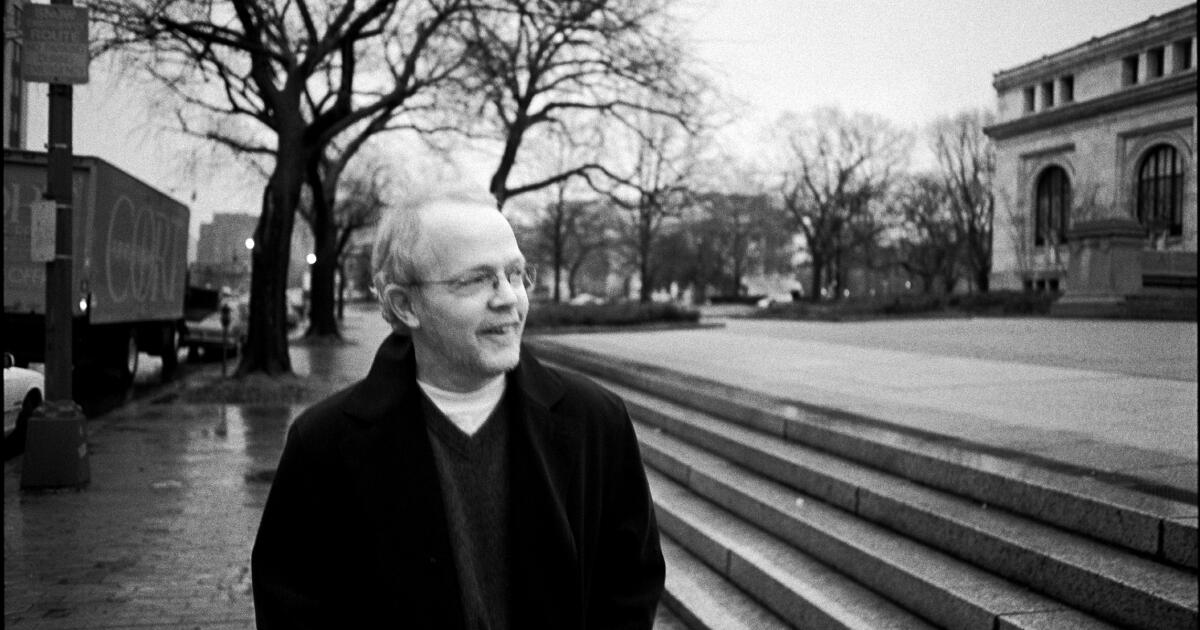

Noah Adams, a longtime host of NPR news program “All Things Considered” and a journalist known for his gentle voice and genuine curiosity, has died. He was 84.
Adams died Oct. 16 at his home in Yellow Springs, Ohio, according to NPR. The cause was complications of a benign brain tumor removed eight years ago, his wife and longtime NPR news producer Neenah Ellis told the New York Times.
A host of the weekday edition of “All Things Considered” for 18 years, Adams helped cover major news events and produced segments from his travels around the country, talking to everyday people, often in small rural towns.
“He never liked talking to people who he knew had preprogrammed things to say,” Melissa Block, a former “All Things Considered” host who’d previously worked as a producer for Adams, said in NPR’s segment announcing his death. “He wanted people who were genuinely speaking from their heart and with conviction and sincerity.”
Born on Sept. 15, 1942, in Ashland, Ky., Adams joined NPR in the mid-1970s after working various jobs including as a DJ and in construction in and around his hometown. A college dropout, Adams was inspired to start working in public radio after encountering “All Things Considered” as a listener.
He was introduced to the program by a colleague shortly after it debuted in 1971. He told The Times in 2002 that he remembered thinking, “That sounds conversational, that they intend for me to be listening, that I’m smart enough to be listening,” when he first heard the show.
After working at the University of Kentucky’s public radio station, he applied for a job at NPR. He was hired as a production assistant on “All Things Considered” in 1975 before becoming a weekend co-host for the show in 1978. He moved to the weekday show in 1982.
Susan Stamberg, Adams’ “All Things Considered” co-host from 1982 to 1987 who died last year, described him as “the most genuine, uncontrived voice in broadcasting” in the foreword of his 1992 book about his work on the program.
“The conviction shines through the words he writes, and the quiet and very powerful way in which he speaks,” she wrote, according to Current. “He is a quiet, careful man, a craftsman in his work, his seriousness softened by a twinkle in his eye, an occasional goofy grin, and the daffodils he’ll bring into the studio on an especially tense or stuffy day.”
Adams mentioned the camaraderie with his colleagues and one-on-one interviews as among the things he would miss when he left his job as host of “All Things Considered” for a second and final time in 2002.
These interviews, which often turned into “a conversation that’s so quiet and so slow,” were the “kind of conversation [that] cannot be accomplished on anything but radio,” he told The Times.
Among Adams’ signature audio work is the 1981 radio documentary “Father Cares: The Last of Jonestown,” as well as a series of interviews with Tom DeBaggio, a man living with Alzheimer’s disease, and an interview with Betsy Walter, an 8-year-old girl whose parents had gotten divorced. Adams wrote a number of books, including “Piano Lessons: Music, Love, and True Adventures,” which chronicled Adams’ quest to learn how to play the piano in his 50s, and “The Flyers: In Search of Wilbur and Orville Wright.”
“He has a writer’s eye, and I think you hear that when he’s on the air,” Robert Siegel, Adams’ “All Things Considered” co-host, said in 2002. “And he takes sound very seriously. When you combine writing with sound, you can create extraordinary radio.”


