
Trindade’s groundbreaking research provides much-needed insight into the global impact of racism, xenophobia, and abusive behavior across social media platforms.
Wilmington, DE. Over 5.4 billion people around the world use social media daily, representing roughly 67% of the global population. Yet, most of the research around the subject of abuse and hate speech that spreads through these platforms is often centered on Anglophone social contexts, especially the United States and the United Kingdom.

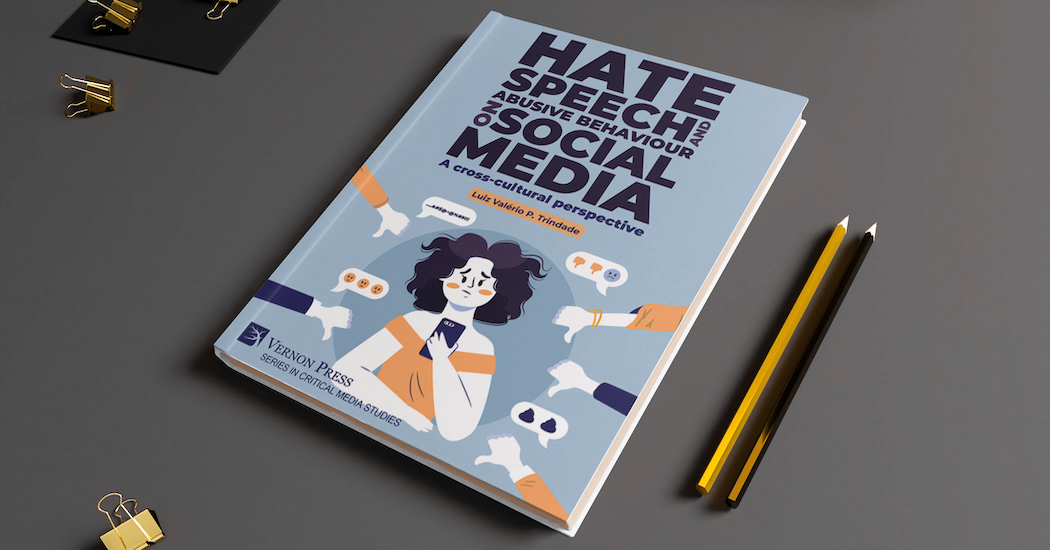
In his groundbreaking new book, Hate Speech and Abusive Behaviour on Social Media, sociologist Luiz Valério P. Trindade offers new insights into how hate speech, cyberbullying, and misogyny spread online – but through the lens of cross-cultural perspectives.
“Luiz Valério’s contributions are important as a complaint against the systemic spread of hate on social media,” says Dr. Thiago Teixeira, a professor of philosophy in Brazil. “A hatred that, in contemporary times, becomes a model of technical management responsible for suggesting the modern and colonial logics of hierarchization and precariousness of subjects announced at a distance from normative systems.”
Dr. Trindade’s research spans 11 non-English speaking countries (Argentina, Brazil, Colombia, Costa Rica, Ecuador, El Salvador, Italy, Mexico, Peru, Portugal, and Spain), and is based on the careful analysis of over 100 scholarly papers, constantly highlighting how racism, homophobia, religious intolerance, and extremist far-right ideologies influence the behavior of countless social media users. In fact, the work highlights the relevance of considering cultural, historical and linguistic factors when analyzing hate speech and abusive behavior on social media.
When reading this book, you will gain a better understanding of how in-depth analysis concerning online anonymity and deviant behavior in digital spaces directly contributes to the spread of a myriad of abusive behavior such as, revenge porn, racism, xenophobia, extremist political discourses and so much more.
“Luiz Valério Trindade’s research has made a decisive contribution to raising awareness about the regulation of social media platforms in Brazil,” says Djamila Ribeiro, a renowned and award-winning philosopher and writer. “It points out precisely how these virtual spaces have become a ‘modern pillory’ while also proposing concrete solutions. A captivating, necessary, and cutting-edge piece of academic research.”
Considering the impressive growth and the ubiquitousness of social media in peoples’ lives, Dr Trindade shines a light on the dual role played by this digital technology as a catalyst and vehicle for disseminating divisive ideologies. In this way, his book is regarded as a crucial reading for any individual, organization, or group working to combat such threats. As such, policymakers, scholars, educators, and undergrad/graduate students can use Hate Speech and Abusive Behaviour on Social Media to increase their knowledge about the phenomenon, foster awareness campaigns, and implement plans of action to tackle the detrimental societal impacts of hate and abuse online.


According to the United Nations General Secretary, hate speech on social media poses serious threats to social cohesion. In this context, Dr. Trindade’s work offers a fresh and innovative perspective of the detrimental societal impacts of this phenomenon that is observed not only in Anglophone social contexts but also elsewhere, and provides a clear explanation of the mechanisms fueling the spread of hate online. Thus, it represents a must-read for anyone trying not only to understand how we got to this state, but also how we can move forward towards a much safer and healthier online ecosystem.
About the Author:
Luiz Valério P. Trindade holds a PhD in Sociology from the University of Southampton (UK) and is currently an Affiliate Social Scientist at the International Panel on the Information Environment (IPIE) based in Zurich (Switzerland). His previous works include Discurso de Ódio nas Redes Sociais (2022) and No Laughing Matter: Race Joking and Resistance in Brazilian Social Media (2020), and the recipient of multiple awards for research on digital hate and online abuse.
Where to Learn More:
Hate Speech and Abusive Behaviour on Social Media: A Cross-Cultural Perspective is available from the publisher’s website https://vernonpress.com/book/2062 as well as all major book retailers such as Amazon, Barnes & Nobles, Powell’s and many others.


