

French Cambodian director Rithy Panh has often cited the genocidal regime of the Khmer Rouge, which killed his family and from which he escaped, as the reason he’s a filmmaker. His movies aren’t always directly about that wretched time. But when they are — as is his most memorable achievement, the Oscar-nominated 2013 documentary “The Missing Picture,” which re-imagined personal memories using clay-figurine dioramas — one senses a grand mosaic being assembled piece by piece linking devastation, aftermath and remembrance, never to be finished, only further detailed.
His latest is the coolly observed and tense historical drama “Meeting With Pol Pot,” which premiered last year at Cannes. It isn’t autobiographical, save its fictionalization of a true story that happened concurrent to his childhood trauma: the Khmer Rouge inviting a trio of Western journalists to witness their proclaimed agrarian utopia and interview the mysterious leader referred to by his people as “Brother No. 1.” Yet even this political junket, which took place in 1978, couldn’t hide a cruel, violent truth from its guests, the unfolding of which Panh is as adept at depicting from the viewpoint of an increasingly horrified visitor as from that of a long-scarred victim.
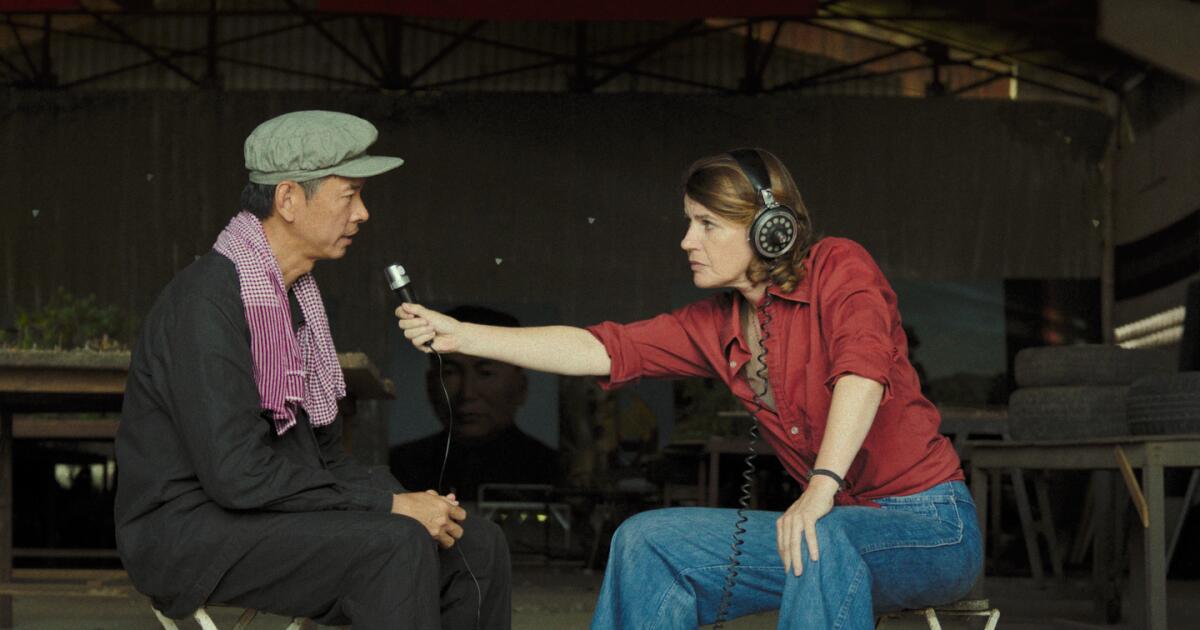
The movie stars Irène Jacob, whose intrepid French reporter Lise — a perfect role for her captivating intelligence — is modeled after the American journalist Elizabeth Becker who was on that trip, and whose later book about Cambodia and her experience, “When the War Was Over,” inspired the screenplay credited to Panh and Pierre Erwan Guillaume. Lise is joined by an ideologically motivated Maoist professor named Alain (Grégoire Colin), quick to enthusiastically namedrop some of their hosts as former school chums in France when they were wannabe revolutionaries. (The character of Alain is based on British academic Malcolm Caldwell, an invitee alongside Becker.) Also there is eagle-eyed photojournalist Paul (Cyril Gueï), who shares Lise’s healthy skepticism and a desire to learn what’s really happening, especially regarding rumors of disappeared intellectuals.
With sound, pacing and images, Panh readily establishes a mood of charged, contingent hospitality, a veneer that seems ready to crack: from the unsettlingly calm opening visual of this tiny French delegation waiting alone on an empty sun-hot tarmac to the strange, authoritarian formality in everything that’s said and shown to them via their guide Sung (Bunhok Lim). Life is being scripted for their microphones and cameras and flanked by armed, blank-faced teenagers. The movie’s square-framed cinematography, too, reminiscent of a staged newsreel, is another subtle touch — one imagines Panh rejecting widescreen as only feeding this evil regime’s view of its own righteous grandiosity.
Only Alain seems eager to ignore the disinformation and embrace this Potemkin village as the real deal (except when his eyes show a gathering concern). But the more Lise questions the pretense of a happily remade society, the nervier everything gets. And when Paul manages to elude his overseers and explore the surrounding area — spurring a frantic search, the menacing tenor of which raises Lise’s hackles — the movie effectively becomes a prison drama, with the trio’s eventual interviewee depicted as a shadowy warden who can decide their fate.
Journalism has never been more under threat than right now and “Meeting with Pol Pot” is a potent reminder of the profession’s value — and inherent dangers — when it confronts and exposes facades. But this eerily elegiac film also reflects its director’s soulful sensibility regarding the mass tragedy that drives his aesthetic temperament, never more so than when he re-deploys his beloved hand-crafted clay figurines for key moments of witnessed atrocity, or threads in archival footage, as if to maintain necessary intimacy between rendering and reality.
Power shields its misdeeds with propaganda, but Panh sees such murderous lies clearly, giving them an honest staging, thick with echoes.
‘Meeting with Pol Pot’
In French and Cambodian, with subtitles
Not rated
Running time: 1 hour, 52 minutes
Playing: Opens Friday, June 20 at Laemmle Glendale

French Cambodian director Rithy Panh has often cited the genocidal regime of the Khmer Rouge, which killed his family and from which he escaped, as the reason he’s a filmmaker. His movies aren’t always directly about that wretched time. But when they are — as is his most memorable achievement, the Oscar-nominated 2013 documentary “The Missing Picture,” which re-imagined personal memories using clay-figurine dioramas — one senses a grand mosaic being assembled piece by piece linking devastation, aftermath and remembrance, never to be finished, only further detailed.
His latest is the coolly observed and tense historical drama “Meeting With Pol Pot,” which premiered last year at Cannes. It isn’t autobiographical, save its fictionalization of a true story that happened concurrent to his childhood trauma: the Khmer Rouge inviting a trio of Western journalists to witness their proclaimed agrarian utopia and interview the mysterious leader referred to by his people as “Brother No. 1.” Yet even this political junket, which took place in 1978, couldn’t hide a cruel, violent truth from its guests, the unfolding of which Panh is as adept at depicting from the viewpoint of an increasingly horrified visitor as from that of a long-scarred victim.
The movie stars Irène Jacob, whose intrepid French reporter Lise — a perfect role for her captivating intelligence — is modeled after the American journalist Elizabeth Becker who was on that trip, and whose later book about Cambodia and her experience, “When the War Was Over,” inspired the screenplay credited to Panh and Pierre Erwan Guillaume. Lise is joined by an ideologically motivated Maoist professor named Alain (Grégoire Colin), quick to enthusiastically namedrop some of their hosts as former school chums in France when they were wannabe revolutionaries. (The character of Alain is based on British academic Malcolm Caldwell, an invitee alongside Becker.) Also there is eagle-eyed photojournalist Paul (Cyril Gueï), who shares Lise’s healthy skepticism and a desire to learn what’s really happening, especially regarding rumors of disappeared intellectuals.
With sound, pacing and images, Panh readily establishes a mood of charged, contingent hospitality, a veneer that seems ready to crack: from the unsettlingly calm opening visual of this tiny French delegation waiting alone on an empty sun-hot tarmac to the strange, authoritarian formality in everything that’s said and shown to them via their guide Sung (Bunhok Lim). Life is being scripted for their microphones and cameras and flanked by armed, blank-faced teenagers. The movie’s square-framed cinematography, too, reminiscent of a staged newsreel, is another subtle touch — one imagines Panh rejecting widescreen as only feeding this evil regime’s view of its own righteous grandiosity.
Only Alain seems eager to ignore the disinformation and embrace this Potemkin village as the real deal (except when his eyes show a gathering concern). But the more Lise questions the pretense of a happily remade society, the nervier everything gets. And when Paul manages to elude his overseers and explore the surrounding area — spurring a frantic search, the menacing tenor of which raises Lise’s hackles — the movie effectively becomes a prison drama, with the trio’s eventual interviewee depicted as a shadowy warden who can decide their fate.
Journalism has never been more under threat than right now and “Meeting with Pol Pot” is a potent reminder of the profession’s value — and inherent dangers — when it confronts and exposes facades. But this eerily elegiac film also reflects its director’s soulful sensibility regarding the mass tragedy that drives his aesthetic temperament, never more so than when he re-deploys his beloved hand-crafted clay figurines for key moments of witnessed atrocity, or threads in archival footage, as if to maintain necessary intimacy between rendering and reality.
Power shields its misdeeds with propaganda, but Panh sees such murderous lies clearly, giving them an honest staging, thick with echoes.
‘Meeting with Pol Pot’
In French and Cambodian, with subtitles
Not rated
Running time: 1 hour, 52 minutes
Playing: Opens Friday, June 20 at Laemmle Glendale

French Cambodian director Rithy Panh has often cited the genocidal regime of the Khmer Rouge, which killed his family and from which he escaped, as the reason he’s a filmmaker. His movies aren’t always directly about that wretched time. But when they are — as is his most memorable achievement, the Oscar-nominated 2013 documentary “The Missing Picture,” which re-imagined personal memories using clay-figurine dioramas — one senses a grand mosaic being assembled piece by piece linking devastation, aftermath and remembrance, never to be finished, only further detailed.
His latest is the coolly observed and tense historical drama “Meeting With Pol Pot,” which premiered last year at Cannes. It isn’t autobiographical, save its fictionalization of a true story that happened concurrent to his childhood trauma: the Khmer Rouge inviting a trio of Western journalists to witness their proclaimed agrarian utopia and interview the mysterious leader referred to by his people as “Brother No. 1.” Yet even this political junket, which took place in 1978, couldn’t hide a cruel, violent truth from its guests, the unfolding of which Panh is as adept at depicting from the viewpoint of an increasingly horrified visitor as from that of a long-scarred victim.
The movie stars Irène Jacob, whose intrepid French reporter Lise — a perfect role for her captivating intelligence — is modeled after the American journalist Elizabeth Becker who was on that trip, and whose later book about Cambodia and her experience, “When the War Was Over,” inspired the screenplay credited to Panh and Pierre Erwan Guillaume. Lise is joined by an ideologically motivated Maoist professor named Alain (Grégoire Colin), quick to enthusiastically namedrop some of their hosts as former school chums in France when they were wannabe revolutionaries. (The character of Alain is based on British academic Malcolm Caldwell, an invitee alongside Becker.) Also there is eagle-eyed photojournalist Paul (Cyril Gueï), who shares Lise’s healthy skepticism and a desire to learn what’s really happening, especially regarding rumors of disappeared intellectuals.
With sound, pacing and images, Panh readily establishes a mood of charged, contingent hospitality, a veneer that seems ready to crack: from the unsettlingly calm opening visual of this tiny French delegation waiting alone on an empty sun-hot tarmac to the strange, authoritarian formality in everything that’s said and shown to them via their guide Sung (Bunhok Lim). Life is being scripted for their microphones and cameras and flanked by armed, blank-faced teenagers. The movie’s square-framed cinematography, too, reminiscent of a staged newsreel, is another subtle touch — one imagines Panh rejecting widescreen as only feeding this evil regime’s view of its own righteous grandiosity.
Only Alain seems eager to ignore the disinformation and embrace this Potemkin village as the real deal (except when his eyes show a gathering concern). But the more Lise questions the pretense of a happily remade society, the nervier everything gets. And when Paul manages to elude his overseers and explore the surrounding area — spurring a frantic search, the menacing tenor of which raises Lise’s hackles — the movie effectively becomes a prison drama, with the trio’s eventual interviewee depicted as a shadowy warden who can decide their fate.
Journalism has never been more under threat than right now and “Meeting with Pol Pot” is a potent reminder of the profession’s value — and inherent dangers — when it confronts and exposes facades. But this eerily elegiac film also reflects its director’s soulful sensibility regarding the mass tragedy that drives his aesthetic temperament, never more so than when he re-deploys his beloved hand-crafted clay figurines for key moments of witnessed atrocity, or threads in archival footage, as if to maintain necessary intimacy between rendering and reality.
Power shields its misdeeds with propaganda, but Panh sees such murderous lies clearly, giving them an honest staging, thick with echoes.
‘Meeting with Pol Pot’
In French and Cambodian, with subtitles
Not rated
Running time: 1 hour, 52 minutes
Playing: Opens Friday, June 20 at Laemmle Glendale
French Cambodian director Rithy Panh has often cited the genocidal regime of the Khmer Rouge, which killed his family and from which he escaped, as the reason he’s a filmmaker. His movies aren’t always directly about that wretched time. But when they are — as is his most memorable achievement, the Oscar-nominated 2013 documentary “The Missing Picture,” which re-imagined personal memories using clay-figurine dioramas — one senses a grand mosaic being assembled piece by piece linking devastation, aftermath and remembrance, never to be finished, only further detailed.
His latest is the coolly observed and tense historical drama “Meeting With Pol Pot,” which premiered last year at Cannes. It isn’t autobiographical, save its fictionalization of a true story that happened concurrent to his childhood trauma: the Khmer Rouge inviting a trio of Western journalists to witness their proclaimed agrarian utopia and interview the mysterious leader referred to by his people as “Brother No. 1.” Yet even this political junket, which took place in 1978, couldn’t hide a cruel, violent truth from its guests, the unfolding of which Panh is as adept at depicting from the viewpoint of an increasingly horrified visitor as from that of a long-scarred victim.
The movie stars Irène Jacob, whose intrepid French reporter Lise — a perfect role for her captivating intelligence — is modeled after the American journalist Elizabeth Becker who was on that trip, and whose later book about Cambodia and her experience, “When the War Was Over,” inspired the screenplay credited to Panh and Pierre Erwan Guillaume. Lise is joined by an ideologically motivated Maoist professor named Alain (Grégoire Colin), quick to enthusiastically namedrop some of their hosts as former school chums in France when they were wannabe revolutionaries. (The character of Alain is based on British academic Malcolm Caldwell, an invitee alongside Becker.) Also there is eagle-eyed photojournalist Paul (Cyril Gueï), who shares Lise’s healthy skepticism and a desire to learn what’s really happening, especially regarding rumors of disappeared intellectuals.
With sound, pacing and images, Panh readily establishes a mood of charged, contingent hospitality, a veneer that seems ready to crack: from the unsettlingly calm opening visual of this tiny French delegation waiting alone on an empty sun-hot tarmac to the strange, authoritarian formality in everything that’s said and shown to them via their guide Sung (Bunhok Lim). Life is being scripted for their microphones and cameras and flanked by armed, blank-faced teenagers. The movie’s square-framed cinematography, too, reminiscent of a staged newsreel, is another subtle touch — one imagines Panh rejecting widescreen as only feeding this evil regime’s view of its own righteous grandiosity.
Only Alain seems eager to ignore the disinformation and embrace this Potemkin village as the real deal (except when his eyes show a gathering concern). But the more Lise questions the pretense of a happily remade society, the nervier everything gets. And when Paul manages to elude his overseers and explore the surrounding area — spurring a frantic search, the menacing tenor of which raises Lise’s hackles — the movie effectively becomes a prison drama, with the trio’s eventual interviewee depicted as a shadowy warden who can decide their fate.
Journalism has never been more under threat than right now and “Meeting with Pol Pot” is a potent reminder of the profession’s value — and inherent dangers — when it confronts and exposes facades. But this eerily elegiac film also reflects its director’s soulful sensibility regarding the mass tragedy that drives his aesthetic temperament, never more so than when he re-deploys his beloved hand-crafted clay figurines for key moments of witnessed atrocity, or threads in archival footage, as if to maintain necessary intimacy between rendering and reality.
Power shields its misdeeds with propaganda, but Panh sees such murderous lies clearly, giving them an honest staging, thick with echoes.
‘Meeting with Pol Pot’
In French and Cambodian, with subtitles
Not rated
Running time: 1 hour, 52 minutes
Playing: Opens Friday, June 20 at Laemmle Glendale

French Cambodian director Rithy Panh has often cited the genocidal regime of the Khmer Rouge, which killed his family and from which he escaped, as the reason he’s a filmmaker. His movies aren’t always directly about that wretched time. But when they are — as is his most memorable achievement, the Oscar-nominated 2013 documentary “The Missing Picture,” which re-imagined personal memories using clay-figurine dioramas — one senses a grand mosaic being assembled piece by piece linking devastation, aftermath and remembrance, never to be finished, only further detailed.
His latest is the coolly observed and tense historical drama “Meeting With Pol Pot,” which premiered last year at Cannes. It isn’t autobiographical, save its fictionalization of a true story that happened concurrent to his childhood trauma: the Khmer Rouge inviting a trio of Western journalists to witness their proclaimed agrarian utopia and interview the mysterious leader referred to by his people as “Brother No. 1.” Yet even this political junket, which took place in 1978, couldn’t hide a cruel, violent truth from its guests, the unfolding of which Panh is as adept at depicting from the viewpoint of an increasingly horrified visitor as from that of a long-scarred victim.
The movie stars Irène Jacob, whose intrepid French reporter Lise — a perfect role for her captivating intelligence — is modeled after the American journalist Elizabeth Becker who was on that trip, and whose later book about Cambodia and her experience, “When the War Was Over,” inspired the screenplay credited to Panh and Pierre Erwan Guillaume. Lise is joined by an ideologically motivated Maoist professor named Alain (Grégoire Colin), quick to enthusiastically namedrop some of their hosts as former school chums in France when they were wannabe revolutionaries. (The character of Alain is based on British academic Malcolm Caldwell, an invitee alongside Becker.) Also there is eagle-eyed photojournalist Paul (Cyril Gueï), who shares Lise’s healthy skepticism and a desire to learn what’s really happening, especially regarding rumors of disappeared intellectuals.
With sound, pacing and images, Panh readily establishes a mood of charged, contingent hospitality, a veneer that seems ready to crack: from the unsettlingly calm opening visual of this tiny French delegation waiting alone on an empty sun-hot tarmac to the strange, authoritarian formality in everything that’s said and shown to them via their guide Sung (Bunhok Lim). Life is being scripted for their microphones and cameras and flanked by armed, blank-faced teenagers. The movie’s square-framed cinematography, too, reminiscent of a staged newsreel, is another subtle touch — one imagines Panh rejecting widescreen as only feeding this evil regime’s view of its own righteous grandiosity.
Only Alain seems eager to ignore the disinformation and embrace this Potemkin village as the real deal (except when his eyes show a gathering concern). But the more Lise questions the pretense of a happily remade society, the nervier everything gets. And when Paul manages to elude his overseers and explore the surrounding area — spurring a frantic search, the menacing tenor of which raises Lise’s hackles — the movie effectively becomes a prison drama, with the trio’s eventual interviewee depicted as a shadowy warden who can decide their fate.
Journalism has never been more under threat than right now and “Meeting with Pol Pot” is a potent reminder of the profession’s value — and inherent dangers — when it confronts and exposes facades. But this eerily elegiac film also reflects its director’s soulful sensibility regarding the mass tragedy that drives his aesthetic temperament, never more so than when he re-deploys his beloved hand-crafted clay figurines for key moments of witnessed atrocity, or threads in archival footage, as if to maintain necessary intimacy between rendering and reality.
Power shields its misdeeds with propaganda, but Panh sees such murderous lies clearly, giving them an honest staging, thick with echoes.
‘Meeting with Pol Pot’
In French and Cambodian, with subtitles
Not rated
Running time: 1 hour, 52 minutes
Playing: Opens Friday, June 20 at Laemmle Glendale
French Cambodian director Rithy Panh has often cited the genocidal regime of the Khmer Rouge, which killed his family and from which he escaped, as the reason he’s a filmmaker. His movies aren’t always directly about that wretched time. But when they are — as is his most memorable achievement, the Oscar-nominated 2013 documentary “The Missing Picture,” which re-imagined personal memories using clay-figurine dioramas — one senses a grand mosaic being assembled piece by piece linking devastation, aftermath and remembrance, never to be finished, only further detailed.
His latest is the coolly observed and tense historical drama “Meeting With Pol Pot,” which premiered last year at Cannes. It isn’t autobiographical, save its fictionalization of a true story that happened concurrent to his childhood trauma: the Khmer Rouge inviting a trio of Western journalists to witness their proclaimed agrarian utopia and interview the mysterious leader referred to by his people as “Brother No. 1.” Yet even this political junket, which took place in 1978, couldn’t hide a cruel, violent truth from its guests, the unfolding of which Panh is as adept at depicting from the viewpoint of an increasingly horrified visitor as from that of a long-scarred victim.
The movie stars Irène Jacob, whose intrepid French reporter Lise — a perfect role for her captivating intelligence — is modeled after the American journalist Elizabeth Becker who was on that trip, and whose later book about Cambodia and her experience, “When the War Was Over,” inspired the screenplay credited to Panh and Pierre Erwan Guillaume. Lise is joined by an ideologically motivated Maoist professor named Alain (Grégoire Colin), quick to enthusiastically namedrop some of their hosts as former school chums in France when they were wannabe revolutionaries. (The character of Alain is based on British academic Malcolm Caldwell, an invitee alongside Becker.) Also there is eagle-eyed photojournalist Paul (Cyril Gueï), who shares Lise’s healthy skepticism and a desire to learn what’s really happening, especially regarding rumors of disappeared intellectuals.
With sound, pacing and images, Panh readily establishes a mood of charged, contingent hospitality, a veneer that seems ready to crack: from the unsettlingly calm opening visual of this tiny French delegation waiting alone on an empty sun-hot tarmac to the strange, authoritarian formality in everything that’s said and shown to them via their guide Sung (Bunhok Lim). Life is being scripted for their microphones and cameras and flanked by armed, blank-faced teenagers. The movie’s square-framed cinematography, too, reminiscent of a staged newsreel, is another subtle touch — one imagines Panh rejecting widescreen as only feeding this evil regime’s view of its own righteous grandiosity.
Only Alain seems eager to ignore the disinformation and embrace this Potemkin village as the real deal (except when his eyes show a gathering concern). But the more Lise questions the pretense of a happily remade society, the nervier everything gets. And when Paul manages to elude his overseers and explore the surrounding area — spurring a frantic search, the menacing tenor of which raises Lise’s hackles — the movie effectively becomes a prison drama, with the trio’s eventual interviewee depicted as a shadowy warden who can decide their fate.
Journalism has never been more under threat than right now and “Meeting with Pol Pot” is a potent reminder of the profession’s value — and inherent dangers — when it confronts and exposes facades. But this eerily elegiac film also reflects its director’s soulful sensibility regarding the mass tragedy that drives his aesthetic temperament, never more so than when he re-deploys his beloved hand-crafted clay figurines for key moments of witnessed atrocity, or threads in archival footage, as if to maintain necessary intimacy between rendering and reality.
Power shields its misdeeds with propaganda, but Panh sees such murderous lies clearly, giving them an honest staging, thick with echoes.
‘Meeting with Pol Pot’
In French and Cambodian, with subtitles
Not rated
Running time: 1 hour, 52 minutes
Playing: Opens Friday, June 20 at Laemmle Glendale
French Cambodian director Rithy Panh has often cited the genocidal regime of the Khmer Rouge, which killed his family and from which he escaped, as the reason he’s a filmmaker. His movies aren’t always directly about that wretched time. But when they are — as is his most memorable achievement, the Oscar-nominated 2013 documentary “The Missing Picture,” which re-imagined personal memories using clay-figurine dioramas — one senses a grand mosaic being assembled piece by piece linking devastation, aftermath and remembrance, never to be finished, only further detailed.
His latest is the coolly observed and tense historical drama “Meeting With Pol Pot,” which premiered last year at Cannes. It isn’t autobiographical, save its fictionalization of a true story that happened concurrent to his childhood trauma: the Khmer Rouge inviting a trio of Western journalists to witness their proclaimed agrarian utopia and interview the mysterious leader referred to by his people as “Brother No. 1.” Yet even this political junket, which took place in 1978, couldn’t hide a cruel, violent truth from its guests, the unfolding of which Panh is as adept at depicting from the viewpoint of an increasingly horrified visitor as from that of a long-scarred victim.
The movie stars Irène Jacob, whose intrepid French reporter Lise — a perfect role for her captivating intelligence — is modeled after the American journalist Elizabeth Becker who was on that trip, and whose later book about Cambodia and her experience, “When the War Was Over,” inspired the screenplay credited to Panh and Pierre Erwan Guillaume. Lise is joined by an ideologically motivated Maoist professor named Alain (Grégoire Colin), quick to enthusiastically namedrop some of their hosts as former school chums in France when they were wannabe revolutionaries. (The character of Alain is based on British academic Malcolm Caldwell, an invitee alongside Becker.) Also there is eagle-eyed photojournalist Paul (Cyril Gueï), who shares Lise’s healthy skepticism and a desire to learn what’s really happening, especially regarding rumors of disappeared intellectuals.
With sound, pacing and images, Panh readily establishes a mood of charged, contingent hospitality, a veneer that seems ready to crack: from the unsettlingly calm opening visual of this tiny French delegation waiting alone on an empty sun-hot tarmac to the strange, authoritarian formality in everything that’s said and shown to them via their guide Sung (Bunhok Lim). Life is being scripted for their microphones and cameras and flanked by armed, blank-faced teenagers. The movie’s square-framed cinematography, too, reminiscent of a staged newsreel, is another subtle touch — one imagines Panh rejecting widescreen as only feeding this evil regime’s view of its own righteous grandiosity.
Only Alain seems eager to ignore the disinformation and embrace this Potemkin village as the real deal (except when his eyes show a gathering concern). But the more Lise questions the pretense of a happily remade society, the nervier everything gets. And when Paul manages to elude his overseers and explore the surrounding area — spurring a frantic search, the menacing tenor of which raises Lise’s hackles — the movie effectively becomes a prison drama, with the trio’s eventual interviewee depicted as a shadowy warden who can decide their fate.
Journalism has never been more under threat than right now and “Meeting with Pol Pot” is a potent reminder of the profession’s value — and inherent dangers — when it confronts and exposes facades. But this eerily elegiac film also reflects its director’s soulful sensibility regarding the mass tragedy that drives his aesthetic temperament, never more so than when he re-deploys his beloved hand-crafted clay figurines for key moments of witnessed atrocity, or threads in archival footage, as if to maintain necessary intimacy between rendering and reality.
Power shields its misdeeds with propaganda, but Panh sees such murderous lies clearly, giving them an honest staging, thick with echoes.
‘Meeting with Pol Pot’
In French and Cambodian, with subtitles
Not rated
Running time: 1 hour, 52 minutes
Playing: Opens Friday, June 20 at Laemmle Glendale
French Cambodian director Rithy Panh has often cited the genocidal regime of the Khmer Rouge, which killed his family and from which he escaped, as the reason he’s a filmmaker. His movies aren’t always directly about that wretched time. But when they are — as is his most memorable achievement, the Oscar-nominated 2013 documentary “The Missing Picture,” which re-imagined personal memories using clay-figurine dioramas — one senses a grand mosaic being assembled piece by piece linking devastation, aftermath and remembrance, never to be finished, only further detailed.
His latest is the coolly observed and tense historical drama “Meeting With Pol Pot,” which premiered last year at Cannes. It isn’t autobiographical, save its fictionalization of a true story that happened concurrent to his childhood trauma: the Khmer Rouge inviting a trio of Western journalists to witness their proclaimed agrarian utopia and interview the mysterious leader referred to by his people as “Brother No. 1.” Yet even this political junket, which took place in 1978, couldn’t hide a cruel, violent truth from its guests, the unfolding of which Panh is as adept at depicting from the viewpoint of an increasingly horrified visitor as from that of a long-scarred victim.
The movie stars Irène Jacob, whose intrepid French reporter Lise — a perfect role for her captivating intelligence — is modeled after the American journalist Elizabeth Becker who was on that trip, and whose later book about Cambodia and her experience, “When the War Was Over,” inspired the screenplay credited to Panh and Pierre Erwan Guillaume. Lise is joined by an ideologically motivated Maoist professor named Alain (Grégoire Colin), quick to enthusiastically namedrop some of their hosts as former school chums in France when they were wannabe revolutionaries. (The character of Alain is based on British academic Malcolm Caldwell, an invitee alongside Becker.) Also there is eagle-eyed photojournalist Paul (Cyril Gueï), who shares Lise’s healthy skepticism and a desire to learn what’s really happening, especially regarding rumors of disappeared intellectuals.
With sound, pacing and images, Panh readily establishes a mood of charged, contingent hospitality, a veneer that seems ready to crack: from the unsettlingly calm opening visual of this tiny French delegation waiting alone on an empty sun-hot tarmac to the strange, authoritarian formality in everything that’s said and shown to them via their guide Sung (Bunhok Lim). Life is being scripted for their microphones and cameras and flanked by armed, blank-faced teenagers. The movie’s square-framed cinematography, too, reminiscent of a staged newsreel, is another subtle touch — one imagines Panh rejecting widescreen as only feeding this evil regime’s view of its own righteous grandiosity.
Only Alain seems eager to ignore the disinformation and embrace this Potemkin village as the real deal (except when his eyes show a gathering concern). But the more Lise questions the pretense of a happily remade society, the nervier everything gets. And when Paul manages to elude his overseers and explore the surrounding area — spurring a frantic search, the menacing tenor of which raises Lise’s hackles — the movie effectively becomes a prison drama, with the trio’s eventual interviewee depicted as a shadowy warden who can decide their fate.
Journalism has never been more under threat than right now and “Meeting with Pol Pot” is a potent reminder of the profession’s value — and inherent dangers — when it confronts and exposes facades. But this eerily elegiac film also reflects its director’s soulful sensibility regarding the mass tragedy that drives his aesthetic temperament, never more so than when he re-deploys his beloved hand-crafted clay figurines for key moments of witnessed atrocity, or threads in archival footage, as if to maintain necessary intimacy between rendering and reality.
Power shields its misdeeds with propaganda, but Panh sees such murderous lies clearly, giving them an honest staging, thick with echoes.
‘Meeting with Pol Pot’
In French and Cambodian, with subtitles
Not rated
Running time: 1 hour, 52 minutes
Playing: Opens Friday, June 20 at Laemmle Glendale


