L.A. Metro’s three new D line extension stations feature nine public artworks
Art deco motifs, fossils and massive drawings of hands are among the installations that will greet riders passing through the three new stations on L.A. Metro’s D Line extension.
The underground subway stations, which connect downtown Los Angeles to Beverly Hills, are home to nine site-specific artworks by Mariana Castillo Deball, Eamon Ore-Giron, Ken Gonzales-Day, Todd Gray, Karl Haendel, Soo Kim, Fran Siegel, Susan Silton and Mark Dean Veca.
The goal was to make the new public art a “world-class experience” for riders — one that matched the caliber of the acclaimed museums the new subway route makes accessible along Wilshire Boulevard, said Metro deputy executive officer Zipporah Yamamoto, who leads the agency’s public art program.
“When you walk through the stations, you’re basically walking through a series of immersive artworks on every single level,” Yamamoto said. “It’s not like hanging paintings above a sofa … where the art comes in at the end.”
Participating artists did not have to reside in Los Angeles, but their projects had to respond to the station’s location, history and culture and include a community engagement component.
“Without artwork that is specific in its reference to place, all the stations would look the same,” Yamamoto said, adding that she hopes the art will encourage riders to explore a neighborhood further.
Metal placards installed near each piece feature a scannable QR code that reveals more about the artist.
The competitive selection process began roughly a decade ago, Yamamoto said. More than 1,200 people responded to the agency’s call for artists. Finalists were paid to develop proposals that were judged by a panel of art professionals including curators from the museums along Miracle Mile.
Metro’s art program is primarily funded by a 0.5% budget set aside from construction costs allotted for new transit projects, according to spokesperson Missy Colman.
Metro plans to open the D Line extension in three phases, with a goal of completing the full route by fall 2027. When finished, it will include seven new stations and connect Koreatown to Westwood.
The first phase opened Friday and includes the Wilshire/La Brea, Wilshire/Fairfax and Wilshire/La Cienega stations.
The Times spoke with four artists whose work will be inside.
Eamon Ore-Giron
Artist Eamon Ore-Giron stands in front of his artwork at the Wilshire/La Brea Metro station on Friday, May 1, 2026, in Los Angeles.
(Carlin Stiehl / For The Times)
A series of converging yellow rays brighten the Wilshire/La Brea station.
Echo Park-based artist Eamon Ore-Giron’s “Infinite Landscape: Los Ángeles Para Siempre” uses forced perspective to trick viewers into feeling like they are being pulled in or out of a portal.
Ore-Giron was born and raised in Tucson and has lived in Mexico City, San Francisco and Guadalajara. He completed a master’s degree in fine arts at UCLA, and his work has been featured at the Museum of Contemporary Art Denver and San Francisco Museum of Modern Art, among others.
Circular patterns, placed on abstract “tracks,” represent transit riders.
Ore-Giron has long viewed the subway as a “magical portal.” He has fond memories of taking the Madrid Metro with his siblings and of the excitement and slight fear he felt as he watched the train lights emerge from darkness. As a young person without a car, transit opened up the city, he said.
His work reflects on the history of Miracle Mile. In the 1920s, Art Deco buildings rose along Wilshire Boulevard as the street transformed from a remote dirt path into a bustling, car-oriented commercial district. The structure’s bold designs were meant to catch the eyes of drivers.


Two views of artist Eamon Ore-Giron’s artwork at the Wilshire/La Brea Metro station.
(Carlin Stiehl / For The Times)
Ore-Giron’s work aims to connect L.A.’s past with the future and reframe the site’s car-centric history for pedestrians.
“This [Metro] expansion in a lot of ways is the next step in Los Angeles evolving into a more densely urban city, moving out of an era of the car-dominant culture,” Ore-Giron said.
Ore-Giron said he was also drawn to the Art Deco style because of the international dialogue it represented. In crafting what was then the style of the future, the architects at the time were influenced by Egyptian and Maya motifs.
The color palette consists of hues commonly found in Art Deco architecture, including muted green, sapphire and ruby.
He considered using gold. The metallic color is a signature part of his well-known “Infinite Regress” paintings, and it is often seen in Art Deco building details. But he decided it would feel like “too much” in a subway station, and instead chose a softer yellow.

Artist Eamon Ore-Giron’s artwork at the Wilshire/La Brea Metro station.
(Carlin Stiehl / For The Times)
The colors also evoke hazy Los Angeles skies, hills and buildings seen from a distance. Much is left to the viewer’s interpretation.
“You could think of it as the subconscious idea of the architecture of L.A.,” Ore-Giron offered.
Fran Siegel

Artist Fran Siegel stands in front of her artwork at the Wilshire/La Brea Metro station on Friday, May 1, 2026, in Los Angeles.
(Carlin Stiehl / For The Times)
San Pedro-based artist Fran Siegel spent a year and a half taking long walks along Wilshire Boulevard to create her project, called “Re: Orientation,” for Metro.
Siegel said she was on the same stretch of road so often that people began to wonder if she was a location scout.
What she was really looking for was light. With a camera in tow, Siegel traversed the street at different times of the day, and she noticed that as the day waned, sunlight would bounce from one building to another, casting ghostly projections.
“They were like little miracles,” she said.
Siegel has received two Fulbright awards to conduct research in Brazil and Lisbon, Portugal. A former art professor at Cal State Long Beach, her work has been featured in the Getty’s Pacific Standard Time exhibitions.


Two views of artist Fran Siegel’s artwork at the Wilshire/La Brea Metro station.
(Carlin Stiehl / For The Times)
Siegel came up with the idea for “Re: Orientation” as she studied a map of Los Angeles and noticed the clashing street grids. Downtown Los Angeles’ street grid is diagonal, a legacy of Spanish rule. West of Hoover Street, the grid reorients itself, straightening into an American-style street grid.
“I saw that the sun rises and sets on Wilshire Boulevard because it’s a complete East-West access street,” Siegel said. “I was really fascinated with seeing it all as a clock.”
The massive collage occupies both sides of the concourse at Wilshire/La Brea and plays with time, place and light.
It features Siegel’s photographs, which were taken through dichroic lenses, and scans of ink drawings on rice paper. She hopes the artwork, which she designed to be slowly read, will encourage people to see Wilshire Boulevard in a new light.

Artist Fran Siegel stands in front of her artwork at the Wilshire/La Brea Metro station.
(Carlin Stiehl / For The Times)
During one visit, riders might notice Siegel’s photograph of a mammoth tusk — a fossil uncovered by crews during construction of the station. On another, viewers might linger on a picture of dirt, which Siegel captured during a trip 120 feet underground while the station was under construction. Or they might recognize the Feng Shui Yundo culled from the nearby Korean Cultural Center.
“By not just showing snapshots of the place, but … making a composition out of it, they could see that all these things form together into an experience of one place,” Siegel said.
Karl Haendel

Artist Karl Haendel stands in front of his work inside the Wilshire/Fairfax Metro station on Friday, May 1, 2026, in Los Angeles.
(Carlin Stiehl / For The Times)
Artist Karl Haendel, from L.A.’s Mount Washington neighborhood, considers himself a “handmade labor fetishist.”
His artwork “Hands and Things,” which spans the entrance and middle levels of the Wilshire/Fairfax station, features photos and photorealistic pencil drawings of the hands of more than 30 people who lived or worked around the station.
“I’m interested in touch, activity, humanness — the character of being alive and human — and connection,” said Haendel, who grew up on the East Coast and completed a master’s of fine art at UCLA.
Haendel’s work is in the collections of the Guggenheim Museum, Museum of Modern Art, New York, and the Whitney Museum of American Art.
He wanted to capture portraits of people’s hands to highlight craftsmanship and labor. Unlike with faces, viewers don’t judge hands by conventional beauty standards, Haendel said.
Haendel and his assistant knocked on doors and visited local businesses to find community members willing to accompany them to museums and cultural institutions and participate in the project.
Each hand is seen interacting with an object sourced from a number of surrounding museums and cultural institutions, including Los Angeles County Museum of Art, the Academy Museum of Motion Pictures and Holocaust Museum LA.
Hancock Park Elementary Principal Ashley Parker, for instance, holds a shovel dripping with tar from the La Brea Tar Pits. Tenagne Belachew, chef at Lalibela, an Ethiopian restaurant on Fairfax Avenue, holds a traditional Ethiopian coffeepot. El Rey Theatre projectionist Tori Yorochko hoists a scepter prop that was featured in the 1963 movie “Cleopatra” starring Elizabeth Taylor.

Artist Karl Haendel’s work inside the Wilshire/Fairfax Metro station.
(Carlin Stiehl / For The Times)
Haendel asked participants to interact with the objects in playful and investigative ways. He tweaked the images, removing plastic gloves and flipping objects like a vase sideways to make for a more engaging composition.
Documentary filmmaker Reginald Turner, a board member of Pan Pacific Park, wears a metal gear from the Petersen Automotive Museum on his index finger like a ring. Renee Weitzer, who spent over three decades working at Los Angeles City Hall, grasps onto the leg of a Mattel-designed Ken doll from LACMA’s collection.
Haendel, who is colorblind, said he initially planned for the entire work to be drawn in pencil and in grayscale, like much of his other work. He incorporated the colorful reference photographs into the final piece after Metro staff encouraged him to make the piece more uplifting.
Making art for a gallery or museum means more creative control. But when it comes to creating public art, Haendel said, “I’m of service to the community.” He said he tried to take into consideration the Metro workers and transit riders and other community members who would see the piece every day.

Artist Karl Haendel’s work inside the Wilshire/Fairfax Metro station.
(Carlin Stiehl / For The Times)
“It’s a good shift in perspective and it forces a kind of humility,” he said.
Haendel said he hopes his work makes ordinary moments like waiting for a train a little more interesting and sparks people’s curiosity about the neighborhood’s history.
“Maybe they want to go into these museums around here,” Haendel said. “Maybe they want to go to LACMA after seeing this very cool alarm clock. Maybe they want to go to the Holocaust Museum after [wondering] ‘what is this?’”
Todd Gray

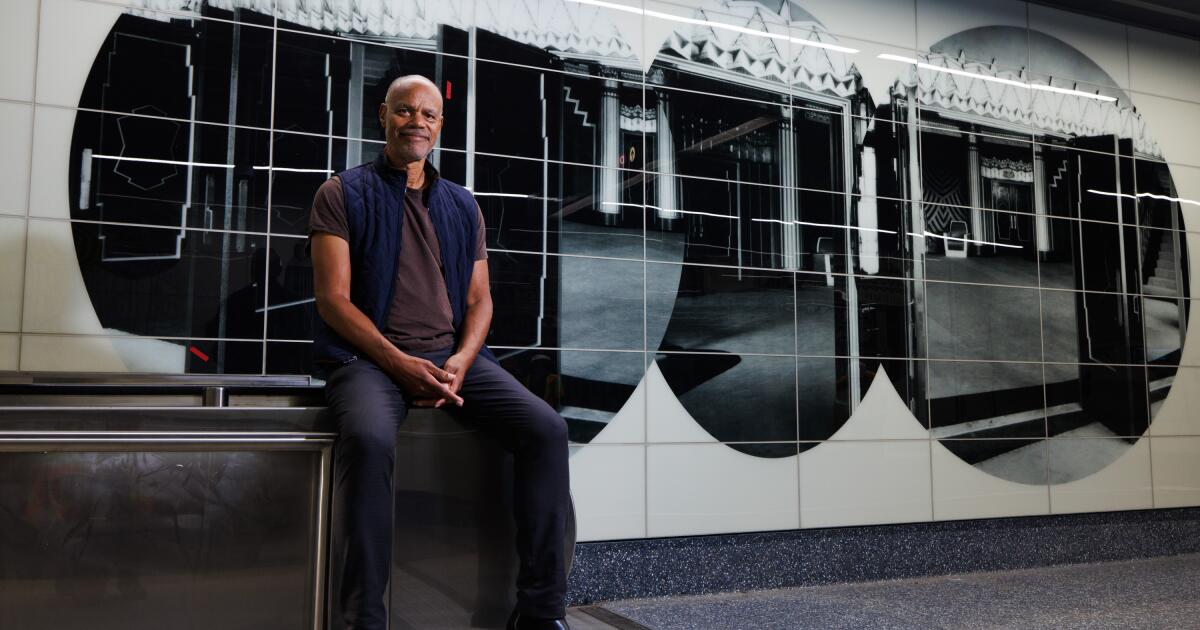
Artist Todd Gray sits in front of his work inside the Wilshire/La Cienega Metro station on Friday, May 1, 2026, in Los Angeles.
(Carlin Stiehl / For The Times)
The glass walls of the Wilshire/La Cienega station are blue because of an accident, according to Los Angeles photo-artist Todd Gray.
In “Mining the Archives: S. Charles Lee, Architect,” Gray placed original preliminary architectural sketches of nearby Saban Theatre alongside historic photographs of the theater taken after it was built.
Gray, who grew up near the Fairfax District, often admired the exterior of the Fox Wilshire movie palace, now the Saban Theatre. (He was not a movie buff, so he seldom went in.)

Artist Todd Gray’s work inside the Wilshire/La Cienega Metro station.
(Carlin Stiehl / For The Times)
Gray’s interest in the theater led him to UCLA’s extensive archive of papers by prolific Los Angeles architect S. Charles Lee, who was credited with designing more than 400 theaters globally. There, he found Lee’s detailed hand-drawn sketches of the building and its interior.
As Gray worked with old, yellowing scans of Lee’s drawings in Photoshop, he accidentally inverted the colors. The result—white ink against a deep blue background—reminded him of architectural blueprints. He leaned into the concept.
Gray is known for his layered photographic compositions, including his recent piece “Octavia’s Gaze,” a commission for LACMA’s new David Geffen Galleries.
Photographs are supposed to be objective, he said. Yet their meanings can be altered simply by changing context or editing a caption.
“What I like to do by covering things is make the photograph a question,” Gray said. “Because it’s not stating an irrefutable fact … viewers will [wonder] what’s behind it.”

Artist Todd Gray lies down in front of his work inside the Wilshire/La Cienega Metro station.
(Carlin Stiehl / For The Times)
A series of colorful circles overlay Lee’s ink sketches. These circles, Gray explained, are cropped photos of textiles from Mexico, Guatemala and Japan that he found at fabric shops around Los Angeles.
They are meant to acknowledge the presence of the minority communities that were allowed to work, but not live, in the neighborhood.
“I wanted [them] to be welcome in here,” Gray said.

Artist Todd Gray’s work inside the Wilshire/La Cienega Metro station.
(Carlin Stiehl / For The Times)

L.A. Metro’s three new D line extension stations feature nine public artworks
Art deco motifs, fossils and massive drawings of hands are among the installations that will greet riders passing through the three new stations on L.A. Metro’s D Line extension.
The underground subway stations, which connect downtown Los Angeles to Beverly Hills, are home to nine site-specific artworks by Mariana Castillo Deball, Eamon Ore-Giron, Ken Gonzales-Day, Todd Gray, Karl Haendel, Soo Kim, Fran Siegel, Susan Silton and Mark Dean Veca.
The goal was to make the new public art a “world-class experience” for riders — one that matched the caliber of the acclaimed museums the new subway route makes accessible along Wilshire Boulevard, said Metro deputy executive officer Zipporah Yamamoto, who leads the agency’s public art program.
“When you walk through the stations, you’re basically walking through a series of immersive artworks on every single level,” Yamamoto said. “It’s not like hanging paintings above a sofa … where the art comes in at the end.”
Participating artists did not have to reside in Los Angeles, but their projects had to respond to the station’s location, history and culture and include a community engagement component.
“Without artwork that is specific in its reference to place, all the stations would look the same,” Yamamoto said, adding that she hopes the art will encourage riders to explore a neighborhood further.
Metal placards installed near each piece feature a scannable QR code that reveals more about the artist.
The competitive selection process began roughly a decade ago, Yamamoto said. More than 1,200 people responded to the agency’s call for artists. Finalists were paid to develop proposals that were judged by a panel of art professionals including curators from the museums along Miracle Mile.
Metro’s art program is primarily funded by a 0.5% budget set aside from construction costs allotted for new transit projects, according to spokesperson Missy Colman.
Metro plans to open the D Line extension in three phases, with a goal of completing the full route by fall 2027. When finished, it will include seven new stations and connect Koreatown to Westwood.
The first phase opened Friday and includes the Wilshire/La Brea, Wilshire/Fairfax and Wilshire/La Cienega stations.
The Times spoke with four artists whose work will be inside.
Eamon Ore-Giron
Artist Eamon Ore-Giron stands in front of his artwork at the Wilshire/La Brea Metro station on Friday, May 1, 2026, in Los Angeles.
(Carlin Stiehl / For The Times)
A series of converging yellow rays brighten the Wilshire/La Brea station.
Echo Park-based artist Eamon Ore-Giron’s “Infinite Landscape: Los Ángeles Para Siempre” uses forced perspective to trick viewers into feeling like they are being pulled in or out of a portal.
Ore-Giron was born and raised in Tucson and has lived in Mexico City, San Francisco and Guadalajara. He completed a master’s degree in fine arts at UCLA, and his work has been featured at the Museum of Contemporary Art Denver and San Francisco Museum of Modern Art, among others.
Circular patterns, placed on abstract “tracks,” represent transit riders.
Ore-Giron has long viewed the subway as a “magical portal.” He has fond memories of taking the Madrid Metro with his siblings and of the excitement and slight fear he felt as he watched the train lights emerge from darkness. As a young person without a car, transit opened up the city, he said.
His work reflects on the history of Miracle Mile. In the 1920s, Art Deco buildings rose along Wilshire Boulevard as the street transformed from a remote dirt path into a bustling, car-oriented commercial district. The structure’s bold designs were meant to catch the eyes of drivers.
Two views of artist Eamon Ore-Giron’s artwork at the Wilshire/La Brea Metro station.
(Carlin Stiehl / For The Times)
Ore-Giron’s work aims to connect L.A.’s past with the future and reframe the site’s car-centric history for pedestrians.
“This [Metro] expansion in a lot of ways is the next step in Los Angeles evolving into a more densely urban city, moving out of an era of the car-dominant culture,” Ore-Giron said.
Ore-Giron said he was also drawn to the Art Deco style because of the international dialogue it represented. In crafting what was then the style of the future, the architects at the time were influenced by Egyptian and Maya motifs.
The color palette consists of hues commonly found in Art Deco architecture, including muted green, sapphire and ruby.
He considered using gold. The metallic color is a signature part of his well-known “Infinite Regress” paintings, and it is often seen in Art Deco building details. But he decided it would feel like “too much” in a subway station, and instead chose a softer yellow.
Artist Eamon Ore-Giron’s artwork at the Wilshire/La Brea Metro station.
(Carlin Stiehl / For The Times)
The colors also evoke hazy Los Angeles skies, hills and buildings seen from a distance. Much is left to the viewer’s interpretation.
“You could think of it as the subconscious idea of the architecture of L.A.,” Ore-Giron offered.
Fran Siegel
Artist Fran Siegel stands in front of her artwork at the Wilshire/La Brea Metro station on Friday, May 1, 2026, in Los Angeles.
(Carlin Stiehl / For The Times)
San Pedro-based artist Fran Siegel spent a year and a half taking long walks along Wilshire Boulevard to create her project, called “Re: Orientation,” for Metro.
Siegel said she was on the same stretch of road so often that people began to wonder if she was a location scout.
What she was really looking for was light. With a camera in tow, Siegel traversed the street at different times of the day, and she noticed that as the day waned, sunlight would bounce from one building to another, casting ghostly projections.
“They were like little miracles,” she said.
Siegel has received two Fulbright awards to conduct research in Brazil and Lisbon, Portugal. A former art professor at Cal State Long Beach, her work has been featured in the Getty’s Pacific Standard Time exhibitions.
Two views of artist Fran Siegel’s artwork at the Wilshire/La Brea Metro station.
(Carlin Stiehl / For The Times)
Siegel came up with the idea for “Re: Orientation” as she studied a map of Los Angeles and noticed the clashing street grids. Downtown Los Angeles’ street grid is diagonal, a legacy of Spanish rule. West of Hoover Street, the grid reorients itself, straightening into an American-style street grid.
“I saw that the sun rises and sets on Wilshire Boulevard because it’s a complete East-West access street,” Siegel said. “I was really fascinated with seeing it all as a clock.”
The massive collage occupies both sides of the concourse at Wilshire/La Brea and plays with time, place and light.
It features Siegel’s photographs, which were taken through dichroic lenses, and scans of ink drawings on rice paper. She hopes the artwork, which she designed to be slowly read, will encourage people to see Wilshire Boulevard in a new light.
Artist Fran Siegel stands in front of her artwork at the Wilshire/La Brea Metro station.
(Carlin Stiehl / For The Times)
During one visit, riders might notice Siegel’s photograph of a mammoth tusk — a fossil uncovered by crews during construction of the station. On another, viewers might linger on a picture of dirt, which Siegel captured during a trip 120 feet underground while the station was under construction. Or they might recognize the Feng Shui Yundo culled from the nearby Korean Cultural Center.
“By not just showing snapshots of the place, but … making a composition out of it, they could see that all these things form together into an experience of one place,” Siegel said.
Karl Haendel
Artist Karl Haendel stands in front of his work inside the Wilshire/Fairfax Metro station on Friday, May 1, 2026, in Los Angeles.
(Carlin Stiehl / For The Times)
Artist Karl Haendel, from L.A.’s Mount Washington neighborhood, considers himself a “handmade labor fetishist.”
His artwork “Hands and Things,” which spans the entrance and middle levels of the Wilshire/Fairfax station, features photos and photorealistic pencil drawings of the hands of more than 30 people who lived or worked around the station.
“I’m interested in touch, activity, humanness — the character of being alive and human — and connection,” said Haendel, who grew up on the East Coast and completed a master’s of fine art at UCLA.
Haendel’s work is in the collections of the Guggenheim Museum, Museum of Modern Art, New York, and the Whitney Museum of American Art.
He wanted to capture portraits of people’s hands to highlight craftsmanship and labor. Unlike with faces, viewers don’t judge hands by conventional beauty standards, Haendel said.
Haendel and his assistant knocked on doors and visited local businesses to find community members willing to accompany them to museums and cultural institutions and participate in the project.
Each hand is seen interacting with an object sourced from a number of surrounding museums and cultural institutions, including Los Angeles County Museum of Art, the Academy Museum of Motion Pictures and Holocaust Museum LA.
Hancock Park Elementary Principal Ashley Parker, for instance, holds a shovel dripping with tar from the La Brea Tar Pits. Tenagne Belachew, chef at Lalibela, an Ethiopian restaurant on Fairfax Avenue, holds a traditional Ethiopian coffeepot. El Rey Theatre projectionist Tori Yorochko hoists a scepter prop that was featured in the 1963 movie “Cleopatra” starring Elizabeth Taylor.
Artist Karl Haendel’s work inside the Wilshire/Fairfax Metro station.
(Carlin Stiehl / For The Times)
Haendel asked participants to interact with the objects in playful and investigative ways. He tweaked the images, removing plastic gloves and flipping objects like a vase sideways to make for a more engaging composition.
Documentary filmmaker Reginald Turner, a board member of Pan Pacific Park, wears a metal gear from the Petersen Automotive Museum on his index finger like a ring. Renee Weitzer, who spent over three decades working at Los Angeles City Hall, grasps onto the leg of a Mattel-designed Ken doll from LACMA’s collection.
Haendel, who is colorblind, said he initially planned for the entire work to be drawn in pencil and in grayscale, like much of his other work. He incorporated the colorful reference photographs into the final piece after Metro staff encouraged him to make the piece more uplifting.
Making art for a gallery or museum means more creative control. But when it comes to creating public art, Haendel said, “I’m of service to the community.” He said he tried to take into consideration the Metro workers and transit riders and other community members who would see the piece every day.
Artist Karl Haendel’s work inside the Wilshire/Fairfax Metro station.
(Carlin Stiehl / For The Times)
“It’s a good shift in perspective and it forces a kind of humility,” he said.
Haendel said he hopes his work makes ordinary moments like waiting for a train a little more interesting and sparks people’s curiosity about the neighborhood’s history.
“Maybe they want to go into these museums around here,” Haendel said. “Maybe they want to go to LACMA after seeing this very cool alarm clock. Maybe they want to go to the Holocaust Museum after [wondering] ‘what is this?’”
Todd Gray
Artist Todd Gray sits in front of his work inside the Wilshire/La Cienega Metro station on Friday, May 1, 2026, in Los Angeles.
(Carlin Stiehl / For The Times)
The glass walls of the Wilshire/La Cienega station are blue because of an accident, according to Los Angeles photo-artist Todd Gray.
In “Mining the Archives: S. Charles Lee, Architect,” Gray placed original preliminary architectural sketches of nearby Saban Theatre alongside historic photographs of the theater taken after it was built.
Gray, who grew up near the Fairfax District, often admired the exterior of the Fox Wilshire movie palace, now the Saban Theatre. (He was not a movie buff, so he seldom went in.)
Artist Todd Gray’s work inside the Wilshire/La Cienega Metro station.
(Carlin Stiehl / For The Times)
Gray’s interest in the theater led him to UCLA’s extensive archive of papers by prolific Los Angeles architect S. Charles Lee, who was credited with designing more than 400 theaters globally. There, he found Lee’s detailed hand-drawn sketches of the building and its interior.
As Gray worked with old, yellowing scans of Lee’s drawings in Photoshop, he accidentally inverted the colors. The result—white ink against a deep blue background—reminded him of architectural blueprints. He leaned into the concept.
Gray is known for his layered photographic compositions, including his recent piece “Octavia’s Gaze,” a commission for LACMA’s new David Geffen Galleries.
Photographs are supposed to be objective, he said. Yet their meanings can be altered simply by changing context or editing a caption.
“What I like to do by covering things is make the photograph a question,” Gray said. “Because it’s not stating an irrefutable fact … viewers will [wonder] what’s behind it.”
Artist Todd Gray lies down in front of his work inside the Wilshire/La Cienega Metro station.
(Carlin Stiehl / For The Times)
A series of colorful circles overlay Lee’s ink sketches. These circles, Gray explained, are cropped photos of textiles from Mexico, Guatemala and Japan that he found at fabric shops around Los Angeles.
They are meant to acknowledge the presence of the minority communities that were allowed to work, but not live, in the neighborhood.
“I wanted [them] to be welcome in here,” Gray said.
Artist Todd Gray’s work inside the Wilshire/La Cienega Metro station.
(Carlin Stiehl / For The Times)

L.A. Metro’s three new D line extension stations feature nine public artworks
Art deco motifs, fossils and massive drawings of hands are among the installations that will greet riders passing through the three new stations on L.A. Metro’s D Line extension.
The underground subway stations, which connect downtown Los Angeles to Beverly Hills, are home to nine site-specific artworks by Mariana Castillo Deball, Eamon Ore-Giron, Ken Gonzales-Day, Todd Gray, Karl Haendel, Soo Kim, Fran Siegel, Susan Silton and Mark Dean Veca.
The goal was to make the new public art a “world-class experience” for riders — one that matched the caliber of the acclaimed museums the new subway route makes accessible along Wilshire Boulevard, said Metro deputy executive officer Zipporah Yamamoto, who leads the agency’s public art program.
“When you walk through the stations, you’re basically walking through a series of immersive artworks on every single level,” Yamamoto said. “It’s not like hanging paintings above a sofa … where the art comes in at the end.”
Participating artists did not have to reside in Los Angeles, but their projects had to respond to the station’s location, history and culture and include a community engagement component.
“Without artwork that is specific in its reference to place, all the stations would look the same,” Yamamoto said, adding that she hopes the art will encourage riders to explore a neighborhood further.
Metal placards installed near each piece feature a scannable QR code that reveals more about the artist.
The competitive selection process began roughly a decade ago, Yamamoto said. More than 1,200 people responded to the agency’s call for artists. Finalists were paid to develop proposals that were judged by a panel of art professionals including curators from the museums along Miracle Mile.
Metro’s art program is primarily funded by a 0.5% budget set aside from construction costs allotted for new transit projects, according to spokesperson Missy Colman.
Metro plans to open the D Line extension in three phases, with a goal of completing the full route by fall 2027. When finished, it will include seven new stations and connect Koreatown to Westwood.
The first phase opened Friday and includes the Wilshire/La Brea, Wilshire/Fairfax and Wilshire/La Cienega stations.
The Times spoke with four artists whose work will be inside.
Eamon Ore-Giron
Artist Eamon Ore-Giron stands in front of his artwork at the Wilshire/La Brea Metro station on Friday, May 1, 2026, in Los Angeles.
(Carlin Stiehl / For The Times)
A series of converging yellow rays brighten the Wilshire/La Brea station.
Echo Park-based artist Eamon Ore-Giron’s “Infinite Landscape: Los Ángeles Para Siempre” uses forced perspective to trick viewers into feeling like they are being pulled in or out of a portal.
Ore-Giron was born and raised in Tucson and has lived in Mexico City, San Francisco and Guadalajara. He completed a master’s degree in fine arts at UCLA, and his work has been featured at the Museum of Contemporary Art Denver and San Francisco Museum of Modern Art, among others.
Circular patterns, placed on abstract “tracks,” represent transit riders.
Ore-Giron has long viewed the subway as a “magical portal.” He has fond memories of taking the Madrid Metro with his siblings and of the excitement and slight fear he felt as he watched the train lights emerge from darkness. As a young person without a car, transit opened up the city, he said.
His work reflects on the history of Miracle Mile. In the 1920s, Art Deco buildings rose along Wilshire Boulevard as the street transformed from a remote dirt path into a bustling, car-oriented commercial district. The structure’s bold designs were meant to catch the eyes of drivers.
Two views of artist Eamon Ore-Giron’s artwork at the Wilshire/La Brea Metro station.
(Carlin Stiehl / For The Times)
Ore-Giron’s work aims to connect L.A.’s past with the future and reframe the site’s car-centric history for pedestrians.
“This [Metro] expansion in a lot of ways is the next step in Los Angeles evolving into a more densely urban city, moving out of an era of the car-dominant culture,” Ore-Giron said.
Ore-Giron said he was also drawn to the Art Deco style because of the international dialogue it represented. In crafting what was then the style of the future, the architects at the time were influenced by Egyptian and Maya motifs.
The color palette consists of hues commonly found in Art Deco architecture, including muted green, sapphire and ruby.
He considered using gold. The metallic color is a signature part of his well-known “Infinite Regress” paintings, and it is often seen in Art Deco building details. But he decided it would feel like “too much” in a subway station, and instead chose a softer yellow.
Artist Eamon Ore-Giron’s artwork at the Wilshire/La Brea Metro station.
(Carlin Stiehl / For The Times)
The colors also evoke hazy Los Angeles skies, hills and buildings seen from a distance. Much is left to the viewer’s interpretation.
“You could think of it as the subconscious idea of the architecture of L.A.,” Ore-Giron offered.
Fran Siegel
Artist Fran Siegel stands in front of her artwork at the Wilshire/La Brea Metro station on Friday, May 1, 2026, in Los Angeles.
(Carlin Stiehl / For The Times)
San Pedro-based artist Fran Siegel spent a year and a half taking long walks along Wilshire Boulevard to create her project, called “Re: Orientation,” for Metro.
Siegel said she was on the same stretch of road so often that people began to wonder if she was a location scout.
What she was really looking for was light. With a camera in tow, Siegel traversed the street at different times of the day, and she noticed that as the day waned, sunlight would bounce from one building to another, casting ghostly projections.
“They were like little miracles,” she said.
Siegel has received two Fulbright awards to conduct research in Brazil and Lisbon, Portugal. A former art professor at Cal State Long Beach, her work has been featured in the Getty’s Pacific Standard Time exhibitions.
Two views of artist Fran Siegel’s artwork at the Wilshire/La Brea Metro station.
(Carlin Stiehl / For The Times)
Siegel came up with the idea for “Re: Orientation” as she studied a map of Los Angeles and noticed the clashing street grids. Downtown Los Angeles’ street grid is diagonal, a legacy of Spanish rule. West of Hoover Street, the grid reorients itself, straightening into an American-style street grid.
“I saw that the sun rises and sets on Wilshire Boulevard because it’s a complete East-West access street,” Siegel said. “I was really fascinated with seeing it all as a clock.”
The massive collage occupies both sides of the concourse at Wilshire/La Brea and plays with time, place and light.
It features Siegel’s photographs, which were taken through dichroic lenses, and scans of ink drawings on rice paper. She hopes the artwork, which she designed to be slowly read, will encourage people to see Wilshire Boulevard in a new light.
Artist Fran Siegel stands in front of her artwork at the Wilshire/La Brea Metro station.
(Carlin Stiehl / For The Times)
During one visit, riders might notice Siegel’s photograph of a mammoth tusk — a fossil uncovered by crews during construction of the station. On another, viewers might linger on a picture of dirt, which Siegel captured during a trip 120 feet underground while the station was under construction. Or they might recognize the Feng Shui Yundo culled from the nearby Korean Cultural Center.
“By not just showing snapshots of the place, but … making a composition out of it, they could see that all these things form together into an experience of one place,” Siegel said.
Karl Haendel
Artist Karl Haendel stands in front of his work inside the Wilshire/Fairfax Metro station on Friday, May 1, 2026, in Los Angeles.
(Carlin Stiehl / For The Times)
Artist Karl Haendel, from L.A.’s Mount Washington neighborhood, considers himself a “handmade labor fetishist.”
His artwork “Hands and Things,” which spans the entrance and middle levels of the Wilshire/Fairfax station, features photos and photorealistic pencil drawings of the hands of more than 30 people who lived or worked around the station.
“I’m interested in touch, activity, humanness — the character of being alive and human — and connection,” said Haendel, who grew up on the East Coast and completed a master’s of fine art at UCLA.
Haendel’s work is in the collections of the Guggenheim Museum, Museum of Modern Art, New York, and the Whitney Museum of American Art.
He wanted to capture portraits of people’s hands to highlight craftsmanship and labor. Unlike with faces, viewers don’t judge hands by conventional beauty standards, Haendel said.
Haendel and his assistant knocked on doors and visited local businesses to find community members willing to accompany them to museums and cultural institutions and participate in the project.
Each hand is seen interacting with an object sourced from a number of surrounding museums and cultural institutions, including Los Angeles County Museum of Art, the Academy Museum of Motion Pictures and Holocaust Museum LA.
Hancock Park Elementary Principal Ashley Parker, for instance, holds a shovel dripping with tar from the La Brea Tar Pits. Tenagne Belachew, chef at Lalibela, an Ethiopian restaurant on Fairfax Avenue, holds a traditional Ethiopian coffeepot. El Rey Theatre projectionist Tori Yorochko hoists a scepter prop that was featured in the 1963 movie “Cleopatra” starring Elizabeth Taylor.
Artist Karl Haendel’s work inside the Wilshire/Fairfax Metro station.
(Carlin Stiehl / For The Times)
Haendel asked participants to interact with the objects in playful and investigative ways. He tweaked the images, removing plastic gloves and flipping objects like a vase sideways to make for a more engaging composition.
Documentary filmmaker Reginald Turner, a board member of Pan Pacific Park, wears a metal gear from the Petersen Automotive Museum on his index finger like a ring. Renee Weitzer, who spent over three decades working at Los Angeles City Hall, grasps onto the leg of a Mattel-designed Ken doll from LACMA’s collection.
Haendel, who is colorblind, said he initially planned for the entire work to be drawn in pencil and in grayscale, like much of his other work. He incorporated the colorful reference photographs into the final piece after Metro staff encouraged him to make the piece more uplifting.
Making art for a gallery or museum means more creative control. But when it comes to creating public art, Haendel said, “I’m of service to the community.” He said he tried to take into consideration the Metro workers and transit riders and other community members who would see the piece every day.
Artist Karl Haendel’s work inside the Wilshire/Fairfax Metro station.
(Carlin Stiehl / For The Times)
“It’s a good shift in perspective and it forces a kind of humility,” he said.
Haendel said he hopes his work makes ordinary moments like waiting for a train a little more interesting and sparks people’s curiosity about the neighborhood’s history.
“Maybe they want to go into these museums around here,” Haendel said. “Maybe they want to go to LACMA after seeing this very cool alarm clock. Maybe they want to go to the Holocaust Museum after [wondering] ‘what is this?’”
Todd Gray
Artist Todd Gray sits in front of his work inside the Wilshire/La Cienega Metro station on Friday, May 1, 2026, in Los Angeles.
(Carlin Stiehl / For The Times)
The glass walls of the Wilshire/La Cienega station are blue because of an accident, according to Los Angeles photo-artist Todd Gray.
In “Mining the Archives: S. Charles Lee, Architect,” Gray placed original preliminary architectural sketches of nearby Saban Theatre alongside historic photographs of the theater taken after it was built.
Gray, who grew up near the Fairfax District, often admired the exterior of the Fox Wilshire movie palace, now the Saban Theatre. (He was not a movie buff, so he seldom went in.)
Artist Todd Gray’s work inside the Wilshire/La Cienega Metro station.
(Carlin Stiehl / For The Times)
Gray’s interest in the theater led him to UCLA’s extensive archive of papers by prolific Los Angeles architect S. Charles Lee, who was credited with designing more than 400 theaters globally. There, he found Lee’s detailed hand-drawn sketches of the building and its interior.
As Gray worked with old, yellowing scans of Lee’s drawings in Photoshop, he accidentally inverted the colors. The result—white ink against a deep blue background—reminded him of architectural blueprints. He leaned into the concept.
Gray is known for his layered photographic compositions, including his recent piece “Octavia’s Gaze,” a commission for LACMA’s new David Geffen Galleries.
Photographs are supposed to be objective, he said. Yet their meanings can be altered simply by changing context or editing a caption.
“What I like to do by covering things is make the photograph a question,” Gray said. “Because it’s not stating an irrefutable fact … viewers will [wonder] what’s behind it.”
Artist Todd Gray lies down in front of his work inside the Wilshire/La Cienega Metro station.
(Carlin Stiehl / For The Times)
A series of colorful circles overlay Lee’s ink sketches. These circles, Gray explained, are cropped photos of textiles from Mexico, Guatemala and Japan that he found at fabric shops around Los Angeles.
They are meant to acknowledge the presence of the minority communities that were allowed to work, but not live, in the neighborhood.
“I wanted [them] to be welcome in here,” Gray said.
Artist Todd Gray’s work inside the Wilshire/La Cienega Metro station.
(Carlin Stiehl / For The Times)
L.A. Metro’s three new D line extension stations feature nine public artworks
Art deco motifs, fossils and massive drawings of hands are among the installations that will greet riders passing through the three new stations on L.A. Metro’s D Line extension.
The underground subway stations, which connect downtown Los Angeles to Beverly Hills, are home to nine site-specific artworks by Mariana Castillo Deball, Eamon Ore-Giron, Ken Gonzales-Day, Todd Gray, Karl Haendel, Soo Kim, Fran Siegel, Susan Silton and Mark Dean Veca.
The goal was to make the new public art a “world-class experience” for riders — one that matched the caliber of the acclaimed museums the new subway route makes accessible along Wilshire Boulevard, said Metro deputy executive officer Zipporah Yamamoto, who leads the agency’s public art program.
“When you walk through the stations, you’re basically walking through a series of immersive artworks on every single level,” Yamamoto said. “It’s not like hanging paintings above a sofa … where the art comes in at the end.”
Participating artists did not have to reside in Los Angeles, but their projects had to respond to the station’s location, history and culture and include a community engagement component.
“Without artwork that is specific in its reference to place, all the stations would look the same,” Yamamoto said, adding that she hopes the art will encourage riders to explore a neighborhood further.
Metal placards installed near each piece feature a scannable QR code that reveals more about the artist.
The competitive selection process began roughly a decade ago, Yamamoto said. More than 1,200 people responded to the agency’s call for artists. Finalists were paid to develop proposals that were judged by a panel of art professionals including curators from the museums along Miracle Mile.
Metro’s art program is primarily funded by a 0.5% budget set aside from construction costs allotted for new transit projects, according to spokesperson Missy Colman.
Metro plans to open the D Line extension in three phases, with a goal of completing the full route by fall 2027. When finished, it will include seven new stations and connect Koreatown to Westwood.
The first phase opened Friday and includes the Wilshire/La Brea, Wilshire/Fairfax and Wilshire/La Cienega stations.
The Times spoke with four artists whose work will be inside.
Eamon Ore-Giron
Artist Eamon Ore-Giron stands in front of his artwork at the Wilshire/La Brea Metro station on Friday, May 1, 2026, in Los Angeles.
(Carlin Stiehl / For The Times)
A series of converging yellow rays brighten the Wilshire/La Brea station.
Echo Park-based artist Eamon Ore-Giron’s “Infinite Landscape: Los Ángeles Para Siempre” uses forced perspective to trick viewers into feeling like they are being pulled in or out of a portal.
Ore-Giron was born and raised in Tucson and has lived in Mexico City, San Francisco and Guadalajara. He completed a master’s degree in fine arts at UCLA, and his work has been featured at the Museum of Contemporary Art Denver and San Francisco Museum of Modern Art, among others.
Circular patterns, placed on abstract “tracks,” represent transit riders.
Ore-Giron has long viewed the subway as a “magical portal.” He has fond memories of taking the Madrid Metro with his siblings and of the excitement and slight fear he felt as he watched the train lights emerge from darkness. As a young person without a car, transit opened up the city, he said.
His work reflects on the history of Miracle Mile. In the 1920s, Art Deco buildings rose along Wilshire Boulevard as the street transformed from a remote dirt path into a bustling, car-oriented commercial district. The structure’s bold designs were meant to catch the eyes of drivers.
Two views of artist Eamon Ore-Giron’s artwork at the Wilshire/La Brea Metro station.
(Carlin Stiehl / For The Times)
Ore-Giron’s work aims to connect L.A.’s past with the future and reframe the site’s car-centric history for pedestrians.
“This [Metro] expansion in a lot of ways is the next step in Los Angeles evolving into a more densely urban city, moving out of an era of the car-dominant culture,” Ore-Giron said.
Ore-Giron said he was also drawn to the Art Deco style because of the international dialogue it represented. In crafting what was then the style of the future, the architects at the time were influenced by Egyptian and Maya motifs.
The color palette consists of hues commonly found in Art Deco architecture, including muted green, sapphire and ruby.
He considered using gold. The metallic color is a signature part of his well-known “Infinite Regress” paintings, and it is often seen in Art Deco building details. But he decided it would feel like “too much” in a subway station, and instead chose a softer yellow.
Artist Eamon Ore-Giron’s artwork at the Wilshire/La Brea Metro station.
(Carlin Stiehl / For The Times)
The colors also evoke hazy Los Angeles skies, hills and buildings seen from a distance. Much is left to the viewer’s interpretation.
“You could think of it as the subconscious idea of the architecture of L.A.,” Ore-Giron offered.
Fran Siegel
Artist Fran Siegel stands in front of her artwork at the Wilshire/La Brea Metro station on Friday, May 1, 2026, in Los Angeles.
(Carlin Stiehl / For The Times)
San Pedro-based artist Fran Siegel spent a year and a half taking long walks along Wilshire Boulevard to create her project, called “Re: Orientation,” for Metro.
Siegel said she was on the same stretch of road so often that people began to wonder if she was a location scout.
What she was really looking for was light. With a camera in tow, Siegel traversed the street at different times of the day, and she noticed that as the day waned, sunlight would bounce from one building to another, casting ghostly projections.
“They were like little miracles,” she said.
Siegel has received two Fulbright awards to conduct research in Brazil and Lisbon, Portugal. A former art professor at Cal State Long Beach, her work has been featured in the Getty’s Pacific Standard Time exhibitions.
Two views of artist Fran Siegel’s artwork at the Wilshire/La Brea Metro station.
(Carlin Stiehl / For The Times)
Siegel came up with the idea for “Re: Orientation” as she studied a map of Los Angeles and noticed the clashing street grids. Downtown Los Angeles’ street grid is diagonal, a legacy of Spanish rule. West of Hoover Street, the grid reorients itself, straightening into an American-style street grid.
“I saw that the sun rises and sets on Wilshire Boulevard because it’s a complete East-West access street,” Siegel said. “I was really fascinated with seeing it all as a clock.”
The massive collage occupies both sides of the concourse at Wilshire/La Brea and plays with time, place and light.
It features Siegel’s photographs, which were taken through dichroic lenses, and scans of ink drawings on rice paper. She hopes the artwork, which she designed to be slowly read, will encourage people to see Wilshire Boulevard in a new light.
Artist Fran Siegel stands in front of her artwork at the Wilshire/La Brea Metro station.
(Carlin Stiehl / For The Times)
During one visit, riders might notice Siegel’s photograph of a mammoth tusk — a fossil uncovered by crews during construction of the station. On another, viewers might linger on a picture of dirt, which Siegel captured during a trip 120 feet underground while the station was under construction. Or they might recognize the Feng Shui Yundo culled from the nearby Korean Cultural Center.
“By not just showing snapshots of the place, but … making a composition out of it, they could see that all these things form together into an experience of one place,” Siegel said.
Karl Haendel
Artist Karl Haendel stands in front of his work inside the Wilshire/Fairfax Metro station on Friday, May 1, 2026, in Los Angeles.
(Carlin Stiehl / For The Times)
Artist Karl Haendel, from L.A.’s Mount Washington neighborhood, considers himself a “handmade labor fetishist.”
His artwork “Hands and Things,” which spans the entrance and middle levels of the Wilshire/Fairfax station, features photos and photorealistic pencil drawings of the hands of more than 30 people who lived or worked around the station.
“I’m interested in touch, activity, humanness — the character of being alive and human — and connection,” said Haendel, who grew up on the East Coast and completed a master’s of fine art at UCLA.
Haendel’s work is in the collections of the Guggenheim Museum, Museum of Modern Art, New York, and the Whitney Museum of American Art.
He wanted to capture portraits of people’s hands to highlight craftsmanship and labor. Unlike with faces, viewers don’t judge hands by conventional beauty standards, Haendel said.
Haendel and his assistant knocked on doors and visited local businesses to find community members willing to accompany them to museums and cultural institutions and participate in the project.
Each hand is seen interacting with an object sourced from a number of surrounding museums and cultural institutions, including Los Angeles County Museum of Art, the Academy Museum of Motion Pictures and Holocaust Museum LA.
Hancock Park Elementary Principal Ashley Parker, for instance, holds a shovel dripping with tar from the La Brea Tar Pits. Tenagne Belachew, chef at Lalibela, an Ethiopian restaurant on Fairfax Avenue, holds a traditional Ethiopian coffeepot. El Rey Theatre projectionist Tori Yorochko hoists a scepter prop that was featured in the 1963 movie “Cleopatra” starring Elizabeth Taylor.
Artist Karl Haendel’s work inside the Wilshire/Fairfax Metro station.
(Carlin Stiehl / For The Times)
Haendel asked participants to interact with the objects in playful and investigative ways. He tweaked the images, removing plastic gloves and flipping objects like a vase sideways to make for a more engaging composition.
Documentary filmmaker Reginald Turner, a board member of Pan Pacific Park, wears a metal gear from the Petersen Automotive Museum on his index finger like a ring. Renee Weitzer, who spent over three decades working at Los Angeles City Hall, grasps onto the leg of a Mattel-designed Ken doll from LACMA’s collection.
Haendel, who is colorblind, said he initially planned for the entire work to be drawn in pencil and in grayscale, like much of his other work. He incorporated the colorful reference photographs into the final piece after Metro staff encouraged him to make the piece more uplifting.
Making art for a gallery or museum means more creative control. But when it comes to creating public art, Haendel said, “I’m of service to the community.” He said he tried to take into consideration the Metro workers and transit riders and other community members who would see the piece every day.
Artist Karl Haendel’s work inside the Wilshire/Fairfax Metro station.
(Carlin Stiehl / For The Times)
“It’s a good shift in perspective and it forces a kind of humility,” he said.
Haendel said he hopes his work makes ordinary moments like waiting for a train a little more interesting and sparks people’s curiosity about the neighborhood’s history.
“Maybe they want to go into these museums around here,” Haendel said. “Maybe they want to go to LACMA after seeing this very cool alarm clock. Maybe they want to go to the Holocaust Museum after [wondering] ‘what is this?’”
Todd Gray
Artist Todd Gray sits in front of his work inside the Wilshire/La Cienega Metro station on Friday, May 1, 2026, in Los Angeles.
(Carlin Stiehl / For The Times)
The glass walls of the Wilshire/La Cienega station are blue because of an accident, according to Los Angeles photo-artist Todd Gray.
In “Mining the Archives: S. Charles Lee, Architect,” Gray placed original preliminary architectural sketches of nearby Saban Theatre alongside historic photographs of the theater taken after it was built.
Gray, who grew up near the Fairfax District, often admired the exterior of the Fox Wilshire movie palace, now the Saban Theatre. (He was not a movie buff, so he seldom went in.)
Artist Todd Gray’s work inside the Wilshire/La Cienega Metro station.
(Carlin Stiehl / For The Times)
Gray’s interest in the theater led him to UCLA’s extensive archive of papers by prolific Los Angeles architect S. Charles Lee, who was credited with designing more than 400 theaters globally. There, he found Lee’s detailed hand-drawn sketches of the building and its interior.
As Gray worked with old, yellowing scans of Lee’s drawings in Photoshop, he accidentally inverted the colors. The result—white ink against a deep blue background—reminded him of architectural blueprints. He leaned into the concept.
Gray is known for his layered photographic compositions, including his recent piece “Octavia’s Gaze,” a commission for LACMA’s new David Geffen Galleries.
Photographs are supposed to be objective, he said. Yet their meanings can be altered simply by changing context or editing a caption.
“What I like to do by covering things is make the photograph a question,” Gray said. “Because it’s not stating an irrefutable fact … viewers will [wonder] what’s behind it.”
Artist Todd Gray lies down in front of his work inside the Wilshire/La Cienega Metro station.
(Carlin Stiehl / For The Times)
A series of colorful circles overlay Lee’s ink sketches. These circles, Gray explained, are cropped photos of textiles from Mexico, Guatemala and Japan that he found at fabric shops around Los Angeles.
They are meant to acknowledge the presence of the minority communities that were allowed to work, but not live, in the neighborhood.
“I wanted [them] to be welcome in here,” Gray said.
Artist Todd Gray’s work inside the Wilshire/La Cienega Metro station.
(Carlin Stiehl / For The Times)

L.A. Metro’s three new D line extension stations feature nine public artworks
Art deco motifs, fossils and massive drawings of hands are among the installations that will greet riders passing through the three new stations on L.A. Metro’s D Line extension.
The underground subway stations, which connect downtown Los Angeles to Beverly Hills, are home to nine site-specific artworks by Mariana Castillo Deball, Eamon Ore-Giron, Ken Gonzales-Day, Todd Gray, Karl Haendel, Soo Kim, Fran Siegel, Susan Silton and Mark Dean Veca.
The goal was to make the new public art a “world-class experience” for riders — one that matched the caliber of the acclaimed museums the new subway route makes accessible along Wilshire Boulevard, said Metro deputy executive officer Zipporah Yamamoto, who leads the agency’s public art program.
“When you walk through the stations, you’re basically walking through a series of immersive artworks on every single level,” Yamamoto said. “It’s not like hanging paintings above a sofa … where the art comes in at the end.”
Participating artists did not have to reside in Los Angeles, but their projects had to respond to the station’s location, history and culture and include a community engagement component.
“Without artwork that is specific in its reference to place, all the stations would look the same,” Yamamoto said, adding that she hopes the art will encourage riders to explore a neighborhood further.
Metal placards installed near each piece feature a scannable QR code that reveals more about the artist.
The competitive selection process began roughly a decade ago, Yamamoto said. More than 1,200 people responded to the agency’s call for artists. Finalists were paid to develop proposals that were judged by a panel of art professionals including curators from the museums along Miracle Mile.
Metro’s art program is primarily funded by a 0.5% budget set aside from construction costs allotted for new transit projects, according to spokesperson Missy Colman.
Metro plans to open the D Line extension in three phases, with a goal of completing the full route by fall 2027. When finished, it will include seven new stations and connect Koreatown to Westwood.
The first phase opened Friday and includes the Wilshire/La Brea, Wilshire/Fairfax and Wilshire/La Cienega stations.
The Times spoke with four artists whose work will be inside.
Eamon Ore-Giron
Artist Eamon Ore-Giron stands in front of his artwork at the Wilshire/La Brea Metro station on Friday, May 1, 2026, in Los Angeles.
(Carlin Stiehl / For The Times)
A series of converging yellow rays brighten the Wilshire/La Brea station.
Echo Park-based artist Eamon Ore-Giron’s “Infinite Landscape: Los Ángeles Para Siempre” uses forced perspective to trick viewers into feeling like they are being pulled in or out of a portal.
Ore-Giron was born and raised in Tucson and has lived in Mexico City, San Francisco and Guadalajara. He completed a master’s degree in fine arts at UCLA, and his work has been featured at the Museum of Contemporary Art Denver and San Francisco Museum of Modern Art, among others.
Circular patterns, placed on abstract “tracks,” represent transit riders.
Ore-Giron has long viewed the subway as a “magical portal.” He has fond memories of taking the Madrid Metro with his siblings and of the excitement and slight fear he felt as he watched the train lights emerge from darkness. As a young person without a car, transit opened up the city, he said.
His work reflects on the history of Miracle Mile. In the 1920s, Art Deco buildings rose along Wilshire Boulevard as the street transformed from a remote dirt path into a bustling, car-oriented commercial district. The structure’s bold designs were meant to catch the eyes of drivers.
Two views of artist Eamon Ore-Giron’s artwork at the Wilshire/La Brea Metro station.
(Carlin Stiehl / For The Times)
Ore-Giron’s work aims to connect L.A.’s past with the future and reframe the site’s car-centric history for pedestrians.
“This [Metro] expansion in a lot of ways is the next step in Los Angeles evolving into a more densely urban city, moving out of an era of the car-dominant culture,” Ore-Giron said.
Ore-Giron said he was also drawn to the Art Deco style because of the international dialogue it represented. In crafting what was then the style of the future, the architects at the time were influenced by Egyptian and Maya motifs.
The color palette consists of hues commonly found in Art Deco architecture, including muted green, sapphire and ruby.
He considered using gold. The metallic color is a signature part of his well-known “Infinite Regress” paintings, and it is often seen in Art Deco building details. But he decided it would feel like “too much” in a subway station, and instead chose a softer yellow.
Artist Eamon Ore-Giron’s artwork at the Wilshire/La Brea Metro station.
(Carlin Stiehl / For The Times)
The colors also evoke hazy Los Angeles skies, hills and buildings seen from a distance. Much is left to the viewer’s interpretation.
“You could think of it as the subconscious idea of the architecture of L.A.,” Ore-Giron offered.
Fran Siegel
Artist Fran Siegel stands in front of her artwork at the Wilshire/La Brea Metro station on Friday, May 1, 2026, in Los Angeles.
(Carlin Stiehl / For The Times)
San Pedro-based artist Fran Siegel spent a year and a half taking long walks along Wilshire Boulevard to create her project, called “Re: Orientation,” for Metro.
Siegel said she was on the same stretch of road so often that people began to wonder if she was a location scout.
What she was really looking for was light. With a camera in tow, Siegel traversed the street at different times of the day, and she noticed that as the day waned, sunlight would bounce from one building to another, casting ghostly projections.
“They were like little miracles,” she said.
Siegel has received two Fulbright awards to conduct research in Brazil and Lisbon, Portugal. A former art professor at Cal State Long Beach, her work has been featured in the Getty’s Pacific Standard Time exhibitions.
Two views of artist Fran Siegel’s artwork at the Wilshire/La Brea Metro station.
(Carlin Stiehl / For The Times)
Siegel came up with the idea for “Re: Orientation” as she studied a map of Los Angeles and noticed the clashing street grids. Downtown Los Angeles’ street grid is diagonal, a legacy of Spanish rule. West of Hoover Street, the grid reorients itself, straightening into an American-style street grid.
“I saw that the sun rises and sets on Wilshire Boulevard because it’s a complete East-West access street,” Siegel said. “I was really fascinated with seeing it all as a clock.”
The massive collage occupies both sides of the concourse at Wilshire/La Brea and plays with time, place and light.
It features Siegel’s photographs, which were taken through dichroic lenses, and scans of ink drawings on rice paper. She hopes the artwork, which she designed to be slowly read, will encourage people to see Wilshire Boulevard in a new light.
Artist Fran Siegel stands in front of her artwork at the Wilshire/La Brea Metro station.
(Carlin Stiehl / For The Times)
During one visit, riders might notice Siegel’s photograph of a mammoth tusk — a fossil uncovered by crews during construction of the station. On another, viewers might linger on a picture of dirt, which Siegel captured during a trip 120 feet underground while the station was under construction. Or they might recognize the Feng Shui Yundo culled from the nearby Korean Cultural Center.
“By not just showing snapshots of the place, but … making a composition out of it, they could see that all these things form together into an experience of one place,” Siegel said.
Karl Haendel
Artist Karl Haendel stands in front of his work inside the Wilshire/Fairfax Metro station on Friday, May 1, 2026, in Los Angeles.
(Carlin Stiehl / For The Times)
Artist Karl Haendel, from L.A.’s Mount Washington neighborhood, considers himself a “handmade labor fetishist.”
His artwork “Hands and Things,” which spans the entrance and middle levels of the Wilshire/Fairfax station, features photos and photorealistic pencil drawings of the hands of more than 30 people who lived or worked around the station.
“I’m interested in touch, activity, humanness — the character of being alive and human — and connection,” said Haendel, who grew up on the East Coast and completed a master’s of fine art at UCLA.
Haendel’s work is in the collections of the Guggenheim Museum, Museum of Modern Art, New York, and the Whitney Museum of American Art.
He wanted to capture portraits of people’s hands to highlight craftsmanship and labor. Unlike with faces, viewers don’t judge hands by conventional beauty standards, Haendel said.
Haendel and his assistant knocked on doors and visited local businesses to find community members willing to accompany them to museums and cultural institutions and participate in the project.
Each hand is seen interacting with an object sourced from a number of surrounding museums and cultural institutions, including Los Angeles County Museum of Art, the Academy Museum of Motion Pictures and Holocaust Museum LA.
Hancock Park Elementary Principal Ashley Parker, for instance, holds a shovel dripping with tar from the La Brea Tar Pits. Tenagne Belachew, chef at Lalibela, an Ethiopian restaurant on Fairfax Avenue, holds a traditional Ethiopian coffeepot. El Rey Theatre projectionist Tori Yorochko hoists a scepter prop that was featured in the 1963 movie “Cleopatra” starring Elizabeth Taylor.
Artist Karl Haendel’s work inside the Wilshire/Fairfax Metro station.
(Carlin Stiehl / For The Times)
Haendel asked participants to interact with the objects in playful and investigative ways. He tweaked the images, removing plastic gloves and flipping objects like a vase sideways to make for a more engaging composition.
Documentary filmmaker Reginald Turner, a board member of Pan Pacific Park, wears a metal gear from the Petersen Automotive Museum on his index finger like a ring. Renee Weitzer, who spent over three decades working at Los Angeles City Hall, grasps onto the leg of a Mattel-designed Ken doll from LACMA’s collection.
Haendel, who is colorblind, said he initially planned for the entire work to be drawn in pencil and in grayscale, like much of his other work. He incorporated the colorful reference photographs into the final piece after Metro staff encouraged him to make the piece more uplifting.
Making art for a gallery or museum means more creative control. But when it comes to creating public art, Haendel said, “I’m of service to the community.” He said he tried to take into consideration the Metro workers and transit riders and other community members who would see the piece every day.
Artist Karl Haendel’s work inside the Wilshire/Fairfax Metro station.
(Carlin Stiehl / For The Times)
“It’s a good shift in perspective and it forces a kind of humility,” he said.
Haendel said he hopes his work makes ordinary moments like waiting for a train a little more interesting and sparks people’s curiosity about the neighborhood’s history.
“Maybe they want to go into these museums around here,” Haendel said. “Maybe they want to go to LACMA after seeing this very cool alarm clock. Maybe they want to go to the Holocaust Museum after [wondering] ‘what is this?’”
Todd Gray
Artist Todd Gray sits in front of his work inside the Wilshire/La Cienega Metro station on Friday, May 1, 2026, in Los Angeles.
(Carlin Stiehl / For The Times)
The glass walls of the Wilshire/La Cienega station are blue because of an accident, according to Los Angeles photo-artist Todd Gray.
In “Mining the Archives: S. Charles Lee, Architect,” Gray placed original preliminary architectural sketches of nearby Saban Theatre alongside historic photographs of the theater taken after it was built.
Gray, who grew up near the Fairfax District, often admired the exterior of the Fox Wilshire movie palace, now the Saban Theatre. (He was not a movie buff, so he seldom went in.)
Artist Todd Gray’s work inside the Wilshire/La Cienega Metro station.
(Carlin Stiehl / For The Times)
Gray’s interest in the theater led him to UCLA’s extensive archive of papers by prolific Los Angeles architect S. Charles Lee, who was credited with designing more than 400 theaters globally. There, he found Lee’s detailed hand-drawn sketches of the building and its interior.
As Gray worked with old, yellowing scans of Lee’s drawings in Photoshop, he accidentally inverted the colors. The result—white ink against a deep blue background—reminded him of architectural blueprints. He leaned into the concept.
Gray is known for his layered photographic compositions, including his recent piece “Octavia’s Gaze,” a commission for LACMA’s new David Geffen Galleries.
Photographs are supposed to be objective, he said. Yet their meanings can be altered simply by changing context or editing a caption.
“What I like to do by covering things is make the photograph a question,” Gray said. “Because it’s not stating an irrefutable fact … viewers will [wonder] what’s behind it.”
Artist Todd Gray lies down in front of his work inside the Wilshire/La Cienega Metro station.
(Carlin Stiehl / For The Times)
A series of colorful circles overlay Lee’s ink sketches. These circles, Gray explained, are cropped photos of textiles from Mexico, Guatemala and Japan that he found at fabric shops around Los Angeles.
They are meant to acknowledge the presence of the minority communities that were allowed to work, but not live, in the neighborhood.
“I wanted [them] to be welcome in here,” Gray said.
Artist Todd Gray’s work inside the Wilshire/La Cienega Metro station.
(Carlin Stiehl / For The Times)
L.A. Metro’s three new D line extension stations feature nine public artworks
Art deco motifs, fossils and massive drawings of hands are among the installations that will greet riders passing through the three new stations on L.A. Metro’s D Line extension.
The underground subway stations, which connect downtown Los Angeles to Beverly Hills, are home to nine site-specific artworks by Mariana Castillo Deball, Eamon Ore-Giron, Ken Gonzales-Day, Todd Gray, Karl Haendel, Soo Kim, Fran Siegel, Susan Silton and Mark Dean Veca.
The goal was to make the new public art a “world-class experience” for riders — one that matched the caliber of the acclaimed museums the new subway route makes accessible along Wilshire Boulevard, said Metro deputy executive officer Zipporah Yamamoto, who leads the agency’s public art program.
“When you walk through the stations, you’re basically walking through a series of immersive artworks on every single level,” Yamamoto said. “It’s not like hanging paintings above a sofa … where the art comes in at the end.”
Participating artists did not have to reside in Los Angeles, but their projects had to respond to the station’s location, history and culture and include a community engagement component.
“Without artwork that is specific in its reference to place, all the stations would look the same,” Yamamoto said, adding that she hopes the art will encourage riders to explore a neighborhood further.
Metal placards installed near each piece feature a scannable QR code that reveals more about the artist.
The competitive selection process began roughly a decade ago, Yamamoto said. More than 1,200 people responded to the agency’s call for artists. Finalists were paid to develop proposals that were judged by a panel of art professionals including curators from the museums along Miracle Mile.
Metro’s art program is primarily funded by a 0.5% budget set aside from construction costs allotted for new transit projects, according to spokesperson Missy Colman.
Metro plans to open the D Line extension in three phases, with a goal of completing the full route by fall 2027. When finished, it will include seven new stations and connect Koreatown to Westwood.
The first phase opened Friday and includes the Wilshire/La Brea, Wilshire/Fairfax and Wilshire/La Cienega stations.
The Times spoke with four artists whose work will be inside.
Eamon Ore-Giron
Artist Eamon Ore-Giron stands in front of his artwork at the Wilshire/La Brea Metro station on Friday, May 1, 2026, in Los Angeles.
(Carlin Stiehl / For The Times)
A series of converging yellow rays brighten the Wilshire/La Brea station.
Echo Park-based artist Eamon Ore-Giron’s “Infinite Landscape: Los Ángeles Para Siempre” uses forced perspective to trick viewers into feeling like they are being pulled in or out of a portal.
Ore-Giron was born and raised in Tucson and has lived in Mexico City, San Francisco and Guadalajara. He completed a master’s degree in fine arts at UCLA, and his work has been featured at the Museum of Contemporary Art Denver and San Francisco Museum of Modern Art, among others.
Circular patterns, placed on abstract “tracks,” represent transit riders.
Ore-Giron has long viewed the subway as a “magical portal.” He has fond memories of taking the Madrid Metro with his siblings and of the excitement and slight fear he felt as he watched the train lights emerge from darkness. As a young person without a car, transit opened up the city, he said.
His work reflects on the history of Miracle Mile. In the 1920s, Art Deco buildings rose along Wilshire Boulevard as the street transformed from a remote dirt path into a bustling, car-oriented commercial district. The structure’s bold designs were meant to catch the eyes of drivers.
Two views of artist Eamon Ore-Giron’s artwork at the Wilshire/La Brea Metro station.
(Carlin Stiehl / For The Times)
Ore-Giron’s work aims to connect L.A.’s past with the future and reframe the site’s car-centric history for pedestrians.
“This [Metro] expansion in a lot of ways is the next step in Los Angeles evolving into a more densely urban city, moving out of an era of the car-dominant culture,” Ore-Giron said.
Ore-Giron said he was also drawn to the Art Deco style because of the international dialogue it represented. In crafting what was then the style of the future, the architects at the time were influenced by Egyptian and Maya motifs.
The color palette consists of hues commonly found in Art Deco architecture, including muted green, sapphire and ruby.
He considered using gold. The metallic color is a signature part of his well-known “Infinite Regress” paintings, and it is often seen in Art Deco building details. But he decided it would feel like “too much” in a subway station, and instead chose a softer yellow.
Artist Eamon Ore-Giron’s artwork at the Wilshire/La Brea Metro station.
(Carlin Stiehl / For The Times)
The colors also evoke hazy Los Angeles skies, hills and buildings seen from a distance. Much is left to the viewer’s interpretation.
“You could think of it as the subconscious idea of the architecture of L.A.,” Ore-Giron offered.
Fran Siegel
Artist Fran Siegel stands in front of her artwork at the Wilshire/La Brea Metro station on Friday, May 1, 2026, in Los Angeles.
(Carlin Stiehl / For The Times)
San Pedro-based artist Fran Siegel spent a year and a half taking long walks along Wilshire Boulevard to create her project, called “Re: Orientation,” for Metro.
Siegel said she was on the same stretch of road so often that people began to wonder if she was a location scout.
What she was really looking for was light. With a camera in tow, Siegel traversed the street at different times of the day, and she noticed that as the day waned, sunlight would bounce from one building to another, casting ghostly projections.
“They were like little miracles,” she said.
Siegel has received two Fulbright awards to conduct research in Brazil and Lisbon, Portugal. A former art professor at Cal State Long Beach, her work has been featured in the Getty’s Pacific Standard Time exhibitions.
Two views of artist Fran Siegel’s artwork at the Wilshire/La Brea Metro station.
(Carlin Stiehl / For The Times)
Siegel came up with the idea for “Re: Orientation” as she studied a map of Los Angeles and noticed the clashing street grids. Downtown Los Angeles’ street grid is diagonal, a legacy of Spanish rule. West of Hoover Street, the grid reorients itself, straightening into an American-style street grid.
“I saw that the sun rises and sets on Wilshire Boulevard because it’s a complete East-West access street,” Siegel said. “I was really fascinated with seeing it all as a clock.”
The massive collage occupies both sides of the concourse at Wilshire/La Brea and plays with time, place and light.
It features Siegel’s photographs, which were taken through dichroic lenses, and scans of ink drawings on rice paper. She hopes the artwork, which she designed to be slowly read, will encourage people to see Wilshire Boulevard in a new light.
Artist Fran Siegel stands in front of her artwork at the Wilshire/La Brea Metro station.
(Carlin Stiehl / For The Times)
During one visit, riders might notice Siegel’s photograph of a mammoth tusk — a fossil uncovered by crews during construction of the station. On another, viewers might linger on a picture of dirt, which Siegel captured during a trip 120 feet underground while the station was under construction. Or they might recognize the Feng Shui Yundo culled from the nearby Korean Cultural Center.
“By not just showing snapshots of the place, but … making a composition out of it, they could see that all these things form together into an experience of one place,” Siegel said.
Karl Haendel
Artist Karl Haendel stands in front of his work inside the Wilshire/Fairfax Metro station on Friday, May 1, 2026, in Los Angeles.
(Carlin Stiehl / For The Times)
Artist Karl Haendel, from L.A.’s Mount Washington neighborhood, considers himself a “handmade labor fetishist.”
His artwork “Hands and Things,” which spans the entrance and middle levels of the Wilshire/Fairfax station, features photos and photorealistic pencil drawings of the hands of more than 30 people who lived or worked around the station.
“I’m interested in touch, activity, humanness — the character of being alive and human — and connection,” said Haendel, who grew up on the East Coast and completed a master’s of fine art at UCLA.
Haendel’s work is in the collections of the Guggenheim Museum, Museum of Modern Art, New York, and the Whitney Museum of American Art.
He wanted to capture portraits of people’s hands to highlight craftsmanship and labor. Unlike with faces, viewers don’t judge hands by conventional beauty standards, Haendel said.
Haendel and his assistant knocked on doors and visited local businesses to find community members willing to accompany them to museums and cultural institutions and participate in the project.
Each hand is seen interacting with an object sourced from a number of surrounding museums and cultural institutions, including Los Angeles County Museum of Art, the Academy Museum of Motion Pictures and Holocaust Museum LA.
Hancock Park Elementary Principal Ashley Parker, for instance, holds a shovel dripping with tar from the La Brea Tar Pits. Tenagne Belachew, chef at Lalibela, an Ethiopian restaurant on Fairfax Avenue, holds a traditional Ethiopian coffeepot. El Rey Theatre projectionist Tori Yorochko hoists a scepter prop that was featured in the 1963 movie “Cleopatra” starring Elizabeth Taylor.
Artist Karl Haendel’s work inside the Wilshire/Fairfax Metro station.
(Carlin Stiehl / For The Times)
Haendel asked participants to interact with the objects in playful and investigative ways. He tweaked the images, removing plastic gloves and flipping objects like a vase sideways to make for a more engaging composition.
Documentary filmmaker Reginald Turner, a board member of Pan Pacific Park, wears a metal gear from the Petersen Automotive Museum on his index finger like a ring. Renee Weitzer, who spent over three decades working at Los Angeles City Hall, grasps onto the leg of a Mattel-designed Ken doll from LACMA’s collection.
Haendel, who is colorblind, said he initially planned for the entire work to be drawn in pencil and in grayscale, like much of his other work. He incorporated the colorful reference photographs into the final piece after Metro staff encouraged him to make the piece more uplifting.
Making art for a gallery or museum means more creative control. But when it comes to creating public art, Haendel said, “I’m of service to the community.” He said he tried to take into consideration the Metro workers and transit riders and other community members who would see the piece every day.
Artist Karl Haendel’s work inside the Wilshire/Fairfax Metro station.
(Carlin Stiehl / For The Times)
“It’s a good shift in perspective and it forces a kind of humility,” he said.
Haendel said he hopes his work makes ordinary moments like waiting for a train a little more interesting and sparks people’s curiosity about the neighborhood’s history.
“Maybe they want to go into these museums around here,” Haendel said. “Maybe they want to go to LACMA after seeing this very cool alarm clock. Maybe they want to go to the Holocaust Museum after [wondering] ‘what is this?’”
Todd Gray
Artist Todd Gray sits in front of his work inside the Wilshire/La Cienega Metro station on Friday, May 1, 2026, in Los Angeles.
(Carlin Stiehl / For The Times)
The glass walls of the Wilshire/La Cienega station are blue because of an accident, according to Los Angeles photo-artist Todd Gray.
In “Mining the Archives: S. Charles Lee, Architect,” Gray placed original preliminary architectural sketches of nearby Saban Theatre alongside historic photographs of the theater taken after it was built.
Gray, who grew up near the Fairfax District, often admired the exterior of the Fox Wilshire movie palace, now the Saban Theatre. (He was not a movie buff, so he seldom went in.)
Artist Todd Gray’s work inside the Wilshire/La Cienega Metro station.
(Carlin Stiehl / For The Times)
Gray’s interest in the theater led him to UCLA’s extensive archive of papers by prolific Los Angeles architect S. Charles Lee, who was credited with designing more than 400 theaters globally. There, he found Lee’s detailed hand-drawn sketches of the building and its interior.
As Gray worked with old, yellowing scans of Lee’s drawings in Photoshop, he accidentally inverted the colors. The result—white ink against a deep blue background—reminded him of architectural blueprints. He leaned into the concept.
Gray is known for his layered photographic compositions, including his recent piece “Octavia’s Gaze,” a commission for LACMA’s new David Geffen Galleries.
Photographs are supposed to be objective, he said. Yet their meanings can be altered simply by changing context or editing a caption.
“What I like to do by covering things is make the photograph a question,” Gray said. “Because it’s not stating an irrefutable fact … viewers will [wonder] what’s behind it.”
Artist Todd Gray lies down in front of his work inside the Wilshire/La Cienega Metro station.
(Carlin Stiehl / For The Times)
A series of colorful circles overlay Lee’s ink sketches. These circles, Gray explained, are cropped photos of textiles from Mexico, Guatemala and Japan that he found at fabric shops around Los Angeles.
They are meant to acknowledge the presence of the minority communities that were allowed to work, but not live, in the neighborhood.
“I wanted [them] to be welcome in here,” Gray said.
Artist Todd Gray’s work inside the Wilshire/La Cienega Metro station.
(Carlin Stiehl / For The Times)
L.A. Metro’s three new D line extension stations feature nine public artworks
Art deco motifs, fossils and massive drawings of hands are among the installations that will greet riders passing through the three new stations on L.A. Metro’s D Line extension.
The underground subway stations, which connect downtown Los Angeles to Beverly Hills, are home to nine site-specific artworks by Mariana Castillo Deball, Eamon Ore-Giron, Ken Gonzales-Day, Todd Gray, Karl Haendel, Soo Kim, Fran Siegel, Susan Silton and Mark Dean Veca.
The goal was to make the new public art a “world-class experience” for riders — one that matched the caliber of the acclaimed museums the new subway route makes accessible along Wilshire Boulevard, said Metro deputy executive officer Zipporah Yamamoto, who leads the agency’s public art program.
“When you walk through the stations, you’re basically walking through a series of immersive artworks on every single level,” Yamamoto said. “It’s not like hanging paintings above a sofa … where the art comes in at the end.”
Participating artists did not have to reside in Los Angeles, but their projects had to respond to the station’s location, history and culture and include a community engagement component.
“Without artwork that is specific in its reference to place, all the stations would look the same,” Yamamoto said, adding that she hopes the art will encourage riders to explore a neighborhood further.
Metal placards installed near each piece feature a scannable QR code that reveals more about the artist.
The competitive selection process began roughly a decade ago, Yamamoto said. More than 1,200 people responded to the agency’s call for artists. Finalists were paid to develop proposals that were judged by a panel of art professionals including curators from the museums along Miracle Mile.
Metro’s art program is primarily funded by a 0.5% budget set aside from construction costs allotted for new transit projects, according to spokesperson Missy Colman.
Metro plans to open the D Line extension in three phases, with a goal of completing the full route by fall 2027. When finished, it will include seven new stations and connect Koreatown to Westwood.
The first phase opened Friday and includes the Wilshire/La Brea, Wilshire/Fairfax and Wilshire/La Cienega stations.
The Times spoke with four artists whose work will be inside.
Eamon Ore-Giron
Artist Eamon Ore-Giron stands in front of his artwork at the Wilshire/La Brea Metro station on Friday, May 1, 2026, in Los Angeles.
(Carlin Stiehl / For The Times)
A series of converging yellow rays brighten the Wilshire/La Brea station.
Echo Park-based artist Eamon Ore-Giron’s “Infinite Landscape: Los Ángeles Para Siempre” uses forced perspective to trick viewers into feeling like they are being pulled in or out of a portal.
Ore-Giron was born and raised in Tucson and has lived in Mexico City, San Francisco and Guadalajara. He completed a master’s degree in fine arts at UCLA, and his work has been featured at the Museum of Contemporary Art Denver and San Francisco Museum of Modern Art, among others.
Circular patterns, placed on abstract “tracks,” represent transit riders.
Ore-Giron has long viewed the subway as a “magical portal.” He has fond memories of taking the Madrid Metro with his siblings and of the excitement and slight fear he felt as he watched the train lights emerge from darkness. As a young person without a car, transit opened up the city, he said.
His work reflects on the history of Miracle Mile. In the 1920s, Art Deco buildings rose along Wilshire Boulevard as the street transformed from a remote dirt path into a bustling, car-oriented commercial district. The structure’s bold designs were meant to catch the eyes of drivers.
Two views of artist Eamon Ore-Giron’s artwork at the Wilshire/La Brea Metro station.
(Carlin Stiehl / For The Times)
Ore-Giron’s work aims to connect L.A.’s past with the future and reframe the site’s car-centric history for pedestrians.
“This [Metro] expansion in a lot of ways is the next step in Los Angeles evolving into a more densely urban city, moving out of an era of the car-dominant culture,” Ore-Giron said.
Ore-Giron said he was also drawn to the Art Deco style because of the international dialogue it represented. In crafting what was then the style of the future, the architects at the time were influenced by Egyptian and Maya motifs.
The color palette consists of hues commonly found in Art Deco architecture, including muted green, sapphire and ruby.
He considered using gold. The metallic color is a signature part of his well-known “Infinite Regress” paintings, and it is often seen in Art Deco building details. But he decided it would feel like “too much” in a subway station, and instead chose a softer yellow.
Artist Eamon Ore-Giron’s artwork at the Wilshire/La Brea Metro station.
(Carlin Stiehl / For The Times)
The colors also evoke hazy Los Angeles skies, hills and buildings seen from a distance. Much is left to the viewer’s interpretation.
“You could think of it as the subconscious idea of the architecture of L.A.,” Ore-Giron offered.
Fran Siegel
Artist Fran Siegel stands in front of her artwork at the Wilshire/La Brea Metro station on Friday, May 1, 2026, in Los Angeles.
(Carlin Stiehl / For The Times)
San Pedro-based artist Fran Siegel spent a year and a half taking long walks along Wilshire Boulevard to create her project, called “Re: Orientation,” for Metro.
Siegel said she was on the same stretch of road so often that people began to wonder if she was a location scout.
What she was really looking for was light. With a camera in tow, Siegel traversed the street at different times of the day, and she noticed that as the day waned, sunlight would bounce from one building to another, casting ghostly projections.
“They were like little miracles,” she said.
Siegel has received two Fulbright awards to conduct research in Brazil and Lisbon, Portugal. A former art professor at Cal State Long Beach, her work has been featured in the Getty’s Pacific Standard Time exhibitions.
Two views of artist Fran Siegel’s artwork at the Wilshire/La Brea Metro station.
(Carlin Stiehl / For The Times)
Siegel came up with the idea for “Re: Orientation” as she studied a map of Los Angeles and noticed the clashing street grids. Downtown Los Angeles’ street grid is diagonal, a legacy of Spanish rule. West of Hoover Street, the grid reorients itself, straightening into an American-style street grid.
“I saw that the sun rises and sets on Wilshire Boulevard because it’s a complete East-West access street,” Siegel said. “I was really fascinated with seeing it all as a clock.”
The massive collage occupies both sides of the concourse at Wilshire/La Brea and plays with time, place and light.
It features Siegel’s photographs, which were taken through dichroic lenses, and scans of ink drawings on rice paper. She hopes the artwork, which she designed to be slowly read, will encourage people to see Wilshire Boulevard in a new light.
Artist Fran Siegel stands in front of her artwork at the Wilshire/La Brea Metro station.
(Carlin Stiehl / For The Times)
During one visit, riders might notice Siegel’s photograph of a mammoth tusk — a fossil uncovered by crews during construction of the station. On another, viewers might linger on a picture of dirt, which Siegel captured during a trip 120 feet underground while the station was under construction. Or they might recognize the Feng Shui Yundo culled from the nearby Korean Cultural Center.
“By not just showing snapshots of the place, but … making a composition out of it, they could see that all these things form together into an experience of one place,” Siegel said.
Karl Haendel
Artist Karl Haendel stands in front of his work inside the Wilshire/Fairfax Metro station on Friday, May 1, 2026, in Los Angeles.
(Carlin Stiehl / For The Times)
Artist Karl Haendel, from L.A.’s Mount Washington neighborhood, considers himself a “handmade labor fetishist.”
His artwork “Hands and Things,” which spans the entrance and middle levels of the Wilshire/Fairfax station, features photos and photorealistic pencil drawings of the hands of more than 30 people who lived or worked around the station.
“I’m interested in touch, activity, humanness — the character of being alive and human — and connection,” said Haendel, who grew up on the East Coast and completed a master’s of fine art at UCLA.
Haendel’s work is in the collections of the Guggenheim Museum, Museum of Modern Art, New York, and the Whitney Museum of American Art.
He wanted to capture portraits of people’s hands to highlight craftsmanship and labor. Unlike with faces, viewers don’t judge hands by conventional beauty standards, Haendel said.
Haendel and his assistant knocked on doors and visited local businesses to find community members willing to accompany them to museums and cultural institutions and participate in the project.
Each hand is seen interacting with an object sourced from a number of surrounding museums and cultural institutions, including Los Angeles County Museum of Art, the Academy Museum of Motion Pictures and Holocaust Museum LA.
Hancock Park Elementary Principal Ashley Parker, for instance, holds a shovel dripping with tar from the La Brea Tar Pits. Tenagne Belachew, chef at Lalibela, an Ethiopian restaurant on Fairfax Avenue, holds a traditional Ethiopian coffeepot. El Rey Theatre projectionist Tori Yorochko hoists a scepter prop that was featured in the 1963 movie “Cleopatra” starring Elizabeth Taylor.
Artist Karl Haendel’s work inside the Wilshire/Fairfax Metro station.
(Carlin Stiehl / For The Times)
Haendel asked participants to interact with the objects in playful and investigative ways. He tweaked the images, removing plastic gloves and flipping objects like a vase sideways to make for a more engaging composition.
Documentary filmmaker Reginald Turner, a board member of Pan Pacific Park, wears a metal gear from the Petersen Automotive Museum on his index finger like a ring. Renee Weitzer, who spent over three decades working at Los Angeles City Hall, grasps onto the leg of a Mattel-designed Ken doll from LACMA’s collection.
Haendel, who is colorblind, said he initially planned for the entire work to be drawn in pencil and in grayscale, like much of his other work. He incorporated the colorful reference photographs into the final piece after Metro staff encouraged him to make the piece more uplifting.
Making art for a gallery or museum means more creative control. But when it comes to creating public art, Haendel said, “I’m of service to the community.” He said he tried to take into consideration the Metro workers and transit riders and other community members who would see the piece every day.
Artist Karl Haendel’s work inside the Wilshire/Fairfax Metro station.
(Carlin Stiehl / For The Times)
“It’s a good shift in perspective and it forces a kind of humility,” he said.
Haendel said he hopes his work makes ordinary moments like waiting for a train a little more interesting and sparks people’s curiosity about the neighborhood’s history.
“Maybe they want to go into these museums around here,” Haendel said. “Maybe they want to go to LACMA after seeing this very cool alarm clock. Maybe they want to go to the Holocaust Museum after [wondering] ‘what is this?’”
Todd Gray
Artist Todd Gray sits in front of his work inside the Wilshire/La Cienega Metro station on Friday, May 1, 2026, in Los Angeles.
(Carlin Stiehl / For The Times)
The glass walls of the Wilshire/La Cienega station are blue because of an accident, according to Los Angeles photo-artist Todd Gray.
In “Mining the Archives: S. Charles Lee, Architect,” Gray placed original preliminary architectural sketches of nearby Saban Theatre alongside historic photographs of the theater taken after it was built.
Gray, who grew up near the Fairfax District, often admired the exterior of the Fox Wilshire movie palace, now the Saban Theatre. (He was not a movie buff, so he seldom went in.)
Artist Todd Gray’s work inside the Wilshire/La Cienega Metro station.
(Carlin Stiehl / For The Times)
Gray’s interest in the theater led him to UCLA’s extensive archive of papers by prolific Los Angeles architect S. Charles Lee, who was credited with designing more than 400 theaters globally. There, he found Lee’s detailed hand-drawn sketches of the building and its interior.
As Gray worked with old, yellowing scans of Lee’s drawings in Photoshop, he accidentally inverted the colors. The result—white ink against a deep blue background—reminded him of architectural blueprints. He leaned into the concept.
Gray is known for his layered photographic compositions, including his recent piece “Octavia’s Gaze,” a commission for LACMA’s new David Geffen Galleries.
Photographs are supposed to be objective, he said. Yet their meanings can be altered simply by changing context or editing a caption.
“What I like to do by covering things is make the photograph a question,” Gray said. “Because it’s not stating an irrefutable fact … viewers will [wonder] what’s behind it.”
Artist Todd Gray lies down in front of his work inside the Wilshire/La Cienega Metro station.
(Carlin Stiehl / For The Times)
A series of colorful circles overlay Lee’s ink sketches. These circles, Gray explained, are cropped photos of textiles from Mexico, Guatemala and Japan that he found at fabric shops around Los Angeles.
They are meant to acknowledge the presence of the minority communities that were allowed to work, but not live, in the neighborhood.
“I wanted [them] to be welcome in here,” Gray said.
Artist Todd Gray’s work inside the Wilshire/La Cienega Metro station.
(Carlin Stiehl / For The Times)
L.A. Metro’s three new D line extension stations feature nine public artworks
Art deco motifs, fossils and massive drawings of hands are among the installations that will greet riders passing through the three new stations on L.A. Metro’s D Line extension.
The underground subway stations, which connect downtown Los Angeles to Beverly Hills, are home to nine site-specific artworks by Mariana Castillo Deball, Eamon Ore-Giron, Ken Gonzales-Day, Todd Gray, Karl Haendel, Soo Kim, Fran Siegel, Susan Silton and Mark Dean Veca.
The goal was to make the new public art a “world-class experience” for riders — one that matched the caliber of the acclaimed museums the new subway route makes accessible along Wilshire Boulevard, said Metro deputy executive officer Zipporah Yamamoto, who leads the agency’s public art program.
“When you walk through the stations, you’re basically walking through a series of immersive artworks on every single level,” Yamamoto said. “It’s not like hanging paintings above a sofa … where the art comes in at the end.”
Participating artists did not have to reside in Los Angeles, but their projects had to respond to the station’s location, history and culture and include a community engagement component.
“Without artwork that is specific in its reference to place, all the stations would look the same,” Yamamoto said, adding that she hopes the art will encourage riders to explore a neighborhood further.
Metal placards installed near each piece feature a scannable QR code that reveals more about the artist.
The competitive selection process began roughly a decade ago, Yamamoto said. More than 1,200 people responded to the agency’s call for artists. Finalists were paid to develop proposals that were judged by a panel of art professionals including curators from the museums along Miracle Mile.
Metro’s art program is primarily funded by a 0.5% budget set aside from construction costs allotted for new transit projects, according to spokesperson Missy Colman.
Metro plans to open the D Line extension in three phases, with a goal of completing the full route by fall 2027. When finished, it will include seven new stations and connect Koreatown to Westwood.
The first phase opened Friday and includes the Wilshire/La Brea, Wilshire/Fairfax and Wilshire/La Cienega stations.
The Times spoke with four artists whose work will be inside.
Eamon Ore-Giron
Artist Eamon Ore-Giron stands in front of his artwork at the Wilshire/La Brea Metro station on Friday, May 1, 2026, in Los Angeles.
(Carlin Stiehl / For The Times)
A series of converging yellow rays brighten the Wilshire/La Brea station.
Echo Park-based artist Eamon Ore-Giron’s “Infinite Landscape: Los Ángeles Para Siempre” uses forced perspective to trick viewers into feeling like they are being pulled in or out of a portal.
Ore-Giron was born and raised in Tucson and has lived in Mexico City, San Francisco and Guadalajara. He completed a master’s degree in fine arts at UCLA, and his work has been featured at the Museum of Contemporary Art Denver and San Francisco Museum of Modern Art, among others.
Circular patterns, placed on abstract “tracks,” represent transit riders.
Ore-Giron has long viewed the subway as a “magical portal.” He has fond memories of taking the Madrid Metro with his siblings and of the excitement and slight fear he felt as he watched the train lights emerge from darkness. As a young person without a car, transit opened up the city, he said.
His work reflects on the history of Miracle Mile. In the 1920s, Art Deco buildings rose along Wilshire Boulevard as the street transformed from a remote dirt path into a bustling, car-oriented commercial district. The structure’s bold designs were meant to catch the eyes of drivers.
Two views of artist Eamon Ore-Giron’s artwork at the Wilshire/La Brea Metro station.
(Carlin Stiehl / For The Times)
Ore-Giron’s work aims to connect L.A.’s past with the future and reframe the site’s car-centric history for pedestrians.
“This [Metro] expansion in a lot of ways is the next step in Los Angeles evolving into a more densely urban city, moving out of an era of the car-dominant culture,” Ore-Giron said.
Ore-Giron said he was also drawn to the Art Deco style because of the international dialogue it represented. In crafting what was then the style of the future, the architects at the time were influenced by Egyptian and Maya motifs.
The color palette consists of hues commonly found in Art Deco architecture, including muted green, sapphire and ruby.
He considered using gold. The metallic color is a signature part of his well-known “Infinite Regress” paintings, and it is often seen in Art Deco building details. But he decided it would feel like “too much” in a subway station, and instead chose a softer yellow.
Artist Eamon Ore-Giron’s artwork at the Wilshire/La Brea Metro station.
(Carlin Stiehl / For The Times)
The colors also evoke hazy Los Angeles skies, hills and buildings seen from a distance. Much is left to the viewer’s interpretation.
“You could think of it as the subconscious idea of the architecture of L.A.,” Ore-Giron offered.
Fran Siegel
Artist Fran Siegel stands in front of her artwork at the Wilshire/La Brea Metro station on Friday, May 1, 2026, in Los Angeles.
(Carlin Stiehl / For The Times)
San Pedro-based artist Fran Siegel spent a year and a half taking long walks along Wilshire Boulevard to create her project, called “Re: Orientation,” for Metro.
Siegel said she was on the same stretch of road so often that people began to wonder if she was a location scout.
What she was really looking for was light. With a camera in tow, Siegel traversed the street at different times of the day, and she noticed that as the day waned, sunlight would bounce from one building to another, casting ghostly projections.
“They were like little miracles,” she said.
Siegel has received two Fulbright awards to conduct research in Brazil and Lisbon, Portugal. A former art professor at Cal State Long Beach, her work has been featured in the Getty’s Pacific Standard Time exhibitions.
Two views of artist Fran Siegel’s artwork at the Wilshire/La Brea Metro station.
(Carlin Stiehl / For The Times)
Siegel came up with the idea for “Re: Orientation” as she studied a map of Los Angeles and noticed the clashing street grids. Downtown Los Angeles’ street grid is diagonal, a legacy of Spanish rule. West of Hoover Street, the grid reorients itself, straightening into an American-style street grid.
“I saw that the sun rises and sets on Wilshire Boulevard because it’s a complete East-West access street,” Siegel said. “I was really fascinated with seeing it all as a clock.”
The massive collage occupies both sides of the concourse at Wilshire/La Brea and plays with time, place and light.
It features Siegel’s photographs, which were taken through dichroic lenses, and scans of ink drawings on rice paper. She hopes the artwork, which she designed to be slowly read, will encourage people to see Wilshire Boulevard in a new light.
Artist Fran Siegel stands in front of her artwork at the Wilshire/La Brea Metro station.
(Carlin Stiehl / For The Times)
During one visit, riders might notice Siegel’s photograph of a mammoth tusk — a fossil uncovered by crews during construction of the station. On another, viewers might linger on a picture of dirt, which Siegel captured during a trip 120 feet underground while the station was under construction. Or they might recognize the Feng Shui Yundo culled from the nearby Korean Cultural Center.
“By not just showing snapshots of the place, but … making a composition out of it, they could see that all these things form together into an experience of one place,” Siegel said.
Karl Haendel
Artist Karl Haendel stands in front of his work inside the Wilshire/Fairfax Metro station on Friday, May 1, 2026, in Los Angeles.
(Carlin Stiehl / For The Times)
Artist Karl Haendel, from L.A.’s Mount Washington neighborhood, considers himself a “handmade labor fetishist.”
His artwork “Hands and Things,” which spans the entrance and middle levels of the Wilshire/Fairfax station, features photos and photorealistic pencil drawings of the hands of more than 30 people who lived or worked around the station.
“I’m interested in touch, activity, humanness — the character of being alive and human — and connection,” said Haendel, who grew up on the East Coast and completed a master’s of fine art at UCLA.
Haendel’s work is in the collections of the Guggenheim Museum, Museum of Modern Art, New York, and the Whitney Museum of American Art.
He wanted to capture portraits of people’s hands to highlight craftsmanship and labor. Unlike with faces, viewers don’t judge hands by conventional beauty standards, Haendel said.
Haendel and his assistant knocked on doors and visited local businesses to find community members willing to accompany them to museums and cultural institutions and participate in the project.
Each hand is seen interacting with an object sourced from a number of surrounding museums and cultural institutions, including Los Angeles County Museum of Art, the Academy Museum of Motion Pictures and Holocaust Museum LA.
Hancock Park Elementary Principal Ashley Parker, for instance, holds a shovel dripping with tar from the La Brea Tar Pits. Tenagne Belachew, chef at Lalibela, an Ethiopian restaurant on Fairfax Avenue, holds a traditional Ethiopian coffeepot. El Rey Theatre projectionist Tori Yorochko hoists a scepter prop that was featured in the 1963 movie “Cleopatra” starring Elizabeth Taylor.
Artist Karl Haendel’s work inside the Wilshire/Fairfax Metro station.
(Carlin Stiehl / For The Times)
Haendel asked participants to interact with the objects in playful and investigative ways. He tweaked the images, removing plastic gloves and flipping objects like a vase sideways to make for a more engaging composition.
Documentary filmmaker Reginald Turner, a board member of Pan Pacific Park, wears a metal gear from the Petersen Automotive Museum on his index finger like a ring. Renee Weitzer, who spent over three decades working at Los Angeles City Hall, grasps onto the leg of a Mattel-designed Ken doll from LACMA’s collection.
Haendel, who is colorblind, said he initially planned for the entire work to be drawn in pencil and in grayscale, like much of his other work. He incorporated the colorful reference photographs into the final piece after Metro staff encouraged him to make the piece more uplifting.
Making art for a gallery or museum means more creative control. But when it comes to creating public art, Haendel said, “I’m of service to the community.” He said he tried to take into consideration the Metro workers and transit riders and other community members who would see the piece every day.
Artist Karl Haendel’s work inside the Wilshire/Fairfax Metro station.
(Carlin Stiehl / For The Times)
“It’s a good shift in perspective and it forces a kind of humility,” he said.
Haendel said he hopes his work makes ordinary moments like waiting for a train a little more interesting and sparks people’s curiosity about the neighborhood’s history.
“Maybe they want to go into these museums around here,” Haendel said. “Maybe they want to go to LACMA after seeing this very cool alarm clock. Maybe they want to go to the Holocaust Museum after [wondering] ‘what is this?’”
Todd Gray
Artist Todd Gray sits in front of his work inside the Wilshire/La Cienega Metro station on Friday, May 1, 2026, in Los Angeles.
(Carlin Stiehl / For The Times)
The glass walls of the Wilshire/La Cienega station are blue because of an accident, according to Los Angeles photo-artist Todd Gray.
In “Mining the Archives: S. Charles Lee, Architect,” Gray placed original preliminary architectural sketches of nearby Saban Theatre alongside historic photographs of the theater taken after it was built.
Gray, who grew up near the Fairfax District, often admired the exterior of the Fox Wilshire movie palace, now the Saban Theatre. (He was not a movie buff, so he seldom went in.)
Artist Todd Gray’s work inside the Wilshire/La Cienega Metro station.
(Carlin Stiehl / For The Times)
Gray’s interest in the theater led him to UCLA’s extensive archive of papers by prolific Los Angeles architect S. Charles Lee, who was credited with designing more than 400 theaters globally. There, he found Lee’s detailed hand-drawn sketches of the building and its interior.
As Gray worked with old, yellowing scans of Lee’s drawings in Photoshop, he accidentally inverted the colors. The result—white ink against a deep blue background—reminded him of architectural blueprints. He leaned into the concept.
Gray is known for his layered photographic compositions, including his recent piece “Octavia’s Gaze,” a commission for LACMA’s new David Geffen Galleries.
Photographs are supposed to be objective, he said. Yet their meanings can be altered simply by changing context or editing a caption.
“What I like to do by covering things is make the photograph a question,” Gray said. “Because it’s not stating an irrefutable fact … viewers will [wonder] what’s behind it.”
Artist Todd Gray lies down in front of his work inside the Wilshire/La Cienega Metro station.
(Carlin Stiehl / For The Times)
A series of colorful circles overlay Lee’s ink sketches. These circles, Gray explained, are cropped photos of textiles from Mexico, Guatemala and Japan that he found at fabric shops around Los Angeles.
They are meant to acknowledge the presence of the minority communities that were allowed to work, but not live, in the neighborhood.
“I wanted [them] to be welcome in here,” Gray said.
Artist Todd Gray’s work inside the Wilshire/La Cienega Metro station.
(Carlin Stiehl / For The Times)