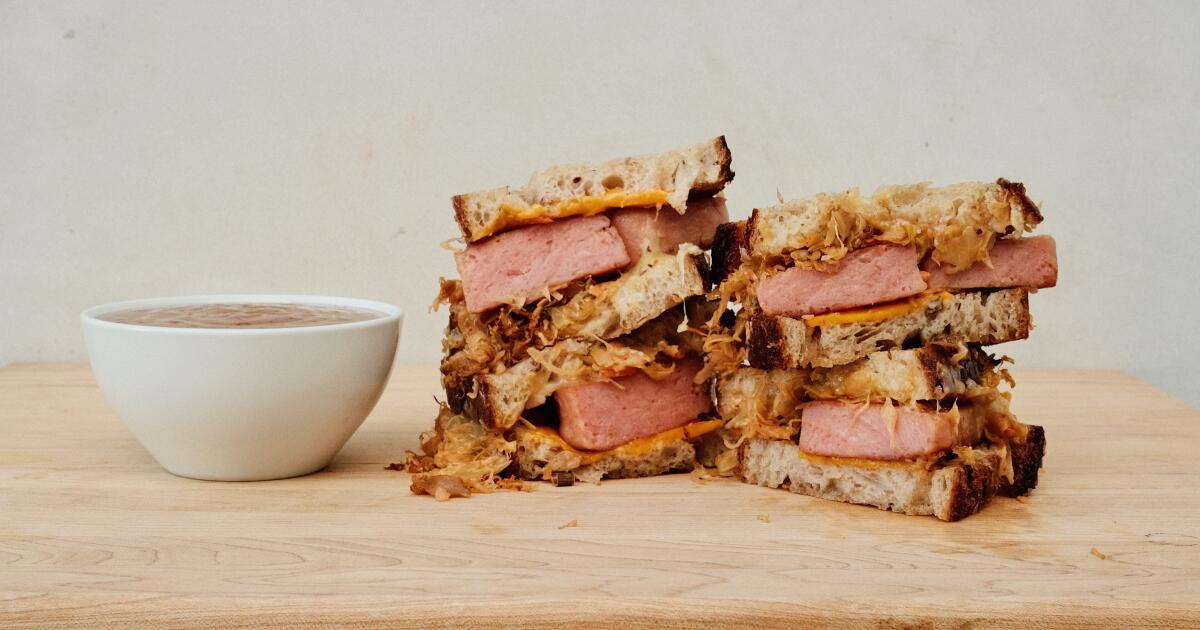
A tangy, porky spin on a classic, Matty Matheson’s grilled cheese is stacked with thick, hearty slices of Spam and a heap of tangy kimchi in a recipe from his cookbook “Soups, Salads, Sandwiches.”
When using a half can of Spam per sandwich by slicing the whole thing into four meaty steaks, the ground-pork product is the centerpiece; for a more equal ratio of ingredients, try halving the amount of Spam by slicing the steaks thinner and still using two steaks (albeit smaller ones) per sandwich. (Wondering what to do with leftover Spam? Try cubing and searing it, then adding it to fried rice.)
Matheson also subverts conventional grilled cheese method by using a skillet’s residual heat to warm the bread as the sandwich is built — but it’s primarily cooked in the oven, not on the stove. It’s an untraditional, kimchi-brightened version of one of the world’s most famous sandwiches, made all the more unique thanks to a gochugaru-flecked garlicky dipping sauce.
“There really is something special about Spam,” Matheson writes. “I think it’s one of the greatest and most versatile ingredients. It could be fried or grilled or smoked or boiled. Any way you cook it is fire, but here it becomes this perfect storm of flavor with fatty Spam, tangy, crunchy kimchi, buttery fried bread, and the cream town USA American cheese. This is just about as good as it gets.”

A tangy, porky spin on a classic, Matty Matheson’s grilled cheese is stacked with thick, hearty slices of Spam and a heap of tangy kimchi in a recipe from his cookbook “Soups, Salads, Sandwiches.”
When using a half can of Spam per sandwich by slicing the whole thing into four meaty steaks, the ground-pork product is the centerpiece; for a more equal ratio of ingredients, try halving the amount of Spam by slicing the steaks thinner and still using two steaks (albeit smaller ones) per sandwich. (Wondering what to do with leftover Spam? Try cubing and searing it, then adding it to fried rice.)
Matheson also subverts conventional grilled cheese method by using a skillet’s residual heat to warm the bread as the sandwich is built — but it’s primarily cooked in the oven, not on the stove. It’s an untraditional, kimchi-brightened version of one of the world’s most famous sandwiches, made all the more unique thanks to a gochugaru-flecked garlicky dipping sauce.
“There really is something special about Spam,” Matheson writes. “I think it’s one of the greatest and most versatile ingredients. It could be fried or grilled or smoked or boiled. Any way you cook it is fire, but here it becomes this perfect storm of flavor with fatty Spam, tangy, crunchy kimchi, buttery fried bread, and the cream town USA American cheese. This is just about as good as it gets.”

A tangy, porky spin on a classic, Matty Matheson’s grilled cheese is stacked with thick, hearty slices of Spam and a heap of tangy kimchi in a recipe from his cookbook “Soups, Salads, Sandwiches.”
When using a half can of Spam per sandwich by slicing the whole thing into four meaty steaks, the ground-pork product is the centerpiece; for a more equal ratio of ingredients, try halving the amount of Spam by slicing the steaks thinner and still using two steaks (albeit smaller ones) per sandwich. (Wondering what to do with leftover Spam? Try cubing and searing it, then adding it to fried rice.)
Matheson also subverts conventional grilled cheese method by using a skillet’s residual heat to warm the bread as the sandwich is built — but it’s primarily cooked in the oven, not on the stove. It’s an untraditional, kimchi-brightened version of one of the world’s most famous sandwiches, made all the more unique thanks to a gochugaru-flecked garlicky dipping sauce.
“There really is something special about Spam,” Matheson writes. “I think it’s one of the greatest and most versatile ingredients. It could be fried or grilled or smoked or boiled. Any way you cook it is fire, but here it becomes this perfect storm of flavor with fatty Spam, tangy, crunchy kimchi, buttery fried bread, and the cream town USA American cheese. This is just about as good as it gets.”
A tangy, porky spin on a classic, Matty Matheson’s grilled cheese is stacked with thick, hearty slices of Spam and a heap of tangy kimchi in a recipe from his cookbook “Soups, Salads, Sandwiches.”
When using a half can of Spam per sandwich by slicing the whole thing into four meaty steaks, the ground-pork product is the centerpiece; for a more equal ratio of ingredients, try halving the amount of Spam by slicing the steaks thinner and still using two steaks (albeit smaller ones) per sandwich. (Wondering what to do with leftover Spam? Try cubing and searing it, then adding it to fried rice.)
Matheson also subverts conventional grilled cheese method by using a skillet’s residual heat to warm the bread as the sandwich is built — but it’s primarily cooked in the oven, not on the stove. It’s an untraditional, kimchi-brightened version of one of the world’s most famous sandwiches, made all the more unique thanks to a gochugaru-flecked garlicky dipping sauce.
“There really is something special about Spam,” Matheson writes. “I think it’s one of the greatest and most versatile ingredients. It could be fried or grilled or smoked or boiled. Any way you cook it is fire, but here it becomes this perfect storm of flavor with fatty Spam, tangy, crunchy kimchi, buttery fried bread, and the cream town USA American cheese. This is just about as good as it gets.”

A tangy, porky spin on a classic, Matty Matheson’s grilled cheese is stacked with thick, hearty slices of Spam and a heap of tangy kimchi in a recipe from his cookbook “Soups, Salads, Sandwiches.”
When using a half can of Spam per sandwich by slicing the whole thing into four meaty steaks, the ground-pork product is the centerpiece; for a more equal ratio of ingredients, try halving the amount of Spam by slicing the steaks thinner and still using two steaks (albeit smaller ones) per sandwich. (Wondering what to do with leftover Spam? Try cubing and searing it, then adding it to fried rice.)
Matheson also subverts conventional grilled cheese method by using a skillet’s residual heat to warm the bread as the sandwich is built — but it’s primarily cooked in the oven, not on the stove. It’s an untraditional, kimchi-brightened version of one of the world’s most famous sandwiches, made all the more unique thanks to a gochugaru-flecked garlicky dipping sauce.
“There really is something special about Spam,” Matheson writes. “I think it’s one of the greatest and most versatile ingredients. It could be fried or grilled or smoked or boiled. Any way you cook it is fire, but here it becomes this perfect storm of flavor with fatty Spam, tangy, crunchy kimchi, buttery fried bread, and the cream town USA American cheese. This is just about as good as it gets.”
A tangy, porky spin on a classic, Matty Matheson’s grilled cheese is stacked with thick, hearty slices of Spam and a heap of tangy kimchi in a recipe from his cookbook “Soups, Salads, Sandwiches.”
When using a half can of Spam per sandwich by slicing the whole thing into four meaty steaks, the ground-pork product is the centerpiece; for a more equal ratio of ingredients, try halving the amount of Spam by slicing the steaks thinner and still using two steaks (albeit smaller ones) per sandwich. (Wondering what to do with leftover Spam? Try cubing and searing it, then adding it to fried rice.)
Matheson also subverts conventional grilled cheese method by using a skillet’s residual heat to warm the bread as the sandwich is built — but it’s primarily cooked in the oven, not on the stove. It’s an untraditional, kimchi-brightened version of one of the world’s most famous sandwiches, made all the more unique thanks to a gochugaru-flecked garlicky dipping sauce.
“There really is something special about Spam,” Matheson writes. “I think it’s one of the greatest and most versatile ingredients. It could be fried or grilled or smoked or boiled. Any way you cook it is fire, but here it becomes this perfect storm of flavor with fatty Spam, tangy, crunchy kimchi, buttery fried bread, and the cream town USA American cheese. This is just about as good as it gets.”
A tangy, porky spin on a classic, Matty Matheson’s grilled cheese is stacked with thick, hearty slices of Spam and a heap of tangy kimchi in a recipe from his cookbook “Soups, Salads, Sandwiches.”
When using a half can of Spam per sandwich by slicing the whole thing into four meaty steaks, the ground-pork product is the centerpiece; for a more equal ratio of ingredients, try halving the amount of Spam by slicing the steaks thinner and still using two steaks (albeit smaller ones) per sandwich. (Wondering what to do with leftover Spam? Try cubing and searing it, then adding it to fried rice.)
Matheson also subverts conventional grilled cheese method by using a skillet’s residual heat to warm the bread as the sandwich is built — but it’s primarily cooked in the oven, not on the stove. It’s an untraditional, kimchi-brightened version of one of the world’s most famous sandwiches, made all the more unique thanks to a gochugaru-flecked garlicky dipping sauce.
“There really is something special about Spam,” Matheson writes. “I think it’s one of the greatest and most versatile ingredients. It could be fried or grilled or smoked or boiled. Any way you cook it is fire, but here it becomes this perfect storm of flavor with fatty Spam, tangy, crunchy kimchi, buttery fried bread, and the cream town USA American cheese. This is just about as good as it gets.”
A tangy, porky spin on a classic, Matty Matheson’s grilled cheese is stacked with thick, hearty slices of Spam and a heap of tangy kimchi in a recipe from his cookbook “Soups, Salads, Sandwiches.”
When using a half can of Spam per sandwich by slicing the whole thing into four meaty steaks, the ground-pork product is the centerpiece; for a more equal ratio of ingredients, try halving the amount of Spam by slicing the steaks thinner and still using two steaks (albeit smaller ones) per sandwich. (Wondering what to do with leftover Spam? Try cubing and searing it, then adding it to fried rice.)
Matheson also subverts conventional grilled cheese method by using a skillet’s residual heat to warm the bread as the sandwich is built — but it’s primarily cooked in the oven, not on the stove. It’s an untraditional, kimchi-brightened version of one of the world’s most famous sandwiches, made all the more unique thanks to a gochugaru-flecked garlicky dipping sauce.
“There really is something special about Spam,” Matheson writes. “I think it’s one of the greatest and most versatile ingredients. It could be fried or grilled or smoked or boiled. Any way you cook it is fire, but here it becomes this perfect storm of flavor with fatty Spam, tangy, crunchy kimchi, buttery fried bread, and the cream town USA American cheese. This is just about as good as it gets.”