

On the Shelf
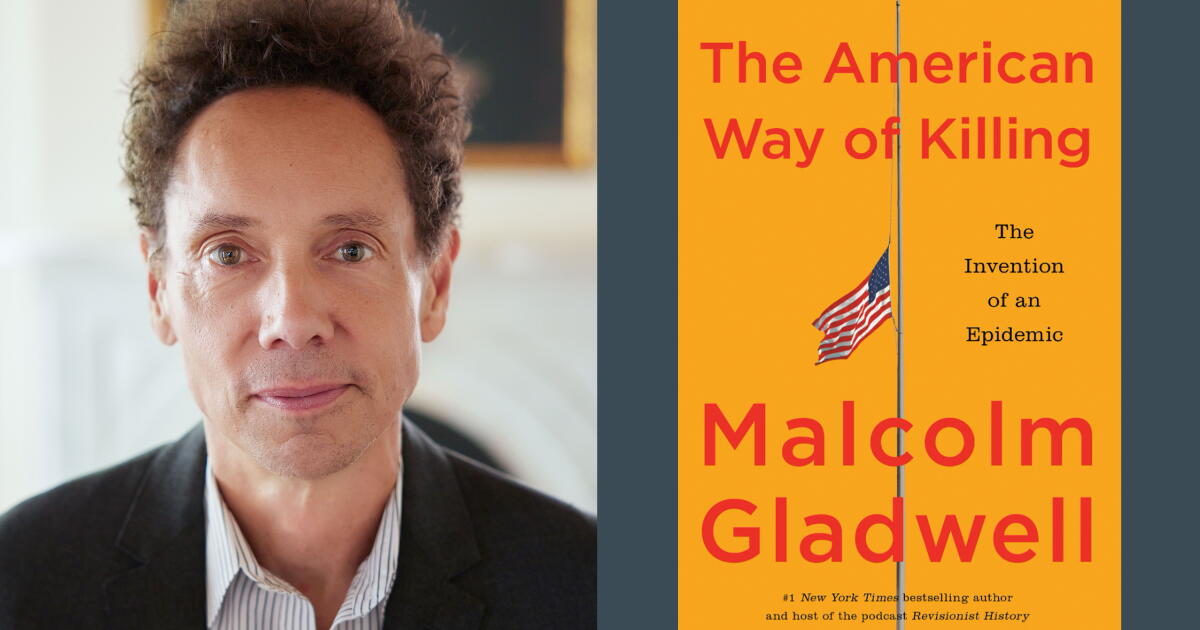
The American Way of Killing: The Invention of an Epidemic
By Malcolm Gladwell
Little Brown & Co.: 304 pages, $34
If you buy books linked on our site, The Times may earn a commission from Bookshop.org, whose fees support independent bookstores.
The federal government’s understanding (or misunderstanding, according to bestselling author Malcolm Gladwell) of the 2nd Amendment all begins with the tale of a rabble-rousing 17th century English nobleman. In 1686, at least one now contested-account recounts the story of Sir John Knight, a devout anti-Catholic, busting into the church of St. Michael in Bristol, England, during services with a gun. His aim? To terrify the King’s subjects. In 2022, more than three centuries later, United States Supreme Court justices used Knight’s acquittal by a jury to take it that the Founding Fathers, who were influenced by English law when drafting the Constitution, were not opposed to the carrying of guns in public for self-defense. This type of logic, which determines the law of the land by interpreting obscure bits of history over utilizing common sense, is what Gladwell calls “bananas.”
In his recently released ninth book, “The American Way of Killing,” Gladwell does what he does well. He digs into a topic, in this case gun violence in America, illuminating unexpected causes and prodding at assumptions that perpetuate what he refers to as a gun violence “epidemic.” The premise is that this epidemic can, in large part, be tied to what he calls a “dishonest conversation.”
“You’re not dealing with the problem as it is,” he says matter of factly, sitting under an olive tree at a cafe in East Hollywood on an unusually scorching fall day. Today, he’s the California version of himself, having traded in his perfectly-pressed New Yorker button down and blazer for a gray T-shirt that, ironically, reads “AMATEUR” in yellow across the front, navy shorts and sneakers with rainbow socks.
He showcases what he means by “dishonest” with one of the first, and prime, examples in the book. The majority of middle-class Americans, he says, believe the most consequential threat to their safety is mass shootings when the data shows it’s actually everyday violence on the streets and in homes. Another misunderstanding at the heart of conversations on gun reform is the belief that assault rifles cause a disproportionate number of homicides, when more deaths are attributable to handguns. What’s most absurd, Gladwell argues, is that assault weapons bans regulate how these guns look more than what they can do. The 1994 federal ban targeted rifles with features like pistol grips, folding stocks and flash suppressors — and manufacturers responded by selling nearly identical rifles without them. When Gladwell investigates whether those features actually make a gun more lethal, the case largely falls apart.
“I have to say, that’s the strangest of all the topics I tackle in the book, because all you have to do is read these assault rifle bans,” he says. “They’re not that long, they’re like four pages. You just have to read them and you’re like ‘Oh, I guess it doesn’t ban assault rifles after all.’”
Presidents of both parties have backed the ban — Reagan, Ford and Carter lobbied Congress to pass it in 1994, and Obama and Biden repeatedly pushed to revive it after it expired, casting it as common sense policy. In general, Gladwell says it’s not uncommon for elected officials to advocate for legislation that they haven’t read or may not fully understand, but that this is an “extreme example” of that and that they also may be pushing the ban as a way of placating members of the public who want to see movement on this issue.
The book, which builds on reporting Gladwell did for the eighth season of his podcast “Revisionist History” titled “Guns,” walks the reader through a variety of studies and anecdotes that, cumulatively, illustrate a problem and potential solutions on every level of society. It examines how kids are taught to regulate their emotions in schools to where hospitals that can treat gun wounds are located, how police departments are staffed, and how people, generally, incorrectly believe that most gun violence is premeditated when, in reality, it’s reactionary and unplanned.
For starters, in order to decrease gun violence in America, Natalie Hipple, professor and chair in the department of criminology and criminal justice at Indiana University Bloomington, says there needs to be shared definitions of the language that’s being used to collect data. Hipple, a source for the book who is also featured on Gladwell’s podcast, worked with colleagues to establish data on what she calls “bullet to skin” incidents to try and figure out how many non-fatal shootings happen in Indianapolis. Among the many “absurdities,” as Gladwell calls them, which he uncovered in his reporting, is that the media and politicians focus on the number of homicides, but whether someone dies or not from a shot isn’t the complete picture of how prevalent gun violence is. There’s a number of other variables outside of getting shot in the first place that contribute to whether someone dies or not: where the bullet hits them, what kind of weapon they’re shot with and at what distance, how long it takes for them to receive medical care, and on and on.
Dr. Babak Sarani, professor of surgery and emergency medicine and chief of trauma surgery at the George Washington University School of Medicine, experienced criticism from colleagues when he and other researchers published a paper finding that the number of people who die from a gunshot wound directly correlates with how close they are to a trauma center. Sarani, another interviewee on Gladwell’s podcast and a source in the book, says, in response, he and the researchers put together a team of well-regarded experts across fields to conduct a more robust study and validated their initial findings. “We got a lot of pushback,” he says, referring to the reactions following that first paper. “A lot of people said, ‘Man you couldn’t be more wrong. Who do you guys think you are, determining who could’ve lived and died?’”
Hipple says she’s gotten positive feedback from colleagues since that first episode aired on “Revisionist History” and that Gladwell did a fantastic job covering a complex issue, but also flagged some unaddressed, and in her mind, key considerations. Gladwell, for example, makes the case that — despite the growing movement in recent years to defund the police and reduce the size of police forces — the data from other countries clearly show that more police reduces violence by police, because they’re less overwhelmed and more resourced. That’s true, says Hipple, but “where are you going to find these people? It’s great to say we need more police. Nobody wants to work these jobs because it burns you out and it comes with trauma.” Other fundamental challenges, she says, are training police against bias — hiring the “right police,” not just more people — and building relationships with the community so that violence can hopefully be deescalated or stopped before it begins. After more than 20 years of working as a criminologist, Hipple says she admits to feeling “a little bit of despair” at the lack of meaningful reform.
“She’s not wrong, I’m not saying it’s going to be easy, but maybe one of the ways you do that is you redefine what the profession is, right? If people have in their mind the notion of being a police officer is essentially being a paramilitary intruder in communities, they don’t want to be a police officer. But what if I redefined the profession to the point where people like you said, ‘Actually, I can do that job. I’d love to do that job,’” responds Gladwell. He says it did occur to him that the case he lays out for increasing the size of police forces to decrease violence by police might be the most controversial part of the book, but that he never can predict how people will respond to his work.
In general, Gladwell says “The American Way of Killing” is not intended to be a definitive account of gun violence in America and that he’s not trying to put forth a solution to the epidemic either. He might, in the future, try to write another book that centers solutions. But he would never suggest he could solve the problem of homicides in America, more broadly, and he believes attempting to do so would be “audacious.” Instead, he’s trying to shed light on what he refers to as “parts of the elephant rather than the whole elephant.”
Gladwell finds those parts through hours and hours of interviews, which he does in a concentrated block as he allows the story to evolve in his mind. “A lot of times, you sense what the story is and it’s just not accurate,” he says. The moment that he’s surprised by something is the moment he knows he’s going to pursue it, he tells me, suddenly sitting up in his chair, his eyes widening with delight as though he’s recalling that moment of discovery. “That’s what we’re chasing, right?,” he says. “You want to surprise people. That’s what the essence of a story is. There has to be something that engages you and challenges you.”
Ben Naddaff-Hafrey, a senior producer at Pushkin Industries, the audio company Gladwell co-founded, says when it comes to gun violence in America, he knows that Gladwell is genuinely moved by this issue and feels it’s very urgent. When producing episodes of the podcast, Naddaff-Hafrey says Gladwell and the rest of the team read everything aloud — in person, if they can — at a beautiful old house in Hudson, N.Y., they refer to as “Pushkin North.” Gladwell wanted to do something similar for the book and read each chapter to them as a producer played back affiliated interview segments. “It’s clear that it’s emotional for him and it’s something he’s really concerned about,” Naddaff-Hafrey says, noting that Gladwell would sometimes tear up when the producer would play back the audio.
Gun violence isn’t just about gun violence, Gladwell says, as he explains why it’s a story that captivates his interest after three decades of reporting on crime and policing. “It encompasses so many aspects of the human experience. Every time someone dies, somebody grieves, a mother, a partner is bereft. It involves violence which is a source of great horror and fascination. To be violent is to step outside of our normal self, right?”
Beyond that, Gladwell says he feels strongly that “a society that’s blinded itself to this issue is a society with something very wrong.” “The American Way of Killing” sets out to address what he sees as the first, fundamental problem: The fact that Americans don’t understand the problem at all. But, he also says, he’s learned that once he releases something, it’s no longer his but the world’s. Rather than pinning grand hopes and dreams to his books, he simply aims to help everyday people make sense of something they otherwise may not have time to.
“If I walk down the street, sometimes people will stop me and tell me how much they like something I wrote,” he says. “That’s the most important kind of feedback, informal feedback. It has made me believe that I have, in some small way, been useful to people.”
Our conversation on the crowded patio of Go Get Em’ Tiger comes to a close, and as we stand up and walk toward Hollywood Boulevard, a woman who appears to be in her 30s and had been working on her laptop throughout the interview yells after us, “I’m a fan! I’m a fan of your work.” He looks up at her, smiles gently and nods in acknowledgment. He may not single-handedly solve homicides in America, but today it seems he’s accomplished his more modest goal of touching at least one Angeleno with his words.
Hartman is a California-based journalist and the publisher of DoubleBlind, a media company at the forefront of the psychedelic movement.


