


“Late Night With the Devil,” a sly, aw-shucksy chiller from sibling filmmakers Cameron Cairnes and Colin Cairnes, is a clever reminder that the entertainment business was built on hocus-pocus. The entire industry is an illusion: actors, dialogue, costumes, sets, editing, even the magic of performers appearing on small screens with a snap, like genies summoned to amuse. Some creative giants were literally magicians. Georges Méliès, the inventor of special effects, honed his craft at the Théâtre Robert-Houdin; later, in the more cynical 1970s — this film‘s setting — Johnny Carson used his roots as the Great Carsoni to boost ratings when he collaborated with professional skeptic James Randi to sabotage the mentalist Uri Geller’s spoon-bending shenanigans on live TV.
Meanwhile in Australia, where the Cairnes brothers were raised, their country’s well-known host Don Lane also brought Randi on as a guest. But when Randi debunked the show’s regular psychic, Lane legendarily ordered Randi to bleep off. With a presto, the Cairnes have transformed Lane’s unctuous, guileless energy into “Late Night’s” Jack Delroy (David Dastmalchian), an eager-to-please showboat with a fatuous swoop of hair. For years, Jack has tried (and failed) to flog his New York-based talk show, “Night Owls With Jack Delroy,” to the top, even trotting out his terminally ill wife, Madeleine (Georgina Haig), for a very special episode. He peddled his own grief and still got beat by Carson.
So on Halloween 1977 — here also a holiday known as Sweeps Week — Jack and his increasingly anxious bandleader, Gus (Rhys Auteri), welcome a mystic (Fayssal Bazzi), a parapsychologist (Laura Gordon), a possibly possessed teenage girl (Ingrid Torelli) and an overbearing naysayer (Ian Bliss) to the show. The movie is presented as found footage of that broadcast from monologue (Billy Carter jokes!) to disaster. During commercial breaks, a handheld camera wanders backstage to see the director (Christopher Kirby) bellow, “Where’s my sacrificial dagger? We’re on in 60 seconds!” As you might guess, all hell breaks loose.
At first, we enjoy the innocence of these retro shivers. Rubber bats dangle on wires. Gus waves a red plastic pitchfork. Jack creeps around as a bedsheet ghost. But even uncostumed, Jack always wears a mask. In just a few rehearsed gestures — a finger point, a pantomimed bat swing — Dastmalchian clues us in that he’s playing a shell hollowed out by ambition. Jack is pleasant, perhaps even genuinely kind. Yet if you peeled away his blank smile, you’d just find more blankness.
The evening truly goes on the fritz when Lilly, Torelli’s young Satanist, enters in a pinafore doing an unnervingly wonderful impersonation of an ordinary schoolgirl. Torelli is a great physical comic; even in wrist restraints, she preens. You know she’s supposed to be scary, but it’s easier to target Bliss’ blowhard unbeliever, who, by design, is so obnoxious that we pray Beelzebub will drag him into the green room.
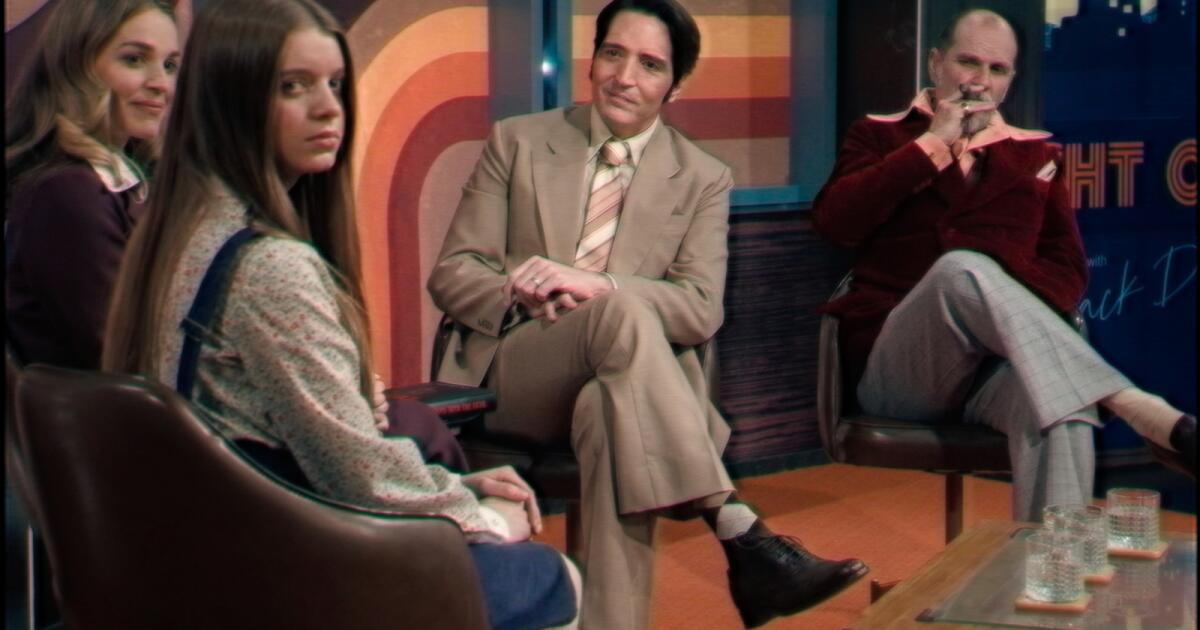
This is a pressure-cooker film, an exercise in small-budget simplicity that leans on one set and one goal: Keep ’em watching. Whatever plot there isn’t time to resolve just wafts away. The restraint encompasses even the muted rainbow stripes on the wall behind Jack’s sofa, since scientists spent the 1970s inventing new shades of brown. Between Otello Stolfo’s pinpoint production design and costume designer Steph Hooke’s wide lapels, the kitsch doesn’t tip over into cartoon. As an ominous note, the logo for “Night Owls” is a bird looming over the Twin Towers.
The movie is a lark, not a hard-hitting statement about how mass media corrupts the soul. That’s in here too, of course, but it sounds tinny. Generations have passed since preachers called television the devil’s box, and now we all know that in the ’80s, some of those moralists will make millions putting their own act on the air. When “Network’s” Howard Beale told people to turn off their TV sets, we felt complicit. When Jack Delroy does it, we’re just admiring how cinematographer Matthew Temple captures his breakdown in a marvelous tracking shot. “I don’t think that television cameras lie,” Lilly insists. Sure, but the people behind the camera do — and what terrifies us now is how little the audience resists being taken for a ride.
‘Late Night With the Devil’
Rated: R, for violent content, some gore, and language including a sexual reference
Running time: 1 hour, 27 minutes
Playing: Starts Friday (with Thursday previews) in general release

“Late Night With the Devil,” a sly, aw-shucksy chiller from sibling filmmakers Cameron Cairnes and Colin Cairnes, is a clever reminder that the entertainment business was built on hocus-pocus. The entire industry is an illusion: actors, dialogue, costumes, sets, editing, even the magic of performers appearing on small screens with a snap, like genies summoned to amuse. Some creative giants were literally magicians. Georges Méliès, the inventor of special effects, honed his craft at the Théâtre Robert-Houdin; later, in the more cynical 1970s — this film‘s setting — Johnny Carson used his roots as the Great Carsoni to boost ratings when he collaborated with professional skeptic James Randi to sabotage the mentalist Uri Geller’s spoon-bending shenanigans on live TV.
Meanwhile in Australia, where the Cairnes brothers were raised, their country’s well-known host Don Lane also brought Randi on as a guest. But when Randi debunked the show’s regular psychic, Lane legendarily ordered Randi to bleep off. With a presto, the Cairnes have transformed Lane’s unctuous, guileless energy into “Late Night’s” Jack Delroy (David Dastmalchian), an eager-to-please showboat with a fatuous swoop of hair. For years, Jack has tried (and failed) to flog his New York-based talk show, “Night Owls With Jack Delroy,” to the top, even trotting out his terminally ill wife, Madeleine (Georgina Haig), for a very special episode. He peddled his own grief and still got beat by Carson.
So on Halloween 1977 — here also a holiday known as Sweeps Week — Jack and his increasingly anxious bandleader, Gus (Rhys Auteri), welcome a mystic (Fayssal Bazzi), a parapsychologist (Laura Gordon), a possibly possessed teenage girl (Ingrid Torelli) and an overbearing naysayer (Ian Bliss) to the show. The movie is presented as found footage of that broadcast from monologue (Billy Carter jokes!) to disaster. During commercial breaks, a handheld camera wanders backstage to see the director (Christopher Kirby) bellow, “Where’s my sacrificial dagger? We’re on in 60 seconds!” As you might guess, all hell breaks loose.
At first, we enjoy the innocence of these retro shivers. Rubber bats dangle on wires. Gus waves a red plastic pitchfork. Jack creeps around as a bedsheet ghost. But even uncostumed, Jack always wears a mask. In just a few rehearsed gestures — a finger point, a pantomimed bat swing — Dastmalchian clues us in that he’s playing a shell hollowed out by ambition. Jack is pleasant, perhaps even genuinely kind. Yet if you peeled away his blank smile, you’d just find more blankness.
The evening truly goes on the fritz when Lilly, Torelli’s young Satanist, enters in a pinafore doing an unnervingly wonderful impersonation of an ordinary schoolgirl. Torelli is a great physical comic; even in wrist restraints, she preens. You know she’s supposed to be scary, but it’s easier to target Bliss’ blowhard unbeliever, who, by design, is so obnoxious that we pray Beelzebub will drag him into the green room.
This is a pressure-cooker film, an exercise in small-budget simplicity that leans on one set and one goal: Keep ’em watching. Whatever plot there isn’t time to resolve just wafts away. The restraint encompasses even the muted rainbow stripes on the wall behind Jack’s sofa, since scientists spent the 1970s inventing new shades of brown. Between Otello Stolfo’s pinpoint production design and costume designer Steph Hooke’s wide lapels, the kitsch doesn’t tip over into cartoon. As an ominous note, the logo for “Night Owls” is a bird looming over the Twin Towers.
The movie is a lark, not a hard-hitting statement about how mass media corrupts the soul. That’s in here too, of course, but it sounds tinny. Generations have passed since preachers called television the devil’s box, and now we all know that in the ’80s, some of those moralists will make millions putting their own act on the air. When “Network’s” Howard Beale told people to turn off their TV sets, we felt complicit. When Jack Delroy does it, we’re just admiring how cinematographer Matthew Temple captures his breakdown in a marvelous tracking shot. “I don’t think that television cameras lie,” Lilly insists. Sure, but the people behind the camera do — and what terrifies us now is how little the audience resists being taken for a ride.
‘Late Night With the Devil’
Rated: R, for violent content, some gore, and language including a sexual reference
Running time: 1 hour, 27 minutes
Playing: Starts Friday (with Thursday previews) in general release

“Late Night With the Devil,” a sly, aw-shucksy chiller from sibling filmmakers Cameron Cairnes and Colin Cairnes, is a clever reminder that the entertainment business was built on hocus-pocus. The entire industry is an illusion: actors, dialogue, costumes, sets, editing, even the magic of performers appearing on small screens with a snap, like genies summoned to amuse. Some creative giants were literally magicians. Georges Méliès, the inventor of special effects, honed his craft at the Théâtre Robert-Houdin; later, in the more cynical 1970s — this film‘s setting — Johnny Carson used his roots as the Great Carsoni to boost ratings when he collaborated with professional skeptic James Randi to sabotage the mentalist Uri Geller’s spoon-bending shenanigans on live TV.
Meanwhile in Australia, where the Cairnes brothers were raised, their country’s well-known host Don Lane also brought Randi on as a guest. But when Randi debunked the show’s regular psychic, Lane legendarily ordered Randi to bleep off. With a presto, the Cairnes have transformed Lane’s unctuous, guileless energy into “Late Night’s” Jack Delroy (David Dastmalchian), an eager-to-please showboat with a fatuous swoop of hair. For years, Jack has tried (and failed) to flog his New York-based talk show, “Night Owls With Jack Delroy,” to the top, even trotting out his terminally ill wife, Madeleine (Georgina Haig), for a very special episode. He peddled his own grief and still got beat by Carson.
So on Halloween 1977 — here also a holiday known as Sweeps Week — Jack and his increasingly anxious bandleader, Gus (Rhys Auteri), welcome a mystic (Fayssal Bazzi), a parapsychologist (Laura Gordon), a possibly possessed teenage girl (Ingrid Torelli) and an overbearing naysayer (Ian Bliss) to the show. The movie is presented as found footage of that broadcast from monologue (Billy Carter jokes!) to disaster. During commercial breaks, a handheld camera wanders backstage to see the director (Christopher Kirby) bellow, “Where’s my sacrificial dagger? We’re on in 60 seconds!” As you might guess, all hell breaks loose.
At first, we enjoy the innocence of these retro shivers. Rubber bats dangle on wires. Gus waves a red plastic pitchfork. Jack creeps around as a bedsheet ghost. But even uncostumed, Jack always wears a mask. In just a few rehearsed gestures — a finger point, a pantomimed bat swing — Dastmalchian clues us in that he’s playing a shell hollowed out by ambition. Jack is pleasant, perhaps even genuinely kind. Yet if you peeled away his blank smile, you’d just find more blankness.
The evening truly goes on the fritz when Lilly, Torelli’s young Satanist, enters in a pinafore doing an unnervingly wonderful impersonation of an ordinary schoolgirl. Torelli is a great physical comic; even in wrist restraints, she preens. You know she’s supposed to be scary, but it’s easier to target Bliss’ blowhard unbeliever, who, by design, is so obnoxious that we pray Beelzebub will drag him into the green room.
This is a pressure-cooker film, an exercise in small-budget simplicity that leans on one set and one goal: Keep ’em watching. Whatever plot there isn’t time to resolve just wafts away. The restraint encompasses even the muted rainbow stripes on the wall behind Jack’s sofa, since scientists spent the 1970s inventing new shades of brown. Between Otello Stolfo’s pinpoint production design and costume designer Steph Hooke’s wide lapels, the kitsch doesn’t tip over into cartoon. As an ominous note, the logo for “Night Owls” is a bird looming over the Twin Towers.
The movie is a lark, not a hard-hitting statement about how mass media corrupts the soul. That’s in here too, of course, but it sounds tinny. Generations have passed since preachers called television the devil’s box, and now we all know that in the ’80s, some of those moralists will make millions putting their own act on the air. When “Network’s” Howard Beale told people to turn off their TV sets, we felt complicit. When Jack Delroy does it, we’re just admiring how cinematographer Matthew Temple captures his breakdown in a marvelous tracking shot. “I don’t think that television cameras lie,” Lilly insists. Sure, but the people behind the camera do — and what terrifies us now is how little the audience resists being taken for a ride.
‘Late Night With the Devil’
Rated: R, for violent content, some gore, and language including a sexual reference
Running time: 1 hour, 27 minutes
Playing: Starts Friday (with Thursday previews) in general release
“Late Night With the Devil,” a sly, aw-shucksy chiller from sibling filmmakers Cameron Cairnes and Colin Cairnes, is a clever reminder that the entertainment business was built on hocus-pocus. The entire industry is an illusion: actors, dialogue, costumes, sets, editing, even the magic of performers appearing on small screens with a snap, like genies summoned to amuse. Some creative giants were literally magicians. Georges Méliès, the inventor of special effects, honed his craft at the Théâtre Robert-Houdin; later, in the more cynical 1970s — this film‘s setting — Johnny Carson used his roots as the Great Carsoni to boost ratings when he collaborated with professional skeptic James Randi to sabotage the mentalist Uri Geller’s spoon-bending shenanigans on live TV.
Meanwhile in Australia, where the Cairnes brothers were raised, their country’s well-known host Don Lane also brought Randi on as a guest. But when Randi debunked the show’s regular psychic, Lane legendarily ordered Randi to bleep off. With a presto, the Cairnes have transformed Lane’s unctuous, guileless energy into “Late Night’s” Jack Delroy (David Dastmalchian), an eager-to-please showboat with a fatuous swoop of hair. For years, Jack has tried (and failed) to flog his New York-based talk show, “Night Owls With Jack Delroy,” to the top, even trotting out his terminally ill wife, Madeleine (Georgina Haig), for a very special episode. He peddled his own grief and still got beat by Carson.
So on Halloween 1977 — here also a holiday known as Sweeps Week — Jack and his increasingly anxious bandleader, Gus (Rhys Auteri), welcome a mystic (Fayssal Bazzi), a parapsychologist (Laura Gordon), a possibly possessed teenage girl (Ingrid Torelli) and an overbearing naysayer (Ian Bliss) to the show. The movie is presented as found footage of that broadcast from monologue (Billy Carter jokes!) to disaster. During commercial breaks, a handheld camera wanders backstage to see the director (Christopher Kirby) bellow, “Where’s my sacrificial dagger? We’re on in 60 seconds!” As you might guess, all hell breaks loose.
At first, we enjoy the innocence of these retro shivers. Rubber bats dangle on wires. Gus waves a red plastic pitchfork. Jack creeps around as a bedsheet ghost. But even uncostumed, Jack always wears a mask. In just a few rehearsed gestures — a finger point, a pantomimed bat swing — Dastmalchian clues us in that he’s playing a shell hollowed out by ambition. Jack is pleasant, perhaps even genuinely kind. Yet if you peeled away his blank smile, you’d just find more blankness.
The evening truly goes on the fritz when Lilly, Torelli’s young Satanist, enters in a pinafore doing an unnervingly wonderful impersonation of an ordinary schoolgirl. Torelli is a great physical comic; even in wrist restraints, she preens. You know she’s supposed to be scary, but it’s easier to target Bliss’ blowhard unbeliever, who, by design, is so obnoxious that we pray Beelzebub will drag him into the green room.
This is a pressure-cooker film, an exercise in small-budget simplicity that leans on one set and one goal: Keep ’em watching. Whatever plot there isn’t time to resolve just wafts away. The restraint encompasses even the muted rainbow stripes on the wall behind Jack’s sofa, since scientists spent the 1970s inventing new shades of brown. Between Otello Stolfo’s pinpoint production design and costume designer Steph Hooke’s wide lapels, the kitsch doesn’t tip over into cartoon. As an ominous note, the logo for “Night Owls” is a bird looming over the Twin Towers.
The movie is a lark, not a hard-hitting statement about how mass media corrupts the soul. That’s in here too, of course, but it sounds tinny. Generations have passed since preachers called television the devil’s box, and now we all know that in the ’80s, some of those moralists will make millions putting their own act on the air. When “Network’s” Howard Beale told people to turn off their TV sets, we felt complicit. When Jack Delroy does it, we’re just admiring how cinematographer Matthew Temple captures his breakdown in a marvelous tracking shot. “I don’t think that television cameras lie,” Lilly insists. Sure, but the people behind the camera do — and what terrifies us now is how little the audience resists being taken for a ride.
‘Late Night With the Devil’
Rated: R, for violent content, some gore, and language including a sexual reference
Running time: 1 hour, 27 minutes
Playing: Starts Friday (with Thursday previews) in general release


