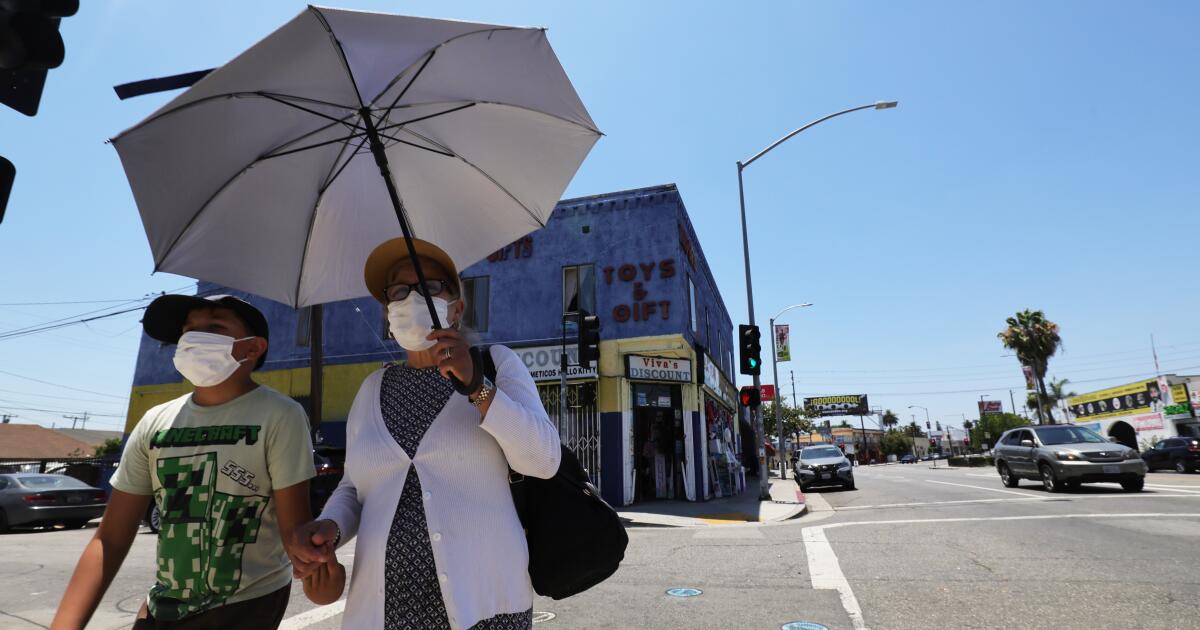

The National Weather Service has issued a heat advisory for this week that includes Los Angeles County and other parts of the southland, especially in valleys and away from the coast.
Temperatures are expected to rise in the Santa Clarita Valley, the East and West San Fernando Valley, as well as parts of the San Gabriel Valley and Northwest LA County Mountains beginning Tuesday and lasting through Thursday, with warm, seasonably elevated fire weather conditions, according to the National Weather Service.
Forecasts indicate the mercury will reach 90 to 105 degrees in the interior; 80 to 90 degrees for the inland coastal plain, including downtown L.A.; with highs in the 80s and lower 90s in the foothills and canyons of southwest Santa Barbara County.
Rose Schoenfeld, meteorologist with the National Weather Service in Oxnard, said temperatures should be 5-to-10 degrees above normal for this time of year thanks to a high-pressure system building up over the region.
While temperatures are expected to cool after Thursday, don’t expect that cooling to last.
“Looking ahead, you might be seeing some outlooks that look pretty favorable, but that heat will linger and redevelop with a pretty impressive heatwave for much of the west, that would be starting next weekend or so,” she said. “It doesn’t seem like we’re out of the woods, even if temperatures start to drop after Thursday.”
The rising mercury coincides a with major marine heat wave across the Pacific Ocean that has the potential to impact weather events around the world, bringing months of warmer oceans, triggering thunderstorms and extreme heat thousands of miles away.
In recent weeks, record heat waves have baked parts of Europe, with temperatures hitting 104 degrees in some countries. France has reported over 1,000 heat-related deaths.
In the U.S., record heat has gripped much of the Midwest and East Coast, with temperatures rising between 110 and 115 degrees in major metropolitan areas, with the National Weather Service issuing an extreme heat warning for much of the Midwest, Mid-Atlantic and Northeast.
The sweltering temperatures have disrupted travel and led to a number of cancellations planned for celebrations over the Fourth of July weekend, including Philadelphia’s Salute to Independence parade. The Great American State Fair, on the National Mall in Washington, was forced to shut down for a few hours.
Amtrak canceled some trains in the Northeast due to excessive heat that could affect the tracks.

The National Weather Service has issued a heat advisory for this week that includes Los Angeles County and other parts of the southland, especially in valleys and away from the coast.
Temperatures are expected to rise in the Santa Clarita Valley, the East and West San Fernando Valley, as well as parts of the San Gabriel Valley and Northwest LA County Mountains beginning Tuesday and lasting through Thursday, with warm, seasonably elevated fire weather conditions, according to the National Weather Service.
Forecasts indicate the mercury will reach 90 to 105 degrees in the interior; 80 to 90 degrees for the inland coastal plain, including downtown L.A.; with highs in the 80s and lower 90s in the foothills and canyons of southwest Santa Barbara County.
Rose Schoenfeld, meteorologist with the National Weather Service in Oxnard, said temperatures should be 5-to-10 degrees above normal for this time of year thanks to a high-pressure system building up over the region.
While temperatures are expected to cool after Thursday, don’t expect that cooling to last.
“Looking ahead, you might be seeing some outlooks that look pretty favorable, but that heat will linger and redevelop with a pretty impressive heatwave for much of the west, that would be starting next weekend or so,” she said. “It doesn’t seem like we’re out of the woods, even if temperatures start to drop after Thursday.”
The rising mercury coincides a with major marine heat wave across the Pacific Ocean that has the potential to impact weather events around the world, bringing months of warmer oceans, triggering thunderstorms and extreme heat thousands of miles away.
In recent weeks, record heat waves have baked parts of Europe, with temperatures hitting 104 degrees in some countries. France has reported over 1,000 heat-related deaths.
In the U.S., record heat has gripped much of the Midwest and East Coast, with temperatures rising between 110 and 115 degrees in major metropolitan areas, with the National Weather Service issuing an extreme heat warning for much of the Midwest, Mid-Atlantic and Northeast.
The sweltering temperatures have disrupted travel and led to a number of cancellations planned for celebrations over the Fourth of July weekend, including Philadelphia’s Salute to Independence parade. The Great American State Fair, on the National Mall in Washington, was forced to shut down for a few hours.
Amtrak canceled some trains in the Northeast due to excessive heat that could affect the tracks.

The National Weather Service has issued a heat advisory for this week that includes Los Angeles County and other parts of the southland, especially in valleys and away from the coast.
Temperatures are expected to rise in the Santa Clarita Valley, the East and West San Fernando Valley, as well as parts of the San Gabriel Valley and Northwest LA County Mountains beginning Tuesday and lasting through Thursday, with warm, seasonably elevated fire weather conditions, according to the National Weather Service.
Forecasts indicate the mercury will reach 90 to 105 degrees in the interior; 80 to 90 degrees for the inland coastal plain, including downtown L.A.; with highs in the 80s and lower 90s in the foothills and canyons of southwest Santa Barbara County.
Rose Schoenfeld, meteorologist with the National Weather Service in Oxnard, said temperatures should be 5-to-10 degrees above normal for this time of year thanks to a high-pressure system building up over the region.
While temperatures are expected to cool after Thursday, don’t expect that cooling to last.
“Looking ahead, you might be seeing some outlooks that look pretty favorable, but that heat will linger and redevelop with a pretty impressive heatwave for much of the west, that would be starting next weekend or so,” she said. “It doesn’t seem like we’re out of the woods, even if temperatures start to drop after Thursday.”
The rising mercury coincides a with major marine heat wave across the Pacific Ocean that has the potential to impact weather events around the world, bringing months of warmer oceans, triggering thunderstorms and extreme heat thousands of miles away.
In recent weeks, record heat waves have baked parts of Europe, with temperatures hitting 104 degrees in some countries. France has reported over 1,000 heat-related deaths.
In the U.S., record heat has gripped much of the Midwest and East Coast, with temperatures rising between 110 and 115 degrees in major metropolitan areas, with the National Weather Service issuing an extreme heat warning for much of the Midwest, Mid-Atlantic and Northeast.
The sweltering temperatures have disrupted travel and led to a number of cancellations planned for celebrations over the Fourth of July weekend, including Philadelphia’s Salute to Independence parade. The Great American State Fair, on the National Mall in Washington, was forced to shut down for a few hours.
Amtrak canceled some trains in the Northeast due to excessive heat that could affect the tracks.
The National Weather Service has issued a heat advisory for this week that includes Los Angeles County and other parts of the southland, especially in valleys and away from the coast.
Temperatures are expected to rise in the Santa Clarita Valley, the East and West San Fernando Valley, as well as parts of the San Gabriel Valley and Northwest LA County Mountains beginning Tuesday and lasting through Thursday, with warm, seasonably elevated fire weather conditions, according to the National Weather Service.
Forecasts indicate the mercury will reach 90 to 105 degrees in the interior; 80 to 90 degrees for the inland coastal plain, including downtown L.A.; with highs in the 80s and lower 90s in the foothills and canyons of southwest Santa Barbara County.
Rose Schoenfeld, meteorologist with the National Weather Service in Oxnard, said temperatures should be 5-to-10 degrees above normal for this time of year thanks to a high-pressure system building up over the region.
While temperatures are expected to cool after Thursday, don’t expect that cooling to last.
“Looking ahead, you might be seeing some outlooks that look pretty favorable, but that heat will linger and redevelop with a pretty impressive heatwave for much of the west, that would be starting next weekend or so,” she said. “It doesn’t seem like we’re out of the woods, even if temperatures start to drop after Thursday.”
The rising mercury coincides a with major marine heat wave across the Pacific Ocean that has the potential to impact weather events around the world, bringing months of warmer oceans, triggering thunderstorms and extreme heat thousands of miles away.
In recent weeks, record heat waves have baked parts of Europe, with temperatures hitting 104 degrees in some countries. France has reported over 1,000 heat-related deaths.
In the U.S., record heat has gripped much of the Midwest and East Coast, with temperatures rising between 110 and 115 degrees in major metropolitan areas, with the National Weather Service issuing an extreme heat warning for much of the Midwest, Mid-Atlantic and Northeast.
The sweltering temperatures have disrupted travel and led to a number of cancellations planned for celebrations over the Fourth of July weekend, including Philadelphia’s Salute to Independence parade. The Great American State Fair, on the National Mall in Washington, was forced to shut down for a few hours.
Amtrak canceled some trains in the Northeast due to excessive heat that could affect the tracks.