
This story is part of Image Issue 15, “Diaspora,” a fantastic voyage through the mecca of food, from Hollywood haunts to mall food courts to L.A. staples. Read the whole issue here.
We’re gonna travel back in time to when I was 12. I went to school in Compton — I’m an L.A. girl through and through and currently live in South L.A. I was in middle school, and all my friends and I ate was Hot Cheetos, and all we drank was Gatorade. That’s just how it was. Those super huge bags at the grocery store? I ate two of those a day. Let’s just say that it started affecting my health, and I ended up waking up shivering in the middle of the night — my mom had to take me to the ER. I was throwing up a bunch of bile. They did a lot of ultrasounds and CT scans, and they couldn’t really see what was going on, so they sent me home. Same thing happened the following day. I got admitted and they had to do an emergency appendicitis, and they ended up finding ovarian cysts too. They told me all of this happened because of my diet. The terrible thing that I did, because I was young, was ask my doctors if I could still eat Hot Cheetos because I was so addicted to them.
It wasn’t until Urrea started going to CalArts for her MFA, driving back and forth from South L.A. to Santa Clarita, that she started seeing which foods were accessible for people in different areas.
(Jazmín Urrea/For The Times)
It wasn’t until I started going to CalArts for my MFA, driving back and forth from South L.A. to Santa Clarita, that I started seeing what was accessible for people in different areas — like grocery stores and how much easier it is for some areas to have access to fresh, healthier foods. I noticed that a lot of the stores around me were little shops and little convenience stores, and healthier food options weren’t so accessible. So I started to dive into this topic of food insecurity and food deserts. This is where this project has led me now. What would Jazmín’s food desert look like? How can I start working with these ideas by literally incorporating candy and talking about the dyes found in these foods that are bad for you?

When Urrea was a kid, she ate two bags of Hot Cheetos a day, until it severely started impacting her health.
(Jazmín Urrea/For The Times)

The paleta sculptures are starting to disintegrate; they’re starting to get slimy and melty.
(Jazmín Urrea/For The Times)
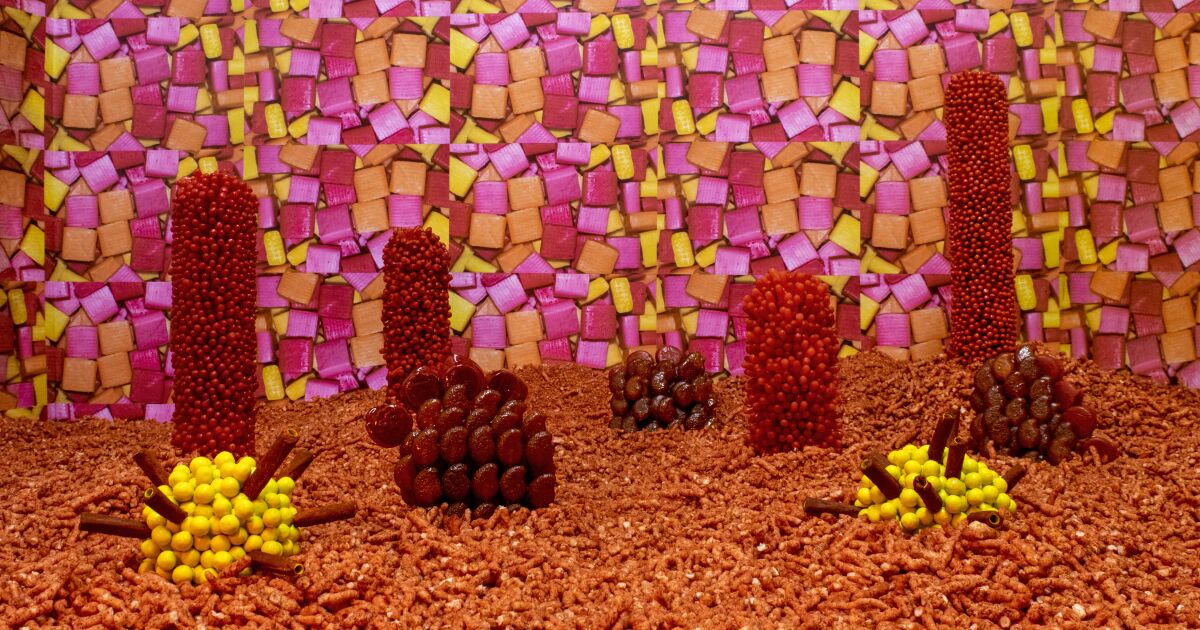
In some of the sculptures, you’ll see mango paletas, and then I have some different chile candies. These are the candies that I’m most attracted to and the ones that I used to really eat, as well as the ones you can find in my neighborhood.
Some of those paleta sculptures are starting to disintegrate; they’re starting to get slimy and melty. My goal would be to install this work in a space where I can see the work deteriorate. Or would the work remain the same? The juxtaposition with the Cheetos is interesting — because the Cheetos are not melting. They’re still intact. And I’ve had those chips since 2017. So you might call them archival Hot Cheetos, because they’re very, very old and they’re still looking great.

Jazmín Urrea is a visual artist working in installation, photography, video, sculpture and performance. She received her MFA in photography and media from CalArts (2017) and a BFA in photography from Cal State Long Beach (2014). Urrea’s works have been exhibited at the Studio Museum in Harlem, the Getty Center, University Art Museum in Long Beach, the Music Center, Flatline and SADE in Los Angeles. She participated in the Current:LA Food triennial (2019) funded by the Department of Cultural Affairs and recently received the Rema Hort Mann Foundation Emerging Artist Grant (2020). She currently lives and works in South Los Angeles.
More stories from Image

This story is part of Image Issue 15, “Diaspora,” a fantastic voyage through the mecca of food, from Hollywood haunts to mall food courts to L.A. staples. Read the whole issue here.
We’re gonna travel back in time to when I was 12. I went to school in Compton — I’m an L.A. girl through and through and currently live in South L.A. I was in middle school, and all my friends and I ate was Hot Cheetos, and all we drank was Gatorade. That’s just how it was. Those super huge bags at the grocery store? I ate two of those a day. Let’s just say that it started affecting my health, and I ended up waking up shivering in the middle of the night — my mom had to take me to the ER. I was throwing up a bunch of bile. They did a lot of ultrasounds and CT scans, and they couldn’t really see what was going on, so they sent me home. Same thing happened the following day. I got admitted and they had to do an emergency appendicitis, and they ended up finding ovarian cysts too. They told me all of this happened because of my diet. The terrible thing that I did, because I was young, was ask my doctors if I could still eat Hot Cheetos because I was so addicted to them.
It wasn’t until Urrea started going to CalArts for her MFA, driving back and forth from South L.A. to Santa Clarita, that she started seeing which foods were accessible for people in different areas.
(Jazmín Urrea/For The Times)
It wasn’t until I started going to CalArts for my MFA, driving back and forth from South L.A. to Santa Clarita, that I started seeing what was accessible for people in different areas — like grocery stores and how much easier it is for some areas to have access to fresh, healthier foods. I noticed that a lot of the stores around me were little shops and little convenience stores, and healthier food options weren’t so accessible. So I started to dive into this topic of food insecurity and food deserts. This is where this project has led me now. What would Jazmín’s food desert look like? How can I start working with these ideas by literally incorporating candy and talking about the dyes found in these foods that are bad for you?
When Urrea was a kid, she ate two bags of Hot Cheetos a day, until it severely started impacting her health.
(Jazmín Urrea/For The Times)
The paleta sculptures are starting to disintegrate; they’re starting to get slimy and melty.
(Jazmín Urrea/For The Times)
In some of the sculptures, you’ll see mango paletas, and then I have some different chile candies. These are the candies that I’m most attracted to and the ones that I used to really eat, as well as the ones you can find in my neighborhood.
Some of those paleta sculptures are starting to disintegrate; they’re starting to get slimy and melty. My goal would be to install this work in a space where I can see the work deteriorate. Or would the work remain the same? The juxtaposition with the Cheetos is interesting — because the Cheetos are not melting. They’re still intact. And I’ve had those chips since 2017. So you might call them archival Hot Cheetos, because they’re very, very old and they’re still looking great.
Jazmín Urrea is a visual artist working in installation, photography, video, sculpture and performance. She received her MFA in photography and media from CalArts (2017) and a BFA in photography from Cal State Long Beach (2014). Urrea’s works have been exhibited at the Studio Museum in Harlem, the Getty Center, University Art Museum in Long Beach, the Music Center, Flatline and SADE in Los Angeles. She participated in the Current:LA Food triennial (2019) funded by the Department of Cultural Affairs and recently received the Rema Hort Mann Foundation Emerging Artist Grant (2020). She currently lives and works in South Los Angeles.
More stories from Image

This story is part of Image Issue 15, “Diaspora,” a fantastic voyage through the mecca of food, from Hollywood haunts to mall food courts to L.A. staples. Read the whole issue here.
We’re gonna travel back in time to when I was 12. I went to school in Compton — I’m an L.A. girl through and through and currently live in South L.A. I was in middle school, and all my friends and I ate was Hot Cheetos, and all we drank was Gatorade. That’s just how it was. Those super huge bags at the grocery store? I ate two of those a day. Let’s just say that it started affecting my health, and I ended up waking up shivering in the middle of the night — my mom had to take me to the ER. I was throwing up a bunch of bile. They did a lot of ultrasounds and CT scans, and they couldn’t really see what was going on, so they sent me home. Same thing happened the following day. I got admitted and they had to do an emergency appendicitis, and they ended up finding ovarian cysts too. They told me all of this happened because of my diet. The terrible thing that I did, because I was young, was ask my doctors if I could still eat Hot Cheetos because I was so addicted to them.
It wasn’t until Urrea started going to CalArts for her MFA, driving back and forth from South L.A. to Santa Clarita, that she started seeing which foods were accessible for people in different areas.
(Jazmín Urrea/For The Times)
It wasn’t until I started going to CalArts for my MFA, driving back and forth from South L.A. to Santa Clarita, that I started seeing what was accessible for people in different areas — like grocery stores and how much easier it is for some areas to have access to fresh, healthier foods. I noticed that a lot of the stores around me were little shops and little convenience stores, and healthier food options weren’t so accessible. So I started to dive into this topic of food insecurity and food deserts. This is where this project has led me now. What would Jazmín’s food desert look like? How can I start working with these ideas by literally incorporating candy and talking about the dyes found in these foods that are bad for you?
When Urrea was a kid, she ate two bags of Hot Cheetos a day, until it severely started impacting her health.
(Jazmín Urrea/For The Times)
The paleta sculptures are starting to disintegrate; they’re starting to get slimy and melty.
(Jazmín Urrea/For The Times)
In some of the sculptures, you’ll see mango paletas, and then I have some different chile candies. These are the candies that I’m most attracted to and the ones that I used to really eat, as well as the ones you can find in my neighborhood.
Some of those paleta sculptures are starting to disintegrate; they’re starting to get slimy and melty. My goal would be to install this work in a space where I can see the work deteriorate. Or would the work remain the same? The juxtaposition with the Cheetos is interesting — because the Cheetos are not melting. They’re still intact. And I’ve had those chips since 2017. So you might call them archival Hot Cheetos, because they’re very, very old and they’re still looking great.
Jazmín Urrea is a visual artist working in installation, photography, video, sculpture and performance. She received her MFA in photography and media from CalArts (2017) and a BFA in photography from Cal State Long Beach (2014). Urrea’s works have been exhibited at the Studio Museum in Harlem, the Getty Center, University Art Museum in Long Beach, the Music Center, Flatline and SADE in Los Angeles. She participated in the Current:LA Food triennial (2019) funded by the Department of Cultural Affairs and recently received the Rema Hort Mann Foundation Emerging Artist Grant (2020). She currently lives and works in South Los Angeles.
More stories from Image
This story is part of Image Issue 15, “Diaspora,” a fantastic voyage through the mecca of food, from Hollywood haunts to mall food courts to L.A. staples. Read the whole issue here.
We’re gonna travel back in time to when I was 12. I went to school in Compton — I’m an L.A. girl through and through and currently live in South L.A. I was in middle school, and all my friends and I ate was Hot Cheetos, and all we drank was Gatorade. That’s just how it was. Those super huge bags at the grocery store? I ate two of those a day. Let’s just say that it started affecting my health, and I ended up waking up shivering in the middle of the night — my mom had to take me to the ER. I was throwing up a bunch of bile. They did a lot of ultrasounds and CT scans, and they couldn’t really see what was going on, so they sent me home. Same thing happened the following day. I got admitted and they had to do an emergency appendicitis, and they ended up finding ovarian cysts too. They told me all of this happened because of my diet. The terrible thing that I did, because I was young, was ask my doctors if I could still eat Hot Cheetos because I was so addicted to them.
It wasn’t until Urrea started going to CalArts for her MFA, driving back and forth from South L.A. to Santa Clarita, that she started seeing which foods were accessible for people in different areas.
(Jazmín Urrea/For The Times)
It wasn’t until I started going to CalArts for my MFA, driving back and forth from South L.A. to Santa Clarita, that I started seeing what was accessible for people in different areas — like grocery stores and how much easier it is for some areas to have access to fresh, healthier foods. I noticed that a lot of the stores around me were little shops and little convenience stores, and healthier food options weren’t so accessible. So I started to dive into this topic of food insecurity and food deserts. This is where this project has led me now. What would Jazmín’s food desert look like? How can I start working with these ideas by literally incorporating candy and talking about the dyes found in these foods that are bad for you?
When Urrea was a kid, she ate two bags of Hot Cheetos a day, until it severely started impacting her health.
(Jazmín Urrea/For The Times)
The paleta sculptures are starting to disintegrate; they’re starting to get slimy and melty.
(Jazmín Urrea/For The Times)
In some of the sculptures, you’ll see mango paletas, and then I have some different chile candies. These are the candies that I’m most attracted to and the ones that I used to really eat, as well as the ones you can find in my neighborhood.
Some of those paleta sculptures are starting to disintegrate; they’re starting to get slimy and melty. My goal would be to install this work in a space where I can see the work deteriorate. Or would the work remain the same? The juxtaposition with the Cheetos is interesting — because the Cheetos are not melting. They’re still intact. And I’ve had those chips since 2017. So you might call them archival Hot Cheetos, because they’re very, very old and they’re still looking great.
Jazmín Urrea is a visual artist working in installation, photography, video, sculpture and performance. She received her MFA in photography and media from CalArts (2017) and a BFA in photography from Cal State Long Beach (2014). Urrea’s works have been exhibited at the Studio Museum in Harlem, the Getty Center, University Art Museum in Long Beach, the Music Center, Flatline and SADE in Los Angeles. She participated in the Current:LA Food triennial (2019) funded by the Department of Cultural Affairs and recently received the Rema Hort Mann Foundation Emerging Artist Grant (2020). She currently lives and works in South Los Angeles.
More stories from Image

This story is part of Image Issue 15, “Diaspora,” a fantastic voyage through the mecca of food, from Hollywood haunts to mall food courts to L.A. staples. Read the whole issue here.
We’re gonna travel back in time to when I was 12. I went to school in Compton — I’m an L.A. girl through and through and currently live in South L.A. I was in middle school, and all my friends and I ate was Hot Cheetos, and all we drank was Gatorade. That’s just how it was. Those super huge bags at the grocery store? I ate two of those a day. Let’s just say that it started affecting my health, and I ended up waking up shivering in the middle of the night — my mom had to take me to the ER. I was throwing up a bunch of bile. They did a lot of ultrasounds and CT scans, and they couldn’t really see what was going on, so they sent me home. Same thing happened the following day. I got admitted and they had to do an emergency appendicitis, and they ended up finding ovarian cysts too. They told me all of this happened because of my diet. The terrible thing that I did, because I was young, was ask my doctors if I could still eat Hot Cheetos because I was so addicted to them.
It wasn’t until Urrea started going to CalArts for her MFA, driving back and forth from South L.A. to Santa Clarita, that she started seeing which foods were accessible for people in different areas.
(Jazmín Urrea/For The Times)
It wasn’t until I started going to CalArts for my MFA, driving back and forth from South L.A. to Santa Clarita, that I started seeing what was accessible for people in different areas — like grocery stores and how much easier it is for some areas to have access to fresh, healthier foods. I noticed that a lot of the stores around me were little shops and little convenience stores, and healthier food options weren’t so accessible. So I started to dive into this topic of food insecurity and food deserts. This is where this project has led me now. What would Jazmín’s food desert look like? How can I start working with these ideas by literally incorporating candy and talking about the dyes found in these foods that are bad for you?
When Urrea was a kid, she ate two bags of Hot Cheetos a day, until it severely started impacting her health.
(Jazmín Urrea/For The Times)
The paleta sculptures are starting to disintegrate; they’re starting to get slimy and melty.
(Jazmín Urrea/For The Times)
In some of the sculptures, you’ll see mango paletas, and then I have some different chile candies. These are the candies that I’m most attracted to and the ones that I used to really eat, as well as the ones you can find in my neighborhood.
Some of those paleta sculptures are starting to disintegrate; they’re starting to get slimy and melty. My goal would be to install this work in a space where I can see the work deteriorate. Or would the work remain the same? The juxtaposition with the Cheetos is interesting — because the Cheetos are not melting. They’re still intact. And I’ve had those chips since 2017. So you might call them archival Hot Cheetos, because they’re very, very old and they’re still looking great.
Jazmín Urrea is a visual artist working in installation, photography, video, sculpture and performance. She received her MFA in photography and media from CalArts (2017) and a BFA in photography from Cal State Long Beach (2014). Urrea’s works have been exhibited at the Studio Museum in Harlem, the Getty Center, University Art Museum in Long Beach, the Music Center, Flatline and SADE in Los Angeles. She participated in the Current:LA Food triennial (2019) funded by the Department of Cultural Affairs and recently received the Rema Hort Mann Foundation Emerging Artist Grant (2020). She currently lives and works in South Los Angeles.
More stories from Image
This story is part of Image Issue 15, “Diaspora,” a fantastic voyage through the mecca of food, from Hollywood haunts to mall food courts to L.A. staples. Read the whole issue here.
We’re gonna travel back in time to when I was 12. I went to school in Compton — I’m an L.A. girl through and through and currently live in South L.A. I was in middle school, and all my friends and I ate was Hot Cheetos, and all we drank was Gatorade. That’s just how it was. Those super huge bags at the grocery store? I ate two of those a day. Let’s just say that it started affecting my health, and I ended up waking up shivering in the middle of the night — my mom had to take me to the ER. I was throwing up a bunch of bile. They did a lot of ultrasounds and CT scans, and they couldn’t really see what was going on, so they sent me home. Same thing happened the following day. I got admitted and they had to do an emergency appendicitis, and they ended up finding ovarian cysts too. They told me all of this happened because of my diet. The terrible thing that I did, because I was young, was ask my doctors if I could still eat Hot Cheetos because I was so addicted to them.
It wasn’t until Urrea started going to CalArts for her MFA, driving back and forth from South L.A. to Santa Clarita, that she started seeing which foods were accessible for people in different areas.
(Jazmín Urrea/For The Times)
It wasn’t until I started going to CalArts for my MFA, driving back and forth from South L.A. to Santa Clarita, that I started seeing what was accessible for people in different areas — like grocery stores and how much easier it is for some areas to have access to fresh, healthier foods. I noticed that a lot of the stores around me were little shops and little convenience stores, and healthier food options weren’t so accessible. So I started to dive into this topic of food insecurity and food deserts. This is where this project has led me now. What would Jazmín’s food desert look like? How can I start working with these ideas by literally incorporating candy and talking about the dyes found in these foods that are bad for you?
When Urrea was a kid, she ate two bags of Hot Cheetos a day, until it severely started impacting her health.
(Jazmín Urrea/For The Times)
The paleta sculptures are starting to disintegrate; they’re starting to get slimy and melty.
(Jazmín Urrea/For The Times)
In some of the sculptures, you’ll see mango paletas, and then I have some different chile candies. These are the candies that I’m most attracted to and the ones that I used to really eat, as well as the ones you can find in my neighborhood.
Some of those paleta sculptures are starting to disintegrate; they’re starting to get slimy and melty. My goal would be to install this work in a space where I can see the work deteriorate. Or would the work remain the same? The juxtaposition with the Cheetos is interesting — because the Cheetos are not melting. They’re still intact. And I’ve had those chips since 2017. So you might call them archival Hot Cheetos, because they’re very, very old and they’re still looking great.
Jazmín Urrea is a visual artist working in installation, photography, video, sculpture and performance. She received her MFA in photography and media from CalArts (2017) and a BFA in photography from Cal State Long Beach (2014). Urrea’s works have been exhibited at the Studio Museum in Harlem, the Getty Center, University Art Museum in Long Beach, the Music Center, Flatline and SADE in Los Angeles. She participated in the Current:LA Food triennial (2019) funded by the Department of Cultural Affairs and recently received the Rema Hort Mann Foundation Emerging Artist Grant (2020). She currently lives and works in South Los Angeles.
More stories from Image
This story is part of Image Issue 15, “Diaspora,” a fantastic voyage through the mecca of food, from Hollywood haunts to mall food courts to L.A. staples. Read the whole issue here.
We’re gonna travel back in time to when I was 12. I went to school in Compton — I’m an L.A. girl through and through and currently live in South L.A. I was in middle school, and all my friends and I ate was Hot Cheetos, and all we drank was Gatorade. That’s just how it was. Those super huge bags at the grocery store? I ate two of those a day. Let’s just say that it started affecting my health, and I ended up waking up shivering in the middle of the night — my mom had to take me to the ER. I was throwing up a bunch of bile. They did a lot of ultrasounds and CT scans, and they couldn’t really see what was going on, so they sent me home. Same thing happened the following day. I got admitted and they had to do an emergency appendicitis, and they ended up finding ovarian cysts too. They told me all of this happened because of my diet. The terrible thing that I did, because I was young, was ask my doctors if I could still eat Hot Cheetos because I was so addicted to them.
It wasn’t until Urrea started going to CalArts for her MFA, driving back and forth from South L.A. to Santa Clarita, that she started seeing which foods were accessible for people in different areas.
(Jazmín Urrea/For The Times)
It wasn’t until I started going to CalArts for my MFA, driving back and forth from South L.A. to Santa Clarita, that I started seeing what was accessible for people in different areas — like grocery stores and how much easier it is for some areas to have access to fresh, healthier foods. I noticed that a lot of the stores around me were little shops and little convenience stores, and healthier food options weren’t so accessible. So I started to dive into this topic of food insecurity and food deserts. This is where this project has led me now. What would Jazmín’s food desert look like? How can I start working with these ideas by literally incorporating candy and talking about the dyes found in these foods that are bad for you?
When Urrea was a kid, she ate two bags of Hot Cheetos a day, until it severely started impacting her health.
(Jazmín Urrea/For The Times)
The paleta sculptures are starting to disintegrate; they’re starting to get slimy and melty.
(Jazmín Urrea/For The Times)
In some of the sculptures, you’ll see mango paletas, and then I have some different chile candies. These are the candies that I’m most attracted to and the ones that I used to really eat, as well as the ones you can find in my neighborhood.
Some of those paleta sculptures are starting to disintegrate; they’re starting to get slimy and melty. My goal would be to install this work in a space where I can see the work deteriorate. Or would the work remain the same? The juxtaposition with the Cheetos is interesting — because the Cheetos are not melting. They’re still intact. And I’ve had those chips since 2017. So you might call them archival Hot Cheetos, because they’re very, very old and they’re still looking great.
Jazmín Urrea is a visual artist working in installation, photography, video, sculpture and performance. She received her MFA in photography and media from CalArts (2017) and a BFA in photography from Cal State Long Beach (2014). Urrea’s works have been exhibited at the Studio Museum in Harlem, the Getty Center, University Art Museum in Long Beach, the Music Center, Flatline and SADE in Los Angeles. She participated in the Current:LA Food triennial (2019) funded by the Department of Cultural Affairs and recently received the Rema Hort Mann Foundation Emerging Artist Grant (2020). She currently lives and works in South Los Angeles.
More stories from Image
This story is part of Image Issue 15, “Diaspora,” a fantastic voyage through the mecca of food, from Hollywood haunts to mall food courts to L.A. staples. Read the whole issue here.
We’re gonna travel back in time to when I was 12. I went to school in Compton — I’m an L.A. girl through and through and currently live in South L.A. I was in middle school, and all my friends and I ate was Hot Cheetos, and all we drank was Gatorade. That’s just how it was. Those super huge bags at the grocery store? I ate two of those a day. Let’s just say that it started affecting my health, and I ended up waking up shivering in the middle of the night — my mom had to take me to the ER. I was throwing up a bunch of bile. They did a lot of ultrasounds and CT scans, and they couldn’t really see what was going on, so they sent me home. Same thing happened the following day. I got admitted and they had to do an emergency appendicitis, and they ended up finding ovarian cysts too. They told me all of this happened because of my diet. The terrible thing that I did, because I was young, was ask my doctors if I could still eat Hot Cheetos because I was so addicted to them.
It wasn’t until Urrea started going to CalArts for her MFA, driving back and forth from South L.A. to Santa Clarita, that she started seeing which foods were accessible for people in different areas.
(Jazmín Urrea/For The Times)
It wasn’t until I started going to CalArts for my MFA, driving back and forth from South L.A. to Santa Clarita, that I started seeing what was accessible for people in different areas — like grocery stores and how much easier it is for some areas to have access to fresh, healthier foods. I noticed that a lot of the stores around me were little shops and little convenience stores, and healthier food options weren’t so accessible. So I started to dive into this topic of food insecurity and food deserts. This is where this project has led me now. What would Jazmín’s food desert look like? How can I start working with these ideas by literally incorporating candy and talking about the dyes found in these foods that are bad for you?
When Urrea was a kid, she ate two bags of Hot Cheetos a day, until it severely started impacting her health.
(Jazmín Urrea/For The Times)
The paleta sculptures are starting to disintegrate; they’re starting to get slimy and melty.
(Jazmín Urrea/For The Times)
In some of the sculptures, you’ll see mango paletas, and then I have some different chile candies. These are the candies that I’m most attracted to and the ones that I used to really eat, as well as the ones you can find in my neighborhood.
Some of those paleta sculptures are starting to disintegrate; they’re starting to get slimy and melty. My goal would be to install this work in a space where I can see the work deteriorate. Or would the work remain the same? The juxtaposition with the Cheetos is interesting — because the Cheetos are not melting. They’re still intact. And I’ve had those chips since 2017. So you might call them archival Hot Cheetos, because they’re very, very old and they’re still looking great.
Jazmín Urrea is a visual artist working in installation, photography, video, sculpture and performance. She received her MFA in photography and media from CalArts (2017) and a BFA in photography from Cal State Long Beach (2014). Urrea’s works have been exhibited at the Studio Museum in Harlem, the Getty Center, University Art Museum in Long Beach, the Music Center, Flatline and SADE in Los Angeles. She participated in the Current:LA Food triennial (2019) funded by the Department of Cultural Affairs and recently received the Rema Hort Mann Foundation Emerging Artist Grant (2020). She currently lives and works in South Los Angeles.
More stories from Image


