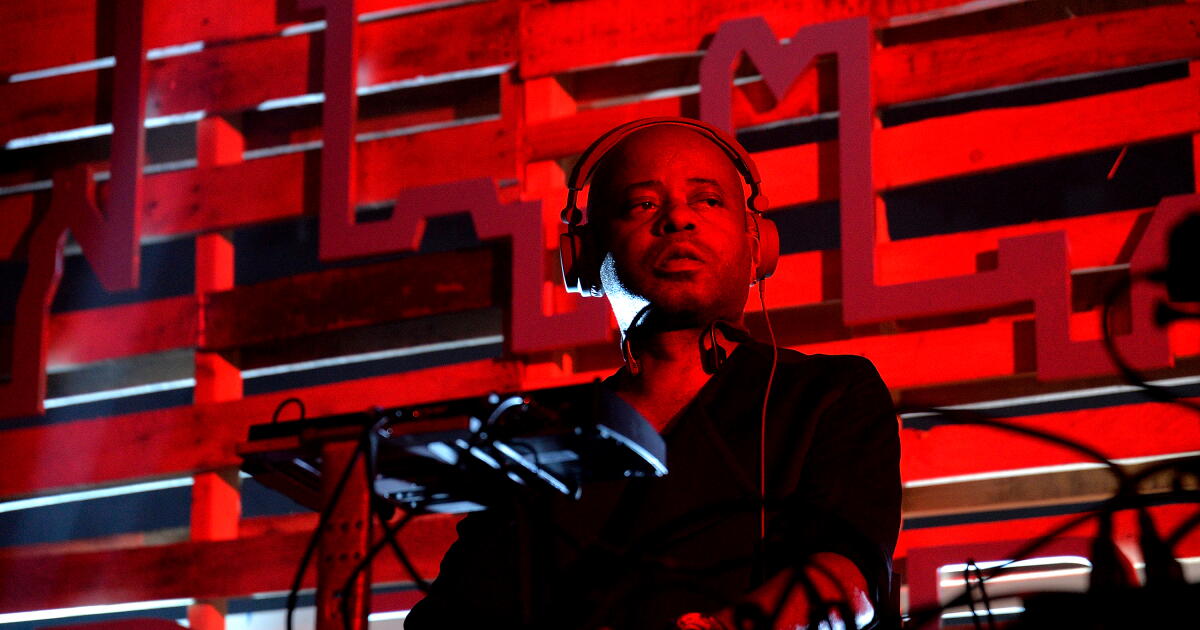
Juan Atkins, the Detroit club music producer who pioneered techno as a genre, has died. He was 64.
Atkins’ death was confirmed in a social media post by his management firm Greensmith Artists. The post did not include a cause of death, though Greensmith said in a statement to Resident Advisor that he was found unresponsive in his hotel room in Mexico City prior to a planned performance. Atkins had suffered from diabetes-related complications in recent years.
Atkins, raised by a concert-promoter father in the shadow of Motown, formed his taste on the progressive Black-owned radio station WGPR-FM. As an artist, he rose to prominence as a teen in the early ’80s with the duo Cybotron, with Richard “3070” Davis. The pair, infatuated with Kraftwerk, Afro-futurism and acid-fried psych rock, retrofitted Detroit funk in the post-disco era with rigorous synthesizers and science-fiction themes on tracks like 1981’s “Alleys of Your Mind.”
They carved a new style of club music that echoed their city’s industrial legacy, and captivated the city’s Black teenage middle class. They scored a major underground hit with “Clear,” famously sampled by Missy Elliott and others.
After leaving Cybotron, Atkins also conjured a new alias, Model 500, for his solo records in 1985. The same year, he founded his longtime record label Metroplex, which released scores of his singles like “No UFO’s” along with 1995’s LP “Deep Space,” 1999’s “Mind and Body” and 2015’s “Digital Solutions.”
Atkins formed deep friendships with two other proto-techno producers, Derrick May and Kevin Saunderson, who became locally known as the Belleville Three (named for the small Michigan town where Atkins had moved to). The trio honed an aesthetic distinct from neighboring Chicago’s emerging style of house music, stripping out vintage soul for chillier, futuristic productions. While house was music was based on samples, designed to call a dance floor together, techno was meant to be challenging, alien and fundamentally new.
His music, including his other production projects like Infiniti and Borderland, was formally radical, and Atkins stressed that this strain of club music could “make social statements,” as he told the Guardian in 2024. Tracks like Cybotron’s “Industrial Lies” — “You buy the missile, buy the laser, buy the tank … Evict the widow, put the money in the bank” — worked as social critique and floor-filler alike. “My lyrics are supposed to make you think about something other than shaking your booty on the dance floor and falling in love.” he said. “I feel like artists have an obligation to say something meaningful.”
In the wake of Atkins’ inventions — as noted on his track “Techno Music” — a new class of acts like Jeff Mills, Drexciya, Robert Hood and Underground Resistance would go on to formalize techno as rooted in a Black, Midwestern subculture with a distinct instrumental virtuosity. While the genre has had a cross-border dialog with Germany since its inception, Atkins was confident that he and his scene got there first.
“I put it this way,” Atkins said. “I know I’m the first one to apply the word ‘techno’ to electronic music. I can’t claim to be the inventor or originator of electronic music, but I can definitely say that I got that.”
Atkins continued to tour and play prominent festivals like Detroit’s Movement and Amsterdam’s Dekmantel, often with his daughter, the musician Milan Ariel Atkins.
Detroit Mayor Mary Sheffield said in a public statement that Atkins “opened doors for generations of Detroit artists who followed him.”
“Today, millions of people dance to music that traces back to him and to our city,” Sheffield continued. “That is a Detroit story: genius, grit, and invention, from neighborhoods the world too often overlooked.”