The crowd at El Cid is writhing and dripping in sweat. If not for the jazz onstage, the scene looks like it’s meant for a sold-out show headlined by a DJ with a cult following. Instead, everyone in the main room is dancing under a glistening disco ball to the syncopations of Riva, a three-piece comprised of a psychedelic saxophonist, drummer and keyboardist. They engulf the floor of the Silver Lake nightclub in an electric surge of high-energy jazz fused with an array of other genres, including jazz-house and bossa nova, luring people to dance and howl after every solo. It’s a standard party for JIJI’s Jazz Club, a roving pop-up series that hosts live jazz in warehouses, wine bars, speakeasies, cafes and other community-oriented spaces across L.A.
JIJI’s founder, Tida Norasingh, curates jazz nights six times per month, filling a necessary music void in L.A.’s cultural firmament. She discovered this dearth after moving back home to Southern California in 2020 from New York, where she lived for three years and built a lifestyle around regularly consuming jazz in stoop sessions, open jams and pop-ups. Jazz was financially accessible, the culture was alive and shows were abundant. But it wasn’t the same in L.A.
“I had a really hard time finding jazz in L.A. after moving back,” she says. “Everyone I asked couldn’t tell me where the good ‘spots’ were and the places everyone pointed me to felt very out-of-touch.”
By “out-of-touch” Norasingh means expensive and boujee. The crowds were mostly lifeless, largely because the majority of jazz venues in L.A. are seated only, and attendees remained silent even after a mesmerizing solo. Venues require a two-drink minimum and shows are expensive to attend. So in 2024, she stopped looking for the music and culture she wanted to be part of and started building it.
DeVaughn Durham and Gengis Don perform at “Can’t Cancel Jazz” presented by JIJI’s Jazz Club at the Slow Jamz Gallery in August in Los Angeles. The pop-up show was to make up for the cancellation of LA Jazz Fest.
(Brian Feinzimer/For The Times)
“It felt like [a lot of these spaces were] stuck in time, and there’s charm to that,” she says. “However, I realized that if those environments exist already, and the thing I was looking for didn’t, then I would just have to make the club I wanted to attend.”
Norasingh, who was a full-time tattoo artist then, hosted the first iteration of JIJI’s Jazz Club in a small studio she was running in the Arts District. JIJI’s didn’t have an Instagram yet, nor were there fliers for the first show. The name “JIJI’s Jazz Club” — an homage to her cat and Hayao Miyazaki’s animated film “Kiki’s Delivery Service” — hadn’t even been conceived yet. She only told her friends about the event she was throwing, but word traveled and her studio was packed.
“I cleared out everything in the tattoo studio,” she says, showing us a video of that first event. “You can still see my stencils in the background! I rented a U-Haul and put all of my stuff in it for the night. I changed the room into a stage and invited a bunch of friends, and made tea and dim sum for an open jam.”
The first event was such a success, she decided to do it again the following month. Attendance grew with each subsequent show, and eventually nearly 200 people thirsty for jazz consistently showed up to her tattoo studio for music. “I was like, ‘Oh my God, my security deposit!’ ”
JIJI’s officially outgrew the studio and moved to a now-defunct venue known as the Resident. But, even in a bigger location, JIJI’s quickly started pulling in around 500 people.

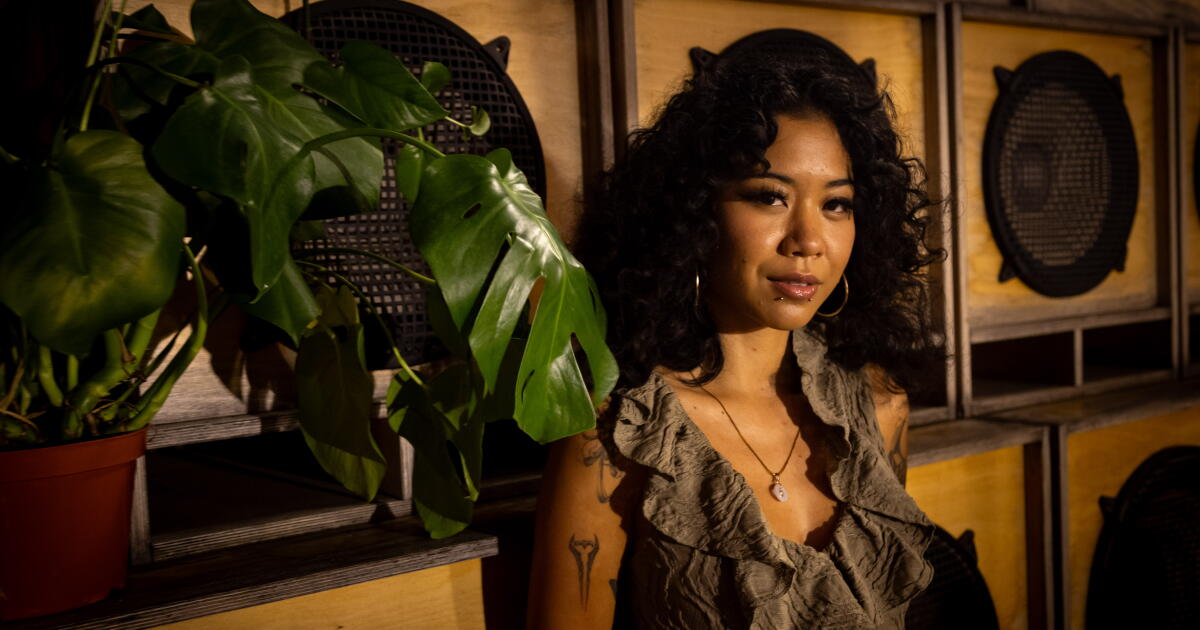
Founded by tattoo artist Tida Norasingh, the roving pop-up grew from an Arts District studio gathering into a community drawing hundreds of people to live music.
(Brian Feinzimer/For The Times)
Norasingh continued tattooing while throwing out-of-pocket jazz shows on the side. But the success of the events ushered in a momentum shift. As a spiritual person, Norasingh waited for the right moon phase and began pouring into her journal, essentially writing down incantations, to manifest a future aligned with the person she felt she was becoming.

“I just started writing down that I give permission to the universe to take away the things that are keeping me distracted versus focus,” she tells us. “I wrote down that I want to live in my truth and that I am built to carry the weight of the work I need to do and that I am built to survive both the negatives and positives that come with life…and then the next day my [tattoo] machine got stolen out of my car after doing a tattoo pop-up and accidentally leaving it in there. I never do that!”
She says tattooing was her only means of income at the time. “I didn’t panic. I was like, ‘Well, I guess I’ll just give everything I got to JiJi’s.”


Tramisha Vaughn and LaShawnda Wallace cheer on performers at the pop-up show “Cant Cancel Jazz” presented by JIJI’s Jazz Club at the Slow Jamz Gallery.
(Brian Feinzimer/For The Times)
When she talks about JIJI’s, Norasingh, whose voluminous black curls and infectious smile command attention, describes it less as a business than as a spiritual vocation. It isn’t about the money, she says. It’s about gathering as an act of resistance in honor of a genre that has carried resistance from its inception.
“JIJI’s is not necessarily profitable at the moment,” she says. “But I get so much in return for it that, when thinking in terms of a business standard, it’s an investment for the future. For me, I see live music and gatherings as an act of protest. I’m more than willing to not only give my money, but also to give my internal resources, my energy, my sleep. The second I see people gather is the second I feel rested. It is so spiritual for me.”
It’s this passion that spurred her into action when the ambitious and highly anticipated L.A. Jazz Fest fell through in mid-August, leaving dozens of jazz artists — including local acts and legends — with nowhere to perform and out the money they were promised. The team behind JIJI’s Jazz Club rallied to do what it always does: Fill a void. JIJI’s collaborated with eight stranded artists and musicians to host a pop-up show, giving them a venue to perform and giving the city back a jazz experience that was ripped out from under it.
“When news dropped that the L.A. Jazz Fest was canceled, my heart broke,” Norasingh says. “I love this city… My heart hurt for the musicians that were proud to be [part of] something that was supposed to be somewhat historic. It was a no-questions-asked decision to do something for some of those affected.”

JIJI’s Jazz Club is bringing high-energy, affordable jazz to warehouses, wine bars and other unconventional venues, creating the lively, dance-friendly scene many Angelenos say the city has lacked.
(Brian Feinzimer/For The Times)
The idea came from Gengis Don, an L.A.-based drummer/artist, previous JiJi’s performer and friend of Norasingh. In collaboration with him, Cass from Fresh Sounds and JiJi’s Jazz Club, the event came together the way it did because of the hands willing to help.

The instinct to create a space for people to gather, even in the aftermath of another event collapsing, is what Norasingh means by the word “club” in JIJI’s Jazz Club. It refers to a group, community or culture people belong to — not just a static venue people file into for an event. JIJI’s, in effect, is a vehicle for third spaces, or social environments separate from home, work or school, that have sharply declined over the past decade. According to a 2024 American Enterprise Institute survey, more than 1 in 5 Americans live in communities with no access to the 10 most common types of public or commercial gathering spaces. And the ones that remain are increasingly either too expensive for the average American or are designed to discourage lingering to create more turnover and, thus, profits.
“It’s expensive to be alive,” she says. “It’s expensive to even just walk outside and breathe. The world is already so complicated and we go through so much. And I think complicating the act of gathering are the pressures of money and capitalism and social standards.”

Gengis Don introduces performers at JIJI’s Jazz Club pop-up show “Can’t Cancel Jazz” at the Slow Jamz Gallery in August in Los Angeles.
(Brian Feinzimer/For The Times)
A few other pop-up jazz events exist around L.A. these days. It makes sense considering JIJI’s Jazz Club exists within the greater context of what musicians and promoters keep referring to as L.A.’s “jazz renaissance.” And while the city’s jazz history runs deep, the scene largely faded once other genres, like R&B and rock ‘n’ roll, took over many decades ago. Now, however, there seems to be more accessible jazz shows in the city than at any other time in recent history. The question of competition comes up in conversation with Norasingh, but she’s quick to squash it.
“Someone asked me the other day if I see this other third space as competition,” she says, “and I was like, ‘well, no. That’s just more resource for gathering . That’s more resource for whatever this is. I don’t own the idea of a third space. I don’t coin the ‘open jams.’ I can only control the way I carry my brand.”
And Norasingh has big plans for the future of her brand. But calling it a “brand” feels reductive. Like Miyazaki, Norasingh is world building. Recently the club posted a lineup of October events just in time for black cat season, including a sip and paint night, album listening parties and a “JiJi’s Halloweed Jazz Mass.” On top of JIJI’s Jazz Club, there’s JIJI’s Film Club, JiJi’s Jazz Lounge — a slow jamz spin off — and soon there will be JiJi’s Jazz Journal, the project’s newspaper.
“JIJI’s is centered around jazz,” she says. “But once you step into the world, you realize that we’re also highlighting film and analog media and we encourage people to read books and just consume art that shapes who you are.”