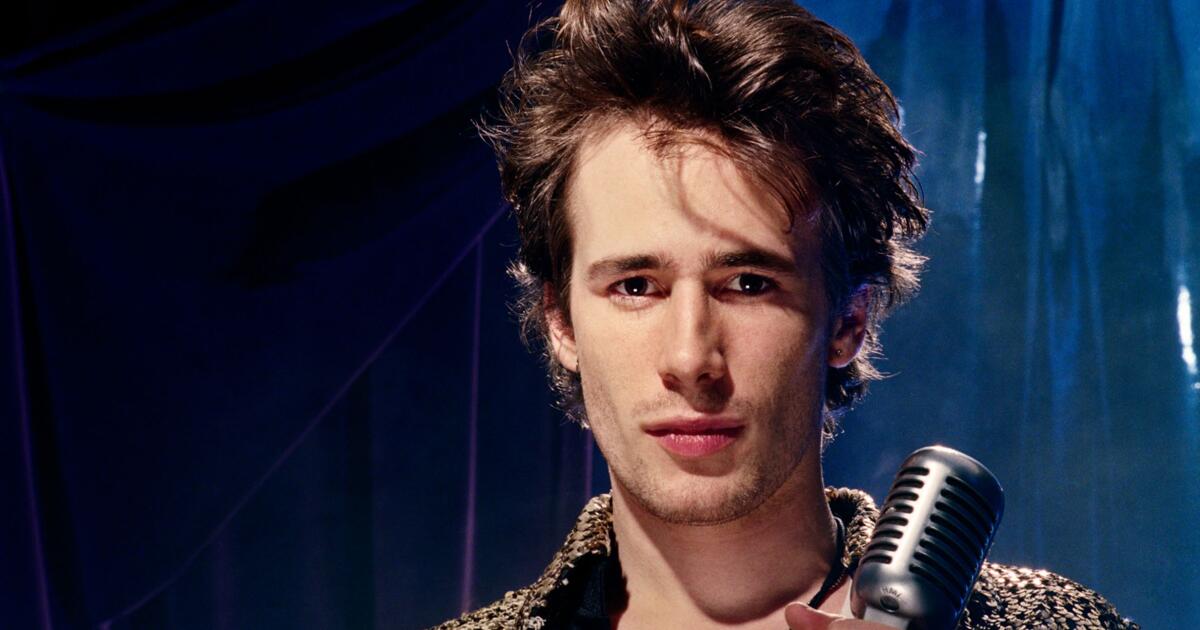

Short, pained lives marked by achievement and promise and then abruptly gone leave a restless afterglow. Youth is supposed to fade away, not become one’s permanent state. And regarding the late musician Jeff Buckley — a roiling romantic with piercing good looks whose singing could rattle bones and raise hairs — that loss in 1997, at the age of 30 from drowning, burns anew with every revisiting of his sparse legacy of recorded material.
Lives are more complicated than what your busted heart may want to read from a voice that conjured heaven and the abyss. So one of the appealing takeaways from the biodoc “It’s Never Over, Jeff Buckley” is a repudiating of the typical narrative of inescapable fate, instead pursuing the richness of a gifted artist’s ups and downs. Director Amy Berg would rather us see Buckley as he was in the world instead of some conveniently doom-laden figure.
The result is loving, spirited and honest: an opportunity for us to get to know the talented, turbulent Buckley through the people who genuinely knew him and cared about him. But also, in clips, copious writings and snatches of voice recordings, we meet someone empathetic yet evasive, ambitious yet self-critical, a son and his own man, especially when sudden stardom proved to be the wrong prism through which to find answers.
With archival material often superimposed over a faint, scratchy-film background, we feel the sensitivity and chaos of Buckley’s single-mom upbringing in Anaheim, the devastating distance of his absentee dad, folk-poet icon Tim Buckley (you’ll never forget the matchbook Jeff saved), and the creative blossoming that happened in New York’s East Village. There, his long-standing influences, from Nina Simone and Edith Piaf to Led Zeppelin and Nusrat Fateh Ali Khan, coalesced into a post-grunge emotionalism anchored by those unbelievable pipes.
Even after Buckley’s record-label discovery leads to the usual music-doc trappings — tour montages, media coverage, performance morsels — Berg wisely keeps the contours of his interior life in the foreground, intimately related by key figures, most prominently Buckley’s mother, Mary Guibert, romantic confidantes such as artist Rebecca Moore and musician Joan Wasser, and bandmates like Michael Tighe. Berg keeps these interviewees close to her camera, too, so we can appreciate their memories as personal gifts, still raw after so many years.
Fans might yearn for more granular unpacking of the music, but it somehow doesn’t feel like an oversight when so much ink on it already exists and so little else has been colored in. The same goes for the blessed absence of boilerplate A-list praise. The global acclaim for his sole album, 1994’s “Grace,” which includes his all-timer rendition of Leonard Cohen’s “Hallelujah,” certainly put admiring superstars (Dylan, Bowie, McCartney) in Buckley’s path, including one of his idols, Robert Plant. But Berg stays true to a viewpoint rooted in Buckley’s conflicting feelings about the pressures and absurdities of fame, and why it ultimately drove him to Memphis to seek the solace to start a second album that was never completed.
The last chapter is thoughtfully handled. Berg makes sure that we understand that his loved ones view his death as an accident, not a suicide, and the movie’s details are convincing. That doesn’t make the circumstances any less heartbreaking, of course. As warmer spotlights go, “It’s Never Over, Jeff Buckley” may never fully expunge what maddens and mystifies about the untimely end of troubled souls. But it candidly dimensionalizes a one-album wonder, virtually ensuring the kind of relistening likely to deepen those echoes.
‘It’s Never Over, Jeff Buckley’
Not rated
Running time: 1 hour, 46 minutes
Playing: In limited release

Short, pained lives marked by achievement and promise and then abruptly gone leave a restless afterglow. Youth is supposed to fade away, not become one’s permanent state. And regarding the late musician Jeff Buckley — a roiling romantic with piercing good looks whose singing could rattle bones and raise hairs — that loss in 1997, at the age of 30 from drowning, burns anew with every revisiting of his sparse legacy of recorded material.
Lives are more complicated than what your busted heart may want to read from a voice that conjured heaven and the abyss. So one of the appealing takeaways from the biodoc “It’s Never Over, Jeff Buckley” is a repudiating of the typical narrative of inescapable fate, instead pursuing the richness of a gifted artist’s ups and downs. Director Amy Berg would rather us see Buckley as he was in the world instead of some conveniently doom-laden figure.
The result is loving, spirited and honest: an opportunity for us to get to know the talented, turbulent Buckley through the people who genuinely knew him and cared about him. But also, in clips, copious writings and snatches of voice recordings, we meet someone empathetic yet evasive, ambitious yet self-critical, a son and his own man, especially when sudden stardom proved to be the wrong prism through which to find answers.
With archival material often superimposed over a faint, scratchy-film background, we feel the sensitivity and chaos of Buckley’s single-mom upbringing in Anaheim, the devastating distance of his absentee dad, folk-poet icon Tim Buckley (you’ll never forget the matchbook Jeff saved), and the creative blossoming that happened in New York’s East Village. There, his long-standing influences, from Nina Simone and Edith Piaf to Led Zeppelin and Nusrat Fateh Ali Khan, coalesced into a post-grunge emotionalism anchored by those unbelievable pipes.
Even after Buckley’s record-label discovery leads to the usual music-doc trappings — tour montages, media coverage, performance morsels — Berg wisely keeps the contours of his interior life in the foreground, intimately related by key figures, most prominently Buckley’s mother, Mary Guibert, romantic confidantes such as artist Rebecca Moore and musician Joan Wasser, and bandmates like Michael Tighe. Berg keeps these interviewees close to her camera, too, so we can appreciate their memories as personal gifts, still raw after so many years.
Fans might yearn for more granular unpacking of the music, but it somehow doesn’t feel like an oversight when so much ink on it already exists and so little else has been colored in. The same goes for the blessed absence of boilerplate A-list praise. The global acclaim for his sole album, 1994’s “Grace,” which includes his all-timer rendition of Leonard Cohen’s “Hallelujah,” certainly put admiring superstars (Dylan, Bowie, McCartney) in Buckley’s path, including one of his idols, Robert Plant. But Berg stays true to a viewpoint rooted in Buckley’s conflicting feelings about the pressures and absurdities of fame, and why it ultimately drove him to Memphis to seek the solace to start a second album that was never completed.
The last chapter is thoughtfully handled. Berg makes sure that we understand that his loved ones view his death as an accident, not a suicide, and the movie’s details are convincing. That doesn’t make the circumstances any less heartbreaking, of course. As warmer spotlights go, “It’s Never Over, Jeff Buckley” may never fully expunge what maddens and mystifies about the untimely end of troubled souls. But it candidly dimensionalizes a one-album wonder, virtually ensuring the kind of relistening likely to deepen those echoes.
‘It’s Never Over, Jeff Buckley’
Not rated
Running time: 1 hour, 46 minutes
Playing: In limited release

Short, pained lives marked by achievement and promise and then abruptly gone leave a restless afterglow. Youth is supposed to fade away, not become one’s permanent state. And regarding the late musician Jeff Buckley — a roiling romantic with piercing good looks whose singing could rattle bones and raise hairs — that loss in 1997, at the age of 30 from drowning, burns anew with every revisiting of his sparse legacy of recorded material.
Lives are more complicated than what your busted heart may want to read from a voice that conjured heaven and the abyss. So one of the appealing takeaways from the biodoc “It’s Never Over, Jeff Buckley” is a repudiating of the typical narrative of inescapable fate, instead pursuing the richness of a gifted artist’s ups and downs. Director Amy Berg would rather us see Buckley as he was in the world instead of some conveniently doom-laden figure.
The result is loving, spirited and honest: an opportunity for us to get to know the talented, turbulent Buckley through the people who genuinely knew him and cared about him. But also, in clips, copious writings and snatches of voice recordings, we meet someone empathetic yet evasive, ambitious yet self-critical, a son and his own man, especially when sudden stardom proved to be the wrong prism through which to find answers.
With archival material often superimposed over a faint, scratchy-film background, we feel the sensitivity and chaos of Buckley’s single-mom upbringing in Anaheim, the devastating distance of his absentee dad, folk-poet icon Tim Buckley (you’ll never forget the matchbook Jeff saved), and the creative blossoming that happened in New York’s East Village. There, his long-standing influences, from Nina Simone and Edith Piaf to Led Zeppelin and Nusrat Fateh Ali Khan, coalesced into a post-grunge emotionalism anchored by those unbelievable pipes.
Even after Buckley’s record-label discovery leads to the usual music-doc trappings — tour montages, media coverage, performance morsels — Berg wisely keeps the contours of his interior life in the foreground, intimately related by key figures, most prominently Buckley’s mother, Mary Guibert, romantic confidantes such as artist Rebecca Moore and musician Joan Wasser, and bandmates like Michael Tighe. Berg keeps these interviewees close to her camera, too, so we can appreciate their memories as personal gifts, still raw after so many years.
Fans might yearn for more granular unpacking of the music, but it somehow doesn’t feel like an oversight when so much ink on it already exists and so little else has been colored in. The same goes for the blessed absence of boilerplate A-list praise. The global acclaim for his sole album, 1994’s “Grace,” which includes his all-timer rendition of Leonard Cohen’s “Hallelujah,” certainly put admiring superstars (Dylan, Bowie, McCartney) in Buckley’s path, including one of his idols, Robert Plant. But Berg stays true to a viewpoint rooted in Buckley’s conflicting feelings about the pressures and absurdities of fame, and why it ultimately drove him to Memphis to seek the solace to start a second album that was never completed.
The last chapter is thoughtfully handled. Berg makes sure that we understand that his loved ones view his death as an accident, not a suicide, and the movie’s details are convincing. That doesn’t make the circumstances any less heartbreaking, of course. As warmer spotlights go, “It’s Never Over, Jeff Buckley” may never fully expunge what maddens and mystifies about the untimely end of troubled souls. But it candidly dimensionalizes a one-album wonder, virtually ensuring the kind of relistening likely to deepen those echoes.
‘It’s Never Over, Jeff Buckley’
Not rated
Running time: 1 hour, 46 minutes
Playing: In limited release
Short, pained lives marked by achievement and promise and then abruptly gone leave a restless afterglow. Youth is supposed to fade away, not become one’s permanent state. And regarding the late musician Jeff Buckley — a roiling romantic with piercing good looks whose singing could rattle bones and raise hairs — that loss in 1997, at the age of 30 from drowning, burns anew with every revisiting of his sparse legacy of recorded material.
Lives are more complicated than what your busted heart may want to read from a voice that conjured heaven and the abyss. So one of the appealing takeaways from the biodoc “It’s Never Over, Jeff Buckley” is a repudiating of the typical narrative of inescapable fate, instead pursuing the richness of a gifted artist’s ups and downs. Director Amy Berg would rather us see Buckley as he was in the world instead of some conveniently doom-laden figure.
The result is loving, spirited and honest: an opportunity for us to get to know the talented, turbulent Buckley through the people who genuinely knew him and cared about him. But also, in clips, copious writings and snatches of voice recordings, we meet someone empathetic yet evasive, ambitious yet self-critical, a son and his own man, especially when sudden stardom proved to be the wrong prism through which to find answers.
With archival material often superimposed over a faint, scratchy-film background, we feel the sensitivity and chaos of Buckley’s single-mom upbringing in Anaheim, the devastating distance of his absentee dad, folk-poet icon Tim Buckley (you’ll never forget the matchbook Jeff saved), and the creative blossoming that happened in New York’s East Village. There, his long-standing influences, from Nina Simone and Edith Piaf to Led Zeppelin and Nusrat Fateh Ali Khan, coalesced into a post-grunge emotionalism anchored by those unbelievable pipes.
Even after Buckley’s record-label discovery leads to the usual music-doc trappings — tour montages, media coverage, performance morsels — Berg wisely keeps the contours of his interior life in the foreground, intimately related by key figures, most prominently Buckley’s mother, Mary Guibert, romantic confidantes such as artist Rebecca Moore and musician Joan Wasser, and bandmates like Michael Tighe. Berg keeps these interviewees close to her camera, too, so we can appreciate their memories as personal gifts, still raw after so many years.
Fans might yearn for more granular unpacking of the music, but it somehow doesn’t feel like an oversight when so much ink on it already exists and so little else has been colored in. The same goes for the blessed absence of boilerplate A-list praise. The global acclaim for his sole album, 1994’s “Grace,” which includes his all-timer rendition of Leonard Cohen’s “Hallelujah,” certainly put admiring superstars (Dylan, Bowie, McCartney) in Buckley’s path, including one of his idols, Robert Plant. But Berg stays true to a viewpoint rooted in Buckley’s conflicting feelings about the pressures and absurdities of fame, and why it ultimately drove him to Memphis to seek the solace to start a second album that was never completed.
The last chapter is thoughtfully handled. Berg makes sure that we understand that his loved ones view his death as an accident, not a suicide, and the movie’s details are convincing. That doesn’t make the circumstances any less heartbreaking, of course. As warmer spotlights go, “It’s Never Over, Jeff Buckley” may never fully expunge what maddens and mystifies about the untimely end of troubled souls. But it candidly dimensionalizes a one-album wonder, virtually ensuring the kind of relistening likely to deepen those echoes.
‘It’s Never Over, Jeff Buckley’
Not rated
Running time: 1 hour, 46 minutes
Playing: In limited release