


When Jonás Derbez was growing up, he would often stay up late into the night watching his saxophonist father perform with a jazz ensemble.
“Listening to his solos brings up so many childhood memories,” Derbez tells The Times over Zoom. “My sister and I would pull up a couple of chairs together and fall asleep while listening to the music in the Jalapa bar where we all lived together.”
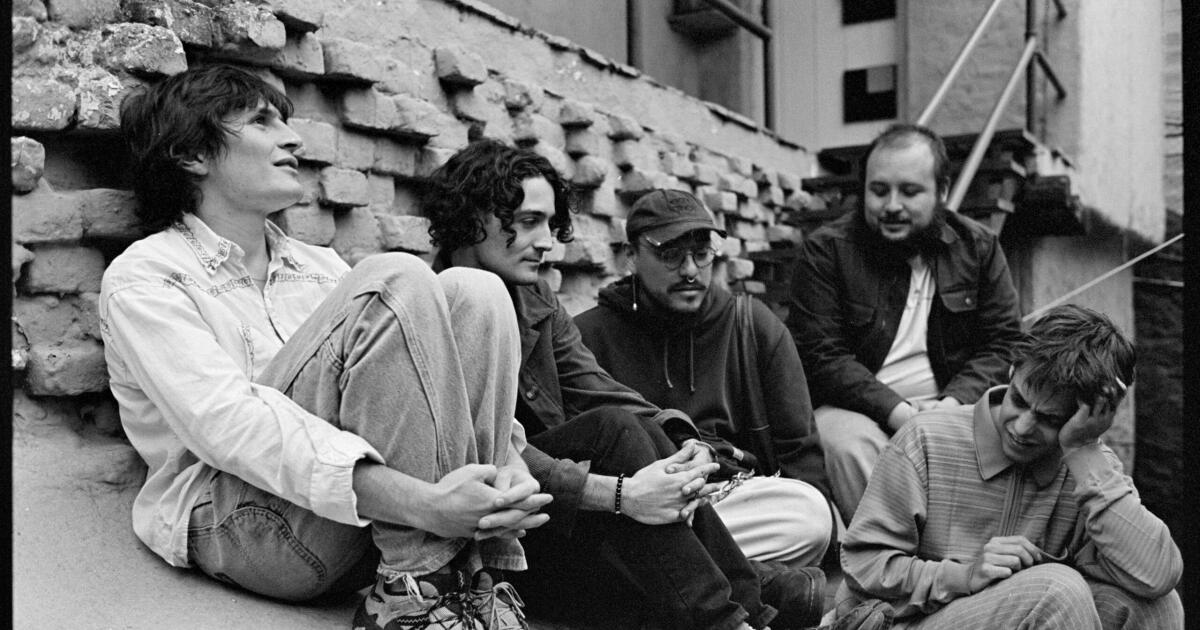
Derbez is now the lead singer, sax player and band manager of Diles Que No Me Maten: one of the most acclaimed indie bands to emerge from Mexico in the last decade. Released in June, the group’s fourth album, “Escrito en Agua,” is a bohemian tour de force — a bewitching combination of freestyle poetry, menacing Krautrock, melancholy shades of jazz and post-rock.
It begins with the somber instrumental “Las Noches Que Dormimos en Sillas” (The Nights When We Slept on Chairs), a tribute to those early listening sessions. Derbez’s father contributes an alto sax solo.
Diles Que No Me Maten found its name in a short story by iconic Mexican writer Juan Rulfo, the author of “Pedro Páramo.” The sound of the band is an anomaly, even within the obscure parameters of underground Latin.
A song like the hypnotic “Hiriku” — the closest thing to a lead single you are likely to find on this record — brims with the neurotic propulsion and icy elegance of the U.K. post-punk band Wire, while the spirit of experimental German outfit Can is probably the group’s deepest, most existential influence.
“We are an improbable band,” admits Derbez with a smile. It’s a sunny afternoon in the Mexican capital, and the disarming sweetness with which he expresses his thoughts mirrors the band’s vulnerable soundscapes.
“There’s a person who was fundamental to the very existence of this group,” he adds. “A producer named Hugo Quezada, one of only two people who own an actual mellotron in Mexico City. He produced our first couple of albums in his tiny apartment, and always mentioned that we were an improbable band. Which was perfect, since the fact that he exists doesn’t make much sense either. The miracle that made our group happen is the sum of many coincidences.”
“It’s really cabrón [cool] how the poetry of Jonás touches people’s hearts,” says Guatemalan cellist and composer Mabe Fratti, the de facto empress of Mexico City’s booming alternative scene. Fratti performed on some of the band’s earliest records, and asked Derbez to house-sit for her while she was away touring.
“We’re really good friends,” she says. “Everyone in that band has his own aesthetic universe, and they manage to coalesce all the different strands. I always feel that they are free of restrictions. Their sound has matured, and they’re never afraid to pick up a new instrument.”
Perhaps the band’s greatest strength is being able to project an intimate familiarity with the present, while drawing freely from the ’60s and ’70s.
Derbez name-drops jazz giants Ornette Coleman and Charlie Haden when discussing the opening track, then mentions a Oaxacan funeral dirge in the same sentence — which speaks volumes about the ability of Latin American rock artists to find transcendence in unexpected combinations. “I started making up songs because I wanted to listen to music in Spanish that sounded like my favorite albums in English, which I couldn’t understand.”
Diles reclines comfortably on the instrumental configuration that makes so many rock bands sing: acoustic and electric guitars, bass, and the cool, angular drumming of Raúl Ponce. But the tracks are enriched with synthesizers, violin, flute, trumpet and clarinet — all five members are multi-instrumentalists.
Here’s where the band generates a fascinating juxtaposition: part of “Escrito en Agua” is recorded in a lo-fi style, with rough-around-the-edges moments — like the kind of teen barrio band that you feel protective of. But at times, the caliber of their technical and harmonic choices sounds arty and sophisticated.

“The contrast is real,” laughs Derbez. “We are different types of instrumentalists with varying degrees of talent and scholarship…. But we like both components equally: the raw stuff and the layered bits. We listen to Phil Collins and [Mexican singer-songwriter] Juan Cirerol. Both can be equally beautiful.”
Initially, Derbez had no intention of becoming a musician, and instead studied filmmaking in college. Since joining the band at the age of 23 — which is when he also began playing music, he adds — he feels fortunate to have found artistic-minded peers who are on the same creative wavelength.
“There’s a passage on the Tao Te Ching that reflects on how heavy it is to possess a fortune in gold,” he says. “What do you do with it? Where do you keep it? Sometimes I get a bit corny about how unreal it feels to contemplate everything we have achieved — especially when we’re on tour. The sheer urgency of making music and getting invested in the reality around us.”
Prestige is something that money can’t buy, however, and Diles is being heralded across the Americas as the band to see in concert. The group’s current European tour includes stops in Spain, France and the U.K. — with a lengthy U.S. jaunt to follow in the fall. This will include an Oct. 13 date at the the Paramount in Los Angeles.
“In the U.S., people who don’t speak Spanish have invited us to their homes and let us sleep on their couches,” he says, a little choked up with emotion. True to their do-it-yourself ethos, the members of Diles rely on external sources of employment to make a living — and because the band’s tours are self-managed, they occasionally involve crashing at a fan’s house for the night. They find no shortage of community, though.
“We have definitely connected with a special energy,” he adds. “We found a way to make art in the specific way in which I believe it should be made. And I just love that.”

When Jonás Derbez was growing up, he would often stay up late into the night watching his saxophonist father perform with a jazz ensemble.
“Listening to his solos brings up so many childhood memories,” Derbez tells The Times over Zoom. “My sister and I would pull up a couple of chairs together and fall asleep while listening to the music in the Jalapa bar where we all lived together.”
Derbez is now the lead singer, sax player and band manager of Diles Que No Me Maten: one of the most acclaimed indie bands to emerge from Mexico in the last decade. Released in June, the group’s fourth album, “Escrito en Agua,” is a bohemian tour de force — a bewitching combination of freestyle poetry, menacing Krautrock, melancholy shades of jazz and post-rock.
It begins with the somber instrumental “Las Noches Que Dormimos en Sillas” (The Nights When We Slept on Chairs), a tribute to those early listening sessions. Derbez’s father contributes an alto sax solo.
Diles Que No Me Maten found its name in a short story by iconic Mexican writer Juan Rulfo, the author of “Pedro Páramo.” The sound of the band is an anomaly, even within the obscure parameters of underground Latin.
A song like the hypnotic “Hiriku” — the closest thing to a lead single you are likely to find on this record — brims with the neurotic propulsion and icy elegance of the U.K. post-punk band Wire, while the spirit of experimental German outfit Can is probably the group’s deepest, most existential influence.
“We are an improbable band,” admits Derbez with a smile. It’s a sunny afternoon in the Mexican capital, and the disarming sweetness with which he expresses his thoughts mirrors the band’s vulnerable soundscapes.
“There’s a person who was fundamental to the very existence of this group,” he adds. “A producer named Hugo Quezada, one of only two people who own an actual mellotron in Mexico City. He produced our first couple of albums in his tiny apartment, and always mentioned that we were an improbable band. Which was perfect, since the fact that he exists doesn’t make much sense either. The miracle that made our group happen is the sum of many coincidences.”
“It’s really cabrón [cool] how the poetry of Jonás touches people’s hearts,” says Guatemalan cellist and composer Mabe Fratti, the de facto empress of Mexico City’s booming alternative scene. Fratti performed on some of the band’s earliest records, and asked Derbez to house-sit for her while she was away touring.
“We’re really good friends,” she says. “Everyone in that band has his own aesthetic universe, and they manage to coalesce all the different strands. I always feel that they are free of restrictions. Their sound has matured, and they’re never afraid to pick up a new instrument.”
Perhaps the band’s greatest strength is being able to project an intimate familiarity with the present, while drawing freely from the ’60s and ’70s.
Derbez name-drops jazz giants Ornette Coleman and Charlie Haden when discussing the opening track, then mentions a Oaxacan funeral dirge in the same sentence — which speaks volumes about the ability of Latin American rock artists to find transcendence in unexpected combinations. “I started making up songs because I wanted to listen to music in Spanish that sounded like my favorite albums in English, which I couldn’t understand.”
Diles reclines comfortably on the instrumental configuration that makes so many rock bands sing: acoustic and electric guitars, bass, and the cool, angular drumming of Raúl Ponce. But the tracks are enriched with synthesizers, violin, flute, trumpet and clarinet — all five members are multi-instrumentalists.
Here’s where the band generates a fascinating juxtaposition: part of “Escrito en Agua” is recorded in a lo-fi style, with rough-around-the-edges moments — like the kind of teen barrio band that you feel protective of. But at times, the caliber of their technical and harmonic choices sounds arty and sophisticated.
“The contrast is real,” laughs Derbez. “We are different types of instrumentalists with varying degrees of talent and scholarship…. But we like both components equally: the raw stuff and the layered bits. We listen to Phil Collins and [Mexican singer-songwriter] Juan Cirerol. Both can be equally beautiful.”
Initially, Derbez had no intention of becoming a musician, and instead studied filmmaking in college. Since joining the band at the age of 23 — which is when he also began playing music, he adds — he feels fortunate to have found artistic-minded peers who are on the same creative wavelength.
“There’s a passage on the Tao Te Ching that reflects on how heavy it is to possess a fortune in gold,” he says. “What do you do with it? Where do you keep it? Sometimes I get a bit corny about how unreal it feels to contemplate everything we have achieved — especially when we’re on tour. The sheer urgency of making music and getting invested in the reality around us.”
Prestige is something that money can’t buy, however, and Diles is being heralded across the Americas as the band to see in concert. The group’s current European tour includes stops in Spain, France and the U.K. — with a lengthy U.S. jaunt to follow in the fall. This will include an Oct. 13 date at the the Paramount in Los Angeles.
“In the U.S., people who don’t speak Spanish have invited us to their homes and let us sleep on their couches,” he says, a little choked up with emotion. True to their do-it-yourself ethos, the members of Diles rely on external sources of employment to make a living — and because the band’s tours are self-managed, they occasionally involve crashing at a fan’s house for the night. They find no shortage of community, though.
“We have definitely connected with a special energy,” he adds. “We found a way to make art in the specific way in which I believe it should be made. And I just love that.”

When Jonás Derbez was growing up, he would often stay up late into the night watching his saxophonist father perform with a jazz ensemble.
“Listening to his solos brings up so many childhood memories,” Derbez tells The Times over Zoom. “My sister and I would pull up a couple of chairs together and fall asleep while listening to the music in the Jalapa bar where we all lived together.”
Derbez is now the lead singer, sax player and band manager of Diles Que No Me Maten: one of the most acclaimed indie bands to emerge from Mexico in the last decade. Released in June, the group’s fourth album, “Escrito en Agua,” is a bohemian tour de force — a bewitching combination of freestyle poetry, menacing Krautrock, melancholy shades of jazz and post-rock.
It begins with the somber instrumental “Las Noches Que Dormimos en Sillas” (The Nights When We Slept on Chairs), a tribute to those early listening sessions. Derbez’s father contributes an alto sax solo.
Diles Que No Me Maten found its name in a short story by iconic Mexican writer Juan Rulfo, the author of “Pedro Páramo.” The sound of the band is an anomaly, even within the obscure parameters of underground Latin.
A song like the hypnotic “Hiriku” — the closest thing to a lead single you are likely to find on this record — brims with the neurotic propulsion and icy elegance of the U.K. post-punk band Wire, while the spirit of experimental German outfit Can is probably the group’s deepest, most existential influence.
“We are an improbable band,” admits Derbez with a smile. It’s a sunny afternoon in the Mexican capital, and the disarming sweetness with which he expresses his thoughts mirrors the band’s vulnerable soundscapes.
“There’s a person who was fundamental to the very existence of this group,” he adds. “A producer named Hugo Quezada, one of only two people who own an actual mellotron in Mexico City. He produced our first couple of albums in his tiny apartment, and always mentioned that we were an improbable band. Which was perfect, since the fact that he exists doesn’t make much sense either. The miracle that made our group happen is the sum of many coincidences.”
“It’s really cabrón [cool] how the poetry of Jonás touches people’s hearts,” says Guatemalan cellist and composer Mabe Fratti, the de facto empress of Mexico City’s booming alternative scene. Fratti performed on some of the band’s earliest records, and asked Derbez to house-sit for her while she was away touring.
“We’re really good friends,” she says. “Everyone in that band has his own aesthetic universe, and they manage to coalesce all the different strands. I always feel that they are free of restrictions. Their sound has matured, and they’re never afraid to pick up a new instrument.”
Perhaps the band’s greatest strength is being able to project an intimate familiarity with the present, while drawing freely from the ’60s and ’70s.
Derbez name-drops jazz giants Ornette Coleman and Charlie Haden when discussing the opening track, then mentions a Oaxacan funeral dirge in the same sentence — which speaks volumes about the ability of Latin American rock artists to find transcendence in unexpected combinations. “I started making up songs because I wanted to listen to music in Spanish that sounded like my favorite albums in English, which I couldn’t understand.”
Diles reclines comfortably on the instrumental configuration that makes so many rock bands sing: acoustic and electric guitars, bass, and the cool, angular drumming of Raúl Ponce. But the tracks are enriched with synthesizers, violin, flute, trumpet and clarinet — all five members are multi-instrumentalists.
Here’s where the band generates a fascinating juxtaposition: part of “Escrito en Agua” is recorded in a lo-fi style, with rough-around-the-edges moments — like the kind of teen barrio band that you feel protective of. But at times, the caliber of their technical and harmonic choices sounds arty and sophisticated.
“The contrast is real,” laughs Derbez. “We are different types of instrumentalists with varying degrees of talent and scholarship…. But we like both components equally: the raw stuff and the layered bits. We listen to Phil Collins and [Mexican singer-songwriter] Juan Cirerol. Both can be equally beautiful.”
Initially, Derbez had no intention of becoming a musician, and instead studied filmmaking in college. Since joining the band at the age of 23 — which is when he also began playing music, he adds — he feels fortunate to have found artistic-minded peers who are on the same creative wavelength.
“There’s a passage on the Tao Te Ching that reflects on how heavy it is to possess a fortune in gold,” he says. “What do you do with it? Where do you keep it? Sometimes I get a bit corny about how unreal it feels to contemplate everything we have achieved — especially when we’re on tour. The sheer urgency of making music and getting invested in the reality around us.”
Prestige is something that money can’t buy, however, and Diles is being heralded across the Americas as the band to see in concert. The group’s current European tour includes stops in Spain, France and the U.K. — with a lengthy U.S. jaunt to follow in the fall. This will include an Oct. 13 date at the the Paramount in Los Angeles.
“In the U.S., people who don’t speak Spanish have invited us to their homes and let us sleep on their couches,” he says, a little choked up with emotion. True to their do-it-yourself ethos, the members of Diles rely on external sources of employment to make a living — and because the band’s tours are self-managed, they occasionally involve crashing at a fan’s house for the night. They find no shortage of community, though.
“We have definitely connected with a special energy,” he adds. “We found a way to make art in the specific way in which I believe it should be made. And I just love that.”
When Jonás Derbez was growing up, he would often stay up late into the night watching his saxophonist father perform with a jazz ensemble.
“Listening to his solos brings up so many childhood memories,” Derbez tells The Times over Zoom. “My sister and I would pull up a couple of chairs together and fall asleep while listening to the music in the Jalapa bar where we all lived together.”
Derbez is now the lead singer, sax player and band manager of Diles Que No Me Maten: one of the most acclaimed indie bands to emerge from Mexico in the last decade. Released in June, the group’s fourth album, “Escrito en Agua,” is a bohemian tour de force — a bewitching combination of freestyle poetry, menacing Krautrock, melancholy shades of jazz and post-rock.
It begins with the somber instrumental “Las Noches Que Dormimos en Sillas” (The Nights When We Slept on Chairs), a tribute to those early listening sessions. Derbez’s father contributes an alto sax solo.
Diles Que No Me Maten found its name in a short story by iconic Mexican writer Juan Rulfo, the author of “Pedro Páramo.” The sound of the band is an anomaly, even within the obscure parameters of underground Latin.
A song like the hypnotic “Hiriku” — the closest thing to a lead single you are likely to find on this record — brims with the neurotic propulsion and icy elegance of the U.K. post-punk band Wire, while the spirit of experimental German outfit Can is probably the group’s deepest, most existential influence.
“We are an improbable band,” admits Derbez with a smile. It’s a sunny afternoon in the Mexican capital, and the disarming sweetness with which he expresses his thoughts mirrors the band’s vulnerable soundscapes.
“There’s a person who was fundamental to the very existence of this group,” he adds. “A producer named Hugo Quezada, one of only two people who own an actual mellotron in Mexico City. He produced our first couple of albums in his tiny apartment, and always mentioned that we were an improbable band. Which was perfect, since the fact that he exists doesn’t make much sense either. The miracle that made our group happen is the sum of many coincidences.”
“It’s really cabrón [cool] how the poetry of Jonás touches people’s hearts,” says Guatemalan cellist and composer Mabe Fratti, the de facto empress of Mexico City’s booming alternative scene. Fratti performed on some of the band’s earliest records, and asked Derbez to house-sit for her while she was away touring.
“We’re really good friends,” she says. “Everyone in that band has his own aesthetic universe, and they manage to coalesce all the different strands. I always feel that they are free of restrictions. Their sound has matured, and they’re never afraid to pick up a new instrument.”
Perhaps the band’s greatest strength is being able to project an intimate familiarity with the present, while drawing freely from the ’60s and ’70s.
Derbez name-drops jazz giants Ornette Coleman and Charlie Haden when discussing the opening track, then mentions a Oaxacan funeral dirge in the same sentence — which speaks volumes about the ability of Latin American rock artists to find transcendence in unexpected combinations. “I started making up songs because I wanted to listen to music in Spanish that sounded like my favorite albums in English, which I couldn’t understand.”
Diles reclines comfortably on the instrumental configuration that makes so many rock bands sing: acoustic and electric guitars, bass, and the cool, angular drumming of Raúl Ponce. But the tracks are enriched with synthesizers, violin, flute, trumpet and clarinet — all five members are multi-instrumentalists.
Here’s where the band generates a fascinating juxtaposition: part of “Escrito en Agua” is recorded in a lo-fi style, with rough-around-the-edges moments — like the kind of teen barrio band that you feel protective of. But at times, the caliber of their technical and harmonic choices sounds arty and sophisticated.
“The contrast is real,” laughs Derbez. “We are different types of instrumentalists with varying degrees of talent and scholarship…. But we like both components equally: the raw stuff and the layered bits. We listen to Phil Collins and [Mexican singer-songwriter] Juan Cirerol. Both can be equally beautiful.”
Initially, Derbez had no intention of becoming a musician, and instead studied filmmaking in college. Since joining the band at the age of 23 — which is when he also began playing music, he adds — he feels fortunate to have found artistic-minded peers who are on the same creative wavelength.
“There’s a passage on the Tao Te Ching that reflects on how heavy it is to possess a fortune in gold,” he says. “What do you do with it? Where do you keep it? Sometimes I get a bit corny about how unreal it feels to contemplate everything we have achieved — especially when we’re on tour. The sheer urgency of making music and getting invested in the reality around us.”
Prestige is something that money can’t buy, however, and Diles is being heralded across the Americas as the band to see in concert. The group’s current European tour includes stops in Spain, France and the U.K. — with a lengthy U.S. jaunt to follow in the fall. This will include an Oct. 13 date at the the Paramount in Los Angeles.
“In the U.S., people who don’t speak Spanish have invited us to their homes and let us sleep on their couches,” he says, a little choked up with emotion. True to their do-it-yourself ethos, the members of Diles rely on external sources of employment to make a living — and because the band’s tours are self-managed, they occasionally involve crashing at a fan’s house for the night. They find no shortage of community, though.
“We have definitely connected with a special energy,” he adds. “We found a way to make art in the specific way in which I believe it should be made. And I just love that.”


