

The history of the wonton in America, like the history of any food, is a string of adaptations to circumstances. So, how exactly did we get to a place where my TikTok feed is full of crab and cheese wontons?
Wontons may be the most ubiquitous of all dumplings. They also seem to be the most chameleonic in terms of preparation and filling. They’re associated with Americanized Chinese food more than any other dumpling, often fried and tucked into countless takeout containers of chow mein and orange chicken.
Sometime during the last century, the wonton went from a humble thin-skinned dumpling often served in soup, to a deep-fried combination plate side dish and a popular vessel for crab and cream cheese.
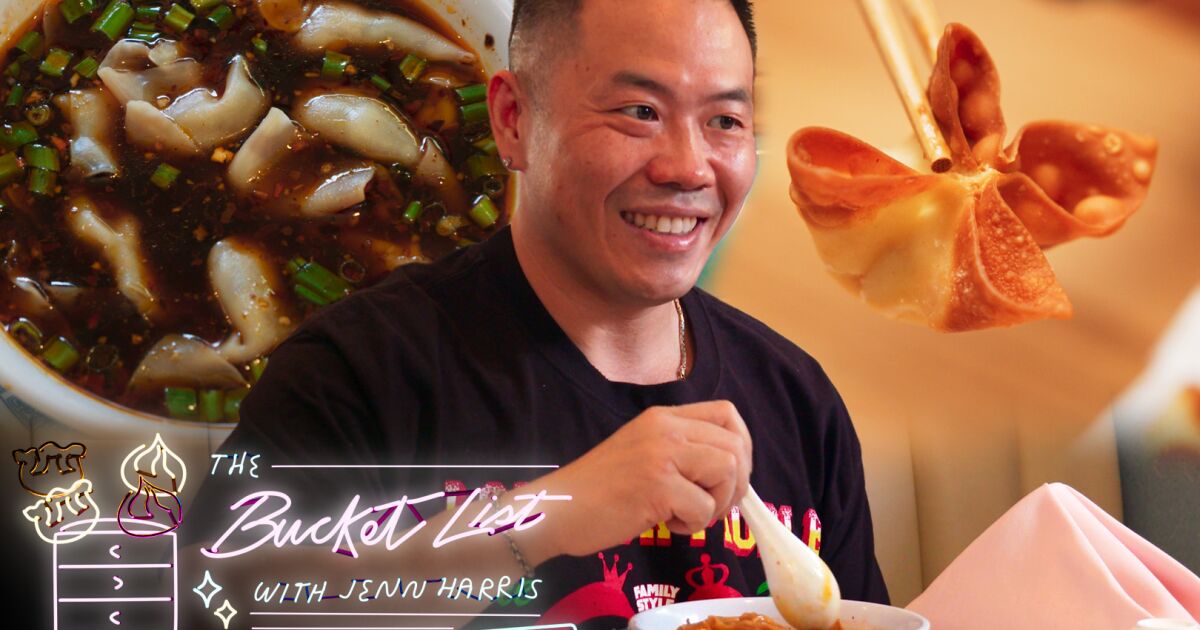
On this week’s episode of “The Bucket List: Dumplings,” we’ll explore two disparate styles of wontons with a visit to Yang Chow, one of the oldest Chinese restaurants serving Mandarin and Sichuan cuisine in Los Angeles, and to the P.F. Chang’s restaurant chain.
The original Yang Chow restaurant opened in Chinatown in the late ’70s. It’s still a family-run business, helmed by Benny Yun, whose father and grandfather opened the first Yang Chow.
At Yang Chow, the spicy wonton soup is a favorite, served as more of a giant bowl of dumpling dipping sauce than an actual soup. It’s made primarily with vinegar, soy and chile, with hot broth added to turn the condiment into a highly slurpable soup.
The thin-skinned wontons are filled with minced pork and shrimp, and folded so that there’s a noticeable excess of wrapper attached to each dumpling, to help soak up the soup.
During our interview, Yun wore a shirt with the words “love our people like you love our food” written across the front. We discussed the surge in crimes and racism targeting the AAPI community during the pandemic, and the racist remarks and calls he’s had to endure for years now. But he sees dumplings and the food from his family’s restaurants as a way to combat that hate and to introduce people to his culture.
The idea of taking something familiar enough like the wonton and adjusting it to anyone’s palate could be seen as the impetus for the crab and cream cheese-filled Crab Rangoon. These wontons have come to symbolize a blurring of cultural lines that’s helped places like P.F. Chang’s thrive around the world.
The restaurant chain was created in 1993 by Paul Fleming of the Fleming’s Prime steakhouses and Philip Chiang, whose mother Cecelia Chiang is credited with introducing American diners to a rich variety of Chinese cuisine in the ’60s with her restaurant the Mandarin in San Francisco, and later a location in Beverly Hills. Philip opened the Mandarette Café in Los Angeles in the ’80s, which served as the inspiration for the P.F. Chang’s restaurants. It’s still open on Beverly Boulevard in its original location, under different ownership. And yes, they now serve Crab Rangoons, though they were never on Chiang’s original menu. They are filled with real crab and cream cheese, similar to the ones you’ll find at P.F. Chang’s.
New episodes of “The Bucket List: Dumplings” will drop every week on YouTube. Make sure to subscribe to our channel and never miss a video.
Restaurants featured on this episode
Yang Chow, 819 N. Broadway, Los Angeles in Chinatown and at 3777 E Colorado Blvd, Pasadena, www.yangchow.com
P.F. Chang’s, multiple locations, including Cerritos, at www.pfchangs.com

The history of the wonton in America, like the history of any food, is a string of adaptations to circumstances. So, how exactly did we get to a place where my TikTok feed is full of crab and cheese wontons?
Wontons may be the most ubiquitous of all dumplings. They also seem to be the most chameleonic in terms of preparation and filling. They’re associated with Americanized Chinese food more than any other dumpling, often fried and tucked into countless takeout containers of chow mein and orange chicken.
Sometime during the last century, the wonton went from a humble thin-skinned dumpling often served in soup, to a deep-fried combination plate side dish and a popular vessel for crab and cream cheese.
On this week’s episode of “The Bucket List: Dumplings,” we’ll explore two disparate styles of wontons with a visit to Yang Chow, one of the oldest Chinese restaurants serving Mandarin and Sichuan cuisine in Los Angeles, and to the P.F. Chang’s restaurant chain.
The original Yang Chow restaurant opened in Chinatown in the late ’70s. It’s still a family-run business, helmed by Benny Yun, whose father and grandfather opened the first Yang Chow.
At Yang Chow, the spicy wonton soup is a favorite, served as more of a giant bowl of dumpling dipping sauce than an actual soup. It’s made primarily with vinegar, soy and chile, with hot broth added to turn the condiment into a highly slurpable soup.
The thin-skinned wontons are filled with minced pork and shrimp, and folded so that there’s a noticeable excess of wrapper attached to each dumpling, to help soak up the soup.
During our interview, Yun wore a shirt with the words “love our people like you love our food” written across the front. We discussed the surge in crimes and racism targeting the AAPI community during the pandemic, and the racist remarks and calls he’s had to endure for years now. But he sees dumplings and the food from his family’s restaurants as a way to combat that hate and to introduce people to his culture.
The idea of taking something familiar enough like the wonton and adjusting it to anyone’s palate could be seen as the impetus for the crab and cream cheese-filled Crab Rangoon. These wontons have come to symbolize a blurring of cultural lines that’s helped places like P.F. Chang’s thrive around the world.
The restaurant chain was created in 1993 by Paul Fleming of the Fleming’s Prime steakhouses and Philip Chiang, whose mother Cecelia Chiang is credited with introducing American diners to a rich variety of Chinese cuisine in the ’60s with her restaurant the Mandarin in San Francisco, and later a location in Beverly Hills. Philip opened the Mandarette Café in Los Angeles in the ’80s, which served as the inspiration for the P.F. Chang’s restaurants. It’s still open on Beverly Boulevard in its original location, under different ownership. And yes, they now serve Crab Rangoons, though they were never on Chiang’s original menu. They are filled with real crab and cream cheese, similar to the ones you’ll find at P.F. Chang’s.
New episodes of “The Bucket List: Dumplings” will drop every week on YouTube. Make sure to subscribe to our channel and never miss a video.
Restaurants featured on this episode
Yang Chow, 819 N. Broadway, Los Angeles in Chinatown and at 3777 E Colorado Blvd, Pasadena, www.yangchow.com
P.F. Chang’s, multiple locations, including Cerritos, at www.pfchangs.com

The history of the wonton in America, like the history of any food, is a string of adaptations to circumstances. So, how exactly did we get to a place where my TikTok feed is full of crab and cheese wontons?
Wontons may be the most ubiquitous of all dumplings. They also seem to be the most chameleonic in terms of preparation and filling. They’re associated with Americanized Chinese food more than any other dumpling, often fried and tucked into countless takeout containers of chow mein and orange chicken.
Sometime during the last century, the wonton went from a humble thin-skinned dumpling often served in soup, to a deep-fried combination plate side dish and a popular vessel for crab and cream cheese.
On this week’s episode of “The Bucket List: Dumplings,” we’ll explore two disparate styles of wontons with a visit to Yang Chow, one of the oldest Chinese restaurants serving Mandarin and Sichuan cuisine in Los Angeles, and to the P.F. Chang’s restaurant chain.
The original Yang Chow restaurant opened in Chinatown in the late ’70s. It’s still a family-run business, helmed by Benny Yun, whose father and grandfather opened the first Yang Chow.
At Yang Chow, the spicy wonton soup is a favorite, served as more of a giant bowl of dumpling dipping sauce than an actual soup. It’s made primarily with vinegar, soy and chile, with hot broth added to turn the condiment into a highly slurpable soup.
The thin-skinned wontons are filled with minced pork and shrimp, and folded so that there’s a noticeable excess of wrapper attached to each dumpling, to help soak up the soup.
During our interview, Yun wore a shirt with the words “love our people like you love our food” written across the front. We discussed the surge in crimes and racism targeting the AAPI community during the pandemic, and the racist remarks and calls he’s had to endure for years now. But he sees dumplings and the food from his family’s restaurants as a way to combat that hate and to introduce people to his culture.
The idea of taking something familiar enough like the wonton and adjusting it to anyone’s palate could be seen as the impetus for the crab and cream cheese-filled Crab Rangoon. These wontons have come to symbolize a blurring of cultural lines that’s helped places like P.F. Chang’s thrive around the world.
The restaurant chain was created in 1993 by Paul Fleming of the Fleming’s Prime steakhouses and Philip Chiang, whose mother Cecelia Chiang is credited with introducing American diners to a rich variety of Chinese cuisine in the ’60s with her restaurant the Mandarin in San Francisco, and later a location in Beverly Hills. Philip opened the Mandarette Café in Los Angeles in the ’80s, which served as the inspiration for the P.F. Chang’s restaurants. It’s still open on Beverly Boulevard in its original location, under different ownership. And yes, they now serve Crab Rangoons, though they were never on Chiang’s original menu. They are filled with real crab and cream cheese, similar to the ones you’ll find at P.F. Chang’s.
New episodes of “The Bucket List: Dumplings” will drop every week on YouTube. Make sure to subscribe to our channel and never miss a video.
Restaurants featured on this episode
Yang Chow, 819 N. Broadway, Los Angeles in Chinatown and at 3777 E Colorado Blvd, Pasadena, www.yangchow.com
P.F. Chang’s, multiple locations, including Cerritos, at www.pfchangs.com
The history of the wonton in America, like the history of any food, is a string of adaptations to circumstances. So, how exactly did we get to a place where my TikTok feed is full of crab and cheese wontons?
Wontons may be the most ubiquitous of all dumplings. They also seem to be the most chameleonic in terms of preparation and filling. They’re associated with Americanized Chinese food more than any other dumpling, often fried and tucked into countless takeout containers of chow mein and orange chicken.
Sometime during the last century, the wonton went from a humble thin-skinned dumpling often served in soup, to a deep-fried combination plate side dish and a popular vessel for crab and cream cheese.
On this week’s episode of “The Bucket List: Dumplings,” we’ll explore two disparate styles of wontons with a visit to Yang Chow, one of the oldest Chinese restaurants serving Mandarin and Sichuan cuisine in Los Angeles, and to the P.F. Chang’s restaurant chain.
The original Yang Chow restaurant opened in Chinatown in the late ’70s. It’s still a family-run business, helmed by Benny Yun, whose father and grandfather opened the first Yang Chow.
At Yang Chow, the spicy wonton soup is a favorite, served as more of a giant bowl of dumpling dipping sauce than an actual soup. It’s made primarily with vinegar, soy and chile, with hot broth added to turn the condiment into a highly slurpable soup.
The thin-skinned wontons are filled with minced pork and shrimp, and folded so that there’s a noticeable excess of wrapper attached to each dumpling, to help soak up the soup.
During our interview, Yun wore a shirt with the words “love our people like you love our food” written across the front. We discussed the surge in crimes and racism targeting the AAPI community during the pandemic, and the racist remarks and calls he’s had to endure for years now. But he sees dumplings and the food from his family’s restaurants as a way to combat that hate and to introduce people to his culture.
The idea of taking something familiar enough like the wonton and adjusting it to anyone’s palate could be seen as the impetus for the crab and cream cheese-filled Crab Rangoon. These wontons have come to symbolize a blurring of cultural lines that’s helped places like P.F. Chang’s thrive around the world.
The restaurant chain was created in 1993 by Paul Fleming of the Fleming’s Prime steakhouses and Philip Chiang, whose mother Cecelia Chiang is credited with introducing American diners to a rich variety of Chinese cuisine in the ’60s with her restaurant the Mandarin in San Francisco, and later a location in Beverly Hills. Philip opened the Mandarette Café in Los Angeles in the ’80s, which served as the inspiration for the P.F. Chang’s restaurants. It’s still open on Beverly Boulevard in its original location, under different ownership. And yes, they now serve Crab Rangoons, though they were never on Chiang’s original menu. They are filled with real crab and cream cheese, similar to the ones you’ll find at P.F. Chang’s.
New episodes of “The Bucket List: Dumplings” will drop every week on YouTube. Make sure to subscribe to our channel and never miss a video.
Restaurants featured on this episode
Yang Chow, 819 N. Broadway, Los Angeles in Chinatown and at 3777 E Colorado Blvd, Pasadena, www.yangchow.com
P.F. Chang’s, multiple locations, including Cerritos, at www.pfchangs.com

The history of the wonton in America, like the history of any food, is a string of adaptations to circumstances. So, how exactly did we get to a place where my TikTok feed is full of crab and cheese wontons?
Wontons may be the most ubiquitous of all dumplings. They also seem to be the most chameleonic in terms of preparation and filling. They’re associated with Americanized Chinese food more than any other dumpling, often fried and tucked into countless takeout containers of chow mein and orange chicken.
Sometime during the last century, the wonton went from a humble thin-skinned dumpling often served in soup, to a deep-fried combination plate side dish and a popular vessel for crab and cream cheese.
On this week’s episode of “The Bucket List: Dumplings,” we’ll explore two disparate styles of wontons with a visit to Yang Chow, one of the oldest Chinese restaurants serving Mandarin and Sichuan cuisine in Los Angeles, and to the P.F. Chang’s restaurant chain.
The original Yang Chow restaurant opened in Chinatown in the late ’70s. It’s still a family-run business, helmed by Benny Yun, whose father and grandfather opened the first Yang Chow.
At Yang Chow, the spicy wonton soup is a favorite, served as more of a giant bowl of dumpling dipping sauce than an actual soup. It’s made primarily with vinegar, soy and chile, with hot broth added to turn the condiment into a highly slurpable soup.
The thin-skinned wontons are filled with minced pork and shrimp, and folded so that there’s a noticeable excess of wrapper attached to each dumpling, to help soak up the soup.
During our interview, Yun wore a shirt with the words “love our people like you love our food” written across the front. We discussed the surge in crimes and racism targeting the AAPI community during the pandemic, and the racist remarks and calls he’s had to endure for years now. But he sees dumplings and the food from his family’s restaurants as a way to combat that hate and to introduce people to his culture.
The idea of taking something familiar enough like the wonton and adjusting it to anyone’s palate could be seen as the impetus for the crab and cream cheese-filled Crab Rangoon. These wontons have come to symbolize a blurring of cultural lines that’s helped places like P.F. Chang’s thrive around the world.
The restaurant chain was created in 1993 by Paul Fleming of the Fleming’s Prime steakhouses and Philip Chiang, whose mother Cecelia Chiang is credited with introducing American diners to a rich variety of Chinese cuisine in the ’60s with her restaurant the Mandarin in San Francisco, and later a location in Beverly Hills. Philip opened the Mandarette Café in Los Angeles in the ’80s, which served as the inspiration for the P.F. Chang’s restaurants. It’s still open on Beverly Boulevard in its original location, under different ownership. And yes, they now serve Crab Rangoons, though they were never on Chiang’s original menu. They are filled with real crab and cream cheese, similar to the ones you’ll find at P.F. Chang’s.
New episodes of “The Bucket List: Dumplings” will drop every week on YouTube. Make sure to subscribe to our channel and never miss a video.
Restaurants featured on this episode
Yang Chow, 819 N. Broadway, Los Angeles in Chinatown and at 3777 E Colorado Blvd, Pasadena, www.yangchow.com
P.F. Chang’s, multiple locations, including Cerritos, at www.pfchangs.com
The history of the wonton in America, like the history of any food, is a string of adaptations to circumstances. So, how exactly did we get to a place where my TikTok feed is full of crab and cheese wontons?
Wontons may be the most ubiquitous of all dumplings. They also seem to be the most chameleonic in terms of preparation and filling. They’re associated with Americanized Chinese food more than any other dumpling, often fried and tucked into countless takeout containers of chow mein and orange chicken.
Sometime during the last century, the wonton went from a humble thin-skinned dumpling often served in soup, to a deep-fried combination plate side dish and a popular vessel for crab and cream cheese.
On this week’s episode of “The Bucket List: Dumplings,” we’ll explore two disparate styles of wontons with a visit to Yang Chow, one of the oldest Chinese restaurants serving Mandarin and Sichuan cuisine in Los Angeles, and to the P.F. Chang’s restaurant chain.
The original Yang Chow restaurant opened in Chinatown in the late ’70s. It’s still a family-run business, helmed by Benny Yun, whose father and grandfather opened the first Yang Chow.
At Yang Chow, the spicy wonton soup is a favorite, served as more of a giant bowl of dumpling dipping sauce than an actual soup. It’s made primarily with vinegar, soy and chile, with hot broth added to turn the condiment into a highly slurpable soup.
The thin-skinned wontons are filled with minced pork and shrimp, and folded so that there’s a noticeable excess of wrapper attached to each dumpling, to help soak up the soup.
During our interview, Yun wore a shirt with the words “love our people like you love our food” written across the front. We discussed the surge in crimes and racism targeting the AAPI community during the pandemic, and the racist remarks and calls he’s had to endure for years now. But he sees dumplings and the food from his family’s restaurants as a way to combat that hate and to introduce people to his culture.
The idea of taking something familiar enough like the wonton and adjusting it to anyone’s palate could be seen as the impetus for the crab and cream cheese-filled Crab Rangoon. These wontons have come to symbolize a blurring of cultural lines that’s helped places like P.F. Chang’s thrive around the world.
The restaurant chain was created in 1993 by Paul Fleming of the Fleming’s Prime steakhouses and Philip Chiang, whose mother Cecelia Chiang is credited with introducing American diners to a rich variety of Chinese cuisine in the ’60s with her restaurant the Mandarin in San Francisco, and later a location in Beverly Hills. Philip opened the Mandarette Café in Los Angeles in the ’80s, which served as the inspiration for the P.F. Chang’s restaurants. It’s still open on Beverly Boulevard in its original location, under different ownership. And yes, they now serve Crab Rangoons, though they were never on Chiang’s original menu. They are filled with real crab and cream cheese, similar to the ones you’ll find at P.F. Chang’s.
New episodes of “The Bucket List: Dumplings” will drop every week on YouTube. Make sure to subscribe to our channel and never miss a video.
Restaurants featured on this episode
Yang Chow, 819 N. Broadway, Los Angeles in Chinatown and at 3777 E Colorado Blvd, Pasadena, www.yangchow.com
P.F. Chang’s, multiple locations, including Cerritos, at www.pfchangs.com
The history of the wonton in America, like the history of any food, is a string of adaptations to circumstances. So, how exactly did we get to a place where my TikTok feed is full of crab and cheese wontons?
Wontons may be the most ubiquitous of all dumplings. They also seem to be the most chameleonic in terms of preparation and filling. They’re associated with Americanized Chinese food more than any other dumpling, often fried and tucked into countless takeout containers of chow mein and orange chicken.
Sometime during the last century, the wonton went from a humble thin-skinned dumpling often served in soup, to a deep-fried combination plate side dish and a popular vessel for crab and cream cheese.
On this week’s episode of “The Bucket List: Dumplings,” we’ll explore two disparate styles of wontons with a visit to Yang Chow, one of the oldest Chinese restaurants serving Mandarin and Sichuan cuisine in Los Angeles, and to the P.F. Chang’s restaurant chain.
The original Yang Chow restaurant opened in Chinatown in the late ’70s. It’s still a family-run business, helmed by Benny Yun, whose father and grandfather opened the first Yang Chow.
At Yang Chow, the spicy wonton soup is a favorite, served as more of a giant bowl of dumpling dipping sauce than an actual soup. It’s made primarily with vinegar, soy and chile, with hot broth added to turn the condiment into a highly slurpable soup.
The thin-skinned wontons are filled with minced pork and shrimp, and folded so that there’s a noticeable excess of wrapper attached to each dumpling, to help soak up the soup.
During our interview, Yun wore a shirt with the words “love our people like you love our food” written across the front. We discussed the surge in crimes and racism targeting the AAPI community during the pandemic, and the racist remarks and calls he’s had to endure for years now. But he sees dumplings and the food from his family’s restaurants as a way to combat that hate and to introduce people to his culture.
The idea of taking something familiar enough like the wonton and adjusting it to anyone’s palate could be seen as the impetus for the crab and cream cheese-filled Crab Rangoon. These wontons have come to symbolize a blurring of cultural lines that’s helped places like P.F. Chang’s thrive around the world.
The restaurant chain was created in 1993 by Paul Fleming of the Fleming’s Prime steakhouses and Philip Chiang, whose mother Cecelia Chiang is credited with introducing American diners to a rich variety of Chinese cuisine in the ’60s with her restaurant the Mandarin in San Francisco, and later a location in Beverly Hills. Philip opened the Mandarette Café in Los Angeles in the ’80s, which served as the inspiration for the P.F. Chang’s restaurants. It’s still open on Beverly Boulevard in its original location, under different ownership. And yes, they now serve Crab Rangoons, though they were never on Chiang’s original menu. They are filled with real crab and cream cheese, similar to the ones you’ll find at P.F. Chang’s.
New episodes of “The Bucket List: Dumplings” will drop every week on YouTube. Make sure to subscribe to our channel and never miss a video.
Restaurants featured on this episode
Yang Chow, 819 N. Broadway, Los Angeles in Chinatown and at 3777 E Colorado Blvd, Pasadena, www.yangchow.com
P.F. Chang’s, multiple locations, including Cerritos, at www.pfchangs.com
The history of the wonton in America, like the history of any food, is a string of adaptations to circumstances. So, how exactly did we get to a place where my TikTok feed is full of crab and cheese wontons?
Wontons may be the most ubiquitous of all dumplings. They also seem to be the most chameleonic in terms of preparation and filling. They’re associated with Americanized Chinese food more than any other dumpling, often fried and tucked into countless takeout containers of chow mein and orange chicken.
Sometime during the last century, the wonton went from a humble thin-skinned dumpling often served in soup, to a deep-fried combination plate side dish and a popular vessel for crab and cream cheese.
On this week’s episode of “The Bucket List: Dumplings,” we’ll explore two disparate styles of wontons with a visit to Yang Chow, one of the oldest Chinese restaurants serving Mandarin and Sichuan cuisine in Los Angeles, and to the P.F. Chang’s restaurant chain.
The original Yang Chow restaurant opened in Chinatown in the late ’70s. It’s still a family-run business, helmed by Benny Yun, whose father and grandfather opened the first Yang Chow.
At Yang Chow, the spicy wonton soup is a favorite, served as more of a giant bowl of dumpling dipping sauce than an actual soup. It’s made primarily with vinegar, soy and chile, with hot broth added to turn the condiment into a highly slurpable soup.
The thin-skinned wontons are filled with minced pork and shrimp, and folded so that there’s a noticeable excess of wrapper attached to each dumpling, to help soak up the soup.
During our interview, Yun wore a shirt with the words “love our people like you love our food” written across the front. We discussed the surge in crimes and racism targeting the AAPI community during the pandemic, and the racist remarks and calls he’s had to endure for years now. But he sees dumplings and the food from his family’s restaurants as a way to combat that hate and to introduce people to his culture.
The idea of taking something familiar enough like the wonton and adjusting it to anyone’s palate could be seen as the impetus for the crab and cream cheese-filled Crab Rangoon. These wontons have come to symbolize a blurring of cultural lines that’s helped places like P.F. Chang’s thrive around the world.
The restaurant chain was created in 1993 by Paul Fleming of the Fleming’s Prime steakhouses and Philip Chiang, whose mother Cecelia Chiang is credited with introducing American diners to a rich variety of Chinese cuisine in the ’60s with her restaurant the Mandarin in San Francisco, and later a location in Beverly Hills. Philip opened the Mandarette Café in Los Angeles in the ’80s, which served as the inspiration for the P.F. Chang’s restaurants. It’s still open on Beverly Boulevard in its original location, under different ownership. And yes, they now serve Crab Rangoons, though they were never on Chiang’s original menu. They are filled with real crab and cream cheese, similar to the ones you’ll find at P.F. Chang’s.
New episodes of “The Bucket List: Dumplings” will drop every week on YouTube. Make sure to subscribe to our channel and never miss a video.
Restaurants featured on this episode
Yang Chow, 819 N. Broadway, Los Angeles in Chinatown and at 3777 E Colorado Blvd, Pasadena, www.yangchow.com
P.F. Chang’s, multiple locations, including Cerritos, at www.pfchangs.com


