

VENICE, Italy — As I settled in last week for Danny Boyle’s “Ink,” the opening night selection of the 2026 Venice Film Festival, a full-page pull quote in one of the dailies that circulate on the Lido caught my eye from across the aisle: “Art that feeds on politics will eventually die of malnutrition.”
The work of Lamborghini chief executive-turned-contemporary artist Patrick Mimran, whose Billboard Project brought 42 such aphorisms to the city at the start of the Biennale in May, this bumper-sticker provocation registered, 6,000 miles from Hollywood, like a message in a bottle from the American entertainment industry. Especially since the 2024 presidential election, as executives curry favor with statesmen and filmmakers attempt to stay above the fray, contemporary political cinema has come under fire, displaced by the savvier business of “comfort viewing” and dismissed as a pitiable remnant of “Woke 1.0.”
Trust me, I get it. I came of age in the shadow of the wars in Afghanistan and Iraq, an era which produced more than its fair share of wooden misfires (such as “World Trade Center,” “Lions for Lambs,” “Rendition” and “Extremely Loud & Incredibly Close”) and remarkably few masterpieces (among them “25th Hour” and, yes, “Zero Dark Thirty”). Then the advent of social media, and its evolution from town square to news ticker to outrage mill, created an incentive for obsessive fans and craven commentators to demand more of art than it can bear. Skepticism of expressly political pop culture, particularly in the U.S. context, hasn’t come out of nowhere.
The problem, as I see it, stems from both the urgency of the crisis we’re in and the misplacement of the skepticism. Whether the issue is climate change, authoritarianism, income inequality or one of countless others, our troubles are more acute now than they were 10, 20, 30 years ago, yet cases of absurd overreach — say, the recent X.com user who disavowed “The Godfather” over its “primarily male fanbase” — continue to be turned into a cudgel against those of us who see the ideological content of movies as eminently fair game for analysis.
At the risk of being labeled a complainer, score-settler or scold, I find the lamentation about an underwhelming Cannes and the lack of major awards contenders at Venice, where political films dominated the official selections, tacitly censorious in its own right. Art is no more worthwhile because it is amoral than because it is moral, and the brush-off regularly given to the subgenre by categorizing it alongside “educational television” or “cancel culture” seems to me a useful fiction, particularly for those who wish to frame trauma-plot flashbacks and dime-store psychoanalysis as nuanced by comparison.
“Hombre Al Agua.”
(Venice Film Festival)
As in “A Liberdade” (Freedom), the black-and-white melodrama Camilo (Gael García Bernal) watches in his downtime in “Hombre Al Agua,” this perspective imagines onscreen politics as studded with ideological proclamations and quotations from Karl Marx. So perhaps it’s karma that Bernal’s third feature as director, in which his Cuban lifeguard is plucked from obscurity to marry into the family (business) of a Mexican millionaire, squanders a pair of promising subplots — about the magnate’s Trumpian foray into Yucatán politics, and his factory workers’ effort to make a documentary about his abuses — to focus on a domestic farce about Camilo’s spoiled wife making her own biopic.
Although “Hombre Al Agua’s” blithe spirit conceives a handful of hilarious images, such as Camilo’s wealthy father-in-law struggling to kayak for a campaign ad, its comedy of manners comes off as shallow as the glorified mud puddle he’s paddling through. Florian Zeller’s “Bunker” at least implicates its characters in the politics it professes. Starring Javier Bardem as Miguel, a successful architect offered a commission to build a tech baron an underground bunker, the film recognizes that the bunker mentality of the upper middle classes — literally and figuratively walling themselves off from their neighbors — reinforces at scale a similar separation between mere privilege and actual obscenity. “Bunker’s” issue isn’t its politics so much as how to present them: In unwieldily combining satire, family drama and finally thriller, it ill serves all three.

“Bunker.”
(Venice Film Festival)
At least they’re trying. In a culture of aggregation and AI summary, the stiffest original thinking still feels as supple as a tone poem, and genuine intellectual ambition akin to a secular miracle. To wit, the best film I’ve seen so far this year, Ryûsuke Hamaguchi’s luminous examination of modern sickness, aging and death, “All of a Sudden,” has at its center a bravura lecture on political economy, whiteboard and all, that I found myself defending to several people who found it pretentious, if not absurd. As Mari (Tao Okamoto) diagrams capitalism and its consequences for Marie-Lou (Virginie Efira) over wee-hours coffee, the passage’s sustained attention to ideology gathers the propulsive force of a dorm-room argument or a shared cigarette outside the bar. It’s alive with the act of thinking politically in motion, where our principles meet the messiness of everyday life.
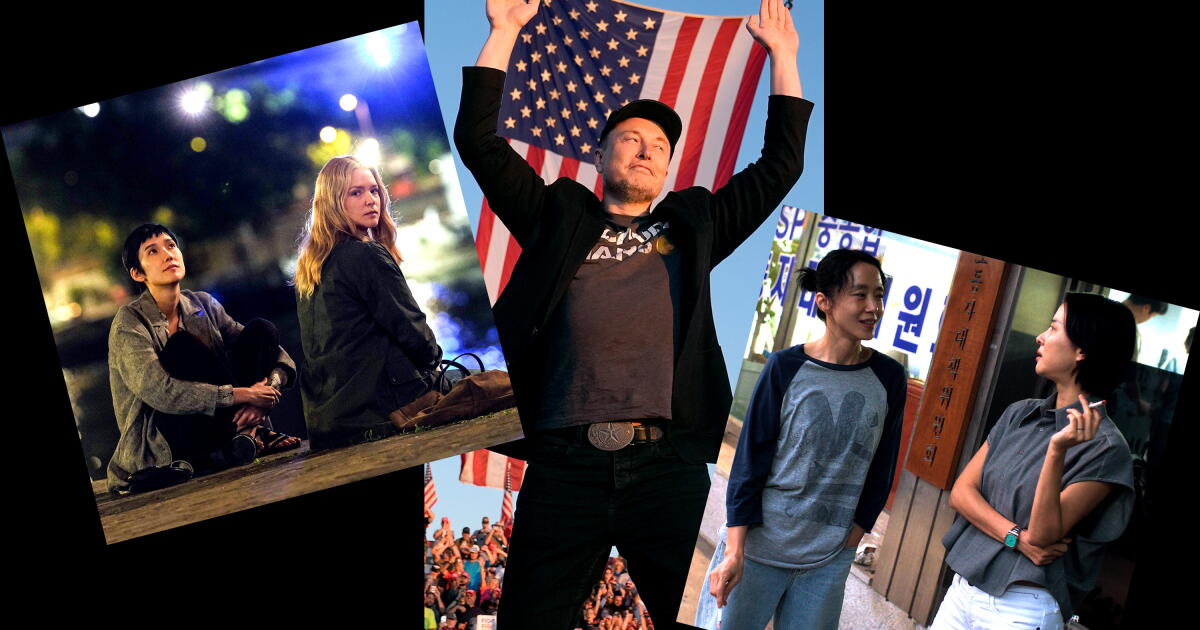
“Success” for political cinema might thus be defined as not having to toggle between personal foreground and ideological backdrop at all. Lee Chang-dong’s superb “Possible Love,” for instance, generates its explosively intimate finale by first investing us in the saga of strikers reeling from a brutal government crackdown. Seen through the prism of the slippery, electric chemistry between a documentarian (Cho Yeo-jeong) and her working-class subject (Jeon Do-yeon), labor relations shape the pair’s connection, conflict and ultimate break until it’s hard to know where personal begins and political ends.
But even at its most explicit, in documentaries, political cinema acts as an antidote to the culture’s wearying vogue for escapism. Alex Gibney’s polemic “Musk,” the most comprehensive dismantling of Elon Musk’s mythos to date, portrays the world’s richest man as the product not of genius but of mendacity and dumb luck, failing upward from Silicon Valley startup culture to the right hand of the president. The film amasses so much evidence, in such strenuous detail, that it practically forces the viewer not to look away. No matter how pathetic his yearning for approval or preposterous his self-promotion, “Musk” posits, we must consider the South African magnate, above all else, as extremely dangerous.
The film is also so up-to-date as to read like a warning from the not-so-distant future. A passing glimpse of Musk speaking via video feed to the far-right Alternative for Germany party in 2025 becomes highly foreboding, for example, when seen just days after the group’s triumph in parliamentary elections in the eastern part of the country. Similarly, many of the revelations in “NAZA,” from “No Other Land” Oscar winners Yuval Abraham and Rachel Szor, were reported in producer The Guardian in the course of filming. But political cinema is capable of conjuring visual ideas that textual journalism and spoken rhetoric cannot. Plunging its sources into the darkness of Tel Aviv rooftops at night to protect their identities, “NAZA,” named after an Israeli military euphemism for civilian deaths, is one of the most striking-looking investigative documentaries in recent memory. Drawing a contrast between Israelis framed in their lamp-lit windows, going about their lives, and evidence from testimonies, hand-drawn diagrams and archival footage of their government’s war crimes against Palestinians, the film establishes that the psychic distance between Tel Aviv and Gaza is far greater than the 60 kilometers marked on the map. More radically, though, it paints a populace anesthetized by propaganda as culpable in those crimes: The most frequent activity we see through the neighbors’ windows in “NAZA” is watching patriotic news coverage, right-wing commentators and Prime Minister Benjamin Netanyahu on TV.

“NAZA.”
(Venice Film Festival)
Next to the suggestion that art which feeds on politics will eventually die of malnutrition, such images are a potent reminder that we are, in fact, already starving. In the American context, after all, Oscar season is just about the last place for broad, sustained attention to challenging studio fare, bold independents, international features and documentaries. With any luck we’ll be chewing over a number of the films discussed here, along with Mike Leigh’s delicate slice of the lives of social workers “Tender Loving Care” and Palme d’Or winner “Fjord,” about the Kafkaesque rituals of Norway’s family court, for months to come, but it’s hard not to see this compartmentalization as depressing, if not dangerous. Against the risks of didacticism — or, God forbid, “preachiness” — I’ll take the productive tension of the occasional cliché or bald statement of purpose. When evangelists of evil are in the ascendance, haven’t the just earned a sermon of their own?
The question comes up directly in “Exile,” the second part of Julia Loktev’s 11-hour magnum opus “My Undesirable Friends,” in which Novaya Gazeta investigative correspondent Elena Kostyuchenko — who will later be poisoned for her efforts to report on the war in Ukraine and Russia’s authoritarian regime — rails against the “bull—” notion that journalists cannot, or should not, be activists.
As fellow subject Irina Dolinina explained last year in in Part I, “Last Air in Moscow,” the desire to remain objective — amoral — can easily bleed into apathy: “It’s very popular to say ‘We’re not interested in politics.’ It’s a veiled way to say, ‘We aren’t interested in the world around us. I’m only interested in myself, what I’ll do tonight, what movie [I’ll see].’”

“My Undesirable Friends: Part II — Exile.”
(Venice Film Festival)
This time around, Dolinina and the other subjects of Loktev’s riveting group portrait are thrown to the four winds by Vladimir Putin’s attacks on the press. In the process,”Exile” drives home the fact that the most mundane acts are not political — not just attending a protest or reporting a story, but checking into a hotel, opening a bank account, selling an apartment. Yet for all its hard truths about life under fascism, for all its subjects’ suffering as they flit from Istanbul to Tbilisi, Riga to Amersterdam, when the ninth of 10 chapters in “My Undesirable Friends” turned I found myself, almost unbelievably, not wanting it to end. Loktev’s friends had become mine too — their personalities, politics and future prospects as important to my understanding of the world as if they worked in the next cubicle or lived on the next block.
The connection I made to “My Undesirable Friends” runs deeper than mere identification, though. In conversation with other Venice premieres like “Musk,” a portrait of Russian-style oligarchy right here at home; “Possible Love,” a response to the rapacious brand of capitalism we’ve exported abroad; and “NAZA,” an indictment of the Israeli government knowingly killing Palestinian civilians, enabled by successive U.S. presidential administrations, “Exile” seemed to me to sound a warning for viewers back in Hollywood much like Irina’s complaint about her sleepwalking countrymen. We may not be interested in politics, but politics are sure as hell interested in us.
This capacity for solidarity-building is the true transformative power of political cinema, which needn’t persuade us that we are all alike so much as show us that in our differences we remain connected. After all, the coming fight — scratch that, the current one — is greater than any nation or art form, and in it I would suggest that even the bluntest weapons are best left on the table. To paraphrase that adage about climate change one now finds recirculating on social media during any fire or flood, the politics of the foreseeable future will manifest as a series of disasters viewed through footage that gets closer and closer to where you live.
Until you’re the one filming it.