
The lure for music stars to cinematize their success will never grow old, and the movies — in need of high-wattage attractions as ever — always seem ready to oblige. The latest to enter that terrain is Abel Tesfaye, the artist known as the Weeknd, whose chart-toppers over the last decade-plus have painted, in club colors and through his haunted falsetto, a hedonist performer’s ups and downs.
It’s one thing to croon about the aftertaste of youthful excess to a dirty, mesmerizing dance beat, however, and another to draw the subject out to a compelling feature length, which the turgid psychodrama “Hurry Up Tomorrow,” starring Tesfaye and directed by Trey Edward Shults, mostly fails to do. But not for lack of trying from the visually vibey “Waves” filmmaker, who wrote the movie with Tesfaye and Reza Fahim, and from co-stars Jenna Ortega and Barry Keoghan, roped into playing along in the superstar’s sandbox of tour-nightmare solipsism.
The title also belongs to the latest hit album of Tesfaye’s, released this year, which the singer-songwriter has hinted in the press to be a redemptive mic drop of sorts for his mysterious sex-and-drugs-fueled Weeknd persona. Whether you call the film a promotional tie-in or companion piece — it was filmed two years ago, before all the album’s tracks were recorded — it’s still little more than a long-form music video vanity project, straining for importance, fumbling at resonance.
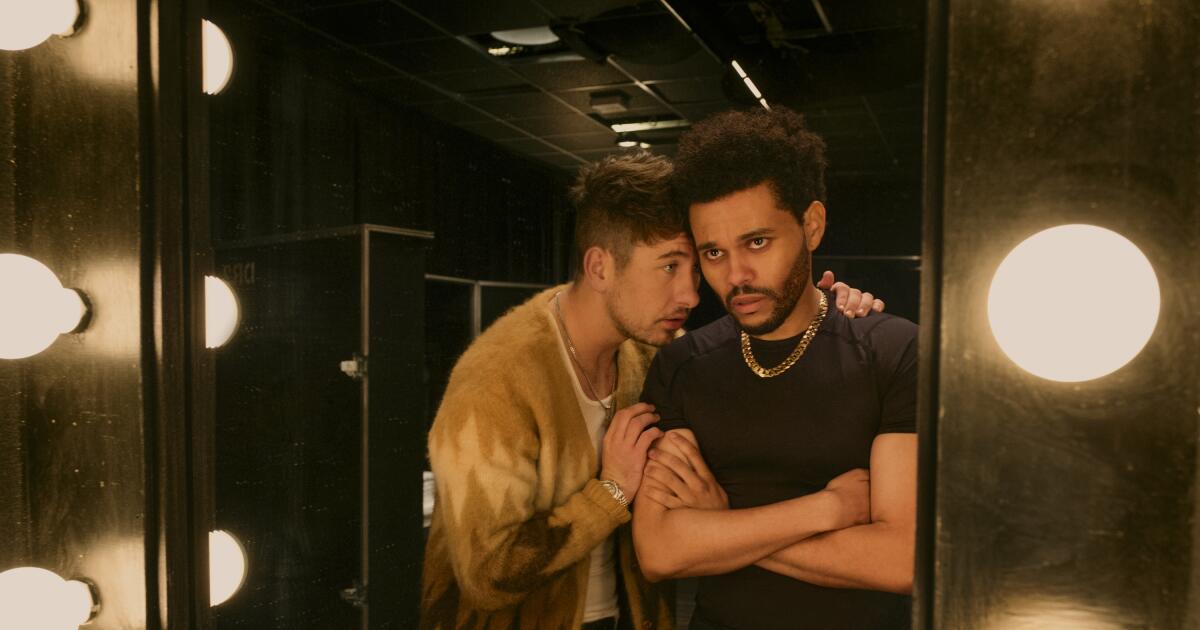
A tight frame on Tesfaye’s boyish, anxious-looking face, his angry girlfriend’s breakup voice message (“I used to think you were a good person!”), and superficial pumping up from his manager (a bro-mode Keoghan), let us know all is not right backstage for this musician on the first night of a big tour. Elsewhere, a distraught young woman (Ortega) drenches a house’s interior with gasoline and sets it on fire, then drives to a gas station to refill her canister.
These tortured souls meet the night his coked-up, busted-heart malaise triggers a walk-off midperformance, and she’s there backstage to lock eyes with him and ask if he’s OK. (He’s not!) From there it’s an escapist date of air hockey, carnival rides and, once they settle in a fancy hotel room, the sharing of a sensitive new song.
In the cold light of day, though, when her vulnerabilities bump up against his reset untouchability — Ortega gets a great line, “You don’t look worried, you look scared” — this impulsive star/fan connection takes a violent turn. Anyone familiar with the HBO series “The Idol” that Tesfaye co-created will soon sense an unwelcome reprise of that short-lived showbiz yarn’s retrograde misogyny.
The germ of an edgy fantasia about an isolated pop icon’s ego death is swimming somewhere in the DNA of “Hurry Up Tomorrow,” but it’s been flattened into a superficial, tear-stained pity party. Shults and cinematographer Chayse Irvin are gifted image makers, but they seem hamstrung applying their bag of style tricks — different aspect ratios, multiple film stocks, 360 shots and roving takes — to so shallow and prideful an exercise. There’s always something to look at but little that illuminates.
As for Tesfaye, he’s not uninteresting as a screen presence, but it’s an embryonic magnetism, in need of material richer than a bunch of close-ups that culminate in a howl of a ballad. In the flimsy narrative’s pseudo-biographical contours — notably the real-life voice loss he experienced onstage a few years ago — parallels to what Prince sought to achieve with the real-life-drawn “Purple Rain” are understandable. But that film was a cannier bid for next-level success, offsetting its three-act corniness with emotional stakes that led to a crescendo of its genius headliner’s performance prowess.
“Hurry Up Tomorrow” is thinner and sloppier. It won’t slam the door on Tesfaye’s movie ambitions, but as a bid to conquer the big screen, it’s an off-putting, see-what-sticks wallow that treats the power of cinema like a midconcert costume change.
‘Hurry Up Tomorrow’
Rated: R for language throughout, drug use, some bloody violence and brief nudity
Running time: 1 hour, 45 minutes
Playing: In wide release

The lure for music stars to cinematize their success will never grow old, and the movies — in need of high-wattage attractions as ever — always seem ready to oblige. The latest to enter that terrain is Abel Tesfaye, the artist known as the Weeknd, whose chart-toppers over the last decade-plus have painted, in club colors and through his haunted falsetto, a hedonist performer’s ups and downs.
It’s one thing to croon about the aftertaste of youthful excess to a dirty, mesmerizing dance beat, however, and another to draw the subject out to a compelling feature length, which the turgid psychodrama “Hurry Up Tomorrow,” starring Tesfaye and directed by Trey Edward Shults, mostly fails to do. But not for lack of trying from the visually vibey “Waves” filmmaker, who wrote the movie with Tesfaye and Reza Fahim, and from co-stars Jenna Ortega and Barry Keoghan, roped into playing along in the superstar’s sandbox of tour-nightmare solipsism.
The title also belongs to the latest hit album of Tesfaye’s, released this year, which the singer-songwriter has hinted in the press to be a redemptive mic drop of sorts for his mysterious sex-and-drugs-fueled Weeknd persona. Whether you call the film a promotional tie-in or companion piece — it was filmed two years ago, before all the album’s tracks were recorded — it’s still little more than a long-form music video vanity project, straining for importance, fumbling at resonance.
A tight frame on Tesfaye’s boyish, anxious-looking face, his angry girlfriend’s breakup voice message (“I used to think you were a good person!”), and superficial pumping up from his manager (a bro-mode Keoghan), let us know all is not right backstage for this musician on the first night of a big tour. Elsewhere, a distraught young woman (Ortega) drenches a house’s interior with gasoline and sets it on fire, then drives to a gas station to refill her canister.
These tortured souls meet the night his coked-up, busted-heart malaise triggers a walk-off midperformance, and she’s there backstage to lock eyes with him and ask if he’s OK. (He’s not!) From there it’s an escapist date of air hockey, carnival rides and, once they settle in a fancy hotel room, the sharing of a sensitive new song.
In the cold light of day, though, when her vulnerabilities bump up against his reset untouchability — Ortega gets a great line, “You don’t look worried, you look scared” — this impulsive star/fan connection takes a violent turn. Anyone familiar with the HBO series “The Idol” that Tesfaye co-created will soon sense an unwelcome reprise of that short-lived showbiz yarn’s retrograde misogyny.
The germ of an edgy fantasia about an isolated pop icon’s ego death is swimming somewhere in the DNA of “Hurry Up Tomorrow,” but it’s been flattened into a superficial, tear-stained pity party. Shults and cinematographer Chayse Irvin are gifted image makers, but they seem hamstrung applying their bag of style tricks — different aspect ratios, multiple film stocks, 360 shots and roving takes — to so shallow and prideful an exercise. There’s always something to look at but little that illuminates.
As for Tesfaye, he’s not uninteresting as a screen presence, but it’s an embryonic magnetism, in need of material richer than a bunch of close-ups that culminate in a howl of a ballad. In the flimsy narrative’s pseudo-biographical contours — notably the real-life voice loss he experienced onstage a few years ago — parallels to what Prince sought to achieve with the real-life-drawn “Purple Rain” are understandable. But that film was a cannier bid for next-level success, offsetting its three-act corniness with emotional stakes that led to a crescendo of its genius headliner’s performance prowess.
“Hurry Up Tomorrow” is thinner and sloppier. It won’t slam the door on Tesfaye’s movie ambitions, but as a bid to conquer the big screen, it’s an off-putting, see-what-sticks wallow that treats the power of cinema like a midconcert costume change.
‘Hurry Up Tomorrow’
Rated: R for language throughout, drug use, some bloody violence and brief nudity
Running time: 1 hour, 45 minutes
Playing: In wide release

The lure for music stars to cinematize their success will never grow old, and the movies — in need of high-wattage attractions as ever — always seem ready to oblige. The latest to enter that terrain is Abel Tesfaye, the artist known as the Weeknd, whose chart-toppers over the last decade-plus have painted, in club colors and through his haunted falsetto, a hedonist performer’s ups and downs.
It’s one thing to croon about the aftertaste of youthful excess to a dirty, mesmerizing dance beat, however, and another to draw the subject out to a compelling feature length, which the turgid psychodrama “Hurry Up Tomorrow,” starring Tesfaye and directed by Trey Edward Shults, mostly fails to do. But not for lack of trying from the visually vibey “Waves” filmmaker, who wrote the movie with Tesfaye and Reza Fahim, and from co-stars Jenna Ortega and Barry Keoghan, roped into playing along in the superstar’s sandbox of tour-nightmare solipsism.
The title also belongs to the latest hit album of Tesfaye’s, released this year, which the singer-songwriter has hinted in the press to be a redemptive mic drop of sorts for his mysterious sex-and-drugs-fueled Weeknd persona. Whether you call the film a promotional tie-in or companion piece — it was filmed two years ago, before all the album’s tracks were recorded — it’s still little more than a long-form music video vanity project, straining for importance, fumbling at resonance.
A tight frame on Tesfaye’s boyish, anxious-looking face, his angry girlfriend’s breakup voice message (“I used to think you were a good person!”), and superficial pumping up from his manager (a bro-mode Keoghan), let us know all is not right backstage for this musician on the first night of a big tour. Elsewhere, a distraught young woman (Ortega) drenches a house’s interior with gasoline and sets it on fire, then drives to a gas station to refill her canister.
These tortured souls meet the night his coked-up, busted-heart malaise triggers a walk-off midperformance, and she’s there backstage to lock eyes with him and ask if he’s OK. (He’s not!) From there it’s an escapist date of air hockey, carnival rides and, once they settle in a fancy hotel room, the sharing of a sensitive new song.
In the cold light of day, though, when her vulnerabilities bump up against his reset untouchability — Ortega gets a great line, “You don’t look worried, you look scared” — this impulsive star/fan connection takes a violent turn. Anyone familiar with the HBO series “The Idol” that Tesfaye co-created will soon sense an unwelcome reprise of that short-lived showbiz yarn’s retrograde misogyny.
The germ of an edgy fantasia about an isolated pop icon’s ego death is swimming somewhere in the DNA of “Hurry Up Tomorrow,” but it’s been flattened into a superficial, tear-stained pity party. Shults and cinematographer Chayse Irvin are gifted image makers, but they seem hamstrung applying their bag of style tricks — different aspect ratios, multiple film stocks, 360 shots and roving takes — to so shallow and prideful an exercise. There’s always something to look at but little that illuminates.
As for Tesfaye, he’s not uninteresting as a screen presence, but it’s an embryonic magnetism, in need of material richer than a bunch of close-ups that culminate in a howl of a ballad. In the flimsy narrative’s pseudo-biographical contours — notably the real-life voice loss he experienced onstage a few years ago — parallels to what Prince sought to achieve with the real-life-drawn “Purple Rain” are understandable. But that film was a cannier bid for next-level success, offsetting its three-act corniness with emotional stakes that led to a crescendo of its genius headliner’s performance prowess.
“Hurry Up Tomorrow” is thinner and sloppier. It won’t slam the door on Tesfaye’s movie ambitions, but as a bid to conquer the big screen, it’s an off-putting, see-what-sticks wallow that treats the power of cinema like a midconcert costume change.
‘Hurry Up Tomorrow’
Rated: R for language throughout, drug use, some bloody violence and brief nudity
Running time: 1 hour, 45 minutes
Playing: In wide release
The lure for music stars to cinematize their success will never grow old, and the movies — in need of high-wattage attractions as ever — always seem ready to oblige. The latest to enter that terrain is Abel Tesfaye, the artist known as the Weeknd, whose chart-toppers over the last decade-plus have painted, in club colors and through his haunted falsetto, a hedonist performer’s ups and downs.
It’s one thing to croon about the aftertaste of youthful excess to a dirty, mesmerizing dance beat, however, and another to draw the subject out to a compelling feature length, which the turgid psychodrama “Hurry Up Tomorrow,” starring Tesfaye and directed by Trey Edward Shults, mostly fails to do. But not for lack of trying from the visually vibey “Waves” filmmaker, who wrote the movie with Tesfaye and Reza Fahim, and from co-stars Jenna Ortega and Barry Keoghan, roped into playing along in the superstar’s sandbox of tour-nightmare solipsism.
The title also belongs to the latest hit album of Tesfaye’s, released this year, which the singer-songwriter has hinted in the press to be a redemptive mic drop of sorts for his mysterious sex-and-drugs-fueled Weeknd persona. Whether you call the film a promotional tie-in or companion piece — it was filmed two years ago, before all the album’s tracks were recorded — it’s still little more than a long-form music video vanity project, straining for importance, fumbling at resonance.
A tight frame on Tesfaye’s boyish, anxious-looking face, his angry girlfriend’s breakup voice message (“I used to think you were a good person!”), and superficial pumping up from his manager (a bro-mode Keoghan), let us know all is not right backstage for this musician on the first night of a big tour. Elsewhere, a distraught young woman (Ortega) drenches a house’s interior with gasoline and sets it on fire, then drives to a gas station to refill her canister.
These tortured souls meet the night his coked-up, busted-heart malaise triggers a walk-off midperformance, and she’s there backstage to lock eyes with him and ask if he’s OK. (He’s not!) From there it’s an escapist date of air hockey, carnival rides and, once they settle in a fancy hotel room, the sharing of a sensitive new song.
In the cold light of day, though, when her vulnerabilities bump up against his reset untouchability — Ortega gets a great line, “You don’t look worried, you look scared” — this impulsive star/fan connection takes a violent turn. Anyone familiar with the HBO series “The Idol” that Tesfaye co-created will soon sense an unwelcome reprise of that short-lived showbiz yarn’s retrograde misogyny.
The germ of an edgy fantasia about an isolated pop icon’s ego death is swimming somewhere in the DNA of “Hurry Up Tomorrow,” but it’s been flattened into a superficial, tear-stained pity party. Shults and cinematographer Chayse Irvin are gifted image makers, but they seem hamstrung applying their bag of style tricks — different aspect ratios, multiple film stocks, 360 shots and roving takes — to so shallow and prideful an exercise. There’s always something to look at but little that illuminates.
As for Tesfaye, he’s not uninteresting as a screen presence, but it’s an embryonic magnetism, in need of material richer than a bunch of close-ups that culminate in a howl of a ballad. In the flimsy narrative’s pseudo-biographical contours — notably the real-life voice loss he experienced onstage a few years ago — parallels to what Prince sought to achieve with the real-life-drawn “Purple Rain” are understandable. But that film was a cannier bid for next-level success, offsetting its three-act corniness with emotional stakes that led to a crescendo of its genius headliner’s performance prowess.
“Hurry Up Tomorrow” is thinner and sloppier. It won’t slam the door on Tesfaye’s movie ambitions, but as a bid to conquer the big screen, it’s an off-putting, see-what-sticks wallow that treats the power of cinema like a midconcert costume change.
‘Hurry Up Tomorrow’
Rated: R for language throughout, drug use, some bloody violence and brief nudity
Running time: 1 hour, 45 minutes
Playing: In wide release