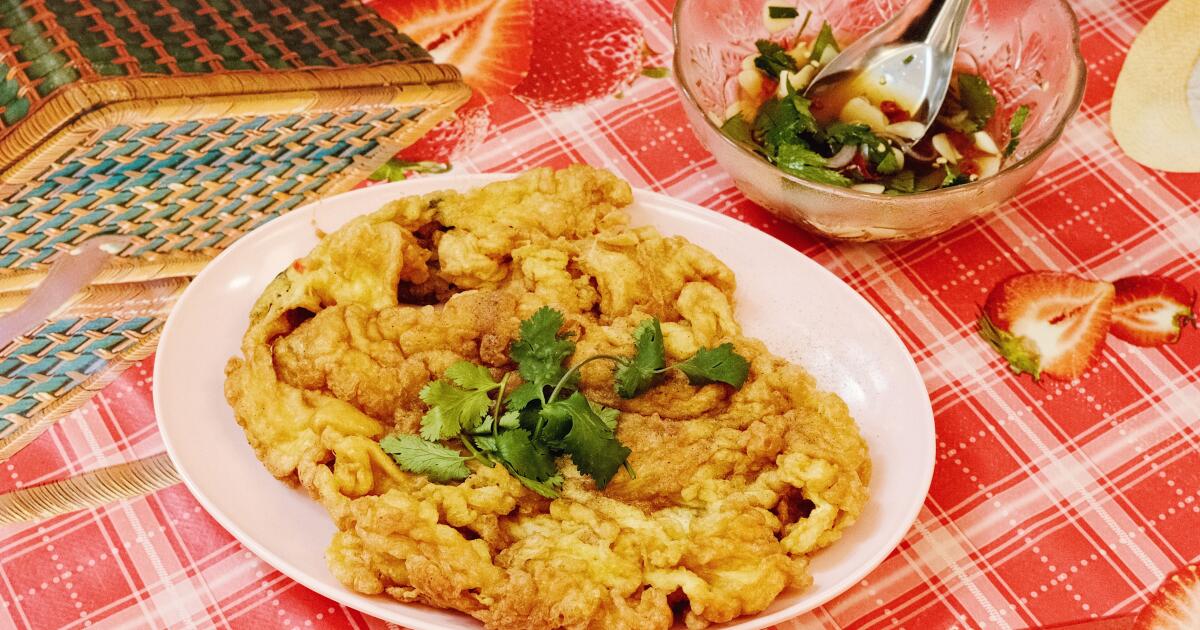

There’s no substitute for the low tables and frenetic energy of Thai restaurant Holy Basil, but it’s possible to re-create some of chef Wedchayan “Deau” Arpapornnopparat’s culinary magic at home. At his downtown and Atwater Village restaurants, he and partner Tongkamal “Joy” Yuon riff on vibrant curries, seafood specials and Thai street-food classics such as kai jiew, the iconic, fluffy Thai fried omelet.
“It’s such a simple dish,” he said, “that maybe it’s the first thing you learn cooking in Thailand. Your mom probably will be like, ‘Hey, can you help me make kai jiew?’”
He accompanies the omelet with prik nam pla, a classic catchall Thai condiment that balances the salt and funk of fish sauce with sugar, all cut through with ample fresh-squeezed lime juice and aromatics like garlic, chiles and cilantro. Arpapornnopparat prefers to make his prik nam pla roughly an hour in advance to let the flavors fully combine.
Don’t let the omelet’s two cups of oil scare you. Arpapornnopparat says that the amount of oil is what maintains a high temperature for the egg to fry in; without it, the eggs would lack that signature fluffy consistency, which sets the kai jiew apart from other fried eggs.
As the oil needs to reach 400 degrees, it’s best to use an infrared thermometer gun or deep-fry thermometer to periodically check the heat; these can be widely found online or in most major home improvement stores for between $15 and $20. When it comes to pans, Arpapornnopparat recommends using an 8-inch frying pan, which will ensure the correct diameter for the omelet; a slightly larger pan can be used, though it will require maintaining the eggs’ shape as they fry. To safeguard against oil spillage, ensure at least 1 inch of room between the oil and the lip of your pan before adding the eggs.
At Holy Basil Arpapornnopparat opts for rice bran oil and serves the kai jiew more simply — with plain egg topped with white pepper and cilantro — but at home the chef says he prefers to cook the omelet this way, with shallots, fish sauce, chiles and garlic adding flavor to the eggs as they fry.
Try this omelet and prik nam pla alone or with rice; with rice, this recipe easily feeds two.

There’s no substitute for the low tables and frenetic energy of Thai restaurant Holy Basil, but it’s possible to re-create some of chef Wedchayan “Deau” Arpapornnopparat’s culinary magic at home. At his downtown and Atwater Village restaurants, he and partner Tongkamal “Joy” Yuon riff on vibrant curries, seafood specials and Thai street-food classics such as kai jiew, the iconic, fluffy Thai fried omelet.
“It’s such a simple dish,” he said, “that maybe it’s the first thing you learn cooking in Thailand. Your mom probably will be like, ‘Hey, can you help me make kai jiew?’”
He accompanies the omelet with prik nam pla, a classic catchall Thai condiment that balances the salt and funk of fish sauce with sugar, all cut through with ample fresh-squeezed lime juice and aromatics like garlic, chiles and cilantro. Arpapornnopparat prefers to make his prik nam pla roughly an hour in advance to let the flavors fully combine.
Don’t let the omelet’s two cups of oil scare you. Arpapornnopparat says that the amount of oil is what maintains a high temperature for the egg to fry in; without it, the eggs would lack that signature fluffy consistency, which sets the kai jiew apart from other fried eggs.
As the oil needs to reach 400 degrees, it’s best to use an infrared thermometer gun or deep-fry thermometer to periodically check the heat; these can be widely found online or in most major home improvement stores for between $15 and $20. When it comes to pans, Arpapornnopparat recommends using an 8-inch frying pan, which will ensure the correct diameter for the omelet; a slightly larger pan can be used, though it will require maintaining the eggs’ shape as they fry. To safeguard against oil spillage, ensure at least 1 inch of room between the oil and the lip of your pan before adding the eggs.
At Holy Basil Arpapornnopparat opts for rice bran oil and serves the kai jiew more simply — with plain egg topped with white pepper and cilantro — but at home the chef says he prefers to cook the omelet this way, with shallots, fish sauce, chiles and garlic adding flavor to the eggs as they fry.
Try this omelet and prik nam pla alone or with rice; with rice, this recipe easily feeds two.

There’s no substitute for the low tables and frenetic energy of Thai restaurant Holy Basil, but it’s possible to re-create some of chef Wedchayan “Deau” Arpapornnopparat’s culinary magic at home. At his downtown and Atwater Village restaurants, he and partner Tongkamal “Joy” Yuon riff on vibrant curries, seafood specials and Thai street-food classics such as kai jiew, the iconic, fluffy Thai fried omelet.
“It’s such a simple dish,” he said, “that maybe it’s the first thing you learn cooking in Thailand. Your mom probably will be like, ‘Hey, can you help me make kai jiew?’”
He accompanies the omelet with prik nam pla, a classic catchall Thai condiment that balances the salt and funk of fish sauce with sugar, all cut through with ample fresh-squeezed lime juice and aromatics like garlic, chiles and cilantro. Arpapornnopparat prefers to make his prik nam pla roughly an hour in advance to let the flavors fully combine.
Don’t let the omelet’s two cups of oil scare you. Arpapornnopparat says that the amount of oil is what maintains a high temperature for the egg to fry in; without it, the eggs would lack that signature fluffy consistency, which sets the kai jiew apart from other fried eggs.
As the oil needs to reach 400 degrees, it’s best to use an infrared thermometer gun or deep-fry thermometer to periodically check the heat; these can be widely found online or in most major home improvement stores for between $15 and $20. When it comes to pans, Arpapornnopparat recommends using an 8-inch frying pan, which will ensure the correct diameter for the omelet; a slightly larger pan can be used, though it will require maintaining the eggs’ shape as they fry. To safeguard against oil spillage, ensure at least 1 inch of room between the oil and the lip of your pan before adding the eggs.
At Holy Basil Arpapornnopparat opts for rice bran oil and serves the kai jiew more simply — with plain egg topped with white pepper and cilantro — but at home the chef says he prefers to cook the omelet this way, with shallots, fish sauce, chiles and garlic adding flavor to the eggs as they fry.
Try this omelet and prik nam pla alone or with rice; with rice, this recipe easily feeds two.
There’s no substitute for the low tables and frenetic energy of Thai restaurant Holy Basil, but it’s possible to re-create some of chef Wedchayan “Deau” Arpapornnopparat’s culinary magic at home. At his downtown and Atwater Village restaurants, he and partner Tongkamal “Joy” Yuon riff on vibrant curries, seafood specials and Thai street-food classics such as kai jiew, the iconic, fluffy Thai fried omelet.
“It’s such a simple dish,” he said, “that maybe it’s the first thing you learn cooking in Thailand. Your mom probably will be like, ‘Hey, can you help me make kai jiew?’”
He accompanies the omelet with prik nam pla, a classic catchall Thai condiment that balances the salt and funk of fish sauce with sugar, all cut through with ample fresh-squeezed lime juice and aromatics like garlic, chiles and cilantro. Arpapornnopparat prefers to make his prik nam pla roughly an hour in advance to let the flavors fully combine.
Don’t let the omelet’s two cups of oil scare you. Arpapornnopparat says that the amount of oil is what maintains a high temperature for the egg to fry in; without it, the eggs would lack that signature fluffy consistency, which sets the kai jiew apart from other fried eggs.
As the oil needs to reach 400 degrees, it’s best to use an infrared thermometer gun or deep-fry thermometer to periodically check the heat; these can be widely found online or in most major home improvement stores for between $15 and $20. When it comes to pans, Arpapornnopparat recommends using an 8-inch frying pan, which will ensure the correct diameter for the omelet; a slightly larger pan can be used, though it will require maintaining the eggs’ shape as they fry. To safeguard against oil spillage, ensure at least 1 inch of room between the oil and the lip of your pan before adding the eggs.
At Holy Basil Arpapornnopparat opts for rice bran oil and serves the kai jiew more simply — with plain egg topped with white pepper and cilantro — but at home the chef says he prefers to cook the omelet this way, with shallots, fish sauce, chiles and garlic adding flavor to the eggs as they fry.
Try this omelet and prik nam pla alone or with rice; with rice, this recipe easily feeds two.