One of Craig Bartlett’s profoundest childhood memories involves a despondent turtle.
In a pet store hidden away in Seattle’s Chinatown, he and his friend Joan came across one in a murky little tank. They took pity on it, bought it and took it home to Portland, Ore. It didn’t come out of its shell for two weeks.
They knew what they had to do. They took the turtle to Square Lake, on Sauvie Island, and laid the turtle down on the shore. The creature’s head emerged from its shell to consider its new circumstances. Slowly but surely, it eased its way into the water and swam away. “We were jumping up and down with a kind of weird joy,” Bartlett remembers.
Much later, when Bartlett was creating his own animated series, he knew that the poetry of that moment, the strange cinematic magic of it, was something he wanted to tap into.
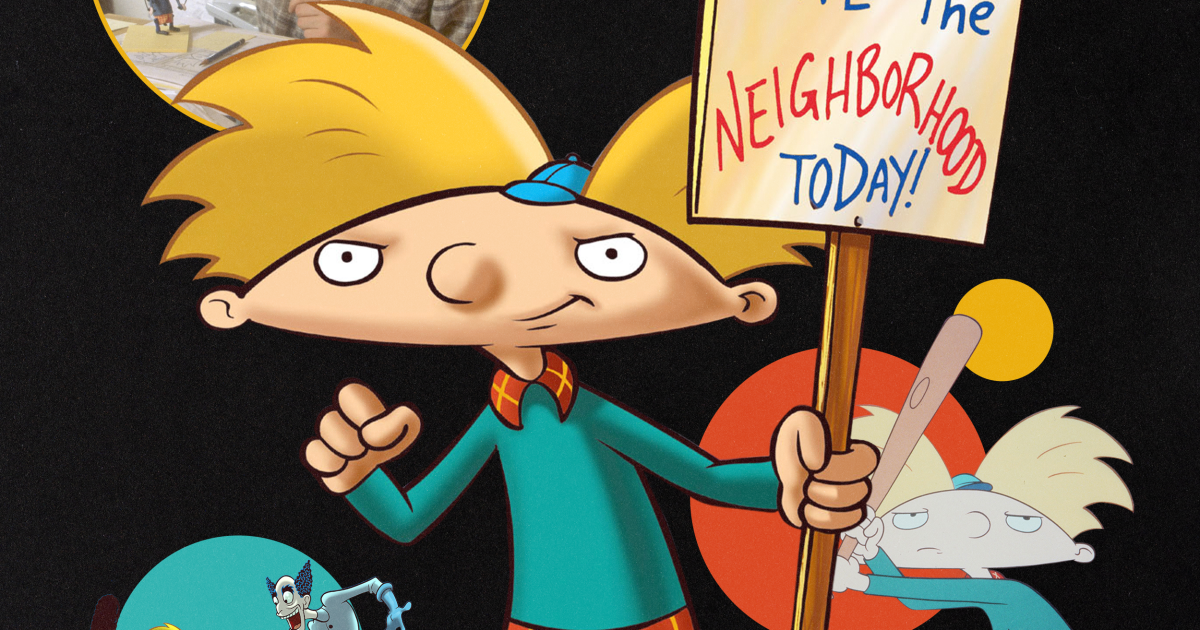
Thirty years ago, on Oct. 7, 1996, “Hey Arnold!” premiered on the kids’ cable network Nickelodeon. With its offbeat, lyrical, sometimes painfully honest portrayal of the feeling of childhood in the city, it quickly set itself apart as a new kind of kids’ show, attracting a dedicated fandom that endures to this day.
An urban ‘Little Rascals’
Arnold was a 9-year-old boy with an elongated ovoid head who enjoyed listening to jazz fusion under the skylight of his attic bedroom. According to Bartlett’s show bible, he was “philosophical, idealistic, romantic and hard to rile.” His best friend was Gerald. He was, in short, a chill little dude.
Bartlett had created the character almost a decade earlier, after a stint producing claymation segments for “Pee-wee’s Playhouse.” Back then, one of the cookie cutters that Bartlett used to cut shapes out of clay happened to be shaped like a football; from the work of his brother-in-law, Matt Groening, he’d also observed the importance of a striking silhouette. The result, in Bartlett’s short claymation films, which played the animation festival circuit and appeared on “Sesame Street,” was a daydreamer with a football-shaped head.
Arnold was created by Bartlett almost a decade before the show was made, after a stint producing claymation segments for “Pee-wee’s Playhouse.”
(Nickelodeon)
In 1993, Nickelodeon was looking to expand its original animation lineup. Toward the end of a long, fruitless pitch meeting with a gaggle of writer-animators, Nickelodeon executive Mary Harrington put on Bartlett’s show reel. She was taken with Arnold right away, and intrigued by Bartlett’s visual style and imagination.
“I liked the way it looked,” she said simply. “I liked the quirkiness of it.”
Bartlett developed the show with Steve Viksten and Joseph Ansolabehere. The trio had previously worked together on Nickelodeon’s “Rugrats” — Bartlett as a story editor, Viksten and Ansolabehere as writers. (One of Bartlett’s contributions to “Rugrats” was Angelica’s stoic, wild-haired doll Cynthia.)

Instead of the suburban setting common to so many cartoons — including Nickelodeon’s “Doug” — “Hey Arnold!” was set firmly in the inner city, a vibrantly gritty amalgam of Seattle, Portland and Brooklyn. As part of his preparations for the series, Bartlett went on a photo-taking expedition through Seattle and Tacoma, collecting imagery of Pacific Northwest grunge to share with his artists: crumbling walls, fire escapes, water towers.
As for Arnold, he lived with his grandparents in an old boarding house under a freeway overpass. The show’s diverse cast also represented what Bartlett called the “multiethnic gumbo” of American cities. The urban aesthetic was augmented with a bluesy, funky score by composer Jim Lang, inspired by Thelonious Monk, Vince Guaraldi and Beck.
There were fantastical elements, but what set “Hey Arnold!” apart was how invested it was in depicting what life is like for a fourth grader. The writers had in mind the intimacy of character-driven cinema of the ‘70s and the French New Wave; “The Little Rascals” was as much of an influence as “The 400 Blows” and “My Life as a Dog.” Ansolabehere and Viksten, who had attended UCLA and tried for years to break into Hollywood, would channel their cinematic storytelling instincts into the show.


Bartlett purposely wanted to steer away from the wacky “Looney Tunes” antics of cartoons like “Animaniacs.” Instead, the melancholy and ennui of “A Charlie Brown Christmas,” which had captivated Bartlett as a 6-year-old, would be a major touchstone.

Craig Bartlett, the creator of Nickelodeon’s “Hey Arnold!” in 2002.
(Paramount / Viacom)
“That was our real rebellion,” Bartlett said, “to make it not a gag show but more kind of moody.”
That stylistic rebellion extended to Arnold as well. “Arnold wasn’t your typical type-A personality lead character,” Harrington said. “He was quieter, he was thoughtful, he was really smart, more creative. But we thought kids could relate to him.”
Writing meetings revolved around discussion of childhood memories and experiences. “Hey Arnold!” built on the narrative foundation the group had established on their previous show.
“‘Rugrats’ opened up to us this idea that you could actually make a show about humans, about the human experience and about childhood,” Ansolabehere said. “The episodes I was proudest of were where you dug something out from inside of your history and your heart.”
Apart from the turtle story, which made it into the episode “Field Trip,” very few of Arnold’s adventures were directly borrowed from Bartlett’s life. Instead, “it was about capturing a feeling,” he said.
Going where no cartoon had gone before
Thematically, too, there was a determination to venture into more adult territory than any kids’ cartoon had previously. The show was frank in its portrayal of, among other subjects, social isolation, economic disparity, the immigrant experience and unconventional families. In “Arnold’s Christmas,” one of the most celebrated and audacious episodes of the show, Mr. Hyunh, a Vietnamese immigrant and resident of Arnold’s boarding house, tells the story of being separated from his daughter Mai during the Vietnam War. In the episode “Helga on the Couch,” Helga’s emotionally neglectful household was on poignant display.
The commitment to authenticity extended to the show’s voice cast, which was made up of child actors. This meant that a succession of actors played Arnold over the years, until their voices changed with the onset of puberty. Spencer Klein, who voiced Arnold in Episodes 61 to 100 and in the first movie in 2002, had the strange experience of joining a show he was already a fan of. “It was a special show,” he said. “It was a show you could really learn valuable life lessons from.”
Klein remembers that the actors recorded in the same room together, allowing them to interact more naturally. “Usually a number of the animators were there too,” he said. “They’d have sketch pads, and we were encouraged to be physically animated when delivering our lines. The animators would incorporate some of the physical aspects of our line deliveries into the animation.”

The show’s voice cast featured child actors, including Spencer Klein, who voiced Arnold in Episodes 61-100 and the first movie. “It was a special show,” he said. “It was a show you could really learn valuable life lessons from.”
(Paramount / Viacom)
In a deft bit of narrative maneuvering, Gerald’s voice breaking was written into the show; Jamil Walker Smith played the character for all five seasons and one movie. Similarly, Francesca Marie Smith voiced Helga G. Pataki for the entirety of “Hey Arnold!” and up to “The Jungle Movie” in 2017.
Conceived as a relentless bully of Arnold, Helga was one of the richer, more complex characters to come out of a kids’ cartoon in its or any era. At first, Ansolabehere said, the writers struggled with her motivation. They didn’t want a repeat of Angelica, the cackling 3-year-old schemer of “Rugrats.” Why did she pick on Arnold?
In Ansolabehere’s memory, Bartlett’s then-wife, Lisa, overheard the writers’ deliberations and casually suggested, “Maybe she’s in love with Arnold.”
“It was like a light bulb went off,” said Ansolabehere. “We were like, that’s it. That’s young love. When we don’t know what to do with it.” In minutes, Bartlett had sketched the makeshift shrine that Helga builds for Arnold in her closet.
Helga’s unrequited love for Arnold became one of the driving forces of the show. “She was a sort of villain who you related to and rooted for,” said writer Rachel Lipman, who joined the show as the first season was coming together. “However much she tortured Arnold, she was far more tormented herself on the inside. She also had this unending internal conflict — she really didn’t want to be in love with Arnold … but she just couldn’t fight the feeling. I hadn’t seen a show where the unrequited love this girl felt for a boy got to be explored to such deep levels.”

Arnold, Gerald and Helga, who was voiced by Francesca Marie Smith. Helga’s unrequited love for Arnold became one of the driving forces of the show.
(Paramount / Viacom)
It didn’t hurt that Smith gave the performance of a lifetime, putting her heart and soul into the melodramatic contradictions of the character, antagonizing Arnold one second and swooning over him the next. Smith’s firecracker performance inspired the writers to give Helga even more to do.
Smith remembers, even as an 8-year-old, feeling very strongly that she didn’t want to sit down while recording. “It was important to me to get the full power of my voice, the physicality of it,” she said. “I certainly remember that after a couple hours of recording, I would just absolutely crash. It’s amazing to me today how much energy I poured into that microphone.”
In 2024, Smith revealed that she was living with the debilitating effects of multiple sclerosis. After a major relapse, and at Bartlett’s urging, she set up an online fundraiser to ease the financial strain of medical treatment. The page was shared widely among “Hey Arnold!” fans; Bartlett also helped raise funds by auctioning off original “Hey Arnold!” cels and hand-painted backgrounds.
It was an indication of the warm and tender feelings viewers still had for Helga and “Hey Arnold!” that Smith’s funding goal was surpassed in a matter of days. “No one is stronger than Helga G. Pataki,” one Reddit user wrote.
“It made such a real impact,” said Smith, emotional at the memory of it. “I’m so grateful.”
Still groovin’ after all these years
The fandom for “Hey Arnold!” hasn’t wavered and remains as strong as ever three decades later. There have been 10 vinyl pressings of “Hey Arnold!” music tracks since 2020. More recently, the show’s composer Jim Lang and his group, the PS 118 All Stars, announced a string of concert dates, playing music from the show around the country, with Bartlett as a special guest vocalist.
Bartlett has also been approached by Paramount Global Publishing to write a novel version of his Helga spinoff idea “The Patakis” and is currently in talks about a “Hey Arnold!” graphic novel.
The concerts are a great showcase of Lang’s groovy, down-tempo tunes — “Hey Arnold!” undoubtedly turned a bunch of young viewers onto jazz — but they’re also a chance for millennial fans to bask in their memories.
Juan Escalante, who attended a concert in August, was transported right back to his childhood bedroom in Venezuela, “when I wished I had a cool room like Arnold’s!”
“‘Hey Arnold!’ felt like a kids’ show that allowed kids to see themselves,” he said, “and their imaginations reflected back at them.”