
Thursday, August 20, 2026
Washington DC
New York
Toronto
Distribution: (800) 510 9863
Press ID
  • Login
RH NEWSROOM National News and Press Releases. Local and Regional Perspectives. Media Advisories.
Yonkers Observer
  • Home
  • World
  • Politics
  • Finance
  • Technology
  • Health
  • Culture
  • Entertainment
  • Trend
No Result
View All Result
  • Home
  • World
  • Politics
  • Finance
  • Technology
  • Health
  • Culture
  • Entertainment
  • Trend
No Result
View All Result
Yonkers Observer
No Result
View All Result
Home Culture

Go see why VistaVision was the Imax of its day

by Yonkers Observer Report
August 20, 2026
in Culture
Share on FacebookShare on Twitter

What is VistaVision? A simple answer: The film goes through sideways.

Both in the camera during shooting and in the projector during screenings, the VistaVision process turns the physical filmstrip on its side, running horizontally through the machine to create a larger image of richer depth and clarity.

After its heyday from 1954 to 1961 beginning with the Bing Crosby holiday musical “White Christmas” through Marlon Brando’s lone directing effort, “One-Eyed Jacks,” VistaVision did not completely disappear, but the cumbersome nature of needing special cameras and projectors made it impractical for wider use. Still, it would go on to be used for special effects work on the first “Star Wars” movie and many others.

And it has enjoyed an unexpected revival as a shooting format in the last few years, beginning with Brady Corbet’s 2024 “The Brutalist,” giving the low-budget production a far more lavish look. Paul Thomas Anderson’s “One Battle After Another” was both shot in the format and shown that way at a handful of venues worldwide.

“Presented in VistaVision,” a new series at the Academy Museum, begins Thursday with a 70mm screening of John Ford’s landmark 1956 Western “The Searchers,” starring John Wayne and Natalie Wood.

Marlon Brando in the 1961 western “One-Eyed Jacks.”

(Academy Museum)

Collecting 16 VistaVision titles, the series follows a recent uptick in audience interest concerning projection formats. A video by “Sinners” filmmaker Ryan Coogler explaining aspect ratios and screen size became a viral hit; some fans used punchcards to note seeing the movie in all its possible exhibition formats. This summer has seen a frenzy around Christopher Nolan’s Imax-shot “The Odyssey,” with audiences clamoring to experience it in various permutations.

“In a way, we’re just picking up on that wave and riding it,” says K.J. Relth-Miller, the museum’s director of film programs. “We already knew that our Academy Museum audiences have an appetite for seeing film on film. And we know that a selling point for many of our screenings is the fact that it’s being presented in 35mm or 70mm. And so to have the opportunity to present something on celluloid in an even rarer format was just something we couldn’t pass up.”

The inspiration for the series began with the fact that the Museum’s holdings included an actual VistaVision projector built in the early 1990s for dailies screenings but which hadn’t been used for decades. Warner Bros. borrowed and refurbished the machine to show “One Battle After Another” for pre-release screenings on the WB lot. It then became the projector used at L.A.’s Vista Theater, one of only four theaters in the world able to show film in the VistaVision format. The projector returned to the museum a few months ago.

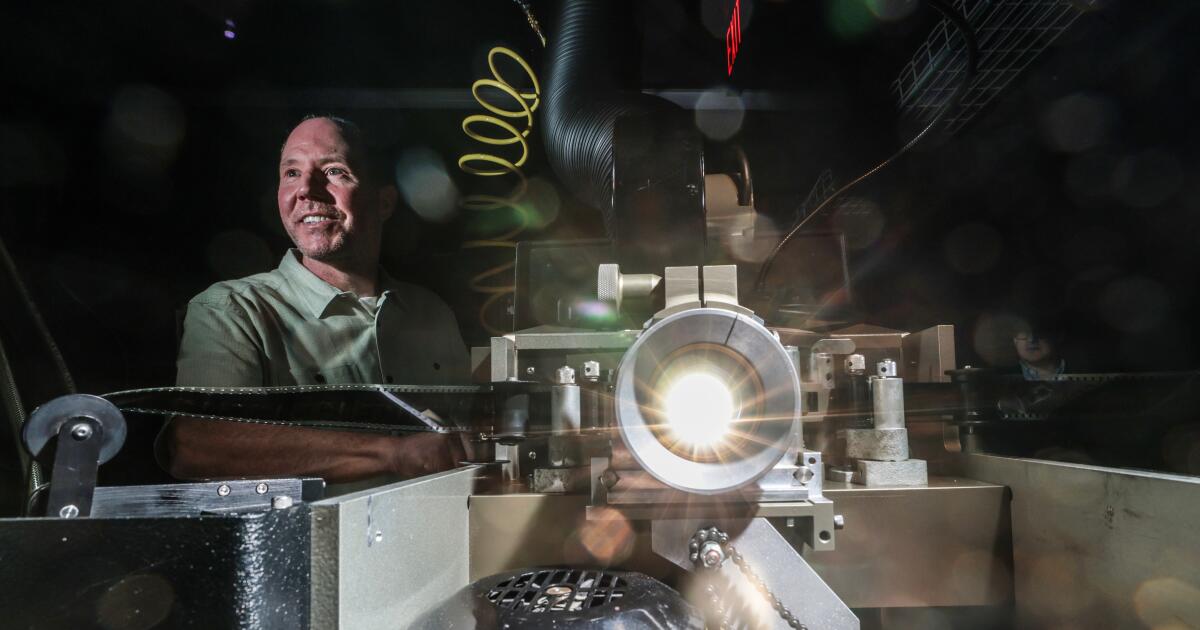
One afternoon earlier this week, Bradley Morris, the Academy’s lead senior projectionist, was in the booth of the David Geffen Theater to test VistaVision footage from Cecil B. DeMille’s 1956 epic “The Ten Commandments.” As the machine whirred to life, the film strip moved from a large platter through a system of rollers, pulled sideways across the front of the lens. Astonishingly vivid images blazed forth onto the theater’s giant screen. (Yul Brynner, Charlton Heston and a seemingly endless army of extras enacted a complex ceremony.)

“It’s sort of a variation on what we already know,” says Morris of learning to work the projector. “It’s on its side and the mirror image. So it runs backwards to what would be sort of a logical assumption of its threading pattern.”

A VistaVision projector sits next to a platter spooling system.

A rare VistaVision projector has been installed in the David Geffen Theater at the Academy Museum.

(Robert Gauthier / Los Angeles Times)

Mastering this unusual system has proved a challenge but an exhilarating one, with the print moving at 180 feet per minute, twice the speed of a conventional projector.

“It’s actually been a lot of fun,” Morris adds, low-key and affable. “There’s still loops and sprockets but it is different.”

Other titles to be shown using the VistaVision projector include John Sturges’ “Gunfight at the O.K. Corral,” Robert Lewis’ musical “Anything Goes” and Michael Curtiz’s comedy “We’re No Angels.” Regardless of whether you know about these films, any of them will make for a one-of-a-kind viewing experience.

“It feels alive in a way,” says Relth-Miller of watching the films in their original format. “There’s just a different energy to seeing a VistaVision print onscreen. It’s a different experience.”

A woman in a blue dress embraces a man in a suit.

Grace Kelly and Cary Grant in Alfred Hitchcock’s 1955 thriller “To Catch a Thief.”

(Academy Museum)

Due to print availability, not every title in the series will be screened using the special equipment. Yet even the museum’s digital presentations of films initially shot on VistaVision feel special. A brand new 4K restoration of Alfred Hitchcock’s 1955 romantic thriller “To Catch A Thief,” starring Cary Grant and Grace Kelly, has never been shown before, while the 4K scans from 35mm elements of films such as “The Girl Rush,” starring Rosalind Russell (poised to be the big rediscovery of the series), “Hot Spell” with Shirley MacLaine and “The Joker Is Wild” with Frank Sinatra are extremely rare screenings.

“It was Paramount’s primary technology that they were looking to show off at the time,” says Relth-Miller of the studio that developed VistaVision. “It was much more a marketing device to encourage folks to see any kind of story, whatever might suit them, and trying to reach as many audiences as possible with as many different genres as possible in their output during that seven-year period.”

The format was developed during an era when Hollywood was attempting to combat the rising popularity of television. Now, when the industry is looking to draw audiences away from streaming services and mobile devices, it is inevitable to compare VistaVision to the contemporary Imax format, which similarly runs film horizontally to increase the size of the image.

A projector beams an image toward the lens.

Yul Brynner in “The Ten Commandments” can be seen through a VistaVision projector.

(Robert Gauthier / Los Angeles Times)

“It’s the same idea,” says Morris, comparing the two formats, “in that how do we take something we already have and modify it to make it look better for the audience? I think that’s probably the way I’d equate it — think Imax from 1955.”

Relth-Miller likens the rise of physical media like VistaVision and vinyl albums to “collecting experiences.”

“It’s just a novel way of experiencing something, especially one that you’ve maybe seen many times,” she says. “There’s a novel experience in seeing it specifically with that audience in that space on that day.”

The Academy Museum’s VistaVision series will also include a number of special guests. “Robocop” actor and author Peter Weller will introduce “Gunfight” and “One-Eyed Jacks,” while Charlotte Barker, Paramount’s senior director of film preservation, along with visual effects supervisor and film historian Craig Barron will do a presentation on the special effects of “The Ten Commandments.”

A sea parts to the raised arms of a prophet.

Charlton Heston as Moses parts the Red Sea in the 1956 movie “The Ten Commandments.”

(Academy Museum)

For a screening of “One Battle After Another” — the third time the film has been shown at the museum, but the first in VistaVision — director Anderson will make his first appearance ever at the Academy Museum.

Besides Anderson, many other contemporary filmmakers have been turning to shooting in the VistaVision format. “The Brutalist” was made with the format before “One Battle,” while Yorgos Lanthimos’ “Bugonia” and Emerald Fennell’s “Wuthering Heights” were also shot with the technology.

Upcoming films including the Tom Cruise-starring “Digger” and Greta Gerwig’s “Narnia: The Magician’s Nephew” are reported to have been shot using the format. Cruise recently hosted an influencer event for “Digger” at which he gave an up-close look at a VistaVision camera used in shooting the movie.

Whether for clout on Letterboxd or simply bragging rights among friends, how one sees a movie has become a key part of the overall experience. The rise in popularity of revival screenings, which find audiences packing theaters in Los Angeles and around the world for acknowledged classics and rediscovered obscurities, has brought a joyful energy back to theaters.

“It’s creating another dimension of culture that nobody could have really anticipated,” says Relth-Miller. “And it’s a really exciting and pleasant surprise.”

Audiences making their way to the Academy’s VistaVision series will be stepping back in time, seeing movies in a way that has been all but obsolete for some 65 years.

“There’s something very special about seeing a work of art as close to the original source as possible, the way the filmmakers intended it,” says Morris. “It isn’t a common thing and it isn’t something that, to the best of our knowledge, anybody’s ever done before.”

What is VistaVision? A simple answer: The film goes through sideways.

Both in the camera during shooting and in the projector during screenings, the VistaVision process turns the physical filmstrip on its side, running horizontally through the machine to create a larger image of richer depth and clarity.

After its heyday from 1954 to 1961 beginning with the Bing Crosby holiday musical “White Christmas” through Marlon Brando’s lone directing effort, “One-Eyed Jacks,” VistaVision did not completely disappear, but the cumbersome nature of needing special cameras and projectors made it impractical for wider use. Still, it would go on to be used for special effects work on the first “Star Wars” movie and many others.

And it has enjoyed an unexpected revival as a shooting format in the last few years, beginning with Brady Corbet’s 2024 “The Brutalist,” giving the low-budget production a far more lavish look. Paul Thomas Anderson’s “One Battle After Another” was both shot in the format and shown that way at a handful of venues worldwide.

“Presented in VistaVision,” a new series at the Academy Museum, begins Thursday with a 70mm screening of John Ford’s landmark 1956 Western “The Searchers,” starring John Wayne and Natalie Wood.

Marlon Brando in the 1961 western “One-Eyed Jacks.”

(Academy Museum)

Collecting 16 VistaVision titles, the series follows a recent uptick in audience interest concerning projection formats. A video by “Sinners” filmmaker Ryan Coogler explaining aspect ratios and screen size became a viral hit; some fans used punchcards to note seeing the movie in all its possible exhibition formats. This summer has seen a frenzy around Christopher Nolan’s Imax-shot “The Odyssey,” with audiences clamoring to experience it in various permutations.

“In a way, we’re just picking up on that wave and riding it,” says K.J. Relth-Miller, the museum’s director of film programs. “We already knew that our Academy Museum audiences have an appetite for seeing film on film. And we know that a selling point for many of our screenings is the fact that it’s being presented in 35mm or 70mm. And so to have the opportunity to present something on celluloid in an even rarer format was just something we couldn’t pass up.”

The inspiration for the series began with the fact that the Museum’s holdings included an actual VistaVision projector built in the early 1990s for dailies screenings but which hadn’t been used for decades. Warner Bros. borrowed and refurbished the machine to show “One Battle After Another” for pre-release screenings on the WB lot. It then became the projector used at L.A.’s Vista Theater, one of only four theaters in the world able to show film in the VistaVision format. The projector returned to the museum a few months ago.

One afternoon earlier this week, Bradley Morris, the Academy’s lead senior projectionist, was in the booth of the David Geffen Theater to test VistaVision footage from Cecil B. DeMille’s 1956 epic “The Ten Commandments.” As the machine whirred to life, the film strip moved from a large platter through a system of rollers, pulled sideways across the front of the lens. Astonishingly vivid images blazed forth onto the theater’s giant screen. (Yul Brynner, Charlton Heston and a seemingly endless army of extras enacted a complex ceremony.)

“It’s sort of a variation on what we already know,” says Morris of learning to work the projector. “It’s on its side and the mirror image. So it runs backwards to what would be sort of a logical assumption of its threading pattern.”

A VistaVision projector sits next to a platter spooling system.

A rare VistaVision projector has been installed in the David Geffen Theater at the Academy Museum.

(Robert Gauthier / Los Angeles Times)

Mastering this unusual system has proved a challenge but an exhilarating one, with the print moving at 180 feet per minute, twice the speed of a conventional projector.

“It’s actually been a lot of fun,” Morris adds, low-key and affable. “There’s still loops and sprockets but it is different.”

Other titles to be shown using the VistaVision projector include John Sturges’ “Gunfight at the O.K. Corral,” Robert Lewis’ musical “Anything Goes” and Michael Curtiz’s comedy “We’re No Angels.” Regardless of whether you know about these films, any of them will make for a one-of-a-kind viewing experience.

“It feels alive in a way,” says Relth-Miller of watching the films in their original format. “There’s just a different energy to seeing a VistaVision print onscreen. It’s a different experience.”

A woman in a blue dress embraces a man in a suit.

Grace Kelly and Cary Grant in Alfred Hitchcock’s 1955 thriller “To Catch a Thief.”

(Academy Museum)

Due to print availability, not every title in the series will be screened using the special equipment. Yet even the museum’s digital presentations of films initially shot on VistaVision feel special. A brand new 4K restoration of Alfred Hitchcock’s 1955 romantic thriller “To Catch A Thief,” starring Cary Grant and Grace Kelly, has never been shown before, while the 4K scans from 35mm elements of films such as “The Girl Rush,” starring Rosalind Russell (poised to be the big rediscovery of the series), “Hot Spell” with Shirley MacLaine and “The Joker Is Wild” with Frank Sinatra are extremely rare screenings.

“It was Paramount’s primary technology that they were looking to show off at the time,” says Relth-Miller of the studio that developed VistaVision. “It was much more a marketing device to encourage folks to see any kind of story, whatever might suit them, and trying to reach as many audiences as possible with as many different genres as possible in their output during that seven-year period.”

The format was developed during an era when Hollywood was attempting to combat the rising popularity of television. Now, when the industry is looking to draw audiences away from streaming services and mobile devices, it is inevitable to compare VistaVision to the contemporary Imax format, which similarly runs film horizontally to increase the size of the image.

A projector beams an image toward the lens.

Yul Brynner in “The Ten Commandments” can be seen through a VistaVision projector.

(Robert Gauthier / Los Angeles Times)

“It’s the same idea,” says Morris, comparing the two formats, “in that how do we take something we already have and modify it to make it look better for the audience? I think that’s probably the way I’d equate it — think Imax from 1955.”

Relth-Miller likens the rise of physical media like VistaVision and vinyl albums to “collecting experiences.”

“It’s just a novel way of experiencing something, especially one that you’ve maybe seen many times,” she says. “There’s a novel experience in seeing it specifically with that audience in that space on that day.”

The Academy Museum’s VistaVision series will also include a number of special guests. “Robocop” actor and author Peter Weller will introduce “Gunfight” and “One-Eyed Jacks,” while Charlotte Barker, Paramount’s senior director of film preservation, along with visual effects supervisor and film historian Craig Barron will do a presentation on the special effects of “The Ten Commandments.”

A sea parts to the raised arms of a prophet.

Charlton Heston as Moses parts the Red Sea in the 1956 movie “The Ten Commandments.”

(Academy Museum)

For a screening of “One Battle After Another” — the third time the film has been shown at the museum, but the first in VistaVision — director Anderson will make his first appearance ever at the Academy Museum.

Besides Anderson, many other contemporary filmmakers have been turning to shooting in the VistaVision format. “The Brutalist” was made with the format before “One Battle,” while Yorgos Lanthimos’ “Bugonia” and Emerald Fennell’s “Wuthering Heights” were also shot with the technology.

Upcoming films including the Tom Cruise-starring “Digger” and Greta Gerwig’s “Narnia: The Magician’s Nephew” are reported to have been shot using the format. Cruise recently hosted an influencer event for “Digger” at which he gave an up-close look at a VistaVision camera used in shooting the movie.

Whether for clout on Letterboxd or simply bragging rights among friends, how one sees a movie has become a key part of the overall experience. The rise in popularity of revival screenings, which find audiences packing theaters in Los Angeles and around the world for acknowledged classics and rediscovered obscurities, has brought a joyful energy back to theaters.

“It’s creating another dimension of culture that nobody could have really anticipated,” says Relth-Miller. “And it’s a really exciting and pleasant surprise.”

Audiences making their way to the Academy’s VistaVision series will be stepping back in time, seeing movies in a way that has been all but obsolete for some 65 years.

“There’s something very special about seeing a work of art as close to the original source as possible, the way the filmmakers intended it,” says Morris. “It isn’t a common thing and it isn’t something that, to the best of our knowledge, anybody’s ever done before.”

What is VistaVision? A simple answer: The film goes through sideways.

Both in the camera during shooting and in the projector during screenings, the VistaVision process turns the physical filmstrip on its side, running horizontally through the machine to create a larger image of richer depth and clarity.

After its heyday from 1954 to 1961 beginning with the Bing Crosby holiday musical “White Christmas” through Marlon Brando’s lone directing effort, “One-Eyed Jacks,” VistaVision did not completely disappear, but the cumbersome nature of needing special cameras and projectors made it impractical for wider use. Still, it would go on to be used for special effects work on the first “Star Wars” movie and many others.

And it has enjoyed an unexpected revival as a shooting format in the last few years, beginning with Brady Corbet’s 2024 “The Brutalist,” giving the low-budget production a far more lavish look. Paul Thomas Anderson’s “One Battle After Another” was both shot in the format and shown that way at a handful of venues worldwide.

“Presented in VistaVision,” a new series at the Academy Museum, begins Thursday with a 70mm screening of John Ford’s landmark 1956 Western “The Searchers,” starring John Wayne and Natalie Wood.

Marlon Brando in the 1961 western “One-Eyed Jacks.”

(Academy Museum)

Collecting 16 VistaVision titles, the series follows a recent uptick in audience interest concerning projection formats. A video by “Sinners” filmmaker Ryan Coogler explaining aspect ratios and screen size became a viral hit; some fans used punchcards to note seeing the movie in all its possible exhibition formats. This summer has seen a frenzy around Christopher Nolan’s Imax-shot “The Odyssey,” with audiences clamoring to experience it in various permutations.

“In a way, we’re just picking up on that wave and riding it,” says K.J. Relth-Miller, the museum’s director of film programs. “We already knew that our Academy Museum audiences have an appetite for seeing film on film. And we know that a selling point for many of our screenings is the fact that it’s being presented in 35mm or 70mm. And so to have the opportunity to present something on celluloid in an even rarer format was just something we couldn’t pass up.”

The inspiration for the series began with the fact that the Museum’s holdings included an actual VistaVision projector built in the early 1990s for dailies screenings but which hadn’t been used for decades. Warner Bros. borrowed and refurbished the machine to show “One Battle After Another” for pre-release screenings on the WB lot. It then became the projector used at L.A.’s Vista Theater, one of only four theaters in the world able to show film in the VistaVision format. The projector returned to the museum a few months ago.

One afternoon earlier this week, Bradley Morris, the Academy’s lead senior projectionist, was in the booth of the David Geffen Theater to test VistaVision footage from Cecil B. DeMille’s 1956 epic “The Ten Commandments.” As the machine whirred to life, the film strip moved from a large platter through a system of rollers, pulled sideways across the front of the lens. Astonishingly vivid images blazed forth onto the theater’s giant screen. (Yul Brynner, Charlton Heston and a seemingly endless army of extras enacted a complex ceremony.)

“It’s sort of a variation on what we already know,” says Morris of learning to work the projector. “It’s on its side and the mirror image. So it runs backwards to what would be sort of a logical assumption of its threading pattern.”

A VistaVision projector sits next to a platter spooling system.

A rare VistaVision projector has been installed in the David Geffen Theater at the Academy Museum.

(Robert Gauthier / Los Angeles Times)

Mastering this unusual system has proved a challenge but an exhilarating one, with the print moving at 180 feet per minute, twice the speed of a conventional projector.

“It’s actually been a lot of fun,” Morris adds, low-key and affable. “There’s still loops and sprockets but it is different.”

Other titles to be shown using the VistaVision projector include John Sturges’ “Gunfight at the O.K. Corral,” Robert Lewis’ musical “Anything Goes” and Michael Curtiz’s comedy “We’re No Angels.” Regardless of whether you know about these films, any of them will make for a one-of-a-kind viewing experience.

“It feels alive in a way,” says Relth-Miller of watching the films in their original format. “There’s just a different energy to seeing a VistaVision print onscreen. It’s a different experience.”

A woman in a blue dress embraces a man in a suit.

Grace Kelly and Cary Grant in Alfred Hitchcock’s 1955 thriller “To Catch a Thief.”

(Academy Museum)

Due to print availability, not every title in the series will be screened using the special equipment. Yet even the museum’s digital presentations of films initially shot on VistaVision feel special. A brand new 4K restoration of Alfred Hitchcock’s 1955 romantic thriller “To Catch A Thief,” starring Cary Grant and Grace Kelly, has never been shown before, while the 4K scans from 35mm elements of films such as “The Girl Rush,” starring Rosalind Russell (poised to be the big rediscovery of the series), “Hot Spell” with Shirley MacLaine and “The Joker Is Wild” with Frank Sinatra are extremely rare screenings.

“It was Paramount’s primary technology that they were looking to show off at the time,” says Relth-Miller of the studio that developed VistaVision. “It was much more a marketing device to encourage folks to see any kind of story, whatever might suit them, and trying to reach as many audiences as possible with as many different genres as possible in their output during that seven-year period.”

The format was developed during an era when Hollywood was attempting to combat the rising popularity of television. Now, when the industry is looking to draw audiences away from streaming services and mobile devices, it is inevitable to compare VistaVision to the contemporary Imax format, which similarly runs film horizontally to increase the size of the image.

A projector beams an image toward the lens.

Yul Brynner in “The Ten Commandments” can be seen through a VistaVision projector.

(Robert Gauthier / Los Angeles Times)

“It’s the same idea,” says Morris, comparing the two formats, “in that how do we take something we already have and modify it to make it look better for the audience? I think that’s probably the way I’d equate it — think Imax from 1955.”

Relth-Miller likens the rise of physical media like VistaVision and vinyl albums to “collecting experiences.”

“It’s just a novel way of experiencing something, especially one that you’ve maybe seen many times,” she says. “There’s a novel experience in seeing it specifically with that audience in that space on that day.”

The Academy Museum’s VistaVision series will also include a number of special guests. “Robocop” actor and author Peter Weller will introduce “Gunfight” and “One-Eyed Jacks,” while Charlotte Barker, Paramount’s senior director of film preservation, along with visual effects supervisor and film historian Craig Barron will do a presentation on the special effects of “The Ten Commandments.”

A sea parts to the raised arms of a prophet.

Charlton Heston as Moses parts the Red Sea in the 1956 movie “The Ten Commandments.”

(Academy Museum)

For a screening of “One Battle After Another” — the third time the film has been shown at the museum, but the first in VistaVision — director Anderson will make his first appearance ever at the Academy Museum.

Besides Anderson, many other contemporary filmmakers have been turning to shooting in the VistaVision format. “The Brutalist” was made with the format before “One Battle,” while Yorgos Lanthimos’ “Bugonia” and Emerald Fennell’s “Wuthering Heights” were also shot with the technology.

Upcoming films including the Tom Cruise-starring “Digger” and Greta Gerwig’s “Narnia: The Magician’s Nephew” are reported to have been shot using the format. Cruise recently hosted an influencer event for “Digger” at which he gave an up-close look at a VistaVision camera used in shooting the movie.

Whether for clout on Letterboxd or simply bragging rights among friends, how one sees a movie has become a key part of the overall experience. The rise in popularity of revival screenings, which find audiences packing theaters in Los Angeles and around the world for acknowledged classics and rediscovered obscurities, has brought a joyful energy back to theaters.

“It’s creating another dimension of culture that nobody could have really anticipated,” says Relth-Miller. “And it’s a really exciting and pleasant surprise.”

Audiences making their way to the Academy’s VistaVision series will be stepping back in time, seeing movies in a way that has been all but obsolete for some 65 years.

“There’s something very special about seeing a work of art as close to the original source as possible, the way the filmmakers intended it,” says Morris. “It isn’t a common thing and it isn’t something that, to the best of our knowledge, anybody’s ever done before.”

What is VistaVision? A simple answer: The film goes through sideways.

Both in the camera during shooting and in the projector during screenings, the VistaVision process turns the physical filmstrip on its side, running horizontally through the machine to create a larger image of richer depth and clarity.

After its heyday from 1954 to 1961 beginning with the Bing Crosby holiday musical “White Christmas” through Marlon Brando’s lone directing effort, “One-Eyed Jacks,” VistaVision did not completely disappear, but the cumbersome nature of needing special cameras and projectors made it impractical for wider use. Still, it would go on to be used for special effects work on the first “Star Wars” movie and many others.

And it has enjoyed an unexpected revival as a shooting format in the last few years, beginning with Brady Corbet’s 2024 “The Brutalist,” giving the low-budget production a far more lavish look. Paul Thomas Anderson’s “One Battle After Another” was both shot in the format and shown that way at a handful of venues worldwide.

“Presented in VistaVision,” a new series at the Academy Museum, begins Thursday with a 70mm screening of John Ford’s landmark 1956 Western “The Searchers,” starring John Wayne and Natalie Wood.

Marlon Brando in the 1961 western “One-Eyed Jacks.”

(Academy Museum)

Collecting 16 VistaVision titles, the series follows a recent uptick in audience interest concerning projection formats. A video by “Sinners” filmmaker Ryan Coogler explaining aspect ratios and screen size became a viral hit; some fans used punchcards to note seeing the movie in all its possible exhibition formats. This summer has seen a frenzy around Christopher Nolan’s Imax-shot “The Odyssey,” with audiences clamoring to experience it in various permutations.

“In a way, we’re just picking up on that wave and riding it,” says K.J. Relth-Miller, the museum’s director of film programs. “We already knew that our Academy Museum audiences have an appetite for seeing film on film. And we know that a selling point for many of our screenings is the fact that it’s being presented in 35mm or 70mm. And so to have the opportunity to present something on celluloid in an even rarer format was just something we couldn’t pass up.”

The inspiration for the series began with the fact that the Museum’s holdings included an actual VistaVision projector built in the early 1990s for dailies screenings but which hadn’t been used for decades. Warner Bros. borrowed and refurbished the machine to show “One Battle After Another” for pre-release screenings on the WB lot. It then became the projector used at L.A.’s Vista Theater, one of only four theaters in the world able to show film in the VistaVision format. The projector returned to the museum a few months ago.

One afternoon earlier this week, Bradley Morris, the Academy’s lead senior projectionist, was in the booth of the David Geffen Theater to test VistaVision footage from Cecil B. DeMille’s 1956 epic “The Ten Commandments.” As the machine whirred to life, the film strip moved from a large platter through a system of rollers, pulled sideways across the front of the lens. Astonishingly vivid images blazed forth onto the theater’s giant screen. (Yul Brynner, Charlton Heston and a seemingly endless army of extras enacted a complex ceremony.)

“It’s sort of a variation on what we already know,” says Morris of learning to work the projector. “It’s on its side and the mirror image. So it runs backwards to what would be sort of a logical assumption of its threading pattern.”

A VistaVision projector sits next to a platter spooling system.

A rare VistaVision projector has been installed in the David Geffen Theater at the Academy Museum.

(Robert Gauthier / Los Angeles Times)

Mastering this unusual system has proved a challenge but an exhilarating one, with the print moving at 180 feet per minute, twice the speed of a conventional projector.

“It’s actually been a lot of fun,” Morris adds, low-key and affable. “There’s still loops and sprockets but it is different.”

Other titles to be shown using the VistaVision projector include John Sturges’ “Gunfight at the O.K. Corral,” Robert Lewis’ musical “Anything Goes” and Michael Curtiz’s comedy “We’re No Angels.” Regardless of whether you know about these films, any of them will make for a one-of-a-kind viewing experience.

“It feels alive in a way,” says Relth-Miller of watching the films in their original format. “There’s just a different energy to seeing a VistaVision print onscreen. It’s a different experience.”

A woman in a blue dress embraces a man in a suit.

Grace Kelly and Cary Grant in Alfred Hitchcock’s 1955 thriller “To Catch a Thief.”

(Academy Museum)

Due to print availability, not every title in the series will be screened using the special equipment. Yet even the museum’s digital presentations of films initially shot on VistaVision feel special. A brand new 4K restoration of Alfred Hitchcock’s 1955 romantic thriller “To Catch A Thief,” starring Cary Grant and Grace Kelly, has never been shown before, while the 4K scans from 35mm elements of films such as “The Girl Rush,” starring Rosalind Russell (poised to be the big rediscovery of the series), “Hot Spell” with Shirley MacLaine and “The Joker Is Wild” with Frank Sinatra are extremely rare screenings.

“It was Paramount’s primary technology that they were looking to show off at the time,” says Relth-Miller of the studio that developed VistaVision. “It was much more a marketing device to encourage folks to see any kind of story, whatever might suit them, and trying to reach as many audiences as possible with as many different genres as possible in their output during that seven-year period.”

The format was developed during an era when Hollywood was attempting to combat the rising popularity of television. Now, when the industry is looking to draw audiences away from streaming services and mobile devices, it is inevitable to compare VistaVision to the contemporary Imax format, which similarly runs film horizontally to increase the size of the image.

A projector beams an image toward the lens.

Yul Brynner in “The Ten Commandments” can be seen through a VistaVision projector.

(Robert Gauthier / Los Angeles Times)

“It’s the same idea,” says Morris, comparing the two formats, “in that how do we take something we already have and modify it to make it look better for the audience? I think that’s probably the way I’d equate it — think Imax from 1955.”

Relth-Miller likens the rise of physical media like VistaVision and vinyl albums to “collecting experiences.”

“It’s just a novel way of experiencing something, especially one that you’ve maybe seen many times,” she says. “There’s a novel experience in seeing it specifically with that audience in that space on that day.”

The Academy Museum’s VistaVision series will also include a number of special guests. “Robocop” actor and author Peter Weller will introduce “Gunfight” and “One-Eyed Jacks,” while Charlotte Barker, Paramount’s senior director of film preservation, along with visual effects supervisor and film historian Craig Barron will do a presentation on the special effects of “The Ten Commandments.”

A sea parts to the raised arms of a prophet.

Charlton Heston as Moses parts the Red Sea in the 1956 movie “The Ten Commandments.”

(Academy Museum)

For a screening of “One Battle After Another” — the third time the film has been shown at the museum, but the first in VistaVision — director Anderson will make his first appearance ever at the Academy Museum.

Besides Anderson, many other contemporary filmmakers have been turning to shooting in the VistaVision format. “The Brutalist” was made with the format before “One Battle,” while Yorgos Lanthimos’ “Bugonia” and Emerald Fennell’s “Wuthering Heights” were also shot with the technology.

Upcoming films including the Tom Cruise-starring “Digger” and Greta Gerwig’s “Narnia: The Magician’s Nephew” are reported to have been shot using the format. Cruise recently hosted an influencer event for “Digger” at which he gave an up-close look at a VistaVision camera used in shooting the movie.

Whether for clout on Letterboxd or simply bragging rights among friends, how one sees a movie has become a key part of the overall experience. The rise in popularity of revival screenings, which find audiences packing theaters in Los Angeles and around the world for acknowledged classics and rediscovered obscurities, has brought a joyful energy back to theaters.

“It’s creating another dimension of culture that nobody could have really anticipated,” says Relth-Miller. “And it’s a really exciting and pleasant surprise.”

Audiences making their way to the Academy’s VistaVision series will be stepping back in time, seeing movies in a way that has been all but obsolete for some 65 years.

“There’s something very special about seeing a work of art as close to the original source as possible, the way the filmmakers intended it,” says Morris. “It isn’t a common thing and it isn’t something that, to the best of our knowledge, anybody’s ever done before.”

What is VistaVision? A simple answer: The film goes through sideways.

Both in the camera during shooting and in the projector during screenings, the VistaVision process turns the physical filmstrip on its side, running horizontally through the machine to create a larger image of richer depth and clarity.

After its heyday from 1954 to 1961 beginning with the Bing Crosby holiday musical “White Christmas” through Marlon Brando’s lone directing effort, “One-Eyed Jacks,” VistaVision did not completely disappear, but the cumbersome nature of needing special cameras and projectors made it impractical for wider use. Still, it would go on to be used for special effects work on the first “Star Wars” movie and many others.

And it has enjoyed an unexpected revival as a shooting format in the last few years, beginning with Brady Corbet’s 2024 “The Brutalist,” giving the low-budget production a far more lavish look. Paul Thomas Anderson’s “One Battle After Another” was both shot in the format and shown that way at a handful of venues worldwide.

“Presented in VistaVision,” a new series at the Academy Museum, begins Thursday with a 70mm screening of John Ford’s landmark 1956 Western “The Searchers,” starring John Wayne and Natalie Wood.

Marlon Brando in the 1961 western “One-Eyed Jacks.”

(Academy Museum)

Collecting 16 VistaVision titles, the series follows a recent uptick in audience interest concerning projection formats. A video by “Sinners” filmmaker Ryan Coogler explaining aspect ratios and screen size became a viral hit; some fans used punchcards to note seeing the movie in all its possible exhibition formats. This summer has seen a frenzy around Christopher Nolan’s Imax-shot “The Odyssey,” with audiences clamoring to experience it in various permutations.

“In a way, we’re just picking up on that wave and riding it,” says K.J. Relth-Miller, the museum’s director of film programs. “We already knew that our Academy Museum audiences have an appetite for seeing film on film. And we know that a selling point for many of our screenings is the fact that it’s being presented in 35mm or 70mm. And so to have the opportunity to present something on celluloid in an even rarer format was just something we couldn’t pass up.”

The inspiration for the series began with the fact that the Museum’s holdings included an actual VistaVision projector built in the early 1990s for dailies screenings but which hadn’t been used for decades. Warner Bros. borrowed and refurbished the machine to show “One Battle After Another” for pre-release screenings on the WB lot. It then became the projector used at L.A.’s Vista Theater, one of only four theaters in the world able to show film in the VistaVision format. The projector returned to the museum a few months ago.

One afternoon earlier this week, Bradley Morris, the Academy’s lead senior projectionist, was in the booth of the David Geffen Theater to test VistaVision footage from Cecil B. DeMille’s 1956 epic “The Ten Commandments.” As the machine whirred to life, the film strip moved from a large platter through a system of rollers, pulled sideways across the front of the lens. Astonishingly vivid images blazed forth onto the theater’s giant screen. (Yul Brynner, Charlton Heston and a seemingly endless army of extras enacted a complex ceremony.)

“It’s sort of a variation on what we already know,” says Morris of learning to work the projector. “It’s on its side and the mirror image. So it runs backwards to what would be sort of a logical assumption of its threading pattern.”

A VistaVision projector sits next to a platter spooling system.

A rare VistaVision projector has been installed in the David Geffen Theater at the Academy Museum.

(Robert Gauthier / Los Angeles Times)

Mastering this unusual system has proved a challenge but an exhilarating one, with the print moving at 180 feet per minute, twice the speed of a conventional projector.

“It’s actually been a lot of fun,” Morris adds, low-key and affable. “There’s still loops and sprockets but it is different.”

Other titles to be shown using the VistaVision projector include John Sturges’ “Gunfight at the O.K. Corral,” Robert Lewis’ musical “Anything Goes” and Michael Curtiz’s comedy “We’re No Angels.” Regardless of whether you know about these films, any of them will make for a one-of-a-kind viewing experience.

“It feels alive in a way,” says Relth-Miller of watching the films in their original format. “There’s just a different energy to seeing a VistaVision print onscreen. It’s a different experience.”

A woman in a blue dress embraces a man in a suit.

Grace Kelly and Cary Grant in Alfred Hitchcock’s 1955 thriller “To Catch a Thief.”

(Academy Museum)

Due to print availability, not every title in the series will be screened using the special equipment. Yet even the museum’s digital presentations of films initially shot on VistaVision feel special. A brand new 4K restoration of Alfred Hitchcock’s 1955 romantic thriller “To Catch A Thief,” starring Cary Grant and Grace Kelly, has never been shown before, while the 4K scans from 35mm elements of films such as “The Girl Rush,” starring Rosalind Russell (poised to be the big rediscovery of the series), “Hot Spell” with Shirley MacLaine and “The Joker Is Wild” with Frank Sinatra are extremely rare screenings.

“It was Paramount’s primary technology that they were looking to show off at the time,” says Relth-Miller of the studio that developed VistaVision. “It was much more a marketing device to encourage folks to see any kind of story, whatever might suit them, and trying to reach as many audiences as possible with as many different genres as possible in their output during that seven-year period.”

The format was developed during an era when Hollywood was attempting to combat the rising popularity of television. Now, when the industry is looking to draw audiences away from streaming services and mobile devices, it is inevitable to compare VistaVision to the contemporary Imax format, which similarly runs film horizontally to increase the size of the image.

A projector beams an image toward the lens.

Yul Brynner in “The Ten Commandments” can be seen through a VistaVision projector.

(Robert Gauthier / Los Angeles Times)

“It’s the same idea,” says Morris, comparing the two formats, “in that how do we take something we already have and modify it to make it look better for the audience? I think that’s probably the way I’d equate it — think Imax from 1955.”

Relth-Miller likens the rise of physical media like VistaVision and vinyl albums to “collecting experiences.”

“It’s just a novel way of experiencing something, especially one that you’ve maybe seen many times,” she says. “There’s a novel experience in seeing it specifically with that audience in that space on that day.”

The Academy Museum’s VistaVision series will also include a number of special guests. “Robocop” actor and author Peter Weller will introduce “Gunfight” and “One-Eyed Jacks,” while Charlotte Barker, Paramount’s senior director of film preservation, along with visual effects supervisor and film historian Craig Barron will do a presentation on the special effects of “The Ten Commandments.”

A sea parts to the raised arms of a prophet.

Charlton Heston as Moses parts the Red Sea in the 1956 movie “The Ten Commandments.”

(Academy Museum)

For a screening of “One Battle After Another” — the third time the film has been shown at the museum, but the first in VistaVision — director Anderson will make his first appearance ever at the Academy Museum.

Besides Anderson, many other contemporary filmmakers have been turning to shooting in the VistaVision format. “The Brutalist” was made with the format before “One Battle,” while Yorgos Lanthimos’ “Bugonia” and Emerald Fennell’s “Wuthering Heights” were also shot with the technology.

Upcoming films including the Tom Cruise-starring “Digger” and Greta Gerwig’s “Narnia: The Magician’s Nephew” are reported to have been shot using the format. Cruise recently hosted an influencer event for “Digger” at which he gave an up-close look at a VistaVision camera used in shooting the movie.

Whether for clout on Letterboxd or simply bragging rights among friends, how one sees a movie has become a key part of the overall experience. The rise in popularity of revival screenings, which find audiences packing theaters in Los Angeles and around the world for acknowledged classics and rediscovered obscurities, has brought a joyful energy back to theaters.

“It’s creating another dimension of culture that nobody could have really anticipated,” says Relth-Miller. “And it’s a really exciting and pleasant surprise.”

Audiences making their way to the Academy’s VistaVision series will be stepping back in time, seeing movies in a way that has been all but obsolete for some 65 years.

“There’s something very special about seeing a work of art as close to the original source as possible, the way the filmmakers intended it,” says Morris. “It isn’t a common thing and it isn’t something that, to the best of our knowledge, anybody’s ever done before.”

What is VistaVision? A simple answer: The film goes through sideways.

Both in the camera during shooting and in the projector during screenings, the VistaVision process turns the physical filmstrip on its side, running horizontally through the machine to create a larger image of richer depth and clarity.

After its heyday from 1954 to 1961 beginning with the Bing Crosby holiday musical “White Christmas” through Marlon Brando’s lone directing effort, “One-Eyed Jacks,” VistaVision did not completely disappear, but the cumbersome nature of needing special cameras and projectors made it impractical for wider use. Still, it would go on to be used for special effects work on the first “Star Wars” movie and many others.

And it has enjoyed an unexpected revival as a shooting format in the last few years, beginning with Brady Corbet’s 2024 “The Brutalist,” giving the low-budget production a far more lavish look. Paul Thomas Anderson’s “One Battle After Another” was both shot in the format and shown that way at a handful of venues worldwide.

“Presented in VistaVision,” a new series at the Academy Museum, begins Thursday with a 70mm screening of John Ford’s landmark 1956 Western “The Searchers,” starring John Wayne and Natalie Wood.

Marlon Brando in the 1961 western “One-Eyed Jacks.”

(Academy Museum)

Collecting 16 VistaVision titles, the series follows a recent uptick in audience interest concerning projection formats. A video by “Sinners” filmmaker Ryan Coogler explaining aspect ratios and screen size became a viral hit; some fans used punchcards to note seeing the movie in all its possible exhibition formats. This summer has seen a frenzy around Christopher Nolan’s Imax-shot “The Odyssey,” with audiences clamoring to experience it in various permutations.

“In a way, we’re just picking up on that wave and riding it,” says K.J. Relth-Miller, the museum’s director of film programs. “We already knew that our Academy Museum audiences have an appetite for seeing film on film. And we know that a selling point for many of our screenings is the fact that it’s being presented in 35mm or 70mm. And so to have the opportunity to present something on celluloid in an even rarer format was just something we couldn’t pass up.”

The inspiration for the series began with the fact that the Museum’s holdings included an actual VistaVision projector built in the early 1990s for dailies screenings but which hadn’t been used for decades. Warner Bros. borrowed and refurbished the machine to show “One Battle After Another” for pre-release screenings on the WB lot. It then became the projector used at L.A.’s Vista Theater, one of only four theaters in the world able to show film in the VistaVision format. The projector returned to the museum a few months ago.

One afternoon earlier this week, Bradley Morris, the Academy’s lead senior projectionist, was in the booth of the David Geffen Theater to test VistaVision footage from Cecil B. DeMille’s 1956 epic “The Ten Commandments.” As the machine whirred to life, the film strip moved from a large platter through a system of rollers, pulled sideways across the front of the lens. Astonishingly vivid images blazed forth onto the theater’s giant screen. (Yul Brynner, Charlton Heston and a seemingly endless army of extras enacted a complex ceremony.)

“It’s sort of a variation on what we already know,” says Morris of learning to work the projector. “It’s on its side and the mirror image. So it runs backwards to what would be sort of a logical assumption of its threading pattern.”

A VistaVision projector sits next to a platter spooling system.

A rare VistaVision projector has been installed in the David Geffen Theater at the Academy Museum.

(Robert Gauthier / Los Angeles Times)

Mastering this unusual system has proved a challenge but an exhilarating one, with the print moving at 180 feet per minute, twice the speed of a conventional projector.

“It’s actually been a lot of fun,” Morris adds, low-key and affable. “There’s still loops and sprockets but it is different.”

Other titles to be shown using the VistaVision projector include John Sturges’ “Gunfight at the O.K. Corral,” Robert Lewis’ musical “Anything Goes” and Michael Curtiz’s comedy “We’re No Angels.” Regardless of whether you know about these films, any of them will make for a one-of-a-kind viewing experience.

“It feels alive in a way,” says Relth-Miller of watching the films in their original format. “There’s just a different energy to seeing a VistaVision print onscreen. It’s a different experience.”

A woman in a blue dress embraces a man in a suit.

Grace Kelly and Cary Grant in Alfred Hitchcock’s 1955 thriller “To Catch a Thief.”

(Academy Museum)

Due to print availability, not every title in the series will be screened using the special equipment. Yet even the museum’s digital presentations of films initially shot on VistaVision feel special. A brand new 4K restoration of Alfred Hitchcock’s 1955 romantic thriller “To Catch A Thief,” starring Cary Grant and Grace Kelly, has never been shown before, while the 4K scans from 35mm elements of films such as “The Girl Rush,” starring Rosalind Russell (poised to be the big rediscovery of the series), “Hot Spell” with Shirley MacLaine and “The Joker Is Wild” with Frank Sinatra are extremely rare screenings.

“It was Paramount’s primary technology that they were looking to show off at the time,” says Relth-Miller of the studio that developed VistaVision. “It was much more a marketing device to encourage folks to see any kind of story, whatever might suit them, and trying to reach as many audiences as possible with as many different genres as possible in their output during that seven-year period.”

The format was developed during an era when Hollywood was attempting to combat the rising popularity of television. Now, when the industry is looking to draw audiences away from streaming services and mobile devices, it is inevitable to compare VistaVision to the contemporary Imax format, which similarly runs film horizontally to increase the size of the image.

A projector beams an image toward the lens.

Yul Brynner in “The Ten Commandments” can be seen through a VistaVision projector.

(Robert Gauthier / Los Angeles Times)

“It’s the same idea,” says Morris, comparing the two formats, “in that how do we take something we already have and modify it to make it look better for the audience? I think that’s probably the way I’d equate it — think Imax from 1955.”

Relth-Miller likens the rise of physical media like VistaVision and vinyl albums to “collecting experiences.”

“It’s just a novel way of experiencing something, especially one that you’ve maybe seen many times,” she says. “There’s a novel experience in seeing it specifically with that audience in that space on that day.”

The Academy Museum’s VistaVision series will also include a number of special guests. “Robocop” actor and author Peter Weller will introduce “Gunfight” and “One-Eyed Jacks,” while Charlotte Barker, Paramount’s senior director of film preservation, along with visual effects supervisor and film historian Craig Barron will do a presentation on the special effects of “The Ten Commandments.”

A sea parts to the raised arms of a prophet.

Charlton Heston as Moses parts the Red Sea in the 1956 movie “The Ten Commandments.”

(Academy Museum)

For a screening of “One Battle After Another” — the third time the film has been shown at the museum, but the first in VistaVision — director Anderson will make his first appearance ever at the Academy Museum.

Besides Anderson, many other contemporary filmmakers have been turning to shooting in the VistaVision format. “The Brutalist” was made with the format before “One Battle,” while Yorgos Lanthimos’ “Bugonia” and Emerald Fennell’s “Wuthering Heights” were also shot with the technology.

Upcoming films including the Tom Cruise-starring “Digger” and Greta Gerwig’s “Narnia: The Magician’s Nephew” are reported to have been shot using the format. Cruise recently hosted an influencer event for “Digger” at which he gave an up-close look at a VistaVision camera used in shooting the movie.

Whether for clout on Letterboxd or simply bragging rights among friends, how one sees a movie has become a key part of the overall experience. The rise in popularity of revival screenings, which find audiences packing theaters in Los Angeles and around the world for acknowledged classics and rediscovered obscurities, has brought a joyful energy back to theaters.

“It’s creating another dimension of culture that nobody could have really anticipated,” says Relth-Miller. “And it’s a really exciting and pleasant surprise.”

Audiences making their way to the Academy’s VistaVision series will be stepping back in time, seeing movies in a way that has been all but obsolete for some 65 years.

“There’s something very special about seeing a work of art as close to the original source as possible, the way the filmmakers intended it,” says Morris. “It isn’t a common thing and it isn’t something that, to the best of our knowledge, anybody’s ever done before.”

What is VistaVision? A simple answer: The film goes through sideways.

Both in the camera during shooting and in the projector during screenings, the VistaVision process turns the physical filmstrip on its side, running horizontally through the machine to create a larger image of richer depth and clarity.

After its heyday from 1954 to 1961 beginning with the Bing Crosby holiday musical “White Christmas” through Marlon Brando’s lone directing effort, “One-Eyed Jacks,” VistaVision did not completely disappear, but the cumbersome nature of needing special cameras and projectors made it impractical for wider use. Still, it would go on to be used for special effects work on the first “Star Wars” movie and many others.

And it has enjoyed an unexpected revival as a shooting format in the last few years, beginning with Brady Corbet’s 2024 “The Brutalist,” giving the low-budget production a far more lavish look. Paul Thomas Anderson’s “One Battle After Another” was both shot in the format and shown that way at a handful of venues worldwide.

“Presented in VistaVision,” a new series at the Academy Museum, begins Thursday with a 70mm screening of John Ford’s landmark 1956 Western “The Searchers,” starring John Wayne and Natalie Wood.

Marlon Brando in the 1961 western “One-Eyed Jacks.”

(Academy Museum)

Collecting 16 VistaVision titles, the series follows a recent uptick in audience interest concerning projection formats. A video by “Sinners” filmmaker Ryan Coogler explaining aspect ratios and screen size became a viral hit; some fans used punchcards to note seeing the movie in all its possible exhibition formats. This summer has seen a frenzy around Christopher Nolan’s Imax-shot “The Odyssey,” with audiences clamoring to experience it in various permutations.

“In a way, we’re just picking up on that wave and riding it,” says K.J. Relth-Miller, the museum’s director of film programs. “We already knew that our Academy Museum audiences have an appetite for seeing film on film. And we know that a selling point for many of our screenings is the fact that it’s being presented in 35mm or 70mm. And so to have the opportunity to present something on celluloid in an even rarer format was just something we couldn’t pass up.”

The inspiration for the series began with the fact that the Museum’s holdings included an actual VistaVision projector built in the early 1990s for dailies screenings but which hadn’t been used for decades. Warner Bros. borrowed and refurbished the machine to show “One Battle After Another” for pre-release screenings on the WB lot. It then became the projector used at L.A.’s Vista Theater, one of only four theaters in the world able to show film in the VistaVision format. The projector returned to the museum a few months ago.

One afternoon earlier this week, Bradley Morris, the Academy’s lead senior projectionist, was in the booth of the David Geffen Theater to test VistaVision footage from Cecil B. DeMille’s 1956 epic “The Ten Commandments.” As the machine whirred to life, the film strip moved from a large platter through a system of rollers, pulled sideways across the front of the lens. Astonishingly vivid images blazed forth onto the theater’s giant screen. (Yul Brynner, Charlton Heston and a seemingly endless army of extras enacted a complex ceremony.)

“It’s sort of a variation on what we already know,” says Morris of learning to work the projector. “It’s on its side and the mirror image. So it runs backwards to what would be sort of a logical assumption of its threading pattern.”

A VistaVision projector sits next to a platter spooling system.

A rare VistaVision projector has been installed in the David Geffen Theater at the Academy Museum.

(Robert Gauthier / Los Angeles Times)

Mastering this unusual system has proved a challenge but an exhilarating one, with the print moving at 180 feet per minute, twice the speed of a conventional projector.

“It’s actually been a lot of fun,” Morris adds, low-key and affable. “There’s still loops and sprockets but it is different.”

Other titles to be shown using the VistaVision projector include John Sturges’ “Gunfight at the O.K. Corral,” Robert Lewis’ musical “Anything Goes” and Michael Curtiz’s comedy “We’re No Angels.” Regardless of whether you know about these films, any of them will make for a one-of-a-kind viewing experience.

“It feels alive in a way,” says Relth-Miller of watching the films in their original format. “There’s just a different energy to seeing a VistaVision print onscreen. It’s a different experience.”

A woman in a blue dress embraces a man in a suit.

Grace Kelly and Cary Grant in Alfred Hitchcock’s 1955 thriller “To Catch a Thief.”

(Academy Museum)

Due to print availability, not every title in the series will be screened using the special equipment. Yet even the museum’s digital presentations of films initially shot on VistaVision feel special. A brand new 4K restoration of Alfred Hitchcock’s 1955 romantic thriller “To Catch A Thief,” starring Cary Grant and Grace Kelly, has never been shown before, while the 4K scans from 35mm elements of films such as “The Girl Rush,” starring Rosalind Russell (poised to be the big rediscovery of the series), “Hot Spell” with Shirley MacLaine and “The Joker Is Wild” with Frank Sinatra are extremely rare screenings.

“It was Paramount’s primary technology that they were looking to show off at the time,” says Relth-Miller of the studio that developed VistaVision. “It was much more a marketing device to encourage folks to see any kind of story, whatever might suit them, and trying to reach as many audiences as possible with as many different genres as possible in their output during that seven-year period.”

The format was developed during an era when Hollywood was attempting to combat the rising popularity of television. Now, when the industry is looking to draw audiences away from streaming services and mobile devices, it is inevitable to compare VistaVision to the contemporary Imax format, which similarly runs film horizontally to increase the size of the image.

A projector beams an image toward the lens.

Yul Brynner in “The Ten Commandments” can be seen through a VistaVision projector.

(Robert Gauthier / Los Angeles Times)

“It’s the same idea,” says Morris, comparing the two formats, “in that how do we take something we already have and modify it to make it look better for the audience? I think that’s probably the way I’d equate it — think Imax from 1955.”

Relth-Miller likens the rise of physical media like VistaVision and vinyl albums to “collecting experiences.”

“It’s just a novel way of experiencing something, especially one that you’ve maybe seen many times,” she says. “There’s a novel experience in seeing it specifically with that audience in that space on that day.”

The Academy Museum’s VistaVision series will also include a number of special guests. “Robocop” actor and author Peter Weller will introduce “Gunfight” and “One-Eyed Jacks,” while Charlotte Barker, Paramount’s senior director of film preservation, along with visual effects supervisor and film historian Craig Barron will do a presentation on the special effects of “The Ten Commandments.”

A sea parts to the raised arms of a prophet.

Charlton Heston as Moses parts the Red Sea in the 1956 movie “The Ten Commandments.”

(Academy Museum)

For a screening of “One Battle After Another” — the third time the film has been shown at the museum, but the first in VistaVision — director Anderson will make his first appearance ever at the Academy Museum.

Besides Anderson, many other contemporary filmmakers have been turning to shooting in the VistaVision format. “The Brutalist” was made with the format before “One Battle,” while Yorgos Lanthimos’ “Bugonia” and Emerald Fennell’s “Wuthering Heights” were also shot with the technology.

Upcoming films including the Tom Cruise-starring “Digger” and Greta Gerwig’s “Narnia: The Magician’s Nephew” are reported to have been shot using the format. Cruise recently hosted an influencer event for “Digger” at which he gave an up-close look at a VistaVision camera used in shooting the movie.

Whether for clout on Letterboxd or simply bragging rights among friends, how one sees a movie has become a key part of the overall experience. The rise in popularity of revival screenings, which find audiences packing theaters in Los Angeles and around the world for acknowledged classics and rediscovered obscurities, has brought a joyful energy back to theaters.

“It’s creating another dimension of culture that nobody could have really anticipated,” says Relth-Miller. “And it’s a really exciting and pleasant surprise.”

Audiences making their way to the Academy’s VistaVision series will be stepping back in time, seeing movies in a way that has been all but obsolete for some 65 years.

“There’s something very special about seeing a work of art as close to the original source as possible, the way the filmmakers intended it,” says Morris. “It isn’t a common thing and it isn’t something that, to the best of our knowledge, anybody’s ever done before.”

What is VistaVision? A simple answer: The film goes through sideways.

Both in the camera during shooting and in the projector during screenings, the VistaVision process turns the physical filmstrip on its side, running horizontally through the machine to create a larger image of richer depth and clarity.

After its heyday from 1954 to 1961 beginning with the Bing Crosby holiday musical “White Christmas” through Marlon Brando’s lone directing effort, “One-Eyed Jacks,” VistaVision did not completely disappear, but the cumbersome nature of needing special cameras and projectors made it impractical for wider use. Still, it would go on to be used for special effects work on the first “Star Wars” movie and many others.

And it has enjoyed an unexpected revival as a shooting format in the last few years, beginning with Brady Corbet’s 2024 “The Brutalist,” giving the low-budget production a far more lavish look. Paul Thomas Anderson’s “One Battle After Another” was both shot in the format and shown that way at a handful of venues worldwide.

“Presented in VistaVision,” a new series at the Academy Museum, begins Thursday with a 70mm screening of John Ford’s landmark 1956 Western “The Searchers,” starring John Wayne and Natalie Wood.

Marlon Brando in the 1961 western “One-Eyed Jacks.”

(Academy Museum)

Collecting 16 VistaVision titles, the series follows a recent uptick in audience interest concerning projection formats. A video by “Sinners” filmmaker Ryan Coogler explaining aspect ratios and screen size became a viral hit; some fans used punchcards to note seeing the movie in all its possible exhibition formats. This summer has seen a frenzy around Christopher Nolan’s Imax-shot “The Odyssey,” with audiences clamoring to experience it in various permutations.

“In a way, we’re just picking up on that wave and riding it,” says K.J. Relth-Miller, the museum’s director of film programs. “We already knew that our Academy Museum audiences have an appetite for seeing film on film. And we know that a selling point for many of our screenings is the fact that it’s being presented in 35mm or 70mm. And so to have the opportunity to present something on celluloid in an even rarer format was just something we couldn’t pass up.”

The inspiration for the series began with the fact that the Museum’s holdings included an actual VistaVision projector built in the early 1990s for dailies screenings but which hadn’t been used for decades. Warner Bros. borrowed and refurbished the machine to show “One Battle After Another” for pre-release screenings on the WB lot. It then became the projector used at L.A.’s Vista Theater, one of only four theaters in the world able to show film in the VistaVision format. The projector returned to the museum a few months ago.

One afternoon earlier this week, Bradley Morris, the Academy’s lead senior projectionist, was in the booth of the David Geffen Theater to test VistaVision footage from Cecil B. DeMille’s 1956 epic “The Ten Commandments.” As the machine whirred to life, the film strip moved from a large platter through a system of rollers, pulled sideways across the front of the lens. Astonishingly vivid images blazed forth onto the theater’s giant screen. (Yul Brynner, Charlton Heston and a seemingly endless army of extras enacted a complex ceremony.)

“It’s sort of a variation on what we already know,” says Morris of learning to work the projector. “It’s on its side and the mirror image. So it runs backwards to what would be sort of a logical assumption of its threading pattern.”

A VistaVision projector sits next to a platter spooling system.

A rare VistaVision projector has been installed in the David Geffen Theater at the Academy Museum.

(Robert Gauthier / Los Angeles Times)

Mastering this unusual system has proved a challenge but an exhilarating one, with the print moving at 180 feet per minute, twice the speed of a conventional projector.

“It’s actually been a lot of fun,” Morris adds, low-key and affable. “There’s still loops and sprockets but it is different.”

Other titles to be shown using the VistaVision projector include John Sturges’ “Gunfight at the O.K. Corral,” Robert Lewis’ musical “Anything Goes” and Michael Curtiz’s comedy “We’re No Angels.” Regardless of whether you know about these films, any of them will make for a one-of-a-kind viewing experience.

“It feels alive in a way,” says Relth-Miller of watching the films in their original format. “There’s just a different energy to seeing a VistaVision print onscreen. It’s a different experience.”

A woman in a blue dress embraces a man in a suit.

Grace Kelly and Cary Grant in Alfred Hitchcock’s 1955 thriller “To Catch a Thief.”

(Academy Museum)

Due to print availability, not every title in the series will be screened using the special equipment. Yet even the museum’s digital presentations of films initially shot on VistaVision feel special. A brand new 4K restoration of Alfred Hitchcock’s 1955 romantic thriller “To Catch A Thief,” starring Cary Grant and Grace Kelly, has never been shown before, while the 4K scans from 35mm elements of films such as “The Girl Rush,” starring Rosalind Russell (poised to be the big rediscovery of the series), “Hot Spell” with Shirley MacLaine and “The Joker Is Wild” with Frank Sinatra are extremely rare screenings.

“It was Paramount’s primary technology that they were looking to show off at the time,” says Relth-Miller of the studio that developed VistaVision. “It was much more a marketing device to encourage folks to see any kind of story, whatever might suit them, and trying to reach as many audiences as possible with as many different genres as possible in their output during that seven-year period.”

The format was developed during an era when Hollywood was attempting to combat the rising popularity of television. Now, when the industry is looking to draw audiences away from streaming services and mobile devices, it is inevitable to compare VistaVision to the contemporary Imax format, which similarly runs film horizontally to increase the size of the image.

A projector beams an image toward the lens.

Yul Brynner in “The Ten Commandments” can be seen through a VistaVision projector.

(Robert Gauthier / Los Angeles Times)

“It’s the same idea,” says Morris, comparing the two formats, “in that how do we take something we already have and modify it to make it look better for the audience? I think that’s probably the way I’d equate it — think Imax from 1955.”

Relth-Miller likens the rise of physical media like VistaVision and vinyl albums to “collecting experiences.”

“It’s just a novel way of experiencing something, especially one that you’ve maybe seen many times,” she says. “There’s a novel experience in seeing it specifically with that audience in that space on that day.”

The Academy Museum’s VistaVision series will also include a number of special guests. “Robocop” actor and author Peter Weller will introduce “Gunfight” and “One-Eyed Jacks,” while Charlotte Barker, Paramount’s senior director of film preservation, along with visual effects supervisor and film historian Craig Barron will do a presentation on the special effects of “The Ten Commandments.”

A sea parts to the raised arms of a prophet.

Charlton Heston as Moses parts the Red Sea in the 1956 movie “The Ten Commandments.”

(Academy Museum)

For a screening of “One Battle After Another” — the third time the film has been shown at the museum, but the first in VistaVision — director Anderson will make his first appearance ever at the Academy Museum.

Besides Anderson, many other contemporary filmmakers have been turning to shooting in the VistaVision format. “The Brutalist” was made with the format before “One Battle,” while Yorgos Lanthimos’ “Bugonia” and Emerald Fennell’s “Wuthering Heights” were also shot with the technology.

Upcoming films including the Tom Cruise-starring “Digger” and Greta Gerwig’s “Narnia: The Magician’s Nephew” are reported to have been shot using the format. Cruise recently hosted an influencer event for “Digger” at which he gave an up-close look at a VistaVision camera used in shooting the movie.

Whether for clout on Letterboxd or simply bragging rights among friends, how one sees a movie has become a key part of the overall experience. The rise in popularity of revival screenings, which find audiences packing theaters in Los Angeles and around the world for acknowledged classics and rediscovered obscurities, has brought a joyful energy back to theaters.

“It’s creating another dimension of culture that nobody could have really anticipated,” says Relth-Miller. “And it’s a really exciting and pleasant surprise.”

Audiences making their way to the Academy’s VistaVision series will be stepping back in time, seeing movies in a way that has been all but obsolete for some 65 years.

“There’s something very special about seeing a work of art as close to the original source as possible, the way the filmmakers intended it,” says Morris. “It isn’t a common thing and it isn’t something that, to the best of our knowledge, anybody’s ever done before.”

Leave a Reply Cancel reply

Your email address will not be published. Required fields are marked *

Recommended

Gazans Mass at Border for Safety, but Find Only More Peril

3 years ago

DeSantis Visits New York on Tour Meant to Show He Is Tough on Crime

3 years ago

Clementine Stollen Cookies

8 months ago

Mariska Hargitay helped get over 11,000 rape kits tested

2 years ago
Yonkers Observer

© 2025 Yonkers Observer or its affiliated companies.

Navigate Site

  • About
  • Advertise
  • Terms & Conditions
  • Privacy Policy
  • Disclaimer
  • Contact

Follow Us

No Result
View All Result
  • Home
  • World
  • Politics
  • Finance
  • Technology
  • Health
  • Culture
  • Entertainment
  • Trend

© 2025 Yonkers Observer or its affiliated companies.

Welcome Back!

Login to your account below

Forgotten Password?

Retrieve your password

Please enter your username or email address to reset your password.

Log In