

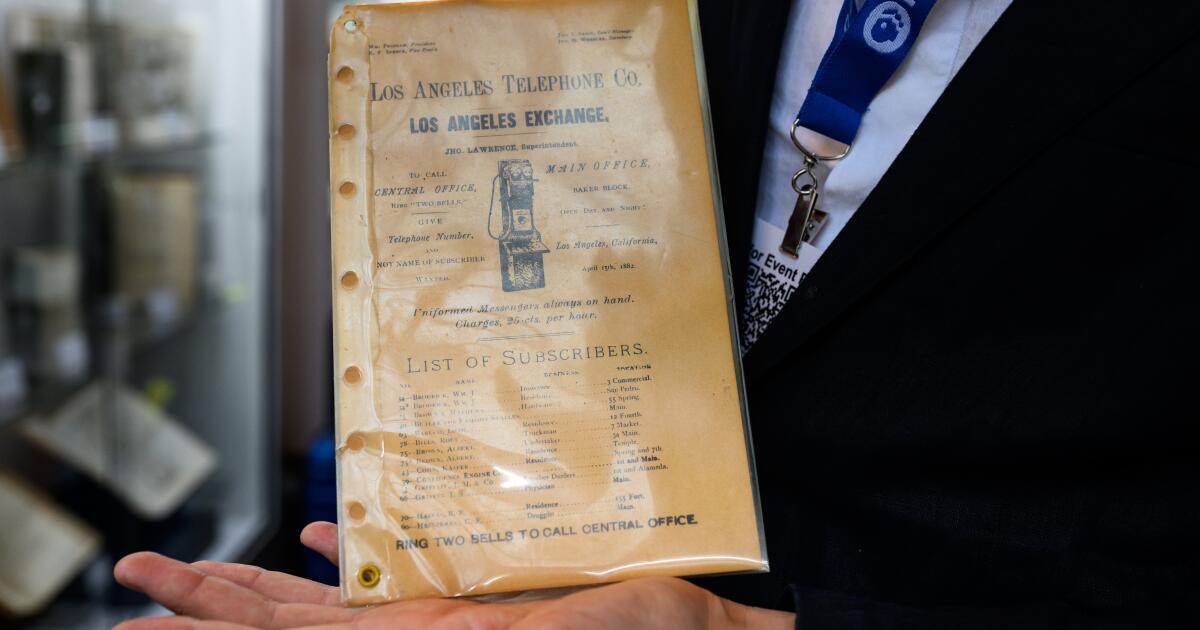
This 1882 L.A. phonebook includes just 90 names.
(William Liang / For The Times)
On April 3, 1882, the city permitted the Los Angeles Telephone Co. to string lines within city limits. A week later, L.A. printed its first phone book. Most early directories were tossed once a new one arrived, but Peter Harrington Rare Books has a rare surviving copy, titled “Los Angeles Telephone Book (1882),” priced around $13,000.
The single, folded sheet lists just 90 names, mostly businesses near historic downtown such as liveries, saloons, physicians, mills, druggists and the local undertaker. Included are instructions for calling the central office, along with one- and two-digit numbers for USC’s first president, M.M. Bovard (dial “58”), and the Los Angeles Club (dial “38”). Seen at auction only twice in modern records, the directory is a rare piece of early Californiana — as much a record of the city’s earliest telecommunications as a social snapshot of fin de siècle Los Angeles.

This 1882 L.A. phonebook includes just 90 names.
(William Liang / For The Times)
On April 3, 1882, the city permitted the Los Angeles Telephone Co. to string lines within city limits. A week later, L.A. printed its first phone book. Most early directories were tossed once a new one arrived, but Peter Harrington Rare Books has a rare surviving copy, titled “Los Angeles Telephone Book (1882),” priced around $13,000.
The single, folded sheet lists just 90 names, mostly businesses near historic downtown such as liveries, saloons, physicians, mills, druggists and the local undertaker. Included are instructions for calling the central office, along with one- and two-digit numbers for USC’s first president, M.M. Bovard (dial “58”), and the Los Angeles Club (dial “38”). Seen at auction only twice in modern records, the directory is a rare piece of early Californiana — as much a record of the city’s earliest telecommunications as a social snapshot of fin de siècle Los Angeles.

This 1882 L.A. phonebook includes just 90 names.
(William Liang / For The Times)
On April 3, 1882, the city permitted the Los Angeles Telephone Co. to string lines within city limits. A week later, L.A. printed its first phone book. Most early directories were tossed once a new one arrived, but Peter Harrington Rare Books has a rare surviving copy, titled “Los Angeles Telephone Book (1882),” priced around $13,000.
The single, folded sheet lists just 90 names, mostly businesses near historic downtown such as liveries, saloons, physicians, mills, druggists and the local undertaker. Included are instructions for calling the central office, along with one- and two-digit numbers for USC’s first president, M.M. Bovard (dial “58”), and the Los Angeles Club (dial “38”). Seen at auction only twice in modern records, the directory is a rare piece of early Californiana — as much a record of the city’s earliest telecommunications as a social snapshot of fin de siècle Los Angeles.
This 1882 L.A. phonebook includes just 90 names.
(William Liang / For The Times)
On April 3, 1882, the city permitted the Los Angeles Telephone Co. to string lines within city limits. A week later, L.A. printed its first phone book. Most early directories were tossed once a new one arrived, but Peter Harrington Rare Books has a rare surviving copy, titled “Los Angeles Telephone Book (1882),” priced around $13,000.
The single, folded sheet lists just 90 names, mostly businesses near historic downtown such as liveries, saloons, physicians, mills, druggists and the local undertaker. Included are instructions for calling the central office, along with one- and two-digit numbers for USC’s first president, M.M. Bovard (dial “58”), and the Los Angeles Club (dial “38”). Seen at auction only twice in modern records, the directory is a rare piece of early Californiana — as much a record of the city’s earliest telecommunications as a social snapshot of fin de siècle Los Angeles.

This 1882 L.A. phonebook includes just 90 names.
(William Liang / For The Times)
On April 3, 1882, the city permitted the Los Angeles Telephone Co. to string lines within city limits. A week later, L.A. printed its first phone book. Most early directories were tossed once a new one arrived, but Peter Harrington Rare Books has a rare surviving copy, titled “Los Angeles Telephone Book (1882),” priced around $13,000.
The single, folded sheet lists just 90 names, mostly businesses near historic downtown such as liveries, saloons, physicians, mills, druggists and the local undertaker. Included are instructions for calling the central office, along with one- and two-digit numbers for USC’s first president, M.M. Bovard (dial “58”), and the Los Angeles Club (dial “38”). Seen at auction only twice in modern records, the directory is a rare piece of early Californiana — as much a record of the city’s earliest telecommunications as a social snapshot of fin de siècle Los Angeles.
This 1882 L.A. phonebook includes just 90 names.
(William Liang / For The Times)
On April 3, 1882, the city permitted the Los Angeles Telephone Co. to string lines within city limits. A week later, L.A. printed its first phone book. Most early directories were tossed once a new one arrived, but Peter Harrington Rare Books has a rare surviving copy, titled “Los Angeles Telephone Book (1882),” priced around $13,000.
The single, folded sheet lists just 90 names, mostly businesses near historic downtown such as liveries, saloons, physicians, mills, druggists and the local undertaker. Included are instructions for calling the central office, along with one- and two-digit numbers for USC’s first president, M.M. Bovard (dial “58”), and the Los Angeles Club (dial “38”). Seen at auction only twice in modern records, the directory is a rare piece of early Californiana — as much a record of the city’s earliest telecommunications as a social snapshot of fin de siècle Los Angeles.
This 1882 L.A. phonebook includes just 90 names.
(William Liang / For The Times)
On April 3, 1882, the city permitted the Los Angeles Telephone Co. to string lines within city limits. A week later, L.A. printed its first phone book. Most early directories were tossed once a new one arrived, but Peter Harrington Rare Books has a rare surviving copy, titled “Los Angeles Telephone Book (1882),” priced around $13,000.
The single, folded sheet lists just 90 names, mostly businesses near historic downtown such as liveries, saloons, physicians, mills, druggists and the local undertaker. Included are instructions for calling the central office, along with one- and two-digit numbers for USC’s first president, M.M. Bovard (dial “58”), and the Los Angeles Club (dial “38”). Seen at auction only twice in modern records, the directory is a rare piece of early Californiana — as much a record of the city’s earliest telecommunications as a social snapshot of fin de siècle Los Angeles.
This 1882 L.A. phonebook includes just 90 names.
(William Liang / For The Times)
On April 3, 1882, the city permitted the Los Angeles Telephone Co. to string lines within city limits. A week later, L.A. printed its first phone book. Most early directories were tossed once a new one arrived, but Peter Harrington Rare Books has a rare surviving copy, titled “Los Angeles Telephone Book (1882),” priced around $13,000.
The single, folded sheet lists just 90 names, mostly businesses near historic downtown such as liveries, saloons, physicians, mills, druggists and the local undertaker. Included are instructions for calling the central office, along with one- and two-digit numbers for USC’s first president, M.M. Bovard (dial “58”), and the Los Angeles Club (dial “38”). Seen at auction only twice in modern records, the directory is a rare piece of early Californiana — as much a record of the city’s earliest telecommunications as a social snapshot of fin de siècle Los Angeles.


