
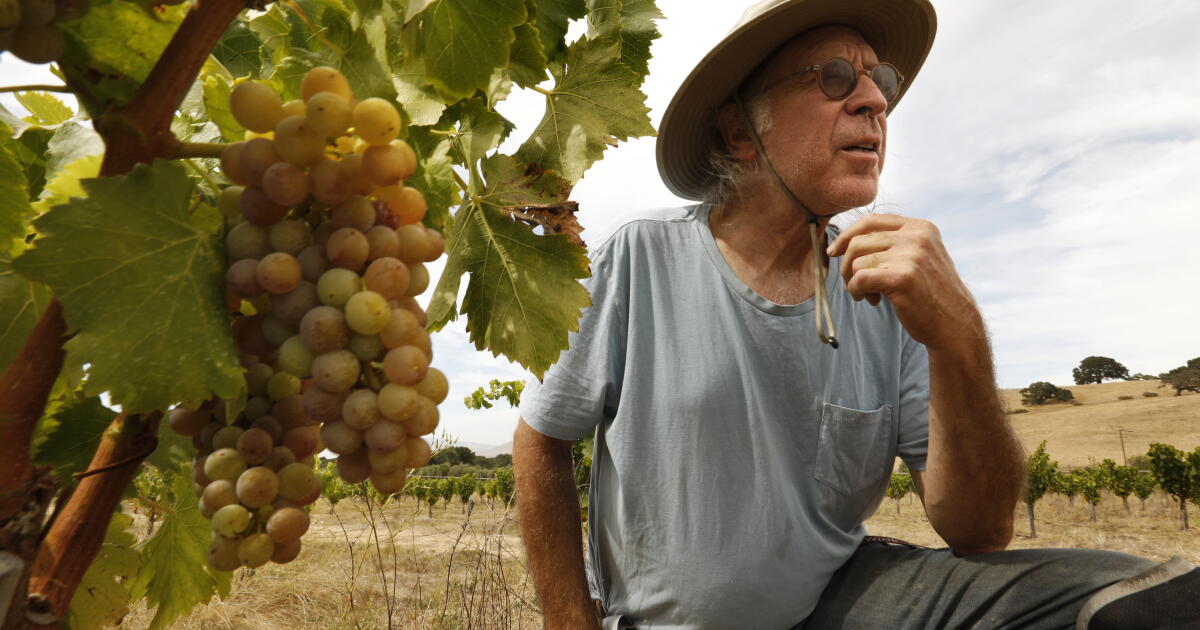
Tufts of the famous winemaker Randall Grahm’s long hair peek out of a battered sun hat in thin gray wisps, and the furrows on his forehead are many and deeply set. He sighs a lot. He fidgets. When he first appears in “The Terroirist,” the new documentary directed by Jeffrey Reiner (“The Affair,” “Friday Night Lights”), our initial impression is that Grahm, one of the California wine industry’s most legendary iconoclasts, is getting old.
In a career spanning nearly 50 years, Grahm has created several high-flying wine ventures, including Bonny Doon Vineyard, Big House, Pacific Rim, Cardinal Zin, the Language of Yes and others. His most famous wine, a Rhône-inspired red blend from Bonny Doon called Le Cigare Volant, brought with it a preposterous backstory involving UFOs landing in French vineyards, launching an extraterrestrial iconography the likes of which had never been seen in the American wine market. He earned a global reputation for groundbreaking wines and antic wine promotions, for sublime bottlings and dubious vinous experiments, all conveyed with immoderate theatricality. Where Reiner picks up the story — his first documentary — Grahm, now 73, is forging yet another new path.
Grahm in the documentary “The Terroirist”: “How much time do I actually have,” he asks himself, “to physically accomplish what I need to accomplish?”
(The Terroririst)
In a stark opening sequence, Reiner guides his subject toward the realization that he may not outlive his ambitions. “How much time do I actually have,” he asks himself, “to physically accomplish what I need to accomplish?” In the next shot Grahm tells Reiner he’s been diagnosed with Parkinson’s disease. That’s when you realize this will not be an ordinary wine documentary. And that this winemaker, this self-described “dreamer, quixotic seeker of vinous truth and beauty,” might be running out of road.
“Yes,” Grahm says in a recent conversation, “I’ve got kind of a medically complex situation going right now, to my great chagrin.”
Grahm’s long quest for vinous truth has led him to the Popelouchum vineyard, a large parcel planted to 30 acres in California’s San Benito County, east of Monterey, resting squarely on the San Andreas faultline. Popelouchum (the name means “paradise” in the language of the Indigenous people of the area) is Grahm’s most ambitious project, and most personal. It’s home to more than a dozen grape varieties, some well known (like Pinot Noir and Grenache) and some quite obscure (like Ruché and Ciliegiolo).
Those plantings are finally old enough to reveal what the site can express, what the French call terroir, and the occasion for the pun in the movie’s title. “The Terroirist” tells the story of that vineyard project coming to fruition, and of the man trying to will it into existence as he faces his own mortality.
Part of Grahm’s goal at Popelouchum was to conduct a vast genetic experiment, to attempt to grow vines, and create new varieties, from grapeseeds. Genetic variation is rampant and wildly unpredictable in grapevines, as it is in other tree fruits (like apples), so vines are typically propagated by grafting genetically identical cuttings to rootstock. Growing them from seed is a fool’s errand; it’s simply not done. So naturally, Grahm had to try. His dream was to evaluate thousands of plants grown from seed, and not only to isolate an entirely new, wholly American variety, but one ideally suited for this site. It would be terroir like no other: terroir to the nth degree.

“The Terroirist” tells the story of Grahm’s longtime vineyard project Popelouchum coming to fruition, and of the man trying to will it into existence as he faces his own mortality.
(The Terroririst)
Grahm seems to approach the prospect in terms of its statistical probability, supplemented by hope. “Maybe this mixed population would be uniquely suited to San Juan Bautista conditions,” he says. “More drought-tolerant, better acidity, whatever it might be, a vehicle for expressing the uniqueness of the site itself by diffusing the varietal character, or softening it, to allow the soil characteristics to emerge.”
For thousands of reasons, things did not go as planned, though it must be said that when it comes to Grahm, this is a common refrain. He has since reined in his experiment to the offspring of a single variety, Serine, which yielded about 150 variations, half white, half red. These are now in the ground; Grahm still hopes to find the needle in this more manageable haystack. Next year, or the year after, he’ll be able to evaluate fruit from these fledglings.
Jeffrey Reiner first read about Popelouchum in a New Yorker story written by Adam Gopnik in 2018, chronicling the early years at Popelouchum. Reiner identified with Grahm’s decision to walk away from mass-produced wines. As the producer and director of several TV series, the most successful of which, “Friday Night Lights,” brought him universal acclaim, he was executing his own exit plan from the Hollywood studio system. He had just completed an independent film, “Lake George,” which opened to solid reviews in late 2024. He wanted his next project to be a documentary.
Reiner was already well acquainted with Grahm’s wines. Like many a successful studio creative, Reiner was a wine lover: Back in the ’90s, in what he describes as “a career funk,” he used to bolster his spirits at a wine bar at the Original Farmers Market. One day a server offered him a glass of rosé. Reiner was aghast. “I don’t drink white Zinfandel,” he sneered, but took a sip anyway and was introduced to the restorative powers of pink: dry, lightly perfumed rosé wines made in a lively Provençale style. “Until that moment,” he says, “I had no idea that wine could do that.” The wine was Bonny Doon Vin Gris de Cigare.
Within the year he’d joined the Bonny Doon wine club and learned, as one does, that Grahm made dozens of wines, from dozens of grape varieties, reflecting a curiosity, a creativity and possibly a lack of impulse control that Reiner had never encountered before in the world of wine. “It wasn’t ‘domain this’ or ‘chateau that,’ you know?” he says. “It was Big House Red, it was the flying saucer on Cigare Volant. God, he had some great labels.” In one sequence in the film, he flashes those labels in a dizzying montage that leaves you momentarily dazed.

Winemaker Grahm and director Reiner in a behind-the-scenes photo during the production of “The Terroririst.”
(The Terroririst)
They began to collaborate in 2024. Reiner was struck by his subject’s intelligence, his wit and his volubility. He learned that for Grahm the Popelouchum project wasn’t so much a business as a quest. “He was so connected to the land and to making it work,” he says. “I could tell that he was up against it. And so I said to him, ‘You’re not going to give up on this, right?’ and he said, ‘No, I can’t give up on this land.’ He was sticking to his guns. And that to me said, ‘OK, I think I have a movie here.’”
After Grahm’s intimations of mortality in the opening scenes, the movie settles into a gentler, less urgent rhythm. Like many wine documentaries, this one takes us through the seasons; there are shots of Grahm walking with the help of a cane between vine rows, ruminating on the coming vintage; shots of various memorabilia, gathering dust; and bat poop in a storage building. Reiner provides commentary with talking heads like critic Elaine Chukan Brown, winemakers Bob Lindquist and Rajat Parr and former Bonny Doon collaborators Patrice Boyle and John Locke.
Also we meet Grahm’s daughter, Amélie, age 20. At the time of filming, Amélie has just begun to express some interest in wine and the wine business, offering hope that Grahm’s efforts may attract a successor.
The most trenchant comments, perhaps, come from Grahm’s partner Chinshu Huang, who conveys a mixture of love and exasperation. “It’s almost as if it needs to be something difficult for him to want to do it,” she says at one point. “He wouldn’t choose the easy way to go, no matter what the path is.”

In Reiner’s telling, Grahm’s devotion to his vineyard resembles a practice, the ways Buddhists and dancers practice, to be proficient, to have purpose. Grahm would agree.
“Taking care of a vineyard is in a sense my spiritual path,” says Grahm, “my way of learning somehow to become less of a luftmensch, and to put my feet on the ground and see things around me, to be more present. It’s sort of my gesture toward learning how to be more of a human being, something closer to what a human being is, or should be, or could be,” and then he adds — because he can’t help himself: “I think.”
“The Terroirist” will be available on most streaming platforms on Nov. 13.

Tufts of the famous winemaker Randall Grahm’s long hair peek out of a battered sun hat in thin gray wisps, and the furrows on his forehead are many and deeply set. He sighs a lot. He fidgets. When he first appears in “The Terroirist,” the new documentary directed by Jeffrey Reiner (“The Affair,” “Friday Night Lights”), our initial impression is that Grahm, one of the California wine industry’s most legendary iconoclasts, is getting old.
In a career spanning nearly 50 years, Grahm has created several high-flying wine ventures, including Bonny Doon Vineyard, Big House, Pacific Rim, Cardinal Zin, the Language of Yes and others. His most famous wine, a Rhône-inspired red blend from Bonny Doon called Le Cigare Volant, brought with it a preposterous backstory involving UFOs landing in French vineyards, launching an extraterrestrial iconography the likes of which had never been seen in the American wine market. He earned a global reputation for groundbreaking wines and antic wine promotions, for sublime bottlings and dubious vinous experiments, all conveyed with immoderate theatricality. Where Reiner picks up the story — his first documentary — Grahm, now 73, is forging yet another new path.
Grahm in the documentary “The Terroirist”: “How much time do I actually have,” he asks himself, “to physically accomplish what I need to accomplish?”
(The Terroririst)
In a stark opening sequence, Reiner guides his subject toward the realization that he may not outlive his ambitions. “How much time do I actually have,” he asks himself, “to physically accomplish what I need to accomplish?” In the next shot Grahm tells Reiner he’s been diagnosed with Parkinson’s disease. That’s when you realize this will not be an ordinary wine documentary. And that this winemaker, this self-described “dreamer, quixotic seeker of vinous truth and beauty,” might be running out of road.
“Yes,” Grahm says in a recent conversation, “I’ve got kind of a medically complex situation going right now, to my great chagrin.”
Grahm’s long quest for vinous truth has led him to the Popelouchum vineyard, a large parcel planted to 30 acres in California’s San Benito County, east of Monterey, resting squarely on the San Andreas faultline. Popelouchum (the name means “paradise” in the language of the Indigenous people of the area) is Grahm’s most ambitious project, and most personal. It’s home to more than a dozen grape varieties, some well known (like Pinot Noir and Grenache) and some quite obscure (like Ruché and Ciliegiolo).
Those plantings are finally old enough to reveal what the site can express, what the French call terroir, and the occasion for the pun in the movie’s title. “The Terroirist” tells the story of that vineyard project coming to fruition, and of the man trying to will it into existence as he faces his own mortality.
Part of Grahm’s goal at Popelouchum was to conduct a vast genetic experiment, to attempt to grow vines, and create new varieties, from grapeseeds. Genetic variation is rampant and wildly unpredictable in grapevines, as it is in other tree fruits (like apples), so vines are typically propagated by grafting genetically identical cuttings to rootstock. Growing them from seed is a fool’s errand; it’s simply not done. So naturally, Grahm had to try. His dream was to evaluate thousands of plants grown from seed, and not only to isolate an entirely new, wholly American variety, but one ideally suited for this site. It would be terroir like no other: terroir to the nth degree.
“The Terroirist” tells the story of Grahm’s longtime vineyard project Popelouchum coming to fruition, and of the man trying to will it into existence as he faces his own mortality.
(The Terroririst)
Grahm seems to approach the prospect in terms of its statistical probability, supplemented by hope. “Maybe this mixed population would be uniquely suited to San Juan Bautista conditions,” he says. “More drought-tolerant, better acidity, whatever it might be, a vehicle for expressing the uniqueness of the site itself by diffusing the varietal character, or softening it, to allow the soil characteristics to emerge.”
For thousands of reasons, things did not go as planned, though it must be said that when it comes to Grahm, this is a common refrain. He has since reined in his experiment to the offspring of a single variety, Serine, which yielded about 150 variations, half white, half red. These are now in the ground; Grahm still hopes to find the needle in this more manageable haystack. Next year, or the year after, he’ll be able to evaluate fruit from these fledglings.
Jeffrey Reiner first read about Popelouchum in a New Yorker story written by Adam Gopnik in 2018, chronicling the early years at Popelouchum. Reiner identified with Grahm’s decision to walk away from mass-produced wines. As the producer and director of several TV series, the most successful of which, “Friday Night Lights,” brought him universal acclaim, he was executing his own exit plan from the Hollywood studio system. He had just completed an independent film, “Lake George,” which opened to solid reviews in late 2024. He wanted his next project to be a documentary.
Reiner was already well acquainted with Grahm’s wines. Like many a successful studio creative, Reiner was a wine lover: Back in the ’90s, in what he describes as “a career funk,” he used to bolster his spirits at a wine bar at the Original Farmers Market. One day a server offered him a glass of rosé. Reiner was aghast. “I don’t drink white Zinfandel,” he sneered, but took a sip anyway and was introduced to the restorative powers of pink: dry, lightly perfumed rosé wines made in a lively Provençale style. “Until that moment,” he says, “I had no idea that wine could do that.” The wine was Bonny Doon Vin Gris de Cigare.
Within the year he’d joined the Bonny Doon wine club and learned, as one does, that Grahm made dozens of wines, from dozens of grape varieties, reflecting a curiosity, a creativity and possibly a lack of impulse control that Reiner had never encountered before in the world of wine. “It wasn’t ‘domain this’ or ‘chateau that,’ you know?” he says. “It was Big House Red, it was the flying saucer on Cigare Volant. God, he had some great labels.” In one sequence in the film, he flashes those labels in a dizzying montage that leaves you momentarily dazed.
Winemaker Grahm and director Reiner in a behind-the-scenes photo during the production of “The Terroririst.”
(The Terroririst)
They began to collaborate in 2024. Reiner was struck by his subject’s intelligence, his wit and his volubility. He learned that for Grahm the Popelouchum project wasn’t so much a business as a quest. “He was so connected to the land and to making it work,” he says. “I could tell that he was up against it. And so I said to him, ‘You’re not going to give up on this, right?’ and he said, ‘No, I can’t give up on this land.’ He was sticking to his guns. And that to me said, ‘OK, I think I have a movie here.’”
After Grahm’s intimations of mortality in the opening scenes, the movie settles into a gentler, less urgent rhythm. Like many wine documentaries, this one takes us through the seasons; there are shots of Grahm walking with the help of a cane between vine rows, ruminating on the coming vintage; shots of various memorabilia, gathering dust; and bat poop in a storage building. Reiner provides commentary with talking heads like critic Elaine Chukan Brown, winemakers Bob Lindquist and Rajat Parr and former Bonny Doon collaborators Patrice Boyle and John Locke.
Also we meet Grahm’s daughter, Amélie, age 20. At the time of filming, Amélie has just begun to express some interest in wine and the wine business, offering hope that Grahm’s efforts may attract a successor.
The most trenchant comments, perhaps, come from Grahm’s partner Chinshu Huang, who conveys a mixture of love and exasperation. “It’s almost as if it needs to be something difficult for him to want to do it,” she says at one point. “He wouldn’t choose the easy way to go, no matter what the path is.”
In Reiner’s telling, Grahm’s devotion to his vineyard resembles a practice, the ways Buddhists and dancers practice, to be proficient, to have purpose. Grahm would agree.
“Taking care of a vineyard is in a sense my spiritual path,” says Grahm, “my way of learning somehow to become less of a luftmensch, and to put my feet on the ground and see things around me, to be more present. It’s sort of my gesture toward learning how to be more of a human being, something closer to what a human being is, or should be, or could be,” and then he adds — because he can’t help himself: “I think.”
“The Terroirist” will be available on most streaming platforms on Nov. 13.


