


Latin pop supergroups are few and far between. Serú Girán and Texas Tornados are probably the twin pillars, but beyond that? Bad Bunny and J Balvin went no further beyond “Oasis.” Alex & Daniel? Sadly, you can’t even stream their record anymore. And unfortunately, the crew from the “Mas Maíz” video never made a full album.
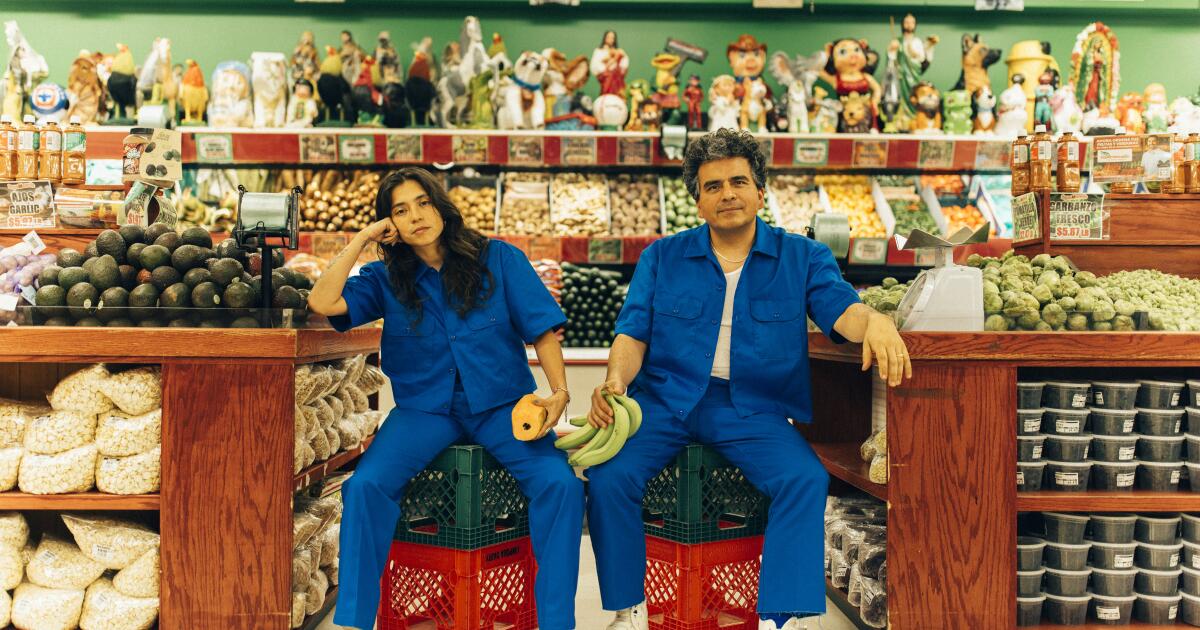
But now, we can add another group to this brief list. Helado Tropical is the newest project from Roberto Lange (Helado Negro) and Fabi Reyna (Reyna Tropical), spawned from a one-off studio hang and evolved into a resplendent self-titled LP, released in July.
Described by the pair as the world’s first “R&B lo-fi tropical wave” album, “Helado Tropical” is a work of uninhibited collaboration. Songs float in and out like ghosts from a machine. The duo layer backing tracks until they seemingly collapse, like the dueling accenting rhythms of “Soledad” or the spacey and spectacular “Sensación,” which reaches a level of yearning that Emerald Fennell’s “Wuthering Heights” couldn’t buy.
But the most powerful tracks, such as “Tocando” and “Déjate Caer,” are tethered with fraught introspection, undoubtedly impacted by these being Reyna’s first set of new compositions released since the death of her musical partner Nectali Díaz in 2022.
It’s an album that aligns with each musician’s trademarks — characterized by Lange’s soothing electronica and Reyna’s eclectic elasticity — but an entirely unique work within their respective discographies. The Times spoke with the duo on the eve of their first nationwide tour this month, with a special night at the Ford on Thursday, Aug. 13.
This interview has been edited for length and clarity.
This project is the collaboration of two people with idiosyncratic musical styles. How did you reconcile your individual tastes when this pivoted into a larger LP?
Roberto Lange: It was real-time creation more than anything. Fabi and I would take turns, I’d play a synthesizer melody and she would strum guitar chords, searching for rhythmic ideas; sometimes we’d just shout at each other. Fabi would scream, “Yo, it’d be dope at a little higher tempo!” and we’d push it from there.
I’m sure anyone who’s a musician can speak to this, but I think improvisation is part of creation, like improvising melodic ideas when you’re writing lyrics so you get into this very ecstatic and spontaneous form of yourself, where your brain becomes this sound creation machine. Once it feels right, then it becomes this form of architecture. We’ve found the land, and now we’re building on top.
Was there a moment in the studio when you realized that you’d formed a band?
Fabi Reyna: It hit us by the end of the first session. We reached a point where we were both really inspired. It helps that we’re both very meticulous and detail-oriented. We’re both a little obsessive. When you’re someone who has such a big vision and energy, and then meet another person willing to step back and offer you space, which you can each reciprocate — it’s such a beautiful push and pull and pulse of energy.
In your separate projects, you both have a distinctive set of themes that carry over across works, but it’s rooted in a deep level of introspection. Many songs on “Helado Tropical” directly address personal isolation and the ability to let go, like “Tocando.” As to you specifically, Fabi, did you intend on such autobiographical songwriting or was this borne out of your collaboration with Roberto?
Reyna: One of my practices going into a writing session alone, or with anyone else, is to make a moment for intuitive research. I don’t necessarily go in feeling like I’m gonna write about anything in particular, but I am really curious and interested in what that moment holds, and lyrically, if it flows. I’m learning as the end of the lyrics are being written.
In general, I hold that duality a lot — sonically leaning into joy and movement and dance, and then lyrically being in the shadow and focusing on the transformation. When I looked at the lyrics, it was this moment, describing what I had experienced: seeking guidance in heartbreak, grief, pain.

Roberto, did you find yourself anticipating where Fabi was going during the songwriting process or were you focused on reconciling her words to fit the music?
Lange: There were times where Fabi and I had constructed this world, and it wasn’t a song, per se, but Fabi would say “I’ll be right back” — and she would run to the other end of the studio, sit in a chair, writing and thinking. Then she would come back with a set of lyrics. Then we would record it, and then I’d think, “This is amazing.” All the words she can encapsulate for an emotion, a reaction, a response on her end. I would focus on my own interpretation of what she was thinking.
The album standout appears to be “Sensación.” In the lyrics, there’s a split between the romantic — “Getting to know the morning/Your taste all around my body is sensation” — and the cathartic — “That I lost you yesterday/I saw you again/Who will witness your final act to forget.” Who is responsible for this duality of yearning?
Reyna: In the studio, I had a lot of moments where I felt totally alone, but what comforted me was our creative process. “Sensación” is a song about two sides of a feeling, which is beautiful.
I was going into a little sexy mode, and Roberto was like “Bet,” [or] “let me add to that.” From there it was like, “OK, this guy knows what’s up.” It’s my favorite song on the record.
This is probably the first supergroup of Latino electronic music stars. We’re having a bit of a moment right now between yourselves and artists like Elysia Crampton, Ela Minus, and Sofia Kourtesis, among others. How do you react when people put you into a group with those other musicians? Do you feel like you’re part of a scene?
Lange: I don’t have a choice, right? I mean, how would you label us? I think it’s hard because when you think about these labels, some are interestingly thoughtful and some are pretty broad like “electronic” by itself. I don’t really feel like we fall into these genre scenes.
Reyna: The other day, I thought “what’s our genre?” Personally I think of it as “R&B lo-fi tropical wave.” As a norteña, I grew up with music as a form of justice. Border culture is about fighting constantly against homophobia and sexism and racism and classism. I felt driven to music that is for and by Black and brown experiences, about fighting for your own culture, and fighting for your home place.
Call it social justice or activism or whatever, those are just containers for the actual daily work that we do to survive and thrive. I think that awareness of that spirit in the music that you grow with over time can help break the rules of Latinidad and allow us to build our own worlds through our perspectives and intersectional experiences.
What can people kind of expect from the tour?
Lange: Besides the “Helado Tropical” songs, we’ll be playing music from our individual works. But we’ll have some mystery too. I’ve always been forward with costuming and theatrics, but it’s been cool seeing what Fabi’s been creating for our visuals. It’s gonna be cool to see how we can extend that world to the audience.
Reyna: I promise that it will be curated. The shows will always be for the people.
What have you taken away from the experience of working so closely during this recording?
Reyna: We’re very supportive of one another. You can feel that in our music, you’re gonna see it on stage. And right now we need to support each other so badly with everything that we’re going through as a community, as a people in the world.
Lange: My takeaway from working with Fabi is the inspiration she provided in the studio. It’s testament to this idea about opening up your creative world; about trying something and taking a risk and not being scared to make an opportunity work, about accepting ideas for what they are. We’ve created this work, and then maybe this new genre that nobody even knows yet. And now we’re building on that foundation together.
Is there another Helado Tropical record in the works? Will it be called Reyna Negro?
Reyna: He’s stuck with me. I’ve officially locked him in the studio for life. We want to keep writing. We want to keep making music, see what happens. As long as it feels fun and exciting. I want to keep doing it.

Latin pop supergroups are few and far between. Serú Girán and Texas Tornados are probably the twin pillars, but beyond that? Bad Bunny and J Balvin went no further beyond “Oasis.” Alex & Daniel? Sadly, you can’t even stream their record anymore. And unfortunately, the crew from the “Mas Maíz” video never made a full album.
But now, we can add another group to this brief list. Helado Tropical is the newest project from Roberto Lange (Helado Negro) and Fabi Reyna (Reyna Tropical), spawned from a one-off studio hang and evolved into a resplendent self-titled LP, released in July.
Described by the pair as the world’s first “R&B lo-fi tropical wave” album, “Helado Tropical” is a work of uninhibited collaboration. Songs float in and out like ghosts from a machine. The duo layer backing tracks until they seemingly collapse, like the dueling accenting rhythms of “Soledad” or the spacey and spectacular “Sensación,” which reaches a level of yearning that Emerald Fennell’s “Wuthering Heights” couldn’t buy.
But the most powerful tracks, such as “Tocando” and “Déjate Caer,” are tethered with fraught introspection, undoubtedly impacted by these being Reyna’s first set of new compositions released since the death of her musical partner Nectali Díaz in 2022.
It’s an album that aligns with each musician’s trademarks — characterized by Lange’s soothing electronica and Reyna’s eclectic elasticity — but an entirely unique work within their respective discographies. The Times spoke with the duo on the eve of their first nationwide tour this month, with a special night at the Ford on Thursday, Aug. 13.
This interview has been edited for length and clarity.
This project is the collaboration of two people with idiosyncratic musical styles. How did you reconcile your individual tastes when this pivoted into a larger LP?
Roberto Lange: It was real-time creation more than anything. Fabi and I would take turns, I’d play a synthesizer melody and she would strum guitar chords, searching for rhythmic ideas; sometimes we’d just shout at each other. Fabi would scream, “Yo, it’d be dope at a little higher tempo!” and we’d push it from there.
I’m sure anyone who’s a musician can speak to this, but I think improvisation is part of creation, like improvising melodic ideas when you’re writing lyrics so you get into this very ecstatic and spontaneous form of yourself, where your brain becomes this sound creation machine. Once it feels right, then it becomes this form of architecture. We’ve found the land, and now we’re building on top.
Was there a moment in the studio when you realized that you’d formed a band?
Fabi Reyna: It hit us by the end of the first session. We reached a point where we were both really inspired. It helps that we’re both very meticulous and detail-oriented. We’re both a little obsessive. When you’re someone who has such a big vision and energy, and then meet another person willing to step back and offer you space, which you can each reciprocate — it’s such a beautiful push and pull and pulse of energy.
In your separate projects, you both have a distinctive set of themes that carry over across works, but it’s rooted in a deep level of introspection. Many songs on “Helado Tropical” directly address personal isolation and the ability to let go, like “Tocando.” As to you specifically, Fabi, did you intend on such autobiographical songwriting or was this borne out of your collaboration with Roberto?
Reyna: One of my practices going into a writing session alone, or with anyone else, is to make a moment for intuitive research. I don’t necessarily go in feeling like I’m gonna write about anything in particular, but I am really curious and interested in what that moment holds, and lyrically, if it flows. I’m learning as the end of the lyrics are being written.
In general, I hold that duality a lot — sonically leaning into joy and movement and dance, and then lyrically being in the shadow and focusing on the transformation. When I looked at the lyrics, it was this moment, describing what I had experienced: seeking guidance in heartbreak, grief, pain.
Roberto, did you find yourself anticipating where Fabi was going during the songwriting process or were you focused on reconciling her words to fit the music?
Lange: There were times where Fabi and I had constructed this world, and it wasn’t a song, per se, but Fabi would say “I’ll be right back” — and she would run to the other end of the studio, sit in a chair, writing and thinking. Then she would come back with a set of lyrics. Then we would record it, and then I’d think, “This is amazing.” All the words she can encapsulate for an emotion, a reaction, a response on her end. I would focus on my own interpretation of what she was thinking.
The album standout appears to be “Sensación.” In the lyrics, there’s a split between the romantic — “Getting to know the morning/Your taste all around my body is sensation” — and the cathartic — “That I lost you yesterday/I saw you again/Who will witness your final act to forget.” Who is responsible for this duality of yearning?
Reyna: In the studio, I had a lot of moments where I felt totally alone, but what comforted me was our creative process. “Sensación” is a song about two sides of a feeling, which is beautiful.
I was going into a little sexy mode, and Roberto was like “Bet,” [or] “let me add to that.” From there it was like, “OK, this guy knows what’s up.” It’s my favorite song on the record.
This is probably the first supergroup of Latino electronic music stars. We’re having a bit of a moment right now between yourselves and artists like Elysia Crampton, Ela Minus, and Sofia Kourtesis, among others. How do you react when people put you into a group with those other musicians? Do you feel like you’re part of a scene?
Lange: I don’t have a choice, right? I mean, how would you label us? I think it’s hard because when you think about these labels, some are interestingly thoughtful and some are pretty broad like “electronic” by itself. I don’t really feel like we fall into these genre scenes.
Reyna: The other day, I thought “what’s our genre?” Personally I think of it as “R&B lo-fi tropical wave.” As a norteña, I grew up with music as a form of justice. Border culture is about fighting constantly against homophobia and sexism and racism and classism. I felt driven to music that is for and by Black and brown experiences, about fighting for your own culture, and fighting for your home place.
Call it social justice or activism or whatever, those are just containers for the actual daily work that we do to survive and thrive. I think that awareness of that spirit in the music that you grow with over time can help break the rules of Latinidad and allow us to build our own worlds through our perspectives and intersectional experiences.
What can people kind of expect from the tour?
Lange: Besides the “Helado Tropical” songs, we’ll be playing music from our individual works. But we’ll have some mystery too. I’ve always been forward with costuming and theatrics, but it’s been cool seeing what Fabi’s been creating for our visuals. It’s gonna be cool to see how we can extend that world to the audience.
Reyna: I promise that it will be curated. The shows will always be for the people.
What have you taken away from the experience of working so closely during this recording?
Reyna: We’re very supportive of one another. You can feel that in our music, you’re gonna see it on stage. And right now we need to support each other so badly with everything that we’re going through as a community, as a people in the world.
Lange: My takeaway from working with Fabi is the inspiration she provided in the studio. It’s testament to this idea about opening up your creative world; about trying something and taking a risk and not being scared to make an opportunity work, about accepting ideas for what they are. We’ve created this work, and then maybe this new genre that nobody even knows yet. And now we’re building on that foundation together.
Is there another Helado Tropical record in the works? Will it be called Reyna Negro?
Reyna: He’s stuck with me. I’ve officially locked him in the studio for life. We want to keep writing. We want to keep making music, see what happens. As long as it feels fun and exciting. I want to keep doing it.

Latin pop supergroups are few and far between. Serú Girán and Texas Tornados are probably the twin pillars, but beyond that? Bad Bunny and J Balvin went no further beyond “Oasis.” Alex & Daniel? Sadly, you can’t even stream their record anymore. And unfortunately, the crew from the “Mas Maíz” video never made a full album.
But now, we can add another group to this brief list. Helado Tropical is the newest project from Roberto Lange (Helado Negro) and Fabi Reyna (Reyna Tropical), spawned from a one-off studio hang and evolved into a resplendent self-titled LP, released in July.
Described by the pair as the world’s first “R&B lo-fi tropical wave” album, “Helado Tropical” is a work of uninhibited collaboration. Songs float in and out like ghosts from a machine. The duo layer backing tracks until they seemingly collapse, like the dueling accenting rhythms of “Soledad” or the spacey and spectacular “Sensación,” which reaches a level of yearning that Emerald Fennell’s “Wuthering Heights” couldn’t buy.
But the most powerful tracks, such as “Tocando” and “Déjate Caer,” are tethered with fraught introspection, undoubtedly impacted by these being Reyna’s first set of new compositions released since the death of her musical partner Nectali Díaz in 2022.
It’s an album that aligns with each musician’s trademarks — characterized by Lange’s soothing electronica and Reyna’s eclectic elasticity — but an entirely unique work within their respective discographies. The Times spoke with the duo on the eve of their first nationwide tour this month, with a special night at the Ford on Thursday, Aug. 13.
This interview has been edited for length and clarity.
This project is the collaboration of two people with idiosyncratic musical styles. How did you reconcile your individual tastes when this pivoted into a larger LP?
Roberto Lange: It was real-time creation more than anything. Fabi and I would take turns, I’d play a synthesizer melody and she would strum guitar chords, searching for rhythmic ideas; sometimes we’d just shout at each other. Fabi would scream, “Yo, it’d be dope at a little higher tempo!” and we’d push it from there.
I’m sure anyone who’s a musician can speak to this, but I think improvisation is part of creation, like improvising melodic ideas when you’re writing lyrics so you get into this very ecstatic and spontaneous form of yourself, where your brain becomes this sound creation machine. Once it feels right, then it becomes this form of architecture. We’ve found the land, and now we’re building on top.
Was there a moment in the studio when you realized that you’d formed a band?
Fabi Reyna: It hit us by the end of the first session. We reached a point where we were both really inspired. It helps that we’re both very meticulous and detail-oriented. We’re both a little obsessive. When you’re someone who has such a big vision and energy, and then meet another person willing to step back and offer you space, which you can each reciprocate — it’s such a beautiful push and pull and pulse of energy.
In your separate projects, you both have a distinctive set of themes that carry over across works, but it’s rooted in a deep level of introspection. Many songs on “Helado Tropical” directly address personal isolation and the ability to let go, like “Tocando.” As to you specifically, Fabi, did you intend on such autobiographical songwriting or was this borne out of your collaboration with Roberto?
Reyna: One of my practices going into a writing session alone, or with anyone else, is to make a moment for intuitive research. I don’t necessarily go in feeling like I’m gonna write about anything in particular, but I am really curious and interested in what that moment holds, and lyrically, if it flows. I’m learning as the end of the lyrics are being written.
In general, I hold that duality a lot — sonically leaning into joy and movement and dance, and then lyrically being in the shadow and focusing on the transformation. When I looked at the lyrics, it was this moment, describing what I had experienced: seeking guidance in heartbreak, grief, pain.
Roberto, did you find yourself anticipating where Fabi was going during the songwriting process or were you focused on reconciling her words to fit the music?
Lange: There were times where Fabi and I had constructed this world, and it wasn’t a song, per se, but Fabi would say “I’ll be right back” — and she would run to the other end of the studio, sit in a chair, writing and thinking. Then she would come back with a set of lyrics. Then we would record it, and then I’d think, “This is amazing.” All the words she can encapsulate for an emotion, a reaction, a response on her end. I would focus on my own interpretation of what she was thinking.
The album standout appears to be “Sensación.” In the lyrics, there’s a split between the romantic — “Getting to know the morning/Your taste all around my body is sensation” — and the cathartic — “That I lost you yesterday/I saw you again/Who will witness your final act to forget.” Who is responsible for this duality of yearning?
Reyna: In the studio, I had a lot of moments where I felt totally alone, but what comforted me was our creative process. “Sensación” is a song about two sides of a feeling, which is beautiful.
I was going into a little sexy mode, and Roberto was like “Bet,” [or] “let me add to that.” From there it was like, “OK, this guy knows what’s up.” It’s my favorite song on the record.
This is probably the first supergroup of Latino electronic music stars. We’re having a bit of a moment right now between yourselves and artists like Elysia Crampton, Ela Minus, and Sofia Kourtesis, among others. How do you react when people put you into a group with those other musicians? Do you feel like you’re part of a scene?
Lange: I don’t have a choice, right? I mean, how would you label us? I think it’s hard because when you think about these labels, some are interestingly thoughtful and some are pretty broad like “electronic” by itself. I don’t really feel like we fall into these genre scenes.
Reyna: The other day, I thought “what’s our genre?” Personally I think of it as “R&B lo-fi tropical wave.” As a norteña, I grew up with music as a form of justice. Border culture is about fighting constantly against homophobia and sexism and racism and classism. I felt driven to music that is for and by Black and brown experiences, about fighting for your own culture, and fighting for your home place.
Call it social justice or activism or whatever, those are just containers for the actual daily work that we do to survive and thrive. I think that awareness of that spirit in the music that you grow with over time can help break the rules of Latinidad and allow us to build our own worlds through our perspectives and intersectional experiences.
What can people kind of expect from the tour?
Lange: Besides the “Helado Tropical” songs, we’ll be playing music from our individual works. But we’ll have some mystery too. I’ve always been forward with costuming and theatrics, but it’s been cool seeing what Fabi’s been creating for our visuals. It’s gonna be cool to see how we can extend that world to the audience.
Reyna: I promise that it will be curated. The shows will always be for the people.
What have you taken away from the experience of working so closely during this recording?
Reyna: We’re very supportive of one another. You can feel that in our music, you’re gonna see it on stage. And right now we need to support each other so badly with everything that we’re going through as a community, as a people in the world.
Lange: My takeaway from working with Fabi is the inspiration she provided in the studio. It’s testament to this idea about opening up your creative world; about trying something and taking a risk and not being scared to make an opportunity work, about accepting ideas for what they are. We’ve created this work, and then maybe this new genre that nobody even knows yet. And now we’re building on that foundation together.
Is there another Helado Tropical record in the works? Will it be called Reyna Negro?
Reyna: He’s stuck with me. I’ve officially locked him in the studio for life. We want to keep writing. We want to keep making music, see what happens. As long as it feels fun and exciting. I want to keep doing it.
Latin pop supergroups are few and far between. Serú Girán and Texas Tornados are probably the twin pillars, but beyond that? Bad Bunny and J Balvin went no further beyond “Oasis.” Alex & Daniel? Sadly, you can’t even stream their record anymore. And unfortunately, the crew from the “Mas Maíz” video never made a full album.
But now, we can add another group to this brief list. Helado Tropical is the newest project from Roberto Lange (Helado Negro) and Fabi Reyna (Reyna Tropical), spawned from a one-off studio hang and evolved into a resplendent self-titled LP, released in July.
Described by the pair as the world’s first “R&B lo-fi tropical wave” album, “Helado Tropical” is a work of uninhibited collaboration. Songs float in and out like ghosts from a machine. The duo layer backing tracks until they seemingly collapse, like the dueling accenting rhythms of “Soledad” or the spacey and spectacular “Sensación,” which reaches a level of yearning that Emerald Fennell’s “Wuthering Heights” couldn’t buy.
But the most powerful tracks, such as “Tocando” and “Déjate Caer,” are tethered with fraught introspection, undoubtedly impacted by these being Reyna’s first set of new compositions released since the death of her musical partner Nectali Díaz in 2022.
It’s an album that aligns with each musician’s trademarks — characterized by Lange’s soothing electronica and Reyna’s eclectic elasticity — but an entirely unique work within their respective discographies. The Times spoke with the duo on the eve of their first nationwide tour this month, with a special night at the Ford on Thursday, Aug. 13.
This interview has been edited for length and clarity.
This project is the collaboration of two people with idiosyncratic musical styles. How did you reconcile your individual tastes when this pivoted into a larger LP?
Roberto Lange: It was real-time creation more than anything. Fabi and I would take turns, I’d play a synthesizer melody and she would strum guitar chords, searching for rhythmic ideas; sometimes we’d just shout at each other. Fabi would scream, “Yo, it’d be dope at a little higher tempo!” and we’d push it from there.
I’m sure anyone who’s a musician can speak to this, but I think improvisation is part of creation, like improvising melodic ideas when you’re writing lyrics so you get into this very ecstatic and spontaneous form of yourself, where your brain becomes this sound creation machine. Once it feels right, then it becomes this form of architecture. We’ve found the land, and now we’re building on top.
Was there a moment in the studio when you realized that you’d formed a band?
Fabi Reyna: It hit us by the end of the first session. We reached a point where we were both really inspired. It helps that we’re both very meticulous and detail-oriented. We’re both a little obsessive. When you’re someone who has such a big vision and energy, and then meet another person willing to step back and offer you space, which you can each reciprocate — it’s such a beautiful push and pull and pulse of energy.
In your separate projects, you both have a distinctive set of themes that carry over across works, but it’s rooted in a deep level of introspection. Many songs on “Helado Tropical” directly address personal isolation and the ability to let go, like “Tocando.” As to you specifically, Fabi, did you intend on such autobiographical songwriting or was this borne out of your collaboration with Roberto?
Reyna: One of my practices going into a writing session alone, or with anyone else, is to make a moment for intuitive research. I don’t necessarily go in feeling like I’m gonna write about anything in particular, but I am really curious and interested in what that moment holds, and lyrically, if it flows. I’m learning as the end of the lyrics are being written.
In general, I hold that duality a lot — sonically leaning into joy and movement and dance, and then lyrically being in the shadow and focusing on the transformation. When I looked at the lyrics, it was this moment, describing what I had experienced: seeking guidance in heartbreak, grief, pain.
Roberto, did you find yourself anticipating where Fabi was going during the songwriting process or were you focused on reconciling her words to fit the music?
Lange: There were times where Fabi and I had constructed this world, and it wasn’t a song, per se, but Fabi would say “I’ll be right back” — and she would run to the other end of the studio, sit in a chair, writing and thinking. Then she would come back with a set of lyrics. Then we would record it, and then I’d think, “This is amazing.” All the words she can encapsulate for an emotion, a reaction, a response on her end. I would focus on my own interpretation of what she was thinking.
The album standout appears to be “Sensación.” In the lyrics, there’s a split between the romantic — “Getting to know the morning/Your taste all around my body is sensation” — and the cathartic — “That I lost you yesterday/I saw you again/Who will witness your final act to forget.” Who is responsible for this duality of yearning?
Reyna: In the studio, I had a lot of moments where I felt totally alone, but what comforted me was our creative process. “Sensación” is a song about two sides of a feeling, which is beautiful.
I was going into a little sexy mode, and Roberto was like “Bet,” [or] “let me add to that.” From there it was like, “OK, this guy knows what’s up.” It’s my favorite song on the record.
This is probably the first supergroup of Latino electronic music stars. We’re having a bit of a moment right now between yourselves and artists like Elysia Crampton, Ela Minus, and Sofia Kourtesis, among others. How do you react when people put you into a group with those other musicians? Do you feel like you’re part of a scene?
Lange: I don’t have a choice, right? I mean, how would you label us? I think it’s hard because when you think about these labels, some are interestingly thoughtful and some are pretty broad like “electronic” by itself. I don’t really feel like we fall into these genre scenes.
Reyna: The other day, I thought “what’s our genre?” Personally I think of it as “R&B lo-fi tropical wave.” As a norteña, I grew up with music as a form of justice. Border culture is about fighting constantly against homophobia and sexism and racism and classism. I felt driven to music that is for and by Black and brown experiences, about fighting for your own culture, and fighting for your home place.
Call it social justice or activism or whatever, those are just containers for the actual daily work that we do to survive and thrive. I think that awareness of that spirit in the music that you grow with over time can help break the rules of Latinidad and allow us to build our own worlds through our perspectives and intersectional experiences.
What can people kind of expect from the tour?
Lange: Besides the “Helado Tropical” songs, we’ll be playing music from our individual works. But we’ll have some mystery too. I’ve always been forward with costuming and theatrics, but it’s been cool seeing what Fabi’s been creating for our visuals. It’s gonna be cool to see how we can extend that world to the audience.
Reyna: I promise that it will be curated. The shows will always be for the people.
What have you taken away from the experience of working so closely during this recording?
Reyna: We’re very supportive of one another. You can feel that in our music, you’re gonna see it on stage. And right now we need to support each other so badly with everything that we’re going through as a community, as a people in the world.
Lange: My takeaway from working with Fabi is the inspiration she provided in the studio. It’s testament to this idea about opening up your creative world; about trying something and taking a risk and not being scared to make an opportunity work, about accepting ideas for what they are. We’ve created this work, and then maybe this new genre that nobody even knows yet. And now we’re building on that foundation together.
Is there another Helado Tropical record in the works? Will it be called Reyna Negro?
Reyna: He’s stuck with me. I’ve officially locked him in the studio for life. We want to keep writing. We want to keep making music, see what happens. As long as it feels fun and exciting. I want to keep doing it.


