

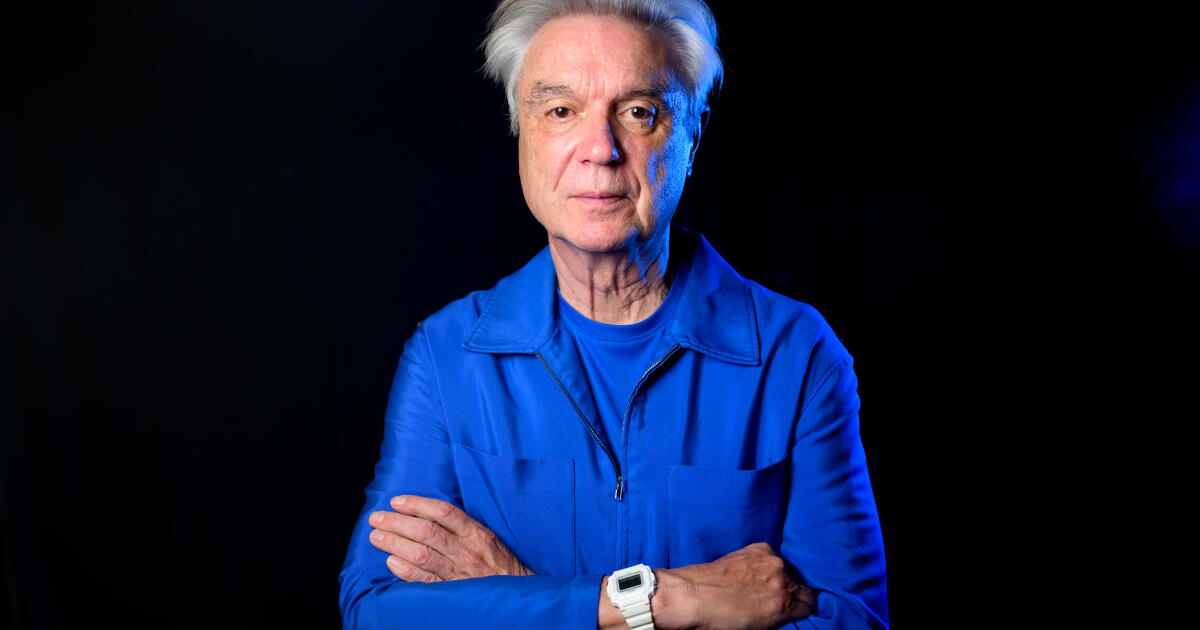

BERKELEY — Twelve hours after walking offstage at the Greek Theatre on Tuesday night, David Byrne sits down with a cup of coffee on the patio of a tony hillside hotel and admits that he’s starting to get a little misty.
Last night’s concert on the campus of UC Berkeley was one of the remaining few on Byrne’s yearlong world tour after 2025’s “Who Is The Sky?” album. About an hour from now, a bus will pull up to ferry the 74-year-old musician and the dozen or so members of his touring company to the airport for a quick flight to Los Angeles, where they’re set to perform Friday and Saturday nights at the Hollywood Bowl.
“There’s a firepit over there,” Byrne says, pointing across the patio, “so after the show we all sat around and told stories. Everyone’s such a joy to work with — we’re all having a really good time.” He sighs. “That’s kind of rare, actually.”
“Who Is The Sky?,” which Byrne made with the producer Kid Harpoon, contrasts deep lyrics about art, home and enlightenment with bright pop arrangements filled with crisp grooves and singalong melodies. (Kid Harpoon, whose real name is Tom Hull, is known for the hits he’s created with Harry Styles and Miley Cyrus.) In the show, Byrne blends whimsical new tunes like “My Apartment Is My Friend” and “I Met the Buddha at a Downtown Party” with jittery oldies by Talking Heads, the hugely influential art-rock band he formed in 1975 with Jerry Harrison, Chris Frantz and Tina Weymouth.
Yet even when the songs get dark — as in “Life During Wartime,” which comes with images of police violence on the enormous digital screens behind the players — the mood is euphoric: Like Byrne’s previous tour behind 2018’s “American Utopia,” this one has the musicians holding their instruments as they execute choreographed moves on a bare stage; the result is more or less a nonstop dance party. (Also like “American Utopia,” which Spike Lee adapted into an acclaimed concert film, this tour will make its way to movie screens courtesy of “The Brutalist” director Brady Corbet.)
So you can see why Byrne would be sad to see it come to an end, not least because he’s been using his days off to tool around a given town and take pictures of cool local color. At the top of the gig in Berkeley, he showed photos from a hike he’d taken and of a car he’d come across with a tricked-out sound system.
“Any ideas of things to see in L.A.?” he asks me, dressed in a violet-colored chore jacket only a few shades removed from the blue one he wore onstage. “That hike was a workout. Even some of the dancers said those hills were steep.”
“Life During Wartime” was maybe 15% faster last night than the original record.
Could’ve been, yes. You’ll have to ask the drummers — they set the tempo, and they get excited and it kind of ramps up. It’s sometimes hard for me to keep up — I’ve got a lot of words to get out.
I was fortunate to be at Van Halen’s next-to-last show at the Hollywood Bowl, and I remember every song felt insanely fast.
Wonder if that was drugs?
You ever see Van Halen?
Never saw them live. David Lee Roth was a Talking Heads fan — came to visit our rehearsal loft once. I was kind of surprised: “How did you…?”
David Byrne performs at the Coachella festival in April.
(Christina House / Los Angeles Times)
Would you say things turned out better or worse than the future you predicted in “Life During Wartime”?
Well, we’re not having a total civil war. There’s maybe still a chance that could happen, but it seems there’s more resistance now than there was before — a sense that we don’t have to just roll over and take all the stuff that’s going on. The footage we got kind of hits home.
You show the video of the guy on the bike pedaling away from ICE agents in Chicago.
That often gets a cheer.
I wondered if it ever doesn’t.
In the United States, no. Seeing the underdog get away — that’s a pretty timeworn story. We didn’t have that video at the beginning of the tour — it didn’t exist. I saw it on some news service, and I thought, oh, this has to lead the whole sequence. When we were first putting the show together, we had more video stuff. But screens are really seductive, so you start looking at that. We said, no, you have to connect with real live people, then you can put it up.
Have you been to the Sphere in Las Vegas?
A bunch of the band and I went to see “Wizard of Oz.” I haven’t seen a band in there. But it was really a lot of fun — quite a spectacle with the video all around you.
Don Henley compares the Eagles’ role there to the organist at a silent movie.
The pit band, yeah. That’s a thing to do — works especially well, I would imagine, for bands like the Eagles and other groups that don’t do a whole lot of song and dance.
At 74, can your body do all the dancing you want to do?
Oh, no. With more physical training, I’d probably be able to do a little more than I can now. But I’m never gonna be able to do what some of the dancers can do.
How about what you used to be able to do?
Like in “Stop Making Sense”? There’s some stuff in there where I go, nope, can’t do that. But I can do other things. I don’t have a feeling that I’m barely getting by.
Are you an exerciser?
I have a person I see in New York. It hasn’t happened so much lately because we’ve been moving around so much. But Sasha [Rivero, from the touring company] leads us through these warm-up exercises before shows — kind of a cross between strength training and yoga.
Beyond the value of staying agile, how do you think about maintaining your looks?
I’m aware it’s a thing. If I came across as old and decrepit, it might be less exciting for some of the audience. Not great for business.
When did your hair go gray?
In the ’90s, I want to say. I dyed it for a while when I started seeing a fair amount of gray coming in. Then at one point I was on holiday with my then-wife and just said, “Let’s cut it off and see what’s under there.” By that point it was pretty much all gray. I was OK with it.
Who’s a performer you admire who’s still out there doing it late in life?
Caetano Veloso — he’s served as a role model for me. He’s someone who’s reinvented himself over and over and over again — done records that are very different than the record before. Even on the same record, he can be really experimental and then do something incredibly romantic.
Can you envision a time when you’d stop performing?
I don’t think so. I can see there might be a point where I don’t do as much dancing around.
I’ve seen Willie Nelson probably half a dozen times in the last 10 years. He sits there and plays, and it’s great.
“My Apartment Is My Friend,” that was inspired by a Willie Nelson song: “Hello Walls.” There’s also a George Jones song, “The Grand Tour,” where he takes you into his place: “This is where she sat, that’s where she put out her cigarette,” all this kind of stuff. I loved that you can make an apartment into a character. So I started putting down ideas, and I realized: Should I reveal that it’s about an apartment right off the bat, or should I wait till the last line of the chorus? Before that, you don’t know — it sounds like a love song. The title gives it away. But Tom, when I said “should I change the title?” he said, “The title’s what got me to listen to the demo.”
If I say that the songs from the new album didn’t come alive for me until the show, how does that strike you?
Good and bad. I wish the record had the same impact that the songs have live. But then I also think to myself: Well, the reason you go to see a live show is because you’re getting something more than you get by just putting a record on.

(Josh Edelson / For The Times)
You’ve been playing for years for now with this mobile handheld setup.
I wasn’t sure an audience was gonna go for it. I don’t know why, but I thought it was kind of a big step for an audience to take in.
To not have the traditional rock band stage set.
“Here’s the drummer — we know what he does.” There were people on the last tour who would say, “It’s got to be playback — you’re not really playing it.” So I added an introduction to a song where one by one we introduced the musicians at the beginning of the song, and you could hear how we put it together. An unexpected consequence is that it democratized the whole stage experience for the band members. There’s parts where the drummers come to the front and I go to the back, which you would never have in a regular kind of show where the drummer’s stuck on a riser. Everyone gets to be a star — everyone gets to be recognized as an individual.
Would you say your eagerness to share the spotlight could only have come after years of being the focal point?
I have no idea.
Most of the musicians are pretty young.
Younger than me, anyway.
Why is that important to you?
I learn from them — musically but also personally. I learn about what music they’re listening to, what their experiences have been, what their take on things is. They’re not living in the past — they don’t have nostalgia for the good old days.
In 2023, you spent a fair chunk of time looking back with the rest of Talking Heads for a rerelease of “Stop Making Sense.” Did you enjoy that or grit your teeth through it?
It was fine — it was really nice. As we said over and over, we’re very proud of that show and the music that we did and the film that Jonathan [Demme] made. And that it was going to connect with a completely new generation. Jerry came to the show last night. He lives in Marin.
You guys hang out?
Afterwards, yeah. I mean, he had to drive back. He said he enjoyed it — said it was a good show. I connected him with our keyboard player because the keyboard player came up with these interesting technical things I thought Jerry might be interested in. He has an accelerometer attached to his arm — you don’t see it because his sleeve covers it — where he raises his arm and it increases the volume like a foot pedal on a keyboard.
Tell me about Brady Corbet’s concert movie. He shot it in 70mm.
To be honest, I wasn’t sure why. But Brady made the case, and it wasn’t about bringing people into the theater. He said when you go to 70mm it’s a little bit closer to what your eye experiences.

Talking Heads in Italy in 1982: Tina Weymouth, from left, Jerry Harrison, Chris Frantz and David Byrne.
(Luciano Viti / Getty Images)
This is kind of a cutesy formulation, but I wonder if it’s pushing back on the dominance of vertical video.
Biologically and evolutionary-wise, we experience the world horizontally. We don’t go walking around looking up at the sky — the stuff that’s gonna come get us is somewhere on our eye level.
Jimmy Iovine gave an interview to the New York Times the other day where he said one of the last things he asked AI was about your set list.
He could’ve just asked me.
Iovine was extremely pro-AI in this interview. What’s your vibe?
My vibe is positive and negative. On the positive side, we’ve all heard the hype from Silicon Valley that we’re gonna have medical breakthroughs. The negatives — how could there not be massive job loss? What concerns me is the environmental stuff. The last thing the planet needs is a massive increase in energy usage. We’re talking about the survival of species — of everything that lives on Earth. To ramp up that part of what humans do just seems like the worst possible thing you could do.
The other thing that worries me is that machines aren’t really thinking — they’re probabilistic. This stuff has been designed intentionally to mimic human beings, and we are very, very easily fooled. I think that’s dangerous because we give it agency. We assume all these things about it — we trust it. I mean, people will listen to a political argument from a chatbot more than they will from another person.
Seems bad.
Right?
Any worthwhile creative application you can identify?
I used it a little bit to animate my drawings in one of the sequences from the show. They’re my drawings — I wasn’t taking from anybody else. In that case I feel like it’s a tool that’s very efficient. Might put some animators out of work, but if I had to pay the rate for animators on something like that, it would take a year to do and cost me a fortune.
What if the producer on your next record says, “Hey, here’s a little shortcut we can use”?
We already use little shortcuts — Auto-Tune is one. That’s not AI, but we’ve been using those kinds of tools, and there’s always the danger of overusing them. When people use Auto-Tune a tiny bit, it’s pretty much invisible. But on a lot of records — I’m not talking about the Cher record — it’s a little too perfect, and you start to lose the human connection. So it’s not a clear-cut choice of: Do I use this or not? It’s: Do I get seduced and use it too much?

BERKELEY — Twelve hours after walking offstage at the Greek Theatre on Tuesday night, David Byrne sits down with a cup of coffee on the patio of a tony hillside hotel and admits that he’s starting to get a little misty.
Last night’s concert on the campus of UC Berkeley was one of the remaining few on Byrne’s yearlong world tour after 2025’s “Who Is The Sky?” album. About an hour from now, a bus will pull up to ferry the 74-year-old musician and the dozen or so members of his touring company to the airport for a quick flight to Los Angeles, where they’re set to perform Friday and Saturday nights at the Hollywood Bowl.
“There’s a firepit over there,” Byrne says, pointing across the patio, “so after the show we all sat around and told stories. Everyone’s such a joy to work with — we’re all having a really good time.” He sighs. “That’s kind of rare, actually.”
“Who Is The Sky?,” which Byrne made with the producer Kid Harpoon, contrasts deep lyrics about art, home and enlightenment with bright pop arrangements filled with crisp grooves and singalong melodies. (Kid Harpoon, whose real name is Tom Hull, is known for the hits he’s created with Harry Styles and Miley Cyrus.) In the show, Byrne blends whimsical new tunes like “My Apartment Is My Friend” and “I Met the Buddha at a Downtown Party” with jittery oldies by Talking Heads, the hugely influential art-rock band he formed in 1975 with Jerry Harrison, Chris Frantz and Tina Weymouth.
Yet even when the songs get dark — as in “Life During Wartime,” which comes with images of police violence on the enormous digital screens behind the players — the mood is euphoric: Like Byrne’s previous tour behind 2018’s “American Utopia,” this one has the musicians holding their instruments as they execute choreographed moves on a bare stage; the result is more or less a nonstop dance party. (Also like “American Utopia,” which Spike Lee adapted into an acclaimed concert film, this tour will make its way to movie screens courtesy of “The Brutalist” director Brady Corbet.)
So you can see why Byrne would be sad to see it come to an end, not least because he’s been using his days off to tool around a given town and take pictures of cool local color. At the top of the gig in Berkeley, he showed photos from a hike he’d taken and of a car he’d come across with a tricked-out sound system.
“Any ideas of things to see in L.A.?” he asks me, dressed in a violet-colored chore jacket only a few shades removed from the blue one he wore onstage. “That hike was a workout. Even some of the dancers said those hills were steep.”
“Life During Wartime” was maybe 15% faster last night than the original record.
Could’ve been, yes. You’ll have to ask the drummers — they set the tempo, and they get excited and it kind of ramps up. It’s sometimes hard for me to keep up — I’ve got a lot of words to get out.
I was fortunate to be at Van Halen’s next-to-last show at the Hollywood Bowl, and I remember every song felt insanely fast.
Wonder if that was drugs?
You ever see Van Halen?
Never saw them live. David Lee Roth was a Talking Heads fan — came to visit our rehearsal loft once. I was kind of surprised: “How did you…?”
David Byrne performs at the Coachella festival in April.
(Christina House / Los Angeles Times)
Would you say things turned out better or worse than the future you predicted in “Life During Wartime”?
Well, we’re not having a total civil war. There’s maybe still a chance that could happen, but it seems there’s more resistance now than there was before — a sense that we don’t have to just roll over and take all the stuff that’s going on. The footage we got kind of hits home.
You show the video of the guy on the bike pedaling away from ICE agents in Chicago.
That often gets a cheer.
I wondered if it ever doesn’t.
In the United States, no. Seeing the underdog get away — that’s a pretty timeworn story. We didn’t have that video at the beginning of the tour — it didn’t exist. I saw it on some news service, and I thought, oh, this has to lead the whole sequence. When we were first putting the show together, we had more video stuff. But screens are really seductive, so you start looking at that. We said, no, you have to connect with real live people, then you can put it up.
Have you been to the Sphere in Las Vegas?
A bunch of the band and I went to see “Wizard of Oz.” I haven’t seen a band in there. But it was really a lot of fun — quite a spectacle with the video all around you.
Don Henley compares the Eagles’ role there to the organist at a silent movie.
The pit band, yeah. That’s a thing to do — works especially well, I would imagine, for bands like the Eagles and other groups that don’t do a whole lot of song and dance.
At 74, can your body do all the dancing you want to do?
Oh, no. With more physical training, I’d probably be able to do a little more than I can now. But I’m never gonna be able to do what some of the dancers can do.
How about what you used to be able to do?
Like in “Stop Making Sense”? There’s some stuff in there where I go, nope, can’t do that. But I can do other things. I don’t have a feeling that I’m barely getting by.
Are you an exerciser?
I have a person I see in New York. It hasn’t happened so much lately because we’ve been moving around so much. But Sasha [Rivero, from the touring company] leads us through these warm-up exercises before shows — kind of a cross between strength training and yoga.
Beyond the value of staying agile, how do you think about maintaining your looks?
I’m aware it’s a thing. If I came across as old and decrepit, it might be less exciting for some of the audience. Not great for business.
When did your hair go gray?
In the ’90s, I want to say. I dyed it for a while when I started seeing a fair amount of gray coming in. Then at one point I was on holiday with my then-wife and just said, “Let’s cut it off and see what’s under there.” By that point it was pretty much all gray. I was OK with it.
Who’s a performer you admire who’s still out there doing it late in life?
Caetano Veloso — he’s served as a role model for me. He’s someone who’s reinvented himself over and over and over again — done records that are very different than the record before. Even on the same record, he can be really experimental and then do something incredibly romantic.
Can you envision a time when you’d stop performing?
I don’t think so. I can see there might be a point where I don’t do as much dancing around.
I’ve seen Willie Nelson probably half a dozen times in the last 10 years. He sits there and plays, and it’s great.
“My Apartment Is My Friend,” that was inspired by a Willie Nelson song: “Hello Walls.” There’s also a George Jones song, “The Grand Tour,” where he takes you into his place: “This is where she sat, that’s where she put out her cigarette,” all this kind of stuff. I loved that you can make an apartment into a character. So I started putting down ideas, and I realized: Should I reveal that it’s about an apartment right off the bat, or should I wait till the last line of the chorus? Before that, you don’t know — it sounds like a love song. The title gives it away. But Tom, when I said “should I change the title?” he said, “The title’s what got me to listen to the demo.”
If I say that the songs from the new album didn’t come alive for me until the show, how does that strike you?
Good and bad. I wish the record had the same impact that the songs have live. But then I also think to myself: Well, the reason you go to see a live show is because you’re getting something more than you get by just putting a record on.
(Josh Edelson / For The Times)
You’ve been playing for years for now with this mobile handheld setup.
I wasn’t sure an audience was gonna go for it. I don’t know why, but I thought it was kind of a big step for an audience to take in.
To not have the traditional rock band stage set.
“Here’s the drummer — we know what he does.” There were people on the last tour who would say, “It’s got to be playback — you’re not really playing it.” So I added an introduction to a song where one by one we introduced the musicians at the beginning of the song, and you could hear how we put it together. An unexpected consequence is that it democratized the whole stage experience for the band members. There’s parts where the drummers come to the front and I go to the back, which you would never have in a regular kind of show where the drummer’s stuck on a riser. Everyone gets to be a star — everyone gets to be recognized as an individual.
Would you say your eagerness to share the spotlight could only have come after years of being the focal point?
I have no idea.
Most of the musicians are pretty young.
Younger than me, anyway.
Why is that important to you?
I learn from them — musically but also personally. I learn about what music they’re listening to, what their experiences have been, what their take on things is. They’re not living in the past — they don’t have nostalgia for the good old days.
In 2023, you spent a fair chunk of time looking back with the rest of Talking Heads for a rerelease of “Stop Making Sense.” Did you enjoy that or grit your teeth through it?
It was fine — it was really nice. As we said over and over, we’re very proud of that show and the music that we did and the film that Jonathan [Demme] made. And that it was going to connect with a completely new generation. Jerry came to the show last night. He lives in Marin.
You guys hang out?
Afterwards, yeah. I mean, he had to drive back. He said he enjoyed it — said it was a good show. I connected him with our keyboard player because the keyboard player came up with these interesting technical things I thought Jerry might be interested in. He has an accelerometer attached to his arm — you don’t see it because his sleeve covers it — where he raises his arm and it increases the volume like a foot pedal on a keyboard.
Tell me about Brady Corbet’s concert movie. He shot it in 70mm.
To be honest, I wasn’t sure why. But Brady made the case, and it wasn’t about bringing people into the theater. He said when you go to 70mm it’s a little bit closer to what your eye experiences.
Talking Heads in Italy in 1982: Tina Weymouth, from left, Jerry Harrison, Chris Frantz and David Byrne.
(Luciano Viti / Getty Images)
This is kind of a cutesy formulation, but I wonder if it’s pushing back on the dominance of vertical video.
Biologically and evolutionary-wise, we experience the world horizontally. We don’t go walking around looking up at the sky — the stuff that’s gonna come get us is somewhere on our eye level.
Jimmy Iovine gave an interview to the New York Times the other day where he said one of the last things he asked AI was about your set list.
He could’ve just asked me.
Iovine was extremely pro-AI in this interview. What’s your vibe?
My vibe is positive and negative. On the positive side, we’ve all heard the hype from Silicon Valley that we’re gonna have medical breakthroughs. The negatives — how could there not be massive job loss? What concerns me is the environmental stuff. The last thing the planet needs is a massive increase in energy usage. We’re talking about the survival of species — of everything that lives on Earth. To ramp up that part of what humans do just seems like the worst possible thing you could do.
The other thing that worries me is that machines aren’t really thinking — they’re probabilistic. This stuff has been designed intentionally to mimic human beings, and we are very, very easily fooled. I think that’s dangerous because we give it agency. We assume all these things about it — we trust it. I mean, people will listen to a political argument from a chatbot more than they will from another person.
Seems bad.
Right?
Any worthwhile creative application you can identify?
I used it a little bit to animate my drawings in one of the sequences from the show. They’re my drawings — I wasn’t taking from anybody else. In that case I feel like it’s a tool that’s very efficient. Might put some animators out of work, but if I had to pay the rate for animators on something like that, it would take a year to do and cost me a fortune.
What if the producer on your next record says, “Hey, here’s a little shortcut we can use”?
We already use little shortcuts — Auto-Tune is one. That’s not AI, but we’ve been using those kinds of tools, and there’s always the danger of overusing them. When people use Auto-Tune a tiny bit, it’s pretty much invisible. But on a lot of records — I’m not talking about the Cher record — it’s a little too perfect, and you start to lose the human connection. So it’s not a clear-cut choice of: Do I use this or not? It’s: Do I get seduced and use it too much?

BERKELEY — Twelve hours after walking offstage at the Greek Theatre on Tuesday night, David Byrne sits down with a cup of coffee on the patio of a tony hillside hotel and admits that he’s starting to get a little misty.
Last night’s concert on the campus of UC Berkeley was one of the remaining few on Byrne’s yearlong world tour after 2025’s “Who Is The Sky?” album. About an hour from now, a bus will pull up to ferry the 74-year-old musician and the dozen or so members of his touring company to the airport for a quick flight to Los Angeles, where they’re set to perform Friday and Saturday nights at the Hollywood Bowl.
“There’s a firepit over there,” Byrne says, pointing across the patio, “so after the show we all sat around and told stories. Everyone’s such a joy to work with — we’re all having a really good time.” He sighs. “That’s kind of rare, actually.”
“Who Is The Sky?,” which Byrne made with the producer Kid Harpoon, contrasts deep lyrics about art, home and enlightenment with bright pop arrangements filled with crisp grooves and singalong melodies. (Kid Harpoon, whose real name is Tom Hull, is known for the hits he’s created with Harry Styles and Miley Cyrus.) In the show, Byrne blends whimsical new tunes like “My Apartment Is My Friend” and “I Met the Buddha at a Downtown Party” with jittery oldies by Talking Heads, the hugely influential art-rock band he formed in 1975 with Jerry Harrison, Chris Frantz and Tina Weymouth.
Yet even when the songs get dark — as in “Life During Wartime,” which comes with images of police violence on the enormous digital screens behind the players — the mood is euphoric: Like Byrne’s previous tour behind 2018’s “American Utopia,” this one has the musicians holding their instruments as they execute choreographed moves on a bare stage; the result is more or less a nonstop dance party. (Also like “American Utopia,” which Spike Lee adapted into an acclaimed concert film, this tour will make its way to movie screens courtesy of “The Brutalist” director Brady Corbet.)
So you can see why Byrne would be sad to see it come to an end, not least because he’s been using his days off to tool around a given town and take pictures of cool local color. At the top of the gig in Berkeley, he showed photos from a hike he’d taken and of a car he’d come across with a tricked-out sound system.
“Any ideas of things to see in L.A.?” he asks me, dressed in a violet-colored chore jacket only a few shades removed from the blue one he wore onstage. “That hike was a workout. Even some of the dancers said those hills were steep.”
“Life During Wartime” was maybe 15% faster last night than the original record.
Could’ve been, yes. You’ll have to ask the drummers — they set the tempo, and they get excited and it kind of ramps up. It’s sometimes hard for me to keep up — I’ve got a lot of words to get out.
I was fortunate to be at Van Halen’s next-to-last show at the Hollywood Bowl, and I remember every song felt insanely fast.
Wonder if that was drugs?
You ever see Van Halen?
Never saw them live. David Lee Roth was a Talking Heads fan — came to visit our rehearsal loft once. I was kind of surprised: “How did you…?”
David Byrne performs at the Coachella festival in April.
(Christina House / Los Angeles Times)
Would you say things turned out better or worse than the future you predicted in “Life During Wartime”?
Well, we’re not having a total civil war. There’s maybe still a chance that could happen, but it seems there’s more resistance now than there was before — a sense that we don’t have to just roll over and take all the stuff that’s going on. The footage we got kind of hits home.
You show the video of the guy on the bike pedaling away from ICE agents in Chicago.
That often gets a cheer.
I wondered if it ever doesn’t.
In the United States, no. Seeing the underdog get away — that’s a pretty timeworn story. We didn’t have that video at the beginning of the tour — it didn’t exist. I saw it on some news service, and I thought, oh, this has to lead the whole sequence. When we were first putting the show together, we had more video stuff. But screens are really seductive, so you start looking at that. We said, no, you have to connect with real live people, then you can put it up.
Have you been to the Sphere in Las Vegas?
A bunch of the band and I went to see “Wizard of Oz.” I haven’t seen a band in there. But it was really a lot of fun — quite a spectacle with the video all around you.
Don Henley compares the Eagles’ role there to the organist at a silent movie.
The pit band, yeah. That’s a thing to do — works especially well, I would imagine, for bands like the Eagles and other groups that don’t do a whole lot of song and dance.
At 74, can your body do all the dancing you want to do?
Oh, no. With more physical training, I’d probably be able to do a little more than I can now. But I’m never gonna be able to do what some of the dancers can do.
How about what you used to be able to do?
Like in “Stop Making Sense”? There’s some stuff in there where I go, nope, can’t do that. But I can do other things. I don’t have a feeling that I’m barely getting by.
Are you an exerciser?
I have a person I see in New York. It hasn’t happened so much lately because we’ve been moving around so much. But Sasha [Rivero, from the touring company] leads us through these warm-up exercises before shows — kind of a cross between strength training and yoga.
Beyond the value of staying agile, how do you think about maintaining your looks?
I’m aware it’s a thing. If I came across as old and decrepit, it might be less exciting for some of the audience. Not great for business.
When did your hair go gray?
In the ’90s, I want to say. I dyed it for a while when I started seeing a fair amount of gray coming in. Then at one point I was on holiday with my then-wife and just said, “Let’s cut it off and see what’s under there.” By that point it was pretty much all gray. I was OK with it.
Who’s a performer you admire who’s still out there doing it late in life?
Caetano Veloso — he’s served as a role model for me. He’s someone who’s reinvented himself over and over and over again — done records that are very different than the record before. Even on the same record, he can be really experimental and then do something incredibly romantic.
Can you envision a time when you’d stop performing?
I don’t think so. I can see there might be a point where I don’t do as much dancing around.
I’ve seen Willie Nelson probably half a dozen times in the last 10 years. He sits there and plays, and it’s great.
“My Apartment Is My Friend,” that was inspired by a Willie Nelson song: “Hello Walls.” There’s also a George Jones song, “The Grand Tour,” where he takes you into his place: “This is where she sat, that’s where she put out her cigarette,” all this kind of stuff. I loved that you can make an apartment into a character. So I started putting down ideas, and I realized: Should I reveal that it’s about an apartment right off the bat, or should I wait till the last line of the chorus? Before that, you don’t know — it sounds like a love song. The title gives it away. But Tom, when I said “should I change the title?” he said, “The title’s what got me to listen to the demo.”
If I say that the songs from the new album didn’t come alive for me until the show, how does that strike you?
Good and bad. I wish the record had the same impact that the songs have live. But then I also think to myself: Well, the reason you go to see a live show is because you’re getting something more than you get by just putting a record on.
(Josh Edelson / For The Times)
You’ve been playing for years for now with this mobile handheld setup.
I wasn’t sure an audience was gonna go for it. I don’t know why, but I thought it was kind of a big step for an audience to take in.
To not have the traditional rock band stage set.
“Here’s the drummer — we know what he does.” There were people on the last tour who would say, “It’s got to be playback — you’re not really playing it.” So I added an introduction to a song where one by one we introduced the musicians at the beginning of the song, and you could hear how we put it together. An unexpected consequence is that it democratized the whole stage experience for the band members. There’s parts where the drummers come to the front and I go to the back, which you would never have in a regular kind of show where the drummer’s stuck on a riser. Everyone gets to be a star — everyone gets to be recognized as an individual.
Would you say your eagerness to share the spotlight could only have come after years of being the focal point?
I have no idea.
Most of the musicians are pretty young.
Younger than me, anyway.
Why is that important to you?
I learn from them — musically but also personally. I learn about what music they’re listening to, what their experiences have been, what their take on things is. They’re not living in the past — they don’t have nostalgia for the good old days.
In 2023, you spent a fair chunk of time looking back with the rest of Talking Heads for a rerelease of “Stop Making Sense.” Did you enjoy that or grit your teeth through it?
It was fine — it was really nice. As we said over and over, we’re very proud of that show and the music that we did and the film that Jonathan [Demme] made. And that it was going to connect with a completely new generation. Jerry came to the show last night. He lives in Marin.
You guys hang out?
Afterwards, yeah. I mean, he had to drive back. He said he enjoyed it — said it was a good show. I connected him with our keyboard player because the keyboard player came up with these interesting technical things I thought Jerry might be interested in. He has an accelerometer attached to his arm — you don’t see it because his sleeve covers it — where he raises his arm and it increases the volume like a foot pedal on a keyboard.
Tell me about Brady Corbet’s concert movie. He shot it in 70mm.
To be honest, I wasn’t sure why. But Brady made the case, and it wasn’t about bringing people into the theater. He said when you go to 70mm it’s a little bit closer to what your eye experiences.
Talking Heads in Italy in 1982: Tina Weymouth, from left, Jerry Harrison, Chris Frantz and David Byrne.
(Luciano Viti / Getty Images)
This is kind of a cutesy formulation, but I wonder if it’s pushing back on the dominance of vertical video.
Biologically and evolutionary-wise, we experience the world horizontally. We don’t go walking around looking up at the sky — the stuff that’s gonna come get us is somewhere on our eye level.
Jimmy Iovine gave an interview to the New York Times the other day where he said one of the last things he asked AI was about your set list.
He could’ve just asked me.
Iovine was extremely pro-AI in this interview. What’s your vibe?
My vibe is positive and negative. On the positive side, we’ve all heard the hype from Silicon Valley that we’re gonna have medical breakthroughs. The negatives — how could there not be massive job loss? What concerns me is the environmental stuff. The last thing the planet needs is a massive increase in energy usage. We’re talking about the survival of species — of everything that lives on Earth. To ramp up that part of what humans do just seems like the worst possible thing you could do.
The other thing that worries me is that machines aren’t really thinking — they’re probabilistic. This stuff has been designed intentionally to mimic human beings, and we are very, very easily fooled. I think that’s dangerous because we give it agency. We assume all these things about it — we trust it. I mean, people will listen to a political argument from a chatbot more than they will from another person.
Seems bad.
Right?
Any worthwhile creative application you can identify?
I used it a little bit to animate my drawings in one of the sequences from the show. They’re my drawings — I wasn’t taking from anybody else. In that case I feel like it’s a tool that’s very efficient. Might put some animators out of work, but if I had to pay the rate for animators on something like that, it would take a year to do and cost me a fortune.
What if the producer on your next record says, “Hey, here’s a little shortcut we can use”?
We already use little shortcuts — Auto-Tune is one. That’s not AI, but we’ve been using those kinds of tools, and there’s always the danger of overusing them. When people use Auto-Tune a tiny bit, it’s pretty much invisible. But on a lot of records — I’m not talking about the Cher record — it’s a little too perfect, and you start to lose the human connection. So it’s not a clear-cut choice of: Do I use this or not? It’s: Do I get seduced and use it too much?
BERKELEY — Twelve hours after walking offstage at the Greek Theatre on Tuesday night, David Byrne sits down with a cup of coffee on the patio of a tony hillside hotel and admits that he’s starting to get a little misty.
Last night’s concert on the campus of UC Berkeley was one of the remaining few on Byrne’s yearlong world tour after 2025’s “Who Is The Sky?” album. About an hour from now, a bus will pull up to ferry the 74-year-old musician and the dozen or so members of his touring company to the airport for a quick flight to Los Angeles, where they’re set to perform Friday and Saturday nights at the Hollywood Bowl.
“There’s a firepit over there,” Byrne says, pointing across the patio, “so after the show we all sat around and told stories. Everyone’s such a joy to work with — we’re all having a really good time.” He sighs. “That’s kind of rare, actually.”
“Who Is The Sky?,” which Byrne made with the producer Kid Harpoon, contrasts deep lyrics about art, home and enlightenment with bright pop arrangements filled with crisp grooves and singalong melodies. (Kid Harpoon, whose real name is Tom Hull, is known for the hits he’s created with Harry Styles and Miley Cyrus.) In the show, Byrne blends whimsical new tunes like “My Apartment Is My Friend” and “I Met the Buddha at a Downtown Party” with jittery oldies by Talking Heads, the hugely influential art-rock band he formed in 1975 with Jerry Harrison, Chris Frantz and Tina Weymouth.
Yet even when the songs get dark — as in “Life During Wartime,” which comes with images of police violence on the enormous digital screens behind the players — the mood is euphoric: Like Byrne’s previous tour behind 2018’s “American Utopia,” this one has the musicians holding their instruments as they execute choreographed moves on a bare stage; the result is more or less a nonstop dance party. (Also like “American Utopia,” which Spike Lee adapted into an acclaimed concert film, this tour will make its way to movie screens courtesy of “The Brutalist” director Brady Corbet.)
So you can see why Byrne would be sad to see it come to an end, not least because he’s been using his days off to tool around a given town and take pictures of cool local color. At the top of the gig in Berkeley, he showed photos from a hike he’d taken and of a car he’d come across with a tricked-out sound system.
“Any ideas of things to see in L.A.?” he asks me, dressed in a violet-colored chore jacket only a few shades removed from the blue one he wore onstage. “That hike was a workout. Even some of the dancers said those hills were steep.”
“Life During Wartime” was maybe 15% faster last night than the original record.
Could’ve been, yes. You’ll have to ask the drummers — they set the tempo, and they get excited and it kind of ramps up. It’s sometimes hard for me to keep up — I’ve got a lot of words to get out.
I was fortunate to be at Van Halen’s next-to-last show at the Hollywood Bowl, and I remember every song felt insanely fast.
Wonder if that was drugs?
You ever see Van Halen?
Never saw them live. David Lee Roth was a Talking Heads fan — came to visit our rehearsal loft once. I was kind of surprised: “How did you…?”
David Byrne performs at the Coachella festival in April.
(Christina House / Los Angeles Times)
Would you say things turned out better or worse than the future you predicted in “Life During Wartime”?
Well, we’re not having a total civil war. There’s maybe still a chance that could happen, but it seems there’s more resistance now than there was before — a sense that we don’t have to just roll over and take all the stuff that’s going on. The footage we got kind of hits home.
You show the video of the guy on the bike pedaling away from ICE agents in Chicago.
That often gets a cheer.
I wondered if it ever doesn’t.
In the United States, no. Seeing the underdog get away — that’s a pretty timeworn story. We didn’t have that video at the beginning of the tour — it didn’t exist. I saw it on some news service, and I thought, oh, this has to lead the whole sequence. When we were first putting the show together, we had more video stuff. But screens are really seductive, so you start looking at that. We said, no, you have to connect with real live people, then you can put it up.
Have you been to the Sphere in Las Vegas?
A bunch of the band and I went to see “Wizard of Oz.” I haven’t seen a band in there. But it was really a lot of fun — quite a spectacle with the video all around you.
Don Henley compares the Eagles’ role there to the organist at a silent movie.
The pit band, yeah. That’s a thing to do — works especially well, I would imagine, for bands like the Eagles and other groups that don’t do a whole lot of song and dance.
At 74, can your body do all the dancing you want to do?
Oh, no. With more physical training, I’d probably be able to do a little more than I can now. But I’m never gonna be able to do what some of the dancers can do.
How about what you used to be able to do?
Like in “Stop Making Sense”? There’s some stuff in there where I go, nope, can’t do that. But I can do other things. I don’t have a feeling that I’m barely getting by.
Are you an exerciser?
I have a person I see in New York. It hasn’t happened so much lately because we’ve been moving around so much. But Sasha [Rivero, from the touring company] leads us through these warm-up exercises before shows — kind of a cross between strength training and yoga.
Beyond the value of staying agile, how do you think about maintaining your looks?
I’m aware it’s a thing. If I came across as old and decrepit, it might be less exciting for some of the audience. Not great for business.
When did your hair go gray?
In the ’90s, I want to say. I dyed it for a while when I started seeing a fair amount of gray coming in. Then at one point I was on holiday with my then-wife and just said, “Let’s cut it off and see what’s under there.” By that point it was pretty much all gray. I was OK with it.
Who’s a performer you admire who’s still out there doing it late in life?
Caetano Veloso — he’s served as a role model for me. He’s someone who’s reinvented himself over and over and over again — done records that are very different than the record before. Even on the same record, he can be really experimental and then do something incredibly romantic.
Can you envision a time when you’d stop performing?
I don’t think so. I can see there might be a point where I don’t do as much dancing around.
I’ve seen Willie Nelson probably half a dozen times in the last 10 years. He sits there and plays, and it’s great.
“My Apartment Is My Friend,” that was inspired by a Willie Nelson song: “Hello Walls.” There’s also a George Jones song, “The Grand Tour,” where he takes you into his place: “This is where she sat, that’s where she put out her cigarette,” all this kind of stuff. I loved that you can make an apartment into a character. So I started putting down ideas, and I realized: Should I reveal that it’s about an apartment right off the bat, or should I wait till the last line of the chorus? Before that, you don’t know — it sounds like a love song. The title gives it away. But Tom, when I said “should I change the title?” he said, “The title’s what got me to listen to the demo.”
If I say that the songs from the new album didn’t come alive for me until the show, how does that strike you?
Good and bad. I wish the record had the same impact that the songs have live. But then I also think to myself: Well, the reason you go to see a live show is because you’re getting something more than you get by just putting a record on.
(Josh Edelson / For The Times)
You’ve been playing for years for now with this mobile handheld setup.
I wasn’t sure an audience was gonna go for it. I don’t know why, but I thought it was kind of a big step for an audience to take in.
To not have the traditional rock band stage set.
“Here’s the drummer — we know what he does.” There were people on the last tour who would say, “It’s got to be playback — you’re not really playing it.” So I added an introduction to a song where one by one we introduced the musicians at the beginning of the song, and you could hear how we put it together. An unexpected consequence is that it democratized the whole stage experience for the band members. There’s parts where the drummers come to the front and I go to the back, which you would never have in a regular kind of show where the drummer’s stuck on a riser. Everyone gets to be a star — everyone gets to be recognized as an individual.
Would you say your eagerness to share the spotlight could only have come after years of being the focal point?
I have no idea.
Most of the musicians are pretty young.
Younger than me, anyway.
Why is that important to you?
I learn from them — musically but also personally. I learn about what music they’re listening to, what their experiences have been, what their take on things is. They’re not living in the past — they don’t have nostalgia for the good old days.
In 2023, you spent a fair chunk of time looking back with the rest of Talking Heads for a rerelease of “Stop Making Sense.” Did you enjoy that or grit your teeth through it?
It was fine — it was really nice. As we said over and over, we’re very proud of that show and the music that we did and the film that Jonathan [Demme] made. And that it was going to connect with a completely new generation. Jerry came to the show last night. He lives in Marin.
You guys hang out?
Afterwards, yeah. I mean, he had to drive back. He said he enjoyed it — said it was a good show. I connected him with our keyboard player because the keyboard player came up with these interesting technical things I thought Jerry might be interested in. He has an accelerometer attached to his arm — you don’t see it because his sleeve covers it — where he raises his arm and it increases the volume like a foot pedal on a keyboard.
Tell me about Brady Corbet’s concert movie. He shot it in 70mm.
To be honest, I wasn’t sure why. But Brady made the case, and it wasn’t about bringing people into the theater. He said when you go to 70mm it’s a little bit closer to what your eye experiences.
Talking Heads in Italy in 1982: Tina Weymouth, from left, Jerry Harrison, Chris Frantz and David Byrne.
(Luciano Viti / Getty Images)
This is kind of a cutesy formulation, but I wonder if it’s pushing back on the dominance of vertical video.
Biologically and evolutionary-wise, we experience the world horizontally. We don’t go walking around looking up at the sky — the stuff that’s gonna come get us is somewhere on our eye level.
Jimmy Iovine gave an interview to the New York Times the other day where he said one of the last things he asked AI was about your set list.
He could’ve just asked me.
Iovine was extremely pro-AI in this interview. What’s your vibe?
My vibe is positive and negative. On the positive side, we’ve all heard the hype from Silicon Valley that we’re gonna have medical breakthroughs. The negatives — how could there not be massive job loss? What concerns me is the environmental stuff. The last thing the planet needs is a massive increase in energy usage. We’re talking about the survival of species — of everything that lives on Earth. To ramp up that part of what humans do just seems like the worst possible thing you could do.
The other thing that worries me is that machines aren’t really thinking — they’re probabilistic. This stuff has been designed intentionally to mimic human beings, and we are very, very easily fooled. I think that’s dangerous because we give it agency. We assume all these things about it — we trust it. I mean, people will listen to a political argument from a chatbot more than they will from another person.
Seems bad.
Right?
Any worthwhile creative application you can identify?
I used it a little bit to animate my drawings in one of the sequences from the show. They’re my drawings — I wasn’t taking from anybody else. In that case I feel like it’s a tool that’s very efficient. Might put some animators out of work, but if I had to pay the rate for animators on something like that, it would take a year to do and cost me a fortune.
What if the producer on your next record says, “Hey, here’s a little shortcut we can use”?
We already use little shortcuts — Auto-Tune is one. That’s not AI, but we’ve been using those kinds of tools, and there’s always the danger of overusing them. When people use Auto-Tune a tiny bit, it’s pretty much invisible. But on a lot of records — I’m not talking about the Cher record — it’s a little too perfect, and you start to lose the human connection. So it’s not a clear-cut choice of: Do I use this or not? It’s: Do I get seduced and use it too much?


