

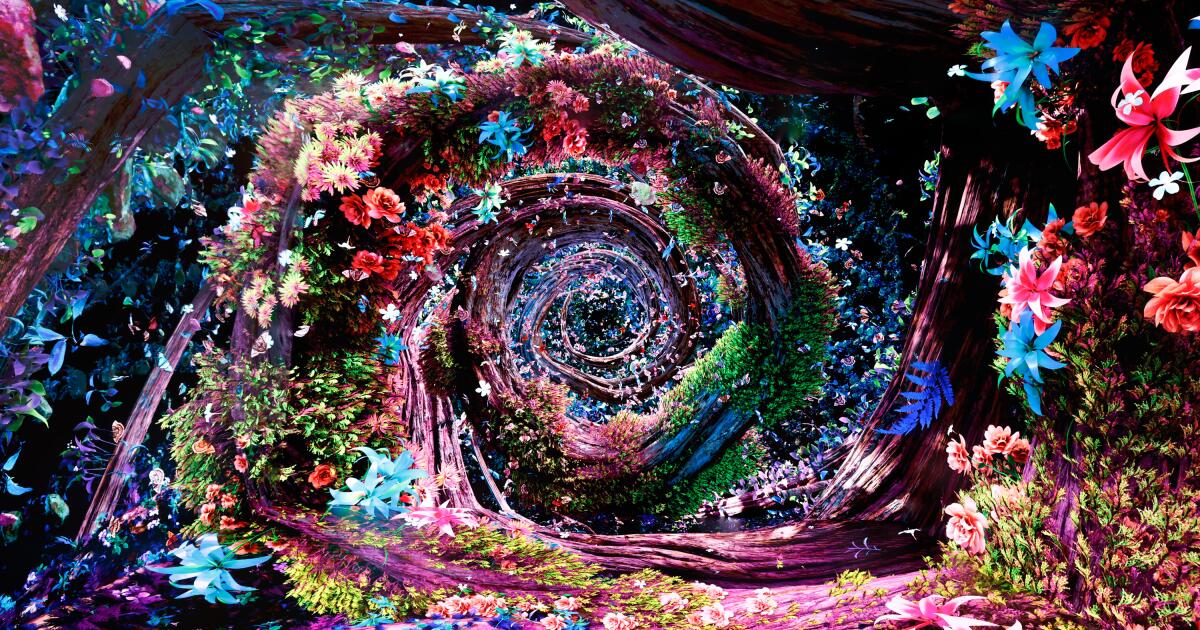
“The system is the art,” says Refik Anadol during a recent tour of Dataland, the 25,000-square-foot immersive, environmental, generative, multisensory AI arts museum in downtown L.A. that represents the culmination of Anadol’s career thus far.
Set to open later this month inside the stacked towers of Frank Gehry’s Grand LA, and in the context of Gehry’s enduring vision for a Grand Avenue arts corridor, the museum lately occupies Anadol’s every waking moment
AI will do that. Dataland — a museum built with artificial intelligence — arrives as debates explode across socio-political lines about the impact of the advancing technology on our culture, cognition, communication, economy, environment and careers, including in the arts. From the Holy See to Silicon Valley, each day brings a fresh wave of discourse.
With Dataland, Anadol and his studio co-founder, artist, producer and cultural researcher Efsun Erkılıç, are diving headfirst into this heady, discursive vortex bearing a message: AI doesn’t need to be an opponent when humanity has the power to turn it into an ally.
Dataland’s inaugural exhibition, “Machine Dreams: Rainforest,” is the studio’s opening salvo in the battle to redefine our burgeoning relationship with the evolving technology.
Dataland co-founders Refik Anadol, left, and Efsun Erkilic stand inside the Infinity Room at the museum.
(Carlin Stiehl / For The Times)
With minimal spoilers, a visitor’s journey begins with a very spaceship-like onboarding that involves voluntary biometric sharing and a certain amount of agency as to the contours of your experience, including what it will smell like.
You are oriented within the mainframe and its manifesto by a calming female voice with a soothing British accent, before you gently descend into a vast, destabilizing cavern built entirely of light, sound and liquid-like floors.
It is a wonderment-inducing sensoria that, while rainforest themed, reaches beyond imagery into nostalgia, surrealism, futurism and a sublime cognitive reorientation toward overwhelming beauty that seems designed to target and destroy whatever skepticism and cynicism you brought with you.
Thus cleansed of expectation, you move through a series of smaller, even intimate spaces in which you are given free access to a literal universe of biological data. You also witness your own body energy — and that of your fellow viewers — affect the art as it evolves in real time, and peek behind the scenes into the nerve center of the whole operation.

Dataland runs on a generative AI system called the Large Nature Model, which was trained on material from partner institutions including the Smithsonian, London’s Natural History Museum, the Cornell Lab of Ornithology, iNaturalist and Getty.
(Carlin Stiehl / For The Times)
L’Oréal Luxe partnered with the studio to develop a projective scent journey inspired by the rainforests, and eventually, the sense of taste is engaged through Data.Chocolate, a limited-edition four-piece tasting collection crafted with Valerie Confections that translates datasets of cacao genetics and Amazonian concepts into physical flavor profiles.
The underlying engine driving the museum’s experience is the Large Nature Model, a first-of-its-kind open-access multi-modal artificial intelligence system trained entirely on environmental datasets rather than human text outputs.
To ground this heavy computational architecture in environmental responsibility, the Large Nature Model is hosted by a dedicated Google Cloud server cluster in Oregon running on 87% carbon-free renewable energy. The power required to process and reiterate the artwork for a single visitor’s stay is roughly equivalent to one smartphone charge.
Any heavy electrical footprint is restricted to the initial training phase of the neural networks, whereas the daily interactive inference runs at highly optimized, slower processing speeds to maintain strict carbon neutrality.
“It’s all ethically collected data as well,” insists Anadol, referring to partnerships with institutions including the Smithsonian, London’s Natural History Museum, the Cornell Lab of Ornithology, iNaturalist and Getty, which provided access to a comprehensive corpus exceeding 500 million nature images and representing 2.2 million distinct biological species.

“We traveled to 16 rainforests, we sought and received all necessary permissions,” says Dataland co-founder Refik Anadol. “This is not just another AI model. It’s an AI model collected with harmony and with the idea that one day this museum can dream.”
(Carlin Stiehl / For The Times)
Rather than relying exclusively on archival institutional repositories, the studio executed specialized field expeditions to a variety of distinct global environments to gather raw primary telemetry like detailed images, LiDAR scans, weather data and sound.
“We traveled to 16 rainforests, we sought and received all necessary permissions,” Anadol says. “This is not just another AI model. It’s an AI model collected with harmony and with the idea that one day this museum can dream.”
Anadol means that quite literally.
He and Erkılıç have achieved international acclaim for their team’s decades of foundational experimentation collaborating with dataset intelligences at the AI frontier, as well as for architecturally-scaled, narratively engaged visual embodiments of abstract technological constructs. This includes 2018’s “WDCH Dreams,” which mapped 45 terabytes of orchestral metadata onto the exterior of Walt Disney Concert Hall,
So when, at a moment of being swept almost literally off one’s feet by a swirling, whirling, radiant light and sound orchestration, enhanced by bespoke scents and actively responsive to your own body’s biometrics, Anadol says that Dataland is alive, insisting that “the living museum is the art,” it actually seems possible.

Inside the Data Pavilion at Dataland, the world’s first museum of AI arts.
(Carlin Stiehl / For The Times)
That a digital museum can feel innately organic is a direct outgrowth of Anadol’s environmental awareness and a personal spiritual evolution inspired by botanical stewardship, and endless experiential conjectures as to how art engages and co-creates individual, collective and trans-human consciousness.
“Each time the museum records the humidity or hears the water inside the trunks we can talk about the heartbeat of a tree,” says Anadol, with obvious delight. “Each time the museum responds to the rainforest — it can be Amazonia, Indonesia, Australia — the resultant acoustic archive grows.”
The LNM holds 50 million bird songs, including a 1987 recording of the final known mating call of the now-extinct Kaua’i ‘ō’ō bird, a quasi-mythological creature that Anadol says has also visited his dreams.
“The starting point is a real rainforest that exists in the world. Then the story begins. We hear those locations,” Anadol says. “The sound is also evolving wherever the museum connects with meteorological patterns and weather phenomena. That’s why we call it a living museum because it’s not just a beautiful image or video or sound. It’s truly a living ecosystem.”
This expansive data-landscape is bound not only to those locations, but to a set of unique cultural collaborations, including Google’s Quantum AI and Envisioning Studio programs, and the Indigenous Amazonian Yawanawá community, a remote nation of 700 people which has become a kind of spiritual home for Anadol. And not only for him.

Dataland co-founder Refik Anadol stands in the museum’s Data Pavilion.
(Carlin Stiehl / For The Times)
The most radical theoretical dimension of the project emerges from a collaboration with Hartmut Neven, Google’s vice president of engineering for quantum AI, who approaches consciousness as an empirical scientific problem — and who found his own way to the Yawanawá before connecting with Anadol.
Neven said he is particularly interested in understanding the brain, including, “the forbidden fruit” of trying to make sense of what constitutes conscious experience. His current best theory is that it’s generated by quantum processes, suggesting that awareness exists on a continuous spectrum across all matter rather than remaining the exclusive domain of mammalian brains.
“Everything is made of the same stuff. You know, like my car is made of the same stuff I’m made of,” explains Nevens. “I think consciousness is [part of that, and thus] ultimately understandable.”
Anadol Studio’s active creative partnership with Google deepened after Refik’s own more recent stays in the Sacred Village, taking advantage of what Neven characterizes as “the ethnobotanical knowledge that Indigenous tribes still possess.”
Traditional songs are woven directly into the multi-channel soundscapes of Dataland. Specific fluid visual structures shifting across the walls have been formally classified as “Ruwe Pinu” by tribal leader Nixiwaka, referring to an ancient mythological entity that appears in ancestral cosmology. In Dataland’s exhibition Ruwe Pinu becomes a responsive software canvas for a faraway culture and a primordial future.
“Behind the walls, as you can see, the medium is more than a screen,” explains Anadol. “We want to invent this feeling of being inside these universes, the sonification of nature in tune with what we call generative reality.”

The server room that runs Dataland takes up an additional 10,000 square feet of the museum.
(Carlin Stiehl / For The Times)
The museum’s soundscape includes original music by composer and sound designer Kerim Karaoğlu, and incorporates traditional music from the Amazon setting. The sound system is handled by an L-Acoustics L-ISA 250-speaker matrix suspended dynamically behind a specialized acoustic fabric wall, material that Anadol loves to let people touch gently to confirm its woven tensile character.
“You walk in, and [Dataland] responds to you. You’re instantly a part of the artwork,” says Mira Lane, Google’s vice president of technology and society, head of the Envision Lab creative cohort, and an artist herself. “When you walk into a museum or gallery right now, the artwork’s not responding to you. It’s a one-way conversation.”
With Dataland, Refik and Erkılıç have constructed a conceptual defense against contemporary cultural anxieties, rejecting the narrative of machine versus human to reframe artificial intelligence as a mirror reflecting civilization.
Lane positions this effort against broader commercial trends. She says that people reject AI slop because “it feels really easy. It’s throwaway, it’s superficial,” whereas artists like Anadol are, “showing how much work went into it.”
“He’s very clear about his process and the way he’s ethically approached data collection, the way he works with the Yawanawá tribes,” Lane says.
In 2023, Anadol founded the “Winds of Yawanawá” blockchain initiative, a digital art collection that generated millions of dollars to finance Indigenous-helmed cultural infrastructure.

Dataland’s co-founders, Refik Anadol and Efsun Erkilic, believe the museum can help people rethink their relationship to AI.
(Carlin Stiehl / For The Times)
“I think he is being very thoughtful and very intentional about the work that he’s doing, but at the same time, he’s also making us look at things in a different way,” Lane added.
Ultimately, no matter how alive the museum is or isn’t, implementation of these systems requires humans. The Refik Anadol Studio team consists of 20 people in Los Angeles, from 10 different countries, fluent in 12 languages. It’s an inclusive environment that rejects the solo artistic ego in favor of human-machine collaboration that almost immediately escapes its creator’s grasp.
To further its mission, Dataland has established an artist residency program in partnership with Google Arts & Culture, providing emerging digital creators with a six-month residency, a $25,000 grant, and advanced cloud processing access to develop new works.
By inviting the public into a dynamic action-perception loop where human heartbeats and quantum noise co-create the visual architecture, Dataland moves beyond the limits of static historic mediums, shifting AI from a feared opponent into an active creative partner.
“It has been said that the arts, the religions and the sciences are all branches of the same tree. And I very much live by that,” says Neven.
Shakespeare wrote that nothing in the world is good or bad but thinking makes it so, and in that spirit Lane, like Anadol and Erkılıç, remains resolutely optimistic about what the Dataland model heralds.
“If everything we believe is true, we’re about to open up a moment where there’s more abundance, more opportunity. And we should all be feeling inspired and hopeful and taking advantage of that and imagining things that we could do better as humanity,” Lane says.
“It’s opening another gateway,” says Erkılıç of the museum and its mission. “It’s a little bit of a provocation in that sense because we don’t know anything about AI. AI is still developing. It’s still evolving. We just met AI, whatever it is.”
Erkılıç says she doesn’t give much credence to the AI versus humanity panic. Over thousands of years humans have built and destroyed civilizations, killed gods and created new ones, she says, adding, “Right now you’re telling me that it’s machine versus humans and you’re ready to give up? It’s impossible. We’re too strong.”

“The system is the art,” says Refik Anadol during a recent tour of Dataland, the 25,000-square-foot immersive, environmental, generative, multisensory AI arts museum in downtown L.A. that represents the culmination of Anadol’s career thus far.
Set to open later this month inside the stacked towers of Frank Gehry’s Grand LA, and in the context of Gehry’s enduring vision for a Grand Avenue arts corridor, the museum lately occupies Anadol’s every waking moment
AI will do that. Dataland — a museum built with artificial intelligence — arrives as debates explode across socio-political lines about the impact of the advancing technology on our culture, cognition, communication, economy, environment and careers, including in the arts. From the Holy See to Silicon Valley, each day brings a fresh wave of discourse.
With Dataland, Anadol and his studio co-founder, artist, producer and cultural researcher Efsun Erkılıç, are diving headfirst into this heady, discursive vortex bearing a message: AI doesn’t need to be an opponent when humanity has the power to turn it into an ally.
Dataland’s inaugural exhibition, “Machine Dreams: Rainforest,” is the studio’s opening salvo in the battle to redefine our burgeoning relationship with the evolving technology.
Dataland co-founders Refik Anadol, left, and Efsun Erkilic stand inside the Infinity Room at the museum.
(Carlin Stiehl / For The Times)
With minimal spoilers, a visitor’s journey begins with a very spaceship-like onboarding that involves voluntary biometric sharing and a certain amount of agency as to the contours of your experience, including what it will smell like.
You are oriented within the mainframe and its manifesto by a calming female voice with a soothing British accent, before you gently descend into a vast, destabilizing cavern built entirely of light, sound and liquid-like floors.
It is a wonderment-inducing sensoria that, while rainforest themed, reaches beyond imagery into nostalgia, surrealism, futurism and a sublime cognitive reorientation toward overwhelming beauty that seems designed to target and destroy whatever skepticism and cynicism you brought with you.
Thus cleansed of expectation, you move through a series of smaller, even intimate spaces in which you are given free access to a literal universe of biological data. You also witness your own body energy — and that of your fellow viewers — affect the art as it evolves in real time, and peek behind the scenes into the nerve center of the whole operation.
Dataland runs on a generative AI system called the Large Nature Model, which was trained on material from partner institutions including the Smithsonian, London’s Natural History Museum, the Cornell Lab of Ornithology, iNaturalist and Getty.
(Carlin Stiehl / For The Times)
L’Oréal Luxe partnered with the studio to develop a projective scent journey inspired by the rainforests, and eventually, the sense of taste is engaged through Data.Chocolate, a limited-edition four-piece tasting collection crafted with Valerie Confections that translates datasets of cacao genetics and Amazonian concepts into physical flavor profiles.
The underlying engine driving the museum’s experience is the Large Nature Model, a first-of-its-kind open-access multi-modal artificial intelligence system trained entirely on environmental datasets rather than human text outputs.
To ground this heavy computational architecture in environmental responsibility, the Large Nature Model is hosted by a dedicated Google Cloud server cluster in Oregon running on 87% carbon-free renewable energy. The power required to process and reiterate the artwork for a single visitor’s stay is roughly equivalent to one smartphone charge.
Any heavy electrical footprint is restricted to the initial training phase of the neural networks, whereas the daily interactive inference runs at highly optimized, slower processing speeds to maintain strict carbon neutrality.
“It’s all ethically collected data as well,” insists Anadol, referring to partnerships with institutions including the Smithsonian, London’s Natural History Museum, the Cornell Lab of Ornithology, iNaturalist and Getty, which provided access to a comprehensive corpus exceeding 500 million nature images and representing 2.2 million distinct biological species.
“We traveled to 16 rainforests, we sought and received all necessary permissions,” says Dataland co-founder Refik Anadol. “This is not just another AI model. It’s an AI model collected with harmony and with the idea that one day this museum can dream.”
(Carlin Stiehl / For The Times)
Rather than relying exclusively on archival institutional repositories, the studio executed specialized field expeditions to a variety of distinct global environments to gather raw primary telemetry like detailed images, LiDAR scans, weather data and sound.
“We traveled to 16 rainforests, we sought and received all necessary permissions,” Anadol says. “This is not just another AI model. It’s an AI model collected with harmony and with the idea that one day this museum can dream.”
Anadol means that quite literally.
He and Erkılıç have achieved international acclaim for their team’s decades of foundational experimentation collaborating with dataset intelligences at the AI frontier, as well as for architecturally-scaled, narratively engaged visual embodiments of abstract technological constructs. This includes 2018’s “WDCH Dreams,” which mapped 45 terabytes of orchestral metadata onto the exterior of Walt Disney Concert Hall,
So when, at a moment of being swept almost literally off one’s feet by a swirling, whirling, radiant light and sound orchestration, enhanced by bespoke scents and actively responsive to your own body’s biometrics, Anadol says that Dataland is alive, insisting that “the living museum is the art,” it actually seems possible.
Inside the Data Pavilion at Dataland, the world’s first museum of AI arts.
(Carlin Stiehl / For The Times)
That a digital museum can feel innately organic is a direct outgrowth of Anadol’s environmental awareness and a personal spiritual evolution inspired by botanical stewardship, and endless experiential conjectures as to how art engages and co-creates individual, collective and trans-human consciousness.
“Each time the museum records the humidity or hears the water inside the trunks we can talk about the heartbeat of a tree,” says Anadol, with obvious delight. “Each time the museum responds to the rainforest — it can be Amazonia, Indonesia, Australia — the resultant acoustic archive grows.”
The LNM holds 50 million bird songs, including a 1987 recording of the final known mating call of the now-extinct Kaua’i ‘ō’ō bird, a quasi-mythological creature that Anadol says has also visited his dreams.
“The starting point is a real rainforest that exists in the world. Then the story begins. We hear those locations,” Anadol says. “The sound is also evolving wherever the museum connects with meteorological patterns and weather phenomena. That’s why we call it a living museum because it’s not just a beautiful image or video or sound. It’s truly a living ecosystem.”
This expansive data-landscape is bound not only to those locations, but to a set of unique cultural collaborations, including Google’s Quantum AI and Envisioning Studio programs, and the Indigenous Amazonian Yawanawá community, a remote nation of 700 people which has become a kind of spiritual home for Anadol. And not only for him.
Dataland co-founder Refik Anadol stands in the museum’s Data Pavilion.
(Carlin Stiehl / For The Times)
The most radical theoretical dimension of the project emerges from a collaboration with Hartmut Neven, Google’s vice president of engineering for quantum AI, who approaches consciousness as an empirical scientific problem — and who found his own way to the Yawanawá before connecting with Anadol.
Neven said he is particularly interested in understanding the brain, including, “the forbidden fruit” of trying to make sense of what constitutes conscious experience. His current best theory is that it’s generated by quantum processes, suggesting that awareness exists on a continuous spectrum across all matter rather than remaining the exclusive domain of mammalian brains.
“Everything is made of the same stuff. You know, like my car is made of the same stuff I’m made of,” explains Nevens. “I think consciousness is [part of that, and thus] ultimately understandable.”
Anadol Studio’s active creative partnership with Google deepened after Refik’s own more recent stays in the Sacred Village, taking advantage of what Neven characterizes as “the ethnobotanical knowledge that Indigenous tribes still possess.”
Traditional songs are woven directly into the multi-channel soundscapes of Dataland. Specific fluid visual structures shifting across the walls have been formally classified as “Ruwe Pinu” by tribal leader Nixiwaka, referring to an ancient mythological entity that appears in ancestral cosmology. In Dataland’s exhibition Ruwe Pinu becomes a responsive software canvas for a faraway culture and a primordial future.
“Behind the walls, as you can see, the medium is more than a screen,” explains Anadol. “We want to invent this feeling of being inside these universes, the sonification of nature in tune with what we call generative reality.”
The server room that runs Dataland takes up an additional 10,000 square feet of the museum.
(Carlin Stiehl / For The Times)
The museum’s soundscape includes original music by composer and sound designer Kerim Karaoğlu, and incorporates traditional music from the Amazon setting. The sound system is handled by an L-Acoustics L-ISA 250-speaker matrix suspended dynamically behind a specialized acoustic fabric wall, material that Anadol loves to let people touch gently to confirm its woven tensile character.
“You walk in, and [Dataland] responds to you. You’re instantly a part of the artwork,” says Mira Lane, Google’s vice president of technology and society, head of the Envision Lab creative cohort, and an artist herself. “When you walk into a museum or gallery right now, the artwork’s not responding to you. It’s a one-way conversation.”
With Dataland, Refik and Erkılıç have constructed a conceptual defense against contemporary cultural anxieties, rejecting the narrative of machine versus human to reframe artificial intelligence as a mirror reflecting civilization.
Lane positions this effort against broader commercial trends. She says that people reject AI slop because “it feels really easy. It’s throwaway, it’s superficial,” whereas artists like Anadol are, “showing how much work went into it.”
“He’s very clear about his process and the way he’s ethically approached data collection, the way he works with the Yawanawá tribes,” Lane says.
In 2023, Anadol founded the “Winds of Yawanawá” blockchain initiative, a digital art collection that generated millions of dollars to finance Indigenous-helmed cultural infrastructure.
Dataland’s co-founders, Refik Anadol and Efsun Erkilic, believe the museum can help people rethink their relationship to AI.
(Carlin Stiehl / For The Times)
“I think he is being very thoughtful and very intentional about the work that he’s doing, but at the same time, he’s also making us look at things in a different way,” Lane added.
Ultimately, no matter how alive the museum is or isn’t, implementation of these systems requires humans. The Refik Anadol Studio team consists of 20 people in Los Angeles, from 10 different countries, fluent in 12 languages. It’s an inclusive environment that rejects the solo artistic ego in favor of human-machine collaboration that almost immediately escapes its creator’s grasp.
To further its mission, Dataland has established an artist residency program in partnership with Google Arts & Culture, providing emerging digital creators with a six-month residency, a $25,000 grant, and advanced cloud processing access to develop new works.
By inviting the public into a dynamic action-perception loop where human heartbeats and quantum noise co-create the visual architecture, Dataland moves beyond the limits of static historic mediums, shifting AI from a feared opponent into an active creative partner.
“It has been said that the arts, the religions and the sciences are all branches of the same tree. And I very much live by that,” says Neven.
Shakespeare wrote that nothing in the world is good or bad but thinking makes it so, and in that spirit Lane, like Anadol and Erkılıç, remains resolutely optimistic about what the Dataland model heralds.
“If everything we believe is true, we’re about to open up a moment where there’s more abundance, more opportunity. And we should all be feeling inspired and hopeful and taking advantage of that and imagining things that we could do better as humanity,” Lane says.
“It’s opening another gateway,” says Erkılıç of the museum and its mission. “It’s a little bit of a provocation in that sense because we don’t know anything about AI. AI is still developing. It’s still evolving. We just met AI, whatever it is.”
Erkılıç says she doesn’t give much credence to the AI versus humanity panic. Over thousands of years humans have built and destroyed civilizations, killed gods and created new ones, she says, adding, “Right now you’re telling me that it’s machine versus humans and you’re ready to give up? It’s impossible. We’re too strong.”

“The system is the art,” says Refik Anadol during a recent tour of Dataland, the 25,000-square-foot immersive, environmental, generative, multisensory AI arts museum in downtown L.A. that represents the culmination of Anadol’s career thus far.
Set to open later this month inside the stacked towers of Frank Gehry’s Grand LA, and in the context of Gehry’s enduring vision for a Grand Avenue arts corridor, the museum lately occupies Anadol’s every waking moment
AI will do that. Dataland — a museum built with artificial intelligence — arrives as debates explode across socio-political lines about the impact of the advancing technology on our culture, cognition, communication, economy, environment and careers, including in the arts. From the Holy See to Silicon Valley, each day brings a fresh wave of discourse.
With Dataland, Anadol and his studio co-founder, artist, producer and cultural researcher Efsun Erkılıç, are diving headfirst into this heady, discursive vortex bearing a message: AI doesn’t need to be an opponent when humanity has the power to turn it into an ally.
Dataland’s inaugural exhibition, “Machine Dreams: Rainforest,” is the studio’s opening salvo in the battle to redefine our burgeoning relationship with the evolving technology.
Dataland co-founders Refik Anadol, left, and Efsun Erkilic stand inside the Infinity Room at the museum.
(Carlin Stiehl / For The Times)
With minimal spoilers, a visitor’s journey begins with a very spaceship-like onboarding that involves voluntary biometric sharing and a certain amount of agency as to the contours of your experience, including what it will smell like.
You are oriented within the mainframe and its manifesto by a calming female voice with a soothing British accent, before you gently descend into a vast, destabilizing cavern built entirely of light, sound and liquid-like floors.
It is a wonderment-inducing sensoria that, while rainforest themed, reaches beyond imagery into nostalgia, surrealism, futurism and a sublime cognitive reorientation toward overwhelming beauty that seems designed to target and destroy whatever skepticism and cynicism you brought with you.
Thus cleansed of expectation, you move through a series of smaller, even intimate spaces in which you are given free access to a literal universe of biological data. You also witness your own body energy — and that of your fellow viewers — affect the art as it evolves in real time, and peek behind the scenes into the nerve center of the whole operation.
Dataland runs on a generative AI system called the Large Nature Model, which was trained on material from partner institutions including the Smithsonian, London’s Natural History Museum, the Cornell Lab of Ornithology, iNaturalist and Getty.
(Carlin Stiehl / For The Times)
L’Oréal Luxe partnered with the studio to develop a projective scent journey inspired by the rainforests, and eventually, the sense of taste is engaged through Data.Chocolate, a limited-edition four-piece tasting collection crafted with Valerie Confections that translates datasets of cacao genetics and Amazonian concepts into physical flavor profiles.
The underlying engine driving the museum’s experience is the Large Nature Model, a first-of-its-kind open-access multi-modal artificial intelligence system trained entirely on environmental datasets rather than human text outputs.
To ground this heavy computational architecture in environmental responsibility, the Large Nature Model is hosted by a dedicated Google Cloud server cluster in Oregon running on 87% carbon-free renewable energy. The power required to process and reiterate the artwork for a single visitor’s stay is roughly equivalent to one smartphone charge.
Any heavy electrical footprint is restricted to the initial training phase of the neural networks, whereas the daily interactive inference runs at highly optimized, slower processing speeds to maintain strict carbon neutrality.
“It’s all ethically collected data as well,” insists Anadol, referring to partnerships with institutions including the Smithsonian, London’s Natural History Museum, the Cornell Lab of Ornithology, iNaturalist and Getty, which provided access to a comprehensive corpus exceeding 500 million nature images and representing 2.2 million distinct biological species.
“We traveled to 16 rainforests, we sought and received all necessary permissions,” says Dataland co-founder Refik Anadol. “This is not just another AI model. It’s an AI model collected with harmony and with the idea that one day this museum can dream.”
(Carlin Stiehl / For The Times)
Rather than relying exclusively on archival institutional repositories, the studio executed specialized field expeditions to a variety of distinct global environments to gather raw primary telemetry like detailed images, LiDAR scans, weather data and sound.
“We traveled to 16 rainforests, we sought and received all necessary permissions,” Anadol says. “This is not just another AI model. It’s an AI model collected with harmony and with the idea that one day this museum can dream.”
Anadol means that quite literally.
He and Erkılıç have achieved international acclaim for their team’s decades of foundational experimentation collaborating with dataset intelligences at the AI frontier, as well as for architecturally-scaled, narratively engaged visual embodiments of abstract technological constructs. This includes 2018’s “WDCH Dreams,” which mapped 45 terabytes of orchestral metadata onto the exterior of Walt Disney Concert Hall,
So when, at a moment of being swept almost literally off one’s feet by a swirling, whirling, radiant light and sound orchestration, enhanced by bespoke scents and actively responsive to your own body’s biometrics, Anadol says that Dataland is alive, insisting that “the living museum is the art,” it actually seems possible.
Inside the Data Pavilion at Dataland, the world’s first museum of AI arts.
(Carlin Stiehl / For The Times)
That a digital museum can feel innately organic is a direct outgrowth of Anadol’s environmental awareness and a personal spiritual evolution inspired by botanical stewardship, and endless experiential conjectures as to how art engages and co-creates individual, collective and trans-human consciousness.
“Each time the museum records the humidity or hears the water inside the trunks we can talk about the heartbeat of a tree,” says Anadol, with obvious delight. “Each time the museum responds to the rainforest — it can be Amazonia, Indonesia, Australia — the resultant acoustic archive grows.”
The LNM holds 50 million bird songs, including a 1987 recording of the final known mating call of the now-extinct Kaua’i ‘ō’ō bird, a quasi-mythological creature that Anadol says has also visited his dreams.
“The starting point is a real rainforest that exists in the world. Then the story begins. We hear those locations,” Anadol says. “The sound is also evolving wherever the museum connects with meteorological patterns and weather phenomena. That’s why we call it a living museum because it’s not just a beautiful image or video or sound. It’s truly a living ecosystem.”
This expansive data-landscape is bound not only to those locations, but to a set of unique cultural collaborations, including Google’s Quantum AI and Envisioning Studio programs, and the Indigenous Amazonian Yawanawá community, a remote nation of 700 people which has become a kind of spiritual home for Anadol. And not only for him.
Dataland co-founder Refik Anadol stands in the museum’s Data Pavilion.
(Carlin Stiehl / For The Times)
The most radical theoretical dimension of the project emerges from a collaboration with Hartmut Neven, Google’s vice president of engineering for quantum AI, who approaches consciousness as an empirical scientific problem — and who found his own way to the Yawanawá before connecting with Anadol.
Neven said he is particularly interested in understanding the brain, including, “the forbidden fruit” of trying to make sense of what constitutes conscious experience. His current best theory is that it’s generated by quantum processes, suggesting that awareness exists on a continuous spectrum across all matter rather than remaining the exclusive domain of mammalian brains.
“Everything is made of the same stuff. You know, like my car is made of the same stuff I’m made of,” explains Nevens. “I think consciousness is [part of that, and thus] ultimately understandable.”
Anadol Studio’s active creative partnership with Google deepened after Refik’s own more recent stays in the Sacred Village, taking advantage of what Neven characterizes as “the ethnobotanical knowledge that Indigenous tribes still possess.”
Traditional songs are woven directly into the multi-channel soundscapes of Dataland. Specific fluid visual structures shifting across the walls have been formally classified as “Ruwe Pinu” by tribal leader Nixiwaka, referring to an ancient mythological entity that appears in ancestral cosmology. In Dataland’s exhibition Ruwe Pinu becomes a responsive software canvas for a faraway culture and a primordial future.
“Behind the walls, as you can see, the medium is more than a screen,” explains Anadol. “We want to invent this feeling of being inside these universes, the sonification of nature in tune with what we call generative reality.”
The server room that runs Dataland takes up an additional 10,000 square feet of the museum.
(Carlin Stiehl / For The Times)
The museum’s soundscape includes original music by composer and sound designer Kerim Karaoğlu, and incorporates traditional music from the Amazon setting. The sound system is handled by an L-Acoustics L-ISA 250-speaker matrix suspended dynamically behind a specialized acoustic fabric wall, material that Anadol loves to let people touch gently to confirm its woven tensile character.
“You walk in, and [Dataland] responds to you. You’re instantly a part of the artwork,” says Mira Lane, Google’s vice president of technology and society, head of the Envision Lab creative cohort, and an artist herself. “When you walk into a museum or gallery right now, the artwork’s not responding to you. It’s a one-way conversation.”
With Dataland, Refik and Erkılıç have constructed a conceptual defense against contemporary cultural anxieties, rejecting the narrative of machine versus human to reframe artificial intelligence as a mirror reflecting civilization.
Lane positions this effort against broader commercial trends. She says that people reject AI slop because “it feels really easy. It’s throwaway, it’s superficial,” whereas artists like Anadol are, “showing how much work went into it.”
“He’s very clear about his process and the way he’s ethically approached data collection, the way he works with the Yawanawá tribes,” Lane says.
In 2023, Anadol founded the “Winds of Yawanawá” blockchain initiative, a digital art collection that generated millions of dollars to finance Indigenous-helmed cultural infrastructure.
Dataland’s co-founders, Refik Anadol and Efsun Erkilic, believe the museum can help people rethink their relationship to AI.
(Carlin Stiehl / For The Times)
“I think he is being very thoughtful and very intentional about the work that he’s doing, but at the same time, he’s also making us look at things in a different way,” Lane added.
Ultimately, no matter how alive the museum is or isn’t, implementation of these systems requires humans. The Refik Anadol Studio team consists of 20 people in Los Angeles, from 10 different countries, fluent in 12 languages. It’s an inclusive environment that rejects the solo artistic ego in favor of human-machine collaboration that almost immediately escapes its creator’s grasp.
To further its mission, Dataland has established an artist residency program in partnership with Google Arts & Culture, providing emerging digital creators with a six-month residency, a $25,000 grant, and advanced cloud processing access to develop new works.
By inviting the public into a dynamic action-perception loop where human heartbeats and quantum noise co-create the visual architecture, Dataland moves beyond the limits of static historic mediums, shifting AI from a feared opponent into an active creative partner.
“It has been said that the arts, the religions and the sciences are all branches of the same tree. And I very much live by that,” says Neven.
Shakespeare wrote that nothing in the world is good or bad but thinking makes it so, and in that spirit Lane, like Anadol and Erkılıç, remains resolutely optimistic about what the Dataland model heralds.
“If everything we believe is true, we’re about to open up a moment where there’s more abundance, more opportunity. And we should all be feeling inspired and hopeful and taking advantage of that and imagining things that we could do better as humanity,” Lane says.
“It’s opening another gateway,” says Erkılıç of the museum and its mission. “It’s a little bit of a provocation in that sense because we don’t know anything about AI. AI is still developing. It’s still evolving. We just met AI, whatever it is.”
Erkılıç says she doesn’t give much credence to the AI versus humanity panic. Over thousands of years humans have built and destroyed civilizations, killed gods and created new ones, she says, adding, “Right now you’re telling me that it’s machine versus humans and you’re ready to give up? It’s impossible. We’re too strong.”
“The system is the art,” says Refik Anadol during a recent tour of Dataland, the 25,000-square-foot immersive, environmental, generative, multisensory AI arts museum in downtown L.A. that represents the culmination of Anadol’s career thus far.
Set to open later this month inside the stacked towers of Frank Gehry’s Grand LA, and in the context of Gehry’s enduring vision for a Grand Avenue arts corridor, the museum lately occupies Anadol’s every waking moment
AI will do that. Dataland — a museum built with artificial intelligence — arrives as debates explode across socio-political lines about the impact of the advancing technology on our culture, cognition, communication, economy, environment and careers, including in the arts. From the Holy See to Silicon Valley, each day brings a fresh wave of discourse.
With Dataland, Anadol and his studio co-founder, artist, producer and cultural researcher Efsun Erkılıç, are diving headfirst into this heady, discursive vortex bearing a message: AI doesn’t need to be an opponent when humanity has the power to turn it into an ally.
Dataland’s inaugural exhibition, “Machine Dreams: Rainforest,” is the studio’s opening salvo in the battle to redefine our burgeoning relationship with the evolving technology.
Dataland co-founders Refik Anadol, left, and Efsun Erkilic stand inside the Infinity Room at the museum.
(Carlin Stiehl / For The Times)
With minimal spoilers, a visitor’s journey begins with a very spaceship-like onboarding that involves voluntary biometric sharing and a certain amount of agency as to the contours of your experience, including what it will smell like.
You are oriented within the mainframe and its manifesto by a calming female voice with a soothing British accent, before you gently descend into a vast, destabilizing cavern built entirely of light, sound and liquid-like floors.
It is a wonderment-inducing sensoria that, while rainforest themed, reaches beyond imagery into nostalgia, surrealism, futurism and a sublime cognitive reorientation toward overwhelming beauty that seems designed to target and destroy whatever skepticism and cynicism you brought with you.
Thus cleansed of expectation, you move through a series of smaller, even intimate spaces in which you are given free access to a literal universe of biological data. You also witness your own body energy — and that of your fellow viewers — affect the art as it evolves in real time, and peek behind the scenes into the nerve center of the whole operation.
Dataland runs on a generative AI system called the Large Nature Model, which was trained on material from partner institutions including the Smithsonian, London’s Natural History Museum, the Cornell Lab of Ornithology, iNaturalist and Getty.
(Carlin Stiehl / For The Times)
L’Oréal Luxe partnered with the studio to develop a projective scent journey inspired by the rainforests, and eventually, the sense of taste is engaged through Data.Chocolate, a limited-edition four-piece tasting collection crafted with Valerie Confections that translates datasets of cacao genetics and Amazonian concepts into physical flavor profiles.
The underlying engine driving the museum’s experience is the Large Nature Model, a first-of-its-kind open-access multi-modal artificial intelligence system trained entirely on environmental datasets rather than human text outputs.
To ground this heavy computational architecture in environmental responsibility, the Large Nature Model is hosted by a dedicated Google Cloud server cluster in Oregon running on 87% carbon-free renewable energy. The power required to process and reiterate the artwork for a single visitor’s stay is roughly equivalent to one smartphone charge.
Any heavy electrical footprint is restricted to the initial training phase of the neural networks, whereas the daily interactive inference runs at highly optimized, slower processing speeds to maintain strict carbon neutrality.
“It’s all ethically collected data as well,” insists Anadol, referring to partnerships with institutions including the Smithsonian, London’s Natural History Museum, the Cornell Lab of Ornithology, iNaturalist and Getty, which provided access to a comprehensive corpus exceeding 500 million nature images and representing 2.2 million distinct biological species.
“We traveled to 16 rainforests, we sought and received all necessary permissions,” says Dataland co-founder Refik Anadol. “This is not just another AI model. It’s an AI model collected with harmony and with the idea that one day this museum can dream.”
(Carlin Stiehl / For The Times)
Rather than relying exclusively on archival institutional repositories, the studio executed specialized field expeditions to a variety of distinct global environments to gather raw primary telemetry like detailed images, LiDAR scans, weather data and sound.
“We traveled to 16 rainforests, we sought and received all necessary permissions,” Anadol says. “This is not just another AI model. It’s an AI model collected with harmony and with the idea that one day this museum can dream.”
Anadol means that quite literally.
He and Erkılıç have achieved international acclaim for their team’s decades of foundational experimentation collaborating with dataset intelligences at the AI frontier, as well as for architecturally-scaled, narratively engaged visual embodiments of abstract technological constructs. This includes 2018’s “WDCH Dreams,” which mapped 45 terabytes of orchestral metadata onto the exterior of Walt Disney Concert Hall,
So when, at a moment of being swept almost literally off one’s feet by a swirling, whirling, radiant light and sound orchestration, enhanced by bespoke scents and actively responsive to your own body’s biometrics, Anadol says that Dataland is alive, insisting that “the living museum is the art,” it actually seems possible.
Inside the Data Pavilion at Dataland, the world’s first museum of AI arts.
(Carlin Stiehl / For The Times)
That a digital museum can feel innately organic is a direct outgrowth of Anadol’s environmental awareness and a personal spiritual evolution inspired by botanical stewardship, and endless experiential conjectures as to how art engages and co-creates individual, collective and trans-human consciousness.
“Each time the museum records the humidity or hears the water inside the trunks we can talk about the heartbeat of a tree,” says Anadol, with obvious delight. “Each time the museum responds to the rainforest — it can be Amazonia, Indonesia, Australia — the resultant acoustic archive grows.”
The LNM holds 50 million bird songs, including a 1987 recording of the final known mating call of the now-extinct Kaua’i ‘ō’ō bird, a quasi-mythological creature that Anadol says has also visited his dreams.
“The starting point is a real rainforest that exists in the world. Then the story begins. We hear those locations,” Anadol says. “The sound is also evolving wherever the museum connects with meteorological patterns and weather phenomena. That’s why we call it a living museum because it’s not just a beautiful image or video or sound. It’s truly a living ecosystem.”
This expansive data-landscape is bound not only to those locations, but to a set of unique cultural collaborations, including Google’s Quantum AI and Envisioning Studio programs, and the Indigenous Amazonian Yawanawá community, a remote nation of 700 people which has become a kind of spiritual home for Anadol. And not only for him.
Dataland co-founder Refik Anadol stands in the museum’s Data Pavilion.
(Carlin Stiehl / For The Times)
The most radical theoretical dimension of the project emerges from a collaboration with Hartmut Neven, Google’s vice president of engineering for quantum AI, who approaches consciousness as an empirical scientific problem — and who found his own way to the Yawanawá before connecting with Anadol.
Neven said he is particularly interested in understanding the brain, including, “the forbidden fruit” of trying to make sense of what constitutes conscious experience. His current best theory is that it’s generated by quantum processes, suggesting that awareness exists on a continuous spectrum across all matter rather than remaining the exclusive domain of mammalian brains.
“Everything is made of the same stuff. You know, like my car is made of the same stuff I’m made of,” explains Nevens. “I think consciousness is [part of that, and thus] ultimately understandable.”
Anadol Studio’s active creative partnership with Google deepened after Refik’s own more recent stays in the Sacred Village, taking advantage of what Neven characterizes as “the ethnobotanical knowledge that Indigenous tribes still possess.”
Traditional songs are woven directly into the multi-channel soundscapes of Dataland. Specific fluid visual structures shifting across the walls have been formally classified as “Ruwe Pinu” by tribal leader Nixiwaka, referring to an ancient mythological entity that appears in ancestral cosmology. In Dataland’s exhibition Ruwe Pinu becomes a responsive software canvas for a faraway culture and a primordial future.
“Behind the walls, as you can see, the medium is more than a screen,” explains Anadol. “We want to invent this feeling of being inside these universes, the sonification of nature in tune with what we call generative reality.”
The server room that runs Dataland takes up an additional 10,000 square feet of the museum.
(Carlin Stiehl / For The Times)
The museum’s soundscape includes original music by composer and sound designer Kerim Karaoğlu, and incorporates traditional music from the Amazon setting. The sound system is handled by an L-Acoustics L-ISA 250-speaker matrix suspended dynamically behind a specialized acoustic fabric wall, material that Anadol loves to let people touch gently to confirm its woven tensile character.
“You walk in, and [Dataland] responds to you. You’re instantly a part of the artwork,” says Mira Lane, Google’s vice president of technology and society, head of the Envision Lab creative cohort, and an artist herself. “When you walk into a museum or gallery right now, the artwork’s not responding to you. It’s a one-way conversation.”
With Dataland, Refik and Erkılıç have constructed a conceptual defense against contemporary cultural anxieties, rejecting the narrative of machine versus human to reframe artificial intelligence as a mirror reflecting civilization.
Lane positions this effort against broader commercial trends. She says that people reject AI slop because “it feels really easy. It’s throwaway, it’s superficial,” whereas artists like Anadol are, “showing how much work went into it.”
“He’s very clear about his process and the way he’s ethically approached data collection, the way he works with the Yawanawá tribes,” Lane says.
In 2023, Anadol founded the “Winds of Yawanawá” blockchain initiative, a digital art collection that generated millions of dollars to finance Indigenous-helmed cultural infrastructure.
Dataland’s co-founders, Refik Anadol and Efsun Erkilic, believe the museum can help people rethink their relationship to AI.
(Carlin Stiehl / For The Times)
“I think he is being very thoughtful and very intentional about the work that he’s doing, but at the same time, he’s also making us look at things in a different way,” Lane added.
Ultimately, no matter how alive the museum is or isn’t, implementation of these systems requires humans. The Refik Anadol Studio team consists of 20 people in Los Angeles, from 10 different countries, fluent in 12 languages. It’s an inclusive environment that rejects the solo artistic ego in favor of human-machine collaboration that almost immediately escapes its creator’s grasp.
To further its mission, Dataland has established an artist residency program in partnership with Google Arts & Culture, providing emerging digital creators with a six-month residency, a $25,000 grant, and advanced cloud processing access to develop new works.
By inviting the public into a dynamic action-perception loop where human heartbeats and quantum noise co-create the visual architecture, Dataland moves beyond the limits of static historic mediums, shifting AI from a feared opponent into an active creative partner.
“It has been said that the arts, the religions and the sciences are all branches of the same tree. And I very much live by that,” says Neven.
Shakespeare wrote that nothing in the world is good or bad but thinking makes it so, and in that spirit Lane, like Anadol and Erkılıç, remains resolutely optimistic about what the Dataland model heralds.
“If everything we believe is true, we’re about to open up a moment where there’s more abundance, more opportunity. And we should all be feeling inspired and hopeful and taking advantage of that and imagining things that we could do better as humanity,” Lane says.
“It’s opening another gateway,” says Erkılıç of the museum and its mission. “It’s a little bit of a provocation in that sense because we don’t know anything about AI. AI is still developing. It’s still evolving. We just met AI, whatever it is.”
Erkılıç says she doesn’t give much credence to the AI versus humanity panic. Over thousands of years humans have built and destroyed civilizations, killed gods and created new ones, she says, adding, “Right now you’re telling me that it’s machine versus humans and you’re ready to give up? It’s impossible. We’re too strong.”

“The system is the art,” says Refik Anadol during a recent tour of Dataland, the 25,000-square-foot immersive, environmental, generative, multisensory AI arts museum in downtown L.A. that represents the culmination of Anadol’s career thus far.
Set to open later this month inside the stacked towers of Frank Gehry’s Grand LA, and in the context of Gehry’s enduring vision for a Grand Avenue arts corridor, the museum lately occupies Anadol’s every waking moment
AI will do that. Dataland — a museum built with artificial intelligence — arrives as debates explode across socio-political lines about the impact of the advancing technology on our culture, cognition, communication, economy, environment and careers, including in the arts. From the Holy See to Silicon Valley, each day brings a fresh wave of discourse.
With Dataland, Anadol and his studio co-founder, artist, producer and cultural researcher Efsun Erkılıç, are diving headfirst into this heady, discursive vortex bearing a message: AI doesn’t need to be an opponent when humanity has the power to turn it into an ally.
Dataland’s inaugural exhibition, “Machine Dreams: Rainforest,” is the studio’s opening salvo in the battle to redefine our burgeoning relationship with the evolving technology.
Dataland co-founders Refik Anadol, left, and Efsun Erkilic stand inside the Infinity Room at the museum.
(Carlin Stiehl / For The Times)
With minimal spoilers, a visitor’s journey begins with a very spaceship-like onboarding that involves voluntary biometric sharing and a certain amount of agency as to the contours of your experience, including what it will smell like.
You are oriented within the mainframe and its manifesto by a calming female voice with a soothing British accent, before you gently descend into a vast, destabilizing cavern built entirely of light, sound and liquid-like floors.
It is a wonderment-inducing sensoria that, while rainforest themed, reaches beyond imagery into nostalgia, surrealism, futurism and a sublime cognitive reorientation toward overwhelming beauty that seems designed to target and destroy whatever skepticism and cynicism you brought with you.
Thus cleansed of expectation, you move through a series of smaller, even intimate spaces in which you are given free access to a literal universe of biological data. You also witness your own body energy — and that of your fellow viewers — affect the art as it evolves in real time, and peek behind the scenes into the nerve center of the whole operation.
Dataland runs on a generative AI system called the Large Nature Model, which was trained on material from partner institutions including the Smithsonian, London’s Natural History Museum, the Cornell Lab of Ornithology, iNaturalist and Getty.
(Carlin Stiehl / For The Times)
L’Oréal Luxe partnered with the studio to develop a projective scent journey inspired by the rainforests, and eventually, the sense of taste is engaged through Data.Chocolate, a limited-edition four-piece tasting collection crafted with Valerie Confections that translates datasets of cacao genetics and Amazonian concepts into physical flavor profiles.
The underlying engine driving the museum’s experience is the Large Nature Model, a first-of-its-kind open-access multi-modal artificial intelligence system trained entirely on environmental datasets rather than human text outputs.
To ground this heavy computational architecture in environmental responsibility, the Large Nature Model is hosted by a dedicated Google Cloud server cluster in Oregon running on 87% carbon-free renewable energy. The power required to process and reiterate the artwork for a single visitor’s stay is roughly equivalent to one smartphone charge.
Any heavy electrical footprint is restricted to the initial training phase of the neural networks, whereas the daily interactive inference runs at highly optimized, slower processing speeds to maintain strict carbon neutrality.
“It’s all ethically collected data as well,” insists Anadol, referring to partnerships with institutions including the Smithsonian, London’s Natural History Museum, the Cornell Lab of Ornithology, iNaturalist and Getty, which provided access to a comprehensive corpus exceeding 500 million nature images and representing 2.2 million distinct biological species.
“We traveled to 16 rainforests, we sought and received all necessary permissions,” says Dataland co-founder Refik Anadol. “This is not just another AI model. It’s an AI model collected with harmony and with the idea that one day this museum can dream.”
(Carlin Stiehl / For The Times)
Rather than relying exclusively on archival institutional repositories, the studio executed specialized field expeditions to a variety of distinct global environments to gather raw primary telemetry like detailed images, LiDAR scans, weather data and sound.
“We traveled to 16 rainforests, we sought and received all necessary permissions,” Anadol says. “This is not just another AI model. It’s an AI model collected with harmony and with the idea that one day this museum can dream.”
Anadol means that quite literally.
He and Erkılıç have achieved international acclaim for their team’s decades of foundational experimentation collaborating with dataset intelligences at the AI frontier, as well as for architecturally-scaled, narratively engaged visual embodiments of abstract technological constructs. This includes 2018’s “WDCH Dreams,” which mapped 45 terabytes of orchestral metadata onto the exterior of Walt Disney Concert Hall,
So when, at a moment of being swept almost literally off one’s feet by a swirling, whirling, radiant light and sound orchestration, enhanced by bespoke scents and actively responsive to your own body’s biometrics, Anadol says that Dataland is alive, insisting that “the living museum is the art,” it actually seems possible.
Inside the Data Pavilion at Dataland, the world’s first museum of AI arts.
(Carlin Stiehl / For The Times)
That a digital museum can feel innately organic is a direct outgrowth of Anadol’s environmental awareness and a personal spiritual evolution inspired by botanical stewardship, and endless experiential conjectures as to how art engages and co-creates individual, collective and trans-human consciousness.
“Each time the museum records the humidity or hears the water inside the trunks we can talk about the heartbeat of a tree,” says Anadol, with obvious delight. “Each time the museum responds to the rainforest — it can be Amazonia, Indonesia, Australia — the resultant acoustic archive grows.”
The LNM holds 50 million bird songs, including a 1987 recording of the final known mating call of the now-extinct Kaua’i ‘ō’ō bird, a quasi-mythological creature that Anadol says has also visited his dreams.
“The starting point is a real rainforest that exists in the world. Then the story begins. We hear those locations,” Anadol says. “The sound is also evolving wherever the museum connects with meteorological patterns and weather phenomena. That’s why we call it a living museum because it’s not just a beautiful image or video or sound. It’s truly a living ecosystem.”
This expansive data-landscape is bound not only to those locations, but to a set of unique cultural collaborations, including Google’s Quantum AI and Envisioning Studio programs, and the Indigenous Amazonian Yawanawá community, a remote nation of 700 people which has become a kind of spiritual home for Anadol. And not only for him.
Dataland co-founder Refik Anadol stands in the museum’s Data Pavilion.
(Carlin Stiehl / For The Times)
The most radical theoretical dimension of the project emerges from a collaboration with Hartmut Neven, Google’s vice president of engineering for quantum AI, who approaches consciousness as an empirical scientific problem — and who found his own way to the Yawanawá before connecting with Anadol.
Neven said he is particularly interested in understanding the brain, including, “the forbidden fruit” of trying to make sense of what constitutes conscious experience. His current best theory is that it’s generated by quantum processes, suggesting that awareness exists on a continuous spectrum across all matter rather than remaining the exclusive domain of mammalian brains.
“Everything is made of the same stuff. You know, like my car is made of the same stuff I’m made of,” explains Nevens. “I think consciousness is [part of that, and thus] ultimately understandable.”
Anadol Studio’s active creative partnership with Google deepened after Refik’s own more recent stays in the Sacred Village, taking advantage of what Neven characterizes as “the ethnobotanical knowledge that Indigenous tribes still possess.”
Traditional songs are woven directly into the multi-channel soundscapes of Dataland. Specific fluid visual structures shifting across the walls have been formally classified as “Ruwe Pinu” by tribal leader Nixiwaka, referring to an ancient mythological entity that appears in ancestral cosmology. In Dataland’s exhibition Ruwe Pinu becomes a responsive software canvas for a faraway culture and a primordial future.
“Behind the walls, as you can see, the medium is more than a screen,” explains Anadol. “We want to invent this feeling of being inside these universes, the sonification of nature in tune with what we call generative reality.”
The server room that runs Dataland takes up an additional 10,000 square feet of the museum.
(Carlin Stiehl / For The Times)
The museum’s soundscape includes original music by composer and sound designer Kerim Karaoğlu, and incorporates traditional music from the Amazon setting. The sound system is handled by an L-Acoustics L-ISA 250-speaker matrix suspended dynamically behind a specialized acoustic fabric wall, material that Anadol loves to let people touch gently to confirm its woven tensile character.
“You walk in, and [Dataland] responds to you. You’re instantly a part of the artwork,” says Mira Lane, Google’s vice president of technology and society, head of the Envision Lab creative cohort, and an artist herself. “When you walk into a museum or gallery right now, the artwork’s not responding to you. It’s a one-way conversation.”
With Dataland, Refik and Erkılıç have constructed a conceptual defense against contemporary cultural anxieties, rejecting the narrative of machine versus human to reframe artificial intelligence as a mirror reflecting civilization.
Lane positions this effort against broader commercial trends. She says that people reject AI slop because “it feels really easy. It’s throwaway, it’s superficial,” whereas artists like Anadol are, “showing how much work went into it.”
“He’s very clear about his process and the way he’s ethically approached data collection, the way he works with the Yawanawá tribes,” Lane says.
In 2023, Anadol founded the “Winds of Yawanawá” blockchain initiative, a digital art collection that generated millions of dollars to finance Indigenous-helmed cultural infrastructure.
Dataland’s co-founders, Refik Anadol and Efsun Erkilic, believe the museum can help people rethink their relationship to AI.
(Carlin Stiehl / For The Times)
“I think he is being very thoughtful and very intentional about the work that he’s doing, but at the same time, he’s also making us look at things in a different way,” Lane added.
Ultimately, no matter how alive the museum is or isn’t, implementation of these systems requires humans. The Refik Anadol Studio team consists of 20 people in Los Angeles, from 10 different countries, fluent in 12 languages. It’s an inclusive environment that rejects the solo artistic ego in favor of human-machine collaboration that almost immediately escapes its creator’s grasp.
To further its mission, Dataland has established an artist residency program in partnership with Google Arts & Culture, providing emerging digital creators with a six-month residency, a $25,000 grant, and advanced cloud processing access to develop new works.
By inviting the public into a dynamic action-perception loop where human heartbeats and quantum noise co-create the visual architecture, Dataland moves beyond the limits of static historic mediums, shifting AI from a feared opponent into an active creative partner.
“It has been said that the arts, the religions and the sciences are all branches of the same tree. And I very much live by that,” says Neven.
Shakespeare wrote that nothing in the world is good or bad but thinking makes it so, and in that spirit Lane, like Anadol and Erkılıç, remains resolutely optimistic about what the Dataland model heralds.
“If everything we believe is true, we’re about to open up a moment where there’s more abundance, more opportunity. And we should all be feeling inspired and hopeful and taking advantage of that and imagining things that we could do better as humanity,” Lane says.
“It’s opening another gateway,” says Erkılıç of the museum and its mission. “It’s a little bit of a provocation in that sense because we don’t know anything about AI. AI is still developing. It’s still evolving. We just met AI, whatever it is.”
Erkılıç says she doesn’t give much credence to the AI versus humanity panic. Over thousands of years humans have built and destroyed civilizations, killed gods and created new ones, she says, adding, “Right now you’re telling me that it’s machine versus humans and you’re ready to give up? It’s impossible. We’re too strong.”
“The system is the art,” says Refik Anadol during a recent tour of Dataland, the 25,000-square-foot immersive, environmental, generative, multisensory AI arts museum in downtown L.A. that represents the culmination of Anadol’s career thus far.
Set to open later this month inside the stacked towers of Frank Gehry’s Grand LA, and in the context of Gehry’s enduring vision for a Grand Avenue arts corridor, the museum lately occupies Anadol’s every waking moment
AI will do that. Dataland — a museum built with artificial intelligence — arrives as debates explode across socio-political lines about the impact of the advancing technology on our culture, cognition, communication, economy, environment and careers, including in the arts. From the Holy See to Silicon Valley, each day brings a fresh wave of discourse.
With Dataland, Anadol and his studio co-founder, artist, producer and cultural researcher Efsun Erkılıç, are diving headfirst into this heady, discursive vortex bearing a message: AI doesn’t need to be an opponent when humanity has the power to turn it into an ally.
Dataland’s inaugural exhibition, “Machine Dreams: Rainforest,” is the studio’s opening salvo in the battle to redefine our burgeoning relationship with the evolving technology.
Dataland co-founders Refik Anadol, left, and Efsun Erkilic stand inside the Infinity Room at the museum.
(Carlin Stiehl / For The Times)
With minimal spoilers, a visitor’s journey begins with a very spaceship-like onboarding that involves voluntary biometric sharing and a certain amount of agency as to the contours of your experience, including what it will smell like.
You are oriented within the mainframe and its manifesto by a calming female voice with a soothing British accent, before you gently descend into a vast, destabilizing cavern built entirely of light, sound and liquid-like floors.
It is a wonderment-inducing sensoria that, while rainforest themed, reaches beyond imagery into nostalgia, surrealism, futurism and a sublime cognitive reorientation toward overwhelming beauty that seems designed to target and destroy whatever skepticism and cynicism you brought with you.
Thus cleansed of expectation, you move through a series of smaller, even intimate spaces in which you are given free access to a literal universe of biological data. You also witness your own body energy — and that of your fellow viewers — affect the art as it evolves in real time, and peek behind the scenes into the nerve center of the whole operation.
Dataland runs on a generative AI system called the Large Nature Model, which was trained on material from partner institutions including the Smithsonian, London’s Natural History Museum, the Cornell Lab of Ornithology, iNaturalist and Getty.
(Carlin Stiehl / For The Times)
L’Oréal Luxe partnered with the studio to develop a projective scent journey inspired by the rainforests, and eventually, the sense of taste is engaged through Data.Chocolate, a limited-edition four-piece tasting collection crafted with Valerie Confections that translates datasets of cacao genetics and Amazonian concepts into physical flavor profiles.
The underlying engine driving the museum’s experience is the Large Nature Model, a first-of-its-kind open-access multi-modal artificial intelligence system trained entirely on environmental datasets rather than human text outputs.
To ground this heavy computational architecture in environmental responsibility, the Large Nature Model is hosted by a dedicated Google Cloud server cluster in Oregon running on 87% carbon-free renewable energy. The power required to process and reiterate the artwork for a single visitor’s stay is roughly equivalent to one smartphone charge.
Any heavy electrical footprint is restricted to the initial training phase of the neural networks, whereas the daily interactive inference runs at highly optimized, slower processing speeds to maintain strict carbon neutrality.
“It’s all ethically collected data as well,” insists Anadol, referring to partnerships with institutions including the Smithsonian, London’s Natural History Museum, the Cornell Lab of Ornithology, iNaturalist and Getty, which provided access to a comprehensive corpus exceeding 500 million nature images and representing 2.2 million distinct biological species.
“We traveled to 16 rainforests, we sought and received all necessary permissions,” says Dataland co-founder Refik Anadol. “This is not just another AI model. It’s an AI model collected with harmony and with the idea that one day this museum can dream.”
(Carlin Stiehl / For The Times)
Rather than relying exclusively on archival institutional repositories, the studio executed specialized field expeditions to a variety of distinct global environments to gather raw primary telemetry like detailed images, LiDAR scans, weather data and sound.
“We traveled to 16 rainforests, we sought and received all necessary permissions,” Anadol says. “This is not just another AI model. It’s an AI model collected with harmony and with the idea that one day this museum can dream.”
Anadol means that quite literally.
He and Erkılıç have achieved international acclaim for their team’s decades of foundational experimentation collaborating with dataset intelligences at the AI frontier, as well as for architecturally-scaled, narratively engaged visual embodiments of abstract technological constructs. This includes 2018’s “WDCH Dreams,” which mapped 45 terabytes of orchestral metadata onto the exterior of Walt Disney Concert Hall,
So when, at a moment of being swept almost literally off one’s feet by a swirling, whirling, radiant light and sound orchestration, enhanced by bespoke scents and actively responsive to your own body’s biometrics, Anadol says that Dataland is alive, insisting that “the living museum is the art,” it actually seems possible.
Inside the Data Pavilion at Dataland, the world’s first museum of AI arts.
(Carlin Stiehl / For The Times)
That a digital museum can feel innately organic is a direct outgrowth of Anadol’s environmental awareness and a personal spiritual evolution inspired by botanical stewardship, and endless experiential conjectures as to how art engages and co-creates individual, collective and trans-human consciousness.
“Each time the museum records the humidity or hears the water inside the trunks we can talk about the heartbeat of a tree,” says Anadol, with obvious delight. “Each time the museum responds to the rainforest — it can be Amazonia, Indonesia, Australia — the resultant acoustic archive grows.”
The LNM holds 50 million bird songs, including a 1987 recording of the final known mating call of the now-extinct Kaua’i ‘ō’ō bird, a quasi-mythological creature that Anadol says has also visited his dreams.
“The starting point is a real rainforest that exists in the world. Then the story begins. We hear those locations,” Anadol says. “The sound is also evolving wherever the museum connects with meteorological patterns and weather phenomena. That’s why we call it a living museum because it’s not just a beautiful image or video or sound. It’s truly a living ecosystem.”
This expansive data-landscape is bound not only to those locations, but to a set of unique cultural collaborations, including Google’s Quantum AI and Envisioning Studio programs, and the Indigenous Amazonian Yawanawá community, a remote nation of 700 people which has become a kind of spiritual home for Anadol. And not only for him.
Dataland co-founder Refik Anadol stands in the museum’s Data Pavilion.
(Carlin Stiehl / For The Times)
The most radical theoretical dimension of the project emerges from a collaboration with Hartmut Neven, Google’s vice president of engineering for quantum AI, who approaches consciousness as an empirical scientific problem — and who found his own way to the Yawanawá before connecting with Anadol.
Neven said he is particularly interested in understanding the brain, including, “the forbidden fruit” of trying to make sense of what constitutes conscious experience. His current best theory is that it’s generated by quantum processes, suggesting that awareness exists on a continuous spectrum across all matter rather than remaining the exclusive domain of mammalian brains.
“Everything is made of the same stuff. You know, like my car is made of the same stuff I’m made of,” explains Nevens. “I think consciousness is [part of that, and thus] ultimately understandable.”
Anadol Studio’s active creative partnership with Google deepened after Refik’s own more recent stays in the Sacred Village, taking advantage of what Neven characterizes as “the ethnobotanical knowledge that Indigenous tribes still possess.”
Traditional songs are woven directly into the multi-channel soundscapes of Dataland. Specific fluid visual structures shifting across the walls have been formally classified as “Ruwe Pinu” by tribal leader Nixiwaka, referring to an ancient mythological entity that appears in ancestral cosmology. In Dataland’s exhibition Ruwe Pinu becomes a responsive software canvas for a faraway culture and a primordial future.
“Behind the walls, as you can see, the medium is more than a screen,” explains Anadol. “We want to invent this feeling of being inside these universes, the sonification of nature in tune with what we call generative reality.”
The server room that runs Dataland takes up an additional 10,000 square feet of the museum.
(Carlin Stiehl / For The Times)
The museum’s soundscape includes original music by composer and sound designer Kerim Karaoğlu, and incorporates traditional music from the Amazon setting. The sound system is handled by an L-Acoustics L-ISA 250-speaker matrix suspended dynamically behind a specialized acoustic fabric wall, material that Anadol loves to let people touch gently to confirm its woven tensile character.
“You walk in, and [Dataland] responds to you. You’re instantly a part of the artwork,” says Mira Lane, Google’s vice president of technology and society, head of the Envision Lab creative cohort, and an artist herself. “When you walk into a museum or gallery right now, the artwork’s not responding to you. It’s a one-way conversation.”
With Dataland, Refik and Erkılıç have constructed a conceptual defense against contemporary cultural anxieties, rejecting the narrative of machine versus human to reframe artificial intelligence as a mirror reflecting civilization.
Lane positions this effort against broader commercial trends. She says that people reject AI slop because “it feels really easy. It’s throwaway, it’s superficial,” whereas artists like Anadol are, “showing how much work went into it.”
“He’s very clear about his process and the way he’s ethically approached data collection, the way he works with the Yawanawá tribes,” Lane says.
In 2023, Anadol founded the “Winds of Yawanawá” blockchain initiative, a digital art collection that generated millions of dollars to finance Indigenous-helmed cultural infrastructure.
Dataland’s co-founders, Refik Anadol and Efsun Erkilic, believe the museum can help people rethink their relationship to AI.
(Carlin Stiehl / For The Times)
“I think he is being very thoughtful and very intentional about the work that he’s doing, but at the same time, he’s also making us look at things in a different way,” Lane added.
Ultimately, no matter how alive the museum is or isn’t, implementation of these systems requires humans. The Refik Anadol Studio team consists of 20 people in Los Angeles, from 10 different countries, fluent in 12 languages. It’s an inclusive environment that rejects the solo artistic ego in favor of human-machine collaboration that almost immediately escapes its creator’s grasp.
To further its mission, Dataland has established an artist residency program in partnership with Google Arts & Culture, providing emerging digital creators with a six-month residency, a $25,000 grant, and advanced cloud processing access to develop new works.
By inviting the public into a dynamic action-perception loop where human heartbeats and quantum noise co-create the visual architecture, Dataland moves beyond the limits of static historic mediums, shifting AI from a feared opponent into an active creative partner.
“It has been said that the arts, the religions and the sciences are all branches of the same tree. And I very much live by that,” says Neven.
Shakespeare wrote that nothing in the world is good or bad but thinking makes it so, and in that spirit Lane, like Anadol and Erkılıç, remains resolutely optimistic about what the Dataland model heralds.
“If everything we believe is true, we’re about to open up a moment where there’s more abundance, more opportunity. And we should all be feeling inspired and hopeful and taking advantage of that and imagining things that we could do better as humanity,” Lane says.
“It’s opening another gateway,” says Erkılıç of the museum and its mission. “It’s a little bit of a provocation in that sense because we don’t know anything about AI. AI is still developing. It’s still evolving. We just met AI, whatever it is.”
Erkılıç says she doesn’t give much credence to the AI versus humanity panic. Over thousands of years humans have built and destroyed civilizations, killed gods and created new ones, she says, adding, “Right now you’re telling me that it’s machine versus humans and you’re ready to give up? It’s impossible. We’re too strong.”
“The system is the art,” says Refik Anadol during a recent tour of Dataland, the 25,000-square-foot immersive, environmental, generative, multisensory AI arts museum in downtown L.A. that represents the culmination of Anadol’s career thus far.
Set to open later this month inside the stacked towers of Frank Gehry’s Grand LA, and in the context of Gehry’s enduring vision for a Grand Avenue arts corridor, the museum lately occupies Anadol’s every waking moment
AI will do that. Dataland — a museum built with artificial intelligence — arrives as debates explode across socio-political lines about the impact of the advancing technology on our culture, cognition, communication, economy, environment and careers, including in the arts. From the Holy See to Silicon Valley, each day brings a fresh wave of discourse.
With Dataland, Anadol and his studio co-founder, artist, producer and cultural researcher Efsun Erkılıç, are diving headfirst into this heady, discursive vortex bearing a message: AI doesn’t need to be an opponent when humanity has the power to turn it into an ally.
Dataland’s inaugural exhibition, “Machine Dreams: Rainforest,” is the studio’s opening salvo in the battle to redefine our burgeoning relationship with the evolving technology.
Dataland co-founders Refik Anadol, left, and Efsun Erkilic stand inside the Infinity Room at the museum.
(Carlin Stiehl / For The Times)
With minimal spoilers, a visitor’s journey begins with a very spaceship-like onboarding that involves voluntary biometric sharing and a certain amount of agency as to the contours of your experience, including what it will smell like.
You are oriented within the mainframe and its manifesto by a calming female voice with a soothing British accent, before you gently descend into a vast, destabilizing cavern built entirely of light, sound and liquid-like floors.
It is a wonderment-inducing sensoria that, while rainforest themed, reaches beyond imagery into nostalgia, surrealism, futurism and a sublime cognitive reorientation toward overwhelming beauty that seems designed to target and destroy whatever skepticism and cynicism you brought with you.
Thus cleansed of expectation, you move through a series of smaller, even intimate spaces in which you are given free access to a literal universe of biological data. You also witness your own body energy — and that of your fellow viewers — affect the art as it evolves in real time, and peek behind the scenes into the nerve center of the whole operation.
Dataland runs on a generative AI system called the Large Nature Model, which was trained on material from partner institutions including the Smithsonian, London’s Natural History Museum, the Cornell Lab of Ornithology, iNaturalist and Getty.
(Carlin Stiehl / For The Times)
L’Oréal Luxe partnered with the studio to develop a projective scent journey inspired by the rainforests, and eventually, the sense of taste is engaged through Data.Chocolate, a limited-edition four-piece tasting collection crafted with Valerie Confections that translates datasets of cacao genetics and Amazonian concepts into physical flavor profiles.
The underlying engine driving the museum’s experience is the Large Nature Model, a first-of-its-kind open-access multi-modal artificial intelligence system trained entirely on environmental datasets rather than human text outputs.
To ground this heavy computational architecture in environmental responsibility, the Large Nature Model is hosted by a dedicated Google Cloud server cluster in Oregon running on 87% carbon-free renewable energy. The power required to process and reiterate the artwork for a single visitor’s stay is roughly equivalent to one smartphone charge.
Any heavy electrical footprint is restricted to the initial training phase of the neural networks, whereas the daily interactive inference runs at highly optimized, slower processing speeds to maintain strict carbon neutrality.
“It’s all ethically collected data as well,” insists Anadol, referring to partnerships with institutions including the Smithsonian, London’s Natural History Museum, the Cornell Lab of Ornithology, iNaturalist and Getty, which provided access to a comprehensive corpus exceeding 500 million nature images and representing 2.2 million distinct biological species.
“We traveled to 16 rainforests, we sought and received all necessary permissions,” says Dataland co-founder Refik Anadol. “This is not just another AI model. It’s an AI model collected with harmony and with the idea that one day this museum can dream.”
(Carlin Stiehl / For The Times)
Rather than relying exclusively on archival institutional repositories, the studio executed specialized field expeditions to a variety of distinct global environments to gather raw primary telemetry like detailed images, LiDAR scans, weather data and sound.
“We traveled to 16 rainforests, we sought and received all necessary permissions,” Anadol says. “This is not just another AI model. It’s an AI model collected with harmony and with the idea that one day this museum can dream.”
Anadol means that quite literally.
He and Erkılıç have achieved international acclaim for their team’s decades of foundational experimentation collaborating with dataset intelligences at the AI frontier, as well as for architecturally-scaled, narratively engaged visual embodiments of abstract technological constructs. This includes 2018’s “WDCH Dreams,” which mapped 45 terabytes of orchestral metadata onto the exterior of Walt Disney Concert Hall,
So when, at a moment of being swept almost literally off one’s feet by a swirling, whirling, radiant light and sound orchestration, enhanced by bespoke scents and actively responsive to your own body’s biometrics, Anadol says that Dataland is alive, insisting that “the living museum is the art,” it actually seems possible.
Inside the Data Pavilion at Dataland, the world’s first museum of AI arts.
(Carlin Stiehl / For The Times)
That a digital museum can feel innately organic is a direct outgrowth of Anadol’s environmental awareness and a personal spiritual evolution inspired by botanical stewardship, and endless experiential conjectures as to how art engages and co-creates individual, collective and trans-human consciousness.
“Each time the museum records the humidity or hears the water inside the trunks we can talk about the heartbeat of a tree,” says Anadol, with obvious delight. “Each time the museum responds to the rainforest — it can be Amazonia, Indonesia, Australia — the resultant acoustic archive grows.”
The LNM holds 50 million bird songs, including a 1987 recording of the final known mating call of the now-extinct Kaua’i ‘ō’ō bird, a quasi-mythological creature that Anadol says has also visited his dreams.
“The starting point is a real rainforest that exists in the world. Then the story begins. We hear those locations,” Anadol says. “The sound is also evolving wherever the museum connects with meteorological patterns and weather phenomena. That’s why we call it a living museum because it’s not just a beautiful image or video or sound. It’s truly a living ecosystem.”
This expansive data-landscape is bound not only to those locations, but to a set of unique cultural collaborations, including Google’s Quantum AI and Envisioning Studio programs, and the Indigenous Amazonian Yawanawá community, a remote nation of 700 people which has become a kind of spiritual home for Anadol. And not only for him.
Dataland co-founder Refik Anadol stands in the museum’s Data Pavilion.
(Carlin Stiehl / For The Times)
The most radical theoretical dimension of the project emerges from a collaboration with Hartmut Neven, Google’s vice president of engineering for quantum AI, who approaches consciousness as an empirical scientific problem — and who found his own way to the Yawanawá before connecting with Anadol.
Neven said he is particularly interested in understanding the brain, including, “the forbidden fruit” of trying to make sense of what constitutes conscious experience. His current best theory is that it’s generated by quantum processes, suggesting that awareness exists on a continuous spectrum across all matter rather than remaining the exclusive domain of mammalian brains.
“Everything is made of the same stuff. You know, like my car is made of the same stuff I’m made of,” explains Nevens. “I think consciousness is [part of that, and thus] ultimately understandable.”
Anadol Studio’s active creative partnership with Google deepened after Refik’s own more recent stays in the Sacred Village, taking advantage of what Neven characterizes as “the ethnobotanical knowledge that Indigenous tribes still possess.”
Traditional songs are woven directly into the multi-channel soundscapes of Dataland. Specific fluid visual structures shifting across the walls have been formally classified as “Ruwe Pinu” by tribal leader Nixiwaka, referring to an ancient mythological entity that appears in ancestral cosmology. In Dataland’s exhibition Ruwe Pinu becomes a responsive software canvas for a faraway culture and a primordial future.
“Behind the walls, as you can see, the medium is more than a screen,” explains Anadol. “We want to invent this feeling of being inside these universes, the sonification of nature in tune with what we call generative reality.”
The server room that runs Dataland takes up an additional 10,000 square feet of the museum.
(Carlin Stiehl / For The Times)
The museum’s soundscape includes original music by composer and sound designer Kerim Karaoğlu, and incorporates traditional music from the Amazon setting. The sound system is handled by an L-Acoustics L-ISA 250-speaker matrix suspended dynamically behind a specialized acoustic fabric wall, material that Anadol loves to let people touch gently to confirm its woven tensile character.
“You walk in, and [Dataland] responds to you. You’re instantly a part of the artwork,” says Mira Lane, Google’s vice president of technology and society, head of the Envision Lab creative cohort, and an artist herself. “When you walk into a museum or gallery right now, the artwork’s not responding to you. It’s a one-way conversation.”
With Dataland, Refik and Erkılıç have constructed a conceptual defense against contemporary cultural anxieties, rejecting the narrative of machine versus human to reframe artificial intelligence as a mirror reflecting civilization.
Lane positions this effort against broader commercial trends. She says that people reject AI slop because “it feels really easy. It’s throwaway, it’s superficial,” whereas artists like Anadol are, “showing how much work went into it.”
“He’s very clear about his process and the way he’s ethically approached data collection, the way he works with the Yawanawá tribes,” Lane says.
In 2023, Anadol founded the “Winds of Yawanawá” blockchain initiative, a digital art collection that generated millions of dollars to finance Indigenous-helmed cultural infrastructure.
Dataland’s co-founders, Refik Anadol and Efsun Erkilic, believe the museum can help people rethink their relationship to AI.
(Carlin Stiehl / For The Times)
“I think he is being very thoughtful and very intentional about the work that he’s doing, but at the same time, he’s also making us look at things in a different way,” Lane added.
Ultimately, no matter how alive the museum is or isn’t, implementation of these systems requires humans. The Refik Anadol Studio team consists of 20 people in Los Angeles, from 10 different countries, fluent in 12 languages. It’s an inclusive environment that rejects the solo artistic ego in favor of human-machine collaboration that almost immediately escapes its creator’s grasp.
To further its mission, Dataland has established an artist residency program in partnership with Google Arts & Culture, providing emerging digital creators with a six-month residency, a $25,000 grant, and advanced cloud processing access to develop new works.
By inviting the public into a dynamic action-perception loop where human heartbeats and quantum noise co-create the visual architecture, Dataland moves beyond the limits of static historic mediums, shifting AI from a feared opponent into an active creative partner.
“It has been said that the arts, the religions and the sciences are all branches of the same tree. And I very much live by that,” says Neven.
Shakespeare wrote that nothing in the world is good or bad but thinking makes it so, and in that spirit Lane, like Anadol and Erkılıç, remains resolutely optimistic about what the Dataland model heralds.
“If everything we believe is true, we’re about to open up a moment where there’s more abundance, more opportunity. And we should all be feeling inspired and hopeful and taking advantage of that and imagining things that we could do better as humanity,” Lane says.
“It’s opening another gateway,” says Erkılıç of the museum and its mission. “It’s a little bit of a provocation in that sense because we don’t know anything about AI. AI is still developing. It’s still evolving. We just met AI, whatever it is.”
Erkılıç says she doesn’t give much credence to the AI versus humanity panic. Over thousands of years humans have built and destroyed civilizations, killed gods and created new ones, she says, adding, “Right now you’re telling me that it’s machine versus humans and you’re ready to give up? It’s impossible. We’re too strong.”
“The system is the art,” says Refik Anadol during a recent tour of Dataland, the 25,000-square-foot immersive, environmental, generative, multisensory AI arts museum in downtown L.A. that represents the culmination of Anadol’s career thus far.
Set to open later this month inside the stacked towers of Frank Gehry’s Grand LA, and in the context of Gehry’s enduring vision for a Grand Avenue arts corridor, the museum lately occupies Anadol’s every waking moment
AI will do that. Dataland — a museum built with artificial intelligence — arrives as debates explode across socio-political lines about the impact of the advancing technology on our culture, cognition, communication, economy, environment and careers, including in the arts. From the Holy See to Silicon Valley, each day brings a fresh wave of discourse.
With Dataland, Anadol and his studio co-founder, artist, producer and cultural researcher Efsun Erkılıç, are diving headfirst into this heady, discursive vortex bearing a message: AI doesn’t need to be an opponent when humanity has the power to turn it into an ally.
Dataland’s inaugural exhibition, “Machine Dreams: Rainforest,” is the studio’s opening salvo in the battle to redefine our burgeoning relationship with the evolving technology.
Dataland co-founders Refik Anadol, left, and Efsun Erkilic stand inside the Infinity Room at the museum.
(Carlin Stiehl / For The Times)
With minimal spoilers, a visitor’s journey begins with a very spaceship-like onboarding that involves voluntary biometric sharing and a certain amount of agency as to the contours of your experience, including what it will smell like.
You are oriented within the mainframe and its manifesto by a calming female voice with a soothing British accent, before you gently descend into a vast, destabilizing cavern built entirely of light, sound and liquid-like floors.
It is a wonderment-inducing sensoria that, while rainforest themed, reaches beyond imagery into nostalgia, surrealism, futurism and a sublime cognitive reorientation toward overwhelming beauty that seems designed to target and destroy whatever skepticism and cynicism you brought with you.
Thus cleansed of expectation, you move through a series of smaller, even intimate spaces in which you are given free access to a literal universe of biological data. You also witness your own body energy — and that of your fellow viewers — affect the art as it evolves in real time, and peek behind the scenes into the nerve center of the whole operation.
Dataland runs on a generative AI system called the Large Nature Model, which was trained on material from partner institutions including the Smithsonian, London’s Natural History Museum, the Cornell Lab of Ornithology, iNaturalist and Getty.
(Carlin Stiehl / For The Times)
L’Oréal Luxe partnered with the studio to develop a projective scent journey inspired by the rainforests, and eventually, the sense of taste is engaged through Data.Chocolate, a limited-edition four-piece tasting collection crafted with Valerie Confections that translates datasets of cacao genetics and Amazonian concepts into physical flavor profiles.
The underlying engine driving the museum’s experience is the Large Nature Model, a first-of-its-kind open-access multi-modal artificial intelligence system trained entirely on environmental datasets rather than human text outputs.
To ground this heavy computational architecture in environmental responsibility, the Large Nature Model is hosted by a dedicated Google Cloud server cluster in Oregon running on 87% carbon-free renewable energy. The power required to process and reiterate the artwork for a single visitor’s stay is roughly equivalent to one smartphone charge.
Any heavy electrical footprint is restricted to the initial training phase of the neural networks, whereas the daily interactive inference runs at highly optimized, slower processing speeds to maintain strict carbon neutrality.
“It’s all ethically collected data as well,” insists Anadol, referring to partnerships with institutions including the Smithsonian, London’s Natural History Museum, the Cornell Lab of Ornithology, iNaturalist and Getty, which provided access to a comprehensive corpus exceeding 500 million nature images and representing 2.2 million distinct biological species.
“We traveled to 16 rainforests, we sought and received all necessary permissions,” says Dataland co-founder Refik Anadol. “This is not just another AI model. It’s an AI model collected with harmony and with the idea that one day this museum can dream.”
(Carlin Stiehl / For The Times)
Rather than relying exclusively on archival institutional repositories, the studio executed specialized field expeditions to a variety of distinct global environments to gather raw primary telemetry like detailed images, LiDAR scans, weather data and sound.
“We traveled to 16 rainforests, we sought and received all necessary permissions,” Anadol says. “This is not just another AI model. It’s an AI model collected with harmony and with the idea that one day this museum can dream.”
Anadol means that quite literally.
He and Erkılıç have achieved international acclaim for their team’s decades of foundational experimentation collaborating with dataset intelligences at the AI frontier, as well as for architecturally-scaled, narratively engaged visual embodiments of abstract technological constructs. This includes 2018’s “WDCH Dreams,” which mapped 45 terabytes of orchestral metadata onto the exterior of Walt Disney Concert Hall,
So when, at a moment of being swept almost literally off one’s feet by a swirling, whirling, radiant light and sound orchestration, enhanced by bespoke scents and actively responsive to your own body’s biometrics, Anadol says that Dataland is alive, insisting that “the living museum is the art,” it actually seems possible.
Inside the Data Pavilion at Dataland, the world’s first museum of AI arts.
(Carlin Stiehl / For The Times)
That a digital museum can feel innately organic is a direct outgrowth of Anadol’s environmental awareness and a personal spiritual evolution inspired by botanical stewardship, and endless experiential conjectures as to how art engages and co-creates individual, collective and trans-human consciousness.
“Each time the museum records the humidity or hears the water inside the trunks we can talk about the heartbeat of a tree,” says Anadol, with obvious delight. “Each time the museum responds to the rainforest — it can be Amazonia, Indonesia, Australia — the resultant acoustic archive grows.”
The LNM holds 50 million bird songs, including a 1987 recording of the final known mating call of the now-extinct Kaua’i ‘ō’ō bird, a quasi-mythological creature that Anadol says has also visited his dreams.
“The starting point is a real rainforest that exists in the world. Then the story begins. We hear those locations,” Anadol says. “The sound is also evolving wherever the museum connects with meteorological patterns and weather phenomena. That’s why we call it a living museum because it’s not just a beautiful image or video or sound. It’s truly a living ecosystem.”
This expansive data-landscape is bound not only to those locations, but to a set of unique cultural collaborations, including Google’s Quantum AI and Envisioning Studio programs, and the Indigenous Amazonian Yawanawá community, a remote nation of 700 people which has become a kind of spiritual home for Anadol. And not only for him.
Dataland co-founder Refik Anadol stands in the museum’s Data Pavilion.
(Carlin Stiehl / For The Times)
The most radical theoretical dimension of the project emerges from a collaboration with Hartmut Neven, Google’s vice president of engineering for quantum AI, who approaches consciousness as an empirical scientific problem — and who found his own way to the Yawanawá before connecting with Anadol.
Neven said he is particularly interested in understanding the brain, including, “the forbidden fruit” of trying to make sense of what constitutes conscious experience. His current best theory is that it’s generated by quantum processes, suggesting that awareness exists on a continuous spectrum across all matter rather than remaining the exclusive domain of mammalian brains.
“Everything is made of the same stuff. You know, like my car is made of the same stuff I’m made of,” explains Nevens. “I think consciousness is [part of that, and thus] ultimately understandable.”
Anadol Studio’s active creative partnership with Google deepened after Refik’s own more recent stays in the Sacred Village, taking advantage of what Neven characterizes as “the ethnobotanical knowledge that Indigenous tribes still possess.”
Traditional songs are woven directly into the multi-channel soundscapes of Dataland. Specific fluid visual structures shifting across the walls have been formally classified as “Ruwe Pinu” by tribal leader Nixiwaka, referring to an ancient mythological entity that appears in ancestral cosmology. In Dataland’s exhibition Ruwe Pinu becomes a responsive software canvas for a faraway culture and a primordial future.
“Behind the walls, as you can see, the medium is more than a screen,” explains Anadol. “We want to invent this feeling of being inside these universes, the sonification of nature in tune with what we call generative reality.”
The server room that runs Dataland takes up an additional 10,000 square feet of the museum.
(Carlin Stiehl / For The Times)
The museum’s soundscape includes original music by composer and sound designer Kerim Karaoğlu, and incorporates traditional music from the Amazon setting. The sound system is handled by an L-Acoustics L-ISA 250-speaker matrix suspended dynamically behind a specialized acoustic fabric wall, material that Anadol loves to let people touch gently to confirm its woven tensile character.
“You walk in, and [Dataland] responds to you. You’re instantly a part of the artwork,” says Mira Lane, Google’s vice president of technology and society, head of the Envision Lab creative cohort, and an artist herself. “When you walk into a museum or gallery right now, the artwork’s not responding to you. It’s a one-way conversation.”
With Dataland, Refik and Erkılıç have constructed a conceptual defense against contemporary cultural anxieties, rejecting the narrative of machine versus human to reframe artificial intelligence as a mirror reflecting civilization.
Lane positions this effort against broader commercial trends. She says that people reject AI slop because “it feels really easy. It’s throwaway, it’s superficial,” whereas artists like Anadol are, “showing how much work went into it.”
“He’s very clear about his process and the way he’s ethically approached data collection, the way he works with the Yawanawá tribes,” Lane says.
In 2023, Anadol founded the “Winds of Yawanawá” blockchain initiative, a digital art collection that generated millions of dollars to finance Indigenous-helmed cultural infrastructure.
Dataland’s co-founders, Refik Anadol and Efsun Erkilic, believe the museum can help people rethink their relationship to AI.
(Carlin Stiehl / For The Times)
“I think he is being very thoughtful and very intentional about the work that he’s doing, but at the same time, he’s also making us look at things in a different way,” Lane added.
Ultimately, no matter how alive the museum is or isn’t, implementation of these systems requires humans. The Refik Anadol Studio team consists of 20 people in Los Angeles, from 10 different countries, fluent in 12 languages. It’s an inclusive environment that rejects the solo artistic ego in favor of human-machine collaboration that almost immediately escapes its creator’s grasp.
To further its mission, Dataland has established an artist residency program in partnership with Google Arts & Culture, providing emerging digital creators with a six-month residency, a $25,000 grant, and advanced cloud processing access to develop new works.
By inviting the public into a dynamic action-perception loop where human heartbeats and quantum noise co-create the visual architecture, Dataland moves beyond the limits of static historic mediums, shifting AI from a feared opponent into an active creative partner.
“It has been said that the arts, the religions and the sciences are all branches of the same tree. And I very much live by that,” says Neven.
Shakespeare wrote that nothing in the world is good or bad but thinking makes it so, and in that spirit Lane, like Anadol and Erkılıç, remains resolutely optimistic about what the Dataland model heralds.
“If everything we believe is true, we’re about to open up a moment where there’s more abundance, more opportunity. And we should all be feeling inspired and hopeful and taking advantage of that and imagining things that we could do better as humanity,” Lane says.
“It’s opening another gateway,” says Erkılıç of the museum and its mission. “It’s a little bit of a provocation in that sense because we don’t know anything about AI. AI is still developing. It’s still evolving. We just met AI, whatever it is.”
Erkılıç says she doesn’t give much credence to the AI versus humanity panic. Over thousands of years humans have built and destroyed civilizations, killed gods and created new ones, she says, adding, “Right now you’re telling me that it’s machine versus humans and you’re ready to give up? It’s impossible. We’re too strong.”


