

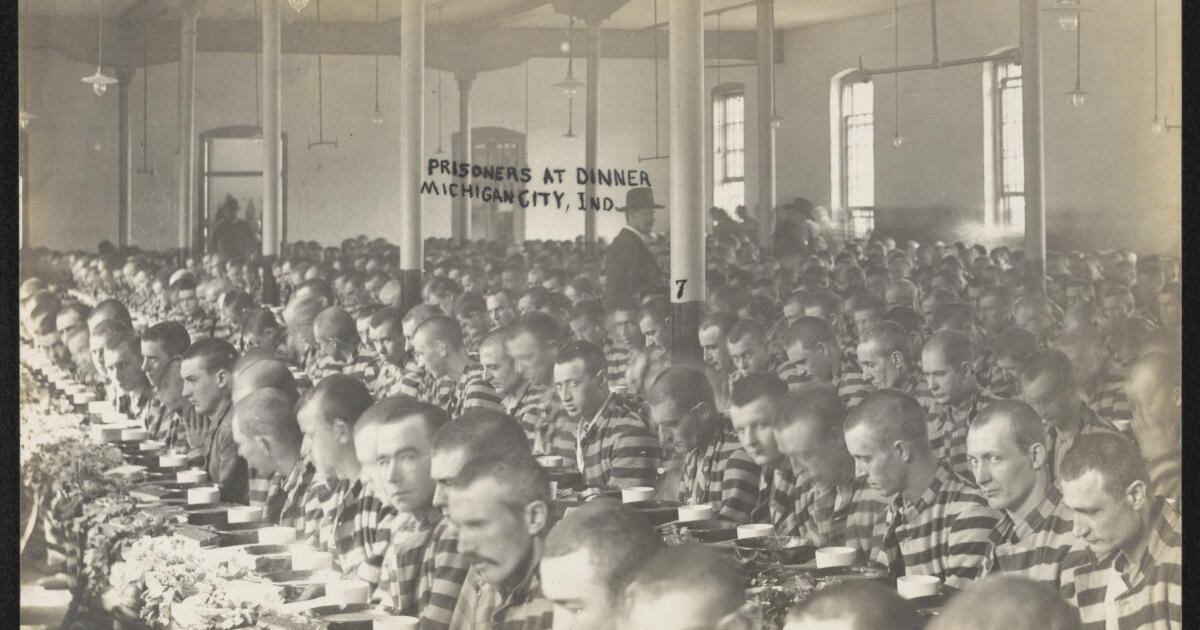
“Crime and Punishment in America,” running in four two-hour installments Monday through Thursday on PBS, travels across 250 years of American law and disorder. Written and directed by Ken Burns associate and collaborator Lynn Novick, it takes a big swing at a subject that could occupy an entire year of installments. The point is made repeatedly that the U.S. incarcerates far more than its share of miscreants (20% of the world’s prison population, as of 2008, with the greatest number per capita). We’re No. 1!
Novick tracks changing notions of what was considered a crime and what was considered a punishment, with the problem that the former did always not fit the latter — which is to say the punishment outstripped the crime. It’s presented very much in the house style: stories of individuals chosen to illustrate a point knitted into a many-tendriled, overarching chronological narrative. It’s interesting, educational and admittedly inconclusive, but generally valuable as food for thought.
Unlike some Burns and/or Novick projects (“Baseball,” “Jazz,” “The National Parks,” “Muhammad Ali”), the American saga the series is documenting is not calculated to fill you up with pride — although there have been moments when the prison builders or fixers felt they were onto something good, and obviously some (many?) who work in the field believe in their work. (Though there is reportedly a high level of substance abuse, divorce and suicide for correctional officers.)
Under the dulcet guidance of narrator Keith David, we begin in old colonial times when people would be punished in public. (Whippings, stocks, etc.) A really sensational hanging might draw thousands. Moving this business behind closed doors was viewed as an enlightened advancement. “The reformation of a criminal can never be affected by a public punishment,” said Dr. Benjamin Rush of Philadelphia, a signer of the Declaration of Independence. The Constitution and the Bill of Rights came along with their bans on cruel and unusual punishment, unwarranted search and seizure and the right to a defense, not that a court would necessarily appoint an attorney if a defendant could not afford one.
There are stories of criminals, of what people who weren’t criminals thought about criminals, and how the authorities (who were sometimes criminals themselves) dealt with criminals. And about people accused of being criminals but weren’t, who were sometimes convicted, and sometimes just lynched. (Saying the loud part even louder, Mississippi Gov. James K. Vardaman, in office from 1904 to 1908, declared, “If it is necessary, every Negro in Mississippi will be lynched. It’ll be done to maintain white supremacy.”) Someone will come along to reform prison or police departments — Teddy Roosevelt, say, who was president of New York’s board of police commissioners, from 1895 to 1897; or Thomas Mott Osborne, who brought educational programs into Sing Sing in 1914, having already gone undercover there as a prisoner; or August Vollmer, Berkeley’s first police chief, who created the country’s first police academy, and urged recruits to learn to listen rather than just make arrests.
And then something will happen historically (World War II, the Bolshevik Revolution, the Cold War, political protests, some sensational cluster of crimes, the theorized arrival in 1995 by Princeton political scientist John J. DiIulio Jr. of a breed of young sociopathic “superpredators”) to fill the populace with fear — the white populace, generally — on the back of which politicians will advocate for tougher laws, more police and longer sentences. (The superpredators never arrived; in fact, the crime rate went down.) And the prisons fill up, and grow overcrowded, and so more prisons are built. The arc of the moral universe bends toward justice, and then bends back.
Novick has taken on a big task, and even at eight hours, “Crime & Punishment” feels like a slice — a generous one — rather than the pie. At the same time there is so much in that slice, as if anything that might possibly relate to the title has been included at least in passing, that the ingredients don’t completely cohere.
We get the notorious Elam Lynds, warden of Auburn State Prison from 1821 to 1825, and Sing Sing thereafter, who sent contracted convicts out to work during the day, kept them in solitary confinement at night and whipped them in between; his rent-an-inmate system operated unchecked in the post-Reconstruction Jim Crow South, where places like Louisiana’s Angola State Prison were run like plantations, with worse conditions. There’s Jesse James. John Dillinger. The forced sterilization of prisoners. Warrantless arrests and deportations of people of color. (Why does that sound familiar?) Prohibition and the birth of the FBI under J. Edgar Hoover. The wartime internment of more than 120,000 Japanese nationals and Japanese Americans. (Hoover was against it, interestingly.) “Dragnet.” L.A. Police Chief William H. Parker and his “thin blue line” at war with South and East L.A. over decades. Attica. Women driven into the system by domestic abuse. The victims’ rights movement. The mafia makes no more than a cameo appearance, but we have all had quite enough of them, anyway. There is surprisingly little about guns.
Novick also touches only lightly on the matter of white-collar crime, perhaps because white-collar criminals — the richer ones, anyway — rarely go to prison, or even to trial; that much of what happens in the justice system amounts to class war is demonstrated or asserted many times over. “Broke people get screwed,” says Philadelphia Dist. Atty. Larry Krasner. Clarence Darrow, in the last century: “The laws are really organized for the protection of the men that rule the world.”
There is also little sense of what the prison system might actually look like now, apart from their being a lot of them and that, says legal scholar John Pfaff, they “tend to be rural American jobs programs,” appearing in places where industries have shut down and work has disappeared. Given that most of us know it only from television, it would have been interesting to see.
For now, we’re still on that moral arc to justice. Says poet Reginald Dwayne Betts, who after eight years behind bars — he tells his story here— earned a master’s degree in creative writing and a Yale law degree, and was awarded a MacArthur fellowship: “We all deserve a world that is governed by mercy and not one that’s governed by vengeance.”
No argument.


